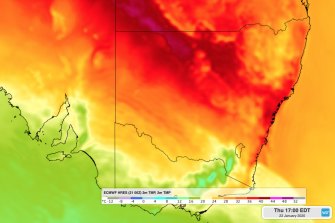
Scorching heatwave brings bushfire threats to Australia
A dangerous heatwave is sweeping across parts of Australia with some temperatures predicted to reach up to 18 degrees Celsius above average.
Firefighters are already battling bushfires in Queensland and South Australia with further warnings in place for today.
In South Australia, an emergency message has been reduced in Templers in the Barossa Valley, north of Adelaide.
Crews are monitoring for flare-ups amid extreme fire levels.
In Queensland, two bushfires are burning in Rockhampton and Fraser Island.
Bushfires have broken through containment lines with hot, dry and windy weather expected to hinder firefighting efforts today.
Residents are not being advised to leave the island.
Total fire bans are in place across parts of Queensland, South Australia, New South Wales and Victoria.
Nearly three billion animals were killed or displaced by Australia's devastating wildfires in 2019 and 2020, according to a new report, with experts calling it "one of the worst wildlife disasters in modern history".
The study, released on Tuesday by scientists from several Australian universities, said 2.46 billion reptiles, 180 million birds, 143 million mammals and 51 million frogs were harmed in the blazes that ripped through the country.
While the report did not say how many animals died directly because of the fires, the prospects for those that escaped the flames "were probably not great" due to a lack of food, shelter and protection from predators, said author Chris Dickman, a professor in ecology at the University of Sydney.
The fires ravaged more than 115,000 square kilometres (44,400 square miles) of drought-stricken bushland and forest across Australia in late 2019 and early 2020, killing more than 30 people and destroying thousands of homes.
It was the broadest and most prolonged bushfire season in modern Australian history, with scientists attributing the severity of the crisis to the impacts of climate change.
Emergency
bushfire cuts off rural communities from Canberra | ABC News
The
Orroral Valley bushfire in the Namadgi National Park has burned more
than one-seventh of the ACT but has so far been kept away from
Canberra suburbs. The out-of-control fire, which a military
helicopter accidentally ignited this week, is burning at an emergency
level. The blaze continues to intensify and is expected to worsen in
this afternoon's hot, windy conditions. There is currently no threat
to the southern suburbs of the ACT, but authorities have urged people
in the township of Tharwa and the southernmost suburbs of Banks,
Gordon and Conder to monitor conditions. Meanwhile, New South Wales
firefighters are battling the fast-moving, emergency-level Clear
Range fire south of the border, which flared up when embers from the
ACT blaze spread. The Clear Range fire is threatening properties in
Michelago, Colinton and Bredbo. Residents have been told it is too
late to leave and to seek shelter. Reporter Phil Williams has more
from Colinton, south of Michelago, near that fire front.
Elevated fire conditions in the ACT set to accumulate on Saturday afternoon...
The warm and windy conditions forecast for the ACT and NSW surrounds on Saturday are set
to accumulate in the afternoon. The Bureau of Meteorology has issued a severe fire weather
warning for the ACT on Saturday. Strong wind gusts of up to 45km/h are set to hit elevated
areas on the fireground and winds are set to pick up across the ACT late morning, BOM
meteorologist Gabrielle Woodhouse said. But winds on the fireground were forecast to persist
overnight on Friday. "In Canberra city itself we will see winds increasing from about 10 or 11am in the morning," Ms Woodhouse said. "But through the higher parts, it may remain a bit windy overnight and become windier slightly
earlier than Canberra city itself." Northwesterly winds in the afternoon, along with hot
temperatures will be when the fire danger is at its highest. Canberra Times
Two days ago I was alarmed to find the following headline but could find nothing about this in Australian media except to reassure people it was all under control. A correspondent from Canberra on RNZ this morning dismissed concerns. Now it's back to panic stations
A
state of emergency has
been declared in the ACT ‼️
ABC,via Facebook
It
comes as Canberra faces the most dangerous fire conditions since the
2003 bushfires.
The
state of emergency comes amid 'very high' to 'severe' fire danger the
next few days and heatwave conditions.
The
Orroral fire is at a watch and act alert level with no threat to
properties.
However,
Canberrans — particularly those in the south — need to be
prepared for things to change and for the fire to potentially reach
the southern-most suburbs of the ACT.
NSW
residents are warned recent rainfall has not extinguished bushfires
burning across the state, and there is no room for complacency with
high temperatures and elevated fire danger about to return.
The
Rural Fire Service (RFS) has graded fire danger at "severe"
levels in a number of regions on Thursday, including the Shoalhaven,
Hunter, Illawarra, Sydney, North Western, and the southern and
central ranges.
Total
fire bans are in place for each of those areas on Thursday.
The
Bureau of Meteorology is forecasting temperatures in the high-30s to
low-40s for much of NSW on Thursday amid strong north-westerly winds.
Sydney
is predicted to hit a high of 41, with the chance of a thunderstorm
in the afternoon and evening as well as gusty winds. Even the Bondi
area, which is usually a few degrees colder due to coastal winds, is
tipped to reach 39 degrees.
Fire
weather is looking particularly dangerous in the Blue Mountains,
where 45-60km/h winds are forecast with gusts in elevated areas
potentially surpassing 90km/h.
A
weak southerly change won't hit Sydney until early on Friday morning,
dropping temperatures and bringing possible showers – but
temperatures on Friday and the weekend will remain above the average
(26) for January.
Nowra,
near the Currowan fire that has devastated much of the Shoalhaven
region, is also forecast to hit 40 on Thursday. Bowral, in the
Southern Highlands, with fires burning to its north and south, is
forecast to reach 35.
With
more than 60 fires still burning across NSW, RFS spokesman Ben
Shepherd said Thursday will be another "testing day" for
firefighters and communities close to the danger.
Recent
heavy rainfall across parts of the state "was most welcome but
it might give people a false sense of security", he said.
While
isolated areas received a large volume of rain during wild
thunderstorms earlier this week, many firegrounds – including in
the Southern Highlands and far south coast, only received 10-15mm, Mr
Shepherd said.
While
that "did take the sting out of current fire activity", it
was not enough to significantly impact the fire danger.
"By
no means are [the fires] all out, and it is likely over coming days
that we will see fires burn and move again," he said.
Isolated
heavy rain accompanying thunderstorms on Thursday evening may also
contribute to increasingly dangerous conditions across NSW
firegrounds, with loosened soil in fire-damaged areas potentially
causing landslips and falling trees.
Thunderstorms
moving across the state may also result in a repeat of the dust
storms seen in central-western NSW on Monday, bureau meteorologist
Abrar Shabren said.
There
is also potential for dry lightning strikes to result in new
ignitions, and hot weather in the days following could see them catch
on if there is not enough moisture around.
However,
Mr Shabren said there appears to be more showers on the horizon for
next week.
Despite
estimates that over a billion animals have been killed by bushfires,
the NSW government has given no indication it will cease commercial
kangaroo culling.
A
spokesperson for the NSW Department of Planning Industry and
Environment (DPIE) told Yahoo News Australia that a significant
portion of the fire activity in NSW was in the non-commercial
management zone along the coast.
The
spokesman noted that commercial harvesting had already been suspended
in four areas due to low population densities.
“DPIE
will be monitoring fire and harvesting activity within the commercial
management zones and will be engaging with commercial harvesters and
animal dealers that may operate within the affected zones,” the
spokesperson said.
“Our
goal is to ensure that kangaroo populations remain ecologically
sustainable.”
In
the fire-ravaged coastal areas, at least two prominent kangaroo
sanctuaries have been decimated by the fires.
Sara
Tilling from Cobargo Wildlife Sanctuary told Yahoo News Australia
that few animals remain alive on her 850-acre property.
“We’ve
just lost our only survivor from our mob. I’m not in a great space
right now,” she said.
Nearby,
Wild2Free near Batemans Bay was also destroyed, but a handful of
kangaroos remain and they are being tended to by sanctuary owner Rae
Harvey.
Ms
Harvey told Yahoo News Australia last week that before the fires she
considered the area to be the last stronghold of kangaroos in NSW.
“The
fires have gone all the way to the water and they’ve had nowhere
left to run,” she said.
“I
couldn’t talk to people about it – I just felt their fear, and
pain.
“There’s
no wildlife left now, we’re killing the last of them.”
“Unless
a sophisticated aerial count is done, there’s absolutely no way the
minister for the environment should allow any slaughter of any
kangaroo for any purpose,” he said.
“That
doesn’t matter whether it’s commercial, mitigation, or
recreational.
“The
government should move to ceasing all harm to them.”
Why
customers are flooding Coles, Woolworths social media pages with
viral image
Brutal
heatwave continues to decimate 'vulnerable' bat population
How
to help Australian wildlife decimated by bushfires
Mr
Pearson revealed that after assisting with fire-affected animals, he
submitted a letter to the NSW environment minister today calling for
the kangaroo cull to be immediately halted.
He
noted the Victorian government announced yesterday that it will
suspend the commercial cull until authorities could ascertain how
wildlife numbers had been impacted by the fires.
At least 80% of the Blue Mountains world heritage area and more than 50% of the Gondwana world heritage rainforests have burned in Australia’s ongoing bushfire crisis.
The scale of the disaster is such that it could affect the diversity of eucalypts for which the Blue Mountains world heritage area is recognised, said John Merson, the executive director of the Blue Mountains World Heritage Institute.
The data is based on a Guardian Australia analysis of areas burned in New South Wales and Queensland and was confirmed by the NSW government.
The
Murray-Darling Basin Royal Commission has found Australia’s
Murray-Darling Basin Authority (MDBA) acted unlawfully and
“completely ignored” climate change projections when determining
water allocation.
The
findings of the Commission were made public on Thursday and
highlighted the complex web of issues threatening the Murray which
are exemplified by the recent fish deaths in the Darling River and
dry riverbeds at Walgett in NSW.
The
report was particularly critical of the government’s failure to
acknowledge scientist recommendations in the past and lack of
openness when describing water management decision-making processes.
Parts
of Australia are littered with animal carcasses as wildfires continue
to devastate the country, an animal charity has said.
“I
can barely describe it,” says Evan Quartermain from Humane Society
International. “In some places you can’t walk 10 metres without
coming across another carcass.”
The
charity has rescued animals on Kangaroo Island suffering from burns,
smoke inhalation and mental trauma, as well as building food and
water stations for unharmed animals.
The
island – famous for its natural wildlife – is “utterly scorched
with charred animal bodies everywhere”, according to the Humane
Society International CEO.
“At
one area, which was badly burned a week ago, the scenes were nothing
short of apocalyptic,” Erica Martin said.
The
devastating bushfires currently ravaging the country have been
burning for months and have resulted in dozens of lives lost and
thousands of homes destroyed.
Countless
Australians have been impacted by the bushfire crisis, with the
blazes turning many lives completely upside down.
A
series of aerial images taken in bushfire affected areas and provided
by Nearmap show the major impact these fires have had on multiple
communities.
As
a mega-fire continues to burn in the Blue Mountains World Heritage
Area near Sydney, concern about the future of some of the region's
unique flora and fauna is increasing.
Key
points:
Experts
say it could take centuries for the ecosystem to recover after the
bushfires — if at all
Wildlife
rescue groups have seen a large loss of kangaroos, wallabies,
possums, insects and marsupials, and other groups fear relic plant
species could be "wiped out"
The
Invasive Species Council is calling for culls to address feral
animal populations while vegetation cover is reduced
Local
plant and animal rescue groups have been swinging into action to help
with recovery, but one expert has warned that the environment may
"never recover".
"It
will take decades or even centuries to recover," said Brajesh
Singh, an ecosystem ecologist at the Hawkesbury Institute.
"And
the rate of recovery will also depend on rainfall in the next few
weeks, months and years.
"Action
should be taken reduce greenhouse emissions, move to a carbon neutral
economy and reduce the rate of global warming."
Farmers are facing a sudden spike in fodder prices, on top of drought and
fire costs
Dirty Power: Big Coal’s network of influence over the coalition government
Australian Woman Speaks The Truth - People Who Have Lost A Home, NEED A HOME, NOT A
THERAPIST!
She responds to the Australian gov't allocating $76 million for mental health services to fire victims. Does anyone know this woman channel? If so, please drop the link below.
“We
have been made trespassers on our own country,”
The
Queensland government has extinguished native title over 1,385
hectares of Wangan and Jagalingou country for the proposed Adani
coalmine in Queensland’s Galilee Basin - without any public
announcement of the decision.
The
decision could see Wangan and Jagalingou protesters forcibly removed
by police from their traditional lands, including lands used for
ceremonies.
W&J
Council leader Adrian Burragubba, and a group of Wangan and
Jagalingou representatives, had been calling on the government to
rule out transferring their land, arguing they had never given their
consent for Adani to occupy their country.
In
a meeting with government officials Friday, seeking a halt on leases
being issued for mine infrastructure, they learned the state
government had instead granted Adani exclusive possession freehold
title over large swathes of their lands on Thursday, including the
area currently occupied for ceremonial purposes.
Bushfire
victims are wary of using caravans as temporary accommodation due to
a NSW law preventing their long-term use without council approval.
The
issue was discovered by volunteer organisation Find A Bed, which was
set up as a mediator between those who want to donate between the
bushfire recovery effort and victims.
They
have received caravans as donations for emergency accommodation, but
a state law is stopping people from accepting the offer.
The
legislation states caravans, campervans and tents can only be used
for two days at a time without prior council approval. They also
can’t be occupied for more than 60 days over a 12-month period.
Find
A Bed co-founder Erin Riley tells Luke Grant they have approached the
state government and asked for an exemption for bushfire victims.
“We
haven’t got a yes yet but it was positive, so we’re hoping that a
bit of attention and a bit of pressure might get this amendment
added.”
Adani
mine would be 'unviable' without $4.4bn in subsidies, report finds
Read
more
“We
have been made trespassers on our own country,” Burragubba said.
“Our
ceremonial grounds, in place for a time of mourning for our lands as
Adani begins its destructive processes, are now controlled by
billionaire miner Adani.

 Posts