Showing posts with label oil production. Show all posts

Friday, 19 January 2018

Venezuela's oil production is collapsing at an accelerating pace

Peak oil and economic sabotage by the Americans is largely behind this, not “socialist inefficiency”

Venezuela’s Oil Production Is Collapsing

Sharp drop in output increases the odds of a debt default, worsens economic crisis

A dilapidated oil platform on Maracaibo Lake.
18 January, 2018


CARACAS, Venezuela—Venezuela’s oil output is collapsing at an accelerating pace, deepening an economic and humanitarian crisis and increasing the chances the country will default on its debts.

Crude production fell 11% in December from the month before, according to government figures released Thursday. Over all of 2017, output was down 29%, among the steepest national declines in recent history, driven by mismanagement and under investment at the state oil company, say industry observers and oilmen.
The drop is deeper than that experienced by Iraq after the 2003 war there—when the amount of crude pumped fell 23%—or by Russia during the collapse of the Soviet Union, according to data from the Organization of the Petroleum Exporting Countries.
In Venezuela, there is no war, nor strike,” said Evanán Romero, a former director of government-run Petróleos de Venezuela SA. “What’s left of the oil industry is crumbling on its own.”

Oil is critical to Venezuela’s state-led economy. Petroleum sales bring in 95% of the country’s foreign-currency earnings, so declining output will make it harder for the government to import everything from machinery to food and medicine.
Over the past four years, the country’s economy has shrunk by about 40% and inflation has surged—topping 2,600% last year, according to the National Assembly. Nearly one in four factories didn’t reopen after Christmas, according to a local industry association.
Malnutrition is spreading among the young and elderly, while health officials report a resurgence of illnesses ranging from malaria to diphtheria. Meanwhile social stability is fraying. At least four people have died during outbreaks of looting in recent weeks.
The government is already resorting to barter—seeking to trade diamonds and other valuables—in an effort to bring in sorely needed supplies as President Nicolás Maduro prepares for elections this year.
This week, the state oil company’s new chief, National Guard Gen. Manuel Quevedo, blamed the production downturn on sabotage and terrorist attacks by the opposition. He didn’t offer any evidence. He said output has stabilized and will grow to 2.5 million barrels a day this year.
Most analysts, however, expect Venezuela’s production to continue falling. By this year’s end, output could fall to 1.3 million barrels a day, according to Francisco Monaldi, a Venezuelan energy expert at Rice University.

The only discussion right now is how much is it going to decline by. There is no talk of a turnaround,” said Luisa Palacios, analyst at consultancy Medley Global Advisors in New York.
In December, daily production fell by 216,000 barrels to 1.6 million—the 15th consecutive monthly decline. In the last 12 months, Venezuelan output fell by 649,000 barrels a day.
The decline has been exacerbated by a management purge at state-run PdVSA by Mr. Maduro that has paralyzed the oil giant. Seventy senior managers have been jailed on graft allegations in the past three months. Generals with no industry experience have been named to run the firm.
U.S. sanctions have also hurt, scaring off some of the last remaining investors.

A boy, his clothes saturated with oil, sits in a  boat at the fishing town of Cabimas.
A boy, his clothes saturated with oil, sits in a boat at the fishing town of Cabimas. PHOTO: FABIOLA FERRERO FOR THE WALL STREET JOURNAL

Multinational firms partnered with PdVSA in southern Venezuela, home to the world’s biggest oil reserves in the Orinoco Oil Belt, have cut spending to a minimum because of overdue bills, red tape and high taxes, say oil industry executives.
International operators have essentially zero appetite for putting any additional investment dollars into Venezuela under current conditions,” said Pavel Molchanov, oil analyst at brokerage Raymond James.
Venezuela’s large output drop means the country has been the only major oil producer to not benefit from rising crude prices. The value of the Venezuelan oil export basket rose 25% last year on the back of stronger global demand and shrinking inventories.
But this windfall was wiped out by lower output and the rising cost of oil products imported by PdVSA to aid its operations.
Brokerage Torino Capital forecasts that the value of Venezuelan oil exports will fall about three billion dollars this year to $26.5 billion. As recently as 2012 the country earned $93 billion from oil exports.
Roughly 1.3 million barrels a day of Venezuelan oil goes to the country’s domestic market or is pledged in prepaid supply and debt deals with allies Russia, China and Cuba, according to Rice University’s Mr. Monaldi.
That leaves precious little to sell in the open market. Exports to the U.S., Venezuela’s top cash-paying customer, fell 20% in 2017 to 593,000 barrels a day, according to BMI Research.
The larger void in global energy supplies resulting from Venezuela’s faltering production may push oil prices higher and allow other heavy-crude producers like Canada, Iraq and Mexico to seize market share, Medley’s Ms. Palacios said.
Venezuela’s decline is already benefiting its OPEC peers who have been able to raise their own output without breaking the cartel’s production cut agreement. OPEC’s overall production edged higher by 42,000 barrels a day in December from the previous month.
A full-blown default on Venezuelan debts—the country has already been struggling to pay interest and principal on its $60-billion foreign debt—could put more oil sales at risk.
PdVSA and the central government are in default on more than $700 million of bond payments. The state oil company hasn’t made any interest payments for a month, raising fears that creditors could start seizing oil shipments as compensation.
Last week, a tanker carrying Venezuelan crude was detained in the Caribbean island of Curaçao at the request of an unidentified group of investors seeking $30 million in back payments from Venezuela, according to diplomats familiar with the matter.
If Venezuela’s oil shipments become a target, that would be the worst possible scenario for the country’s oil industry,” said Artyom Tchen, an Oslo-based oil analyst at consultancy Rystad Energy.
Write to Anatoly Kurmanaev at Anatoly.kurmanaev@wsj.com and Kejal Vyas at kejal.vyas@wsj.com


Monday, 28 August 2017

Hurricane curtails US energy production

Every cloud has a silver lining

Harvey throws a wrench into U.S. energy engine

Image result for Harvey throws a wrench into U.S. energy engine
28 August, 2017


HOUSTON (Reuters) - A hurricane in the heart of the U.S. energy industry is set to curtail near-record U.S. oil production for several weeks, with the impact expected to reverberate throughout the country and across international energy markets.


Harvey hit the Texas shore as a fierce Category 4 hurricane, causing massive flooding that has knocked out 11 percent of U.S. refining capacity, a quarter of oil production from the U.S. Gulf of Mexico, and closed ports all along the Texas coast.


Gasoline futures jumped as much as 7 percent to their highest level in more than two years in early Monday trading in Asia as traders took stock of the storm’s impact.


The outages will limit the availability of U.S. crude, gasoline and other refined products for global consumers and further push up prices, analysts said.


Damage assessments could take days to weeks to complete, and the storm continues to drop unprecedented levels of rain as it lingers west of Houston, home to oil, gas, pipeline and chemical plants. And restarts are dangerous periods, as fires and explosions can occur.


So far, the federal government has not announced if it will release barrels of oil or refined products from the nation’s Strategic Petroleum Reserve (SPR), which holds nearly 680 million barrels of oil.


The SPR was established in the 1970s to prevent supply shocks in the wake of an embargo imposed by several members of the Organization of the Petroleum Exporting Countries (OPEC).


This is not like anything we have ever seen before,” said Bruce Jefferis, chief executive of Aon Energy, a risk consulting practice. It is too soon to gauge the full extent of Harvey’s damage to the region’s energy infrastructure, he said.


More than 30 inches (76 cm) fell in the Houston area in 48 hours and a lot more rain is forecast, according to the National Weather Service.


The storm was felt from coastal ports to inland oil and gas wells. Oil producers in the Eagle Ford shale region of south Texas have halted some operations.


At least four marine terminals in the Corpus Christi area, an export hub for energy deliveries to Latin America and Asia, remained closed due to the storm.


A vessel is spotted listing in a channel from a U.S. Coast Guard helicopter during an overflight after Hurricane Harvey passed the area from Port Aransas to Port O'Connor, Texas, August 26, 2017. U.S. Coast Guard/Petty Officer 3rd Class Johanna Strickland ia REUTERS
We just simply don’t know yet the damage all this rain will have on Houston’s energy infrastructure,” said Andrew Lipow, president of energy consultancy Lipow Oil Associates LLC.


Texas refineries could be offline for up to a month if their storm-drainage pumps become submerged, he said.


U.S. gasoline prices jump as Hurricane Harvey knocks out Texas refineries


As the storm churned towards Texas on Friday, U.S. gasoline futures RBc1 rose to their highest level in three years for this time of year. Those gains came even before several large Houston area refiners, including Exxon Mobil Corp (XOM.N), halted some operations.


Exxon closed the second largest U.S. refinery, its 560,500 barrel-per-day (bpd) refinery in Baytown, Texas, complex because of flooding. Royal Dutch Shell Plc (RDSa.L) also halted operations at its 325,700-bpd Deer Park, Texas, refinery. The refinery may be shut for the week, it said.


Flooding on highways between Houston and Texas City nearer to the coast led Marathon Petroleum Corp (MPC.N) to cut back gasoline production at the company’s 459,000-bpd Galveston Bay Refinery in Texas City, said sources familiar with plant operations.


Marathon Petroleum (MPC.N) employees were unable to drive to work and conditions at the plant forced the company to reduce gasoline output, said industry sources. Marathon spokesman Jamal Kheiry declined to discuss plant operations.


Not every plant in the region was hit. Operations were stable at the largest U.S. crude refinery, Motiva Enterprises’ [MOTIV.UL] 603,000-bpd Port Arthur plant, the company said.


Motiva double-staffed the refinery's crew ahead of the storm, as did Total SA (TOTF.PA) at the company's 225,500-bpd Port Arthur refinery, said sources familiar with plant operations.


Coastal refineries in Texas account for one-quarter of the U.S. crude oil refining capacity. All of those refineries have been impacted by Harvey since Thursday when refineries in Corpus Christi, Texas, shut in production ahead of the storm's landfall on Friday.


Colonial Pipeline, the largest mover of gasoline, diesel and other refined products in the United States, said its operations had not been affected by Harvey. Any disruptions to the conduit would send prices across the U.S. Southeast and Northeast soaring. Traders have been keeping a close eye on whether there will be an outage at the pipeline.


Citgo Petroleum Corp [PDVSAC.UL] and Flint Hills Resources [FHR.UL], two of the refiners that closed last week as the storm approached, did not provide updates about the status of their Corpus Christi refineries on Sunday.

Wednesday, 18 May 2016

Fort McMurray fires: the Beast roars back into the tar-sands

We are living now in the Age of Consequences on a day where nothing else really matters, except for the rapid growing climate crisis (that's the wrong noun) and the consequences.


"Such huge extents of extreme fire hazard over northern and far-northern regions that typically experience much, much cooler weather is a feature that is absolutely consistent with effects resulting from human-forced warming. A warming that continues to be made worse by the extraction of carbon-based fuels like those unearthed at the tar sands facilities now endangered by the very fires of climate change they helped to ignite."


First just the facts presented in a way that matters.

The Beast Growls — Warming-Induced Wildfire Again Doubles in Size, Burns Tar Sands Workers’ Camp


18 May, 2016
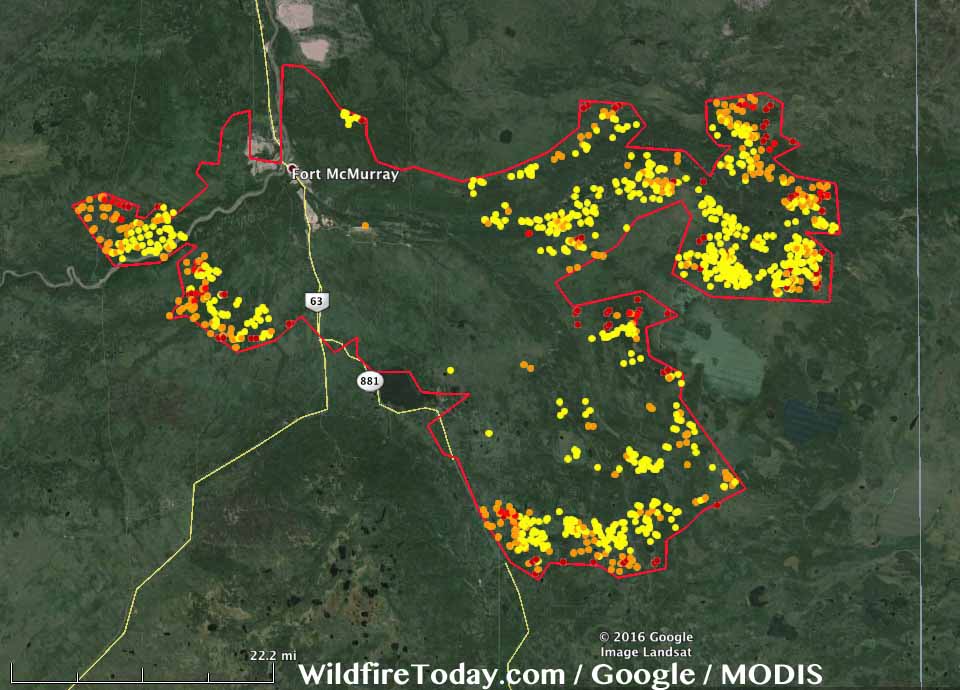
On Monday, strong southerly winds and freakishly hot temperatures near 80 degrees (F) combined to fan the still-raging Fort McMurray Fire in Alberta, Canada. The monstrous, climate change enhanced, blaze swelled. And by the end of the day it had expanded to cover more than 354,000 hectares, 1,360 square miles, or an area larger than the state of Rhode Island.
In a little more than a week, a fire that emergency response personnel are calling ‘The Beast’ had once again doubled in size.
The Beast Growls
(The Fort McMurray Fire again exploded on Monday — invading tar sands facilities even as the eastern sections of the fire came to within 7 kilometers of the Saskatchewan border. Image source: LANCE MODIS.)

As the fire expanded, it swept north and east. Casting off choking, dense smoke, the fire spiked air quality ratings to 38 (a 10 is considered dangerous), forcing emergency response personnel, workers, and those few people now inhabiting the blackened town of Fort McMurray to wear particulate filtration masks. The bad air quality caused some officials to speculate that the return of more than 80,000 residents to the town could be delayed. The evacuees had been forced from their homes by the fires during early May — a wave of climate change refugees that have now faced a three week period of dislocation. But any thought of residents returning was swiftly overwhelmed by the rapidly-expanding fire itself.

8,000 More Evacuations, Oil Worker Camp Burned

As the town of Fort McMurray choked in the smoke of resurgent fires, walls of flame moving north and east again threatened tar sands facilities. Firefighters scrambled to widen fire breaks as fires moving as fast as 40 kilometers per hour leapt defensive lines and entered some of the industrial sections.
Ironically-named Travis Fairweather, a wildfire information officer, described the completely untenable situation:
Yesterday the fire was showing extreme behaviour and lots of smoke in the air. We had to pull the firefighters off the line because it was so dangerous out there.”
The entire industrial zone fell swiftly under threat and by late Monday more than 8,000 tar sands workers from a total of 19 camps had been ordered to evacuate. By Tuesday morning, the Blacksand Lodge — a temporary residence for oil workers manning tar sands facilities located 35 kilometers to the north of Fort McMurrary — had succumbed to the flames. A large facility, the Blacksand camp provided 665 residential units for workers. In total, it’s estimated that about 6,000 workers remain in tar sands facilities and emergency responders are coordinating to organize an air evacuation if necessary.

Fort McMurray fire extent May 16
(Fort McMurray Fire extent with hotspots as of early Monday on May 16. The region affected by the fire as of this time was truly vast — stretching nearly 50 miles long and 30 miles wide. Through late Wednesday, the massive blaze is likely to again claim more ground. Image source: Wildfire Today.)

Fire Situation to Remain Extreme on Tuesday and Wednesday

Southerly winds and far above average air temperatures are again expected to worsen fire conditions on Tuesday and Wednesday. Highs are predicted to hit near 80 in Fort McMurray on both days and dry conditions are expected to dominate. So continued rapid growth of the McMurray Fire over this period is likely. With fires now on three sides of the industrial zone and within sections of the tar sands facilites, we can expect a continued threat to the oil production zone over at least the next 48 hours.
Long range forecasts indicate that warmer than normal conditions are likely to continue over the next week. However, rainfall predicted on Thursday and Saturday could again slow the fire’s growth — giving firefighters another shot at containing this massive blaze. It’s worth noting, though, that the fire is now so large and intense that it will likely take weeks to months to extinguish.
Extreme Fires in the Context of Human-Caused Climate Change

Overall, more than 530,000 hectares have now burned throughout Canada. This total is more than 24 times the amount of land consumed in fires by this time last year. During the 20th Century, large May burn extents of the kind Canada is experiencing during 2016 were unheard of. For much of Canada — May tended to be a cool month featuring temperatures in the 40s, 50s and 60s (F). Not the 70s and 80s (F) that have tended to crop up so frequently this year. Fires tended to be sparse and small — if they ignited at all. But the heat, a growing number of dead trees, and a thawing zone of carbon-rich and flammable permafrost have all added to the fire danger. Evidence that a very rapid pace of warming and related damage to Canada’s forests is having an extraordinary and dangerous impact.


Over the coming seven days, abnormal 60-70 degree (F) temperatures are expected to expand throughout even the far northwestern regions of Canada — reaching all the way to where the Arctic Ocean meets the Mackenzie Delta and spiking fire hazards within that thawing permafrost zone. Such huge extents of extreme fire hazard over northern and far-northern regions that typically experience much, much cooler weather is a feature that is absolutely consistent with effects resulting from human-forced warming. A warming that continues to be made worse by the extraction of carbon-based fuels like those unearthed at the tar sands facilities now endangered by the very fires of climate change they helped to ignite.

Links:
Hat tip to DT Lange
Hat tip to Colorado Bob
Hat tip to Greg
Hat tip to Redsky


Tuesday, 17 May 2016

Peak Oil is back!

We have been told that Peak Oil is bunkum and disproven. In fact it never went away.
50% Of Proved Oil Reserves May Have Just Vanished


27 April, 2016


An extensive new scientific analysis published in Wiley Interdisciplinary Reviews: Energy & Environment says that proved conventional oil reserves as detailed in industry sources are likely “overstated” by half.

According to standard sources like the Oil & Gas Journal, BP’s Annual Statistical Review of World Energy, and the US Energy Information Administration, the world contains 1.7 trillion barrels of proved conventional reserves.

However, according to the new study by Professor Michael Jefferson of the ESCP Europe Business School, a former chief economist at oil major Royal Dutch/Shell Group, this official figure which has helped justify massive investments in new exploration and development, is almost double the real size of world reserves.
Wiley Interdisciplinary Reviews (WIRES) is a series of high-quality peer-reviewed publications which runs authoritative reviews of the literature across relevant academic disciplines.

According to Professor Michael Jefferson, who spent nearly 20 years at Shell in various senior roles from head of planning in Europe to director of oil supply and trading, “the five major Middle East oil exporters altered the basis of their definition of ‘proved’ conventional oil reserves from a 90 percent probability down to a 50 percent probability from 1984. The result has been an apparent (but not real) increase in their ‘proved’ conventional oil reserves of some 435 billion barrels.”

Global reserves have been further inflated, he wrote in his study, by adding reserve figures from Venezuelan heavy oil and Canadian tar sands – despite the fact that they are “more difficult and costly to extract” and generally of “poorer quality” than conventional oil. This has brought up global reserve estimates by a further 440 billion barrels.

Jefferson’s conclusion is stark: “Put bluntly, the standard claim that the world has proved conventional oil reserves of nearly 1.7 trillion barrels is overstated by about 875 billion barrels. Thus, despite the fall in crude oil prices from a new peak in June, 2014, after that of July, 2008, the ‘peak oil’ issue remains with us.”

The study referred to here is: Overview A global energy assessment,
Michael Jefferson

Against the background of IIASA’s massive (their word) ‘global energy assessment’ (GEA), this paper takes a closer look at the challenges posed by population growth, energy poverty, the fossil fuels and carbon storage, renewable energy, energy efficiency, natural catastrophes, and potential climatic change to offer a somber, although arguably more realistic, overview of what the future may hold than the GEA achieved. © 2015 John Wiley & Sons, Ltd

I thought the above article worth a post of its own. After all it is a vindication of what many of us have been saying for years now. And I especially call your attention to the line: “the standard claim that the world has proved conventional oil reserves of nearly 1.7 trillion barrels is overstated by about 875 billion barrels.”

That puts conventional reserves at about 825 billion barrels. That is OPEC + Non-OPEC, that is everything, well, everything conventional. That is almost exactly the amount of reserves I have been claiming for years. I have been thrashing this straw for over a decade and it feels good to get some vindication.


Here are a couple of other peak oil articles in the news this week:


On March 29th, the Government Accountability Office (GAO), also referred to as the ‘congressional watchdog’, released a much-anticipated report called Crude Oil: Uncertainty about future oil supply makes it important to develop a strategy for addressing a peak and decline in oil production.

This report was initiated by a request, just over a year ago, from Congressman Roscoe Bartlet, a very vocal proponent of the peak oil theory in the U.S. Congress.

The significance of this report cannot be under-stated. For the first time in North America, an independent and nonpartisan agency that works for Congress and the American people has gone on record stating that peak oil is a real and pressing concern that the government should be preparing for.


Strange new economic phenomena will kick in the moment oil production peaks, turning normal national finance ministry policies on their heads

The reason there is such heated debate over when exactly peak oil is due to arrive is because, at the point of the peak, the fundamental laws of economics governing oil production, consumption, and prices, will flip over to a whole new paradigm. And because oil is very much the key commodity at the root of all economic activity in the modern industrial world, the flip-over of economic laws governing oil will deeply affect, and even potentially flip over, the fundamental economic laws governing all of the world’s industrial activity.

And… I thought I would just add a couple of charts taken from the EIA’s latest Short-Term Energy Outlook.

(Click to enlarge)

The EIA expects shale oil and the rest of the lower 48 states to continue to decline but slow the decline next year and plateau in the last quarter of 2017 at 5.7 million barrels per day.


(Click to enlarge)

The saving grace, the EIA believes, will come from the Gulf of Mexico. They have GOM production reaching 1.93 million barrels per day in December of 2017. The spikes downward in August, September and October of 2017 and 2017 are obviously the EIA trying to anticipate the hurricane season. I think they are being overly cautious here. It is unlikely that disruptions of this magnitude will occur.

(Click to enlarge)

And, after you combine the two above charts then add in Alaska you get the above production numbers and projection.

Jean Laherrere posted me all the below: It is good to see that he is also in agreement with the above article.

Jefferson in this 2016 paper writes:

put bluntly, the standard claim that the world has proved conventional oil reserves of nearly 1.7 trillion barrels is overstated by about 875 billion barrels.”

Since my graph of political current proved and 2P backdated remaining reserves in 1998 Scientific American (with 1700 missing fields) I have updated often in many papers this very important graph (the most important in my opinion) because it explains the huge discrepancy between the economists relying on official data and the technicians relying on confidential data.


You can see in my graph the conventional oil remaining reserves is, at end 2015, about 1700 Gb for IEA and OGJ (EIA) but at about 800 Gb for the backdated confidential technical sources, in line with Michael Jefferson

I am glad to see IIASA (which designed the very optimistic energy scenarios for the IPCC reports, in particular with the crazy CRP 8.5) showing more realistic assessments.