Showing posts with label glacier. Show all posts

Wednesday, 27 February 2019

Ice berg to calve off Antarctica


Iceberg twice the size of New York City is set to break away from Antarctica

Once a rapidly spreading rift intersects with another fissure, an iceberg of at least 660sq miles is set to be loosened, Nasa says

26 February, 2019

An iceberg roughly twice the size of New York City is set to break away from an Antarctic ice shelf as a result of a rapidly spreading rift that is being monitored by Nasa.

A crack along part of the Brunt ice shelf in Antarctica first appeared in October 2016, according to the National Aeronautics and Space Administration (Nasa). 

The crack is spreading to the east. This rift, known as a Halloween crack, is set to intersect with another fissure that was apparently stable for the past 35 years but is now accelerating north at a rate of around 2.5 miles a year.

Once these two rifts meet, which could happen within weeks, an iceberg of at least 660sq miles is set to be loosened.

This process, also known as calving, occurs naturally with ice shelves but “recent changes are unfamiliar in this area” and could lead to the destabilization of the Brunt ice shelf, Nasa warned.

The likely future loss of the ice on the other side of the Halloween Crack suggests that more instability is possible,” said Chris Shuman, a glaciologist with Nasa and the University of Maryland Baltimore County.

While the anticipated iceberg is large by most measures, it is dwarfed by other recent Antarctic breakaways. In July 2017, one of the largest ever icebergs calved from the Larsen C ice shelf. At 2,200sq miles it was nearly twice the size of the US state of Delaware.

The long-term future of Antarctic ice shelves will have a major influence on sea level rise around the world. A report released by US and UK scientists last year stated that ice in Antarctica is melting at a record-breaking rate, posing a major threat to coastal cities.

The study found that melting of the ice sheet has accelerated threefold in the last five years. Unless drastic action is taken to reduce greenhouse gas emissions and limit global warming, scientists estimate that Antarctica’s melting ice should add more than 25cm to total global sea level rise by 2070.


Brunt Ice Shelf


From Wikipedia, the free encyclopedia
Jump to navigationJump to search
View of Brunt Ice Shelf from the maiden flight of Operation IceBridge's Antarctica 2011 campaign with NASA's DC-8
The Brunt Ice Shelf borders the Antarctic coast of Coats Land between Dawson-Lambton Glacier and Stancomb-Wills Glacier Tongue. It was named by the UK Antarctic Place-names Committee after David Brunt, British meteorologist, Physical Secretary of the Royal Society, 1948–57, who was responsible for the initiation of the Royal Society Expedition to this ice shelf in 1955.
It was the location of the base of the Royal Society Expedition, 1955–59 which was taken over as the British Halley Research Station.
The Brunt Icefalls (75°55′S 25°0′W) extend along Caird Coast for about 80 kilometres (50 mi), where the steep ice-covered coast descends to Brunt Ice Shelf. The icefalls were discovered November 5, 1967, in the course of a United States Navy Squadron VXE-6 flight over the coast in LC-130 aircraft, and was plotted by the United States Geological Survey from air photos obtained at that time. It was named by the Advisory Committee on Antarctic Names in association with the Brunt Ice Shelf.

Corrientes Refuge[edit]

Refuge Corrientes 75°34′00″S 26°36′00″W is an Antarctic refuge located on the Brunt Ice Shelf, in the Caird Coast of the Weddell Sea, in the eastern part of the Coats Land. The refuge, administered by the Argentine Army, was inaugurated on January 10, 1961 and depends on the Belgrano II Base; it is located close to the Halley Research Station.[1]

Friday, 8 February 2019

Calving at New Zealand's Tasman Glacier


New Zealand is busy bickering about petrol prices while the world burns

Large chunks of ice break from Tasman Glacier in South Island

Large chunks of ice have come off the Tasman Glacier on the South Island's west coast.
ANTHONY HARRIS/FACEBOOK

8 February, 2019

Photos have emerged of huge chunks of ice which have broken off the Tasman Glacier.

The photos were posted to Facebook by two local guides who were alerted to the event in the Aoraki/Mount Cook National Park early on Wednesday morning.

"Glacier Explorers called us about the event so we got there after they had cleaned up some of the chaos," Anthony Harris, a guide at Southern Alps Guiding, said.

Large chunks of ice have come off the Tasman Glacier on the South Island's west coast.

"Luckily the kayaks were racked and above the height of the waterline."

A tidal surge up to 2 metres high smashed the jetty about and lifted a boat trailer upside down onto another trailer, Harris said.

The process is known as glacial calving.

"All in all, this is the most significant event I've seen in the last five years on the Tasman.

"The present SE [southeasterly] is holding these bergs in the northern section of the lake and will do so for at least another day or two.

"Once we get a NW [northwester] they will begin to fill the lake with bergs of all sizes ... some of these are really big."

Glaciologist Heather Purdie says large calving events happen about once every two years at the Tasman Glacier.

The breaking of ice chunks from the edge of glaciers is known as glacial calving.

University of Canterbury glaciologist Heather Purdie said large calving events like this one happened about once every two years on the Tasman Glacier.

They were caused by glacial ice above the water melting, putting pressure on the ice beneath it still under the water.

The photos were taken by two guides who operate in the area.

The photos were taken by two guides who operate in the area.
When the pressure became too much, the ice eventually snapped off.

"The water gets in underneath the ice and sort of jacks it up, and it snaps off.

"Large calving events are less frequent but the icebergs that come up are really big."

The calving was caused by ice above the water melting, putting pressure on ice still under the water.

The calving was not necessarily the result of global warming, although the glacier retreating and becoming smaller was attributable to warming, Purdie said.

"Not necessarily because of global warming". Yeah, right!

This is from last year


NZ glaciers shrank significantly in hot summer
The summer heatwave has massively affected New Zealand's glaciers, resulting in the largest annual ice loss on record.

10 May, 2018

The meltback was observed by the annual Glacier Snowline Survey, a collaboration between NIWA and Victoria University.

Survey founder Trevor Chinn said it was one of the largest glacier meltbacks since he began the survey in 1977.

"A glacier is the best climate change indicator you can use," he said.

New Zealand glaciers have lost 30 percent of their ice, in the 40 years that the annual snowline survey has been running.

Whether these dramatic results could be directly attributed to climate change "is the $64,000 question", Niwa climate scientist Andrew Lorrey said.

Niwa said it was embarking on formal testing in collaboration with Victoria University and the University of Melbourne to see if a definitive correlation could be found.

"Can you actually get a natural event like this, or is it something where climate change has loaded the dice and it's pushed us over some sort of threshold?" Dr Lorrey said.

"Those are the questions we're looking to answer."


Tuesday, 5 February 2019

'Dangerous' Antarctic glacier has a hole roughly two-thirds area of Manhattan

Huge Cavity Melted Out in Antarctica Glacier


Paul Beckwith


Total melt of west Antarctic glaciers would raise global sea levels about 5 meters; Greenland glacier melt would add 7 meters; east Antarctic plus mountain glacier melt would add 60 meters (total about 72 meters = 238 feet). I discuss how melt rates of Antarctica glaciers are rapidly increasing due to warm salty ocean water incursions under the ice; in fact under Thwaites Glacier in west Antarctica an enormous hole (about 4 km wide x 10 km long by 300 meters high) has appeared in only a few years.


'Dangerous' Antarctic glacier has a hole roughly two-thirds area of Manhattan, scientists warn

Wednesday, 23 January 2019

Monday, 5 November 2018

Wednesday, 10 October 2018

Huge Iceberg Poised to Break Off Antarctica's Pine Island Glacier

Huge Iceberg Poised to Break Off Antarctica's Pine Island Glacier” (Oct. 9, 2018)


Margo reviews two articles from today that cover the potential calving of Pine Island Glacier and shows how to find it on NASA Worldview.
Time is short - get your spiritual houses in order. God bless everyone. Power to the Truth!
Peace,
Margo

Show Links:


Huge Iceberg Poised to Break Off Antarctica's Pine Island Glacier
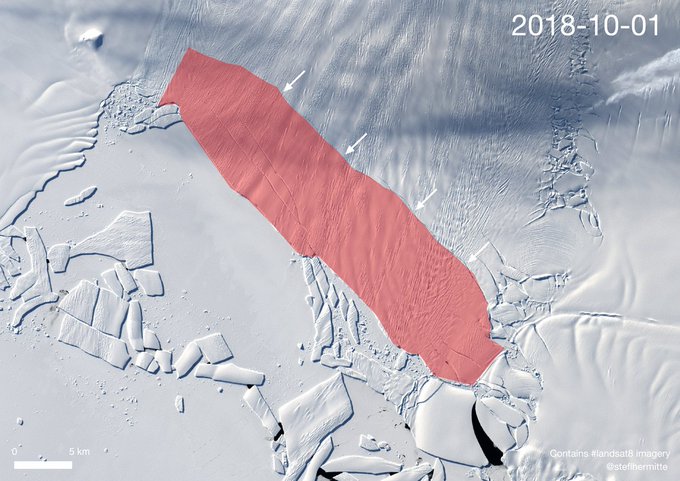
Satellite images showing the Pine Island Glacier on Sept. 17, 2018 and Oct. 1, 2018.
Credit: Landsat OLI imagery processed by Stef Lhermitte/Delft University of Technology

A newly discovered long and craggy rift is splintering across West Antarctica's Pine Island Glacier, satellite images show.

The nearly 19-mile-long (30 kilometers) rift started in the middle of the ice shelf, where the ice shelf touches warmer ocean waters that are melting it from underneath, said Stef Lhermitte, an assistant professor in the Department of Geoscience and Remote Sensing at the Delft University of Technology in the Netherlands.

The rift only has about another 6 miles (10 km) to go before one or more icebergs calf, breaking off from the glacier, Lhermitte said. Another such event happened a mere year ago in 2017, when an iceberg 4.5 times the size of Manhattan broke off Pine Island Glacier. [Photo Gallery: Antarctica's Pine Island Glacier Cracks]


The area of the upcoming Pine Island Glacier is about 115 square miles (300 square kilometers).
Credit: Landsat OLI imagery processed by Stef Lhermitte/Delft University of Technology

Lhermitte found the new crack by analyzing satellite images of the glacier, which he receives every day in his email inbox. "It was Wednesday evening [Oct. 3] and all of a sudden I saw something I didn't see the day before," he told Live Science.

If the iceberg breaks off in one piece, it will be a whopping 115 square miles (300 square kilometers), which is even larger than the one that broke off last year. (The 2017 iceberg was 103 square miles, or 267 square km.)


The upcoming ~300km iceberg (or its disintegrated pieces) will be the next large calving event after iceberg B-44 last year and the 6th large calving of since 2018 [2/n]
If the resulting iceberg is large enough, it will receive a name, Lhermitte noted. But, regardless of whether the crack leads to one or many icebergs, this will be the sixth large-calving event that Pine Island Glacier has experienced since 2001, he said.

Granted, it's natural for a glacier to calf icebergs. But what's concerning about Pine Island Glacier is that it's calving icebergs more frequently than it used to, Lhermitte said. Pine Island Glacier birthed icebergs in January 2001, November 2007, December 2011, August 2015 and September 2017.

The red line shows where the 2017 Pine Island Glacier iceberg broke off. The blue line shows the newfound rift.
Credit: Landsat OLI imagery processed by Stef Lhermitte/Delft University of Technology

The upcoming iceberg isn't loose yet, "but the fact that the rift is almost across the entire glacier, it might happen relatively soon," Lhermitte said.

It's challenging, however, to say what "soon" means. According to Lhermitte, the calving event will likely happen in a matter of weeks or months, "but it probably won't take years," he said. "I expect this to happen from now to sometime this Antarctic summer."

Once the breakage happens, the iceberg will likely stay frozen if it hangs out with the sea ice in the Antarctic. But if ocean currents carry it farther north, the iceberg will melt in the warmer waters, Lhermitte said.

Pine Island Glacier is one of the fastest flowing glaciers in Antarctica. Every year, it loses 45 billion tons (40.8 billion metric tons) of ice, which in turn causes sea levels to rise 0.03 inches (1 millimeter) every eight years, The Washington Post reported last year. Sea levels would rise 1.7 feet (0.5 m) if the entire glacier melted.

This video, which runs from 2002 to 2016, depicts just how much ice Pine Island Glacier is losing. (In the video, the colors yellow, orange, red and black represent ice loss, while blue indicates ice gain.)
Ice shelves are important because — like dirt clogging a sink that slows the drain of water — they impede the glacier from flowing full force out into the ocean, Lhermitte said. Once the upcoming calving event happens, Pine Island Glacier will have retreated nearly 4 miles (6 km), Lhermitte wrote on Twitter.

As for why Pine Island Glacier is losing more of its ice shelf (the icy portion that doesn't touch the bedrock, but extends over the ocean), it's hard to say. The warm water that is melting the ice shelf from underneath was pushed up from the deep ocean, Lhermitte said.

"The reason why we get this upwelling of warm water is certainly climate related, but it's very difficult to say if this is climate change related," he said. "Antarctica is a very sensitive continent for climate change. But for this individual iceberg, this is impossible to infer."
Originally published on Live Science.