Showing posts with label dairy. Show all posts

Wednesday, 3 March 2021

NZ whole milk powder prices rose 21%

This sort of thing is never reported in the mainstream media these days, so I am posting it here

 Dairy prices skyrocket

New Zealand dairy farmers woke up to some very good news. The overnight Global Dairy Trade (GDT) auction recorded a massive jump in prices.


https://www.ruralnewsgroup.co.nz/dairy-news/dairy-general-news/dairy-prices-skyrocket

3 March, 2021

The GDT price index jumped 15% compared to the previous auction, its eighth consecutive price rise.

Whole milk powder prices, used by Fonterra to set its milk payout, rose a whopping 21% to US$4364/MT, a seven-year high.

Key Results

AMF index up 7.4%, average price US$5,929/MT

Butter index up 13.7%, average price US$5,826/MT

BMP index down 0.3%, average price US$3,144/MT

Ched index up 1.3%, average price US$4,280/MT

LAC index up 4.9%, average price US$1,278/MT

SMP index up 3.5%, average price US$3,302/MT

SWP not offered

WMP index up 21.0%, average price US$4,364/MT


Tuesday, 12 March 2019

NZ journalist on NZ dairy


New Zealand journalist, Rachel Stewart on NZ dairy pollution of waterways


Deep Green Resistance


Rachel Stewart is a writer/Journalist, and current columnist with the NZ Herald, 2016 Winner of the ‘Opinion Writer of the Year’ at New Zealand’s Canon Media Awards. Ex-agricultural leader turned dairy industry critic, falconer, protector of rivers, and everything wild

Sunday, 10 March 2019

Dr. Mike Joy's editorial on the accelerating dissolution of the life-supporting capacity of our planet


This cris-de-coeur from New Zealand's leading academic on New Zealand's water coincides with my own position.

I can't imagine any academic in the public arena saying more and holding down a job.


Dr. Mike Joy's editorial

Image result for nz water pollution

I am reproducing Mike Joy's editorial from the last IGPS newsletter in its entirety to ensure that this has a wider readership.

It echoes my own thinking but more eloquently put - that we must stop business as usual immediately and take action with extreme urgency to avoid the end of our life support systems. Also to save other species - we have no right to destroy their lives and futures.

Scientists have issued us with dire warnings about what is ahead: the time to take commensurate action is NOW!

Senior Researcher Mike Joy reflects on our ongoing failure to save ourselves from environmental disaster.

Via Facebook


"Because of my research arena, I’m inundated daily by revelations of the accelerating dissolution of the life-supporting capacity of our planet. While this realisation is depressing, what is worse is that as I absorb this information I feel more and more detached from society. Because despite all these warning signs, all I see and hear around me is business-as-usual with economic growth still the supreme imperative.

I guess my feeling of disconnection comes from the fact that there seems to be so little awareness of the reality of the dilemma that we're in, and no sign of any urgency, panic or concrete movement towards the monumental changes required for civilization on anything like its current scale to have a future.

I constantly struggle to understand this cognitive dissonance, while also realising I’m guilty of it myself. Why haven’t we made the changes, or even slowed down? It’s not as if there is doubt about what is happening. Since I was child we have wiped out 60% of animal species and this destruction is speeding up with the current extinction rate 1000 times higher than background rates.

The species loss is not surprising when you consider that now the biomass of humans, our food and pet animals are more than 30 times higher than that of all wild animals on the planet.

In my childhood there were warnings about our increasingly perilous environmental situation. Back then the idea of modelling limits to growth came into being, and despite being ridiculed at the time the predictions have turned out to be chillingly accurate.

Then in the early 1990s came the World Scientists’ Warning to Humanity followed up last year by a more strident “Second Warning to Humanity“ this time signed by 25,000 scientists. Both warnings unambiguously declared that if we don't radically change the way we live the planet the planet will soon no longer support us.

In my lifetime carbon dioxide emissions have more than doubled. Even just since the UN Climate Change Convention in 1992 they've grown by another 60%. Fossil fuel use is now more than five times higher than when I was born. We are burning 80% more coal now than we were as recently as the year 2000. Looking around, the impacts of this fossil fuel largesse on the climate and thus the planet are obvious; in the last 22 years we have had the warmest 20 years on record, the ice loss from Antarctica is 6 times higher than it was when I was a child and the Arctic ocean has lost 95% of its old ice in that period.

There is much optimism about techno-solutions to our dilemma. Sadly this has become a real opportunity for snake-oil salespeople to promote their hype, and often it is lapped up by a following desperate for a sign that we won’t have to change. Here in New Zealand many assume that because we have a high proportion of renewable electricity, we have started the needed transition. They don’t realise that electricity is a small proportion of our primary energy use. Despite the hype around renewables, globally our energy supply is not transitioning to renewable sources. In fact renewable energy has not replaced any other form of energy: it has only added to the mix. We now use proportionally more fossil energy than at any other time in our history.

The sobering fact is that the world economy remains hopelessly coupled to fossil fuel use. As my colleague Robert McLachlan from Massey University showed, we must reduce greenhouse gas emissions by 6% per year from now until 2050 to have a hope. Given that GDP is inextricably locked to greenhouse gas emissions, achieving that reduction would require a 6% per year reduction in GDP. You would think this reality would have economists worked up, but they seem oblivious. Will we just march on to the inevitable collapse?

The only change I see is a ramping up of rhetoric about making change. Despite dozens of international conferences on fossil fuel reduction and even an international treaty that came into force in 1994, human-made greenhouse gas emissions are still rising. The agreements sound splendid, but they are unenforceable, they have no verification requirements and they do not require anything remotely close to the level of change needed to avoid catastrophe. Worse, they engender a false feeling among much of the public that the problem is being dealt with.

In a few hundred years we have expended energy which was stored up over millions of years. In doing this we have grossly overshot the Earth’s carrying capacity. Every year we have an extra 90 million people on the planet. That means 90 million more mouths to feed, 90 million more to house and supply with consumer goods mostly made from non-renewable resources. Take away fossil fuels, and we no longer have the ability to support our current population. Fossil fuels reserves are like a battery that was charged over millions of years, which we are recklessly discharging in a few decades.

I hope that through my role at the IGPS I can do something to reduce the cognitive dissonance that is impeding action. I am convinced that one big reason the required changes are not made is because people are not aware of how bad things are. Thus, politicians and policy makers avoid the required changes, because they know they will be rejected by voters, because voters lack the necessary sense of urgency. I want to push for real change through information dissemination; and I want to challenge others, especially academics, to be more outspoken."


This talk is from last year


These photos taken by Pam Crisp on a hike into Wellingtons' water catchment after a good flush of rain shows what we have to lose


Monday, 21 January 2019

Overseas media covers New Zealand's water scandal

At first I got excited, thinking it was a bit of original kiwi journalism but it turns out to be from Reuters.

New Zealand's deteriorating water raises a stink
By Praveen Menon
21 January, 2019

100% Pure? New Zealand's clean, green image took a beating this summer as tourists travelling through the countryside posted pictures of lakes and rivers off limits due to contamination by farm effluent, garbage and human faeces.
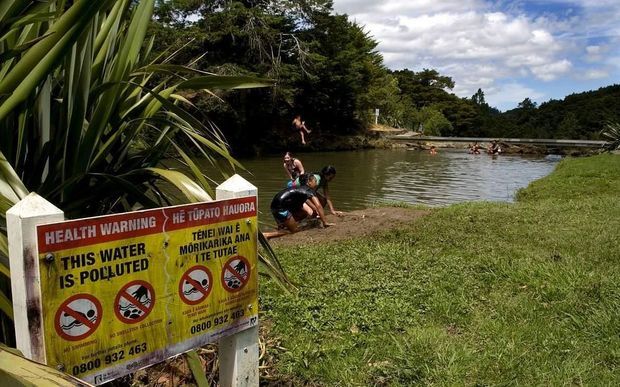
Polluted riverExperts say the water quality of once pristine rivers and lakes has deteriorated. (File photo) Photo: RNZ


A booming dairy farming industry, along with a surge in tourists seeking unspoiled natural attractions, has taken its toll on the country's environment, heavily marketed as '100% Pure'.

Particularly affected is its vast network of once pristine rivers and lakes, which are now some of the most polluted among OECD countries, according to some experts.

About 60 percent of them were unfit for swimming, the Environment Ministry said in a report in 2014. Experts said water quality had deteriorated further since.

In a Colmar Brunton survey conducted last month, 82 percent of respondents said they were "extremely or very" concerned about the pollution of rivers and lakes, more than any other issue including living costs, child poverty and climate change.

"(New Zealanders) are extremely worried that they are losing their ability to swim, fish and gather food from their rivers, lakes and streams," said Martin Taylor, the chief executive of Fish & Game New Zealand, a non-government agency that commissioned the survey.

"People see those activities as their birthright, but over the last 20 years, that right is being lost because the level of pollution in waterways has increased as farming intensifies."

With an election coming next year, political experts said water pollution could be a key issue for Prime Minister Jacinda Ardern. Ms Ardern led a coalition to power in 2017 promising social reforms and laws to protect the environment, but business confidence has suffered under her government.

#toomanycows


RNZ reporter Carol Stiles sent in a picture of cows having a chilly start to the day in Taumarunui on 27 June, 2018.Effluent from dairy farms has been blamed in the past for contaminating waters. Photo: RNZ/ Carol Stiles

More than 13,000 people signed a #toomanycows Greenpeace campaign on Twitter launched last week calling for a ban on synthetic nitrogen fertiliser.

"New Zealand already has way too many cows, and synthetic nitrogen is the key driver of the dairy intensification and expansion that leads to the dangerous double whammy of harm to rivers and climate," said Nick Young from Greenpeace.

New Zealand has nearly five million cows, more than its human population of about 4.7 million.

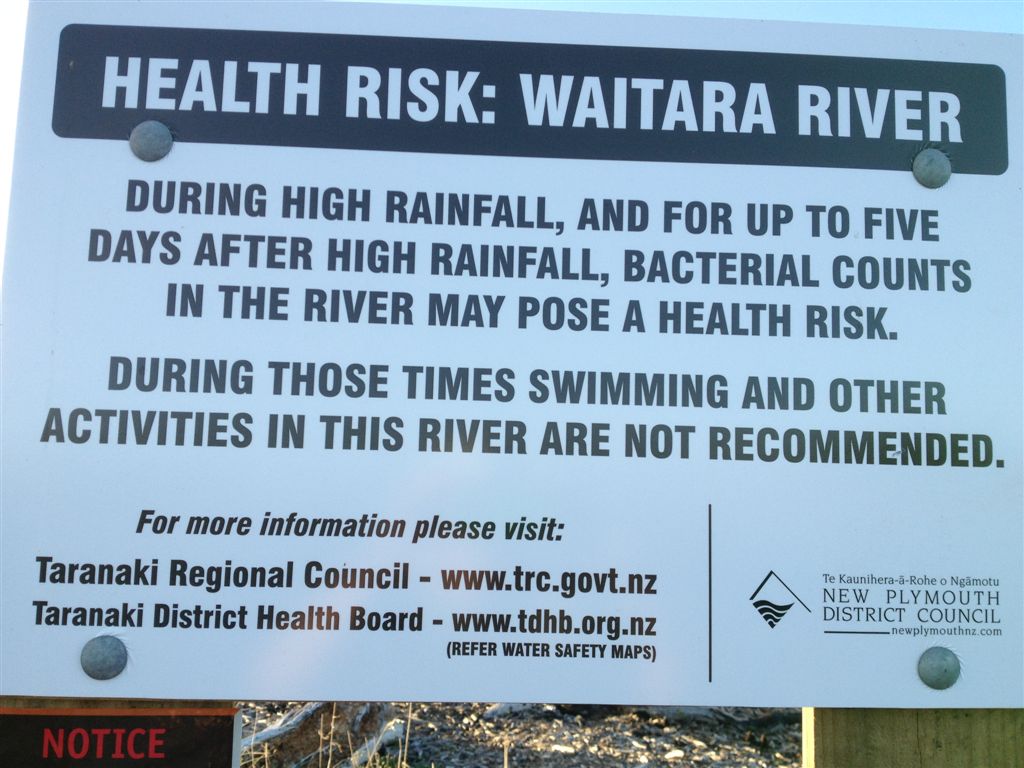
Popular swimming holes near the famed Mt Taranaki in the west of New Zealand's North Island were shut this month due to high E. coli bacteria, an indicator of faecal contamination. Tests are underway to determine the cause, but effluent from nearby dairy farms has been blamed in the past for contaminating these waters.

DairyNZ Chief Executive Tim Mackle said dairy farmers had been doing their bit, with 97 percent of waterways on dairy farms fenced off from cows, and significant work done to establish riparian margins and wetlands.

"The reality is that all types of land use contribute to water quality - and that farming, whether it's vegetables, fruit, beef, sheep, dairy, deer or even wine - must all work together to make sure waterways are protected," Mackle said in a statement.

"The most polluted rivers actually run through urban centres, and this is where the public can do their bit too."

Only about 15 percent of New Zealand's streams run through dairy farms, he added.

'Own goal'
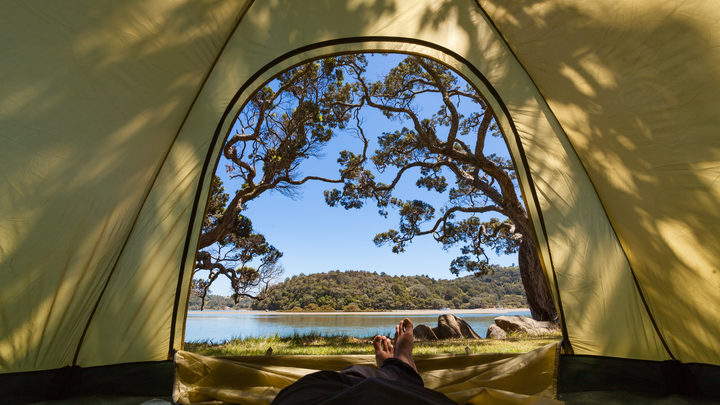

view of ocean from a tentPhoto: Courtesy of Off The Beaten Track

Dairy and tourism directly contribute about 3.5 percent and 6.1 percent respectively to New Zealand's $200 billion GDP.

Both industries rely on the country's clean, green image with cascading rivers, unspoiled forests and lush pastures that made it the ideal backdrop for the popular Lord of the Rings and The Hobbit movie series.

The sparsely populated country is spread over a mountainous area about the size of the UK or California, more than a quarter of which is set aside for reserves and national parks.

Hoards of tourists are expected to arrive in the country next month during the Chinese New Year, a peak travel season, which residents feel will take a further toll on the natural environment. Chinese are the second largest source of tourists to New Zealand after neighbouring Australia, according to 2018 data.

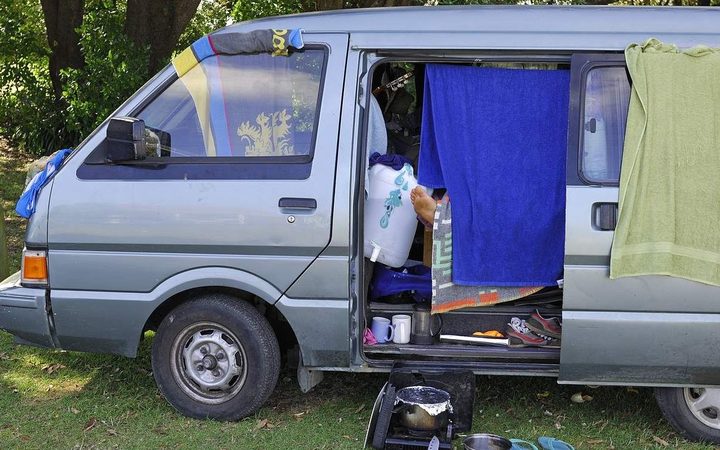
Apart from polluting the water, residents also fear mass tourism and freedom campers may destroy the country's iconic landscape, as seen in places like Venice, Boracay and Bali.

Overcrowding in Venice forced the local administration to restrict access to tourists while Boracay was shut down last year, after mass tourism turned the famed Philippines island into a "cesspool".

A freedom camper.


A freedom camper. Photo: PHOTO NZ

Richard Davies, tourism policy manager at the Ministry of Business, Innovation and Employment, said the increase in the number of campers had caused problems in some areas, waste being one of them.

"We have a collective duty to care for our environment and for New Zealand, and there have been a number of initiatives to help educate local and international campers on how to camp responsibility, and funding for infrastructure to help local bodies to address the issues that can arise," he said.

Mike Joy, a senior researcher at Victoria University of Wellington's Institute for Governance and Policy Studies said the environment was paying the price for hands-off governance and the intensification of dairy and tourism industries.

"It's an own goal... they are shooting themselves in the foot. The biggest value add this country can have is its clean, green image and they are just ruining that image," Mr Joy said.

The government has said it was committed to improving water quality. In 2017 it set a national target of making 90 percent of New Zealand's large rivers and lakes swimmable by 2040, with an interim target of 80 percent swimmable by 2030.

Mr Joy, who is a member of some government working groups, said change would only happen if governments took on the powerful dairy and tourism industries.

"Right now, a lot more money is spent on spin and propaganda but there's been very little change."
- Reuters

Thursday, 24 May 2018

Sharemilkers lose everything after raising alarm about M bovis

The horrors of New Zealand dairy farming


RNZ

The sharemilkers who first raised the alarm about sick cows, leading to the discovery of Mycoplasma bovis, say they have been left homeless, penniless and without work.

Mary Potgieter and her husband were sharemilkers on the van Leeuwen farm in South Canterbury. She told RNZ's Checkpoint about the discovery of the cattle disease, and how all of the farm's cows had to be killed.

"It's really sad for me. I was getting new born calves by then. The cows had started calving at the end of July and the works wouldn't take the calves or pets.

"But this time Pet Food had come. [They] shoot the calves in the pens and I'd go back the next day and there would be blood in the pens. There were still calves alive as they were only allowed to take a certain number a day."

The rest of the cows had also been killed.

She described the discovery of the cattle disease and said she noticed some of the cows were "springing" in May 2017, which was an indicator they were ready to calve. This was worrying as it was too early in the year. 

They pulled at a cow's teat and what came out "was like butter". They called the vet, who did some tests which came back negative. During this time some of the cows displayed symptoms of arthritis and struggled to walk on their front legs.

They separated the cows - 162 of 352 were affected at that time. The pushed back on the vet to make more tests.

By July 2017 it was diagnosed as Mycoplasma bovis.

"We didn't know what it was. It was the first time we had heard that word," Mrs Potgieter said.

"When we heard what it was, and how bad it was, we were shocked." 
"He said it was down to management, that we didn't work properly."

After all the cows were culled they were forced to leave all of their equipment, including tractors and silage wagons, to move to Australia to look for work. 

"I don't think the bank's going to be happy about this but we've been living on our credit card," Mrs Potgieter said.

She hoped the van Leeuwen Dairy Group would distribute some of their compensation if or when they received it.

"If MPI doesn't pay up soon I'm going to have to declare bankruptcy."

Of this disease she said: "If it wasn't for the vets it never would have come out."


Monday, 11 September 2017

New Zealand - polluted paradise

People & Power - Polluted Paradise - People and Power


al-Jazeera

New Zealand's pristine and abundant rivers and lakes have long been central to its proud reputation as a land of breath-taking natural beauty - and fundamental to a clean, green, outdoorsy brand that's used to attract millions of foreign visitors every year.

But are its waterways really as sparkling and bountiful as the tourist ads suggest?


Sunday, 3 September 2017

Al-Jazeera doco on NZ's fresh water crisis

New Zealand: Polluted Paradise
Al Jazeera English investigates New Zealand’s freshwater crisis

New Zealand: Polluted Paradise

Monday, 28 August 2017, 8:38 am
Press Release: Al Jazeera
Monday 28 August 2017 New Zealand’s sparkling and abundant rivers and lakes are fundamental to its image as a land of outstanding natural beauty – key features of a supposedly clean, green environment brand that attracts visitors from around the world.
But in a new two-part, year long, documentary investigation, Al Jazeera’s People & Power series discovers a murkier reality hidden in the depths: a disturbing tale of polluted and dried-up waterways, questionable irrigation schemes, an over-mighty farming lobby and claims of undue government interference.
New Zealand: Polluted Paradise (Part 1) airs on THURSDAY, 31 AUGUST 2017 AT 10.30 AM AND 9:30 PM
In part one of New Zealand: Polluted Paradise, filmmaker Naashon Zalk examines plans for a controversial dam and irrigation project, the Ruataniwha Water Storage Scheme, in Hawke’s Bay.
Its supporters have seen the scheme as a solution to drought problems, which have hampered the region's economic development. Opponents say it would have damaging consequences for the environment, leading to a huge increase in intensive dairy farming, which has already caused serious water pollution in the area’s fresh water supplies.
Following a 2016 drinking water contamination incident in Havelock North, which caused thousands of people to become sick with gastroenteritis, dozens of whom were hospitalised, a regional election was held that looked set to determine the future of the Ruataniwha scheme. Zalk and his crew went behind the scenes with the campaigns of two local politicians, one in favour of the project and one who opposed it.
Against this background as arguments rage, the film then delves deep into the reasons behind New Zealand’s freshwater pollution problems, which environmental campaigners say are exacerbated by similar large-scale irrigation schemes in other parts of the country.
New Zealand: Polluted Paradise (Part 2) airs on THURSDAY, 7 SEPTEMBER 2017 AT 10.30 AM AND 9:30 PM
 the second part of this exclusive People & Power investigation, as the machinations over the Ruataniwha project move to a climax, the Al Jazeera team examines disturbing allegations of undue political interference in the irrigation scheme at a national level. The episode also looks into the circumstances of the central government’s highly controversial 2010 sacking of anti-irrigation scheme councillors from a regional authority in Canterbury in New Zealand’s South Island and their replacement with non-elected officials.

Sunday, 16 July 2017

On New Zealand's disappearing fresh water

Drinking river water – Tourism NZ puts visitors at risk
Frank McSkasy


16 July, 2017


When it comes to irresponsibility and incompetence, we are well used to National’s performance over the last eight years. Homelessness and rising unaffordability, under-funding in healthcare and education; corporate subsidies; wasting taxpayers’ money on pointless exercises; increasing environmental degradation; uncontrolled migration to prop up a lack-lustre economy; and more scandals than we can recall – are National’s track record since 2008.

Up till now, National’s ineptness has impacted only on New Zealanders.
But not content with policies that have impacted harshly on a wide sector of the local population,National has now set its sights on how to screw up  visiting tourists;
.
.
While concerns grow about the health of New Zealand’s waterways – including the potential for reputational damage – it has not changed the way the country presents itself to the world.
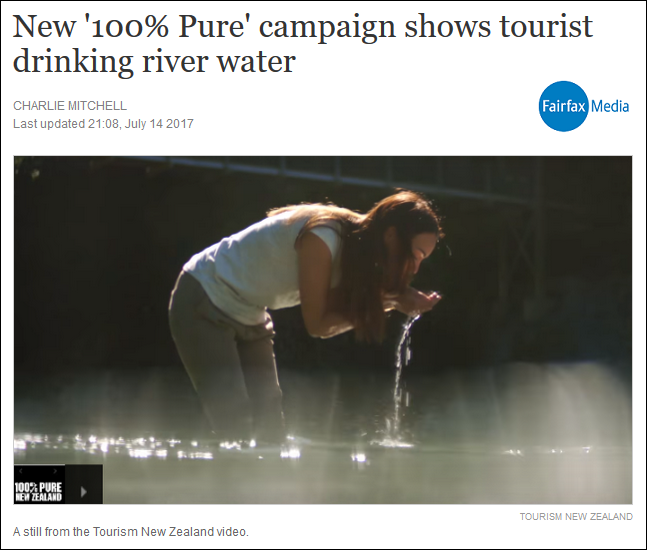
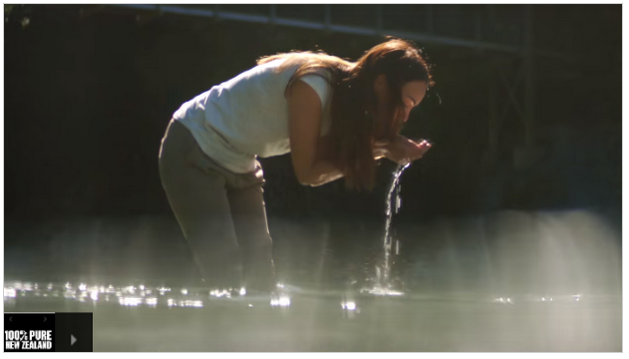
The latest “100% Pure” campaign, released last week, shows a tourist drinking water from a river, something that would be dangerous in parts of the country.

Tourism New Zealand is a government-owned and operated Crown Entity;
Tourism New Zealand is a Crown Entity funded by the New Zealand Governmentand established under the New Zealand Tourism Board Act 1991. We are led by a Board of Directors appointed by the Minister of Tourism and have a team of around 150 staff in 13 offices around the world. From humble beginnings, we are now the oldest tourism marketing department in the world.

The current Minister of Tourism is Paula Bennett. The same Minister who once advocatedcontraception for beneficiaries as some kind of ‘cure’ for sole-parenting.

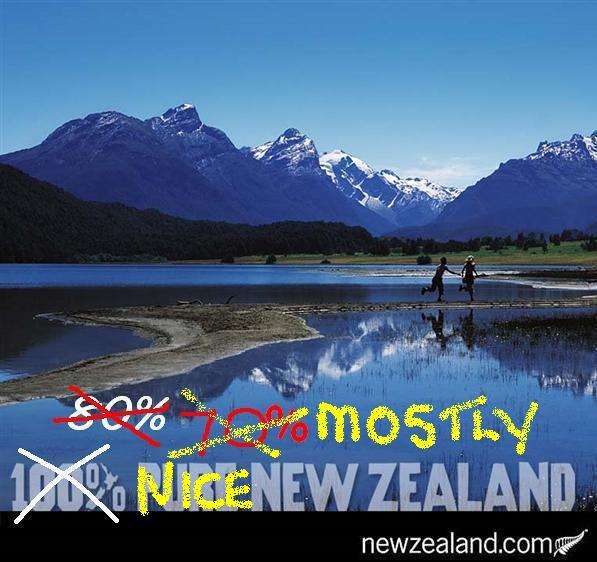
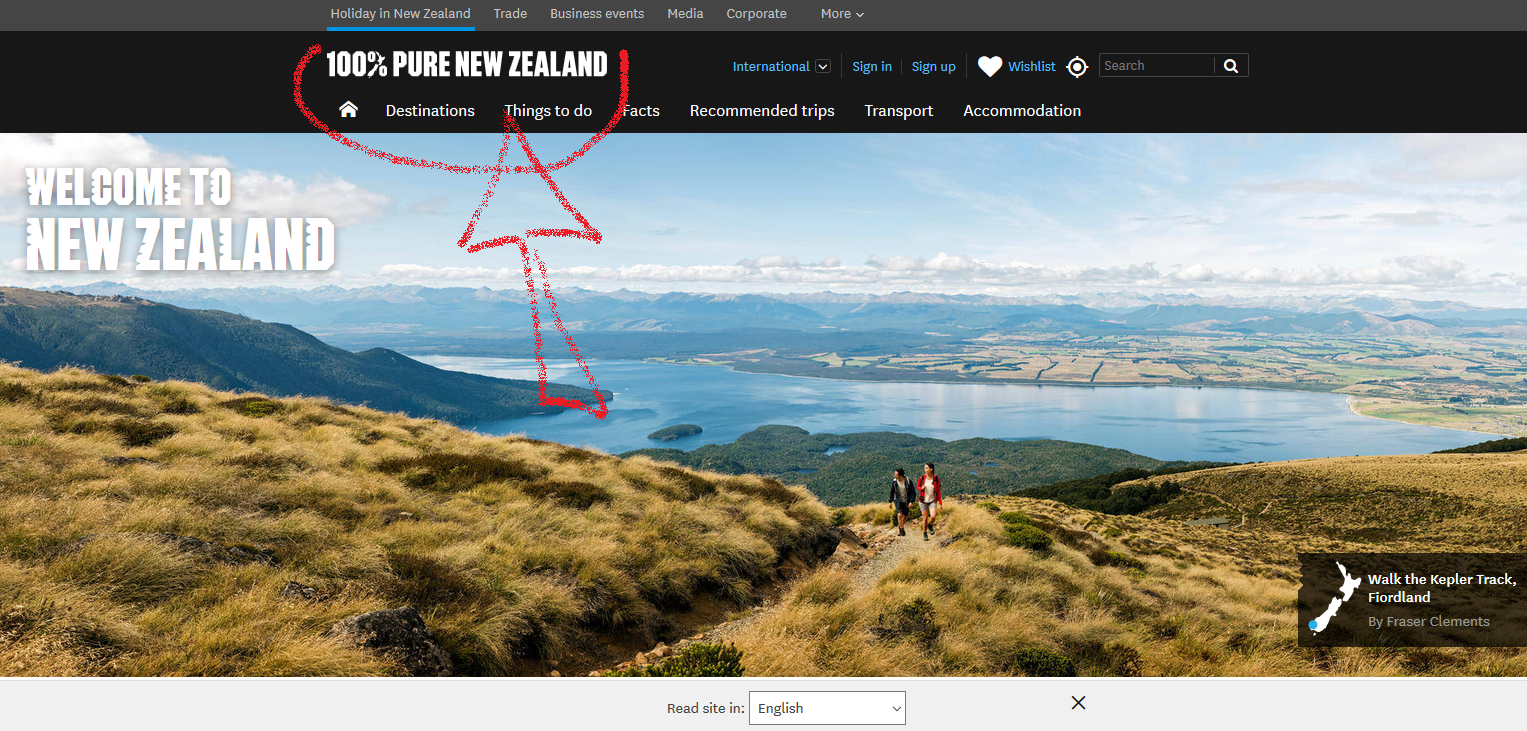
A major aspect  of Tourism NZ’s advertising campaign involves the “100% Pure” theme – a claim largely ridiculed and dismissed by most New Zealanders as a bad-taste joke;
.
.
As at 15 July, around 245,000 views have been made of the video on Tourism NZ’s Facebook page;
.
.
Interestingly, whilst the woman in the image is depicted as scooping up the water and raising it toward her face, the video switches scene before her hands reach her face.
Obviously the producers of this video were not prepared to risk the woman’s  health by actually expecting her drink the water.
For good reason.
Many of New Zealand’s waterways are polluted to varying degrees by urban and dairying run-off. In 2013, the Environment Ministry reported that 61% of monitored rivers in New Zealand were unsafe for swimming. Waterways were either “poor” or “very poor” quality.

Ministry data showed that the worst performing  regions were also heavy dairy farming regions. Nine waterways in Canterbury rated “very poor”. Manawatu-Whanganui, Southland, and Taranaki had seven waterways listed as “very poor”. Hawkes Bay and Wellington had five each.
.
.
Drinking  water from our lakes, rivers, and streams is a hazardous activity in 21st Century New Zealand. There is the risk of  infection; serious illness, and perhaps death from toxic algae, giardia, e.coli, campylobacter, etc.
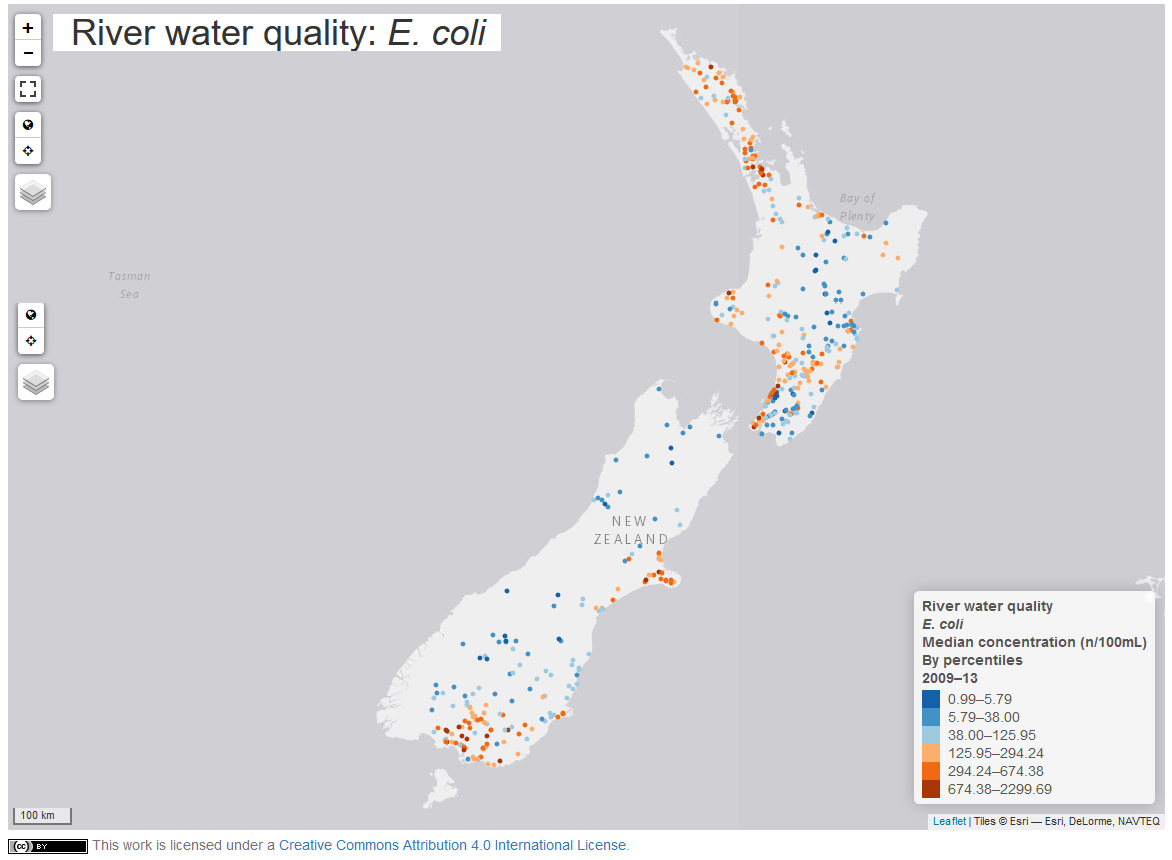
Statistics NZ has a convenient map of e.coli levels throughout the country;
.
.
Most New Zealanders are now aware of the serious health-risks posed by our polluted waterways – especially as urban populations and  dairy farming has increased  in the last nine years.  We have people like Dr Mike Joy, Massey University’s freshwater ecologist, to thank for breaking the silence on our polluted waterways;
.
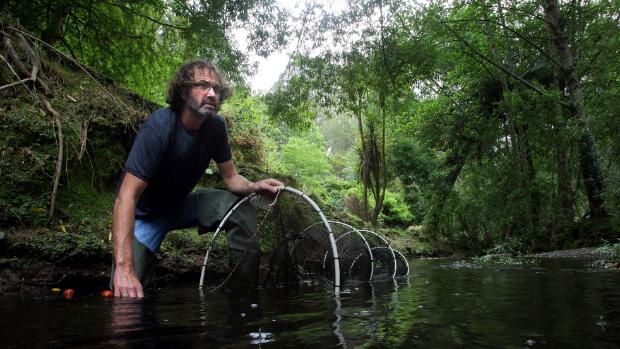
Dr Mike Joy – Massey University freshwater ecologist
.
Dr Joy’s  revelations were unpopular with many in the business world and right-wing politics. People like National Party supporter and corporate lobbyist, Mark Unsworth,  bitterly attacked Dr Joy in a vitriolic email in November 2012;
.
From: Mark Unsworth [mark@sul.co.nz]
Sent: Wednesday, 21 November 2012 12:15 a.m.
To: Joy, Mike
Subject: Ego Trip
Dear Dr Joy 
Is your ego so great that you feel the need to sabotage all the efforts made by those promoting tourism in NZ because of your passionate views on the environment ? 

You have the right to hold strong views but you ,as an academic whose salary is paid for by others taxes, must also act responsibly .
Letting your ego run riot worldwide in the manner you did can only lead to lower levels of inbound tourism.
You may not care given your tenure in a nice comfy University lounge ,but to others this affects income and jobs. 

Give that some thought next time you feel the need to see your name in print in New York .And possibly think of changing your name from Joy to Misery-its more accurate 


Cheers 

Mark Unsworth”
.
Unsworth was not attacking Dr Joy for incorrect facts. Unsworth was attacking Dr Joy for making public true facts.

Even our former esteemed Dear Leader, John Key, was dismissive of the scientist’s warnings;
He’s one academic, and like lawyers, I could provide you another one that’ll give you a counter-view.”

Since then, the demonisation of Dr Joy has been replaced with understanding and acceptance. Like climate-change, river and lake pollution will not conveniently ‘go away’ if we ignore it. The consequences of ignoring the problem will be severe for us, and the environment, as the OECD warned us just this year;
New Zealand’s environment is under increasing stress due to an economy reliant on primary industries, the Organisation for Economic Co-operation and Development (OECD) says.
It appeared to be resulting in environmental trade-offs, which put the country’s “green” reputation at risk, it said.
In a just-released report, the OECD urged New Zealand to come up with a long-term vision to transition to a greener, low-carbon economy.
[…]
New Zealand’s environment is under increasing stress due to an economy reliant on primary industries, the Organisation for Economic Co-operation and Development (OECD) says.
It appeared to be resulting in environmental trade-offs, which put the country’s “green” reputation at risk, it said.
In a just-released report, the OECD urged New Zealand to come up with a long-term vision to transition to a greener, low-carbon economy.
[…]
It detailed the environmental impact of farming intensification, and warned freshwater pollution would continue under current economic growth plans.
New Zealand’s nitrogen balance had worsened more than any other OECD country between 1998 and 2009, primarily due to farming intensification.

Unfortunately, the best efforts of the Green Party to turn back the tide of water-pollution has often been stymied by intransigence and self-interest in  Parliament.
In October 2012, Green MP Catherine Delahunty’s private member’s bill – Resource Management (Restricted Duration of Certain Discharge and Coastal Permits) Amendment Bill – was drawn from the Ballot. The Bill would have reduced the amount of time that discharges could be made into our rivers “in exceptional circumstances”. (Yes, industries are allowed to discharge waste into our waterways! Who knew!?)
.

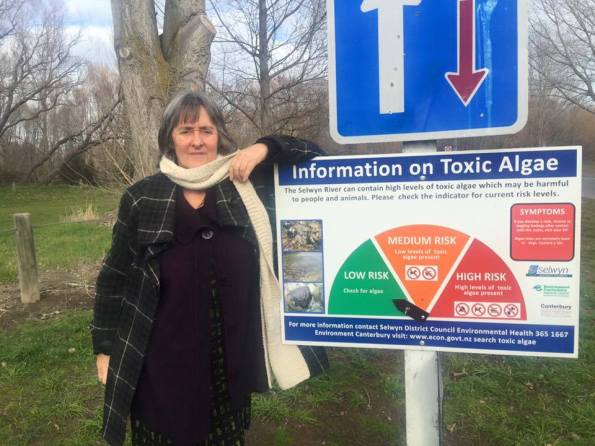
Greens MP, Catherine Delahunty, at the Selwyn River
.
As reported in the NZ Herald in October 2012;
Green MP Catherine Delahunty said her member’s bill, which has passed its first reading, sought to close a loophole in the Resource Management Act that allowed contaminating discharges with toxic effects and discolouration of waters under “exceptional circumstances”.
Ms Delahunty said the phrase included no timeframe, and had been used to justify long-term pollution of some waterways and coastal areas.
Her bill would limit its use to five years.

Ms Delahunty’s Bill was voted down at it’s Second Reading by National (59 votes); NZ First (7 votes); ACT (1 vote), and  Peter Dunne.
This means that a company such as Tasman Pulp and Paper Mill is legally entitled to continuously dump pollutants into the Tarawera River in the Bay of Plenty. The rationale is that the mill hires local people, so pollution is a “necessary evil”. (Ironically, the products are then shipped back to Norway, which also portrays itself as “clean and green”.)

The Tarawera River’s nick-name is “The Black Darin“.

So our rivers and lakes will continue to be fouled by agriculture, dairying, industry, and urban activity.
Meanwhile, a government Crown Entity blithely produces and promotes a video depicting a woman drinking from one of our waterways.
What tourists don’t understand is what may be lurking up-river, just out of sight around the next bend;
.
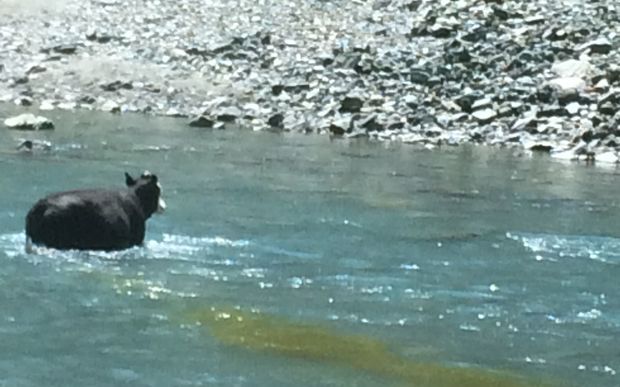
Note the brown stain flowing from the cow.
What might that be?
Now look at what National, via Tourism NZ, is promoting as safely drinkable.
.
.
New Zealand should post a Health Warning at every airport terminal.
Preferably before someone gets seriously ill. Or dies.

References

Tourism NZ: About
Facebook: Tourism NZ