Former Assistant Secretary of Housing and investment advisor Catherine Austin Fitts says you have to be careful and fully understand Bitcoin. Fitts explains, “We do know they want to go to an all-digital system with central bank cryptos. The easiest way to build the prison is to get freedom lovers everywhere to build the prison for you. To me, Bitcoin has always been the prototype on the way to building the all-digital crypto system that they would love to put into place. You have $400 trillion in fiat (currency) and it needs a place to go. If you are trying to buy up all the gold, silver and farmland, the last thing you need is competition from retail. They want to shift them into crypto and get them to build the crypto train tracks. In a funny kind of way, it’s brilliant.
There is talk by big banks that Bitcoin could go to $300,000 per unit by the end of the year. Fitts thinks, “This is absolutely possible. This is pure politics. This has nothing to do with economics. How much will the central bankers, who can print as much money as they want, spend to get you into this platform? Your guess is as good as mine. The sky’s the limit as to how much they can spend. Remember, once they decide to bring out the central bank currencies, and they have steadily been regulating the crypto currencies, Bitcoin and everything else, so the day they decide to take this to zero, they can do it. If you are going to invest into cryptos and build our prison for us, what you need to know is this thing could go to $300,000, and it can also go to zero. This is a highly speculative market, and you need to approach it accordingly.”
Fitts warns of a dark future if the central bankers get everything they want. Fitts says, “When they decide to shut down our bank accounts and say you all get on crypto, universal basic income and take that injection or you can’t transact on the financial system, this is instituting a totalitarian system through the financial system. . . . When they shut that trap door, what you need to think about is where are you going to buy food?”
In closing, Fitts says, “We are in Never, Never Land. We have two groups in our society: One group that can print money, and the other who can earn money. What we saw last year is the people who could print money declared war on the people who earn money. They basically said we are going to shut down your businesses, and we are going to suck up and take your market share or buy you out with money we print out of thin air. . . . We have no pandemic. What this is is an economic war.”
Join Greg Hunter of USAWatchdog.com as he goes One-on-One with Catherine Austin Fitts, publisher of The Solari Report.
While financial regulators
across the world are cracking down on bitcoin, Swiss Financial Market
Supervisory Authority (FINMA) has decided to encourage digital currencies by
issuing guidelines on initial coin offerings (ICOs).
According to the regulator,
Switzerland has recently seen a sharp growth in the number of upcoming ICOs
planned to be launched in the country, as well as numerous enquiries about
cryptocurrency regulation. In an attempt to encourage the ICO market and
blockchain technology, FINMA has clarified how standards around anti-money
laundering and securities regulations could be applied to virtual currencies.
The central bank of Thailand has
ordered the country's banks and other financial organizations to stop all
operations with digital currencies for fear of possible problems with
unregulated trading.
“The application of blockchain
technology has innovative potential within and far beyond the financial
markets. However, blockchain-based projects conducted analogously to regulated
activities cannot simply circumvent the tried and tested regulatory framework,”
FINMA chief executive Mark Branson said.
“Our balanced approach to handling
ICO projects and enquiries allows legitimate innovators to navigate the
regulatory landscape and so launch their projects in a way consistent with our
laws protecting investors and the integrity of the financial system,” the CEO
highlighted.
It's only a matter of time
before cryptocurrencies come under government regulation, according to the head
of the International Monetary Fund (IMF) Christine Lagarde.
In assessing ICOs, the regulator
will focus on the economic function and purpose of the tokens, or
blockchain-based units, issued by the organizer. As the current regulatory base
lacks generally recognized terminology for the classification of tokens both in
Switzerland and internationally, FINMA has categorized tokens and ICOs of those
tokens into three categories: payment tokens, utility tokens and asset tokens.
“ICOs can also exist in hybrid
forms of the above categories. For example, anti-money laundering regulation
would apply to utility tokens that can also be widely used as a means of
payment or are intended to be used as such,”the press release said.
Earlier this year, South Korea
banned the use of anonymous bank accounts in cryptocurrency trading amid deep
concerns over potential money laundering and other crimes. At the same time, a
senior official at the People’s Bank of China urged for a blanket ban on
services related to cryptocurrency trading in the country.
LIVE:
Bitcoin Sell-Off Continues - LIVE BREAKING NEWS COVERAGE
The
sell-off of cryptocurrency Bitcoin is continuing tonight as the price
has fallen below $6,100. Other cryptocurrencies like Ethereum and
Ripple are sharply down, too. Is this the big crash? We have LIVE
BREAKING NEWS COVERAGE of the bitcoin price drop.
“The
Dow Jones industrial average plunged more than 1,100 points Monday as
stocks took their worst loss in six and a half years. Two days of
steep losses have erased the market's gains from the start of this
year and ended a period of record-setting calm for stocks.”
U.S.
Stocks Sink Most Since 2011 as Rout Deepens: Markets Wrap
S&P
sectors decline across the board; Treasuries, gold rally
Equity
plunge follows declines in Asia, Europe markets
U.S.
stocks plunged the most in 6 1/2 years, with the Dow Jones Industrial
Average sinking more than 1,100 points, as the equity selloff reached
a fever pitch amid rising concern that inflation will force interest
rates higher. Treasuries rallied and gold rose on haven demand.
Volatility
roared back into American equity markets, as the S&P 500 Index
sank 4.1 percent to wipe out its January gain and turn lower on the
year. The index capped its worst day since the U.S. lost its pristine
credit rating, topping the rout that followed China’s shock
devaluation of the yuan, the Brexit selloff and jitters heading into
the presidential election. Trading volume was almost double the
30-day average. All but two stocks in the broad gauge declined.
“This
is classic risk off that may not end any time soon,” says Win Thin,
head of emerging-market currency strategy at Brown Brothers Harriman.
Selling
accelerated shortly after 3 p.m. in New York, with the Dow sinking
more than 800 points in a matter of 15 minutes only to snap back. The
blue-chip index ended lower by 4.6 percent -- its steepest drop since
August 2011, and is also lower for the year. The Cboe Volatility
Index more than doubled to its highest level in 2 1/2 years.
Treasuries
popped, sending the 10-year yield down more than 10 basis points, and
gold future pushed higher. The dollar stabilized while the yen
advanced.
While
Friday’s market rout came amid U.S. wage data on Friday that
pointed to quickening inflation, which would lead to higher rates
and, in turn, rising borrowing costs for companies, the selling
Monday came amid few major data points.
“I
think sentiment was a little too optimistic,” said Brad McMillan,
chief investment officer for Commonwealth Financial Network. “What
was driving the market up in January? It wasn’t the fundamentals,
as good as they were, it was excessive confidence.”
Elsewhere,
oil extended declines after U.S. explorers raised the number of rigs
drilling for crude to the most since August. Copper climbed the most
in a week. Bitcoin slid below $7,000
Monetary
policy decisions are due in Australia, Russia, India, Brazil,
Poland, Romania, the U.K., New Zealand, Serbia, Peru and the
Philippines.
Earnings
season continues with reports from Bristol-Myers Squibb, Ryanair,
Toyota Motor Corp., BNP Paribas, BP, General Motors, Walt Disney,
SoftBank, Sanofi, Philip Morris, Total, Tesla, Rio Tinto, L’Oreal
and Twitter.
Dallas
Fed President Robert Kaplan and New York Fed President William
Dudley are among policy officials due to speak in Frankfurt and New
York.
These
are the main moves in markets:
Stocks
The
S&P 500 fell 4.1 percent as of 4 p.m. New York time.
The
Dow fell 1,178 points, or 4.6 percent, while the Nasdaq averages
were off by more than 3.7 percent.
The
Stoxx Europe 600 Index declined 1.6 percent , hitting the lowest in
almost 12 weeks with its sixth consecutive decline.
The
MSCI Emerging Markets Index lost 1.9 percent.
Currencies
The
Bloomberg Dollar Spot Index gained 0.3 percent.
The
euro decreased 0.5 percent to $1.2405.
The
British pound declined 0.8 percent to $1.4001, the weakest in almost
two weeks.
The
Japanese yen gained 0.3 percent to 109.79 per dollar.
Bonds
The
yield on 10-year Treasuries fell four basis points to 2.81
percent.
Germany’s
10-year yield declined three basis points to 0.74 percent, the
largest decrease in almost six weeks.
Britain’s
10-year yield declined two basis points to 1.558 percent.
Commodities
West
Texas Intermediate crude dipped 2.2 percent to $64.01 a barrel.
Gold
advanced 0.1 percent to $1,334.76 an ounce.
Copper
gained 1.8 percent to $7,169 per metric ton.
Bitcoin
Tumbles Almost 20% as Crypto Backlash Accelerates
Lloyds
joins U.S. banks in prohibiting purchases with cards
Value
of the biggest cryptocurrency drops by as much as $1,990
Bitcoin
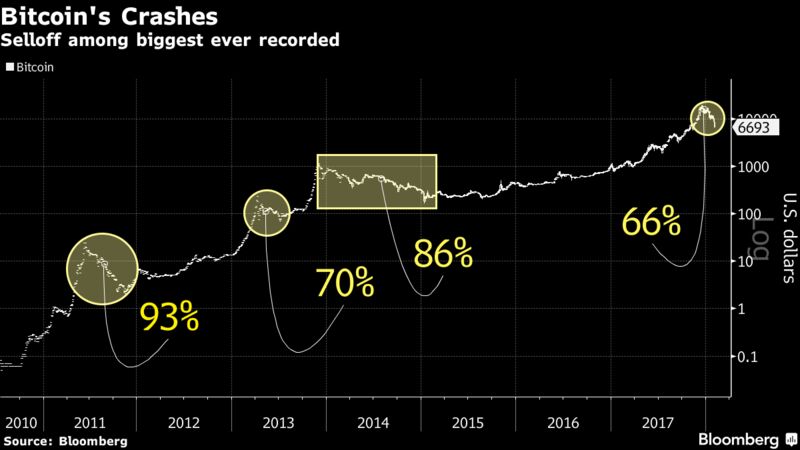
tumbled for a fifth day, dropping below $7,000 for the first time
since November and leading other digital tokens lower, as a backlash
by banks and government regulators against the speculative frenzy
that drove cryptocurrencies to dizzying heights last year picks up
steam.
The
biggest digital currency sank as much as 22 percent to $6,579, before
trading at $7,054 as of 4:08 p.m. in New York, according to composite
Bloomberg pricing. It has erased about 65 percent of its value from a
record high $19,511 in December. Rival coins also retreated on
Monday, with Ripple losing as much as 21 percent and Ethereum and
Litecoin also weaker.
“Although
no fundamental change triggered this crash, the parabolic growth this
market has experienced had to slow down at some point,” Lucas
Nuzzi, a senior analyst at Digital Asset Research, wrote in an email.
“All that it took this time was a large lot of sell orders.”
Weeks
of negative news and commercial setbacks have buffeted digital
tokens. Lloyds Banking Group Plc joined a growing number of big
credit-card issuers have said they’re halting purchases of
cryptocurrencies on their cards, including JPMorgan Chase & Co.
and Bank of America Corp. Several cited risk aversion and a desire to
protect their customers.
SEC
Chairman Jay Clayton said he supports efforts to bring clarity to
cryptocurrency issues and that existing rules weren’t designed with
such trading in mind, according to prepared remarks for
a Senate Banking Committee hearing Tuesday on virtual currencies.
Bitcoin’s
longest run of losses since Christmas day has coincided with
investors exiting risky assets across the board, with
stocks retreating globally.
Bitcoin so far seems to be struggling to live up to any comparison
with gold as a store of value, which is an argument made by some of
its supporters. Bullion edged higher as other safe havens -- the yen,
Swiss franc and bonds -- also gained.
Regulators
in what have been some of the hottest market overseas are also
seeking to gain more control of trading. China will block all
websites, including foreign platforms, related to cryptocurrency
trading and initial coin offerings in an attempt to finally stamp out
speculation in the market, according to a South China Morning Post
report.
Meanwhile,
North Korea is trying to
hack South
Korea’s cryptocurrency-related programs to steal digital currencies
and has already stolen tens of billions of won worth, Yonhap News
reported. And authorities in digital-coin powerhouse South Korea and
other countries are weighing increased regulatory scrutiny of the
industry, news which helped spark the ongoing selloff.
Yet
some Bitcoin stalwarts remain unconcerned.
“There
are a few catalysts: people paying taxes, and general mean
reversion,” Kyle Samani, managing partner at crypto hedge fund
Multicoin Capital, said in an email. “Overall, this is probably
healthy given the run up in November-January.”
The
Market Just Erased All Of 2018 Gains, Distraction?, Watch Gold &
Cryptos!
The
Bitcoin Crash has finally taken place as the king of cryptocurrencies
plunged a staggering 45% from its record high in just five days.
On December 17th, Bitcoin reached a peak of $19,800 but fell to a low
of 10,887 in early market trading today. However, the Bitcoin
price has recovered from its lows and is now trading at $13,500.
So,
the big question to all the Bitcoin investors and crypto traders…..
Will the market recover or will the crash continue? Well, if we
go by charts that show assets moving up in a straight line, I believe
we are going to see much lower prices. I don’t know if it
will take days, weeks or months… but lower it will go.
So,
the big question on the minds of many investors is… which asset is
more of a bubble, Bitcoin or Gold? If we use the cost of
production as a guide, my answer is Bitcoin:
Currently,
Bitcoin is fetching an estimated $4,700 profit per coin versus $136
for gold.
According
to the research done by Marc Bevand (discussed in the article linked
above), he calculated the cost to produce Bitcoin in August was
approximately $1,500. I adjusted that cost up to $1,800 for the
beginning of November. At the time, the price of Bitcoin was
trading at $6,500. Thus, the profit per Bitcoin was $4,700.
Now, compare that to cost to produce gold from the top two primary
gold miners at $1,115. Thus,
Barrick and Newmont primary gold miners were enjoying an 11% profit
margin while the Bitcoin miners were enjoying a 72% profit.
And…
that is when Bitcoin was trading less than half of what it is
currently. Furthermore, I presented this chart on Bitcoin’s
cost of production:
Here
we can see how the different estimated costs of Bitcoin production
and the price movements. A few weeks back I emailed Marc Bevand
and asked what he calculated as the new cost of Bitcoin production.
He stated that it was between $3,000-$4,000. I didn’t make a
new chart, but with the price of Bitcoin heading towards $20,000, the
Bitcoin miners were making upwards of $16-$17,000 a pop. No
wonder the price of Bitcoin finally POPPED.
There
is a new trend by individuals in the alternative media community
who are now selling out of precious metals and buying into Bitcoin
and cryptocurrencies.
While this may seem like a good
idea, especially when Bitcoin and the cryptocurrencies reach new
all-time highs, it is likely a big mistake. Now, I am not
saying that individuals shouldn’t invest in cryptocurrencies.
Rather, it’s a lousy idea to sell all of one’s precious metals
holdings and put it all into Bitcoin and cryptocurrencies.
Recently,
Sean at SGTReport published a short video in which part of the
headlined was titled as “SILVER
BULL CAPITULATES.”
In the video, Sean explains how past frequent guest and precious
metal analyst, Andy Hoffman, has sold out of all his silver and is
now only in Bitcoin and gold. Andy explains in his interview on
Crush The Street that he sold all of his silver this summer as he
really has no interest in it. He goes on to say, “Because, in
a digital age, I just don’t believe people are going to store
thousands of pounds of silver hoping that the gold-silver ratio is
going to come down.”
I
have to tell you, not only do I find this sort of thinking, utterly
preposterous, I also find it quite troubling that analysts who have
been promoting precious metals for the past decade are now implying
that gold and silver are no longer high-quality stores of value.
I disagree entirely with this faulty and superficial analysis.
Unfortunately,
those analysts that moved away precious metals and into Bitcoin and
Cryptos fail to understand the DIRE ENERGY predicament we are
facing.
They believe we are heading into a BRAND NEW HIGH-TECH
world with lots of neat new gadgets and billions of Dollars in
cryptocurrency profits to live life PHAT on the HOG.
Well,
as my favorite expression goes… GOD HATH A SENSE OF HUMOR.
It
doesn’t take long for digital profits to turn into digital losses
in the crypto markets.
However, nothing goes down in a straight line. If we look at
Bitcoin’s huge spike up to $1,150 at the end of 2013, it took a
while for it to fall 75%:
As
we can see in the chart, Bitcoin dropped from a high of $1,150 to
$600 quite quickly. It then bounced back up to almost $1,000,
before selling off even lower to $500. Although, this time
around, Bitcoin’s plunge below 75% can occur much quicker…. even
in days. But, I am not going to make that call. I stopped
giving price targets for any asset classes years ago. It’s a
fool’s game.
Regardless,
if we assume the latest Bitcoin’s mining cost is $3,000-$4,000,
then we still have a long way to go.
Furthermore, here is a chart showing that Bitcoin’s
transaction fees increased from 31 cents at the beginning of 2017 to
$55 currently.
Thus, the higher Bitcoin goes in price, the more unusable it is for
payment of goods and services. Who wants to buy a $5 cup of
coffee at Starbucks with Bitcoin if it cost you $55 for the
transaction?
Moreover,
how valuable is a cryptocurrency when it falls 45% in five days.
Again, Bitcoin reached a high of $19,880 on Dec 17th, and fell to a
low of $10,887 today:
According
to the current market price of Bitcoin, it is now trading down $7,000
or 35% lower from its high:
I
have to tell you, that chart looks very UGLY. Right now a lot
of new Bitcoin investors are wondering if they should hold on or to
sell before it goes down any further. While some analysts have
stated that Bitcoin will reach $50,000 and then $100,000… this sort
of trading activity can drive a person crazy.
I
don’t know if Bitcoin will ever reach $100,000, but I wouldn’t
bet on it. Mike Maloney put out his new Hidden Secrets Of
Money Ep 8: From Bitcoin To Hashgraph: The Crypto Revolution:
Mike
explains in the video that HashGraph will make a lot of the
cryptocurrencies obsolete. It takes a massive amount of energy
just to do one Bitcoin transaction that it is not really useful as a
currency or payment system. The Hashgraph technology does the
same sort of thing as Bitcoin and the other cryptos, but it takes
very little energy.
As
I mentioned in my previous article, the skyrocketing Bitcoin price is
what has SUCKED IN most of the demand.
Only a small percentage of techie Geeks were interested in what
Bitcoin had to offer. It wasn’t until Bitcoin’s price went
into the stratosphere that investors starting buying like crazy.
Now, we see Bitcoin mentioned on the major financial networks.
Again,
nothing goes down in a straight line. I wouldn’t be surprised
to see Bitcoin rally here for a while. It could actually go
back up significantly before selling off again. But, if
Hashgraph can do with Bitcoin does at a fraction of the energy, then
it is likely that Bitcoin will go down as the biggest Bubble in
history.
We are currently experiencing record high traffic. This is resulting in some customers having slow performance or issues logging into their http://Coinbase.com accounts. We are actively working to resolve this as quickly as possible.
We do note that GDAX pricing appears to be at a significant premium to several other exchanges.
* * *
Update: Bitcoin just surpased $16,000... speechless...
* * *
In the last 36 hours, Bitcoin has blasted through $12,000, $13,000, $14,000, and now $15,000 levels in an unprecedented 28% surge...
With a market cap of around $250 billion, Bitcoin is bigger than Proctor & Gamble and approaching the size of Wal-Mart as the 12 biggest 'company' in the S&P 500.
As CoinTelegraqph reports, the price is likely being driven by news of the imminent launch of Bitcoin futures trading. CBOE will be launching their futures market this coming Sunday, December 10, with CME Group following on December 18. Nasdaq plans to launch futures trading in the summer of 2018 and Japan’s Tokyo Financial Exchange is preparing to launch futures trading as well.
GDAX, Coinbase’s digital currency exchange, has been leading the rally all day. The price on GDAX is currently about $500 ahead of other Western Bitcoin exchanges. The likeliest - and most bullish - explanation is that Coinbase is the easiest way for new Bitcoin investors to get involved. Consequently, when GDAX leads the charge as it has today, it probably means new “retail” investors are fueling the rally.
Meanwhile, as CoinDesk reports, Ron Paul wants to know: would you take $10,000 in bitcoin, cash or something else?
The former U.S. Congressman from Texas is currently holding a poll on his official Twitter account that asks in which form they would take $10,000 from a "wealthy person". The catch: you can't get rid of it for 10 years.
Paul – who earlier this year called for the U.S. government to "stay out" of bitcoin – put the question to his more than 650,000 followers, asking if they would take $10,000 in the form of bitcoin, dollars, gold or 10-year U.S. Treasury Bonds. The result thus far – one hour remains in the poll at press time – indicate that of the more than 70,000 responses, 54 percent expressed support for bitcoin.
Gold took the second-highest amount with 36 percent, followed by a mere 8 percent for the 10-year bonds. Just 2 percent indicated that they would take the Federal Reserve Notes if offered.
A wealthy person wants to gift you $10,000. You get to choose in which form you'll take the gift. But there's a catch: You must keep the gift in the form that you choose, and you can't touch it for 10 years.
Speaking with TheStreet in October, Paul conceded that he's no expert on cryptocurrencies (back in 2014, he argued that bitcoin wasn't "true money"). That said, he voiced his support for cryptocurrency in the most recent interview, arguing that it lends credence to the emergence of alternative currencies against the U.S. dollar.
"Money is a bubble that never pops," he said at yesterday's Token Summit II in San Francisco.
He told attendees:
"It's a consensus hallucination."
And speaking to the newfound attention to bitcoin, Ravikant said people are interested in growing the wealth that they have. With most savings accounts returning zero these days – as central banks conduct what Ravikant called their "grand money printing experiment" – the general public is looking for alternative places to store their money and watch it grow.
Bitcoin and other protocols seem to offer that, as even the less-developed cryptocurrencies are showing substantial returns.
"I think people are looking to solve their money problems," he said.
Additionally, Coindesk notes that the former chairman of the U.S. Federal Reserve, Alan Greenspan, has joined the many financial luminaries to recently criticize bitcoin's value.
Speaking to CNBC, Greenspan compared bitcoin to that of an early American form of money called "Continental currency" that came into use in 1775 and had become worthless by 1782. The paper-based legal tender was used at the time of the American Revolution and was not backed by a commodity such as gold.
Noting that bitcoin will likely suffer similar fate, Greenspan said that a "significant share" of Continental currency was still used to create "real goods and services," even though it had no ultimate worth.
He continued:
"Bitcoin is really a fascinating example of how human beings create value, and is not always rational ... It is not a rational currency in that case."
Greenspan's comments come as the value of a bitcoin is soaring beyond most expectations, having gained thousands of dollars in value in the last two days.
And finally, for those calling this a "bubble" - we would humbly suggest you ain't seen nothing yet...
Steve Keen and Max Keiser debate bitcoin and whether it is a store of value or a bubble
The Bitcoin debate: Max Keiser vs. Steve Keen
Max
Keiser and Alex Jones on bitcoin
Austin/We
Have A Problem. Alex Come Back/The Great Deception is Strong. The
Beast System is like a Casino. It must have many winners at first to
draw in the multitudes. The Black Hole.
Eric
Holthaus discusses the ecological costs of the bitcoin revolution
If
you’re like me, you’ve probably been ignoring the bitcoin
phenomenon for years — because it seemed too complex, far-fetched,
or maybe even too libertarian. But if you have any interest in a
future where the world moves beyond fossil fuels, you and I should
both start paying attention now.
Last
week, the value of a single bitcoin broke the $10,000 barrier for the
first time. Over the weekend, the price nearly hit $12,000. At the
beginning of this year, it was less than $1,000.
If
you had bought $100 in bitcoin back in 2011, your investment would be
worth nearly $4 million today. All over the internet there are
stories of people who treated their friends to lunch a few years ago
and, as a novelty, paid with bitcoin. Those same people are now
realizing that if they’d just paid in cash and held onto their
digital currency, they’d now have enough money to buy a house.
That
sort of precipitous rise is stunning, of course, but bitcoin wasn’t
intended to be an investment instrument. Its creators envisioned it
as a replacement for money itself — a decentralized, secure,
anonymous method for transferring value between people.
But
what they might not have accounted for is how much of an energy suck
the computer network behind bitcoin could one day become. Simply put,
bitcoin is slowing the effort to achieve a rapid transition away from
fossil fuels. What’s more, this is just the beginning. Given its
rapidly growing climate footprint, bitcoin is a malignant
development, and it’s getting worse.
Cryptocurrencies
like bitcoin provide a unique service: Financial transactions that
don’t require governments to issue currency or banks to process
payments. Writing in the Atlantic, Derek Thompson calls bitcoin an
“ingenious and potentially transformative technology” that the
entire economy could be built on — the currency equivalent of the
internet. Some are even speculating that bitcoin could someday make
the U.S. dollar obsolete.
But
the rise of bitcoin is also happening at a specific moment in
history: Humanity is decades behind schedule on counteracting climate
change, and every action in this era should be evaluated on its net
impact on the climate. Increasingly, bitcoin is failing the test.
Digital
financial transactions come with a real-world price: The tremendous
growth of cryptocurrencies has created an exponential demand for
computing power. As bitcoin grows, the math problems computers must
solve to make more bitcoin (a process called “mining”) get more
and more difficult — a wrinkle designed to control the currency’s
supply.
Today,
each bitcoin transaction requires the same amount of energy used to
power nine homes in the U.S. for one day. And miners are constantly
installing more and faster computers. Already, the aggregate
computing power of the bitcoin network is nearly 100,000 times larger
than the world’s 500 fastest supercomputers combined.
The
total energy use of this web of hardware is huge — an estimated 31
terawatt-hours per year. More than 150 individual countries in the
world consume less energy annually. And that power-hungry network is
currently increasing its energy use every day by about 450
gigawatt-hours, roughly the same amount of electricity the entire
country of Haiti uses in a year.
That
sort of electricity use is pulling energy from grids all over the
world, where it could be charging electric vehicles and powering
homes, to bitcoin-mining farms. In Venezuela, where rampant
hyperinflation and subsidized electricity has led to a boom in
bitcoin mining, rogue operations are now occasionally causing
blackouts across the country. The world’s largest bitcoin mines are
in China, where they siphon energy from huge hydroelectric dams, some
of the cheapest sources of carbon-free energy in the world. One
enterprising Tesla owner even attempted to rig up a mining operation
in his car, to make use of free electricity at a public charging
station.
In
just a few months from now, at bitcoin’s current growth rate, the
electricity demanded by the cryptocurrency network will start to
outstrip what’s available, requiring new energy-generating plants.
And with the climate conscious racing to replace fossil fuel-base
plants with renewable energy sources, new stress on the grid means
more facilities using dirty technologies. By July 2019, the bitcoin
network will require more electricity than the entire United States
currently uses. By February 2020, it will use as much electricity as
the entire world does today.
This
is an unsustainable trajectory. It simply can’t continue.
There
are already several efforts underway to reform how the bitcoin
network processes transactions, with the hope that it’ll one day
require less electricity to make new coins. But as with other
technological advances like irrigation in agriculture and outdoor LED
lighting, more efficient systems for mining bitcoin could have the
effect of attracting thousands of new miners.
It’s
certain that the increasing energy burden of bitcoin transactions
will divert progress from electrifying the world and reducing global
carbon emissions. In fact, I’d guess it probably already has. The
only question at this point is: by how much?

 Posts
Posts