Showing posts with label anthrax. Show all posts

Thursday, 4 August 2016

The Anthrax outbreak in Yamal

"About 75 years ago, a reindeer fell sick to anthrax. Laying down to die upon the frozen ground of Siberia, the poor creature’s carcass froze in the Arctic climate. With it, the deadly infectious bacteria teeming in the deer’s body were stilled into an inert latency.


"In the decades after, billions of tons of carbon bellowed out into the world’s air from fossil-fuel burning and carbon-spewing machines spreading around the globe. The heat-trapping properties of these carbon gasses subsequently warmed the Arctic and the frozen permafrost that was this ill-fated deer’s — and the anthrax’s — tomb.


"For the deer, there would be no second life, as rising temperatures bring decomposition 75 years after its death. But as the flesh of that deer warmed, the long-frozen anthrax bacteria began to revive. Over the past week, this climate-change-released anthrax spread back into the deer population, killing about 2,300 reindeer. It also leapt into humans, resulting in dozens of hospitalizations, with half the victims as children — and so far, one human death."


Anthrax-Spewing Zombie Deer Are the Least of Your Warming Planet Worries

Diseased carcasses dating to World War II aren’t the only surprises coming our way, courtesy of climate change.

2 August, 2016


Climate change is like a box of chocolates. You never know what you’re going to get. In northern Russia, you get anthrax.

Climate ChangeConditions that are melting Arctic permafrost there recently thawed the carcasses of deer felled by anthrax some 75 years ago, when World War II raged. Warmer temperatures then reactivated the infectious disease, which can survive in hibernation for decades. Dozens of people have been hospitalized, half of them children, with eight confirmed cases and one death. Making matters worse, a heatwave combined with the anthrax outbreak may have killed more than 2,300 deer—new ones.

As apocalyptic as this development may seem, it’s perhaps the least worrisome byproduct of warming near the top of the earth, which is heating up the fastest. Retreating ice and softening permafrost, both in the Arctic and elsewhere, have already begun to yield other curiosities and dangers, some of which can do a lot more damage than a pile of dead deer:


Frozen cemeteries give up their dead

Twenty-five years ago, during a foray into the Ötztal Alps between Austria and Italy, two German hikers came across the remains of a less-fortunate peer. They assumed he died within recent times, but Ötzi, as the cadaver was nicknamed, turned out to be more than 5,000 years old. He was embedded in ice through the rise of human civilization. Since then, bodies that are hundreds of years old, or more, have turned up in northern British Columbia, Bolivia, and the Russian steppe. Melting ice has uncovered soldiers and airplane pilots who met their fates in more recent decades.

Climate change may be the best thing to happen to anthropologists in years. For the rest of us? Not so much.


This place is a mammoth dump


The annals of climate change are filled with items too small to affect the big picture, but memorable nonetheless: shrinking sheep, nicer spiders, and even increases in kidney stones. Then there’s mammoth dung.

Humanity isn’t the first mammal to roam the northern tundra, nor the biggest. But people may be the most discreet with our bodily functions. Not so the woolly mammoth: In pockets of permafrost are their digestive remains. Nine years ago, a widely circulated news report raised the specter of ancient dung-driven emissions. 

The research community hasn’t returned to the topic as a major risk factor. Yet.


Bacteria have plenty of reheated planet to eat


Thawing, century-old deer that spew anthrax sound like the beginning of a Hollywood zombie thriller. But a bigger, less-exciting horror film is also playing out as permafrost becomes sometimes-frost.

Scientists in 2014 discovered what may turn out to be a true workhorse of the warming world: bacteria that eat through thawing soil. These organisms, including Methanoflorens stordalenmirensis, gobble up nutrients and metabolize them into methane, a heat-trapping gas. Some of it breaks down into carbon dioxide, which while much less damaging to the atmosphere (molecule-per-molecule), sticks around for much, much longer.

A methane-burping bacterial colony here or there never hurt anybody. But widespread Arctic melting may serve these microbes a feast of geologic proportions. And that means potentially dangerous amounts of methane pouring into an already toasty atmosphere. Permafrost stores about double the carbon that the atmosphere does. The better the bacteria do, the more carbon joins the sky, the warmer earth becomes. Repeat

Last year, researchers based mostly in the U.S. recommended stronger monitoring of methane and CO2 emissions from the Arctic. But there’s some good news: They say “increased permafrost carbon emissions in a warming climate are more likely to be gradual and sustained rather than abrupt and massive,” which may be the ultimate example of cold comfort

Walking a methane minefield
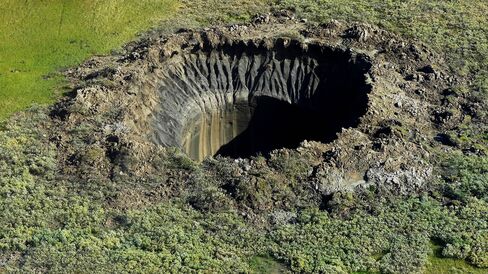
An aerial view of a crater on the Yamal Peninsula in northern Siberia.

Before the anthrax scare, Siberia's Yamal Peninsula attracted scientific and media attention because pockets of methane gas began spontaneously erupting, leaving craters a couple of hundred feet across and just as deep. Russian scientists think the craters are caused by underground gas leaking up toward the surface through fissures. With warming temperatures, the methane expands until it blows its top.


Craters formed in the last few years have begun to fill with water on their way to becoming the first new lakes of the Human Epoch. 

Wednesday, 3 August 2016

The anthrax outbreak on Yamal - Вспышка сибирской язвы на Ямале

Вспышка сибирской язвы на Ямале: потепление разбудило бактерию

Outbreak of anthrax on Yamal: warming woke up the bacteria


BBC,
2 August, 2016

После первой за последние 75 лет вспышки сибирской язвы властям Ямало-Ненецкого автономного округа придется провести большую работу по выявлению старых скотомогильников и ограничению доступа к ним, считает заместитель директора по научной работе Центрального НИИ эпидемиологии Роспотребнадзора Виктор Малеев.

Сибирская язва стала причиной смерти ребенка, который скончался в понедельник. Число подтвержденных случаев заболевания у людей уже достигло 20-ти, сообщила во вторник главный внештатный специалист минздрава по инфекционным заболеваниям Ирина Шестаков.

По словам Шестаковой, восемь из 20 заболевших - дети. Всего госпитализировано 90 человек, находившихся в очаге инфекции в Ямальском районе, но у большинства из них диагноз не подтверждается.
Поводом для госпитализации были малейшие недомогания, в том числе насморк и раздражение на кожи.


"Несколько пациентов, которые вызывали у нас опасение еще несколько дней назад, сегодня, по результатам утреннего обхода, показали стабильное состояние с совершенно четкой положительной динамикой", - заявила Шестаков.

Случаи заболевания, как правило, относятся к семьям оленеводов. От сибирской язвы в регионе погибли 2,3 тысячи оленей.

По версии местных властей, олени в поисках корма наткнулись на останки погибшего от сибирской язвы животного и затем заразили друг друга.
Власти ЯНАО уже начали проводить вакцинацию - как животных, так и семей оленеводов. Первыми вакцину получат жители из "чистой зоны", живущие рядом с очагом заболевания.

Тем временем все люди, которые были непосредственно в очаге, получают антибактериальные препараты в рамках профилактики, а через три дня после этого им будут сделаны прививки.

Русская служба Би-би-си поговорила с Виктором Малеевым о том, насколько опасна вспышка заболевания в ЯНАО и что теперь нужно делать местным властям, чтобы избежать таких инцидентов в будущем.

Скотомогильник с охраной

Би-би-си: Каковы причины вспышки сибирской язвы в ЯНАО и можно ли сказать, что это какой-то из ряда вон выходящий случай?

Виктор Малеев: Сказать, что это что-то выдающееся, конечно, нельзя, потому что были и больше вспышки. Причина основная в том, что скотомогильники, которые раньше были под вечной мерзлотой, видимо, оттаяли, и активизировалась бактерия. Она обычно в споровой форме, а здесь она была в вегетативной форме.

Одна из причин - это то, что мы можем не знать местонахождения всех скотомогильников, а эта бактерия может храниться сотни лет.

Когда много лет назад была вспышка заболевания, тоже была очень высокая температура. Это заболевание животных, и сейчас там больше двух тысяч северных оленей погибло.

Поскольку там очень тесное проживание людей, они живут рядом со стойбищами, то есть заболевшие и среди них. Пока один ребенок умер, и у него была кишечная форма: он, по-видимому, употреблял зараженное мясо.
Сейчас занимаются очень важной проблемой - утилизацией умерших животных и созданием нового скотомогильника на много лет вперед, с охраной, чтобы у людей уже не было возможности поймать эту бактерию.


Bacillus anthracis
Image caption
Споры и вегетативные клетки возбудителя сибирской язвы - Bacillus anthracis - под микроскопом

Би-би-си: Значит ли это, что общины ненцев-оленеводов находятся в очень уязвимом положении по отношению к этому и другим заболеваниям, которые передаются через животных?

В.М.: Наверное, в какой-то степени да. У них такая жизнь, они наиболее тесно общаются с животными, и так было в течение многих веков. Наверное, лучше, когда люди отдельно, животные отдельно, но это такой тип жизни, который существует во многих частях мира. Хотя, конечно, детей можно было бы и подальше держать, наверное.

Би-би-си: Насколько велика общественная опасность этой вспышки заболевания? Скажем, стоит ли людям на Ямале, которые не являются оленеводами и не живут близко к ним, чего-то опасаться?

В.М.: Нет, эта инфекция таким образом не передается. Она кожная, то есть это контактный путь передачи, только люди, общавшиеся с оленями.

В данном случае там кожная форма, только у одного мальчика была кишечная форма, а кожная форма опасна только при соприкосновении. 

Поскольку все больные с кожной формой уже лежат изолированные, то, что кто-то будет тесно тереться об эту кожу, - это исключено, поэтому контактный путь передачи не опасен для остальных.

Правда, надо за другими наблюдать, потому что мы не знаем, сколько людей общалось с оленями.

Влияние климата

Би-би-си: Каков прогноз и когда сибирскую язву выявляют у человека? От чего это зависит?

В.М.: Прогноз зависит от времени начала лечения и от формы заболевания. Когда в Америке были случаи биотерроризма, заболевание распространялось воздушно-капельным путем. Легочная форма, как в случаях с биотерроризмом, - это хуже, а когда кожная, то обычно считается, что летальность - до 10%.

Би-би-си: В последний раз сибирская язва была зафиксирована на Ямале в 1941 году, 75 лет назад. Почему болезнь возвращается?

В.М.: Климат, климат. Климатические изменения оказывают сильное влияние. Старые скотомогильники: видимо, просто пока была вечная мерзлота, мы не знали до конца, что там было.

Эти места плохо исследованы, а скотомогильники по 100 лет после захоронения являются опасными, а сейчас такая ситуация получилась с резким потеплением климата.

В других регионах России доступ к скотомогильникам ограничен, они известны, они охраняются, никакой деятельности там не ведется. А здесь все-таки кочевые места, огромные пространства.

Би-би-си: Сообщалось, что производитель вакцины от сибирской язвы отгрузил для Ямала тысячу доз. Кому в первую очередь предназначена вакцина?

В.М.: Сейчас у нас, в основном, вакцинируются ветеринары, животноводы. Сейчас надо быть особенно осторожными, потому что мы не знаем: может быть, какие-то олени уже перенесли нетяжелые формы заболевания, а люди с ними общаются.

Еще нужно вакцинировать лабораторных работников, которые работают с бактериями. Вакцина, слава Богу, есть. Во многих других заболеваниях ее нет.

Сейчас главное - вернуться к вопросу этих скотомогильников, чтобы ограничить их, чтобы животные уже туда не лазили


Диагноз "сибирская язва" подтвердился у восьми кочевников Ямало-Ненецкого автономного округа (ЯНАО), трое из них дети. Об этом в понедельник сообщили в пресс-службе губернатора округа.


"Предварительный диагноз "сибирская язва" подтвержден лабораторными исследованиями у восьми пациентов, трое из них дети. Медики ведут интенсивное лечение и применяют профилактические меры в отношении всех пациентов", - отметили в пресс-службе.

Tuesday, 2 August 2016

Update on anthrax outbreak in Yamal - Первая жертва сибирской язвы

"Now the concern is that in the unprecedented recent heatwave - with a prolonged period where temperatures were between 25C and 35C in this Arctic location - anthrax spores were released into the air and carried by the wind. "


Child, 12, died from anthrax, as nine cases confirmed of the deadly disease

Boy killed 'after lethal infection 'awoke' in human graveyard due to unprecedented heat wave'.

01 August 2016


'I was informed about the death of the boy in our hospital. There are no words to express my condition. I feel sorry, I pass my condolences to his parents'. Picture: Press Service of Yamalo-Nenetsk Governors Office

The boy, Denis, died on Saturday from the virulent intestinal form of anthrax after eating infected venison. His grandmother died a day earlier, but as yet the cause is not established. 

Eight other people are now confirmed to be suffering from anthrax, including three children, according to preliminary diagnoses in the outbreak on the Yamal Peninsula in northern Siberia.

The dead boy was a member of a reindeer herding family. 

A total of 72 people are now in hospital, a rise of 32 since Friday, under close observation amid fears of a major outbreak. 41 of those hospitalised are children as Russia copes with a full scale health emergency above the polar circle which has also killed thousands of reindeer.

Child, 12, died from anthrax, as nine cases confirmed of the deadly disease
A total of 72 people are now in hospital, a rise of 32 since Friday. Picture: Press Service of Yamalo-Nenetsk Governor's Office

The majority of samples taken from families of reindeer herders at the scene of the anthrax outbreak in the Arctic have proved negative, yet medics are closely observing all people admitted to hospital from the infected area. 

The reports on fatalities suggest that the grandmother  perished on Friday at her nomadic camp, yet news only came out today.

Local governor Dmitry Kobylkin said: 'I was informed about the death of the boy in our hospital. There are no words to express my condition. I feel sorry, I pass my condolences to his parents. 

'God knows, we made strenuous efforts from the first day, did everything possible, to save the lives of everyone. We just fought for the life of each. 

'But the infection was wily, returning 75 years later, it took the child's life.'
Child, 12, died from anthrax, as nine cases confirmed of the deadly disease

Child, 12, died from anthrax, as nine cases confirmed of the deadly disease

Child, 12, died from anthrax, as nine cases confirmed of the deadly disease
The cause of the anthrax outbreak could have been infected human remains from a local Nenets burial ground. Pictures: Znak.com, Vesti Yamal, Prof Florian Stammler

The governor urged local people to carefully follow doctors' recommendations. 'We will beat this infection. We are not alone, many people help us. Today we all have to be careful - and very careful - not to give any chance to this infection.' 

The boy was rushed to hospital but medics were unable to save him. 

Analysis of the cause of his death has been confirmed as anthrax, but the reason for the grandmother's demise is not yet known. 

The Yamal governor's office was unaware of the reported fatalities when the first media claims appeared. 

In a new development, the cause of the anthrax outbreak could have been infected human remains from a local burial ground, officials have admitted. 

Until now, the deadly disease was believed to have been caused by hot weather melting the permafrost and exposing the corpse of a contaminated reindeer. Today it was revealed that a cemetery close to last month's shock outbreak, the first in 70 years in Yamalo-Nenets region, is now under suspicion too. 

Child, 12, died from anthrax, as nine cases confirmed of the deadly disease

Child, 12, died from anthrax, as nine cases confirmed of the deadly disease

Child, 12, died from anthrax, as nine cases confirmed of the deadly disease

Child, 12, died from anthrax, as nine cases confirmed of the deadly disease
Russia's chief infections doctor Irina Shestakova was rushing to the region today. Pictures: Vesti Yamal, Press Service of Yamalo-Nenetsk Governor's Office

It was also disclosed that the number of reindeer suspected of dying from anthrax poisoning in the last 10 days or so is 2,349, almost double the figure given when the emergency was first announced. 

Some 4,500 animals have been given vaccinations against the infection, with plans to boost this figure to 41,000 in a concerted bid to stop the lethal disease spreading. 

Meanwhile, the carcasses of diseased reindeer are being incinerated at high temperature to prevent a spread of infection.

The operation is being spearheaded by the Russian Army's biological warfare troops who are wearing full scale protective gear as they deal with the anthrax-infected animals.

Russia's chief infections doctor Irina Shestakova was rushing to the region today.

Child, 12, died from anthrax, as nine cases confirmed of the deadly disease

Child, 12, died from anthrax, as nine cases confirmed of the deadly disease
Emergency teams from the army, Emergencies Ministry, and Health Ministry are on the ground in Yamal in a major operation to prevent a spread. Pictures: Russian Ministry of Emergencies 

In a worrying development, veterinarians have identified the burial ground - pictured - that they fear is the source of the current infection. 

It is an old Nenets cemetery in 40 kilometres from the current centre of the infection. In contrast to Soviet and Orthodox funerals, the bodies are not buried deep in the earth. Instead the traditional Nenets custom was to place them in a wooden box, a kind of coffin, on an open hill.

Now the concern is that in the unprecedented recent heatwave - with a prolonged period where temperatures were between 25C and 35C in this Arctic location - anthrax spores were released into the air and carried by the wind. 

Governor's press secretary Nadezhda Noskova told The Siberian Times: 'We are working out all the versions of what has happened. The first version is that due to the very hot weather permafrost thawed and bared the carcass of an animal which died from anthrax long ago. 

'The other version is that it could have been a human body. The point is that Nenets and Khanty peoples do not bury their dead in the ground.

'They put them into the wooden coffins - they resemble boxes - and place them on a stand or hillock. 

'The old cemetery could be also the source of the diseчase.'

She confirmed that the last case of anthrax in the region was in 1941, and that since 1968 Yamal has been declared clear of anthrax. 

Child, 12, died from anthrax, as nine cases confirmed of the deadly disease

Child, 12, died from anthrax, as nine cases confirmed of the deadly disease
The operation is being spearheaded by the Russian Army's biological warfare troops. Pictures: Russian Ministry of Emergencies 

The European Union carried out its own checks for anthrax in 2001 ahead of venison export approval for the EU being given to company Yamal Reindeers.

It was reported on Monday that there are now 72 people in hospital under observation, a rise of 32 since Friday night. 

Emergency teams from the army, Emergencies Ministry, and Health Ministry are on the ground in Yamal in a major operation to prevent a spread.

Vice-governor Mikhail Kagan travelled with a mobile military unit for a close inspection of the infected area. 

Their aim was to define borders of the site where dead animals will be destroyed. A field camp with a laboratory will be built next to this site. 

'Work will begin to dispose of dead reindeers and vaccinating people that were left in the area. We should be done with animals' vaccination in about two weeks,' he said. 'We have experimented to find the most effective way. 

'Specialists worked in protective costumes, because, you understand, it is a dangerous area. 

'A person can work in such a costume for not more than two and a half hours, especially giving the hot weather. 

'We have chosen the most effective way of elimination - we will burn the bodies with petroleum products and car tyres.' 

Some 15 carcasses have been destroyed in this way today. 'The burning of the dead bodies will be held continually all day.'


На Ямале бушует сибирская язва


Первая жертва сибирской язвы: такой угрозы не было с начала прошлого века


Умер 12-летний ребенок. Страшный диагноз на сегодняшний день подтвердился у восьми кочевников, трое из них — дети. На борьбу со злом, о котором не вспоминали последние 75 лет, брошены внушительные силы спасателей и инфекционистов. Под наблюдением врачей находятся десятки людей, введен строжайший карантин.

В зоне карантина МЧС и военные приступают к борьбе с сибирской язвой. С самолетов выгружают необходимую технику и химические препараты. В тундру прибывают несколько сотен военных и спасателей. На месте началась дезинфекция и дератизация зараженных территорий — обработано больше 23 тысяч квадратных метров. Началось и уничтожение зараженных оленей.

"Три часа мы там находились. Попробовали, как все это будет. Происходить все будет просто: горюче-смазочные материалы, шины, все это будет уничтожаться", — говорит заместитель губернатора Ямало-Ненецкого автономного округа Михаил Каган.

На прошлой неделе Ямальская тундра стала зоной карантина. От опасной инфекции полегло больше двух с половиной тысяч оленей. Вспышку сибирской язвы специалисты связывают и с небывалой жарой на Севере, почти + 35°. Северные олени, непривычные к таким высоким температурам, оказались уязвимы к оттаявшим в вечной мерзлоте спорам сибирской язвы.

"Она у животных протекает как септическая форма, как тяжелое, смертельное заболевание, а у человека именно как язва. То есть, на коже возникают своего рода карбункулы, которые мы неплохо научились лечить антибиотиками широкого спектра действия", — поясняет главный инфекционист Федерального медико-биологического агентства Владимир Никифоров.

На данный момент в больнице Салехарда находится 72 человека. Причем, большинство из них - дети. Результаты анализов подтвердили диагноз у восьми кочевников: сибирская язва.

По словам губернатора Ямало-Ненецкого автономного округа Дмитрия Кобылкина, ситуация средней тяжести, заболевшие находятся под наблюдением.

"Надеемся, что сделаем все максимально возможное, чтобы люди выжили. Но одного мальчика мы потеряли", — признает глава региона.

Всех кочевников из близлежащих к очагу территорий, эвакуировали на безопасное расстояние. Больше двухсот человек получают профилактическое лечение. На месте ЧП продолжается совместная работа Минобороны и МЧС по дезинфекции территорий.

Командующий войсками радиационной, химической и биозащиты Центрального военного округа генерал-майор Валерий Васильев по-военному краток: "Взаимодействие налажено".

Очаг сибирской язвы на Ямале полностью локализован. Ситуация с распространением инфекции под контролем.

Заместитель директора центрального НИИ эпидемиологии Роспотребнадзора Вадим Покровский объясняет особенности заболевания.

"По счастью оно не передается от человека к человеку, но если эти споры попадают к какому-то животному, оно может заболеть сибирской язвой, умереть. Если люди съедят это животное или будут работать со шкурой, то они могут заразиться сибирской язвой", — отметил ученый.

На Ямале летом забой оленей не проводят, поэтому риска распространения инфекции в другие регионы нет. Тем более, сейчас, когда на время карантина вывоз продуктов животноводства из тундры категорически запрещен.


Специалисты тем временем продолжают спасать уцелевшее поголовье — в рамках массовой вакцинации помощь ветеринаров должна охватить больше 40 тысяч голов крупнейшего в мире стада северных оленей

The nightmare in Siberia

Melting Permafrost Releases Deadly, Long-Dormant Anthrax in Siberia

"This week's anthrax outbreak signals that global warming is transforming Siberia's lonely wilderness into a feverish nightmarescape"

The cause of the anthrax outbreak could have been infected human remains from a local Nenets burial ground. (Photo: Siberian Times)


CommonDreams,
1 August, 2016


A Russian heatwave has activated long-dormant anthrax bacteria in Siberia, sickening at least 13 people and killing one boy and more than 2,300 reindeer.
According to the Siberian Times on Monday:
A total of 72 people are now in hospital, a rise of 32 since Friday, under close observation amid fears of a major outbreak. 41 of those hospitalized are children as Russia copes with a full scale health emergency above the polar circle which has also killed thousands of reindeer.
A state of emergency has been imposed throughout the region in western Siberia, and reindeer herding communities have been quarantined.

While NBC News last week pinned the blame for the outbreak on "[t]he carcass of a reindeer thought to have died from anthrax decades ago," new reports suggest an old burial ground could be the source. 

Nadezhda Noskova, press secretary of the Yamalo-Nenets Autonomous Region government, told the Siberian Times:
We are working out all the versions of what has happened. The first version is that due to the very hot weather permafrost thawed and bared the carcass of an animal which died from anthrax long ago. 
The other version is that it could have been a human body. The point is that Nenets and Khanty peoples do not bury their dead in the ground.
They put them into the wooden coffins—they resemble boxes—and place them on a stand or hillock. 
The old cemetery could be also the source of the disease.
But regardless of the precise culprit, there's little doubt that climate change is exacerbating the health crisis.


The Washington Post noted last week, "Temperatures have soared in western Russia's Yamal tundra this summer," with several regions seeing record heat. Indeed, temperatures in the Yamal tundra above the Arctic Circle have hit highs of 95°F this summer, compared to an average of 77°F.


The Post quoted two Russian researchers, who warned in 2011: "As a consequence of permafrost melting, the vectors of deadly infections of the 18th and 19th centuries may come back...especially near the cemeteries where the victims of these infections were buried."


"The extreme heat has triggered a seemingly endless rash of freak weather, natural disasters, and signs of ecological malaise, including enormous wildfires, record flooding, and natural moon bounces [methane bubbles] that might be explosive," staff writer Maddie Stone reported at Gizmodo. "But above all else, this week's anthrax outbreak—the first to hit the region since 1941—signals that global warming is transforming Siberia's lonely wilderness into a feverish nightmarescape."


Or, as Charles Pierce wrote at Esquire on Monday, "an anthrax strain that has spent 75 years resting, sleeping a lot, going a few times a week to the Bacteria Gym, and generally muscling up, gets another chance at sickening reindeer and people because the Great Climate Change Hoax has thawed the permafrost, so it gets its shot at the reindeer and people that didn't die in the record wildfires. I would point out that one of our two major political parties doesn't believe that any of this is happening, and that the party's candidate for president thinks it all might be a hoax thought up by the Chinese."


22 July 2016

Scientists say a 'fountain of gas' poured from jelly-like trembling earth in tundra on Belyy Island in northern Siberia.

The swelling pockets in the permafrost - revealed this week by The Siberian Times - are leaking 'alarming' levels of ecologically dangerous gases, according to scientists who have observed this 'unique' phenomenon. Some 15 pockets have been found on the Arctic island, around one metre in diameter.


Measurements taken by researchers on expeditions to the island found that after removing grass and soil from the 'bubbling' ground, the carbon dioxide (CO2) concentration released was 20 times above the norm, while the methane(CH4) level was 200 times higher. 


Wildfires in Russia: much worse than you could imagine


Blogpost by Khalimat Tekeeva


Greenpeace,

3 June, 2016


According to analysis of recent satellite data, forest fires in eastern Russia currently cover more than 3.5 million hectares of forested land. An area larger than Belgium!


And the fire season in Russia isn't over yet.


This year's forest fires are close to becoming one of the most devastating in recent Russian history. Usually around 5 to 6 million hectares of forest burn in a year. Russian meteorologists say that this summer in Russia will be warm and dry – weather fire fighters hate.


    Forest fires in Zabaikalsky region, Siberia, Russia. This land suffered from wildfires for years. © Greenpeace / Maria Vasileva

        Fires and climate change

    Russia is warming faster than the rest of the planet. According to a new report by Russia's climate and environment agency, between 1976 and 2012 average temperatures in Russia rose 0.43°C (0.8°F) a decade – more than twice the global average of 0.17°C.

    Extremely dry weather in Siberia is one of the impacts of climate change according to natural reserve rangers in Zapovednoye Podlemorye on lake Baikal. Wildfires release massive amounts of carbon which causes climate change which makes the fires worse. It's a terrible cycle.

    Dangerous extreme weather is on the rise in Russia  © Quartz | qz.com

    As a result, we face forest fires in one of the largest forested region in the world – the Russian Boreal forest. It's also one of the most 'biologically outstanding' places in the world, home to a range of species – from wolves and brown bears to golden eagles and siberian accentors. These species suffered when a forest fire almost entirely engulfed the natural reserve in Baikal three days ago.

     Aerial image of Siberian taiga, also known as boreal forest, near Surgur. © Denis Sinyakov / Greenpeace

        What can you do?

    The Greenpeace Wildland Fire Program (WFP) trains volunteers to suppress wildfires. They are motivated to stay at the forefront of the peat, grass and forest fires around Baikal. We shared our experience with the local groups which helps them be much more effective than the official forest management bodies. They are thankful that you can help Greenpeace Russia promote this underreported story about the real scale of the forest fires in Siberia.

    Greenpeace and local volunteers suppress peatfires in Central Ecological Zone of the Baikal Natural Territory (UNESCO Site), Republic Buryatia, Siberia, Russia © Greenpeace / Maria Vasileva

    Forest management in Russia is in crisis. State foresters and fire fighting services don't have enough resources, like experienced fire fighters, foresters and equipment. That's why they try to hide the problem and to understate the scale. That's why Greenpeace Russia's main goal is to not let the government hide wildfires.

    We need your support to make this problem world-known, so that the Russian government can't ignore wildfires anymore. Please share this blog!

    Khalimat Tekeeva is a Press Officer with Greenpeace Russia.


Excessive methane burst North and East of Greenland. 07 31 2016
Looks like it is coming up from the Arctic and Greenland Ocean. 

Excessive methane everywhere and more excessive methane over Siberia. 

Anything over 1250 ppb is unlivable.

Carbon Monixide 08 01 2016


Meanwhile, thousands of miles to the west...

Moscow's warm records tumble after heatwave in July


Photo jeremynicholl.photoshelter.com
1 August, 2016


Last month's heat wave made July 2016 was one of the 20 hottest months in the history of Moscow's weather observations, the capital's meteorological bureau said on August 1.

"July's average temperature was 20.9 degrees Celsius, which is 2.7 degrees higher than usual.

July 2016 was one of 20 hottest Julys in the past 137 years," the department said.

A new high was set with a record breaking 31.8 degrees Celsius being recorded on July 30.

Moscow received 130 percent of normal precipitation in July 2016, making it the 18th rainiest July in recorded history.

Heavy rains drenched the capital on the night of July 18.


Other stories

One month's rain in two hours destroys Ellicott City maine street in Maryland killing two

40 people killed 35 others injured due to lightning strikes in Odisha, India

Spanish high season on alert as temperatures set to soar to above 42 C (108 Degrees)

37 people dead 26 missing and 2,000 houses destroyed from floods and landslides in Nepal

Temperatures to hit 110 degrees (43C) during the weekend in the San Fernando Valley

Astounding statistics! Over one years rain in one day kills 225, 250,000 trapped and 53,000 houses destroyed in China

Kuwait tie's the world’s highest known temperature this week at 129.2 degrees (54 Celsius).

India –124 Dead 55,000 dead cattle and 336,555 damaged homes after monsoon rains

Two weeks after heavy rain left 128 people dead another 100 dead or missing in new China floods

Unprecedented and undeniable! June marks 14 consecutive months of record heat for the globe

Deadly Texas heat wave kills four and is the hottest summer since 1994

Greenland lost over a trillion tons of ice from Jan. 1, 2011 to Dec. 31, 2014 report claims

Parts of Europe on alert as a heatwave moves in with some parts hitting 40C (104F)

Tropical Depression 6E (Estelle) to strengthen into tropical storm today

Tropical Storm Darby set to strengthen in the Eastern Pacific

New York set to beat July heat records as high humidity pushes temperature in Central New York to nearly 100F (38C)

3 dead due to heat wave in the Abruzzo region Italy

Hurricane Celia set to strengthen into a "major hurricane" in the East Pacific

A new record: Ten thousand lightning flashes lit up Hong Kong's night sky over the weekend

22 dead and 170,000 forced from their homes from Flash floods in India

11 dead 200 villages marooned as devastating flash floods hit Madhya Pradesh India

500,000 evacuated as deadly Typhoon Nepartak makes landfall in China

Super Typhoon Nepartak hit's Taiwan: 331,900 households without power, strongest winds since 1901