Showing posts with label Vanuatu. Show all posts

Wednesday, 14 February 2018

Cyclone Gita upgrade to Category 5, headed for Vanuatu

Cyclone Gita upgraded as it hurls towards Vanuatu


Radio NZ

Cyclone Gita has this afternoon been upgraded to a category five storm packing winds of 203 kilometres an hour as it tracks towards New Caledonia and Vanuatu.


Barbara Dreaver has the latest.

Tuesday, 3 October 2017

The evacuation of Vanuatu

Vanuatu launches a Dunkirk-style evacuation on the northern island of Ambae as a flotilla of boats rescues islanders from an erupting volcano.

Photo AFP

3 October, 2017

Vanuatu has launched a Dunkirk-style evacuation on the northern island of Ambae as a flotilla of boats rescues islanders from an erupting volcano.

The eruption has polluted many of the island's water sources leaving thousands of people in need of safe drinking water, Red Cross delegate Joe Cropp told Reuters by phone on Sunday.

"Water is crucial," he said.

"It's important to get on top of it right away."

The Manaro Voui volcano, the nation's largest, was seen hurling steam and rocks into the air by New Zealand vulcanologist Brad Scott who flew over the volcano on Saturday.

"Maybe about every 8 to 10 seconds there was an explosion, throwing lava bombs up maybe 50 to 100 meters above the crater and there's also two small lava flows that are flowing across the island into the lake as well," he said in an interview with Radio NZ published on Sunday.

Crowds of islanders from at least three evacuation points on the island have begun boarding a flotilla of ships including ferries, canoes and commercial vessels for the safety of surrounding islands Maewo, Pentecost and Santo.

The Vanuatu Government wants all 11,000 islanders evacuated by Oct. 6.
Australia sent amphibious Bay Class landing ship HMAS Choules on Saturday to help move the population, and it is expected to arrive by the middle of the week.

Some islanders are flying out while others have already moved to stay with friends or relatives in the capital, Port Vila. More than 6000 people have gone to emergency shelters on the South Pacific island in preparation for the total evacuation.

Manaro Voui stirred to life in September, threatening island residents with burning ash, toxic gas and acid rain.

The volcano is crowned by crater lakes.

One of them, Lake Voui, is directly on top of the eruption making it dangerously explosive and posing the deadly threat of a lahar: a boiling mud flow down the side of the mountain, Macquarie University vulcanologist Christopher Firth told Reuters by telephone on Saturday.


Monday, 2 October 2017

Dunkirk-like evacuation in Vanuatu

Perhaps Donald J. Trump should call the Vanuatu government for some advise on evacuations and an air lift in Puerto Rico?


---Kevin Hester

Vanuatu launches a Dunkirk-style evacuation on the northern island of Ambae as a flotilla of boats rescues islanders from an erupting volcano.

Photo AFP
2 October, 2017

Vanuatu has launched a Dunkirk-style evacuation on the northern island of Ambae as a flotilla of boats rescues islanders from an erupting volcano.


The eruption has polluted many of the island's water sources leaving thousands of people in need of safe drinking water, Red Cross delegate Joe Cropp told Reuters by phone on Sunday.

"Water is crucial," he said.

"It's important to get on top of it right way."

The Manaro Voui volcano, the nation's largest, was seen hurling steam and rocks into the air by New Zealand vulcanologist Brad Scott who flew over the volcano on Saturday.

"Maybe about every 8 to 10 seconds there was an explosion, throwing lava bombs up maybe 50 to 100 meters above the crater and there's also two small lava flows that are flowing across the island into the lake as well," he said in an interview with Radio NZ published on Sunday.

Crowds of islanders from at least three evacuation points on the island have begun boarding a flotilla of ships including ferries, canoes and commercial vessels for the safety of surrounding islands Maewo, Pentecost and Santo.
The Vanuatu Government wants all 11,000 islanders evacuated by Oct. 6.
Australia sent amphibious Bay Class landing ship HMAS Choules on Saturday to help move the population, and it is expected to arrive by the middle of the week.
Some islanders are flying out while others have already moved to stay with friends or relatives in the capital, Port Vila. More than 6000 people have gone to emergency shelters on the South Pacific island in preparation for the total evacuation.

Manaro Voui stirred to life in September, threatening island residents with burning ash, toxic gas and acid rain.

The volcano is crowned by crater lakes.

One of them, Lake Voui, is directly on top of the eruption making it dangerously explosive and posing the deadly threat of a lahar: a boiling mud flow down the side of the mountain, Macquarie University vulcanologist Christopher Firth told Reuters by telephone on Saturday.


Friday, 29 September 2017

A mass evacuation in Vanuatu

Ambae evacuation effort in full swing
An armada of ferries, trawlers and other boats is heading towards the Vanuatu island of Ambae, as the country prepares to evacuate about five percent of its population


30 September, 2017


Footage of the from the summit of Mt Lombenben. Uploaded to Facebook by Nixon Garae Tambeana Subs by

0:00 / 1:30
The government yesterday decided to evacuate the whole population of Ambae, as the island's volcano continues to erupt.

More than 7000 people are already crammed into coastal evacuation centres, as a thick layer of volcanic ash and acid rain blankets villages and crops.
The disaster coordinator on Ambae Manuel Ure said authorities were hoping to clear the whole island - more than 11,000 people - this weekend.

The evacuees will be scattered around the nearby islands of Santo, Pentecost, Malekula and Maewo, he said.

"A few people have already made personal arrangements to travel out from Ambae to their families in either Port Vila or Santo or the other islands, but the provincial arrangement, we are waiting [for] ships to come in and are hoping that we can evacuate most people probably during the weekend."

But Mr Ure said money and resources were really tight and he called on other provinces to assist more.

People being evacuated on Ambae.People being evacuated on Ambae. Photo: YumiToktok

"We continue to supply them with basic food but at the moment we still have problem with food, shelter and water.

"The Vanuatu government been promising to give us some money and support us with funds and at the moment we received just 1 million vatu ($NZ12,800), but managing 8000 people that amount of money is not enough and we are still running out of shelter, food and water."

A leader in the Malbangbang area of southern Pentecost, Robinson Tema, said chiefs had made the decision to accept about 500 evacuees.
He said villagers were clearing out Nakamals and churches, readying for their arrival some time before Sunday.

"The area that I'm living in, they have lots of rivers. Maybe with food, we need help from the government to support us with food to feed the people who will be coming from Amba."

Mr Tema said he did not know how long people would be staying.

People devastated at having to leave their homes


The head of the provincial government on Ambae Georgewin Garae said people were upset at having to leave their home.

Mr Garae said islanders were used to the volcano - one of the world's most active - but he has never seen it erupt like it is currently.

He said people were devastated at what's going on, but safety was paramount.
"It is very devastating, it is very sad, the information that was going out yesterday notifying people of the move, people were crying. But then the understanding is that safety comes first."

Mr Garae said it is impossible to say how long it may be before they can return.
He said ships were starting to arrive from around the country with much needed supplies.

"We are hopeful that the ship that is coming today will provide enough for the remaining two or three days before we evacuate them to the other locations."

Mr Garae said he expeced the island to be completely evacuated by the middle of next week.

People from all walks of life are contributing to the Ambae relief effort.People from all walks of life are contributing to the Ambae relief effort. Photo: Vanuatu Daily Post

Lavinia Mahit of Auckland has family on Amba.

She said the situation was heartbreaking.

"I'm very concerned, I mean, what do you pack? What do you get? Where do you go?"

"And when you're being evacuated, how do you settle into another village on another island?"


Thursday, 28 September 2017

As Mount Aung prepares to erupt

Bali's imminent Mount Agung eruption could cause "A year without summer" bringing Earth's warming back into balance as 100,000 now evacuated


1816 summer temperature anomaly compared to average temperatures from 1971–2000 By
Giorgiogp2 - Own work, CC BY-SA 3.0, Link


27 September, 2017

  • In the spring and summer of 1816, a persistent "dry fog" was observed in parts of the eastern U.S. The fog reddened and dimmed the sunlight, such that sunspots were visible to the naked eye. Neither wind nor rainfall dispersed the "fog". 
  • 1800 people froze to death.
  • Crops failed causing food shortages across the globe
  • Severe frosts were recorded in June.
  • In the UK families travelled long distances as refugees begging for food.
  • It was the worst famine in Europe during the 19th century

It could be hours away or it could be weeks away, but the Bali governor claims it is imminent and when it blows depending on the size of the eruption, Mount Agung could cause a global cooling, freezing people to death, global crop failures and food shortages across the planet.

Global temperatures could decrease by 0.4–0.7 °C (0.7–1.3 °F).

This would result in major food shortages across the Northern Hemisphere.
The year 1816 is known as the Year Without a Summer also the Poverty Year, the Summer that Never Was, Year There Was No Summer after Mount Tambora erupted in the Dutch East-Indies see Wikipedia link below.

An event like this would be a perfect convenient answer to the scientists claiming our planet is too warm, just imagine a decrease of, 0.4–0.7 °C (0.7–1.3 °F) in global temperatures would bring our planet right back into balance regarding global warming.

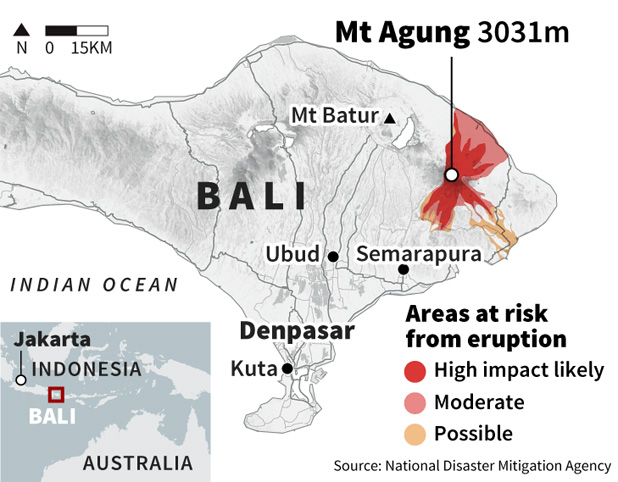
Warnings that a volcano on the Indonesian tourist island of Bali will erupt have sparked an exodus of nearly 100,000 people that is likely to continue to swell, the country's disaster agency said Tuesday. Authorities have ordered the evacuation of villagers living within a high danger zone that in places extends 12 kilometres (7.5 miles) from Mount Agung's crater.

But people further away are also leaving, said National Disaster Mitigation Agency spokesman Sutopo Purwo Nugroho.

The region is being rattled daily by hundreds of tremors from the mountain, which volcanologists say indicates a high chance of an eruption.

Mount Agung last erupted in 1963, killing about 1,100 people.

Evacuees are taking shelter at more than 370 sites across the island that include temporary camps, sport centres, village halls and the houses of friends and relatives.

Villager Wayan Merta said he was among the first to evacuate last week because of his village, Selat, is just 6 kilometres (4 miles) from the summit.

"We have already sold our cattle because we thought it was better than leaving them there for nothing," he said.

"My feeling is the mountain will erupt," he said.

"But no one knows, we just pray."

Sutopo said it was "natural" that people outside the immediate danger zone are leaving.

More than 500,000 people evacuated when Mount Merapi in central Java erupted in 2010, more than double the population in the exclusion zone around that volcano, he said.

In 1963, Agung hurled ash as high as 20 kilometres (12 miles) and remained active about a year. Lava travelled 7.5 kilometres (4.7 miles) and ash reached Jakarta, about 1,000 kilometres (620 miles) way.

"This is the heaviest test in my life and hopefully it will end soon," said Ketut Suliasih, a Selat villager.

She said evacuees are being treated well by the government and community, but like others, she is fearful about the future.

"No eruption. That is my prayer. Otherwise, our farms would not be able to be planted again." President Joko "Jokowi" Widodo visited a sports centre serving as temporary accommodation in a district south of the volcano on Tuesday.
In a televised news conference, he said "the highest priority is the safety of our people" and urged those around Mount Agung to follow the instructions of authorities.

In the Central Java town of Yogyakarta, about 500 people gathered at a Hindu temple to pray for the safety of people near the volcano.

They presented traditional offerings and collected money for the evacuees.
Bali is the only predominantly Hindu province in Indonesia, the world's most populous Muslim country.

Complete exodus ordered on Vanuatu island Ambae


Radio NZ

The alert level for the Manaro volcano is at level 4 - the second highest level - with the Geohazards Department warning of flying rocks, volcanic gas, acid rain and ash falls.


Three volcanoes on brink of erupting

Three volcanoes around Pacific Rim on brink of major eruptions


28 September, 2017


Volcanoes in Mexico, Indonesia and Vanuatu are at varying levels of imminent eruptions having belched smoke, ash and red-hot rocks, covering villages in ash and forcing hundreds of thousands to evacuate.


Popocatepetl volcano near Mexico City was the latest to show life on Wednesday (Thursday NZ Time), heightening the anxieties of Mexicans still shaken by last week's powerful earthquake that killed hundreds and severely damaged thousands of buildings.

Meanwhile, the exodus from a menacing volcano on the Indonesian tourist island of Bali is nearing 100,000 people, a disaster official said on Wednesday, as hundreds of tremors from the mountain were recorded daily.

Smoke, ash and molten rock is seen spewing from Monaro volcano is seen on Vanuatu's northern island Ambae.
REUTERS
A cloud of smoke from Manaro Voui volcano is seen on Vanuatu's northern island Ambae.

In the Pacific island of Vanuatu, a rumbling, belching volcano that's threatening to blow has forced more than 7000 people to flee their homes by Wednesday.

Municipal workers sweep a floor covered with ash after an early eruption of Popocatepetl volcano in Puebla, Mexico.
IMELDA MEDINA/REUTERS

Municipal workers sweep a floor covered with ash after an early eruption of Popocatepetl volcano in Puebla, Mexico.

Popocatepetl, whose name means "Smoking Mountain" in the native Nahuatl language, showered a village at its base with ash, shook with the force of a 1.8 magnitude earthquake and spewed flaming rocks to distances of up to 1km, the National Disaster Prevention Center (Cenapred) said.

Eruptions and exhalations take place on average about twice a year since the volcano reactivated 23 years ago and are not seen by disaster officials as a major threat, but the activity has worried Mexicans following the 7.1 magnitude earthquake eight days ago and a series of aftershocks since.

The earthquake had its epicentre just a few kilometres from the volcano and "probably pushed" the volcanic activity, Carlos Valdez, director of Cenapred, told Reuters. He said the explosions had calmed since dawn.

On a clear day, Popocatepetl looms on the horizon of Mexico City 71km away, and volcanic ash occasionally blows into the city.

Cenapred recommended people living near the volcano prepare for a possible evacuation order under a phase two yellow alert, two stages from a maximum red alert.

Winds blew the ash towards Ecatzingo, a village under the volcano that suffered damage to its church and dozens of houses in last week's quake.

The epicentre of the quake was just to the southeast of Ecatzingo in the state of Puebla.

The death toll from the earthquake has reached 337, with dozens more victims still believed to be beneath the rubble of one collapsed building in Mexico City.

At least 190,000 buildings have been seriously damaged by a series of earthquakes and storms in recent weeks, Mexico's President Enrique Pena Nieto said, with another senior official saying there was a collapse risk at 1500 buildings in the capital.


VOLCANO EXODUS NEARS 100,000

In Bali, the National Disaster Mitigation Agency said more than 96,000 people have now fled the area around Mount Agung in the northeast of the island.

Villagers began leaving in the middle of last week and the number of evacuees has swelled daily since Friday, when the volcano's alert status was raised to the highest level.

Fears that a volcano could erupt imminently in Bali has prompted several countries to issue travel warnings, while Indonesian authorities race to evacuate tens of thousands of people living in the danger zone.

The agency said a monitoring centre had recorded more than 800 earthquakes so far and thin smoke was observed rising 50 metres above the crater.

The volcano last erupted in 1963, killing more than 1100 people, and remained active for about a year.

Agency spokesman Sutopo Purwo Nugroho said the chances of an eruption are "quite big."

Although experts can't predict when with certainty.

The people who have fled the volcano are scattered across Bali in more than 400 different locations including temporary camps, sports centres and other public buildings.

In Karangasem district, volunteers were helping with classes for some of the thousands of children whose schools within the exclusion zone around the volcano are now closed.

A view of Mount Agung, a volcano on the highest alert level, from Karangasem Regency, on the resort island of Bali, ...
DARREN WHITESIDE/REUTERS

A view of Mount Agung, a volcano on the highest alert level, from Karangasem Regency, on the resort island of Bali, Indonesia.

"So far the children look happy and are enjoying themselves," said volunteer Yenni Ariyanti.

"They do not look worried or sad. Hopefully we can continue to maintain their excitement and keep them in good spirits."

The Ministry of Transport says it's ready to deploy 100 buses to take stranded tourists off Bali if an eruption forces the closure of its international airport.


The mountain, about 70km to the northeast of the tourist hotspot of Kuta, is among more than 120 active volcanoes in Indonesia.

Another volcano, Mount Sinabung, has been erupting sporadically since 2010, sometimes blasting volcanic ash several kilometres into the air and forcing more than 30,000 to evacuate their villages.

Indonesia, an archipelago of thousands of islands, is prone to seismic upheaval due to its location on the Pacific 'Ring of Fire', an arc of volcanoes and fault lines encircling the Pacific Basin.

Balinese children play on the beach near Mount Agung, a volcano on the highest alert level, outside the current danger zone in Amed, on the resort island of Bali, Indonesia.

BELCHING VOLCANO MAY BLOW

Also on the 'Ring of Fire', authorities have declared an emergency on Ambae island in Vanuatu, where activity at the Manaro volcano has increased recently, raising fears of a major eruption.

About 10,000 people live on the island, and villagers close to the volcano have been moved to schools and community halls on the island's less vulnerable eastern and western regions.

There is growing fear among evacuees on the Vanuatu island of Ambae with shelter starting to run out as thousands more flee the erupting Manaro Voui volcano.

For those displaced villagers, it's now a waiting game to see whether the volcano erupts or returns to normal activity that's not a threat to them.

Shadrack Welegtabit, the director of Vanuatu's National Disaster Management Office, said a ship had arrived on Wednesday carrying food, water and other essential supplies. He said a second ship was due to arrive on Friday.

New Zealand's military flew over the volcano on Tuesday, and said they noticed huge columns of smoke, ash and volcanic rocks billowing from the crater.

A cloud of smoke from Manaro Voui volcano is seen on Vanuatu's northern island Ambae.
REUTERS
A cloud of smoke from Manaro Voui volcano is seen on Vanuatu's northern island Ambae.

Group captain Nick Olney said they had already planned the aerial survey in an Orion aircraft before the recent activity, but were happy to help provide Vanuatu authorities with images and information.

He said the military "always stands ready to support our Pacific neighbours, especially in times like this."

Vanuatu's Meteorology and Geohazards Department said in an alert that villagers within 6.5km of the volcano face the biggest risk from airborne rocks and volcanic gas.

A cloud of smoke from Monaro volcano is seen on Vanuatu's northern island Ambae.
A cloud of smoke from Monaro volcano is seen on Vanuatu's northern island Amba.

The department warned that acid rain could damage crops across a broader area.

Vanuatu is about one-quarter of the way from Australia to Hawaii. It's made up of 80 islands, about 65 of which are inhabited, and is home to around 280,000 people.

The nation is considered one of the world's most prone to natural disasters, with a half-dozen active volcanoes as well as regular cyclones and earthquakes.