Showing posts with label SIS. Show all posts

Thursday, 20 December 2018

Trump Orders Full Withdrawal From Syria

In Drastic Reversal, Trump Orders Full Withdrawal From Syria After “Victory Over ISIS”
Will America finally exit Syria? Is Trump belatedly making good on his campaign promises?

19 December, 2018


update 2: A troop withdrawal appears already underway after a Pentagon official said it would happen “quickly”.
White House spokesperson Sarah Sanders has issued a formal statement on troop withdrawal from Syria: “We have started returning United States troops home as we transition to the next phase of this campaign.”
Moments after President Trump confirmed reports of US pullout via Twitter saying “We have defeated ISIS in Syria,” Pentagon officials said the president “ordered full US troop withdrawal from Syria,” and that this will be “rapid” — apparently already beginning, per a Reuters breaking report“All U.S. State Department personnel are being evacuated from Syria within 24 hours – official.”
The full White House statement issued Wednesday late morning:
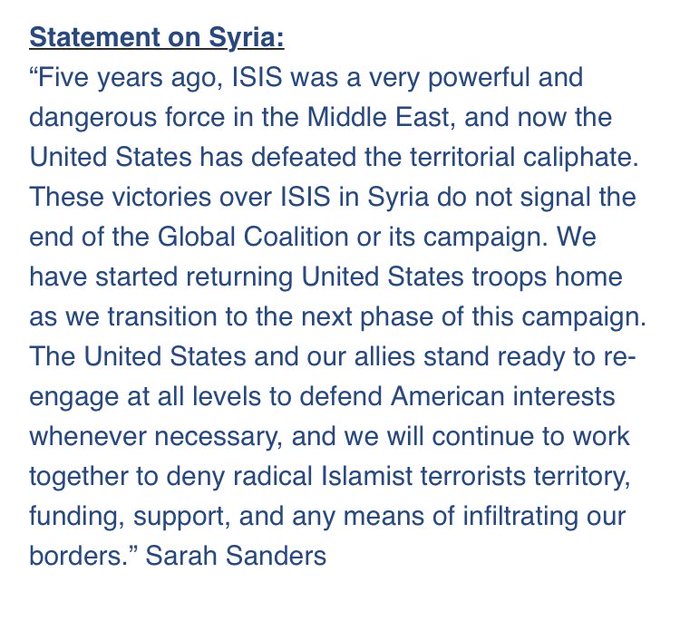


Sarah Sanders: “We have started returning United States troops home as we transition to the next phase of this campaign...”

Meanwhile Israel’s ambassador to the U.N. has vowed to continue combating Iran in Syria if US forces leave. Russia has alternately said “Syria will stabilize” should the thousands of American troops stationed there exit.
***
update: It’s official, within an hour after the first headline the president tweeted “We have defeated ISIS in Syria”and in reference to reports of a planned US troop withdrawal from Syria which unnamed officials say is to be initiated “immediately,” he added that the terror group’s defeat was “my only reason for being there”.
Minutes after the WSJ first broke the story, The Washington Post confirmed the following through a defense official:
The official, who spoke on the condition of anonymity to discuss a decision that has not yet been announced, said the decision would include the entire force of more than 2,000 U.S. service members. It was made on Tuesday, the official said.
President Trump has long promised to conclude the campaign against the Islamic State and has questioned the value of costly and dangerous military missions overseas.
***
The WSJ just reported a monumental and historic reversal in White House policy on Syria, revealing Wednesday morning the Pentagon is preparing to withdraw all forces from northeastern Syria “immediately”:
In an abrupt reversal, the U.S. military is preparing to withdraw its forces from northeastern Syria, people familiar with the matter said Wednesday, a move that throws the American strategy in the Middle East into turmoil.
U.S. officials began informing partners in northeastern Syria of their plans to begin immediately pulling American forces out of the region where they have been trying to wrap up the campaign against Islamic State, the people said.
The WSJ notes the complete 180 reversal in policy, which just days ago was reiterated by officials as an “indefinite” American presence in Syria in order to “counter Iran” while bolstering Kurdish and Arab SDF forces in the East (the YPG-dominated Syrian Democratic Forces), comes following a phone call last week between President Trump and Turkish President Recep Tayyip Erdogan.
For the past week Erdogan has threatened to launch a full-scale cross border assault on US-backed Kurdish forces in Syria, which Turkey has long considered an terrorist extension of the outlawed PKK. This would potentially bring American troops and advisers under fire, who’ve found themselves in the awkward position since entering Syria of training Syrian Kurdish militias on the one hand, and coordinating broadly with a NATO ally on the other.
Perhaps Trump finally took full stock of the fact that the prior planned “indefinite” presence of some 4000 American troops was recipe for a quagmire sure to be Washington’s next Afghan or Iraq style “endless war”?
As one recent intelligence study put it“The prospect of US being militarily involved in Syria, caught in middle of one of most complex conflicts in recent memory, with shifting objectives & ambiguous endgame, has been met with congressional indifference and public apathy.” 
Will America finally exit Syria? Is Trump belatedly making good on his campaign promises?

US withdrawing from Syria aimed at telling Turkey that America is on their side’


Ron Paul


Kevork Almassian

Sunday, 11 February 2018

Russian media: Conflict in Afghanistan about to break out with renewed vigour


United States fails in Afghanistan - Russia makes an unexpected move

The conflict in Syria is drawing to a close, but Afghanistan may be about to break out in conflict with renewed vigor.

10 February, 2018
It is there, according to numerous sources, that the ISIL fighters are moving to continue their war. Will events in Afghanistan develop according to the Syrian scenario? Or is there a chance of avoiding a new big war?
The crisis
The deterioration of the situation in Afghanistan is evident from the reports of the US military. In 2015, Kabul and its Western allies controlled 72% of the administrative districts, and militants - about 7%. According to the latest data, in August 2017 the ratio of the territories under control was  57% compared to 13%, respectively. 
Many rural areas are under the control of Taliban and ISIL militants, in various parts of the country. The zones of their influence are adjacent to the Afghan border, including the neighborhoods with Turkmenistan and Tajikistan.
The controversial control zone  has grown by almost one and a half times in two years, in which both the power structures and militants are present in different proportions. In 2017, the area reached 30% of the territory of Afghanistan, population - 8.1 million people.
According to US data, about 3.7 million people live in areas that are administered by militants. In these places, the radicals establish their own laws, appoint shadow authorities, recruit militants and even collect taxes.
After the withdrawal of most of the US troops from the republic in 2014, militants began to raid regional centers. In 2015 and 2016, the Taliban twice occupied the third-largest Afghan city of Kunduz.
In 2015, the authorities had to lead long-running battles, use artillery and aviation to knock them out of the city quarters.
Terrorists attack district centers regularly, 5-10 times a year, and try to keep it up as long as possible. The record now is the case of the Gorak regional center in Kandahar (south of the country), which the militants held for almost a year, from November 2016 to October 2017.
Afghanistan, with the financial support of NATO, contains a huge number of security forces - more than 350,000 payroll staff, but today this is not enough to keep control over the situation.
In 2017, Kabul had to make a significant reduction in the network of roadblocks and police stations in rural areas, many peripheral roads are now under the control of the Taliban and ISIL.
In Farah and Nimroz (west and south-west of the country), militants create their own roadblocks and even some kind of analogue to "traffic police".
In Herat (West), the Taliban already control more than 20% of local schools, and the province's official education department said it was "happy" due to the work that militants are doing in education. 
Authority in many areas is no longer in the hands of the government, because the police and military are no longer able to protect them. Militants regularly commit raids, resulting in heavy losses.
Recently, the militants created special assault units, "red detachments," designed to quickly capture fortified objects.

These elite units are better armed, equipped with night vision devices, sometimes using captured American armored cars. Their training is led by terrorists who previously participated in military operations in Syria and Iraq.
The events of 2017 showed that the training of Afghan militants has improved significantly, where they can successfully attack even very "difficult" targets. In April, a small group of terrorists attacked the base of the 209th Afghan Army Corps (Balkh, north of the country) during  Friday prayer, resulting in the deaths of, according to various sources, from 140 to 256 military personnel.
In October, during the attack on the base in Mayvanda (Helmand, south of the country), the militants managed not only to kill 43 servicemen, but also to seize the premises and gain a lot of trophies, including weapons and equipment.
The overall ratio of losses of militants and law enforcement officers has increased significantly.  Due to technical superiority and better training, the losses of military used to be 1:2 or 1:3 militants, and in the past year they equaled (1: 1).
The army and the police, according to our calculations, lost about 7-9 thousand people killed, militants - 7,5-10 thousand (of which 1,6 thousand - ISIL militants, others - the Taliban).
It is evident that the Afghan army is giving way to militants. The situation is partially stabilized by the transfer of additional NATO troops to the country, the number of which has reached 14 thousand people.
However, if the process develops in the same way as before, then it will be possible to keep the situation under control only at the cost of an additional transfer of troops, up to 100-120 thousand people.

The revival of ISIL
The threat of ISIL coming to power in Afghanistan is  growing. The number of militants of this terrorist organization in the region is, according to various estimates, from 3 to 10 thousand people.
They re-grouped after the arrival of several hundred "experts" who fled from the liberated areas of Syria and Iraq, many of whom were commanders and seek to create a "new army of the Caliphate."
ISIL in Afghanistan has at least three camps for the training of militants. Each shift trains up to 100 volunteers of all ages. In the "classroom", extremists work with machine guns, mortars, attacks on fortified positions and captured armored vehicles.
Initially, the Afghan ISIL was only a more radical version of the Taliban, in the ranks of which were mostly Afghans and Pakistanis. However, in 2016-2017, a lot of militants from Syria and Iraq, natives of Arab states, CIS countries and even the EU began to arrive in the country.
Their educational level is significantly higher than the average for Afghans. Among the older generation of Afghans,  even illiteracy is common. In addition, the military training that they received during the wars in the Middle East makes them more dangerous than the "classic Taliban."
ISIL have become one of the main problems for the Western Coalition. Their main stronghold of Nangarhar province (southeast) is now called "the most deadly zone in Afghanistan" by the official newspaper of the American army "Stars and Stripes".
The US Army tried to destroy ISIL in the region by bombing them, using the GBU-43 (the famous "mother of all bombs"), but this did not achieve any success in Nangarhar.
The increased level of expertise of the militants who fought in Mosul and Aleppo - may be critical. Such detachments can resist the Afghan army, even with the support of the US Air Force. This will allow them to hold the captured territories longer, use captured weapons more efficiently, including machine guns and mortars.
Ultimately, the Afghan conflict can move from the guerrilla war stage to a full-scale armed conflict, and ISIL can again try to create its "quasi-state" in the war-torn territory.

The peace proces
The Afghan army and NATO troops have not been able to regain control over the country for over 16 years, to the contrary, we see a steady deterioration of the situation.
Recently, the leading specialized publication of the United States, Foreign Affairs, recognized the situation as "dead-end" and proposed, as the only solution, negotiations with a part of the armed opposition.
The problem for the United States is that the negotiating format for solving the Afghan problem is "occupied" by Moscow. At the initiative of Russia, in late 2016, negotiations began with the participation of regional powers, including Afghanistan, China, India, Pakistan and Iran.
Moscow proceeds from the fact that since the problem does not have a military solution, one must rely on negotiations. The Afghan "Taliban" maintain high fighting efficiency thanks to sponsorship from Islamabad.
The agreement of regional players, especially India, which has great influence on Kabul and is a strategic rival of Pakistan, could make Afghanistan a "neutral territory" and exclude any support for militants by its closest neighbors.
Ultimately, this would allow the Taliban to sit down at the negotiating table and enter, perhaps, a coalition government.
Participants of the "Moscow format" have met twice, but both Kabul and New Delhi declared that dialogue with the armed opposition is inadmissible.
The American media in the region launched a real campaign against Moscow, accusing it of supporting the Taliban. It is not excluded that Kabul's position on the issue of dialogue was also largely determined by pressure from Washington.
However, the sharp deterioration of the military situation during 2017, the strengthening of ISIL positions and the risk of a repeat "Iraq scenario" forced regional players to return to the idea of dialogue.
In December 2017, during the negotiations in Oslo, the Russian side managed to reach an agreement with the representatives of Afghanistan, the United States and the EU on relaunching the negotiation process. Kabul gave Moscow a "road map" they see fit for the peace process, which should be approved by Russia in mid February 2018.
If the negotiation process is launched in 2018, then there is  hope to create a stable alliance of legal political elites of Afghanistan, and that part of the Taliban that does not support the idea of ​​expansion under jihadist flags.
These joint forces could try, with the general support of all countries in the region, to eradicate ISIL and other radical groups.
Otherwise, there is a very real risk of deepening the military and political crisis in Afghanistan and drawing neighboring states into the conflict, including Russia and China.

Wednesday, 22 March 2017

NZ pariiament passes spying reforms without opposition

I am following the news every day but this eluded me – I had to be told. Is it any wonder when this important news is not covered by the mainstream media

GCSB spying reforms pass into law
The Government's foreign intelligence agency can now spy on New Zealanders under spying reforms passed into law this afternoon.


21 March, 2017

The New Zealand Intelligence and Security Bill was supported at its final hurdle by all parties except the Greens.

The reforms have not attracted the same level of debate and controversy as the expansion of the Government Communications Security Bureau's (GCSB) powers in 2013. That is partly because the latest round of law changes have cross-party support.
The bill brings the GCSB and the NZ Security Intelligence Service (SIS) under the same laws and warranting regime.
In a fundamental shift in policy, it permits the GCSB to monitor New Zealanders if national security issues are at stake.
Until now, New Zealanders could only be targeted by the agency if they were an agent of a foreign power.
A "Type 1" intelligence warrant will be needed to target New Zealanders using otherwise unlawful activities, such as intercepting phone calls.
That will require approval from the minister and a Commissioner of Intelligence Warrants and will be subject to review by the Inspector-General of Intelligence and Security - a process known as a "triple lock" process.
There will also be new flexibility in terms of getting warrants, including allowing warrants for classes of people rather than named individuals.
The Government has given the example of the intelligence agencies being alerted to a group of unidentified New Zealanders in Syria.
A group warrant would allow them to target those people without having exact information on their identities.
Urgent warrants can also be sought in special cases, including where someone's life is at stake or there is a serious threat to New Zealand's national security.
In such cases, a warrant must still be applied for within 24 hours, and if it is not authorised all information collected would be destroyed.
The reforms also create a new offence for leaking Government information, punishable by up to five years' jail.
The law changes were informed by a broad-sweeping intelligence review by Sir Michael Cullen and Dame Patsy Reddy, released last March.


Thursday, 31 March 2016

The Police State in New Zealand - warrantless гsurveillance

Spy agency carries out warrantless surveillance
The Security Intelligence Service (SIS) has carried out surveillance without a warrant, the minister responsible for the spy agency has confirmed.

31 March, 2016

The new powers were granted to the agency in a 2014 anti-terror law change.

In the agency's annual review, SIS director Rebecca Kitteridge reported that one authorisation was granted between 1 July and 31 December 2015.

The minister, Chris Finlayson, would not confirm the circumstances that led to the authorisation but said the use of warrantless surveillance was pretty rare.

He said the warrants were issued in urgent or emergency situations.


Sunday, 19 April 2015

Spying on ourselves - spying and surveillance in New Zealand

There have been more revelations today about New Zealand's GCSB assisting the NSA with spying - this time with China.

NEW ZEALAND PLOTTED HACK ON CHINA WITH NSA
Ryan Gallagher and Nicky Hager


18 April, 2015

New Zealand spies teamed with National Security Agency hackers to break into a data link in the country’s largest city, Auckland, as part of a secret plan to eavesdrop on Chinese diplomats, documents reveal.

The covert operation, reported Saturday by New Zealand’s Herald on Sundayin collaboration with The Intercept, highlights the contrast between New Zealand’s public and secret approaches to its relationship with China, its largest and most important trading partner.

The hacking project suggests that New Zealand’s electronic surveillance agency, Government Communications Security Bureau, or GCSB, may have violated international treaties that prohibit the interception of diplomatic communications.
New Zealand has signed both the 1961 Vienna Convention on Diplomatic Relations and the 1963 Vienna Convention on Consular Relations, international treaties that protect the “inviolability” of diplomatic correspondance. The country’s prime minister, John Key, said in a recent speech on security that New Zealand had an obligation to support the rule of law internationally, and was “known for its integrity, reliability and independence.”

Last year, Key said that New Zealand’s relationship with China, worth an estimated $15 billion in annual two-way trade, had “never been stronger.” The relationship was not just about “purely trading,” he said, “it is so much broader and much deeper than that.”

In 2013, Key described a meeting with top Chinese officials in Beijing as “extremely warm” and told of how he was viewed as a “real friend” by the country’s premier, Li Keqiang.

At the same time, as minister in charge of the GCSB, Key was overseeing spying against China – which included the top-secret planned operation in Auckland, aimed at the Chinese consulate.

The hacking project is outlined in documents obtained by The Interceptfrom NSA whistleblower Edward Snowden.

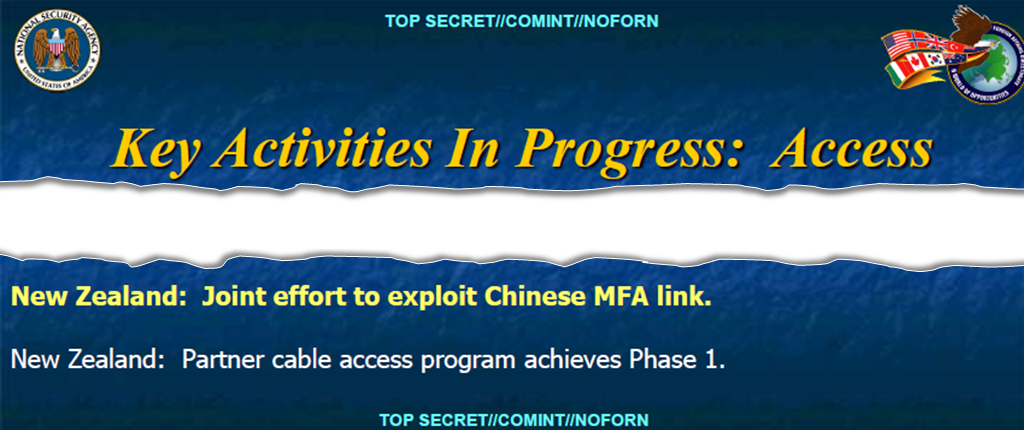
A secret report called “NSA activities in progress 2013,” includes an item titled “New Zealand: Joint effort to exploit Chinese MFA [Ministry of Foreign Affairs] link.” The operation, according to another NSA document, had “identified an MFA data link between the Chinese consulate and Chinese Visa Office in Auckland,” two buildings about a five-minute walk apart on the city’s busy Great South Road.

The document added that the New Zealand agency was “providing additional technical data” on the data link to the NSA’s Tailored Access Operations, a powerful unit that hacks into computer systems and networks to intercept communications. The agencies had “verbally agreed to move forward with a cooperative passive and active effort against this link,” it said.

Passive surveillance refers to a method of eavesdropping on communications that intercepts them as they are flowing over Internet cables, between satellites, or across phone networks. Active surveillance is a more aggressive tactic that involves hacking into computers; in the case of the Auckland operation, active surveillance could have involved planting spyware in the Chinese government computers or routers connected via the consulate data link.

The documents do not reveal whether the operation was successfully completed, due to the timeframe that the records cover. In May 2013, Snowden left his Hawaii-based intelligence job and flew to Hong Kong carrying the cache of secret files. In April 2013, shortly before Snowden’s departure, “formal coordination” on the hacking plan had begun between the NSA and its New Zealand counterpart, according to the documents.

More New Zealand operations targeting China appear to have been ongoing at that time. In another April 2013 NSA document describing the agency’s relationship with New Zealand spies, under the heading “What partner provides to NSA,” the first item on the list is “collection on China.” New Zealand’s GCSB surveillance agency “continues to be especially helpful in its ability to provide NSA ready access to areas and countries that are difficult for the United States to access,” the report said.

China intelligence is handled inside the New Zealand agency by a special section that focuses on economic analysis. According to sources with knowledge of the agency’s operations, its economic section, known as the “IBE,” specialised in Japanese diplomatic communications from 1981 until the late 2000s. In recent years its focus has shifted to intercepted Chinese communications, the sources say.

In response to the revelations, a spokesman for the Chinese Embassy in New Zealand told the Herald on Sunday that the country was “concerned” about the spying. “We attach great importance to the cyber security issue,” the spokesman said, adding that “China proposes to settle disputes through dialogue and formulate codes to regulate cyber space behaviors that are acceptable to all sides.”

China itself is known to be a major perpetrator of espionage on the global stage, and it has been repeatedly accused by the U.S. government of hacking into American computer networks. Last year, China was linked to an apparent intelligence-gathering hack on a powerful New Zealand supercomputer used to conduct weather and climate research.

But the Snowden documents have shown that countries in the so-called “Five Eyes” surveillance alliance – which includes New Zealand, the United States, the United Kingdom, Canada, and Australia – are also heavily involved in conducting aggressive spying and hacking operations across the world.

Previous revelations have detailed how agencies in the alliance have hacked law-abiding companiesforeign government computers, and designed technology to attack and destroy infrastructure using cyberwar techniques. Last year, The Intercept revealed how the NSA had developed the capability to deploy millions of malware “implants” to infect computers and steal data on a large scale.
The NSA, the GCSB and the New Zealand prime minister’s office each declined to answer questions about this story.

GCSB’s acting director, Una Jagose, said in an emailed statement that the agency “exists to protect New Zealand and New Zealanders.” She added: “We have a foreign intelligence mandate. We don’t comment on speculation about matters that may or may not be operational. Everything we do is explicitly authorised and subject to independent oversight.”

Here is the parallel article from the NZ Herald


The government is using ISIS to up the terrorist alert in the country (while 'not exaggerating the threat).  This Radio New Zealand report discusses the likelihood of an attack in New Zealand but skirts round the issue of using the situation to counter internal dissent

How real is the terrorist threat to NZ?


Radio NZ
19 April, 2015

Originally aired on Insight, Sunday 19 April 2015


Brent Edwards, Political Editor - Brent.Edwards@radionz.co.nz

Rebecca Kitteridge is a worried woman.

Since Ms Kitteridge took on the job as director of the Security Intelligence Service 11 months ago, she tells Insight, the threat of a terrorist attack in New Zealand has risen.

Last year she reported the SIS had a watch-list of 30 to 40 people it was monitoring closely.

In typical spy speak she now says the people under watch has increased to the high end of that range, not the low end. Some are considering terrorist action in this country.

But Rebecca Kitteridge does not want to exaggerate the threat.


She says people can still go to the supermarket without worrying about the prospect of being caught up in a terrorist attack.

Ms Kitteridge says it is her job to worry so the public do not have to.

What mainly worries her is the influence of Islamic State, as it uses social media to reach out to disaffected people in the West to not just travel to Syria and Iraq to fight, but to also carry out attacks in their own countries.

"I think it's the first time that we've seen a terrorist organisation actively trying to recruit people to commit attacks internationally and that is the difference from what we see now to what we have seen before.

"So there is an active effort to recruit anybody who might be susceptible to this kind of propaganda to and to give them information on how to commit attacks too."

Islamic State uses a professionally designed and produced magazine Dabiq to get its message across.

Front cover of ISIS propaganda magazine Dabiq

But how serious is the threat and is anyone in the Muslim community taking note of the propaganda?

Young Muslims say they are not aware of Islamic State's social media campaign getting any traction in New Zealand.

Tayyaba Khan is the chief executive of the Change Makers Refugees Forum in Wellington.

"I know for a fact that through my work and through the work that I do with different organisations within the Muslim community, we are not aware of any such social media interaction that can be seen as threatening or concerning," Ms Khan says.

Auckland blogger Latifa Daud agrees.

"No, actually, I haven't seen anything."

Ms Daud says she has not heard anyone talking about Dabiq.

Both she and Ms Khan worry that the focus on Islamic State has made the Muslim community in New Zealand a target.

Ms Ketteridge says she has been very careful to avoid that.

"The fact that there is a very tiny group who might be categorised as Muslim... I think the most important thing to think about with these people is not what is their religion but what are they doing.

"What behaviours are they exhibiting that means that they may be a terrorist risk to this country?" she says.

Ms Khan says while the Muslim communities themselves are peaceful, there might be one or two individuals attracted by Islamic State's propaganda.

"We are extremely concerned about those who might be likely to be affected by this recruitment process and like I said I think we want to get involved because who better to get involved in changing things than the Muslim community themselves."


The SIS has been given greater powers to monitor people, particularly by being able to conduct urgent video surveillance before a warrant is issued.

Those changes were rushed through Parliament late last year, prompting widespread concern from Muslims who felt they were not consulted over powers they believe are directly aimed at them.

Ms Kitteridge says the new powers, plus extra money for the SIS to expand its activities, have helped.

But will those new powers and sending troops to Iraq make New Zealanders safer as they go about their daily business?

One security contractor, who wishes to remain anonymous, believes it is only a matter of time before there is a terrorist incident in this country.

He is appalled by security at public venues, particularly airports.

He says the main threat will come from a so-called lone wolf attack, not from some planned and coordinated terrorist plot.

No one can discount an incident of that nature, including Otago University lecturer Najibullah Lafraie, a former foreign minister for Afghanistan.

"That kind of incident, isolated but nonetheless affecting someone and then ISIS trying to find it and influence so that's possible. Hopefully that's not there but, as I said, we cannot rule it out."

But Professor Ramesh Thakur from the Australian National University says people have to keep the threat in perspective, and made reference to the 2008 terrorist attacks in India when 10 gunmen belonging to the Islamist  terror group, Lashker-e-Taiba, carried out a three-day rampage in Mumbai’s main railway station, five-star hotels and a cafe killing more than 160 people.

"Think of the attention that was given to the terrorist attack on Mumbai. Of course it was a serious incident. But, as I said, in terms of people who are killed on the roads in India and in India it is pedestrians and cyclists who are killed much more than people in the cars, or any other way you look at it, in terms of the real threats to people's safety and security terrorism should rank way down in the sale."

A fire blazes at the Taj Mahal Hotel on 29 November 2008 - one of several sites attacked that month in Mumbai.
A fire blazes at the Taj Mahal Hotel on 29 November 2008 - one of several sites attacked that month in Mumbai. - Photo: AFP

He says Western governments have exaggerated the threat of terrorism to justify giving their spy agencies stronger powers and to win public support for military intervention in the Middle East.

Ms Ketteridge says she has no interest in exaggerating the threat.
She says her job is to worry about the unthinkable so ordinary New Zealanders do not have to worry when they visit the shopping mall.

This program was aired a week ago , featuring Keith Locke of the Green Party who was spied on from the age of 11( for most of his adult life),  and a former SIS spy.

Spying on ourselves - A panel discussion


A couple of weeks back we took a look at the ethics of spying on your friends and neighbours, today we're exploring the ethics of spying on ourselves. Keith Locke is a former Green MP whose SIS file revealed that he had been under surveillance since he was 11 years old and attended a William Morris social evening; Rhys Ball is a former SIS intelligence officer turned Massey University academic; and Kathleen Kuehn is a Victoria University media studies lecturer and author of a forthcoming BWB text on surveillance in New Zealand.


And here is a story about the outing of a police spy