Showing posts with label Paris Agreement. Show all posts

Tuesday, 26 November 2019

China: from climate leader to laggard


Climate change: how China moved from leader to laggard
Beijing’s U-turn on renewables is triggering alarm ahead of UN meeting


FT,
24 November, 2019

The smoggy city of Baoding is known for two things: donkey burgers, and solar panels. An industrial centre just south of Beijing — 45 minutes via high-speed rail — the city’s high-tech zone styles itself as “Power Valley” because it is home to so many solar manufacturers.

But for Vincent Yu, deputy general manager at Yingli Solar, one of the first renewables companies to set up in the city, business has been difficult lately. “These last two years, there has been a lot of pressure. The subsidies for solar projects have fallen,” Mr Yu says. New solar installations in China — running at 53 gigawatts in 2017 when demand peaked — will be about 40 per cent lower this year, he estimates.

The photographs in his office show Yingli in its glory days a decade ago. Sales were surging and the company spent millions sponsoring the 2010 and 2014 football World Cup tournaments. Yingli was the world’s largest solar-panel maker in 2012 and 2013, exporting all over the globe and celebrated in China as a national champion. Its huge factory campus in Baoding still nods to that status, with a spacious museum dedicated to the company’s history as a solar pioneer.

Today Yingli is insolvent. It has been defaulting on debt payments since 2016, and in 2018 it was kicked off the New York Stock Exchange because its market capitalisation had sunk below the minimum $50m threshold. Although Yingli still makes solar panels, its factories operate at a loss and the most valuable asset it has left is the land underneath them. Some question how Yingli is still operating. But analysts believe the political connections of its founder may have helped stave off creditors.

The company is the highest profile casualty of a change in policy that is being felt across the renewable energy sector in a country once celebrated as the world’s clean energy champion. Chinese investment in clean energy is plummeting — down from $76bn during the first half of 2017, to $29bn during the first half of this year.


For the annual UN climate talks, starting next Monday, that is alarming.

Concerns over the impact of climate change have never been higher. But the gap between what countries should be doing, and what they are actually doing — pumping rising levels of carbon dioxide into the air — has never been greater. With the US withdrawing from the Paris climate accord, an increasing amount of attention is on China.

The country is both the greenest in the world, but also the most polluting. It has more wind and solar power than anybody else, yet it is also the world’s biggest builder of new coal plants. Last year, its emissions hit a record high, accounting for more than half of the global increase in energy-related CO2 emissions in 2018, according to the International Energy Agency. This year, Chinese emissions are expected to grow about 3 per cent from 2018.

Everything is at stake for the planet, because the Chinese economy is so much bigger than any other,” says Adair Turner, chair of the Energy Transitions Commission. “Even the whole of Europe is considerably less than Chinese emissions.”

He points to China’s current pledge, that its CO2 emissions will peak by 2030, and says it is nowhere near ambitious enough. “Let’s be clear, if that was all China ever did, then we are on the path to climate disaster,” says Lord Turner, who is lobbying for China to consider a target of net zero emissions by 2050. “That is true of all the [countries that have made pledges under the Paris accord] . . . everyone has always known there would have to be very significant improvements, to get us anywhere close to 2C.”
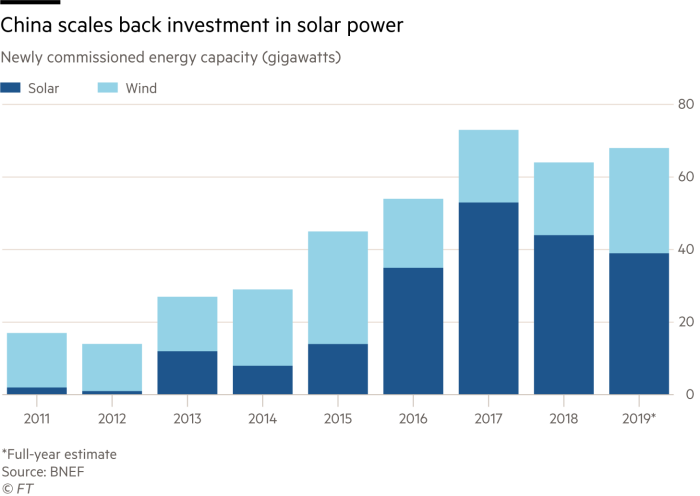
Newly commissioned energy capacity
The Paris climate accord, of which China is a signatory, pledges to limit global warming to well below 2C. But that goal looks increasingly out of reach. The world is on track for 3C of global warming by the end of this century, if current trends continue. That would mean higher sea levels of as much as 1m, threatening more than 600m people in low-lying and coastal areas, according to a recent report from the UN’s Intergovernmental Panel on Climate Change.

The climate pact is under attack from many sides, and the US is withdrawing from the agreement entirely, on President Donald Trump’s orders. Fraying multilateralism has further eviscerated the climate accord, which lacks any enforcement mechanism. China — distracted by a slowing economy, the US trade war and protests in Hong Kong — is not the only reason why the planet is on course for devastating climate change, but it is near the top of the list.


The general momentum on climate and environment issues has been declining [in China],” says Li Shuo, senior global policy adviser at Greenpeace. Climate change has become a lower priority for Beijing. “There is less space for the green agenda,” he says.

China’s investment in renewable energy fell 39 per cent in the first half of this year, compared with the same period in 2018, according to data from Bloomberg New Energy Finance. Beijing yanked subsidies for solar panel projects in the middle of last year, and is shrinking those for wind, causing an abrupt shift.
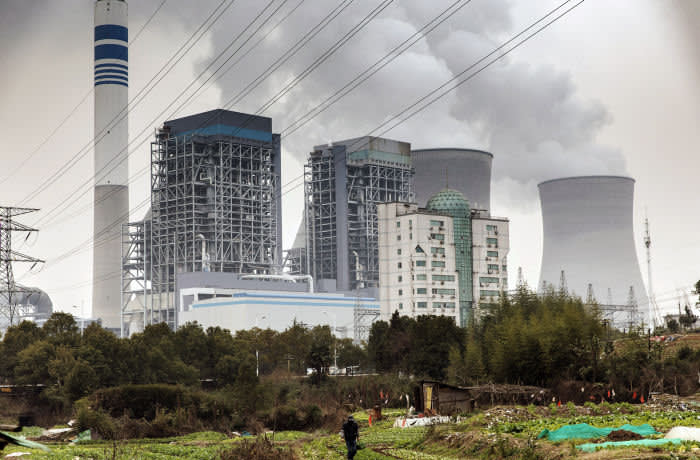
A man walks past vegetables growing in a field as emissions rise from cooling towers at a coal-fired power station in Tongling, Anhui province, China, on Wednesday, Jan. 16, 2019. China's economy expanded at its weakest pace since 2009, according to figures Monday, with gross domestic product rising 6.4 percent in the fourth quarter from a year earlier. Photographer: Qilai Shen/Bloomberg

This is probably a low point,” says Li Junfeng, a senior renewable energy
policymaker and head of the National Centre for Climate Change Strategy Research, part of the government planning ministry. “The new policy is not in place yet, and the old policy [of subsidies] has been stopped.”

Five years ago, when the economy was growing robustly, Beijing saw stronger environmental policies as core to its economic transformation away from energy-intensive heavy industry. Today, with the economy growing at its slowest pace since the early 1990s, that has changed.

The highest political priority in China is trying to stabilise the economy,” says Kevin Tu, an energy economist who previously led the China desk at the IEA. “Anything else, including environmental protection, especially climate change, will have to make some room for these political priorities.”
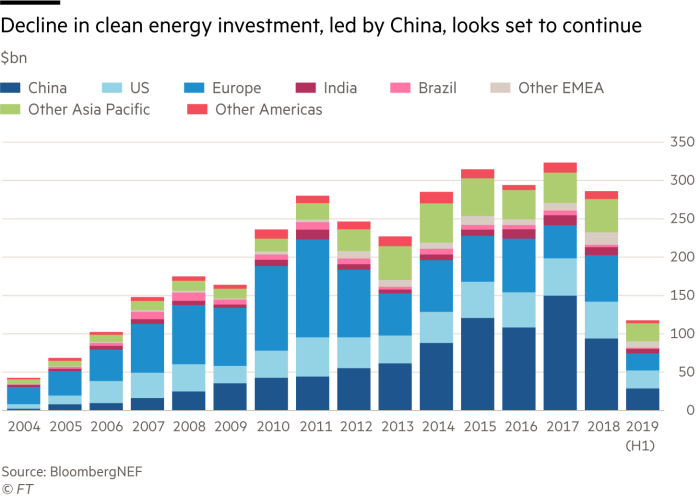
Chart showing that the decline in clean energy investment, led by China, looks set to continue

On paper, China’s climate targets have not changed: Beijing has pledged that its carbon dioxide emissions will peak by 2030, and that it will draw 20 per cent of its primary energy from non-fossil sources by that same date. Yet that promise would allow China to keep increasing its emissions for the next decade, with devastating implications for the planet. Its investments in the Belt and Road Initiative, under which state banks have earmarked more than $30bn to build coal-fired power plants in other countries, is also adding to global emissions.

China’s participation in the Paris climate pact in 2015 was heralded as a great victory by activists. Convincing Beijing to set climate targets was a top priority for the Obama administration. But baked into the negotiations was an expectation that China would achieve its emissions target much earlier than 2030. Next year will be crucial, as countries that signed the Paris accord are supposed to submit enhanced targets — but the mood in Beijing makes a tougher climate goal less likely for China.


China is world's biggest builder of new coal power plants © Getty
Mr Li says deteriorating relations between the US and China — along with the unrest in Hong Kong — have helped fuel a growing nationalist sentiment and a broader anger at the west.

One of the targets of this nationalist ire has been Greta Thunberg, the Swedish teenage activist who is revered as a climate hero in some parts of the world. “Many netizens see [Greta] as representing the general liberal western agenda,” says Mr Li. “There is this larger perspective that the west is ganging up against China.”

At the same time, coal appears to be again in the ascendant with Li Keqiang, China’s premier, last month identifying it as a priority area. China remains the world’s biggest producer. Many see this as part of a growing focus on energy security in Beijing, a result of Chinese leaders being spooked by deteriorating relations with the west. “Energy security anxiety is a blessing for the coal [sector] in China,” says Mr Tu.

Policymakers are also focused on keeping the cost of power cheap to help stimulate the economy, so from January the price of electricity from coal-fired power plants, which is centrally regulated, will be allowed to fluctuate, and is expected to fall.


These factors have compounded the pain for the renewable energy industry. After benefiting from generous subsidies for more than a decade, Beijing axed solar subsidies without warning last year. The payments due have created a deficit of around Rmb200bn ($28bn) in the renewable energy development fund that was paying out the subsidies.

Frank Haugwitz, founder of Asia Europe Clean Energy (Solar) Advisory in Hong Kong, says the subsidies contributed to a solar surge that exceeded the government’s expectations, triggering the sudden cut.

The dice are now loaded in coal’s favour. The new policies for renewable energy are focused on grid parity — only building wind and solar projects that can compete with the price of coal. Yet with coal power prices dropping, and a glut of new coal-fired power stations coming online, it may be challenging for wind and solar to compete. In the wind industry, there has been a rush of projects this year as developers try to capture the last of the subsidies.

Chart showing that the decline in clean energy investment, led by China, looks set to continue
The diplomatic pressure on China to improve its climate targets has been played out in public. During a state visit from Emmanuel Macron, the French president, earlier this month, both sides issued a joint declaration, vowing that the Paris climate deal was “irreversible”, and promising new climate targets aimed at the middle of the century.

Chinese policymakers such as Li Junfeng say the pressure is misplaced, as China is likely to exceed existing climate targets, even if it does not officially adopt new goals. “Now that the US has withdrawn from the Paris agreement, the entire global response to climate change is shifting,” he says. “We have to be realistic . . . There’s no point in being in a rush.”
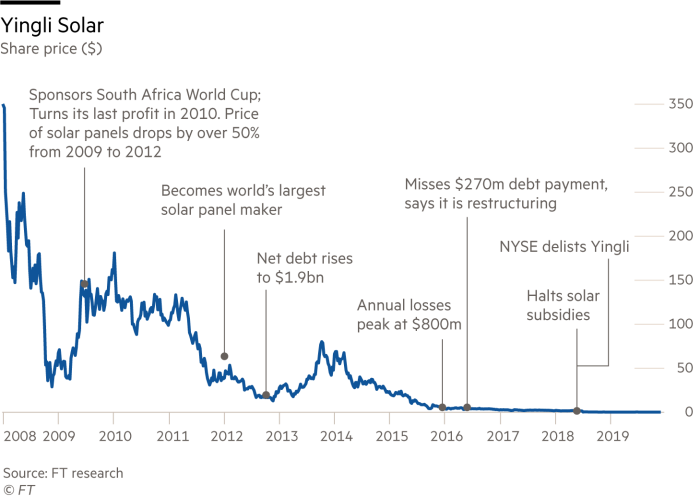
Chart showing Yingli Solar's share price
He also points out that China has achieved, and far surpassed, most of its previous climate targets. A pledge to cut carbon intensity — the amount of carbon produced per unit of GDP — by between 40 and 50 per cent by 2020, compared with 2005 levels, was achieved three years early. It also overachieved on its targets for solar installations, although this runaway growth led to the subsidy deficit.

For many years, action on climate change was the one area that Beijing and western capitals could usually agree on. Even the most hawkish western politician would hold up China’s climate record as an example to be praised.

But that may be changing. “It is going to sour for sure, if China doesn’t move in the right direction, quickly enough,” says Todd Stern, the chief US negotiator for the Paris agreement, who adds there is simply “less leeway” now in terms of global emissions. “We can’t possibly do what we need to do, unless China is doing quite a bit.”

We are sort of entering a new world now . . . It is not just a sense of urgency, it is the math. Do the math, and you will see whether we are doing enough,” says Mr Stern. “The Paris agreement is going to rise and fall, on the level of political will in constituent countries. That has always been true.

The fault is that there is a lack of political will in virtually every country, compared to what there needs to be.”

Solar eclipsed: a pioneering panel-maker retrenches
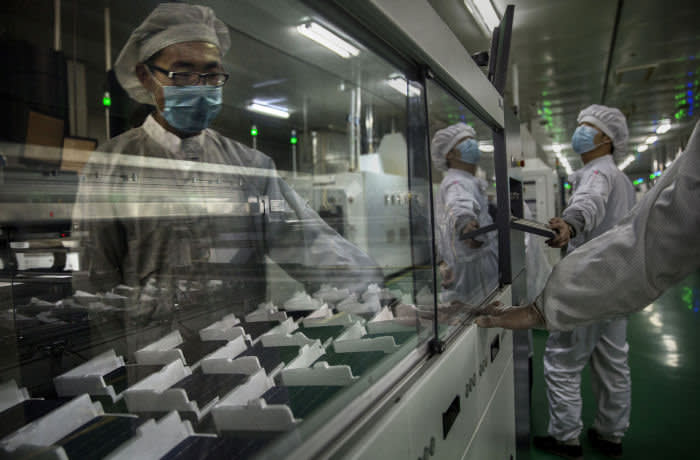
BAODING, CHINA - DECEMBER 4: A technician from Yingli Solar works on equipment that produces solar cells used for solar panels at the company's headquarters on December 4, 2014 in Baoding, Hebei Province. China is the largest energy consumer in the world with the main source of its electricity generated by coal, but in moves to reduce carbon emissions China is also setting records for installing solar panels and generating solar power. (Photo by Kevin Frayer/Getty Images)
The Yingli Solar plant in Baoding © Kevin Frayer/Getty
Stepping on to the Yingli campus in Baoding is like stepping back in time. Employees wear a dark navy jumpsuit with the Yingli sunburst logo on one shoulder and a Chinese flag on the other, giving the place a distinctly communal feel. In front of a large assembly yard, a big stage is decorated in honour of the recent 70th anniversary of the founding of the People’s Republic of China, plastered with slogans such as “remember your mission” and “help each other”.

The company’s problems began at least five years ago, as mounting debt levels combined with plummeting panel prices. Its dire financial situation became evident in May 2016, when Yingli failed to meet a $270m loan payment. Discussions with debtholders, the largest of which is China Development Bank, have since failed to reach conclusion. Shareholders fear the worst: Yingli’s shares on the pink sheets — the over-the-counter market for companies not listed on a major exchange — are trading at just 15 cents a share. The cut in government subsidies for solar projects has only compounded the challenges.

Miao Liansheng, the founder who started his career in the army before becoming an entrepreneur, was once ranked among China’s richest individuals. Mr Miao lives on the Yingli campus, and employees say that he still makes daily appearances to chat with workers.

But today there are fewer workers than there used to be. Many of the factory production lines are quiet. It’s not clear if some are under maintenance, or if they have simply been idled. The company once had around 20,000 employees, but that has fallen to just over 6,000, according to deputy general manager Vincent Yu. This year it will produce panels with capacity of 2.5GW-3.5GW, he says, equivalent to about 3 per cent of global demand.

The Yingli museum shows that the company was, in many ways, a pioneer. It boasted the first automatic soldering equipment in China in 2005 and the first automatic module production line in 2007. But its equipment quickly became outdated, allowing newer entrants to undercut them.

Starting a decade ago, China’s state support for solar panel manufacturers led to overcapacity and vicious price wars. This pushed down the price of solar panels — to the benefit of the rest of the world — but meant that margins were razor-thin, or negative, for panel manufacturers in China.


Wednesday, 2 August 2017

New Zealand: $1.4 billion every year for a decade to offset our emissions

We need to identify and expose the hypocrisy when it comes to the Paris Agreement and the NZ government’s action.

New Zealand's greenhouse emissions have gone through the roof and the rationale of the government is to do as little as possible.

New Zealand to spend $14 billion to meet Paris Agreement targets
Newshub can reveal the cost to the New Zealand economy to meet Paris Agreement targets will be $1.4 billion every year for a decade.


22 May, 2017

But that money won't be spent on reducing New Zealand's domestic emissions - it’ll go towards paying other countries to reduce their emissions.

In documents released under the Official Information Act, a briefing to Judith Collins on her first day as Energy Minister says the cost to the economy of buying international carbon units to offset our own emissions will be $14.2 billion over 10 years.

Carbon trading is the process of buying and selling permits and credits to emit carbon dioxide.

In the documents, officials say "this represents a significant transfer of wealth overseas", and also warn "an over reliance on overseas purchasing at the expense of domestic reductions could also leave New Zealand exposed in the face of increasing global carbon prices beyond 2030".

The cost amounts to $1.4 billion annually.

The Green Party says the bill will only get bigger if no action is taken by the Government to reverse climate pollution, and continues to open new coal mines and irrigation schemes.

Co-leader James Shaw argues it’s cheaper for New Zealand to reduce domestic emissions, and it’s risky to take a gamble on an international carbon price which is subject to increase.

"The Government has always said it's too costly for New Zealand to reduce its own greenhouse gas emissions, but what these documents show is they haven't been completely straight with the public because they haven’t been talking about the cost of paying other countries to do it for us."

The Morgan Foundation calculated that in 2014, New Zealand spent about $3.9 million on carbon credits to offset its domestic emissions.

It’s not yet known where the money will come from to foot the $14.2 billion bill.

Businesses reliant on carbon-intensive transport will be required to buy international credits to account for their emissions, while the government will wear the cost of buying credits for industries exempt from the Emissions Trading Scheme such as agriculture.

New Zealand’s pledge under the Paris Agreement is to reduce emissions by 30 percent below 2005 levels by 2030.

Our domestic emissions are expected to increase overall by 2030


Watch a movie about New Zealand's shameful record over responding to climate change

HOT AIR

Friday, 9 June 2017

The Aim of the Paris Agreement is to financialise Nature

Yesterday, on Nature Bats Last (right at the end of the segement), Cory Morningstar of Wrong Kind of Green and co-presenter for NBL on PRN introduced Prof. Clive Spash who talks about the goal of the Paris Agreement being the monetisation of nature.

In my mind this gives another understanding of Agenda 21 (or its successor) as a way of squeezing economic advantage out of the fictitious process that has little to do with "battling climate change".

If all goes according to plan Prof. Spash will be a guest on NBL.

Go to the 8'30" point in the video below


This Changes Nothing: The Paris Agreement to Ignore Reality
Clive L. Spash


Abstract

At the 21st session of the Conference of the Parties to the United Nations Framework Convention on Climate Change held in Paris, France, 30 November to 11 December 2015, an Agreement was reached by the international community including 195 countries. 

The Agreement has been hailed, by participants and the media, as a major turning point for policy in the struggle to address human-induced climate change. The following is a short critical commentary in which I briefly explain why the Paris Agreement changes nothing. 

I highlight how the Agreement has been reached by removing almost all substantive issues concerning the causes of human-induced climate change and offers no firm plans of action. Instead of substantive cuts in greenhouse gas (GHG) emissions, as soon as possible, the intentions of the parties promise escalation of damages and treat worst-case scenarios as an acceptable 50:50 chance. 

The Paris Agreement signifies commitment to sustained industrial growth, risk management over disaster prevention, and future inventions and technology as saviour. The primary commitment of the international community is to maintain the current social and economic system. 

The result is denial that tackling GHG emissions is incompatible with sustained economic growth. The reality is that Nation States and international corporations are engaged in an unremitting and ongoing expansion of fossil fuel energy exploration, extraction and combustion, and the construction of related infrastructure for production and consumption. 

The targets and promises of the Paris Agreement bear no relationship to biophysical or social and economic reality


The Lies They Tell. The Pitiful State of Environmentalism & its Neoliberalization


The "New Economy" is Not Inclusive

"The route for real change is not via those who are already totally vested in the growth economy and have gained power through it. Rather look for power amongst those who are disenfranchised by the capital accumulating system. Give them voice. Look to organisations that care for them and if they do not exist, create them. Remember that the vast majority are disenfranchised by the current economic system."

Professor Clive L. Spash holds the Chair of Public Policy & Governance at WU in Vienna and is Editor-in-Chief of Environmental Values. 

He has conducted research on climate change economics and policy for over 25 years and his work in the area includes the book Greenhouse economics: Value and ethics as well as numerous articles. 

His critique of carbon trading was the subject of attempted censorship while he was a senior civil servant at the CSIRO in Australia. More information can be found at www.clivespash.org


COMMENTARY: GREENWASH! NOW IN NEW IMPROVED FORMULA [ECONOMIC VALUATION & PAYMENT FOR ENVIRONMENTAL SERVICES]

December 3, 2015
by Clive Spash
+++
October, 2016

This report is an excellent overview of the pitiful state of environmentalism and its neoliberalisation.  The issues raised are important and should be taken seriously.  However, I would like to suggest a few areas in which the argument could benefit from some further reflection.

In opening the paper the introduction emphasises the idea of a “paradigmatic change” (p.2) in terms of what is happening with economic valuation of the environment.  There is no further definition of this concept or its relevance, and I think this suggestion of substantive novelty is in fact misleading.  The ongoing push for incorporating aspects of the social and environmental world into an financial and economic one has been ongoing for at least 200 years.  Some seventy years ago, Karl Polanyi (1944), who is mentioned (p.16), identified the creation of the fictitious commodity as being a necessary part of the industrialisation starting in the early 1800s.  He also recognised the extension of this from labour and land to the environment.  The more recent push of the economics profession, for extensive valuation allied to financial regulatory instruments, goes back to the 1960s.  The role of economic valuation in its modern form had already been successful promoted politically under the Reagan administration, which in 1981 institutionalised the use of cost-benefit analysis for evaluating proposed environmental legislation (Presidential Executive Order 12291).  What is new is only the extent to which economic valuation of the environment, and fictitious commodity creation, have since been pushed, and the readiness of various actors to keep pushing ever further.
costanza_meme_pes_small
For the financiers, bankers and corporate capitalists the drive is the necessity of finding new means of exploitation to capture surplus value, as the old ones become exhausted and/or regulated (hence the need to also roll back regulation as Jutta Kill rightly notes as part of the valuation/market instrument game).  However, what about the environmentalists?  Why do the big environmental non-governmental organisations, such as the Nature Conservancy, back this?  Why do so many ecologists back Natural capital, ecosystems services valuation and biodiversity offsets?  Some notably examples are the likes of Gretchen Daily, systems ecologist Bob Costanza (who many now think is an economist!), and the Nature Conservancy’s chief scientist Peter Kareiva.  What about ecological economist Herman Daly who advocates Natural Capital and tradable permits markets, another financial instrument of exploitation?  (For a critique of emissions trading see Spash, 2010.)  One answer is that all the aforementioned are from the USA and all apparently support the existing corporate model of market capitalism, including prices as efficient means of resource allocation.  Of course they demand some side constraints on the existing systems, but they do not advocate any systemic change or conduct any analysis of the political economy.  Their politics appears to be classic American liberal and, despite the contradictions, their economics maintains core tenets of orthodox belief (e.g. prices allocate resources and do so efficiently).
Yet, there is, in addition to this American camp, another group, of what I term new environmental pragmatists (Spash, 2013), that is more broadly based and geographically widespread.  These are the ones Jutta Kill rightly recognises as advocating instrumental valuation of species, such as bees.  They are often also ecologists, but not necessarily in favour of the American way of life or its inherent political liberalism.  Their concern is to be pragmatic because the desire for material wealth and financial affluence now seems to dominate all systems of political economy, and so they believe the expression of value must be as instrumental to those ends.  Their training in an instrumental natural science may be in part to blame, but their political and economic naivety also plays a key role in their belief that they can win the numbers game in a battle with bankers, financiers and big corporations.  Still, once again, I would emphasise that core aspects of this monetary valuation game, for ‘saving’ the environment, are quite old in content.  In the period from 1880 to 1920 over 1000 studies calculated the monetary value of services provided by birds as a means to show their value and aid their conservation, but the new insecticides made the birds’ services (and the valuation exercises) redundant.  The positive “externalities” of birds had evaporated due to technological innovation.
kareiva_pes_small
In the report, the term “externalities” is used repeatedly and highlighted as a key aspect of the economic approach.  This is a highly problematic concept (as the report notes), but also one that is totally misleading as to the issues involved.  There is nothing about pushing costs on to others that is external to the modern economic system of capital accumulation (whether based in Europe, USA, China, Russia, India, Brazil, Australia or anywhere else).  Indeed this is an essential aspect of how the modern economy operates and maximises the surplus that accrues to the minority.  The powerless, women, poor and the environment are there to be exploited as an internal operation of the political and economic system.  There are no errors or need for systems correction.  This is why Karl W. Kapp (1950) called such activities cost shifting exercises, not externalities.  In our critiques, improving the accuracy and meaningfulness of terminology and conceptualisation would help.  So let’s stop using the neoclassical economists’ term “externalities” for something that is internal to the capital accumulating economic system.
tercek_pes_small
Indeed in other places this accuracy of conceptualisation is exactly what is argued for, e.g. with respect to the need to stop calling Nature “capital” and ecosystems functions “goods and services”.  Jutta Kill correctly identifies the capture of the environmental movement by corporate interests and how this has been matched by the conversion of language and concepts in key areas of the natural sciences informing that movement.  Thus ecology and conservation biology have lost their own scientific terminology (Spash and Aslaksen, 2015).
Along the way I would like to note the importance of the point about the impossibility of ever “internalising externalities”.  As the Laws of Thermodynamics make clear, the materials and energy that we put into our economic systems will come out the other side as waste in equal amounts (but different form).  In short all our production and consumption of energy and materials creates problems for the model of perfect resource pricing so beloved by economic textbooks and neoliberal politics.  If we take the economists at their word, then they must admit that all the prices in the economy are wrong and need to be changed, i.e., price ‘correction’ to account for “externalities” would result in full scale technocratic economic intervention, or what used to be called a planned economy.
The links between offsetting pollution and biodiversity loss through markets, or market like mechanisms, also needs to be linked to the model of development that is now prevalent.  That is a model of resource extractivism come hell or high water.  The backing for the extractivist regime, that maintains the resource supply chains for the consumerist society, is the military.  Fear is a key tool of control now widely deployed in our supposed democracies of the West.  Ours is a world of military intervention and domination in which violent destruction of the ‘other’ is totally legitimised daily in the news, media and entertainment.  Nature is no different, if it gets in the way, just wipe it out and explain to those who benefit the necessity of this for maintaining the political and economic system.  As long as the imperial mode of living (Brand and Wissen, 2013) is enjoyed by enough key people, in the right power structure and sections of the segmented society, nothing needs to change.
After having made these provisos, I would like to note that the report hits many nails squarely on the head.  Not least of these is the fallacious concept of Green Growth and its associated Green Economy.  In the end, selling monetary valuation as saving the planet goes along with the current advocacy of economic growth as the solution to human induced climate change (Spash, 2014).  Both are clearly just, a new improved formulae of that good old favourite corporate product, Greenwash.
rebrand 4

References Cited

Brand, U., Wissen, M., 2013. Crisis and continuity of capitalist society-nature relationships: The imperial mode of living and the limits to environmental governance. Review of International Political Economy 20, 687-711.
Kapp, K.W., 1950. The Social Costs of Private Enterprise. Shocken, New York.
Polanyi, K., 1944. The Great Transformation, 1st edition ed. Rinehart & Company Inc., New York/Toronto.
Spash, C.L., 2010. The brave new world of carbon trading. New Political Economy 15, 169-195.
Spash, C.L., 2013. The shallow or the deep ecological economics movement? Ecological Economics 93, 351-362.
Spash, C.L., 2014. Better Growth, Helping the Paris COP-out?: Fallacies and Omissions of the New Climate Economy Report. Institute for Environment and Regional Development, Vienna.
Spash, C.L., Aslaksen, I., 2015. Re-establishing an ecological discourse in the policy debate over how to value ecosystems and biodiversity. Journal of Environmental Management 159, 245-253.
[Professor Clive L. Spash holds the Chair of Public Policy & Governance at WU in Vienna and is Editor-in-Chief of Environmental Values. He has conducted research on climate change economics and policy for over 25 years and his work in the area includes the book Greenhouse economics: Value and ethics as well as numerous articles. His critique of carbon trading was the subject of attempted censorship while he was a senior civil servant at the CSIRO in Australia. More information can be found at www.clivespash.org.]