Showing posts with label Hurricane Sandy. Show all posts

Thursday, 1 October 2015

Superstorm in the midst of what is supposed to be a quiet hurricane season

Climate Change Superstorm Redux? Joaquin Shows Some Eerie Similarities to Sandy in Forecast.


30 September, 2015

It’s an El Nino year. So that’s supposed to mean a quiet Atlantic Hurricane Season, right? But as the tenth storm of 2015 threatens intensification, very heavy rains, and broadening wind fields as it’s expected to cloak itself in a frontal storm along a track similar to Sandy — it appears a climate-changed riled ocean and atmospheric system have failed to get the message.
Anyone looking at today’s ocean-atmospheric conditions and the Global Forecast System model run predictions probably couldn’t shake off the shivers as a number of chilling similarities to Superstorm Sandy began to show up in the five day outlook. The forecast is very, very uncertain. But it appears we might have a developing Superstorm-like Joaquin on our hands.
There is going to be catastrophic flooding from North Carolina to Massachusetts, and this is going to disrupt the economy regardless of whether or not Hurricane Joaquin makes landfall.”
All Eyes on Joaquin As Climate Change Pattern Dominates North Atlantic
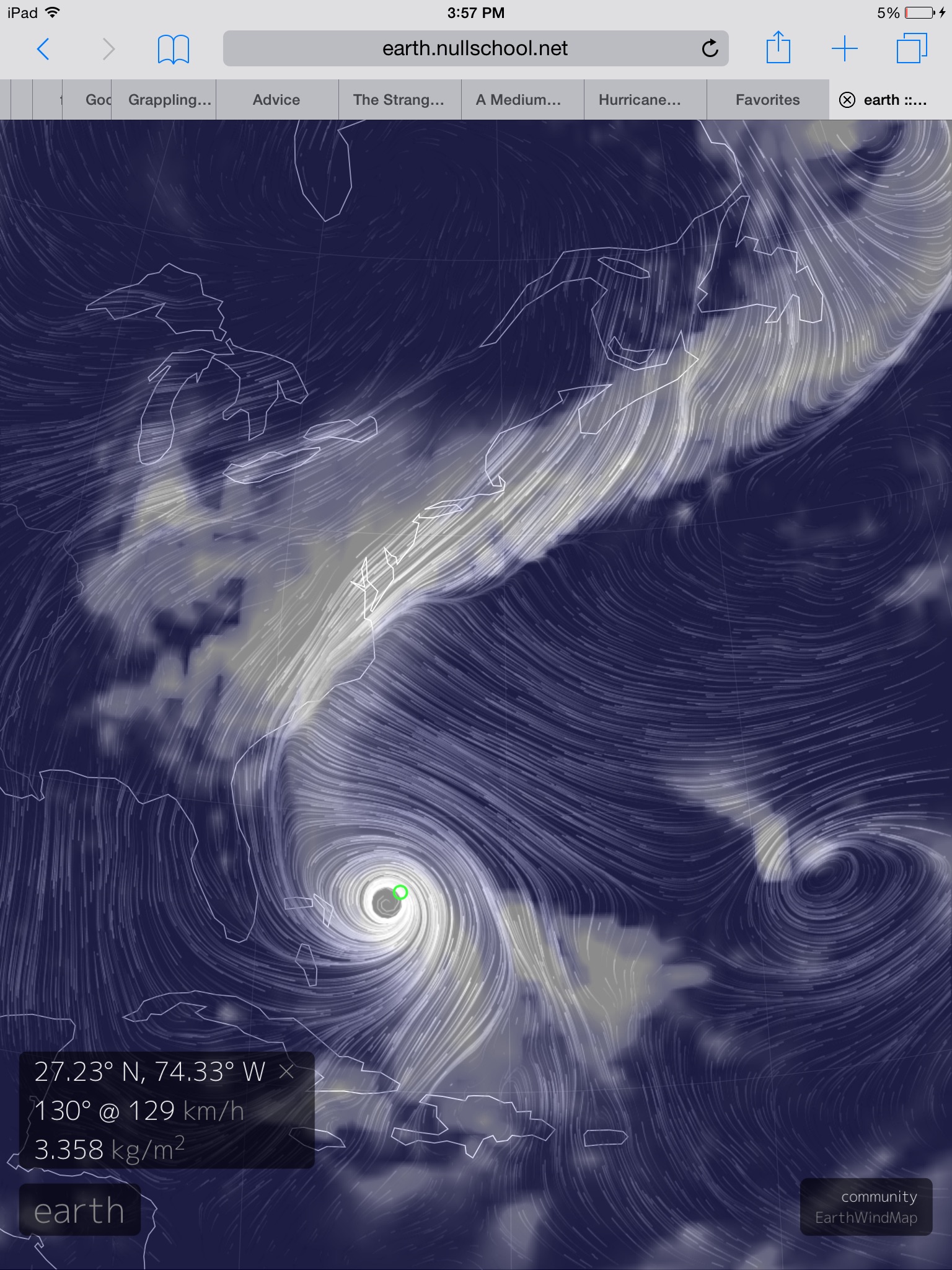
image
(GFS water vapor and wind forecast for October 2 shows a category 2-3 Jaoquine interacting with a powerful trough stretching down across the US East Coast. A trough extending all the way from Norway. Though not a polar trough like the one that interacted with Sandy, and though Joaquin’s characteristics aren’t as likely to go extra-tropical like Sandy, the broadening wind field, the potential left turn and the superstorm combining of trough and hurricane are potentially similar features. Image source: Earth Nullschool.)

A freakish Storms of My Grandchildren‘ type cool pool dominates the northern Atlantic. The backed-up Gulf Stream off the US East Coast is super hot (1-6 degrees Celsius above average). A massive trough is digging in — telegraphing from Norway through Iceland on to Southern Greenland, extending yet southwest over Newfoundland and the Northeastern and Mid Atlantic US. Further south, a developing Hurricane Joaquin over the Bahamas is about to shake hands with this massive trough. Just south of Newfoundland, a blocking high pressure system appears ready to bar Joaquin’s passage to the north and east. Setting up the potential for Joaquin to embed in the trough, to develop a rapidly expanding wind field even as it strengthens, and to possibly make a sickening left turn into the US East Coast.


Jaoquin Forecast — Very Stormy Five Days for US East Coast

Currently, Jaoquine is a strengthening category category 1 hurricane packing 85 mile per hour winds as it drifts toward the southwest near the eastern Bahamas. Over the next two days Jaoquin is expected to strengthen, possibly into a major hurricane, even as it begins to track toward the north and west. This track will result in its interacting with the large trough mentioned above. Even if Jaoquine does not make landfall, its interaction with the trough is expected to dump substantial and torrential amounts of rainfall from North Carolina on through New England even as it drives a broad tropical storm force wind field and related storm surge onto shore.
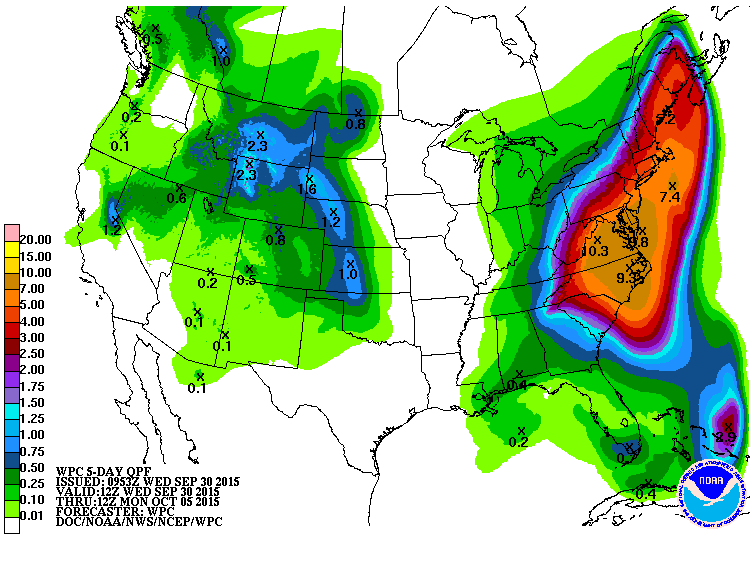
Jaoquine Rainfall
(NOAA five day rainfall forecast shows potential for significant related flooding for the Eastern Seaboard. Image source NOAA CPC.)

According to NOAA forecasts, 5 day rainfall totals are now expected to exceed 7 inches throughout large sections of North Carolina, Virginia, Delaware, New Jersey and Maryland with measures in excess of 5 inches expected from South Carolina all the way to Nantucket.
Joaquin’s wind field is also expected to expand as it interacts with both the trough and large circulation of the blocking high to the north and east. This broad wind field will bring at least strong nor-easter like conditions to the US East Coast. But the broad clockwise circulation off the blocking high also heightens risks that Joaquine will be shoved into the East Coast even as it strengthens.
Current model runs bring a powerful category 1-3 Joaquine, packing a broad wind field with maximum strength from 90-115 mph, on shore near the North Carolina/Virginia border at around 2 PM Eastern Time on Sunday, October 4:

Joaquin track
(The National Hurricane Center shows Joaquin following a course the brings it over the Outer Banks and up the Chesapeake Bay. A worst case track for many sections of the US East Coast. Image source: NHC.)

If such a forecast does play out, it’s bad news. Very very bad news. It would represent a potentially very severe category 1-3 storm embedded in a large wind field and an even larger rain shield. A storm bringing heavy rains for days and lashing the coast with gale force winds up to 24 hours in advance of landfall. Features that would greatly enhance storm surge and flooding impacts — which could be very far reaching. It’s a dangerous potential interaction between Joaquine, a persistently extensive trough stretching across the North Atlantic, and one of the new, heavyweight, blocking patterns that have become so prevalent in this age of human-forced warming. One that could again wrap a hurricane in a, this time very wet, nor’easter.
Like Sandy, it would also serve as a herald for the oncoming new, more intense climate-change driven storms of our present age. Storms that have greater north-south energy exchanges. Storms that may be more more likely to form embedded or hybridized systems and storms that tap both the higher potential pressure and temperature differentials as well as an atmosphere that is more heavily laden with moisture.
Links:
The National Hurricane Center (Please publicly support!)
NOAA Five Day Rainfall Estimates (Frequently Updated)


Saturday, 8 November 2014

Super-typhoon Nuri

The remnants of a Pacific typhoon will pound Alaska with enough force to produce 50-foot waves, then shove across two-thirds of the Lower 48 and drive temperatures to wintry levels net week

Storm Stronger Than Sandy Heads for Alaska, Will Chill Much of U.S.


7 November, 2014


The remnants of a Pacific typhoon will pound Alaska with enough force to produce 50-foot waves, then shove across two-thirds of the Lower 48 and drive temperatures to wintry levels next week.

It’s early in the season, but we are poised for a pure Arctic outbreak,” said Tom Niziol, a winter weather specialist for The Weather Channel.

Forecasters said that the storm, as it approaches the Aleutian Islands this weekend, could be more intense than Superstorm Sandy when it swamped the Northeast two years ago. Weather watchers in Alaska — and Twitter — have labeled the storm the "Bering Bomb."

The Coast Guard and Alaska emergency management authorities were watching the storm. It was expected to mix with cold air and the jet stream, producing hurricane-force wind and extreme waves, when it strikes late Friday or Saturday.

Then comes early winter for tens of millions of people in the rest of the country as the jet stream buckles far to the south. On Monday, the high temperature for Great Falls, Montana, is expected to be 25 degrees, or 20 degrees lower than normal for this time of year. The high on Tuesday in Bismarck, North Dakota, is only expected to be 25, or 16 below normal. And on Wednesday, the mercury will only push to 51 in Dallas and barely above freezing in Cleveland.


By late next week, temperatures will be well below average as far south as the Gulf Coast. The system is also expected to bring snow to parts of the Rockies and Plains net week

View image on external website
It's already begun. Shemya is now measuring sustained winds over 40 mph. http://ow.ly/i/7v5cu 


Monday, 10 June 2013

Hurricane Sandy aftermath

Flood Insurance Costs May Soar For Hardest-Hit Sandy Victims

George Kasimos has almost finished repairing flood damage to his waterfront home, but his Superstorm Sandy nightmare is far from over.


9 June, 2013


Like thousands of others in the hardest-hit coastal stretches of New Jersey and New York, his life is in limbo as he waits to see if tough new coastal rebuilding rules make it just too expensive for him to stay.


That's because the federal government's newly released advisory flood maps have put his Toms River home in the most vulnerable area – the "velocity zone." If that sticks, he'd have to jack his house up 14 feet on stilts at a cost of $150,000 or face up to $30,000 a year in flood insurance premiums.


"Everyone assumes when you say a `home on the water,' people have tons and tons of money, but that's not the case," said Kasimos, whose Toms River home was filled with a foot and a half of water in the storm. "Most of these homeowners are middle class."


Even as those in the most vulnerable coastal areas have struggled to recover from the storm, federal authorities have been issuing them a sobering warning: Raise your homes above the flood plain or face soaring flood insurance costs.


For many, it's an impossible choice. They can't afford to do either. And many unanswered questions have left residents paralyzed with indecision.


Until the new flood maps are finalized in coming months by the Federal Emergency Management Agency, homeowners won't know for sure how high they'll have to raise their homes – if they have to raise them at all.


Officials are urging people to elevate their houses now because they are eligible for federal financial aid. About $350 million of New York City's and $600 million of New Jersey's Sandy relief funding has been allocated for the repair of single- and two-family homes, which could help defray the cost.


But it's still unclear how that money will be distributed among individual homeowners, which means many of them could be on their own financially.


The process of house-raising is laborious and prohibitively expensive, especially for working-class people who are already saddled with storm repair costs. Even a small cottage can cost $60,000 to elevate, while a sprawling multilevel home could run upwards of $250,000.


"You're damned if you do and you're damned if you don't," said Karly Carozza, who is living with her parents while she and her husband decide when to repair their small ranch house in Brick Township, N.J. "It seems like waiting makes the most sense, but when people have nowhere to go, how long do you want them to wait?"


Officials say now is the time to prepare for the future: Sandy will happen again. But many residents don't believe them.


They think Sandy was a fluke, a storm to end all storms, the kind they won't ever see again. And they're preparing to do battle with the government for the right to continue living just as they have for generations – in low-lying abodes that were never built to endure storms, let alone the fierce hurricanes of the 21st century.


___


In Broad Channel in the New York City borough of Queens, where the air smells like fish and ramshackle bungalows are built along the docks, few people are raising their homes. The firefighters, police officers and auto mechanics who live on this marshy island simply can't afford it.


Yet residents here are staring down a possible A or V flood zone designation, putting them squarely on target to incur astronomical insurance premiums. FEMA defines an A zone as an area that has a 26 percent chance of flooding over 30 years. A V zone is the same, but adds the potential hazard of storm waves, increasing insurance premiums.


"The thing that scares me is that we've invested and worked on our houses our whole life," said Frank Porcella, who took out a mortgage to pay for flooding damage to his bungalow. "And now they'll make this place and the area around it a ghost town."


Porcella, who is retired and lives on a fixed income, didn't even consider raising his home. If his flood insurance goes up, he'll simply walk away from his house and his mortgage. He's gambling that the proposed rules will be changed and that another Sandy won't happen again in his lifetime.


Several months before Sandy hit, Congress quietly passed the Biggert-Waters Flood Insurance Reform Act, a bill that authorized skyrocketing premium increases for people in flood-prone communities.


It was a desperate attempt to keep the program financially solvent after it was nearly bankrupted by an onslaught of claims from Hurricane Katrina, which forced the federal government to borrow about $17 billion from the Treasury.


"When Biggert-Waters was passed in 2012, the big issue was this debt," said Larry Larson, a senior policy adviser for the Association of State Floodplain Managers. "And the reality that the program could probably never pay it back."


At the same time, FEMA was already preparing to update flood plain maps that hadn't been revised in more than three decades. The new maps account for sea level rise and other changes to the coastline, putting almost every town in a more stringent flood zone.


If a home lies 4 feet below the flood plain, for example, a homeowner could pay $9,000 a year in flood insurance once the new rates take effect, Larson said. And the cost could be much higher, depending on the designation and where the home sits.


That's why Kasimos founded "Stop FEMA Now!," a grassroots group that's fighting for changes to both Biggert-Waters and the new flood maps.


The group has nearly 4,000 Facebook members and counting. And it's gaining traction from concerned shore-dwellers across the nation, especially those on the Gulf Coast.


Stacey Mattison of Belle Chasse, La., started a Louisiana chapter after learning her annual flood insurance premium will skyrocket from $300 to nearly $10,000.


"Who's going to buy my house knowing they're going to have to fork over an extra 10 grand a year?" she asked.


Sen. Mary Landrieu, a Louisiana Democrat who voted for Biggert-Waters, introduced legislation last month that would delay the premium increases and allow homes that had subsidized rates to keep them, even if they are sold.


___


Can you live on the wild side and ignore the maps?


If you don't have a federally backed mortgage, sure. But if you don't, your home won't be worth much if you try to sell it down the road.


"If it was my house and that was my biggest investment in my life, I'd build it like a tank," said Rod Scott, a consultant for the structural elevation industry in New Orleans, who has been educating thousands of homeowners across New Jersey on house-raising. "I wouldn't squibble and squabble about this or that. I'd put the money in and I'd invest and I'd make it stronger so it can survive."


But many homes with brick or cement foundations simply cannot be raised. To meet the new flood zone requirements, residents could instead fill their basements or first floors and move all electrical equipment to higher floors. Or they could knock them down and rebuild altogether.


To make matters more complex: To elevate in a V zone, people must build breakway walls that allow water to pass through or put their homes on stilts.


Unlike most of her neighbors, Lynn O'Hanlon is set on raising her Broad Channel home where she lives with her husband and two small children. The entire first floor of the two-story house was destroyed, and the place was so badly damaged that engineers say it would collapse if they tried to raise it.


So they're planning to use insurance money to knock the whole thing down and rebuild, possibly as high as 14 feet, depending on the final instructions from FEMA. O'Hanlon hopes the new height will protect her children from future storms.


"We'll be pretty high in the air," she said. "We'll be climbing a lot of stairs."


But she's worried about the future of their cozy community where people have lived for generations in close proximity to the sea.


What will it look like 20 years from now?


"I hope that the money comes through and the houses go up, and we're all one community 14 feet in the air," she said. "Hopefully."


Sunday, 19 May 2013

Post-Sandy: Signs of the future


Rebuilding the New Jersey coastline, but at what cost? – ‘Do you really want to throw good money after bad?’


18 May, 2013

When a handful of retired homeowners from Osborn Island in New Jersey gathered last month to discuss post-Hurricane Sandy rebuilding and environmental protection, L. Stanton Hales Jr., a conservationist, could not have been clearer about the risks they faced.

I said, look people, you built on a marsh island, it’s oxidizing under your feet — it’s shrinking — and that exacerbates the sea level rise,” said Dr. Hales, director of the Barnegat Bay Partnership, an estuary program financed by the Environmental Protection Agency. “Do you really want to throw good money after bad?”

Their answer? Yes.

Nearly seven months after Hurricane Sandy decimated the northeastern coastline, destroying houses and infrastructure and dumping 11 billion gallons of untreated and partially treated sewage into rivers, bays, canals and even some streets, coastal communities have been racing against the clock to prepare for Memorial Day.

Damage to the coastline was severe. In New Jersey, 94 percent of beaches and dunes were damaged, with 14 percent suffering a major loss of dune vegetation and beach erosion of 100 feet or more; 43 percent were moderately affected, losing 50 to 100 feet of beach, according to an assessment by the American Littoral Society.

Thomas Herrington, a professor of ocean engineering at Stevens Institute of Technology in Hoboken, estimated that on one stretch of coastline, 500,000 cubic yards of sand were lost in the storm. “That’s unprecedented,” he said. “You usually lose that in a decade.”

The beach from Bay Head that extends north to Sandy Hook dropped six to eight feet vertically and eroded landward 100 to 150 feet horizontally, he said. In New York Harbor, Raritan Bay and Jamaica Bay, a quarter of the beaches and dunes lost 50 to 100 feet of beach to erosion; on Long Island Sound, about 28 percent faced similar damage. The Army Corps of Engineers will replace 27 million cubic yards of sand along the entire coast to restore and build “engineered beaches” in an effort to protect the homes and communities behind them, said Chris Gardner, a public affairs specialist for the corps’ New York district.

Many officials involved in storm recovery maintain that rebuilding after Hurricane Sandy will be different, incorporating the realities of climate change and rising sea levels. Some ocean engineers and coastal scientists are not so sure.

My fear is that the environmental damage from Hurricane Sandy is going to be long-term and will result more from our response than from the storm itself,” said Robert S. Young, head of the Program for the Study of Developed Shorelines at Western Carolina University.

There have been steps taken” to rebuild better, said Tim Dillingham, executive director of the American Littoral Society. Houses have been elevated, and in New Jersey there are discussions about bigger and better dune systems, he said. But he cautioned, “When you really look at the macro — large scale — we are still going in and building in places that are risky.”

Massive beach nourishment projects will restore beaches but require expensive upkeep and affect ecosystems. Individuals and communities are racing to rebuild sea walls that hasten erosion. And federal taxpayers will foot the bill to rebuild communities that continue to be at risk.

One developer recently went so far as to advertise 24 waterfront acres for sale. The ad acknowledges that the property “has historically been wetlands” — on which development is barred — but noted that the storm had filled it in with sand.

The Army Corps said it would be mindful of advances in thinking about climate change. “We are more integrated with the science agencies than ever before on issues related to climate variability, and the science informs the actionable engineering decisions we make,” said Moira Kelley, a spokeswoman for the assistant corps secretary for civil works.

And agencies are striving to better prepare for storms. In April, the Sandy Rebuilding Task Force — which is focused on regional resiliency — required that those using storm recovery funds to rebuild had to take additional measures to reduce flooding risks. In New Jersey, tougher building codes and the Federal Emergency Management Agency’s new flood maps mean homes are being elevated and floodproofed. New York has committed to using natural infrastructure where possible. And New Jersey and New York are offering voluntary buyouts to homeowners in flood-prone areas: New Jersey will use $300 million of federal money to buy as many as 1,000 homes, while New York has committed an initial $197 million to buying what it hopes will be over 2,000 homes.

In New Jersey, the goal is to target contiguous properties to restore floodplains. State officials said the effort was unprecedented — even if it applied to only a fraction of homes. “We’d have to buy out 200,000 if you wanted to move everyone from potential harm,” said Larry Ragonese, press director of the New Jersey Department of Environmental Protection.

But in Washington, the impulse to dial back legislation that discourages development is percolating. There were efforts in Congress to delay the introduction of higher rates for federal flood insurance (they failed last week).

At the same time, environmental groups have taken issue with Senator Barbara Boxer, Democrat of California, over certain provisions in the Water Resources Development Act, a $12 billion water infrastructure bill that passed the Senate last week, which they feel would weaken the environmental review process. In a statement, Ms. Boxer said the bill did not undermine current laws. “By setting deadlines while preserving the protections in environmental laws, we ensure a sound and timely decision is made,” she said.

Follow us on Twitter and like us on Facebook for news and conversation.
Not all of the environmental impact from Hurricane Sandy has been negative.

Beaches that were flattened in places like Breezy Point, in the Rockaways, and Fire Island may provide unique nesting opportunities for the endangered piping plover. The fluff ball of a bird breeds between April and September.

Sand dumped into some bays could aid eelgrass and clam populations — if boating advocates do not get it dredged.

And at least one effort to restore wildlife habitats had the dual benefit of restoring the beach. In Delaware Bay, the Littoral Society worked with other conservation groups for months to restore and prepare 1.25 miles of shoreline in time for horseshoe crab spawning season. The storm destroyed nearly 70 percent of the New Jersey horseshoe crab habitat.

The crabs are part of a complex food chain. Their eggs provide fuel to thousands of red knot shorebirds — an endangered species in New Jersey — as they migrate from Tierra del Fuego to the Arctic Circle. Through public and private grants, $1.4 million was spent to remove debris and lay down 32,000 cubic yards of sand. Last week, the crabs were spawning and the birds were feasting, Mr. Dillingham said.

Any silver lining for grasses, crabs and shorebirds faces a fundamental threat: the human urge to restore the beaches.

When Dr. Hales told the residents of Osborn Island that they should reconsider rebuilding, they countered that they wanted their children and grandchildren to enjoy the place that was so special to them.

It’s really hard,” he said. But the reality, he added, is “there’s no future there.”

Tuesday, 7 May 2013

Hurricane Sandy aftermath


Superstorm Sandy aid center on Staten Island fights order to leave
A makeshift aid center set up on Staten Island after Superstorm Sandy is told to leave a park, but victims say they still need it.


6 May, 2013

NEW YORK — It has been six months since Donna Graziano packed a barbecue into her car, drove 15 miles from her Brooklyn home to Staten Island, and began cooking for residents of a neighborhood ravaged by Superstorm Sandy. Her one-woman effort in a seaside park expanded into an aid hub that has drawn donations of food, generators, clothes, diapers and household goods, and has become the go-to center for locals seeking advice on everything from emergency aid to mold removal.

Now, the city's parks department says it is time for Graziano's Cedar Grove Community Hub to dismantle its five tents so that the park and nearby beach can welcome summer visitors and begin a major dune reinforcement project. It has given her until Wednesday to find another place to run her freelance aid agency.

Locals who still rely on the hub say they won't leave without a fight, a quandary that highlights the lagging recovery of areas hit hardest by Sandy and the competing interests at play as officials move toward normalcy even as some storm victims struggle with needs unmet.

"The focus should be on fixing up our community, not cleaning up a beach," said Tracy Freeo, a regular visitor to Cedar Grove, which is about a quarter-mile from the ocean in the New Dorp neighborhood of Staten Island.

"They gave up their lives to help us get ours back," she said of the volunteers who have joined Graziano since Sandy hit last October and who staff the Cedar Grove hub 24/7. "Whether it was a roll of toilet paper or just a conversation, they gave comfort."

As Freeo spoke, Graziano did what she usually does from morning until night, when she drives back home to Brooklyn and to her 4-year-old daughter. She sat at a table inside the main tent fielding storm victims' calls and urging them to attend a rally protesting the city's plan to close her down.

When two women entered the tent in search of diapers, she directed them to a volunteer, who led them to another tent stacked with household goods. Behind her, a young man dished up hot meals to passers-by, many from nearby houses still without kitchens.

On the street outside, homes condemned by city inspectors sat with boarded up windows and splintered porches, the grim repetition interrupted by others in various states of repair.

Graziano, a tiny, gravel-voiced woman of 41 with flaming red hair, acknowledges that some might call her an enabler, running a comfort station for people who would rather enjoy free food and conversation than face post-Sandy life in a neighborhood that isn't what it used to be. Graziano says she would happily go back to her old life in Brooklyn, working as a wedding planner and caring for her daughter, if she thought the neighborhood she adopted could take care of itself.

"But six months later, we're still feeding people," she said, slapping her hand down on one of the hot plates of the buffet in the main tent.

"At six months, this should be gone," Graziano said. "But what do you tell someone who has no insurance, has to pay rent while their house is fixed, and is still having to pay a mortgage: 'Hey, I can't help you anymore'?"

Graziano estimates that each day she serves 30 to 100 people in various ways. Some, like Anthony Gambino, need a place to wait for mail delivery. A hulking man with tattoos covering both arms, Gambino is renting a temporary apartment several miles away, but mail still comes to his original home, which is not yet habitable.

"This is a sanctuary for a lot of people," said Gambino, who lost his car and his household belongings to Sandy.

Others, like Colleen DiPersia, use the hub to monitor the rebuilding of their nearby homes and to consult with Graziano and other locals on the necessities: where to find rebuilding supplies, how to tackle mold issues, how to wrestle with insurance companies slow to release checks.

"We're not freeloaders," said DiPersia, whose home was a total loss. She receives $1,400 a month in federal emergency aid to pay for a temporary two-bedroom apartment that she shares with her husband and two children.

The Federal Emergency Management Agency says it realizes that not everyone has recovered from Sandy, which was a hurricane until shortly before it made landfall Oct. 29 and killed 43 people in New York City — 23 of them on Staten Island. More than 250 individuals or families are still living in hotel rooms, and thousands live in temporary apartments or with family and friends.

But debris removal is nearly 95% complete, according to FEMA, and the city says Graziano's tents, loaded with donated clothing, food and household supplies, are sitting on parkland that last summer drew 30,000 visitors.

The parks department also plans to bring in 41,000 cubic yards of sand to protect the coastline at New Dorp and Cedar Grove, spokeswoman Tara Kiernan said.

"We appreciate the group's service to the community following Hurricane Sandy and know they will continue to provide to those in need at their next location," she said.

Where that might be is anyone's guess. Graziano says she's looking for a new space. Her supporters, meanwhile, speculate that the real reason the city wants to close the hub is because some homeowners don't like having activists from the Occupy movement, who are most of Graziano's volunteers, in their midst. The city says politics has nothing to do with its plans.

One of those volunteers, Allan Eaton of Ontario, Calif., said even if that were the case, more important considerations should prevail.

"I look across the street and see a house that hasn't been repaired at all. I see a house that's been leveled," Eaton said. "Are they going to put the issue of some volunteers being Occupy-ers over the needs of residents?"

Tuesday, 30 April 2013

Recovering from hurricane Sandy


6 Months After Sandy: Many Recovered, Thousands Still Homeless


29 April, 2013


Six months after Sandy ravaged the tri-state area, uprooting thousands of trees, decimating homes and submerging cities, many residents say life has mostly returned to normal, though for some, recovery from the deadly storm remains a painstaking process, and "life as normal" a far-away dream that may never be realized.

Separation is the new reality for the Gatti family, a clan of several generations that shared the same three-story home near the ocean on Staten Island until Sandy destroyed it.

The flood-soaked place was demolished months ago, and they're waiting for a government buyout. Now the family is scattered across New Jersey, New York and Texas.

"The whole family's separated," said Marge Gatti, the matriarch. "And it's terrible, you know?"

Tens of thousands of people remain homeless. Housing, business, tourism and coastal protection all remain major issues with the summer vacation — and hurricane — seasons almost here again.

"Some families and some lives have come back together quickly and well, and some people are up and running almost as if nothing ever happened, and for them it's been fine," Gov. Andrew Cuomo said ahead of the six-month mark. "Some people are still very much in the midst of recovery. You still have people in hotel rooms, you still have people doubled up, you still have people fighting with insurance companies, and for them it's been terrible and horrendous."

Lynda Fricchione's flood-damaged home in the Ortley Beach section of Toms River, N.J., is gutted; the roof was fixed just last week. The family is still largely living out of cardboard boxes in an apartment. But waiting for a final decision from federal and state authorities over new flood maps that govern the price of flood insurance is tormenting her and many others.

"The largest problem is, nobody really knows how high we're going to have to elevate the house," she said. "At town hall they told us 5 feet, but then they said it might go down to 3 feet in the summer. Most of us are waiting until the final maps come out. It's wait-and-see."


By many measures, the recovery from Sandy, which struck Oct. 29, has been slow. From Maryland to New Hampshire, the National Hurricane Center attributes 72 deaths directly to Sandy and 87 others indirectly from causes such as hypothermia due to power outages, carbon monoxide poisoning and accidents during cleanup efforts, for a total of 159.

The roller coaster that plunged off a pier in Seaside Heights, N.J., is still in the ocean, although demolition plans are finally moving forward. Scores of homes that were destroyed in nearby Mantoloking still look as they did the day after the storm — piles of rubble and kindling, with the occasional bathroom fixture or personal possession visible among the detritus.

And more than a few residents whose homes were overtaken by mold or completely destroyed in the storm still cry as they drive down the barren streets that once held their valued memories as well as their most fervent hopes for the future.

Throughout the region, many businesses are still shuttered, and an already-tight rental market has become even more so because of the destruction of thousands of units and the crush of displaced storm victims looking to rent the ones that survived.

FEMA has paid out $387.4 million in housing grants and $263 million to communities and nonprofit groups in New Jersey since the storm hit. In New York, Cuomo's administration worked with banks to release more than $200 million in insurance payments.

But insurance companies have not paid out all that many homeowners expected. Municipalities are borrowing tens of millions of dollars to keep the lights on, the fire trucks running and the police stations staffed, waiting for reimbursement from the federal government for storm expenditures they had to fund out of pocket.

And yet, by other measures, remarkable progress has been made. Boardwalks, the tourism lifeblood of the region, are springing back to life. A handful of homes are going up, and the whine of power saws and the thwack of hammers is everywhere in hard-hit beach towns as contractors fix what can be saved and bulldozers knock down what can't.

Volunteers in Highlands, N.J., are rebuilding the home of Bromlyn Link, the single mother of a 17-year-old boy. Link and her son are both members of the town's first aid squad and who spent 12 to 14 hours a day helping friends and neighbors forced to live in shelters for weeks after the storm.

Mantoloking, which was cut in half by the storm and saw all 521 of its homes damaged or destroyed, is creeping back to life. The post office recently reopened, and the first of 50 demolitions will start next week, which is also when Mayor George Nebel will join the 40 other residents who have been able to move back home.

Beaches that were washed away are coming back, due both to nature and bulldozers, and real estate agents say demand for this strangest of upcoming summers appears good, particularly in the large portions of the Jersey shore that were relatively unscathed by Sandy. Beach badges, required for access to most of New Jersey's shoreline, are selling at a near-record pace in Belmar, N.J.


And while towns fortify beaches and dunes and put up sea walls, rock barriers or even sand-filled fabric tubes to guard against future storms, state governments are readying hundreds of millions of dollars to buy out homeowners in flood-prone areas who want to leave.

"We've made a lot of progress in six months; I know we still have a long way to go," Gov. Chris Christie said at a recent town hall meeting. "By Memorial Day, every boardwalk that was destroyed at the Jersey shore will be rebuilt. Businesses are reopening. Rentals are picking up again, roads are back open."

Christie estimated 39,000 New Jersey families remain displaced, down from 161,000 the day after the storm. In New York, more than 250 families are still living in hotel rooms across New York paid for by the Federal Emergency Management Agency, while others are still shacking up with relatives or living in temporary rentals.

Sandy also damaged interior areas, particularly those along rivers in northern New Jersey. Cities including Hoboken and Jersey City were inundated, and officials continue try seek exemptions for skyscrapers and large apartments from federal rules requiring flood-prone buildings to be elevated. George Stauble, whose Little Ferry house took in four feet of water, said FEMA payouts caused some rifts between neighbors.

"Everybody's house had pretty much the same amount of damage, but people are getting different amounts of money, and that's caused some problems," he said, adding some homeowners received as little as $8,000, while others received as much as $29,000.