
 Posts


I am working under the most difficult situation with the internet so will brng only the important headlines for now
Not Just Florida: Georgia And South Carolina Face "Catastrophic Storm Surge"
7
September, 2017
As
Hurricane Irma looks to be hurdling straight for a direct hit on
Southern Florida, meteorologists from Weather Underground are warning
that the most devastating impacts of the storm could be felt much
further north in towns along the coast of Georgia and South Carolina
where the storm surge could be a catastrophic 20-28 feet high in
certain areas. To put that in perspective, Hurricane Katrina in 2005
set a record for the largest storm surge ever recorded along the U.S.
coast at 27.8 feet.
If
Irma makes a trek up the East Coast from Miami to southern South
Carolina as a Category 3 or 4 hurricane, as the models currently
suggest, the portions of the coast that the eyewall touches will
potentially see a massive and catastrophic storm surge, breaking
all-time storm surge records and causing many billions of dollars in
damage. Even areas up to a hundred miles to the north of where the
center makes landfall could potentially see record storm surges. The
area of most concern is the northern coast of Florida, the coast of
Georgia, and the southern coast of South Carolina, due to the concave
shape of the coast, which will act to funnel and concentrate the
storm surge to ridiculous heights. If we look at wunderground’s
storm surge maps for the U.S. East Coast, we see that in a worst-case
Category 3 hurricane hitting at high tide, the storm tide (the
combined effect of the storm surge and the tide) ranges from 17 –
20’ above ground along the northern coast of Florida, and 18 – 23
feet above ground along the Georgia coast. If Irma is a Cat 4, these
numbers increase to 22 – 28 feet for the coast of Georgia. This is
a Katrina-level storm surge, the kind that causes incredible
destruction and mass casualties among those foolish enough to refuse
to evacuate.
So,
which coastal towns are most at risk? As Weather Underground notes,
Savannah in Southern Georgia could see a surge of up to 23 feet if
Irma strikes as a Category 3 storm. Obviously, the surge would be
even larger if Irma manages to maintain Cat-4 winds.
Maximum
of the "Maximum Envelope of Waters" (MOM) storm tide image
for a composite maximum surge for a large suite of possible
mid-strength Category 3 hurricanes (sustained winds of 120 mph)
hitting at high tide (a tide level of 3.5’) along the coast of
Georgia. What’s plotted here is the storm tide--the height above
ground of the storm surge, plus an additional rise in case the storm
hits at high tide. Empty brownish grid cells with no coloration show
where no inundation is computed to occur. Inundation of 19 – 23’
will occur in a worst-case scenario along most of the coast.

Meanwhile,
further north in Charleston, SC the surge could also exceed 20 feet
and flood areas many miles inland from the shore.
Maximum
of the "Maximum Envelope of Waters" (MOM) water depth image
for a composite maximum surge for a large suite of possible
mid-strength Category 3 hurricanes (sustained winds of 120 mph)
hitting at high tide (a tide level of 2.5’) along the coast of
South Carolina near Charleston. If Irma is a Cat 3 in South Carolina,
a worst-case 17 – 21’ storm tide can occur.

Of
course, as we noted earlier, this data has already prompted the
governors of Georgia and South Carolina to declare a state of
emergency and to call for citizens of coastal areas to begin
evacuations immediately.
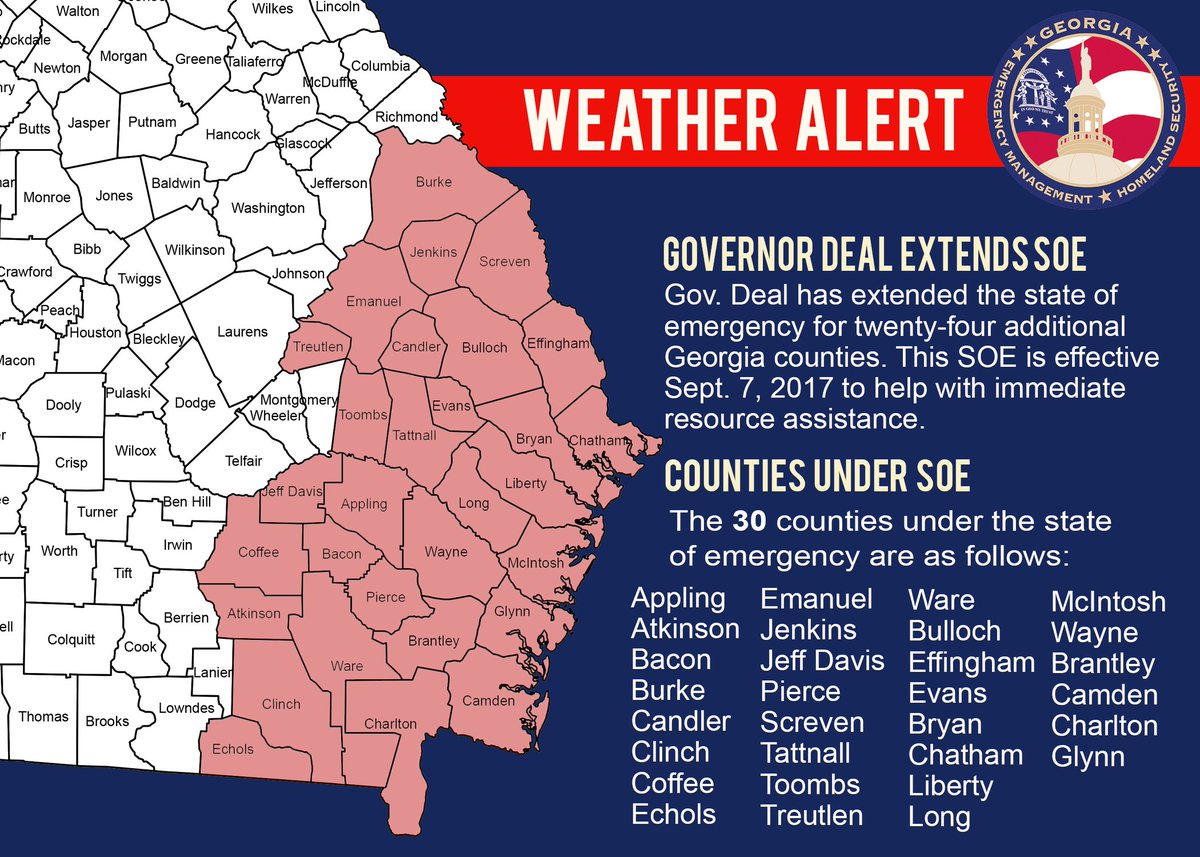
I’ve expanded the state of emergency to 24 additional counties & ordered mandatory evac for some. Read more —> http://bit.ly/2eJfVAo
Ironically,
even though Irma will be her strongest when washing ashore in
Southern Florida, Weather Underground notes that deep water just
offshore helps to subdue the storm surge from Miami to Fort
Lauderdale...
South
Florida is not at as great of a risk of a high storm surge, since
there is deep water offshore, and the mound of water the hurricane
piles up can flow downward into the deep ocean instead of getting
piled up on land. The worst-case storm tide from a Category 4
hurricane for the coast from Miami Beach to West Palm Beach is 7 –
9 feet. However, that deep water allows much larger waves to build
up, and Irma will create big waves that will pound the coast and
cause heavy damage. There is a region of the coast from downtown
Miami southwards, including Biscayne Bay, where the water is shallow,
and the storm tide can be up to 15 feet in a Category 4 hurricane.
The Great Miami Hurricane of 1926, a Category 4 storm, brought a 10 –
15’ storm surge to the coast of Miami along Biscayne Bay.

...which
also should help to somewhat protect the coast on the western shores
of Florida.
I’ve expanded the state of emergency to 24 additional counties & ordered mandatory evac for some. Read more —> http://bit.ly/2eJfVAo

The Atlantic (Florida Straits) side of the Florida Keys also has deep water offshore, limiting the maximum storm surge in a Cat 4 to 8 – 10 feet. The risk is higher on the west (Florida Bay) side of the Keys, where the water is shallower; a worst-case storm tide of 12 – 15 feet can occur there. Any storm tide over six feet is extremely dangerous in the Florida Keys, due to the low elevation of the land. The greatest risk in the Keys, if the current NHC forecast verifies, would be on the Florida Bay (west) side of the Upper Keys, after the center of Irma moves just to the north. The counter-clockwise flow of air around the hurricane will then bring winds out of the southwest that will drive a large storm surge into the west side of the Upper Keys.

Be
that as it may, with winds in excess of 120 mph expected pretty much
across the entire state of Florida, one might be best suited to
prepare for the worst no matter how close you are to the shore.
record for the largest storm surge ever recorded along the U.S. coast
at 27.8 feet.
European model wind gust swathe covers Florida peninsula in hurricane force wind gusts ... #Irma continues up I-75 thru Georgia.
Miami is
in the 'worst possible
position': Eye of the storm has
shifted as
Irma barrels towards the
US mainland - with mandatory
evacuations
issued for Florida
AND Georgia
European model wind gust swathe covers Florida peninsula in hurricane force wind gusts ... #Irma continues up I-75 thru Georgia.

http://www.dailymail.co.uk/news/article-4863996/Florida-Georgia-brace-arrival-Hurricane-Irma.html
-
Meteorologists are now predicting that Miami will bear the brunt of Hurricane Irma when it hits
-
Parts of the Georgia coast, Miami and the entirety of the Florida Keys are now under mandatory evacuation
-
Evacuations went into effect in the Florida Keys on Wednesday and Miami on Thursday
-
Georgia ordered the evacuation of the state's coastal areas - including the city of Savannah - on Thursday
-
Hurricane Irma, a powerful Category 5 storm, is expected to hit south Florida Sunday morning
-
The category 5 storm has caused devastation in the Caribbean, killing at least 13 so far: Eight on St. Martin, three in Puerto Rico, one in Barbuda and one in Anguilla
-
Extensive
damage has been reported on Barbuda and St Martin, with more than 90
per cent of buildings damaged on both islands
'Hunker down, stay where you are': Irma pummels Turks and Caicos with 175mph winds - as Caribbean islands already torn apart by Hurricane rush against the clock for a second round with Category 3 Jose
-
'Monster' Hurricane Irma made landfall in the Turks and Caicos islands Thursday evening into early Friday
-
The category 5 storm has killed at least 13 so far: Eight on St. Martin, three in Puerto Rico, one in Barbuda and one in Anguilla
-
The islands' governor John Freeman said that, for now, people are pretty much on their own on the islands
-
Extensive damage has been reported on Barbuda and St Martin, with more than 90% of buildings damaged on both islands
-
Some 900,000 people are without power on Puerto Rico and at least 50,000 people are without water
-
The hurricane is expected to continue past eastern Cuba before veering north for Florida at the weekend
-
Red Cross said it is preparing for 'a major humanitarian response' as UN estimated 49million will be affected
-
Mandatory
evacuations were ordered in the Florida Keys and parts of Miami as
the scale of the storm emerged
Live updates from RT

Live updates from RT
Hurricane Irma on track for direct hit on Miami – Live updates
Florida nuclear plants to shut ahead of Hurricane Irma
Electricity
generator Florida Power & Light said on Thursday it will shut its
two nuclear power plants before Irma comes ashore as a very powerful
hurricane.
FPL,
a subsidiary of NextEra Energy Inc, generates enough power for about
1.9 million homes at the Turkey Point and St. Lucie plants, which are
both along Florida’s Atlantic Coast, about 20 feet (6 meters) above
sea level.
“We
will safely shut down these nuclear plants well in advance of
hurricane-force winds, and we’ve finalized plans for that
shutdown,” FPL spokesman Rob Gould told a news conference.
The
company will adjust the plans as necessary, “depending upon the
path of the storm,” Gould said. He would not comment on exactly
when the plants would be taken down or how long they could be shut.
The
Energy Department said late on Thursday that the Nuclear Regulatory
Commission expects Turkey Point to close on Friday evening and St.
Lucie to shut about 12 hours later, depending on the storm’s path.
MassiveEvacuation Underway as Florida Prepares for Deadly Hurricane Irma

With
Texas and Louisiana still trying to come to grips with the
destruction of Hurricane Harvey, Florida has gone into full
preparation mode as Category 5 Hurricane Irma makes its way toward
the Sunshine State.
State
officials have already called for residents to head to shelters and
obey all evacuations orders: more than 100,000 were told to evacuate
from Miami-Dade County starting early Thursday.
FEMA Chief, Miami Beach Mayor Warn: "Get Out Now, This Is A Devastating, Nuclear Hurricane"
7
September, 2017
After
laying waste to the Northern Caribbean and leaving most of bankrupt
Puerto Rico without power - perhaps for months - Hurricane Irma,
still a category five storm, is
expected to make landfall near Miami this weekend. Florida
Gov. Rick Scott has already declared a state of emergency, and last
night more than 100,000 Miami-Dade residents in Miami Beach and
low-lying mainland areas were instructed to leave their homes by
Miami Mayor Carlos Gimenez, who issued his first evacuation order.
Now,
FEMA Chief Brock Long says that the storm will have a "truly
devastating" impact when it slams into southern coastal areas of
the US, adding that people in Florida and other states must heed
evacuation orders after the storm killed more than 10 people in the
Caribbean.

The
FEMA chief said Irma would be only the fourth Category Five hurricane
to hit the United States since 19851, conjuring memories of Hurricane
Andrew, which demolished parts of Florida in 1992.

"Bottom
line is the majority of people along the coast have never experienced
a major hurricane like this. It will be truly devastating," he
told CNN.
While
mandatory evacuation orders have so far only been issued in parts of
Florida, Brock expects similar orders to be issued for Georgia, South
Carolina and North Carolina within the next 48 hours, Long said: "The
entire southeastern United States better wake up and pay attention,"
he added.
The
mayor of Miami Beach Philip Levine also warned that Irma could have
an impact of "nuclear" proportions, though it was unclear
if he was referring to the two nuclear power plants that lie directly
in the path of the hurricane.
“We
have talked to people in your city who say, ‘We ain’t going,’”
CBS4’s Hank Tester told Levine. “I hate to hear that. I’ll do
anything in my power to convince them this is a very serious storm.
This is a nuclear hurricane. They should leave the beach, they must
leave the beach."
"As
you know, as of yesterday, I have been telling our residents I
strongly urge they please leave Miami Beach. You have friends, you
have family – go visit them,” Levine said. “Get out of the
barrier island and I am very happy Mayor Gimenez issue the mandatory
evacuation early this evening.”
The
storm is massive and already doing catastrophic damage to several
island nations, Levine said.
“This
storm will envelope us whether it is off shore or on shore. It won’t
make a difference,” Levine said.

As
weather forecaster Michael Ventrice noted on Twitter, Miami remains
the most likely major city to experience hurricane-force winds
because of Irma.

Here is the latest Calibrated City-level probabilities to see Hurricane force winds (>73mph); Miami leading the way but East Coast %s rising
Long,
whose agency is still busy with the aftermath of Hurricane Harvey,
which hit Texas and Louisiana last month, said around 3,000 federal
workers have been mobilized to deal with the emergency. A Harvey
relief bill has passed the House, and looks to soon become law after
Trump made a deal with Democratic leaders Chuck Schumer and Nancy
Pelosi. Otherwise, the agency risks running out of funding by the end
of the week. Three navy ships are also anchored off the coast of
Puerto Rico "to support life-saving missions,” Long said,
although there have so far been no reports of major damage after Irma
swept over the island on Wednesday night.
Floridians
who are fleeing Miami-Dade, Broward County, Palm Beach and elsewhere
were finding highways and backstreets transformed into parking lots
as the scramble to get out of the path of the storm creates epic
traffic bottlenecks.


Meanwhile,
supplies of water, gas and other necessities were running out as
residents stocked up...


