Showing posts with label G20 meeting. Show all posts

Friday, 30 November 2018

Trump cancels planned meeting with Putin at G-20


From earlier
Poroshenko's Kerch Strait stunt aims at derailing Trump-Putin G20 meeting


The Duran’s Alex Christoforou and Editor-in-Chief Alexander Mercouris take a quick look at Poroshenko's claims of a Russian invasion of Ukraine, and how the recent Kerch Strait tensions will feed nicely into the neocon war agenda, derailing any rapprochement between Trump and Putin during the G20 summit

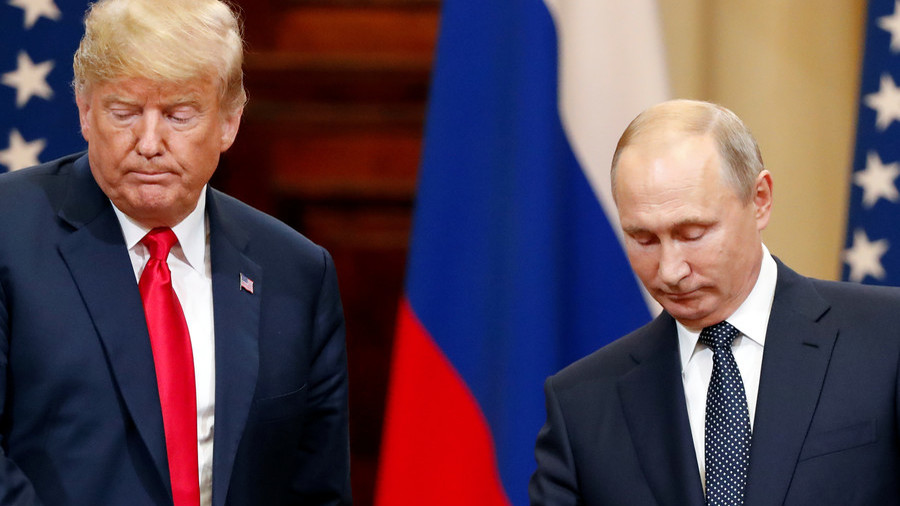
Trump cancels planned meeting with Putin at G20 over Russia-Ukraine flare up
Trump cancels planned meeting with Putin at G20 over Russia-Ukraine flare up

RT,
29 November, 2018


US President Donald Trump has cancelled a scheduled meeting with Russian President Vladimir Putin which was due to take place at the G20 Summit in Buenos Aires on Saturday.

This is how great leaders act!


Trump had previously cast doubt over whether the meeting would take place, telling the Washington Post on Wednesday that “maybe” he would cancel the tete-a-tete, citing the recent confrontation between Russian and Ukrainian military vessels in the Kerch Strait.


Three Ukrainian Navy vessels were apprehended by Russia trying to cross between the Black Sea and the Azov Sea on Sunday. While Kiev said it had informed Russia of the crossing, Moscow said it had not received notification.

Leaving the White House for Argentina on Thursday, Trump told reporters he “probably” would meet with Putin at the summit, but said he would make a decision after receiving a briefing on the plane.

Shortly after, Trump tweeted that “it would be best for all parties concerned” to cancel the meeting with Putin “based on the fact that the ships and sailors have not been returned to Ukraine.”

Trump said he looked forward to a "meaningful summit" when the "situation is resolved."

Responding to Trump's decision, the Kremlin said it had received no confirmation of the cancellation through official channels. A Kremlin spokesperson said if the meeting is off, however, Putin will have a few free hours for other important meetings.

It's not the first time uncertainty has surrounded whether a meeting between the two leaders would take place. In fact, it seems to happen frequently.

Just three days before the pair met in Helsinki in July, Special Counsel Robert Mueller, who is investigating alleged"collusion" between Trump and Russia announced grand jury indictments against 12 Russian military officials for their alleged roles in interfering in US domestic politics. That move prompted White House officials to suggest Mueller was trying to derail the Helsinki meeting.


There were also conflicting reports about a possible meeting between the two leaders in the days before Armistice Day commemorations in Paris last month. In the end, the two reportedly had a brief conversation behind the scenes and shook hands publicly after French organizers changed the seating arrangements at the last minute to avoid having the pair seated next to each other.


Under Pressure: Trump Cancels Upcoming Putin Meeting But Refuses To Blame Russia For Kerch Strait Incident


MOSCOW, Russian Federation – U.S President Donald Trump announced that he was canceling a meeting with Russian leader Vladimir Putin at the G20 summit in Argentina.

He made this decision after reading the report on the incident in the Kerch Strait. According to him, the main reason for the incident was the fact that ships and sailors did not return to Ukraine. Trump was criticized by both Neocon Republicans and Clinton Democrats alike, for failing to ‘condemn’ Russia.

I look forward to a meaningful summit again as soon as the situation is resolved!” – Trump wrote on Twitter .

The Russians, for their part, have also made an official statement. RIA reports that the spokesman for the Russian president, Dmitry Peskov, said that the Kremlin has no official information about canceling the meeting.

At the same time, he noted that if the United States confirms the refusal, then Putin will have a couple extra hours to meet on the sidelines of the summit.

Russian President Vladimir Putin and US President Donald Trump
RevContent InArticle SOLO
The last time world leaders could briefly talk in early November in Paris on the “margins” of events in honor of the centenary of the end of the First World War.

In mid-July, the first full-format meeting between Putin and Trump was held in Helsinki. The conversation between the leaders of Russia and the United States began in a one-on-one format, then negotiations continued with the participation of members of delegations. The heads of state discussed ways of normalizing and developing bilateral relations, and pressing issues on the international agenda.

Provocation in the Kerch Strait

On the morning of November 25, the ships of the Ukrainian Navy, Berdyansk, Nikopol and Yana Kapu, violated the state border of Russia and maneuvered dangerously for several hours without reacting to the legal demands of Russian boats and ships.

Shipping in the Kerch Strait resumed

The vessels were detained, 24 Ukrainian military men were on board, including the SBU officers, who, according to the Center for Public Relations of the FSB, coordinated the provocations.

A criminal case: violation of the state border

Vladimir Putin called the situation in the Kerch Strait pre-prepared provocation, which Petro Poroshenko used as a pretext to impose a state of emergency in Ukraine on the eve of presidential elections.

At the same time, the head of state stressed that Russian border guards were fulfilling their duty to protect the state border.


This is from yesterday 


President Vladimir Putin said the clash between Russian and Ukrainian military ships was a result of foreign nations failing to hold Kiev accountable for bad behavior as long as it remains confrontational towards Russia.


They were the first remarks made by the Russian leader since the confrontation in the Kerch Strait, a narrow passageway between the Black Sea and the Azov Sea, where a strategic bridge connecting Crimea to mainland Russia is located.


The authorities in Kiev are selling anti-Russian sentiment with quite a success today. They have nothing else to do,” Putin said during a business forum in Moscow.

The Russian president said it seemed like Kiev could get away with anything as far as foreign nations supporting Ukraine’s anti-Russian stance were concerned.

If they demand babies for breakfast, they would probably be served babies. They’d say: ‘Why not, they are hungry, what is to be done about it?’ This is such a shortsighted policy and it cannot have a good outcome. It makes the Ukrainian leadership complacent, gives them no incentive to do normal political work in their country or pursue a normal economic policy.

Putin said the incident, which ended in Russia’s seizure of three Ukrainian ships and Kiev imposing a partial martial law in the country, was a “dirty game” by Poroshenko, who needs to suppress his political opponents ahead of the March presidential election. He affirmed that the Ukrainian side was responsible for the escalation of tensions, since the incident was a deliberate and planned provocation by the Ukrainian Navy.

The Russian leader also defended the border guards who stopped the Ukrainian ships from passing through the Kerch Strait, saying it was their duty as sworn service members to do so and that, if they failed, they could face a tribunal for defying an order.


Thursday, 28 November 2013

NSA spying


NSA spied on 2010 G8, G20 summits in Toronto with Canadian help
The National Security Agency conducted widespread surveillance during the 2010 G8 and G20 summits with the blessing of host country Canada’s government.


RT,
28 November, 2013

Documents supplied by former NSA contractor Edward Snowden show the US converted its Ottawa embassy into a security command for six days in June 2010 as world leaders met in Toronto. The covert operation was known to Canadian authorities, CBC News reported.

The documents do not reveal targets of the espionage by the NSA - and possibly by its counterpart, the Communications Security Establishment of Canada (CSEC). The NSA briefing notes say the operation was "closely co-ordinated with the Canadian partner."

Ultimately, the documents obtained by the CBC do not give exact specifications of CSEC’s role, if any, in the Toronto spying. Former Guardian reporter and Snowden’s chosen journalist to receive the NSA documents, Glenn Greenwald, co-wrote the story for CBC.

But the documents do spell out that CSEC’s cooperation in the venture was crucial to ensuring access to telecommunications systems needed to spy on targets during the summits.

Both NSA and CSEC were implicated, along with British counterpart GCHQ, for monitoring phone calls and email of foreign leaders and diplomats at the 2009 G20 summit in London. In addition, it was recently reported that CSEC hacked into phones and computers at the Brazilian government’s department of mines. These revelations also came via documents from Snowden, who has received asylum in Russia.

The revelations also contradict a statement made by an NSA spokesman to The Washington Post on August 30, which said that the US Department of Defense - of which the NSA is is part of - “does not engage in economic espionage in any domain, including cyber.”

The NSA briefing document says the operational plan at the 2010 summit included "providing support to policymakers.”

The Toronto summit was chocked full of major economic issues following the 2008 recession. Measures like the eventually-nixed global bank tax were strongly opposed by the US and Canadian governments. Further banking reform, international development, countering trade protectionism and other issues were on the docket - and on NSA’s list of main agenda items in the aim of supporting “US policy goals.”

The partnerships by some Western spying arms at the Toronto and London summits, not to mention other stories that have come out based on the Snowden documents, call attention once again to the “Five Eyes” surveillance coalition among Australia, Canada, New Zealand, the UK and the US. 

Sunday, 8 September 2013

'The End of an Era'

ABSOLUTELY BRILLIANT COMMENTARY, with which I agree completely. We cannot stop now.

If you haven't contacted your House member or Senators in the U.S., do so. It takes all of five minutes. If you live outside the U.S., make your leaders hear your voice in whatever way you can. If you have not yet fired any "weapon" of resistance with a t-shirt, a picket sign, a demonstration, or civil disobedience... Do So Now. The human race is winning this and you will not want to look back and realize that you were not even a tiny part of this when you could have been. Give yourself that gift of knowing that you took a stand.

I have said this before and I'll repeat it again. Sure, for decades, writing letters to congress, signing petitions did not work. I have referred to these as "weapons" in our struggle. But there are two differences now.

First, it is not just now a majority of the American people, it is a majority of the human family that is speaking with one voice... at the same time.

Secondly, it is not as important what "weapons" are being fired as it is the NUMBER OF PEOPLE firing them. Ask Gulliver how many Lilliputians it took to tie him up.

I believe the Obama Administration will be (has been) forced to back down because what the middle managers in Congress, and the press, and the corporations, and the banks are seeing is that if Obama goes against the will of Congress AND the people, THEY -- as well as Obama -- are finished. It is very much the same with the military where I believe we are closer to open mutiny than ever in U.S. history.

Everything is Lose-Lose for Infinite Growth.

Tyrants fall when those who constitute the machine fail to obey. the soldiers stop fighting. the policeman stop policing. The bureaucrats stop enforcing...

In order to kill the U.S. war machine -- the body of the beast of Infinite Growth -- you must:

-- Sprinkle it with Holy Water
-- Rub it with garlic
-- Hold a mirror up to it
-- Drive a wooden stake through its heart
-- Chop it into pieces
-- Burn it
-- Scatter its ashes to the four winds

We are completing the first three steps now.

We are completing the first three steps now.

Get off your ass, help us finish the job, and give yourself the joy and empowerment that comes from participating and succeeding in a just, righteous and loving cause. Find the love in your heart for all things (including nature) which just want to live in peace. Then, and only then will we be able to turn our attention and hearts and our minds to the threats which are bearing down on us... as One.

---Mike Ruppert


'G20 marks end of Washington's era of dominance'

The US Secretary of State's on a fresh bid to woo European ministers, in a last-minute effort to drum up support for a unilateral strike on Syria. This, after the international chorus of voices against the move grew louder at the G20 summit in St. Petersburg. Even France, which earlier backed unconditional US action, now says it will wait for the results of the UN's probe into the alleged use of chemical weapons in Syria. Political commentator John Wight joins RT to discuss this issue.


Saturday, 7 September 2013

French flip-flops on Syria


Get out the 'freedom fries' - them Frogs can't be trusted!
G20 summit ends poorly for Obama as France pulls back on Syrian time scale
 Vladimir Putin says he and US president stood their ground and neither blinked


7 September, 2013


The G20 summit in St Petersburg ended poorly for US president Barack Obama yesterday as France, his closest ally for military action in Syria, pulled back on the time scale for an attack. The president’s chances of getting the support of Congress in the United States also seemed far from secure.

Not surprisingly, Mr Obama and Russian president Vladimir Putin put very different emphases on how G20 leaders took up their positions as the summit came to an end.

Mr Obama told reporters that most leaders of the G20 countries had agreed that Syrian president Bashar al-Assad was responsible for the chemical weapons attack against civilians that killed more than 1,400 people.

Mr Putin, on the other hand, was adamant that most of the representatives of the world leaders at the summit had opposed an immediate military strike against Syria in retaliation.

Coalition

On the summit’s first day Mr Obama’s objective of gathering a coalition of countries in support of an attack on Syria suffered setbacks when the European Union announced it favoured pushing the issue through the United Nations Security Council. Also Pope Francis, in a letter to Mr Putin as host of the summit, called for a peaceful rather than a military solution to the crisis.

The surprise decision by France’s president François Hollande to wait for the report of UN inspectors made things even more difficult for the US president yesterday.

It is generally believed that it could take another three weeks before the UN inspectors can come up with their report. This means if the US was to strike urgently it would have to do so by itself, without French participation.

All in all there is little doubt that Mr Putin has come out of the summit on his home territory with more kudos than Mr Obama.


‘Strong response’


While the White House issued a statement that 11 countries had condemned the chemical weapons attack in Syria and had called for a “strong international response”, it was not clear how many of them agreed that such a “strong response” involved military action.

The one thing that most leaders at St Petersburg agreed on was that chemical weapons had been used but there was a difference of opinion on who had used them.

Mr Putin has demanded that evidence of the use of banned weapons including sarin gas should be put before the Security Council and that this evidence be of a scientific nature showing the weapons were used by Syrian government forces.

He ruled out agreeing to non-scientific evidence obtained through eavesdropping or other types of espionage.

There has been a long discussion with a clear split in the group,” a G20 source said after the dinner in a Tsarist-era palace in Russia’s former imperial capital, St Petersburg.

Mr Putin said he and Obama stood their ground and neither blinked but at least there was dialogue. “We hear one another, and understand the arguments but we don’t agree. I don’t agree with his arguments, he doesn’t agree with mine. But we hear them, try to analyse them,” Mr Putin said.


‘Political solution’


China’s Xi Jinping also tried, unsuccessfully, to dissuade Mr Obama from military action.

A political solution is the only right way out for the Syrian crisis, and a military strike cannot solve the problem from the root,” Xinhua news agency quoted Mr Xi as saying.

We expect certain countries to have a second thought before action.”

US response to the use of the Security Council as a basis was formulated in a blistering attack on Russia’s use of its veto by the US ambassador to the United Nations, Samantha Power.

In what has been interpreted here in Russia as a cold war response, it has been stressed in Russian media that little criticism was made of China, which has also used its veto consistently against US policies at the council.


France flips on Syria - Russia, China rush Warships


6 September, 2013


St. Petersburg. Today at the G20 meeting in Russia, French President Francois Hollande dealt President Obama another embarrassing setback over Syria. 

Shocking his US ally, Hollande announced that France would not join the US in a military strike and would instead wait until the full UN report is made available. At the same time, Russia and China continue to swarm the Mediterranean Sea with warships in preparation for a war with the US.

The way things are shaping up, President Obama may want to stop asking America’s allies if they would join him in a war against Syria and instead quickly find out who’s willing to defend America against Russia and China. Nobody seems to know what Barack Obama is doing. But everyone can see what Russia and China are doing. They’re building up their military forces, including hundreds of thousands of troops, to fight the United States in World War 3.

France walks away from Obama

As one US ally after another refused to join President Obama in his ‘coalition of the willing’, pro-war advocates repeatedly fell back on the consolation, “At least France is with us.” Today, the French President changed that position. Now, they won’t be attacking and will reserve their decision until after the UN report is published.

In a Herald Sun report breaking the news only hours ago, the outlet points out that earlier this week the French government swore it had the evidence itself proving the Assad government used chemical weapons. Now, President Hollande has shelved that position in lieu of the anticipated UN inspectors report. “Yes, we will wait for the inspectors’ report,” he told reporters at the G20 Summit.

During his post-Summit press conference, President Obama looked worn and weary as he took question after question about Syria. At one point, he criticized a reporter for asking the exact same question that was asked five minutes earlier – would he attack Syria if Congress voted down his request? The President continued his refusal to answer that question.

Earlier, Obama had met with Russian President Vladimir Putin in a closed-door 25-minute meeting. At the exact same time the two men spoke, both nations were speeding their naval fleets to the Syrian coast for possible war with each other. 

While the Russian President has previously said he would not retaliate militarily against the US after a strike on Syria, Putin purposely never commented on what the Russian response would be to a US and Israeli attack on Iran. Many critics believe Obama’s desperate need to attack Syria is a necessary precursor so Israel can attack Hezbollah in Lebanon, Turkey can attack the Kurds in Syria and the US can attack Iran.

Russian and Chinese warships on the move

As reported by CBS News only hours ago, the Speaker of the Russian legislature announced that his nation was cancelling its planned visit to Washington to discuss the crisis in Syria. He blamed the decision not on ill will by his government, but instead on what he termed “deplorable” actions by US Senate President Harry Reid (D-NV) and US House Speaker John Boehner (R-OH). The Russian Speaker said both US legislative leaders refused to meet with their Russian counterparts to avoid hostilities between the two nations. When contacted by CBS, both Boehner’s and Reid’s spokespeople confirmed they had rebuffed the Russian offer to meet.

At the same time Russian news outlets were reporting that US officials refused to meet to discuss peace, they continued on their week-long warning that World War 3 is rapidly approaching due to US aggression. Illustrating their predictions, they reported that two more Russian warships were being dispatched to the Mediterranean Sea. Russia has a naval base on Syria’s coast that it has maintained since the Soviet era. In recent months, more and more warships have joined the rapidly growing fleet.

As far back as June, Whiteout Press began reporting on the Russian Naval buildup in Syria (US and Russia deploy Forces to Syria Conflict). At the time, Russian officials announced they would again patrol the Mediterranean with their nuclear submarine fleet, something they hadn’t done in over 20 years. More ominous, Russian officials confirmed they had ordered their Far East Naval fleet to immediately redeploy to the Mediterranean Sea in preparation for an escalation in the Syrian conflict.

In August, Russia sent even more warships to the Syrian coast including an anti-submarine ship and a missile cruiser. Two days ago, Bloomberg News reported that two more Russian warships were dispatched to the area including two destroyers - the Nastoichivy, the flagship of the Baltic Fleet, and the Moskva missile cruiser. Today, Russia announced that two more warships were heading to Syria including ships from Russia's Black Sea Fleet, the frigate Smetlivyi and the landing ship Nicholai Filchenkov.

Illustrating the buildup even more, three more Russian warships arrived off the coast of Turkey en route to Syria yesterday. As reported by Yahoo News, they included the SSV-201 intelligence ship Priazovye, accompanied by the two landing ships Minsk and Novocherkassk.

China sends warships to Syria

Yesterday, Russian news outlets reported that Chinese warships were also deployed to Syria. Chinese officials claim they are only there as “observers” and should not be seen as a military provocation. As reported by Infowars, the Peoples Liberation Army will deploy a number of Chinese warships to the area, including the Jinggangshan, which was just observed nearing the Suez Canal for entry into the Mediterranean.

Standing in opposition to the growing Russian and Chinese fleets are five US Destroyers and an amphibious warship. The aircraft carrier USS Nimitz and its strike group are also stationed in the nearby Red Sea. The battle group includes the cruiser USS Princeton and the destroyers USS William P. Lawrence, USS Stockdale and USS Shoup. Even more frightening, Infowars and StoryLeak reported three days ago that the US has begun deploying its nuclear missiles and B1 Bombers for the possibility of strikes deep inside Russia. Read the following Whiteout Press articles for more information

.
France cannot afford military operation in Syria


RT,
6 September, 2013

The G20 should be focusing on their flagging economies rather than planning a military operation in Syria they can’t afford, analyst, Alex Korbel, told RT. France, in particular, is at full stretch, with 16 military campaigns abroad and an ailing economy.

The Syrian conflict has eclipsed the G20 meeting in Saint Petersburg, as the international community is unable to come to an agreement over a possible military strike. Washington has put forward a plan for military intervention against the Assad regime, which it believes is responsible for a chemical attack in a Damascus suburb on August 21.
RT: If the UN team of inspectors finds that chemical weapons were used in the Damascus attack, do you believe military intervention could be justified?
Alex Korbel: I think there is no case for military intervention in Syria for several reasons. The first reason is that there is no national interest for France or the US to actually intervene in Syria. The regime of Bashar al Assad was not a problem in the past and it is not clear why it’s now a problem for France and the US. There is no clear objective in the military intervention as it is now presented. Is it about maintaining the credibility of the US? What credibility exactly? The credibility to intervene in unnecessary wars? Is it to ban the use of chemical weapons? Then why does the US have chemical weapons in its arsenal? Is it to weaken the Bashar al Assad regime? In that case you need to put boots on the ground. If it is a humanitarian way to help the civilians, then locking on cruise missiles is not the right solution. 

For all of these reasons the US and France has decided to move ahead with limited military intervention. But still there is a danger of falling down a slippery slope. What if a military intervention has no effect? Are we going to see full war? What would be the consequences in the region? I am thinking about Iran and Lebanon and I am thinking about a war less than 1000 kilometers south of Russia.
There is no broad international support for this war. Germany is against it, the UK is against it, China and Russia are against it. The only countries that are in favor are France, which has not yet consulted parliament, US and Israel and Saudi Arabia. Finally, public opinion is clearly against it everywhere. We saw it in the UK and the public polls in the US and France that the public is massively against military intervention in Syria.
RT: Given the climate of economic crisis in the EU, can France feasibly participate in another military operation?
AK: The economic situation of the EU countries is really bad. We can see in France that public debt is higher than 90 per cent of GDP. We see economic growth is less than 1 per cent. We see across G20 countries on average that unemployment is at 9 per cent and growing, that public debt is 64 per cent and growing, that economic growth is 1 per cent and weakening. What needs to be done is not to intervene militarily in another country.
France is already intervening in 16 countries worldwide. Clearly we don’t have any money to finance a seventeenth operation. The purpose of France, the US and any western power is not to ‘play the cop’ around the world but actually to maintain a sound economic policy first and then maybe lead by example on the international scene. 
Steven Elliot


Syria - British press coverage


Syria civil war: Russia sends another navy ship to the Mediterranean
The deployment follows a spy ship sent to the region on Monday


6 September, 2013


Russia is sending the naval landing ship Nikolai Filchenov to the eastern Mediterranean, reinforcing its presence near Syria, according to state news agency Interfax.


The news comes after Vladimir Putin's government sent a reconnaissance ship, the Priazovye, to the same area on Monday “to gather current information in the area of escalating conflict,” according to a military source quoted by the agency.


The Kremlin, which continues to back the regime of Syrian President Bashar al-Assad, said its ships in the eastern Mediterranean guarantee security as the United States considers launching punitive military strikes on the Middle Eastern country for its alleged use of chemical weapons.


The Russian Navy gave few details of the deployment but one unnamed source, speaking to the agency, said,“The vessel will dock in Novorossiysk where it will take special cargo on board and head to the designated area of military service in the eastern Mediterranean.”


Russia's Defence Ministry declined immediate comment.


Nikolai Filchenkov was not among the vessels that the ministry said last month would enter the Mediterranean as part of a planned rotation.


Russia says it will not get involved militarily in Syria and opposes a possible U.S. intervention, saying it would lack a mandate from the U.N. Security Council, where Moscow has blocked any Western-led attempts to mount pressure on Assad.


The acrimony over Syria has overshadowed a G20 summit in St Petersburg this week and there is little expectation that world powers will be able to overcome differences on the matter.


Meanwhile, the Syrian government has sent military reinforcement to a mainly Christian village north of the capital Damascus, where rebels have clashed with regime troops, according to opposition activists.


The forces Assad has sent to Maaloula include tanks and armoured personnel carriers, and they have taken up positions outside the village, still under the control of local pro-regime militias, according to the Syrian Observatory for Human Rights.


Al-Qa'ida-linked rebel factions attacked Maaloula on Wednesday, and briefly entered the mountainside sanctuary before withdrawing late yesterday.


Obama assembles fragile alliance blaming Assad for chemical attacks
11 G20 countries sign statement calling for 'strong response' to chemical weapons, but Putin says most oppose military action


6 September, 2013


Barack Obama left a fractious G20 summit in St Petersburg on Friday after assembling a fragile alliance of countries accusing Bashar al-Assad of being responsible for using poison gas against civilians. However, the US president left behind a defiant Russian counterpart threatening unspecified military support for Syria if America attacks.


Vladimir Putin claimed that a majority of the G20 opposed any US-led intervention, and gave no ground by continuing to insist that the chemical weapons attacks were a provocation by Syrian rebels designed to win international backing for an attack on the Assad regime. David Cameron described Putin's position as impossible.


Putin revealed that he and Obama had had a one-to-one meeting lasting around 30 minutes in which they had discussed Syria. Both men had listened to the other's position but they had not agreed, he said.


British sources suggested that Obama, struggling to put together a majority in the US Congress for military strikes, may have to wait for up to a fortnight for a vote in the House of Representatives, where opposition is strong.


Echoing that timing, the French president, François Hollande, the only definite European supporter of a military strike, said he did not expect a congressional vote in the US until the UN weapons inspectors had reported on whether there had been a chemical attack on 21 August. Cameron added that no one doubted there had been an attack, not even Syria; the dispute was over culpability, he said.


In a minor diplomatic advance for Obama, 11 of the G20 nations signed a joint statement at the end of the two-day summit calling for "a strong international response to a grave violation of the world's rules" in response to last month's chemical weapons attack in Ghouta, east of the Syrian capital, Damascus.


The signatories, including the UK, the US and France, said evidence "points clearly to the Syrian government being responsible for the attack which is part of a pattern of chemical weapons use by the regime" and warned it would not be possible to achieve a UN consensus on action.


The signatories also "recognise that the UN security council remains paralysed, as it has been for two and a half years. The world cannot wait for endless failed processes that can only lead to suffering in Syria. We support efforts by the US and other countries to reinforce the prohibition on the use of chemical weapons."


The painfully constructed wording stops short of explicit support for a punitive, but limited, military strike by the US. Yet the statement represents more international sympathy than seemed likely at the summit's outset. Other signatories included Australia, Canada, Italy, Japan, South Korea, Saudi Arabia, Spain and Turkey – a coalition that may sway some US congressmen weighing up whether to defy domestic America opinion and back military strikes. A Downing Street source claimed the statement "backs US efforts and the American president has clearly set out his intended military response".


Russia, China, South Africa, Indonesia, Argentina and Brazil were among those that refused to sign. But it was the absence of German chancellor Angela Merkel's signature that was the most frustrating – a result deemed to be a blow to the Franco-German alliance.


Obama, who will address the American people next Tuesday in a televised address, was equivocal on whether he would persuade Congress. "It's conceivable at the end of the day I don't persuade a majority of the American people that it's the right thing to do," he said. "And then each member of Congress is going to have to decide."


The president said he could ignore a rejection of military action by Congress, but hinted such defiance would be hard to justify. A resolution is likely to be voted upon in the Senate on Wednesday after it was formally introduced on Friday. Obama said during remarks at the end of the summit that he put the issue before Congress "because I could not honestly claim that the threat posed by Assad's use of chemical weapons on innocent civilians and women and children posed an imminent, direct threat to the United States".


"The majority of the room is comfortable with our conclusion that Assad, the Assad government, was responsible for their use," he said, adding that this was disputed by Putin.


A number of countries believed that any military force needed to be decided at the UN security council (UNSC), a view he said he did not share. "Given security council paralysis on this issue, if we are serious about upholding a ban on chemical weapons use then an international response is required, and that will not come through security council action," Obama said. That view was shared by Cameron, who argued that world morality could not be "contracted out to the UNSC".


Putin offered a different interpretation of the state of world opinion at his closing press conference. He said: "Will we be helping Syria? We will. And we are already helping – we send arms, we co-operate in the economic sphere."


In many of the private sessions, the Russian president has appeared agnostic on whether the poison gas was used by Assad's forces or rebels. But in public he took a harder line: "I presume that everything concerning the so-called use of chemical weapons is a provocation on the part of the fighters, who expect assistance from the outside, I mean assistance from the countries that have supported them from the very start. This is the essence of this provocation."


He went to argue that the use of force against Syria would be illegitimate. "The use of force on a sovereign state is only possible if it is done for self-defence – and as we know Syria is not attacking the US – or under a decision made by the UN security council," Putin said. "As one participant in our discussion said, those who act otherwise put themselves outside of law."


He said it was not true to assert opinion had been 50-50 divided at the summit. He claimed only Turkey, Canada, Saudi Arabia and France supported military operations against Syria, while Russia, China, India, Indonesia, Argentina, Brazil, South Africa and Italy opposed the option at the summit. Russia also warned the US and its allies against striking any chemical weapon storage facilities in Syria. The Russian foreign ministry said such targeting could release toxic chemicals and give militants or terrorist access to chemical weapons.


"This is a step toward proliferation of chemical weapons not only across the Syrian territory but beyond its borders," the Russian statement said.


The Kremlin said on Friday that Russia was boosting its naval presence in the Mediterranean, moving warships into the area and stoking fears about a larger international conflict if the United States orders air strikes.


Illustrating the risks associated with a strike, the US state department ordered non-essential American diplomats to leave Lebanon, a step under consideration since last week when Obama said he was contemplating military action against the Syrian government.