Showing posts with label navy. Show all posts

Sunday, 12 April 2020

The US military is decimated by covid19


Top Pentagon Generals 


Warn Enemies Not To Attack 


A150 Bases Impacted By 


COVID-19


With a growing number of reports showing the Pentagon absolutely getting pounded by coronavirus, Joint Chiefs of Staff Chairman Gen. Mark Milley issued a statement warning that US readiness remains intact, and that no nation should test the US.
This at a time that as AFP reports, 150 bases as well as aircraft carriers have been affected:
"We're still capable and we're still ready no matter what the threat," Joint Chiefs Chairman General Mark Milley said Thursday. "I wouldn't want any mixed messages going out there to any adversaries that they can take advantage of an opportunity, if you will, at a time of crisis," he added. "That would be a terrible and tragic mistake if they thought that."


US Joint Chiefs Chairman General Mark Milley, via AFP

At a time when coronavirus is creating all sorts of opportunities for cooperation and peace-making, the US military is going in the opposite direction, growling like a wounded beast at a time when it is struggling with the virus.
Obviously a reaction to reports of thousands of US military coronavirus cases, with hundreds on the USS Theodore Roosevelt alone, Milley’s insistence that the US remains ready rings hollow, as a desperate response to ships and bases which are clearly partially or wholly out of action because of the virus.
With the US having such a large military, it isn’t to say that the US is particularly vulnerable right now. Still, offensive capabilities simply must be taxed by 3,366 Defense Department infections. The USS Theodore Roosevelt is in an extended dock because almost 10% of the crew is infected.
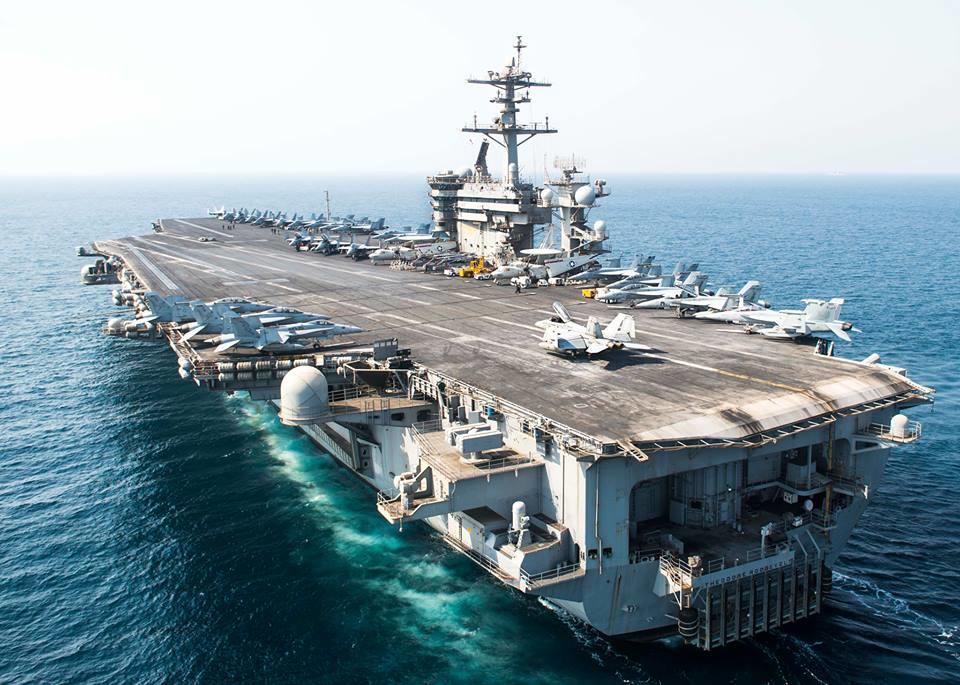

USS Theodore Roosevelt nuclear carrier file image, via US Navy.


Underscoring this reality, the Pentagon has been moving to dial back information sharing on the outbreak within the military, trying to avoid letting potential enemies know which sites are most vulnerable and hit hardest by the virus.
This report is from Hal Turner


JFK SPECIAL WARFARE CENTER FORT BRAGG NC is presently executing an Emergency Deployment Order.
Troops deploying from Ft. Bragg.
HAMAS/Iran Government internal communications intercepted. 
Serious attacks against US Forces in Middle East now considered "imminent."  "State-Sponsored" terrorism.
UPDATE 2:35 PM EDT --
EXECUTION ORDERS HAVE BEEN INTERCEPTED BY US INTEL,  SENT TO HAMAS BY IRANIAN REPUBLICAN GUARD LEADERSHIP, TO ENGAGE FORCES FROM THE UNITED STATES OF AMERICA BECAUSE 4 OF OUR USN NAVY AIRCRAFT CARRIERS ARE NOW INCAPACITATED DUE TO CORONA VIRUS!!

THIS IS AN EXTREME EMERGENCY. HAMAS AND IRAN KNOW USA IS NOW WEAK AND HAS ONLY 50% CAPACITY AT THE AIR ASSET AND NAVAL CARRIER LEVELS OUT OF DIEGO GARCIA TOP SECRET MILITARY BASE!!

SPECIAL OPERATIONS COMMAND ARE NOW SENDING IN SNIPER RECON TEAMS TO ESTABLISH HVT TARGETS IN OPPOSING FORCE LEADERSHIP FOR REGIME CHANGE NEUTRALIZATION THROUGH INTEL RECON TARGET ACQUISITION AND ENGAGEMENT!!

ALERT ALERT THIS IS AN EMERGENCY DEPLOYMENT NOW EXECUTING OPERATION ORDER FOR ENGAGEMENT IN 18 HOURS OR LESS!! MULTIPLE PLATOON SIZE ELEMENT TEAMS ARE ENROUTE FOR HALO INSERTION NOW!!
On orders from POTUS, US Forces are deploying with instructions to attack and destroy by force, certain high level targets.
TruNews yesterday did a very good report on how the military has been affected by coronavirus.


Military Infection Complex: 4 Aircraft Carriers,150 Bases Report COVID-19 Outbreaks


Listen to "Military Infection Complex: 4 Aircraft Carriers,150 Bases Report COVID-19 Outbreaks" on Spreaker.

Here are just a few of the stories discussed.


Acting Navy Secretary blasts USS Theodore Roosevelt captain as ‘too naive or too stupid’ in leaked speech to ship’s crew


Tuesday, 9 July 2019

Losharik - Russia's top-secret project


Shoigu’s Assessment: Secret Weapon Nuclear Sub to Be Repaired and Relaunched Soon


In the headquarters of the Northern Fleet, a commission is investigating the causes of the incident. The Defense Minister held a closed meeting in the headquarters with the military and the designers of the submarine. Right afterward, he reported to the President.

Russian servicemen 'averted 

planetary catastrophe' 

during nuclear submarine 

incident, military official 

claims at funeral


8 July, 2019


The families of the 14 Russian servicemen who died after a fire broke out on a nuclear submarine have reportedly been told that their relatives averted a “planetary catastrophe” before they passed away.
A high-ranking military official is said to have made the comment at a funeral for the crew in St Petersburgh days after the accident in the Barents Sea earlier this week.
The incident remains shrouded in mystery after the Russian government refused to reveal the submarine’s name and its mission, claiming them as state secrets.
However, the Kremlin has said the incident was sparked by a fire in the battery compartment of the submarine.
Defense minister Sergei Shoigu said earlier this week that the onboard nuclear reactor was “operational” after the crew took “necessary measures” to protect it.
His deputy Andrei Kartapolov also claimed the “hero” submariners sealed a hatch to contain the blaze.
The Kremlin has not revealed what exactly occurred, or whether a major incident was averted by the servicemen's actions.
Paying tribute to the crew at the memorial, the unnamed military official said the submariners had prevented a much bigger tragedy, Russian news outlet Open Media reported.
“Today we are seeing off the crew of a research deep water apparatus, who died while performing a combat mission in the cold waters of the Barents Sea. Fourteen dead, 14 lives,” he is quoted as saying. “At the cost of their lives, they saved the lives of their comrades, saved the ship, did not allow a planetary catastrophe.”
The Independent was unable to verify the comments, which did not elaborate on the cause of the accident or how disaster was averted.
Severeal sources have identified the vessel as the A-31, or the Losharik submersible; a nuclear-powered unarmed vessel capable of deep sea missions.
Its exact design is shrouded in secrecy, but it is believed to be an experimental 70m-long craft operating in conjunction with a larger mothership submarine. Developed over 15 years beginning in 1988, it is described as the Russian military’s most advanced deep water vessel.
Some descriptions suggest that it is associated with maritime special forces missions, including spying on ocean-bed cables. It is thought to be capable of diving to depths of up to 6,000m.
Local news agency Severpost reported that the smaller submarine was likely tethered to the larger Podmoskovye atomic submarine when it emerged from the Barents Sea at the mouth of the Kola Bay.
Citing an unnamed fisherman, the publication claimed the submarine was travelling quickly back towards base, but without obvious signs of distress.
What remains unclear is how many of the servicemen survived the initial incident, and how many died on the way to hospital.
Reports that five crew members were receiving treatment in a military hospital in Severomorsk were confirmed by Mr Shoigu.
The ministry of defence later named the 14 dead. Calling them "Heroes of Russia", it said they were called. Denis Dolonsky and Nikolai Filin; first-rank captains Vladimir Abankin, Denis Oparin, Andrei Voskresensky, Konstantin Somov and Konstantin Ivanov; second-rank captains Alexander Avdonin, Alexander Vasilyev, Sergei Danilchenko and Dmitry Solovyev; third-rank captains Viktor Kuzmin and Vladimir Sukhinichev; and captain lieutenant Mikhail Dubkov.
They were buried in Serafimov cemetery nearby a monument to the 118 Russian killed when the Kursk nuclear submarine sank in 2000, the year Vladimir Putin became president.


Tuesday, 25 June 2019

Russian Navy frigate arrives in Cuba


Russian Navy frigate arrives in Cuba under US observation


A Russian Navy frigate armed with cruise missiles has arrived in Havana Harbor for an official visit. As Russian seamen stretch their legs on shore, US warships idle nearby and quietly observe their counterparts.
The frigate Admiral Gorshkov, armed with Kalibr missiles, left the Russian port of Severomorsk in late February for its months-long voyage, making stops in China, Djibouti and Sri Lanka before docking in Cuba on Monday. It is accompanied by several support vessels.


A group of Russian ships from the North Fleet, led by the Admiral Gorshkov frigate, approached the coast of Cuba, said North Fleet spokesman Vadim Serga.
“The group of North Fleet ships headed by the Admiral Gorshkov frigate approached the coast of Cuba. Today the Russian sailors will make a working visit to the capital of the republic – the port city of Havana, with the Elbrus logistic vessel and the tugboat Nikolai Chiker. The average offshore tanker Kama continues its voyage to the eastern Caribbean Sea to the islands of Trinidad and Tobago,” he said.
It was reported that the detachment of ships left for the long voyage from Severomorsk on February 26. Since the beginning of the voyage, the ships and support vessels of the detachment have traveled about 28 thousand nautical miles.
It is reported that during the voyage the Russian sailors made stops at the ports of Djibouti and Colombo as well as at the Chinese port of Qingdao to participate in the celebrations of the 70th anniversary of the People’s Liberation Army of China.

Meanwhile, the hydrographers of the Russian North Fleet intend to confirm assumptions about the existence of new islands and map them during the Arctic expedition in 2019.
The festivities of May were spent in Vladivostok, then they crossed the Pacific Ocean, crossed the equator and made a stopover in Puerto Bolívar, Ecuador. Last week, the detachment passed through the Panama Canal to the Caribbean Sea.
“There are six or seven islands whose existence must be confirmed during the expedition, most of which are supposed to be more than 500 meters long,” Aleksei Kornis, head of the Hydrographic Service of the Fleet, quoted by Izvestia.
According to Kornis, these are islands in the archipelago of Nova Zembla. The assumptions about its existence arose following the analysis of satellite images and data from other expeditions.
“However, the islands are only considered officially discovered when they are trodden by surveyors. It is necessary to establish how these structures are permanent, if, for example, are not part of a glacier,” said Kornis.

https://www.fort-russ.com/2019/06/at-americas-doorstep-russian-navy-ships-arrive-at-cuba/

Friday, 14 June 2019

Israel's nuclear submarines

We pointed out earlier that Israel has both motive and 
opportunity to carry out a false flag attack on Iran

Persian Gulf tanker attacks: 
Israel has silent underwater 

nuclear submarines


© Reuters
One of Israel's Dolphin-class nuclear submarines
SOTT,

14 May, 2019

The 2,400 ton Dolphin 2 model is based on the state-of-the-art Type 212 submarine, which features Air-Independent Propulsion technology and swim faster at twenty-five knots. While diesel submarines rely on noisy air-consuming diesel generators which require the submarine to regularly surface or snorkel, AIP-powered submarines can swim underwater very quietly at low speeds for weeks at a time.

(This article first appeared last year.)
Israel has never officially admitted to possessing nuclear weapons. 

Unofficially, Tel Aviv wants everyone to know it has them, and doesn't hesitate to make thinly-veiled references to its willingness to use them if confronted by an existential threat. Estimates on the size of Tel Aviv's nuclear stockpile range from 80 to 300 nuclear weapons, the latter number exceeding China's arsenal. 

Originally, Israel's nuclear forces relied on air-dropped nuclear bombs and Jericho ballistic missiles. For example, when Egyptian and Syrian armies attacked Israel during the 1973 Yom Kippur War, a squadron of eight Israeli F-4 Phantom jets loaded with nuclear bombs was placed on alert by Prime Minister Golda Meir, ready to unleash nuclear bombs on Cairo and Damascus should the Arab armies break through. 

Though Israel is the only nuclear-armed state in the Middle East, Tel Aviv is preoccupied by the fear that an adversary might one day attempt a first strike to destroy its nuclear missiles and strike planes on the ground before they can retaliate. Currently, the only hostile states likely to acquire such a capability are Iran or Syria. 

To forestall such a strategy, Israeli has aggressively targeted missile and nuclear technology programs in Iraq, Syria and Iran with air raids, sabotage and assassination campaigns. However, it also has developed a second-strike capability - that is, a survivable weapon which promises certain nuclear retaliation no matter how effective an enemy's first strike. 

Most nuclear powers operate nuclear-powered ballistic missile submarines which can spend months quietly submerged deep underwater and at any moment unleash ocean-spanning ballistic missiles to rain apocalyptic destruction on an adversary's major centers. Because there's little chance of finding all of these subs before they fire, they serve as one hell of a disincentive to even think about a first strike. 

But nuclear-powered submarines and SLBMs are prohibitively expensive for a country with the population of New Jersey - so Israeli found a more affordable alternative. 

Berlin's Unconventional Apology 

During the 1991 Gulf War, it emerged that German scientists and firms had played a role in dispersing ballistic missile and chemical weapons technology to various Arab governments-technology which aided Saddam Hussein in bombarding Israel with Scud missiles. This in fact was a long-running sore point: in the early 1960s, Israeli agents even carried out assassination attempts, kidnappings and bombings targeting German weapons scientists working on behalf of Arab governments. 

Chancellor Helmut Kohl hatched a plan to simultaneously compensate Israel for the damages, while generating business for German shipbuilders suffering a downturn due to post-Cold War defense cuts. Starting in the 1970s, German shipbuilder HDW began churning Type 209 diesel electric submarines for export, with nearly 60 still operational around the globe. One Type 209, the San Luis, managed to ambush Royal Navy vessels twice during the Falkland War, though it failed to sink any ship due to the defective torpedoes. 

Kohl offered to fully-subsidize the construction of two enlarged Type 209s, designated the Dolphin-class, as well as cover 50 percent of the cost of a third boat in 1994. The Dolphins displaced 1,900-tons while submerged, measured 57-meters long and are manned by a crew of 35-though they can accommodate up to ten special forces personnel. These entered service 1999-2000 as the INS Dolphin, Leviathan and Tekumah ("Revival"). 


Comment: That is probably not the full story, but if it is, it is among the dumbest plans ever conceived. Israel - thanks to those subs - is currently wrecking Germany's investment in the Iran Deal.. 

Each Dolphin came equipped with six regular tubes for firing 533-millimeter DM2A4 heavyweight fiber-optic guided torpedoes and Harpoon anti-ship missiles-as well as four 650-millimeter mega-sized tubes, which are rare in modern submarines. These tubes can be used to deploy naval commandos for reconnaissance and sabotage missions, which have played a major role in Israeli submarine operations. 

However, the plus-size torpedo tubes have a useful additional function: they can accommodate especially large submarine-launched cruise missiles (SLCM) - missiles large enough to carry a nuclear warhead. While a ballistic missile arcs into space traveling at many times the speed of sound, cruise missiles fly much slower and skim low over the earth's surface. 

In the 1990s the United States declined to provide Israel with submarine-launched Tomahawk cruise missiles due to the rules of the Missile Technology Control Regime prohibiting transfer of cruise missile with a range exceeding 300 miles. 

Instead, Tel Aviv went ahead and developed their own. In 2000, U.S. Navy radars detected test launches of Israeli SLCMs in the Indian Ocean that struck a target 930 miles away. The weapon is generally believed to be the Popeye Turbo - an adaptation of a subsonic air-launched cruise missile that can allegedly carry a 200-kiloton nuclear warhead. However, the SLCM's characteristics are veiled in secrecy and some sources suggest a different missile type entirely is used. An Israeli Dolphin submarine may have struck the Syrian port of Latakia with a conventional cruise missile in 2013 due to reports of a shipment of Russian P-800 anti-ship missiles. 

Israeli Prime minister Benjamin Netanyahu then purchased three more German submarines, arousing considerable controversy as many felt additional boats were unnecessary. In 2012, Der Spiegel published an expose detailing how German engineers were well-aware of the Dolphin 2's intended role as nuclear-weapon delivery system, arousing some controversy with the public, as Chancellor Merkel supposedly agreed to the sale in exchange for unrealized promises from Netanyahu to adopt a more conciliatory policy towards the Palestinians. Israel has nonetheless received two of the Dolphin 2s, the Rahav ('Neptune') and Tanin ('Crocodile') with the Dakar expected in 2018 or 2019. 


Comment: Israel is getting 6 in total. And the cost for all of them is 'subsidized' by the German taxpayer...


The 2,400 ton Dolphin 2 model is based on the state-of-the-art Type 212 submarine, which features Air-Independent Propulsion technology and swim faster at twenty-five knots. While diesel submarines rely on noisy air-consuming diesel generators which require the submarine to regularly surface or snorkel, AIP-powered submarines can swim underwater very quietly at low speeds for weeks at a time.

This not only means 
they are stealthier sea-control platforms, but makes them more viable for lengthy nuclear deterrence patrols. Currently, the Chinese AIP-powered Type 32 Qing-class is the only AIP-powered submarine in service armed with ballistic missiles.

However, as fellow TNI writer Robert Farley points out, there are geographic obstacles that diminish the practicality of Israel's sea-based nuclear deterrence. For now, there is only one intended target: Iran, a country which lies hundreds of miles away from Israel. While Tehran lies barely within the supposed 930-mile range of an Israeli submarine deployed from their base in Haifa into the Mediterranean Sea, the missiles would have to spend over an hour overflying Syria and Iraq, posing navigational and survivability challenges.

A closer avenue for attack would lie in the Persian Gulf, but this would involve transiting the submarines through the Suez Canal (controlled by Egypt), around Africa (impractically far for the Dolphin-class), or stationing some at the naval base at Eilat, which faces the Gulf of Aqaba on the southern tip of Israel and is surrounded by Egypt, Jordan and Saudi Arabia. In short, deploying Israeli submarines to Iran's southern flank would require some degree of cooperation and logistical support from other Middle Eastern states that might not be forthcoming in a crisis scenario.

Farley is probably correct in arguing that the Israel's nuclear-tipped SLCMs are less practical than Tel Aviv's other nuclear-delivery platforms. For that matter, Israel doesn't currently face any adversaries with nuclear capabilities to deter against. However, like the idea of second-strike capability in general, the threat of sea-launched nukes may be 
more intended political weapon than one strictly intended for its military effectiveness.


Monday, 7 January 2019

Trouble brewing in the Black Sea?


MARINE EXPEDITIONARY UNIT TRANSITING DARDANELLES TO BLACK SEA. CRIMEA?

6 January, 2019

Right now, as this story is published, the USS Fort McHenry and embarked elements of the 22nd Marine Expeditionary Unit (MEU) have begun northbound transit of the Dardanelles Strait, enroute to the Black Sea.


That's 2200 U.S. Marines and an incredible variety of war fighting / invasion equipment.

This is precisely the type of military unit one would send if they intended a lightning military strike to take Crimea back from Russia and give it to Ukraine.

A Marine expeditionary unit (MEU, pronounced "Mew"),  is the smallest Marine air-ground task force (MAGTF) in the United States Fleet Marine Force. Each MEU is an expeditionary quick reaction force, deployed and ready for immediate response to any crisis, whether it be natural disaster or combat missions.

A Marine expeditionary unit is normally composed of: a reinforced Marine infantry battalion (designated as a Battalion Landing Team) as the ground combat element, a composite medium tilt-rotor squadron forms the aviation combat element, a combat logistics battalion provides the logistics combat element, and a company-size command element serves as the MEU headquarters group.

Troop strength is about 2,200 and usually commanded by a colonel, and is deployed from amphibious assault ships.

Currently, a Marine expeditionary unit embarks Marines and equipment onto the amphibious warfare ships of an Expeditionary Strike Group (ESG) which also includes escort ships and submarines to protect them from air, surface, and submarine threats.

For further protection and strong air support, such an ESG is often deployed along with one or more carrier battle groups.

The MEU is unique in that its air and ground combat elements are combined with a logistics combat element under one commander; other services do not unite the command of air and ground forces until much higher command levels.

When the United States Army integrates with Air Force assets, it typically is at the theater or corps level, with a general commanding, while at the division level it will integrate with Army aviation, which can be organized as organic at the battalion level.

The MEU's ground combat element also combines artillery, light armor and tanks at a much lower level than was common in the Army until the development of the brigade combat team early in the War on Terror, with a similar concept, the combat command, being utilized in World War II.

This air-ground task force concept is designed to thoroughly exploit the combat power inherent in air and ground assets by closely integrating them into a single force. The MEU brings all the supplies and logistical support it needs to sustain itself for quick mission accomplishment or to pave the way for any follow-up forces. This self-sustainment allows more flexibility in disposition and operations of forces, and allows the MEU to initiate operations sooner and let support catch up later, without having to wait for external logistical support to begin a mission. Deployments on U.S. Navy amphibious assault ships allows MEUs to sea base around the globe, ready for deployment at short notice.
A typical MEU has approximately 2,200 Marines and sailors. It is equipped with:

A UH-1N from the 26th Marine Expeditionary Unit flies past an AH-1W on the flight deck of USS Kearsarge
Qty
Nomenclature
Element
4
M1A1 main battle tank
ground
7 to 16
Light Armored Vehicle
ground
15
Assault Amphibious Vehicle
ground
6
155mm howitzer: M777
ground
8
M252 81mm mortar
ground
8
BGM-71 Tube-Launched, Optically-Tracked, Wire-Guided (TOW) missile weapon system
ground
8
FGM-148 Javelin anti-tank missile
ground
4 to 6
AH-1Z Viper attack helicopters
aviation
3
UH-1Y Venom light utility helicopters
aviation
12
MV-22A Osprey medium-lift tiltrotor aircraft
aviation
4
CH-53E Super Stallion heavy-lift transport helicopters
aviation
6
AV-8B Harrier V/STOL light-attack airplanes
aviation
2
KC-130 Hercules aerial re-fueler/transport airplanes
Note: usually maintained in the continental United States

aviation
2
Reverse Osmosis Water Purification Unit
logistics
1
LMT 3000 water purification unit
logistics
4
Tractor, Rubber Tire, Articulated Steering
logistics
2
TX51-19M Rough Terrain Forklift
logistics
3
D7 bulldozer
logistics
1
Medium Tactical Vehicle Replacement dump truck
logistics
4
Mk48 Logistics Vehicle System
logistics
7
500 gallon water containers
multiple
63
Humvee
multiple
30
Medium Tactical Vehicle Replacement trucks
multiple
5
Boeing Insitu RQ-21 Blackjack
aviation
 
Many types of equipment are, or will soon, undergo a transitory phase as they are replaced. Some examples include the Marine Personnel Carrier replacing the LAV-25, the F-35 Lightning II replacing the AV-8B Harrier, and the CH-53K Super Stallion replacing the CH-53E.
 
The 22nd Marine Expeditionary Unit (22nd MEU) is one of seven Marine Expeditionary Units currently in existence in the United States Marine Corps. It is a Marine Air Ground Task Force with a strength of about 2,200 personnel. They are currently based out of Marine Corps Base Camp Lejeune, North Carolina and fall under the command of the II Marine Expeditionary Force. It is the most decorated of the Marine Corps' seven MEUs.
As shown on the map below, the Dardanelles Strait is the first of two such strategic waterways needing to be traveled to get to the Black Sea.  The second of the two waterways is the Bosphorus Strait which passes through Istanbul.
Much was made prior to Christmas of Ukraine positioning thousands of troops and tanks near Donetsk.  At the time, fears were that Ukraine intended to take the breakaway province and return it by force to Ukrainian control.

NOW, however, it may be that the total buildup of Ukraine forces near Donetsk was to cut-off any Russian reinforcements heading to Crimea, so as to allow CRIMEA TO BE TAKEN BACK.

This is an incredible development in world events and does not bode well for peace.  At all.  

UPDATE 1:42 PM EST --

Sources are now telling me the President will address the nation Wednesday night at 9:00 PM eastern time.   RIGHT NOW we are being told it is to declare a national emergency at the southern border, and use the military to close it or build a wall.  HOWEVER, it could very well be to tell the American people that we are now engaging in combat with Russia in Crimea.  Stay tuned.