More Fires Now Burning in Angola, Congo Than Amazon: Maps
Showing posts with label Congo. Show all posts
Sunday, 25 August 2019
Saturday, 24 August 2019
What about the wildfires in Angola and Congo? Who is reporting on them?
Why does it take a climate change denying site to point this out.
Of course, there is nothing "normal" about massive fires in the rainforest - unless you are 20 years old.
Look at the figures for Angola and Congo.
More
Wildfires Are Burning
In Angola & Congo Than
Brazil
23 August, 2019
Thanks to a concerted effort by American social media 'influencers', everybody and their grandmother is now aware of the fact that wildfires - many of which were allegedly started illegally by farmers seeking to clear out more land for farming or pasture - are tearing through the Amazon.
What many don't realize is that the wildfires in the 'lungs of the Earth' - as French President Emmanuel Macron described the Amazon - actually aren't that uncommon. In fact, they're a natural part of the rainforest's process of self-restoration. In total, this year, fires are up by 83% compared with last year.
And while the rest of the world uses the fires as an excuse to slam Brazilian President Jair Bolsonaro and his environmental policies (some have accused him of tacitly condoning the farmers who set the fires), Bloomberg reports that Brazil is actually third in the world in wildfires over the last 48 hours, citing data from the MODIS satellite analyzed by Weather Source.
Weather Source recorded 6,902 fires in Angola over the past 48 hours, 3,395 in the Democratic Republic of Congo and 2,127 in Brazil.
Like in the Amazon and in California, wildfires aren't all that uncommon in Central Africa.
As for the total number of active wildfires, they're also nowhere near some of the highs recorded in recent years. According to NASA, more than 67,000 fires were reported in a one-week period in June last year, most of which were started by farmers.
Over the past two days, roughly 16,500 wildfires were recorded in the top 10 countries.
Actually, as far as wildfires go, 2019 isn't out of the ordinary in any meaningful sense.
But we're sure the Instagram influencer set will soon clarify all of this in a series of sponsored posts putting the Amazon wildfires in context...right?
Friday, 23 August 2019
No media coverage of fires in Central Africa
Out
of sight, out of mind.
This seems to be the ONLY coverage of fires
in Congo and elsewhere in Africa.
On further perusal THIS COVERAGE IS FROM PREVIOUS YEARS!
Congo
Fires
Descriptions
and images are provided by SeaWiFS
Project, NASA/Goddard Space Flight Center, and
ORBIMAGE.
Description: Hundreds of fires are set every year during the dry season in Central Africa. This true color image from the Sea-viewing Wide Field-of-view Sensor (SeaWiFS) shows dozens of smoke plumes in the Democratic Republic of the Congo on June 29, 2000. Residents burn away scrub and brush annually in the woody savanna to clear land for farming and grazing.
Description: This MODIS true-color image of the Democratic Republic of Congo, Africa, shows dozens of fires burning all over the country. To the far right of the image is Lake Tanganyika, which separates The Democratic Republic of Congo from Tanzania to its east.
Description: Numerous fires are burning in several Africa countries, including Angola (lower left), Zambia (lower right), Tanzania (far right), and the Democratic Republic of Congo (center). The fires appear as red dots. The large lake straddling the border between the Democratic Republic of Congo and Tanzania is Lake Tanganyika.
Unless
otherwise specified, this article was written by Rhett
A. Butler [citation]
News [updates]
Rainforests absorb 20% of emissions annually
(02/19/2009) Undisturbed tropical forests are absorbing nearly a fifth of carbon dioxide released annually by the burning of fossil fuels, according to an analysis of 40 years of data from rainforests in the Central African country of Gabon. Writing in the journal Nature, Simon Lewis and colleagues report that natural forests are an immense carbon sink, helping slow the rise in atmospheric CO2 levels.
Mountain gorilla population in DR Congo increases 12.5%
(01/27/2009) The population of critically endangered mountain gorillas in Democratic Republic of Congo's Virunga National Park increased 12.5 percent in the past 16 months according to a census conducted by the Congolese Wildlife Authority (ICCN). 81 gorillas now live permanently in the park, up from 72 in August 2007.
Congo cancels logging contracts covering 13M hectares
(01/21/2009) Democratic Republic of Congo (DRC) canceled nearly 60 percent of the country's timber contracts following a review of 156 logging concessions granted in recent years, reports Reuters. The anti-corruption probe found that 91 deals covering nearly 13 million of hectares of forest were granted under questionable circumstances or during a moratorium on logging contracts following the 1998-2003 civil war.
Commercial bushmeat trade is devastating wildlife
(09/15/2008) Commercial killing of rainforest wildlife is putting biodiversity at risk and reducing sources of protein for rural populations, warns a new report from the Center for International Forestry Research (CIFOR) and the Secretariat of the Convention on Biological Diversity (CDB).
Markets could save rainforests: an interview with Andrew Mitchell
(08/17/2008) Markets may soon value rainforests as living entities rather than for just the commodities produced when they are cut down, said a tropical forest researcher speaking in June at a conservation biology conference in the South American country of Suriname. Andrew Mitchell, founder and director of the London-based Global Canopy Program (GCP), said he is encouraged by signs that investors are beginning to look at the value of services afforded by healthy forests.
Britain, Norway commit $210 million towards Congo rainforest conservation
(06/24/2008) The governments of Britain and Norway last week announced a $211 million (108 million) initiative to conserve rainforests in the Congo Basin. The plan calls for the use of an advanced satellite camera to monitor deforestation in the region and funding for community-based conservation projects.
Does logging contribute to AIDS deaths in Africa?
(06/14/2008) Logging activities in tropical Africa may pose hidden health risks to wildlife and humans according to a veterinary pathobiologist speaking at a scientific conference in Paramaribo, Suriname.
Congo pygmies use GPS to map eco-certified timber concession
(05/29/2008) Loggers have teamed with indigenous Pygmies to establish the largest ever eco-certified logging scheme.
Forest carbon credits could guide development in Congo
(05/28/2008) An initiative to reduce greenhouse gas emissions by offering carbon credits to countries that reduce deforestation may be one of the best mechanisms for promoting sustainable development in Central Africa says a remote sensing expert from the Woods Hole Research Center (WHRC). Dr. Nadine Laporte, an associate scientist with WHRC who uses remote sensing to analyze land use change in Africa, says that REDD could protect forests, safeguard biodiversity, and improve rural livelihoods in Democratic Republic of Congo (DRC) and other Central African nations.
Indigenous peoples of Congo map their forests with GPS in an effort to save them
(04/13/2008) This week over five hundred villagers in the Democratic Republic of Congo's rainforest will employ GPS technology to map their forests in an effort to preserve their territory from logging companies.
Biochar fund to fight hunger, energy poverty, deforestation, and global warming
(03/10/2008) Biopact, a leading bioenergy web site, has announced the creation of a "Biochar Fund" to help poor farmers improve their quality of life without hurting the environment.
Returns from carbon offsets could beat palm oil in Congo DRC
(12/04/2007) A proposal to pay the Democratic of Congo (DRC) for reducing deforestation could add 15-50 percent to the amount of international aid given to the warn-torn country, reports a new study published by scientists at the Woods Hole Research Center (WHRC). The funds would help alleviate rural poverty while cutting emissions of greenhouse gases and protecting threatened biodiversity.
Logging roads rapidly expanding in Congo rainforest
(06/07/2007) Logging roads are rapidly expanding in the Congo rainforest, report researchers who have constructed the first satellite-based maps of road construction in Central Africa. The authors say the work will help conservation agencies, governments, and scientists better understand how the expansion of logging is impacting the forest, its inhabitants, and global climate.
Illegal logging threatens Congo's forests, global climate
(04/11/2007) Despite government and World Bank assurances to the contrary. a new report from Greenpeace finds that illegal logging is rampant in the Democratic Republic of Congo (DRC). The report, Carving up the Congo, reveals that in spite of a 2002 moratorium on new logging, over 15 million hectares of rainforest have been concessioned to loggers with little regard to the environmental impact or compensation to affected communities.
For this year, this may be the sum of it.
https://modis.gsfc.nasa.gov/gallery/individual.php?db_date=2019-06-14
Thursday, 18 July 2019
The media is hiding the truth about the ebola outbreak in Congo
Ebola
outbreak in Congo declared a global health emergency
https://news.yahoo.com/ebola-outbreak-congo-declared-global-175202499.html
BREAKING
EMERGENCY!! MAJOR DEADLY OUTBREAKS SPREADING FAST! MEDIA IS HIDING
THE TRUTH!!
Congo
Ebola outbreak, a global health emergency
Thursday, 13 June 2019
Ebola makes the mainstream
New Ebola outbreak in Democratic Republic of Congo is 'truly frightening'
The head of a major medical research charity has called the latest outbreak of Ebola in central Africa "truly frightening".
13 June, 2019
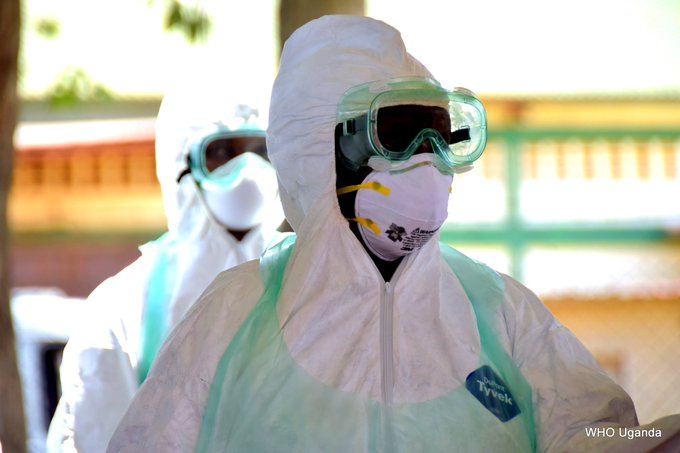
Medical staff of the Ebola Treatment Unit get ready to work during their weekly rehearsal at the Bwera General Hospital in Bwera bordering with the Democratic Republic of Congo, western Uganda, in December. Photo: AFP
Nearly 1400 people have died in the Democratic Republic of Congo.
Dr Jeremy Farrar, the director of the Wellcome Trust, said the epidemic was the worst since that of 2013-16 and has showed "no sign of stopping".
A five-year-old boy has also died in neighbouring Uganda, the first case of Ebola reported in the country.
The Ugandan government is now reporting seven other suspected cases of the virus.
In a statement, Dr Farrar said the spread was "tragic but unfortunately not surprising". He warned that more cases were expected, and a "full" national and international response would be needed to protect lives.
@MinofHealthUG and the @WHO have confirmed a case of #Ebola Virus Disease outbreak in #Uganda. Although there have been numerous previous alerts, this is the first confirmed case in Uganda during the Ebola outbreak on-going in neighbouring Democratic Republic of the Congo.
667 people are talking about this
"The DRC should not have to face this alone," he said.
What's the situation so far?
Since the first case of Ebola in the DRC last August, nearly 1400 people have died - around 70 percent of all those infected.
The outbreak is the second-largest in the history of the disease, with a significant spike in new cases in recent weeks.
Only once before has an outbreak continued to grow more than eight months after it began - that was the epidemic in West Africa between 2013-16, which killed 11,310 people.
Efforts to contain the spread have been hindered by militia group violence and by suspicion towards foreign medical assistance.
Nearly 200 health facilities have been attacked in the DRC this year, forcing health workers to suspend or delay vaccinations and treatments. In February, medical charity Médecins Sans Frontières (MSF) put its activities on hold in Butembo and Katwa - two eastern cities in the outbreak's epicentre.
In Uganda, a five-year-old boy died of the virus on Tuesday, according to the World Health Organisation (WHO).
Officials said his grandmother and younger brother also had the disease. The boy is said to have travelled across the border with his family from the DRC on Sunday. He was then taken to a Ugandan hospital after exhibiting symptoms, including vomiting blood, officials said.
Seven other cases have been confirmed in the country, and Uganda's government said 50 people were suspected to have come into contact with those infected.
What is being done to prevent the spread?
In Uganda, mass gatherings including market days and prayers have been cancelled. Market days in the town of Kasese attract an estimated 20,000 people at the border area.
Uganda's health ministry and the WHO said a rapid response team had been dispatched to identify others at risk and to follow up on eight other possible cases.
The country has already vaccinated about 4700 health workers against the disease, according to a joint statement by WHO and Ugandan health officials.
On Wednesday, WHO head Tedros Adhanom Ghebreyesus said that he would hold an IHR Emergency Committee meeting on 14 June. The group will decide if the outbreak should now be deemed a public health emergency.
What is Ebola?
- Ebola is a virus that initially causes sudden fever, intense weakness, muscle pain and a sore throat.
- It progresses to vomiting, diarrhoea and both internal and external bleeding.
- People are infected when they have direct contact through broken skin, or the mouth and nose, with the blood, vomit, faeces or bodily fluids of someone with Ebola.
- Patients tend to die from dehydration and multiple organ failure.
- BBC
Wednesday, 12 June 2019
ISIS- armed militias are killing health care workers in the Democratic Republic of Congo
20 Congolese boys were tested for Ebola in Texas back in April as ISIS armed militias are killing health care workers in the Democratic Republic of Congo

Photo
World Bank/Vincent Tremeau Health Workers treat a 15-year-old who is
suspected of being infected by Ebola, Beni, Democratic Republic of
Congo. (2019)
the Big Wobble,
12
June, 2019
The
UN health agency yesterday identified a 5-year-old Congolese boy as
thefirst confirmed case of Ebola in Uganda.
Despite numerous
previous alerts in Uganda, this is the first instance in which the
virus has been identified outside DRC during what has become the
worst-ever outbreak in its history.
The five-year-old Congolese
boy travelled across the Ugandan border on Sunday, through the Bwera
Border post.
While seeking medical care at Kagando hospital,
health workers identified Ebola as a possible cause of his
illness.
WHO, and the Ugandan Ministry of Health has dispatched
a Rapid Response Team to the town of Kasese, close to the DRC border,
to identify other people who may be at risk, and ensure they are
monitored and provided with care if they also become ill.
This
comes after Breitbart reported the "Ebola Crisis Hits
Texas-Mexico Border and 20 Congolese Migrants."
Breitbart
reported that a public health official in Laredo, Texas, said 20
Congolese migrants were monitored for Ebola and other diseases in
shelters in his city and across the Mexican border in Nuevo Laredo,
Tamaulipas.
Shortly after his announcement during a Laredo City
Council meeting, the World Health Organization (WHO) considered
declaring a “global emergency” in response to a massive outbreak
of Ebola in the Democratic Republic of the Congo.
“We have 8
Congolese right now in one of our shelters and a dozen in Nuevo
Laredo,” Laredo Health Director Dr Hector Gonzalez told the Laredo
City Councilman George Altget during a council meeting on April
4.
“For them, my concern was Ebola.”
He said that due
to the time element, the Congolese migrants were not developing
symptoms of Ebola. “But, we’re on alert to check that,” he
said.
Almost 2,000 cases of Ebola have been reported in
the Democratic Republic of Congo, as the central African nation
struggles with the second largest outbreak of the disease in
history.
Health officials in the DRC said Sunday there were
1,994 reported cases of the disease, of which 1,900 have been
confirmed as Ebola.
So far, 1,245 people are confirmed to have
died, with another 94 deaths reported.
The outbreak, which began
last August, has proved difficult to bring under control because of
community mistrust and violent attacks on health care workers.
Last
month, the World Health Organization (WHO) said sporadic violence by
ISIS armed militias, limited health care resources and
difficult-to-access locations meant this outbreak was taking place in
one of the "most challenging circumstances ever confronted by
WHO."
Family members watch the deceased victim of the Ebola
virus being buried on May 16, 2019, in Butembo.
The city of
Butembo is at the epicentre of the Ebola crisis in DR Congo. WHO
epidemiologist Dr Richard Mouzoko was killed by armed men in April
while working in Butembo, in North Kivu, a province grappling with a
long-term conflict and dozens of armed groups including ISIS.
Cases
are increasing because of violent acts that set us back each time."
The attack took place during a coordination meeting at the hospital
where Mouzoko was working.
Doctors Without Borders (Medecins
Sans Frontieres) staff have also been attacked, prompting the group
to suspend work in some Ebola-hit areas. The DR Congo outbreak has
affected the northeastern provinces of North Kivu and neighbouring
Ituri.
The two provinces are among the most populous in the
country and border Uganda, Rwanda and South Sudan.
Unlike the
2014 outbreak in West Africa that killed more than 11,000 people,
there are now vaccines and experimental treatments for Ebola.
the Big Wobble,
Despite numerous previous alerts in Uganda, this is the first instance in which the virus has been identified outside DRC during what has become the worst-ever outbreak in its history.
The five-year-old Congolese boy travelled across the Ugandan border on Sunday, through the Bwera Border post.
While seeking medical care at Kagando hospital, health workers identified Ebola as a possible cause of his illness.
WHO, and the Ugandan Ministry of Health has dispatched a Rapid Response Team to the town of Kasese, close to the DRC border, to identify other people who may be at risk, and ensure they are monitored and provided with care if they also become ill.
This comes after Breitbart reported the "Ebola Crisis Hits Texas-Mexico Border and 20 Congolese Migrants."
Breitbart reported that a public health official in Laredo, Texas, said 20 Congolese migrants were monitored for Ebola and other diseases in shelters in his city and across the Mexican border in Nuevo Laredo, Tamaulipas.
Shortly after his announcement during a Laredo City Council meeting, the World Health Organization (WHO) considered declaring a “global emergency” in response to a massive outbreak of Ebola in the Democratic Republic of the Congo.
“We have 8 Congolese right now in one of our shelters and a dozen in Nuevo Laredo,” Laredo Health Director Dr Hector Gonzalez told the Laredo City Councilman George Altget during a council meeting on April 4.
“For them, my concern was Ebola.”
He said that due to the time element, the Congolese migrants were not developing symptoms of Ebola. “But, we’re on alert to check that,” he said.
Almost 2,000 cases of Ebola have been reported in the Democratic Republic of Congo, as the central African nation struggles with the second largest outbreak of the disease in history.
Health officials in the DRC said Sunday there were 1,994 reported cases of the disease, of which 1,900 have been confirmed as Ebola.
So far, 1,245 people are confirmed to have died, with another 94 deaths reported.
The outbreak, which began last August, has proved difficult to bring under control because of community mistrust and violent attacks on health care workers.
Last month, the World Health Organization (WHO) said sporadic violence by ISIS armed militias, limited health care resources and difficult-to-access locations meant this outbreak was taking place in one of the "most challenging circumstances ever confronted by WHO."
Family members watch the deceased victim of the Ebola virus being buried on May 16, 2019, in Butembo.
The city of Butembo is at the epicentre of the Ebola crisis in DR Congo. WHO epidemiologist Dr Richard Mouzoko was killed by armed men in April while working in Butembo, in North Kivu, a province grappling with a long-term conflict and dozens of armed groups including ISIS.
Cases are increasing because of violent acts that set us back each time." The attack took place during a coordination meeting at the hospital where Mouzoko was working.
Doctors Without Borders (Medecins Sans Frontieres) staff have also been attacked, prompting the group to suspend work in some Ebola-hit areas. The DR Congo outbreak has affected the northeastern provinces of North Kivu and neighbouring Ituri.
The two provinces are among the most populous in the country and border Uganda, Rwanda and South Sudan.
Unlike the 2014 outbreak in West Africa that killed more than 11,000 people, there are now vaccines and experimental treatments for Ebola.
Subscribe to:
Posts (Atom)