Showing posts with label Chris Trotter. Show all posts

Friday, 27 September 2019

Chris Trotter: What god has Greta Thunberg offended?


The Curse Of Cassandra.

Chris Trotter

Unheeded: What god has Greta Thunberg offended, I wonder, to be afforded so many opportunities to deliver so many chilling warnings of climate catastrophe to so many world leaders – to so little effect? Like the Trojan seeress, Cassandra, she looks into the future and sees the ruin that awaits her generation, bears witness fearlessly to the truth, and is viciously derided for her trouble.


27 September, 2019


IT WAS CASSANDRA’S divinely administered curse: to see the future – but not to be believed. To secure the daughter of the King of Troy’s affections, the god Apollo bestowed upon her the gift of prophecy. When Cassandra, unsecured, refused his amorous advances, the angry god spat into her mouth: corrupting his own gift and sealing the princess’s fate.

Poor Cassandra, when the people of Troy, delirious at their “victory” over the Greeks, hauled within the city walls the mighty wooden horse left behind by their erstwhile besiegers as a “gift”, the seeress ran at it with axe and fire. The angry Trojans restrained Cassandra – calling her mad. The Greek warriors hidden in the horse’s belly, fated to kindle the proud towers of Ilium, were spared.

What god has Greta Thunberg offended, I wonder, to be afforded so many opportunities to deliver so many chilling warnings of climate catastrophe to so many world leaders – to so little effect? Like the Trojan seeress, she looks into the future and sees the ruin that awaits her generation – and bears witness fearlessly to the truth.

Oh how she speaks! Sometimes with the cold detachment of the judge who looks down upon the convicted killer in the dock, conscious only of her duty to pass the sentence mandated by Mother Nature’s, immutable laws.

On other occasions, such as her speech to the Climate Summit in New York on Tuesday morning, Greta’s ice is mixed with fire. The pig-tailed 16-year-old’s voice trembles with emotions that threaten to overthrow her at any moment. Somehow, she regains control of herself, of her voice. Enough to pronounce her crushing judgement upon the generation who, by their obdurate inaction, have stolen their children’s future.

We will never forgive you!”

Greta Thunberg is not the only player in the Climate Change tragedy upon whom has been laid the dreadful burden of Cassandra. Apollo has also spat into the mouths of the scientists.

All over the world they have laboured to collect the data. New Zealand scientist, Dave Lowe, started recording the slow but steady rise in atmospheric carbon dioxide as far back as 1973. For more than forty years these men and women of Science have watched the evidence accumulate. Knowing that the possibility of their being in error was getting smaller and smaller with every paper that was presented, every report that was published.

They have peered into the future. They know what lies ahead. The melting ice caps; the rising seas; the deadly storms. The Four Horsemen of the Apocalypse: Famine, Pestilence, War and Death have all acknowledged their foresight with a studied nod of their terrifying heads. The scientists, too, have cried out a warning but, like Cassandra – and Greta – they have not been heeded.

Poor Greta. On Tuesday morning she told the assembled leaders of the world’s nations:

You say you hear us and that you understand the urgency. But no matter how sad and angry I am, I do not want to believe that, because if you really understood the situation and still kept on failing to act, then you would be evil and that I refuse to believe.”

No, not evil, Greta. Say rather that we are enchanted. We can hear you but we cannot act. In the fairy tales you invoked so angrily in your speech, characters rendered so unaccountably immobile would be said to be “spellbound”.

What sort of spell could possibly be powerful enough to bind the whole of humanity: commoners as well as kings? To that question Greta’s speech also contained an answer:

People are suffering. People are dying and dying ecosystems are collapsing. We are in the beginning of a mass extinction, and all you can talk about is the money and fairy tales of eternal economic growth”.

Ah, yes – the money. And more than the money. The dream of wealth without consequences; power without restraint. That is the spell, Greta. That has always been the spell. And we cannot break it.

The Pulitzer Prize-winning American poet, Edward Arlington Robinson (1869-1935) was also captivated by the legend of Cassandra. In his eponymous poem he writes:

The power is yours, but not the sight;
You see not upon what you tread;
You have the ages for your guide,
But not the wisdom to be led.

Certainly not by a 16-year-old schoolgirl.

THE GRETA THUNBERG 
PROBLEM, so many men 
freaking out about the tiny 
Swedish climate demon

Is she the brainwasher or brainwashee?


First Dog on the Moon

Friday, 8 February 2019

The Green Party: "Neoliberals on bicycles"


This is the most clear-headed and informed analyses of the current Green Party that I once loved that I have read. I have heard the current party described as “neo-liberals on bicycles”


"The party’s male co-leader, James Shaw, openly touts for the support of “green” capitalists: as if the profits to be extracted from re-branding corporate greed as an “ecologically sustainable business ethos” will somehow render its actual production less dependent on environmental despoliation and unrelenting human exploitation."


The Incredible Lightness of 

Being Green.


8 February, 2019

Putting The Blue Into Green: The party’s male co-leader, James Shaw, openly touts for the support of “green” capitalists: as if the profits to be extracted from re-branding corporate greed as an “ecologically sustainable business ethos” will somehow render its actual production less dependent on environmental despoliation and unrelenting human exploitation.

IF IT’S PERMISSABLE to talk about “Red-Greens”, then why not about “Blue-Greens”? Surely an abiding concern for the natural environment is something which transcends narrow ideological considerations? And, if that’s true, doesn’t it make perfect sense for an environmental party to position itself squarely in the middle of the political spectrum – from whence it can reach out to both the Left and the Right?

Certainly, that’s what Vernon Tava believes, and the former Green MP, Kennedy Graham, agrees with him. In fact, Graham goes further, arguing that contemporary politics is driven by the followers of three great quests. The quest for freedom; the quest for equality; and the quest for sustainability. Graham strongly implies that the greatest of these three is sustainability. Without a sustainable environment, the quests for freedom and equality cannot succeed. This was the sort of thinking that prompted the late Rod Donald to declare: “The Greens are not of the Left. The Greens are not of the Right. The Greens are out in front.”

A great soundbite – but is it true?

It all depends what you mean by “out in front”. If it is intended to describe the vanguard role played by environmental activists in the 1970s and 80s, then the quip has some merit. Up until then “development” was the dominant – and largely uncontested – paradigm, embraced alike by the Capitalist West and the Communist Bloc. The power of science and technology was being unleashed against an intransigent natural world. “Progress” was the word used by both the Left and the Right to describe humankind’s heroic mission to bend Nature to its will. Felling forests, damming rivers and levelling mountains were all achievements to celebrate. Humankind was winning!

It took the Astronaut’s photograph of “Spaceship Earth” to jolt humanity into the realisation that this bright blue planet is all we have – a dazzling repository of life and beauty in an otherwise barren universe. Not an enemy to be subdued, but our one and only home. If there was a foe to be fought, then surely it was rampant industrialism and the insatiable consumerist societies it was spawning? Whether these societies were ruled by Capitalists, or Communists, hardly seemed to matter. The damage inflicted on the planet’s fragile ecosystems by both ideologies was equally catastrophic.

So, yes. Those who grasped the full social, economic and ecological consequences of the development paradigm were, indeed, “out in front” politically.

With the benefit of hindsight, however, it is possible to view the Cold War stand-off between the United States and the Soviet Union as a conflict driven less by ideology than straightforward geopolitical rivalry. The Russians’ state-capitalist system, at enormous cost, was able to maintain a rough military parity with its corporate-capitalist competitors, but was completely outclassed in virtually all other aspects of production. The Russians never mastered the problems of distribution, and, crucially, suffered from a crippling shortage of domestically generated investment capital. The wonder is not that the Soviet Union fell, but that it remained upright for so long!

With the collapse of “actually existing socialism” in Russia and Eastern Europe, and the Chinese Communist Party’s embrace of “socialism with Chinese characteristics” (a.k.a Capitalism!) the Greens’ boast that they were “out in front” lost its sting. The imperatives of corporate capitalism were now driving economic activity across the entire planet. Industrialisation and consumerism were being supercharged – and so was their impact on global ecosystems. Those who stood for the planet were now obliged to stand against a capitalist system whose corporate masters refused to acknowledge (and were, in fact, operating beyond) the moral and political claims of the traditional nation state.

But, as more and more of Earth’s burgeoning human population were swallowed up in the capitalist machine, the amount of CO2 spewing forth from its smokestacks and exhaust pipes was increasing exponentially – soaring towards an atmospheric concentration incompatible with the long-term survival of industrial civilisation. Capitalism was facing its final and fatal contradiction: a negation which only its own negation could negate.

The colour of this capitalist death-machine is, and always has been, blue. Calling yourself a “Blue-Green” is, therefore, oxymoronic. You can no more be a “Blue-Green” than you can be a non-violent boxer or a chaste debauchee. Nor is it defensible to describe yourself as a “Green-Green” – as if rescuing the biosphere can be accomplished without confronting directly the economic system responsible for its devastation. In this regard, the subjective sincerity or insincerity of Vernon Tava and Kennedy Graham is completely irrelevant. Objectively, they are serving the interests of the planet’s enemies – not its friends.

The capitalists’ oft-repeated accusation that they are facing “Red-Greens” is, however, entirely justified. If by “red” is meant a force dedicated to overturning the prevailing capitalist system and replacing it with one in which the three great goals of freedom, equality and sustainability will each become the indispensable guarantor of the other.

From their first appearance in the 1980s, Green parties around the world have presented themselves as both the exemplars and advocates of four foundational principles: Ecological Wisdom; Social Justice; Participatory Democracy; and Nonviolence. Each of these principles is antithetical to the founding principles of Capitalism: The Subjugation of Nature; Human Exploitation; Plutocracy; and Coercive Violence. The dilemma confronting Green supporters in New Zealand in 2019 is just how far the Green Party has drifted from the global Green Movement’s original values. There is a widespread and growing feeling that the Greens’ parliamentary representatives are no longer Capitalism’s enemies, but its enablers.

The party’s male co-leader, James Shaw, openly touts for the support of “green” capitalists: as if the profits to be extracted from re-branding corporate greed as an “ecologically sustainable business ethos” will somehow render its actual production less dependent on environmental despoliation and unrelenting human exploitation.

Only if Green voters are willing to subscribe to the fiction of “weightless” capitalist enterprises that leave no “carbon footprint”, can Shaw’s pitch be rendered credible. Except that, the cellphone in his pocket, the lap-top in his shoulder-bag, both argue against his proposition. If Shaw could only see the horrors attendant upon the extraction of the minerals that make them work; the super-exploitative megafactories in which they are assembled; then he would understand just how crushing the planetary burden off-loaded by his new-found “green” capitalist friends truly is.

As for the Greens’ female co-leader, Marama Davidson. Perhaps the best that can be said of her performance is that it has been distinguished by neither wisdom, nor justice. Nor even by a conspicuous quantum to democracy – participatory or otherwise. Most notably absent has been the founding Green principle of Nonviolence. On the contrary, Davidson’s “woke” faction of the party, caught up in the ever-tightening coils of identity politics, have unleashed a level of emotional violence upon those it deems ideological heretics that must surely make the party’s founders weep.

How different is today’s Green caucus from the “magnificent seven” Green MPs who entered the House of Representatives so triumphantly in 1999. The New Zealand establishment recognised those Greens for what they were: enemies of the status-quo and certainly not the sort of people this country’s capitalists (not even those in the Labour Party!) felt the least bit comfortable about doing business with. Red-Greens they were called: a label which MPs Sue Bradford and Keith Locke wore with pride. Today, to be branded a Red is simply embarrassing: proof only of outdated thinking.

Even so, the National Party leader, Simon Bridges’, enthusiasm for Vernon Tava’s “Blue-Green” initiative is misplaced. Such an obvious example of right-wing “astroturfing” would produce little of electoral value. Besides, all of the time, effort and resources required to draw off enough votes to tip the Greens out of Parliament would, ultimately, be politically counter-productive. New Zealand Capitalism is much better served by leaving the existing Green Party exactly where it is.

Sitting comfortably in the boardroom: sporting a pale-green silk tie and wearing a dark blue suit.


Sunday, 23 December 2018

The NZ public service and recent revelations

Chris Trotter reminds us of how fascism has entered the New Zealand psyche


Working Towards The Führer.

Chris Trotter

All Together Now! In terms of the inviolability of the new neoliberal establishment, it mattered very little whether Labour or National was in power. And, since cabinet ministers from both sides of the aisle clearly regarded ideological boat-rocking as being every bit as career-terminating as state sector CEOs, there was scant incentive to entertain any alternative definitions to what constituted “good governance”. In the years since 1984, therefore, it has made much more sense, personally and politically, to “work towards the [neoliberal] führer”.

21 December, 2018


AN “AFFRONT TO DEMOCRACY”, was the State Services Commissioner’s characterisation of the state bureaucracy’s decision to spy on political activists. Few would disagree. That multiple state agencies felt entitled to contract-out the gathering of political intelligence to the privately owned and operated Thompson & Clark Investigations Ltd reveals a widespread antidemocratic disdain for citizens’ rights within the New Zealand public service. The alarming revelations of the State Services’ inquiry raise two very important questions: How did this disdain for democratic norms become so entrenched? And what, if anything, can Jacinda Ardern’s government do to eradicate it?

The dangerous truth, in relation to the first question, is also painfully relevant to the second. The effective abrogation of democratic norms in New Zealand dates back to 1984 and the events which the former CTU economist and ministerial adviser, Peter Harris, characterised as a “bureaucratic coup d’état”. In was in July 1984 that elements within the NZ Treasury and the Reserve Bank, taking full advantage of the relationships they had been cultivating for at least a year with the parliamentary leadership of the NZ Labour Party, initiated the detailed and extremely radical economic policy programme which came to be known as “Rogernomics”.

This programme, set forth in “Economic Management” – the book-length briefing paper for the incoming Minister of Finance, Roger Douglas – had received no mandate from the electorate. Indeed, the ordinary voter had no inkling whatsoever that the Labour Party of Mickey Savage and Norman Kirk was about to unleash a programme considerably to the right of Margaret Thatcher’s and Ronald Reagan’s. The authors of “Economic Management” were not, however, interested in obtaining a democratic mandate for their proposed reforms. In fact, they strongly suspected that submitting their ideas to the voters was just about the surest way of securing their emphatic rejection.

Since the mid-1970s the conviction had been growing among big-business leaders and high-ranking civil servants living in the wealthiest capitalist nations, that democracy had gotten out of hand; and that unless the scope for democratic intervention in the economy was radically reduced, then the future of capitalism could not be guaranteed. Free Market Economics, as it was called then, or Neoliberalism, as we know it today, was, from the outset, incompatible with the social-democratic principles that had underpinned western policy-making in the post-war world. It could only be imposed, and kept in place, by a political class sealed-off from all manner of pressures from below. If that meant gutting the major parties of the centre-left and right; purging the civil service, academia and the news media of dissenters; and crushing the trade unions – then so be it.

Once it became clear that the free-market “revolution” was not about to be halted in its tracks, all those with an ambition to rise within the new order made haste to learn its rules and spared no effort in enforcing them. This phenomenon: of absorbing and implementing an antidemocratic regime’s imperatives was described by British historian of the Third Reich, Ian Kershaw, as “Working Towards The Fuhrer”. Kershaw lifted the phrase from a speech delivered in 1934 by the Prussian civil servant, Werner Willikens:

Everyone who has the opportunity to observe it knows that the Fuhrer can hardly dictate from above everything which he intends to realize sooner or later. On the contrary, up till now, everyone with a post in the new Germany has worked best when he has, so to speak, worked towards the Fuhrer. Very often and in many spheres, it has been the case—in previous years as well—that individuals have simply waited for orders and instructions. Unfortunately, the same will be true in the future; but in fact, it is the duty of everybody to try to work towards the Fuhrer along the lines he would wish. Anyone who makes mistakes will notice it soon enough. But anyone who really works towards the Fuhrer along his lines and towards his goal will certainly both now and in the future, one day have the finest reward in the form of the sudden legal confirmation of his work.”

The behaviour of New Zealand civil servants and their private sector contractors conforms very neatly to Kershaw’s thesis. In terms of the inviolability of the new neoliberal establishment, it mattered very little whether Labour or National was in power. And, since cabinet ministers from both sides of the aisle clearly regarded ideological boat-rocking as being every bit as career-terminating as state sector CEOs, there was scant incentive to entertain any alternative definitions to what constituted “good governance”. In the years since 1984, therefore, it has made much more sense, personally and politically, to “work towards the [neoliberal] führer”.

Certainly, Kershaw’s “Working Towards the Führer” thesis would explain the behaviour that has so disturbed readers of the State Services Commission’s report like Victoria University’s School of Government academic, Chris Eichbaum. Namely, why so few of the people involved in this “affront to democracy” displayed any awareness that they were behaving unethically. If Neoliberalism, like the Third Reich, is not a force which can be legitimately contradicted or criticised, then obviously any person or group engaging in activities inimical to the implementation of state policy is bound to be considered an enemy of the system.

Not that the neoliberal order will ever acknowledge its political imperatives so honestly. A large measure of bad faith continues to operate within the system. It has to – otherwise the still useful façade of human rights and democratic consent will rapidly fall apart.

Ministries and other state entities reach for the private investigator rather than the police officer because the latter is still (at least in theory) accountable. By contrast, the paper and/or electronic trails left by the likes of Thompson & Clark are considerably more difficult to track than those carefully logged in an official Police investigation. What’s more, the unofficial and private aggregation of “evidence” against the State’s “enemies” opens up the possibility of their unofficial and private punishment.

That job the activist lost, or failed to get. The bank loan that was refused. Simple bad luck? Or something else?

The most sinister aspect of the “Working Towards The Fuhrer” phenomenon is that any obstacles or objections encountered along the way will be taken as evidence of forces working against the führer. Popular resistance to neoliberal objectives is never taken as a sign that those objectives might be ill-advised, counterproductive, or just plain wrong. Rather, it is taken as proof that those responsible for organising such resistance are dangerous and irrational opponents of beneficent policies to which there are no viable alternatives.

It appears never to have occurred to Gerry Brownlee, for example, that the rising levels of desperation and anger among the Christchurch clients of the state-owned Southern Response insurance company – feelings that were manifesting themselves in threats to life and property – might be evidence of massive failures on the company’s part. John Key, similarly, refused to accept that oil and gas exploration might constitute a genuine threat to New Zealand’s (and, ultimately, the entire planet’s) natural environment.

Was Simon Bridges, when he introduced legislation outlawing waterborne protests within 2 kilometres of the oil and gas industry’s drilling platforms, doing no more than working along the lines and towards the goals of his leader?

As above, so below: the law of hierarchy is immutable. Thomson & Clark may have been the tool in the hands of ruthless public servants “working towards the führer”, but the masters of those servants were the neoliberal politicians from both major parties who, ever since 1984, have been tireless in their defence of the neoliberal order against its most fearsome foe – the New Zealand people.

The question, therefore, arises: If the Coalition Government demonstrates the slightest willingness to move against the servants of that neoliberal order (as Greater Christchurch Regeneration Minister, Megan Woods, by forcing the resignation of the Chair of Southern Response, has arguably done already) will the same forces that subverted Labour in 1984 set in motion the measures necessary to bring down Jacinda Ardern’s “issue motivated group” in 2020?

Tuesday, 30 October 2018

Chris Trotter on the NZ Green Party and climate change


Chris Trotter shows the rest of mainstream NZ media what real investigative journalism is like.

The Long-Term Green Advantage of Uncommon Sense.


Thought For Food: Saving the planet and feeding all its people long ago ceased to be a practical proposition. The amount of cultivatable land will shrink – along with the quantity of water necessary to ensure adequate harvests. As the mean global temperature increase passes 2oC, millions of human-beings will begin to starve. 


30 October, 2018


THE MAINSTREAM NEWS media’s constant and effusive praise for Green co-leader, James Shaw, draws into sharp focus the party’s fundamental contradiction. That the supra-political character of the present planetary crisis must doom to failure any attempt to present the Greens as just-another-political-party. Undaunted, Shaw exploits with considerable skill the urgent need of the status-quo’s defenders’ to keep “common-sense solutions” in play. Were in not so tragic, this acquiescence to the short-termism that defines both the intractability of climate change, and of modern politics, would be hugely and comically ironic.

If Shaw’s acquiescence could be offset by a co-leader determined to bear witness to the long-term challenges of responding to anthropogenic global warming, then the damage to the Green cause might be mitigated. Unfortunately, Marama Davidson seems to be as much a prisoner of the short-term as Shaw. In the passing circus parade that is day-to-day politics she has opted for the role of clown.

In fairness, playing the whole Green thing for laughs must be tempting when the challenges are so very, very great. How, for example, do you inform humanity that their sheer numbers preclude any sort of “soft landing” for the climate change crisis?

Saving the planet and feeding all its people long ago ceased to be a practical proposition. The amount of cultivatable land will shrink – along with the quantity of water necessary to ensure adequate harvests. As the mean global temperature increase passes 2oC, millions of human-beings will begin to starve. What is the correct moral response to famine, disease and conflict on an unprecedented scale? When the boatloads of desperate climate-change refugees start appearing off New Zealand’s coast, what should a Green New Zealand government do?

This is a long way from green technological fixes and rehabilitating four-letter words.

So, too, is deciding what to do when the big container ships and the oil-tankers stop venturing this far south. When the sheer number of super-hurricanes renders voyages too far out into the Atlantic, Indian and Pacific Oceans uninsurable. How will a Green government keep the chronically-ill provided with their life-saving pharmaceuticals; and crucial machinery supplied with spare parts; when the flow of these vital imports ceases? How will it keep the lights on and the electric cars powered-up when the snow refuses to fall and the hydro lakes are empty?

Who in today’s Green caucus has the courage to tell New Zealanders that teaching young people the skills required to keep the post-industrial communities of the future functioning is now a matter of urgency. Because in 100 years’ time Auckland, Wellington, Christchurch and Dunedin will be only a fraction of their present size and most of the population will be living in the countryside – where the food is. Which of today’s Greens are working with Maori to preserve the indigenous medical and pharmacological knowledge built-up over the 600 years of non-European occupation of Aotearoa?

Who will dare to tell today’s captains of industry that in 50 years the Internet will be but a memory? That the genocidal global resource wars will kick off with the destruction of the undersea communication cables. That the revolutions, civil and religious wars that roll across the sweltering continents will leave the control hubs for satellite communication unmanned for a generation. That the rocket launching pads will become nesting places for such birds as still fly through Earth’s fetid air.

These are the challenges which Green parties should be preparing us for. The challenges arising out of the fundamental transformations anticipated and demanded in the latest IPCC report. Deluding voters into thinking that somehow the scientists will come up with a way of saving us all: a way which allows capitalism, consumerism and narcissistic individualism to continue unchecked and unmodified; is not something with which any responsible Green should be associated.

Green leadership should be about thinking the unthinkable and working through the changes required to live in the world which humanity’s unthinking folly is steadily bringing into being. It may even be about anticipating that world by encouraging the formation of communities capable of guiding the survivors of humankind’s addiction to fossil-fuels towards a very different way of living on – and with – the planet.

Like the medieval monasteries which kept literature, art and music alive when all around them the vestiges of civilised order were disintegrating, these Green communities may serve as bridges between the devastating collapse of our fossil-fuelled civilisation and the new, much smaller, more self-sufficient and ecologically humble human societies of the future.

Those who preach this Green gospel must anticipate scorn and ridicule from the majority of today’s voters. For a crucial minority, however, this Green version of the future will resonate loudly. And as, one after another, the predictions of the scientists come true, that minority will grow. Until the day eventually dawns when the Greens’ long-prepared and uncompromising policies strike the overwhelming majority of New Zealanders as the only “common-sense-solutions” on offer.

This essay was originally posted on The Daily Blog of Tuesday, 30 October 2018.

Monday, 29 October 2018

A few hometruths about the NZ Greens


Neoliberals on bicycles”


A few overdue hometruths about the Greens.


Who Do The Greens Think They Are?

Chris Trotter

On Life Support: Most activists would assume that an ecological party of the Greens’ pedigree would be in the vanguard of the struggle against climate change: advocates for the most radical and uncompromising means of defending the biosphere. Most activists would, however, be wrong.


27 October,2018


WHAT WE THINK, we become”, observed Siddhartha Gautama, the Enlightened One. What then, have the Greens, particularly their parliamentary representatives, been thinking to become the confused collection of MPs we see today?

The easy answer would be to say that thinking is the one activity the Greens have not been engaging in since facilitating the formation of the Coalition Government. In part, the party’s shambolic unmindfulness is the consequence of sheer panic. The destruction of Metiria Turei caused considerable collateral damage. The party lost a lot of talent – much of which it has yet to successfully replace.

Even more serious than temporarily losing its collective head, however, was the Green Party’s loss of direction. Ever since the 2017 election, the Greens have been spinning around in their own aimless eddies. No longer caught up in the strong currents of ecological activism which had propelled them forward since entering Parliament in their own right in 1999, the Greens energies have been swallowed up in the constantly multiplying micro-conflicts of identity politics.

Such appears to be the fate of all left-wing and progressive organisations that lose the impetus supplied by a single, unifying cause. In the absence of the latter, all the essentially irresolvable conflicts of identity politics – Male vs Female; Black vs White; Cis vs Non-Cis; Trans vs TERF – rush in to fill the vacuum. Regaining the movement’s forward momentum is never easy in these circumstances, but without effective and inspiring leadership it is practically impossible. Tragically, this is precisely where the Aotearoan Greens have ended up: unmoved by a great cause and uninspired by ineffectual leaders.

On the face of it, the Greens predicament is absurd. Most activists would assume that an ecological party of the Greens’ pedigree would be in the vanguard of the struggle against climate change: advocates for the most radical and uncompromising means of defending the biosphere. Most activists would, however, be wrong. The Green Party of Aotearoa is not in the vanguard of the struggle against climate change: it’s best and its brightest are holding down ministerial jobs outside of the Cabinet; diligently toiling in the bureaucratic vineyards of mainstream politics.

In spite of the fact that the latest report from the Intergovernmental Panel on Climate Change (IPCC) calls for massive sacrifices from the world’s wealthiest nations and a fundamental transformation of the global economy, the Aotearoan Greens have committed themselves to “the technological fix” that will, somehow, allow the planet to survive without its most dangerous species having to change very much of anything.

This is nothing short of tragic. Defeating anthropogenic global warming has always depended on humanity treating it as the moral equivalent of war. But, instead of green warriors urging their fellow citizens to fight and, if necessary, die for the planet, Aotearoa has been blessed with a party of conscientious objectors. To the question: “Is anybody standing up to the big corporates? The farmers? The road transport lobby?” James Shaw, Julie Anne Genter and Eugenie Sage reply that they are doing the best they can. That politics is the art of the possible. Moreover, there’s the Budget Responsibility Rules to consider – not to mention the wishes of Labour and NZ First. Not to worry, though, because Marama Davidson is rehabilitating the word “cunt” and sticking it to the misogynist “bros” on social media. Right-on, sister!

The Green Party’s key strategic error, post-election, was to want anything to do with ministerial warrants – or coalition partners. They should have told Labour and NZ First that if push came to shove on the floor of the House, then they would always vote to keep them in office and the National Party in opposition, but, beyond that, all bets were off. They would wield the hammer of justice, ring the bell of freedom and sing the song of love between their brothers and their sisters exactly as they saw fit – while fighting for the planet with all their might.

In the end, the increasingly urgent need to keep Planet Earth liveable is going to burn off the denialists and the compromisers; the incrementalists and the technological fixers. And when that moment comes there needs to be one party that has steadfastly refused to buy into the dangerous optimism of the she’ll-be-righters and the let’s-hope-for-the-besters. A party ready to step forward with the hard answers where all other answers have failed. A party that is willing, after many, many years in the political wilderness, to offer a terrified electorate the same terse instruction that Kyle Reese gave to Sarah Connor in The Terminator: “Come with me if you want to live!”

If the Greens think anthropogenic global warming is real; if they think that only ecological-wisdom-in-arms can defeat it; then that is the sort of party they will become. Sorting out the bros can wait until the planet stops burning.

Tuesday, 23 October 2018

Chris Trotter's comments on Jami-Lee Ross


I have not seen any journalism that would reflect the truth of the matter or the conclusions I came to within minutes of hearing the news on Sunday night.

Missing

Chris Trotter


Where's Jamie? Jamie-Lee Ross has promised to expose what he alleges to be the corruption and moral failings of at least some of this country’s leading parliamentarians. When a person promising revelations of this kind is suddenly uplifted and immured in a secure mental health facility, the public has a right to know on whose authority it was done; how it was accomplished – and to what purpose?


23 October, 2018


LOCKING DISSIDENTS AWAY in mental institutions was arguably a more humane sanction than sending them off to the gulag. Even so, many of the stories that have emerged from the Soviet Union of the 1970s and 80s are just as chilling as Alexander Solzhenitsyn’s description of the camps. “Patients” subjected to chemical lobotomisation wandered the corridors of state asylums like ghosts. By no means all of the citizens detained were released, and those who made it out were much changed. For a start, they were no longer dissidents.

Learning that a New Zealand Member of Parliament had been detained under the Mental Health Act, it was hard not to think of those Soviet era victims. After all, the MP for Botany, Jamie-Lee Ross must be counted among the most destructive malcontents ever to occupy a seat in the NZ House of Representatives. His determination to punish the National Party and its leadership for (as he saw it) abandoning him, was threatening to dissolve all the protections so painstakingly erected by MPs to keep themselves safe from each other’s spite. Prior to Ross’s detention, the party was looking at weeks, perhaps months, of drip-fed excoriation. Who knew how much undiluted political acid Jamie-Lee had in his possession?

Who has that acid now? Who is in possession of Ross’ property? His family? The unnamed mental health facility detaining him? The Police? The National Party? What, if any, obligation are those holding Ross’s phone, his laptop, his hard-copy files, under to keep them safe from prying eyes? What, if anything, has been happening at Ross’s home and/or his parliamentary and electorate offices in the time that has elapsed since he was taken into state custody? Has anyone come calling? If so, who was it – and what were they after?

The public has a right to know the answers to these questions. That would not be the case if Ross was just another citizen, but he is much more than that. Ross is someone who has promised to expose what he alleges to be the corruption and moral failings of at least some of this country’s leading parliamentarians. When a person promising revelations of this kind is suddenly uplifted and immured in a secure mental health facility, the public has a right to know on whose authority it was done; how it was accomplished – and to what purpose?

In particular, the public has a right to know what part, if any, the most obvious beneficiary of Ross’s extraction from the political environment, the NZ National Party, played in his detention.

There has been some comment to the effect that National has a duty of care to Ross. Such a claim presupposes that, in its dealings with Ross, National stands in a relationship akin to that of an employer. Such a presupposition is hard to reconcile with the fact that all political parties are voluntary organisations, whose members are free to remain with them, or leave, as they see fit. Having announced his resignation from the National Party on Tuesday, 16 October, Ross had clearly exercised his right to exit the organisation. Whatever relationship existed between Ross and National ended then. So, why, five days later, was the National Party giving out the very strong impression that it had, in some way, been involved in his detention under the Mental Health Act?

Moreover, if some nebulous duty of care towards Ross remained on National’s part, then why was the party so aggressive in its response to his actions. If its MPs were convinced that their former colleague was mentally unwell (something which the National Opposition’s spokespeople had strongly insinuated in a number of public statements) then why did they feel it necessary to so dramatically increase the stress he was under?

On his Whaleoil blog, Cameron Slater states that it fell to him and at least one other person to inform Ross’s wife of her husband’s fate. This information is deeply disturbing: suggesting, as it does, that at least one of Ross’ next-of-kin was not told of his situation, or even his whereabouts, by the authorities responsible for his detention. If confirmed, it raises serious questions about the legality of the entire process.

This is why the public deserves a full explanation of the Who? What? When? Where? Why? and How? of Jamie-Lee Ross’s detention. There may be a completely acceptable reason for the MP for Botany being taken into custody; and those responsible may have been acting in strict accordance with the provisions of the Mental Health Act; but given the extraordinary circumstances in which Ross and his antagonists were enmeshed, and the very high stakes for which they were playing, the people of New Zealand need to hear it – all of it.

The old Soviet joke had it that the Russians must enjoy the best mental health in the world, because only an insane citizen would complain about living under Communist rule – and so few did. It’s the sort of black humour that dictatorships have long been famous for. Let’s hope that New Zealanders never learn to laugh, however sardonically, at their own loss of freedom.

Saturday, 6 February 2016

Assessing the the 4 February anti-TPPA protest

I really can't say it better than Chris Trotter right now


Making It Stop: Taking stock of 4 February 2016, with some thoughts about the way forward

Chris Trotter


SOME TRIBUTES FIRST, then an apology


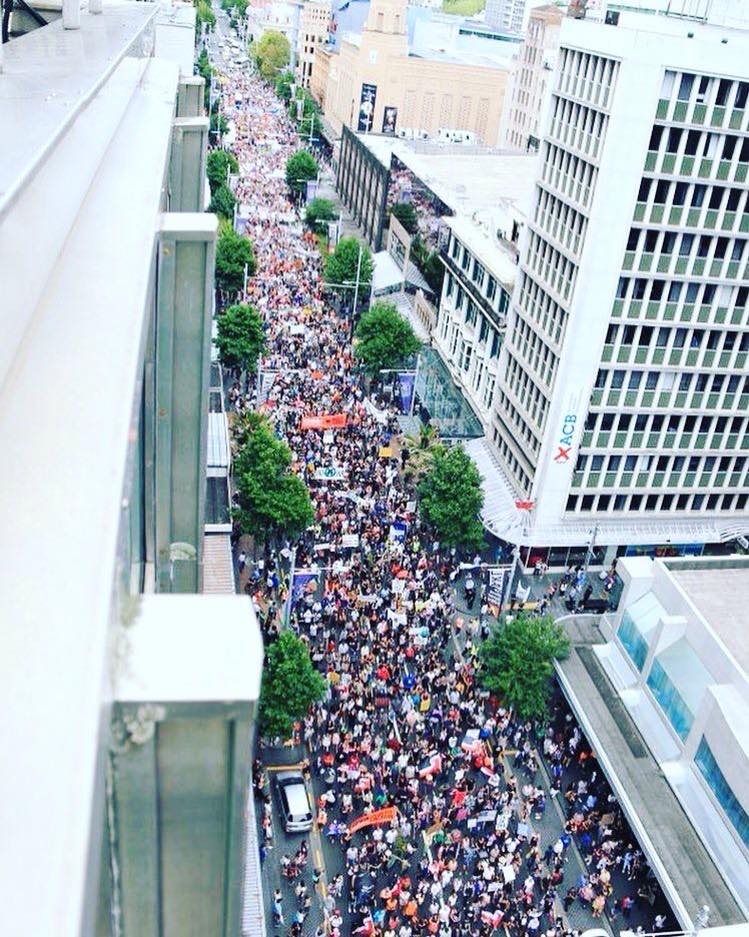
SOME TRIBUTES FIRST, then an apology. To Jane Kelsey and Barry Coates I can only say thank you. Demonstrations like the one I marched in yesterday don’t just happen. They are the product of hours and days and years of hard work, during which people fight not only against loneliness and fatigue, but against the insidious thought that their unceasing efforts might all be in vain. Observing the glowing faces of Jane and Barry, as they rode down Queen Street yesterday afternoon, it was their selfless commitment to battling on, heedless of setbacks and against all odds, that brought tears to my eyes. Once again, thank you.

Tribute is also due to Real Choice. By their extraordinary actions throughout the morning and afternoon of 4 February 2016 they proved just how sterile theoretical debates about tactics and strategy can be. Somehow, in growing older, I had forgotten the words of the young student activist, Mario Savio, spoken 50 years ago on the steps of Sproull Hall at the University of California’s Berkeley campus. In my teens and twenties I had sworn by them, and, to my older self, they certainly bear repeating:

There’s a time when the operation of the machine becomes so odious—makes you so sick at heart—that you can’t take part. You can’t even passively take part. And you’ve got to put your bodies upon the gears and upon the wheels, upon the levers, upon all the apparatus, and you’ve got to make it stop. And you’ve got to indicate to the people who run it, to the people who own it that unless you’re free, the machine will be prevented from working at all.”

Yesterday, Real Choice put their bodies on the asphalt of Auckland’s inner-city carriageways, and for several hours they made things stop. In doing so they sent a much-needed reminder to the people who run, to the people who own, this country that it can, if the provocation is great enough, be prevented from working. No one has indicated that to them for a very long time.

So, to Real Choice I say: Respect. No one was seriously hurt and no one was arrested. In the words of the little man in the grey suit who was right there in the thick of things, that was: “Bloody marvellous!”

I also say: Sorry. For my throw-away, and clearly unfounded, suggestion that Real Choice might be a “false flag” operation, I apologise – and my statement is withdrawn unreservedly. No false-flag operation could possibly have out-thought, out-run and out-manoeuvred the Police like Real Choice did yesterday. The Springbok Tour protesters of 1981 could not have done it better.

BUT, NOW WHAT? In which direction should the energy generated by yesterday’s protest actions be turned?

Happily, there is no shortage of targets.

Parliament resumes sitting on Tuesday, 9 February. The slow wending of the TPPA document through numerous select committee hearings, followed by the Government’s enabling bill’s passage through the four stages of parliamentary debate; both will provide excellent opportunities for carefully targeted protest action. Likewise, the Ministry of Foreign Affairs and Trades’ (MFAT’s) travelling road-show of public presentations intended to “sell” the Government’s pro-TPPA position to the electorate. All should be seen as educative political events, reinforcing the anti-TPPA’s core messages of diminished national sovereignty and a deepening democratic deficit.

The extent to which these core messages have already entered the public’s consciousness has unpleasantly surprised the TPPA’s supporters. They were taken aback at the size and vehemence of the Auckland protests and will already be working on ways to unpick the picture Jane Kelsey and her comrades have embroidered so vividly on the public mind. The Government’s and big businesses’ counter-offensive will have to be met, held, and rolled back.

This will be made considerably easier by the simultaneous fightback against the TPPA occurring all around the Pacific rim – but especially in the United States. Strategically, the struggle is between the progressive/patriotic forces operating within the twelve signatory states, and the defenders of the transnational corporations. Obviously, this puts the “Pro” forces at a serious disadvantage. Far from being able to pass themselves off as promoters of the public good, they will emerge from the contest as the big corporations’ fifth columnists, committed to defeating the patriots fighting to prevent the agreement’s ratification.

John Key and his Government thus risk entering election year as a collection of figurative “Quislings”, guilty of conspiring against the national interest on behalf of entities without countries, morals or scruples. If this perception can be driven deep into the electorate’s mind, then National’s chances of re-election will be nil. More importantly, the victorious progressive/patriotic parties will be swept into office with a broad mandate to take on a corporate plutocracy that has ruled without challenge for far too long.

For the first time in over 30 years, there will be a mass political movement dedicated to putting itself “upon the wheels, upon the levers, upon all the apparatus” of the neoliberal machine – and making it stop.