This
is a very sad day because it represents the passing of a more
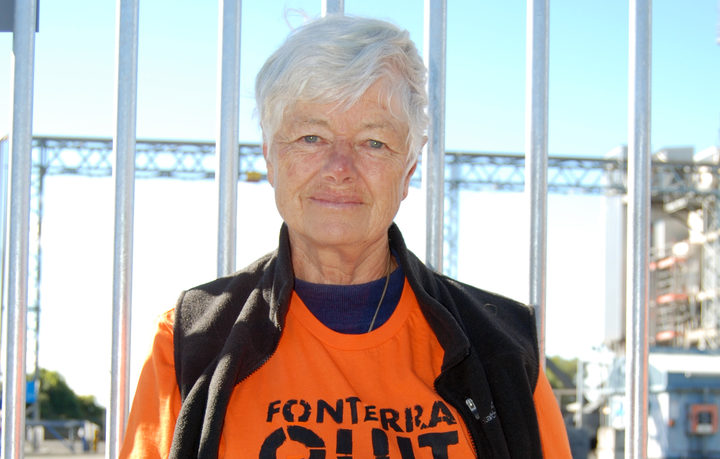
positive era. I knew Jeanette and I know she lived what she fought
for, every day and never stopped being a thoroughly decent person.
It
is doubly sad when I contemplate what the Green Party has morphed
into,
Her
husband, Harry Parke, said the death was totally unexpected.
"Yesterday
morning she was out on the farm doing stuff, she had a bit of a fall
and finally ended up in Thames Hospital where she had a massive
stroke and died at 9.45pm last night - very peacefully I might add."
"The
day before, she was using a chainsaw - that's the sort of person she
is. She worked a lot harder than I ever did. I was totally in awe of
her.
"Fortunately
we both had very much the same convictions about what needed changing
in the planet and we had a very close relationship."
Prime
Minister Jacinda Ardern said Fitzsimons was a steward for the New
Zealand environmental political movement.
During
her 14 years in parliament, Fitzsimons was an early voice for action
on issues now considered mainstream, like climate change, clean
energy and the deteriorating state of New Zealand's water, Ardern
said.
"New
Zealand has lost someone completely and utterly driven by values, who
embodied the notion of leaving this place better than they found it.
Jeanette did that".
Green
Party co-leader Marama Davidson passed on her deepest condolences to
her husband Harry Parke, her children and grandchilden.
She
said Fitzsimons left behind a remarkable legacy and is a taonga and
bastion of the green movement.
Co-leader
James Shaw said Fitzsimons had immense generosity and humility, and
understood that you must work with those you disagree with to forge a
consensus.
Fitzsimons
was never about personality politics and was driven by what was the
right thing to do, he said.
"She
treated everyone with respect no matter their politics, and she
treated everybody with dignity."
Former
Green MP Keith Locke said she was rightly being remembered for her
integrity and was totally committed to the welfare of the planet and
the people on it.
"She
never gave away any of her principles for short term gain."
New
Zealand First leader Winston Peters said she was a hugely significant
figure in the formation of the Green Party, a tireless advocate for
the environment, and a leader who carried herself with great dignity
and conviction.
Fitzsimons
became the co-leader of the Green Party of Aotearoa New Zealand in
1995, and when the party joined the Alliance led by Jim Anderton's
New Labour Party, she took on the deputy leadership role.
After
the first MMP election in 1996, she entered Parliament as a list MP
for the Alliance but it wasn't long before strains appeared in the
grouping.
She
felt herself left out of its decision-making and the Green Party
itself was increasingly unhappy with the Alliance's direction.
Fitzsimons
won the Coromandel seat for the Greens in 1999, the country's first
elected Green MP and was disappointed when she lost it in the
following election, although the party remained in Parliament due to
its party vote.
She
and her co-leader Rod Donald were strong influences in the change in
public perception of the party as a group of sandal-wearing
tree-huggers.
Parke
said Fitzsimons was "instrumental" in getting the Green
Party up and running in the 1990s. More recently, her focus had been
on climate change.
"She
fought really hard to get people to accept you can't keep growing the
economy and stop climate change. It just seems people don't want to
hear that."
Fitzsimons
was known for never raising her voice in the House and never
responding to barbs thrown around in Parliament.
"She
strongly believed that never got you anywhere, that all it did was
take the focus off the subject you were talking about and your energy
needed to be totally on what you were trying to achieve. I think she
held that up admirably," Parke said.
"She
never let her emotions get in the way of what needed to be said and
what needed to be done."
"She
totally lived her convictions and there was no way that anyone could
say she didn't live up to what she was saying."
She
was made a Companion of the New Zealand Order of Merit in 2010.
OskarLafontaine, born 16 September
1943) is a German politician who served in the government of Germany
as Minister of Finance from 1998 to 1999. Previously he was Minister
President of the state of Saarland from 1985 to 1998, and he was also
Chairman of the Social Democratic Party from 1995 to 1999. After
having won the 1998 German federal election along with new Chancellor
Gerhard Schröder, he resigned from all political offices, including
his seat in the German Bundestag, only a half year later and
positioned himself as a popular opponent of Schröder's policies in
the tabloid press.
Germany’s
Greens Are Not Green – They Are Stars And Stripes
Chair
of Die Linke Party comments on Frack-gas, Nordstream II and German
politics
The
Greens are the extended arm of the United States in the German
Bundestag. This has been demonstrated again and again, most recently
on the subject of fracking gas. In the interest of environmental
protection, they should refuse to buy this dirty gas. But as “Friends
of the USA” they keep coming up with something to enable the sale
of this over-priced gas in Germany and Europe.
Now
the green co-chair Annalena Baerbock has come up with something new.
We have “a considerable amount of leverage in our hands with the
Russian Nordstream 2 pretige project,” she says, “to bring Putin
to reason.” After all, the Russians supported the bombing of Syrian
dictator Bashar al-Assad in the Idlib region.
Why
not leverage on the US?
The
jihadists armed by the United States and their Arab friends have
settled there. It is striking that Annalena Baerbock and many Greens
see no leverage in the “US Prestige Fracking Gas Project” against
the US bombardments in several countries and their drone wars that
violates international law. Despite
styling themselves as a “human rights party”, they repeatedly
refuse to pillory the state which is responsible for most human
rights violations with their arms deliveries, trade wars, covert
wars, drone wars and bomb wars terrorizing the world.
Baerbock
is in the tradition of Joschka Fischer, who played a major role in
Germany’s participation in the Yugoslavia war that violated
international law. He is now Senior Strategic Counsel for the
advisory firm of Madelaine Albright, the former Secretary of State
who believes that the US sanctions against Iraq, that resulted in the
death of 500,000 children, were “worth the price”.
So
far, Baerbock has only become a member of the German Marshall Fund
and the transatlantic advisory board of the US-friendly Heinrich Böll
Foundation – but it is only just beginning.
Meanwhile, on the other side of the aisle this is what Britain's Channel 4 comes up with. RT is partially right when it points out this is about a "fourth Industrial Revolution". Just a pity about the planet and its inhabitants.
Can capitalism combat climate change? Bank of England says business can benefit from saving
planet
Meanwhile in New Zealand.The Green Party I was once a member of was implacably against genetic engineering for good reason.
Now its corporate implant, leader James Shaw (who worked, I understand for BP and Bayer, is trying to get the party to make a u-turn if Mike Hosking says this you have to get REALLY WORRIED!
A
Dutch company is pushing on the Government to work quickly to get a
'silver bullet' for reducing methane from cows in New Zealand.
But
Agriculture Minister Damien O'Connor and his ministry both say the
product could technically be used now and have expressed some worry
about it's effect on New Zealand's brand overseas.
Meanwhile,
the Climate Change Minister has expressed excitement about the
product.
This
is the most clear-headed and informed analyses of the current Green
Party that I once loved that I have read. I have heard the current
party described as “neo-liberals on bicycles”
"The
party’s male co-leader, James Shaw, openly touts for the support of
“green” capitalists: as if the profits to be extracted from
re-branding corporate greed as an “ecologically sustainable
business ethos” will somehow render its actual production less
dependent on environmental despoliation and unrelenting human
exploitation."
Putting
The Blue Into Green: The party’s male co-leader, James
Shaw, openly touts for the support of “green” capitalists: as if
the profits to be extracted from re-branding corporate greed as an
“ecologically sustainable business ethos” will somehow render its
actual production less dependent on environmental despoliation and
unrelenting human exploitation.
IF
IT’S PERMISSABLE to talk about “Red-Greens”, then why
not about “Blue-Greens”? Surely an abiding concern for the
natural environment is something which transcends narrow ideological
considerations? And, if that’s true, doesn’t it make perfect
sense for an environmental party to position itself squarely in the
middle of the political spectrum – from whence it can reach out to
both the Left and the Right?
Certainly,
that’s what Vernon Tava believes, and the former Green MP, Kennedy
Graham, agrees with him. In fact, Graham goes further, arguing that
contemporary politics is driven by the followers of three great
quests. The quest for freedom; the quest for equality; and the quest
for sustainability. Graham strongly implies that the greatest of
these three is sustainability. Without a sustainable environment, the
quests for freedom and equality cannot succeed. This was the sort of
thinking that prompted the late Rod Donald to declare: “The Greens
are not of the Left. The Greens are not of the Right. The Greens are
out in front.”
A
great soundbite – but is it true?
It
all depends what you mean by “out in front”. If it is intended to
describe the vanguard role played by environmental activists in the
1970s and 80s, then the quip has some merit. Up until then
“development” was the dominant – and largely uncontested –
paradigm, embraced alike by the Capitalist West and the Communist
Bloc. The power of science and technology was being unleashed against
an intransigent natural world. “Progress” was the word used by
both the Left and the Right to describe humankind’s heroic mission
to bend Nature to its will. Felling forests, damming rivers and
levelling mountains were all achievements to celebrate. Humankind was
winning!
It
took the Astronaut’s photograph of “Spaceship Earth” to jolt
humanity into the realisation that this bright blue planet is all we
have – a dazzling repository of life and beauty in an otherwise
barren universe. Not an enemy to be subdued, but our one and only
home. If there was a foe to be fought, then surely it was rampant
industrialism and the insatiable consumerist societies it was
spawning? Whether these societies were ruled by Capitalists, or
Communists, hardly seemed to matter. The damage inflicted on the
planet’s fragile ecosystems by both ideologies was equally
catastrophic.
So,
yes. Those who grasped the full social, economic
and ecological consequences of the development
paradigm were, indeed, “out in front” politically.
With
the benefit of hindsight, however, it is possible to view the Cold
War stand-off between the United States and the Soviet Union as a
conflict driven less by ideology than straightforward geopolitical
rivalry. The Russians’ state-capitalist system, at enormous cost,
was able to maintain a rough military parity with its
corporate-capitalist competitors, but was completely outclassed in
virtually all other aspects of production. The Russians never
mastered the problems of distribution, and, crucially, suffered from
a crippling shortage of domestically generated investment capital.
The wonder is not that the Soviet Union fell, but that it remained
upright for so long!
With
the collapse of “actually existing socialism” in Russia and
Eastern Europe, and the Chinese Communist Party’s embrace of
“socialism with Chinese characteristics” (a.k.a Capitalism!) the
Greens’ boast that they were “out in front” lost its sting. The
imperatives of corporate capitalism were now driving economic
activity across the entire planet. Industrialisation and consumerism
were being supercharged – and so was their impact on global
ecosystems. Those who stood for the planet were now obliged to stand
against a capitalist system whose corporate masters refused to
acknowledge (and were, in fact, operating beyond) the moral and
political claims of the traditional nation state.
But,
as more and more of Earth’s burgeoning human population were
swallowed up in the capitalist machine, the amount of CO2 spewing
forth from its smokestacks and exhaust pipes was increasing
exponentially – soaring towards an atmospheric concentration
incompatible with the long-term survival of industrial civilisation.
Capitalism was facing its final and fatal contradiction: a negation
which only its own negation could negate.
The
colour of this capitalist death-machine is, and always has been,
blue. Calling yourself a “Blue-Green” is, therefore, oxymoronic.
You can no more be a “Blue-Green” than you can be a non-violent
boxer or a chaste debauchee. Nor is it defensible to describe
yourself as a “Green-Green” – as if rescuing the biosphere can
be accomplished without confronting directly the economic system
responsible for its devastation. In this regard, the subjective
sincerity or insincerity of Vernon Tava and Kennedy Graham is
completely irrelevant. Objectively, they are serving the interests of
the planet’s enemies – not its friends.
The
capitalists’ oft-repeated accusation that they are facing
“Red-Greens” is, however, entirely justified. If by “red” is
meant a force dedicated to overturning the prevailing capitalist
system and replacing it with one in which the three great goals of
freedom, equality and sustainability will each become the
indispensable guarantor of the other.
From
their first appearance in the 1980s, Green parties around the world
have presented themselves as both the exemplars and advocates of four
foundational principles: Ecological Wisdom; Social Justice;
Participatory Democracy; and Nonviolence. Each of these principles is
antithetical to the founding principles of Capitalism: The
Subjugation of Nature; Human Exploitation; Plutocracy; and Coercive
Violence. The dilemma confronting Green supporters in New Zealand in
2019 is just how far the Green Party has drifted from the global
Green Movement’s original values. There is a widespread and growing
feeling that the Greens’ parliamentary representatives are no
longer Capitalism’s enemies, but its enablers.
The
party’s male co-leader, James Shaw, openly touts for the support of
“green” capitalists: as if the profits to be extracted from
re-branding corporate greed as an “ecologically sustainable
business ethos” will somehow render its actual production less
dependent on environmental despoliation and unrelenting human
exploitation.
Only
if Green voters are willing to subscribe to the fiction of
“weightless” capitalist enterprises that leave no “carbon
footprint”, can Shaw’s pitch be rendered credible. Except that,
the cellphone in his pocket, the lap-top in his shoulder-bag, both
argue against his proposition. If Shaw could only see the horrors
attendant upon the extraction of the minerals that make them work;
the super-exploitative megafactories in which they are assembled;
then he would understand just how crushing the planetary burden
off-loaded by his new-found “green” capitalist friends truly is.
As
for the Greens’ female co-leader, Marama Davidson. Perhaps the best
that can be said of her performance is that it has been distinguished
by neither wisdom, nor justice. Nor even by a conspicuous quantum to
democracy – participatory or otherwise. Most notably absent has
been the founding Green principle of Nonviolence. On the contrary,
Davidson’s “woke” faction of the party, caught up in the
ever-tightening coils of identity politics, have unleashed a level of
emotional violence upon those it deems ideological heretics that must
surely make the party’s founders weep.
How
different is today’s Green caucus from the “magnificent seven”
Green MPs who entered the House of Representatives so triumphantly in
1999. The New Zealand establishment recognised those Greens for what
they were: enemies of the status-quo and certainly not the sort of
people this country’s capitalists (not even those in the Labour
Party!) felt the least bit comfortable about doing business with.
Red-Greens they were called: a label which MPs Sue Bradford and Keith
Locke wore with pride. Today, to be branded a Red is simply
embarrassing: proof only of outdated thinking.
Even
so, the National Party leader, Simon Bridges’, enthusiasm for
Vernon Tava’s “Blue-Green” initiative is misplaced. Such an
obvious example of right-wing “astroturfing” would produce little
of electoral value. Besides, all of the time, effort and resources
required to draw off enough votes to tip the Greens out of Parliament
would, ultimately, be politically counter-productive. New Zealand
Capitalism is much better served by leaving the existing Green Party
exactly where it is.
Sitting
comfortably in the boardroom: sporting a pale-green silk tie and
wearing a dark blue suit.
Green Party leader, James Shaw does not think there is a climate emergency
Māori Climate Commissioner and ex-member of right-wing ACT Party thinks there is
A historical background All of this throws me back to 2011 to about a year before I was involved in reporting on abrupt climate change.
I remember a discussion with a Green Party boffin named Nigel T on Peak Oil. He was dead against the Green Party taking a position on Peak Oil because,Nigel contended every message they put out has to be "90% positive" - otherwise the public won't vote for it:
"If you want peak oil and climate change to be mainstream issues, then you must bring them into the mainstream.
You cannot bring issues into the mainstream as a political party if you are marginalised and ineffective."
He even cited a bit of (pseudo) - "scientific research" ti back up his outrageous claims.
Essentially, he was saying that Principle and Truth were out. So they could get the votes they had to put out a 'positive' message. It was all about "going mainstream"
It was an argument for lying to the public.
The Green Party had now fully entered 'mainstream' politics.
It may have brought the Green Party some recognition from the mainstream media and a few more votes but it destroyed absolutely everything the Green Party stood for in my mind. But it also marked the day the NZ Green Party and I parted company.
Here are the comments from Nigel T. to a blogpost of mine from 2011.
Its a shame when people that seem to be able to look at the world with both eyes, still produce one-eyed rants if the evidence does not suit their preconceptions.
If you want a political movement to stay marginalised, then you don't want a political movement.
If you want peak oil and climate change to be mainstream issues, then you must bring them into the mainstream.
You cannot bring issues into the mainstream as a political party if you are marginalised and ineffective.
Please open your other eye and think critically and strategically. If you can think about this from another perspective you might even learn something.
You may even be able to help, rather than offering one-eyed rants.
***
As a political vehicle for these issues, the Green Party's job is to take these issues into the mainstream, and they are following solid science in order to do this.
We are in the unsustainable position we are in because too many people deny science when it is available to us, yet your position here also denies available science.
In the area of climate change, amidst the denial and hypocritical nonsense of all the parties in Parliament the Greens in coalition do not stand out at all. They are just as conservative as anyone in the political sphere.
In fact, it all reeks of hypocrisy.
I am not an insider so I don't know what the Greens have been doing since the Coalition came to. power. The answer is practically nothing.
We have a Green Minister of Climate Change which, one would think might be something to celebrate.
I do know that James Shaw, when it comes to to climate change (especially in the context of a marine heatwave and extremely hot weather) he is missing-in-action. You would think that as a Minister he might have more access to the media in educating the public but there has been silent.
A couple of anecdotes that have come my way indicate just how bad the Greens in power have been.
Last winter we had dinner with the brother of a friend of ours, a New Zealander based in the EU. He is working on a long-term project on a "super-grid" and has had high-level contacts, not only in the EU but in China and India where he met with the Minister of India. When he came to New Zealand he approached the Green Party for a meeting and as he expressed it, couldn't even get an appointment with the janitor.
I have heard another similar story where a local friend could not get any change on a conservation project he was working on. He singled out the Greens for being particularly unhelpful on something that should have been up their alley.
....The Bill won't be a partisan push. After all, as Mr Shaw points out, it was a National-led Government that signed New Zealand up to the Paris Agreement, which commits New Zealand to reducing our greenhouse gas emissions to 30 percent below 2005 levels by 2050.
"We are talking through the detail of the targets between the Government and the Opposition as we negotiate the final form of the Bill," said Mr Shaw.
"I have a view, but there are options that are in front of us and we are talking through the detail of how we do that. I think the thing that people are going to have to realise is that it's going to involve some compromise from everyone. No one is going to get everything that they want as a result of this process… As long as everyone's equally unhappy, we have a chance of getting this over the line."
But it turns out ex-Green Party leader and Greenpeace NZ executive director Russel Norman disagrees with Shaw's approach.
"Do you really want climate policy in New Zealand to be hostage to the backbenches of the National Party?
"You think about the nuclear-free - did we go, 'Oh let's all sit with our hands together and kumbaya, that's how we'll get nuclear free?' No. The Government took a strong lead and eventually National came in behind and admitted it had to follow.
"Government took leadership, we took a strong position on it. Climate change is the same. This is too important to water down to some kind of commission that has no powers, doesn't even affect all gases."
Here is James Shaw singing lavish praise on the National's praises on the 2016 Paris agreement.
Dear James, I assume you have had time to digest the latest watered down prognosis from the ultra-conservative IPCC who say we have 12 years to address the climate crisis when the UN said we had 10 yrs in 1989. Someone is either lying or can’t do math.
I assume you have had time to digest the latest watered down prognosis from the ultra-conservative IPCC who say we have 12 years to address the climate crisis when the UN said we had 10 yrs in 1989. Someone is either lying or can’t do math.
Paul Beckwith from the University of Ottawa was my guest on my radio show Nature Bats Last and he has also been advocating for the declaration of climate emergency for some time.
Climate scientist and go to guy for the corporate press Michael Mann has been caught out lying that 1.5C is still achievable. Quoting his position now is irresponsible in the extreme;
Winning slowly is the same as losing, not facing the multitude of crises we face is dereliction of duty.
What would it take for you to see an emergency?
Best
Kevin Hester
0274406999
Here is the text: Dear Kevin,
The reports produced by the Intergovernmental Panel on Climate Change (IPCC) represent the global scientific concensus, which the New Zealand government accepts.
The Government is committed to taking action on climate change. You refer in your eamil to the IPCC’s recent Special Report of Global Warming of 1.5C. The report is broadly in line with this Government’s direction on climate change and it is highly relevant to the work we are doing with the Zero Carbon Bill, particularly the importance of reaching net zero carbon dioxide emissions globally by 2050 if the world is to succeed in limiting warming to 1.5C above pre-industrial temperatures.
The Government intends that the Bill will create laws to help New Zealand change to a net zero emissions and climate-resilient economy. An Independent Climate Change Commission will also be established under the Bill to provide advice on climate change issues. The new laws will give certainty to New Zealanders that, no matter what government is in power, there will be a long-term approach to climate change that endures political cycles. While I agree with you that urgent action is needed, I think this approach will have greater long-term success than a unilateral decalration of emergency.
Thank you again for your correspondence,
Yours sincerely,
James Shaw
Minister for Climate Change
Here is Kevin's critique of the Green Party from some time back
I have been working on getting the message on abrupt climate change for nearly eight years and have well-and-truly reached the moment of giving up on politics when it concerns abrupt climate change.
There is no truth coming from any political parties or even politicians within parliament. And given what they know the biggest treachery is that of the Greens.
Looking back, I have my doubts that any "remedies" would have worked given the nature of the problem (sorry - that word is totally inadequate).
Kevin calls for the announcement of a "state of emergency".
I have a slightly different approach. I would be calling for a state of Predicament.
When it comes to a "climate emergency" that has just happened - in one place in the UK
I find myself in a quandary when it comes to the Extinction Rebellion. These people, in addition to being justifiably angry about decades of inaction but they are wanting action, now. But there is no action possible at this late stage and I don't know how to communicate this to enthusiastic young people who should have their entire lives in front of them.
Was there ever any possibility of averting this course of events?
During the time of Helen Clark government the Green Party espoused a carbon tax but gave this away during political negotiations for a policy on the carbon emission trading scheme which has to be the most corrupting and self-serving responses that I can think of.
In hindsight the Green Party should have stuck to its guns on a carbon tax. If a carbon tax had been introduced it might just have made a difference (although probably not) - especially if it was along the lines of that advocated by James Hansen (with benefits accruing to ordinary citizens).
When I think more clearly I can see that global heating is part and parcel of human civilisation which is a heat engine.
A postscript
Nothing could confirm all of the above than this article that has come out today written by Donna Awatere-Huata, a former high-wing ACT Party member of Government that is far more radical and hard-hitting than anything I have read from liberals - including the Green Party.
Our Prime Minister, Jacinda Ardern, stated that climate change was her generations ‘nuclear-free moment’, yet when we consider actual environmental policy to date, we can conclude that this ‘moment’ is little more than a feel good nuclear free bumper sticker. This criticism is not just levelled at our Government, the latest research shows it can be made against almost every Government.
Postscript: Kevin Hester just sen tme te following
Further to our on-going discussions regarding the criminal negligence of James Shaw MP and the coalition government’s denial of abrupt climate change, I’d like to draw your attention to my blog post on the fact that the IPCC target of limiting warming to a 2C maximum is both impossible and not safe;https://kevinhester.live/2016/06/05/the-myth-of-2c-being-safe-and-achievable/comment-page-1/

 Posts
Posts




/arc-anglerfish-syd-prod-nzme.s3.amazonaws.com/public/IBI4TXMMR5FC3IERKJ5FU52MVA.jpg)
