Showing posts with label Antactica. Show all posts

Sunday, 24 September 2017

Giant Antarctic iceberg head out to sea

Where have you seen this reported apart from here?

Of course, I realise it pales into significance compared with the NZ election results and your morning latte.

Big Antarctic iceberg edges out to sea


BBC,
22 September, 2017

The giant berg A-68 looks finally to be on the move.
Recent weeks have seen it shuffle back and forth next to the Antarctic ice shelf from which it broke away.
But the latest satellite imagery now indicates the near-6,000 sq km block is swinging out into the Weddell Sea.
A wide stretch of clear water has opened up between the berg's southern end and the remaining Larsen shelf structure, suggesting A-68 is set to swing around and head north.
"Iceberg size
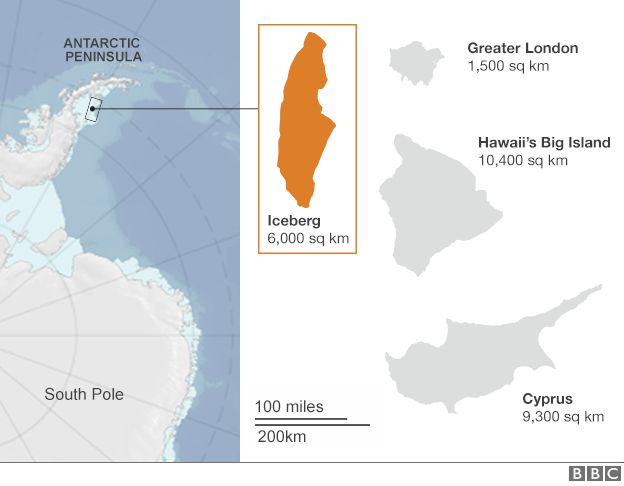
This is the direction the Weddell currents should take the iceberg.
Polar experts expect the trillion-tonne block to essentially bump along the shelf edge until it reaches the great eastward movement of ocean water known as the Antarctic Circumpolar Current.
This would then export what is one of the largest bergs ever recorded out into the South Atlantic.
How far A-68 actually gets along this predicted path is anyone's guess, however. The berg already shows evidence of fragmentation at its edges.
These bits - they carry the designation A-68b, A-68c, etc - all still float close to their parent. But in time they will get separated, and it is entirely possible that big segments with deep keels could get anchored in shallow waters and become semi-permanent "ice islands".
A-68 calved during mid-winter and it required radar satellites - such as Europe's Sentinel-1 spacecraft - with their unique ability to pierce cloud and darkness to keep track of developments.
With the return now to longer days in the Antarctic, opportunities are increasingly opening up for high-resolution optical satellites to take a close look at the state of the berg.
And new imagery from the Spanish Deimos-2 spacecraft shows how the initial sharp edges of the block's northern-western corner have been lost.
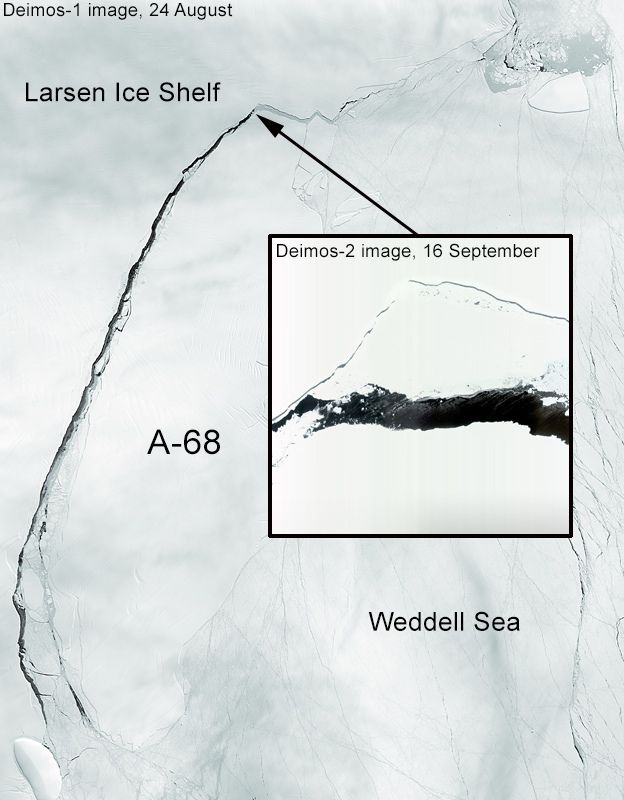
A-68


Scientists are not just looking at the berg; they also continue to monitor the Larsen Ice Shelf.
They are checking to see if its behaviour has changed since the calving.
The shelf is the floating protrusion of glaciers coming off the Antarctic landmass, and the ejection of such a large section of its structure could potentially trigger further fracturing or a change in the speed of ice flow.
So far, however, there is little evidence of either.
When A-68 moves clear of its birth position it will reveal seafloor that probably has not been free of ice cover for 120,000 years - during the peak of the last warm phase in Earth's history known as the Eemian.
The area has already gained protected status from the Commission for the Conservation of Antarctic Marine Living Resources (CCAMLR).
This gives scientists priority access and keeps fisheries activity at bay for a minimum of two years.
Previous research in locations uncovered by departing bergs has found new species.
Expeditions to visit A-68 this coming Antarctic summer season are in the planning stage.


Saturday, 15 July 2017

Antarctic Peinsula is the site of the highest recorded temperatures on the Antarctic continent

The Antarctic Peninsula is one of the areas on the planet with the most warming

Record-Breaking Temperature Reported near Larsen C


Several hundred kilometers away from Larsen C is the site of the highest recorded temperatures on the Antarctic continent. On 24 March 2015, temperatures at Esperanza station at the tip of the Antarctic Peninsula soared to a rather pleasant 17.5°C (that’s 63.5°F).
Temperature extremes in the Antarctic are important to evaluate and document in the face of changing regional and global climate,” scientists involved with verifying this temperature extreme wrote in Eos.


Although this record temperature isn’t directly related to the giant iceberg that just broke off Larsen C and although calving events are part of the normal life cycle of ice shelves, extreme dynamics on Antarctica provide context for overall trends. 

They highlight “the need to continually monitor all of the Antarctic region to ensure that we have the best possible data for climate change analysis at both the regional and global scales,” researchers noted.

Thursday, 6 July 2017

The mother-of-all-icebergs is coming your way

Scientists Know How Big the Larsen C Iceberg Will Be

5 July, 2017


It’s the final countdown. The European Space Agency said on Wednesday that just three miles separate theLarsen C crack — a rift slicing the front off a major Antarctic ice shelf — from open water.


Like a tailor with a tape measure, scientists have been measuring the crack using ESA satellites. The next Sentinel-1 satellite pass will happen later this week, providing a high-resolution look at whether the Larsen C ice shelf has finally calved an iceberg.
ESA’s CryoSat mission has been used to measure the thickness of the eventual Larsen C iceberg. On average, it will be about 625 feet thick but could dip as far as 690 feet below the water's surface.
Credit: 
ESA

While the Sentinel-1 satellite has provided the clearest view of the state of the crack, CryoSat, another ESA mission monitoring ice at both poles, has the ability to see through water and ice, providing the clearest understanding of the volume of the soon-to-be iceberg.

According to remoting sensing expert Noel Gourmelen from the University of Edinburgh, the iceberg will average about 625 feet in thickness from top to bottom, maxing out at about 690 feet below the water’s surface. Knowing the surface area will cover about 2,550 square miles has allowed scientists to estimate that the iceberg will contain roughly 277 cubic miles of ice.

Because it’s breaking off of an ice shelf already floating in the ocean, the iceberg will not have an impact on sea levels. But scientists will be tracking its path through the Southern Ocean because of the threat it could pose to ships, particularly as it calves comparatively smaller icebergs.

The iceberg is expected to have enough ice to fill more than 463 million Olympic swimming pools. Or put another way, it’s enough to cover all 50 states in 4.6 inches of ice, allowing you to skate coast-to-coast and take victory laps around Hawaii and Alaska. So yeah, it’s a huge ice cube, the likes of which has rarely occurred in modern history.
 The paths of all icebergs observed by ESA from 1999-2010. The yellow box shows where the Larsen C iceberg will start its journey.
Credit: 
ESA

The Weddell Sea, which is where the iceberg will begin its journey, typically spits floating ice on a path along the Antarctic Peninsula. From there, icebergs have usually followed a path out into the south Atlantic or along the Antarctic Circumpolar Current, according to historical data compiled by the ESA.

Beyond monitoring the threat to mariners, scientists will be intently checking on what remains of the Larsen C ice shelf. The iceberg-to-be represents approximately 10 percent of the ice shelf’s area. Losing that much mass at once is likely to change how the ice shelf behaves and scientists will be watching closely to see if more icebergs form or if the shelf exhibits other signs of weakness.

If the ice shelf does eventually disappear, it could accelerate the rate of sea level rise by unleashing a torrent of ice currently clinging to the Antarctic Peninsula. It’s a story playing out not just with Larsen C, but with other ice shelves around Antarctica as warming waters and air driven by climate change cut them down to size (though the Larsen C rift is likely due to natural causes). Their continued health is one of the key factors in determining how much oceans will rise.

Editor's Note: A previous version of this story said the Larsen C iceberg contained enough ice to cover all 50 states in an inch of ice. In fact, it could cover them in 4.6 inches of ice.


An enormous iceberg, more than 2,000 square miles in area — or nearly the size of Delaware — is poised to detach from one of the largest floating ice shelves in Antarctica and float off in the Weddell Sea, south of the tip of South America.


Scientists have been expecting the break from the Larsen C ice shelf, monitoring the progress of a crack that extended to over 100 miles long in recent months. The latest update from scientists with NASA and the University of California found that only three remaining miles of ice continue to connect the impending iceberg to the larger shelf.


Those parts of the iceberg that have already detached have begun to move rapidly seaward, widening the rift in recent days and leaving the remaining ice “strained near to breaking point,” according to Adrian Luckman, a scientist monitoring Larsen C at Swansea University in Wales.