Thursday, 1 June 2017

HEADLINES - 05/30/2017

There has been such a preponderance of news from all the hot spots on the globe.


With foreigners fightng for ISIS in Mindanao the conflict in the Philippines is looking more like Syria of the Pacific with the fingerprints of the United States sowing mayhem in yet another country,


Meanwhile, in New Zealand there is little coverage (and no context) despite this from being in our 'backyard' and having so many Philippinos living here.

Philippines

Islamic State fears grow as foreign fighters among bodies in Philippines


SMH, via Facebook

Foreign IS fighters were among the militants who besieged a southern Philippines city, intensifying fears that Islamic State is gaining a foothold in South-east Asia.

Bodies found in Islamic City of Marawi, 830 kilometers south of Manila, after almost a week of fighting include Malaysians, Indonesians, Saudis, an Indian, Yemeni and Chechen an eastern European citizen, according to Rohan Gunaratna, a terrorism expert from the S. Rajaratnam School of International Studies in Singapore.

The Mindanao Island of the Philippines is now Islamic State's epicentre in the region, he said.

Zachary Abuza, another expert on terrorism in South-east Asia, said that while there is no evidence that Islamic State has sent significant support to a dozen militant Islamist groups operating in the southern Philippines, "increasingly South-east Asians are being drawn to Mindanao".

Australia and other nations in the region are so worried about the threat of homegrown IS militants returning from battlefields in Iraq and Syria that they have convened a summit in August to co-ordinate the threat.

Hundreds of battle-hardened fighters are expected to return to the region as IS loses ground in the Middle East.

Attorney-General George Brandis told a Senate committee earlier in May that the return of the fighters is "the issue which is of greatest concern to heads of government and homeland security ministers in the region when it comes to counter-terrorism".

The Philippines, which has in the past downplayed the threat from IS, has confirmed that foreign fighters have played a key role in the siege of the Islamci City of Marawi that has so far left more than 100 people dead and dozens wounded.

"What's happening in Mindanao is no longer rebellion of Filipino citizens. It has transmogrified into invasion by foreign terrorists who heeded the clarion call of the Islamic State to go to the Philippines if they find difficulty in going to Iraq and Syria," said Philippine Solicitor-General Jose Calida.

The militants flew black Islamic State flags during their rampage of the city.

Philippine President Rodrigo Duterte last week imposed martial law, giving security forces sweeping powers, while warning of the threat of "contamination" by IS in his island nation of 100 million people.

Dr. Gunaratna said IS has provided groups in the southern Philippines with propaganda, some foreign fighters and some financial transfers but not huge amounts of money.

"They are moving very slowly but very steadily," he said. "They are not in a hurry."

Professor Abuza, who has written a book about militant Islam in the region, said that while media attention has been on kidnappings and beheadings by the extremist Abu Sayyaf group, the bigger threat is to regional trade and commerce.

He pointed out that between March 2016 and April this year there were 19 separate sea attacks and hostage takings, resulting in the capture of 70 sailors and fishermen from six countries. 

Professor Abuza said Abu Sayyaf is likely to continue to prioritize sea kidnappings, which involve low risk and high reward.

"Tug boats and fishing trawlers are very slow moving and undermanned. They are easy prey," he said.

The August summit is likely to decide on greater law enforcement cooperation and intelligence-sharing across the region.

Malaysia, Indonesia and the Philippines signed an agreement nine months ago for joint patrols in the Sulu Sea, but they have not begun.


ISIS makes military gains in Philippines


The Philippine government declared martial law on Mindanao Island as it continues to battle Islamic State combatants who have made gains in the southern region of the country. RT's Anya Parampil takes a closer look at the situation


Heavy clashes erupted once again in Marawi on Wednesday afternoon local time after ISIS insurgents ambushed a Philippine Army convoy which was heading towards the city centre through its western suburbs.


Using anti-tank weaponry and various types of armaments, the ISIS-linked Maute and Abu Sayyaf militants forced the Philippine troops to abandon their armored vehicles after killing at least a handful of government soldiers.


President Duterte has vowed to “eradicate all traces of Rothschild financial criminality” from the Philippines, announcing that he will no longer respond to pressure or financial blackmail from the US government or Rothschild-controlled global banking institutions.

Meanwhile the United States and NATO are further from controlling the situation than ever, Meanwhile NZ is being pressured to end yet more troops despite the scandal about SAS atrocities.

Afghanistan

Massive Truck Bomb Kills at Least 90 in Kabul’s Embassy District
Hundreds Wounded, Death Toll Expected to Rise

During rush hour Wednesday in Afghanistan’s capital city of Kabul, a massive truck bomb was detonated in the middle of the highly secured diplomatic area, causing massive damage to several embassies in the area, killing at least 90 people and wounding over 400 others.


Britain and the United States are pumping weapons into this conflict and supporting their headchopping Saudi friends

Yemen

Hadi: UAE Backing Southern Yemen Secessionists

Further complicating the Saudi War in Yemen, allies backed by two of the GCC nations involved in the invasion, Saudi Araba and the United Arab Emirates,, are now engaging in open fighting in the “interim” capital city of Aden, with UAE-backed forces seizing the Aden airport, killing one soldier.


More than 17 million people are facing dire food shortages in Yemen, as Oman seeks to mediate a peace deal

Yemen is descending into total collapse, its people facing war, famine and a deadly outbreak of cholera, as the world watches, the UN aid chief said on Tuesday.

Speaking to the UN Security Council, Stephen O'Brien said "the time is now" to end the world's largest food emergency and put Yemen back on the path to survival.

"Crisis is not coming, it is not looming, it is here today - on our watch and ordinary people are paying the price," said O'Brien, the UN undersecretary general for humanitarian affairs.

"The people of Yemen are being subjected to deprivation, disease and death as the world watches."

The crisis is spiralling towards "total social, economic and institutional collapse" in the poor Arab country, O'Brien added.

Could it be that Labour's Jeremy Corbyn is headed for a well-derived victory in the upcoming election and by so doing saving Britain from a move to tyrrany?


United Kingdom election

BBC debate: Rivals attack Theresa May over absence


Corbyn will join BBC leaders’ debate… but ‘chicken' May refuses to accept challenge


Labour leader Jeremy Corbyn has made a last-minute decision to attend Thursday night’s BBC leaders’ debate, despite Prime Minister Theresa May boycotting the live TV grilling.


Corbyn will join BBC leaders’ debate… but ‘chicken' May refuses to accept challenge


Who’s funding Britain's terrorists? ‘Sensitive’ Home Office report may never be published

An investigation commissioned by former Prime Minister David Cameron into the revenue streams behind jihadist groups operating in Britain may never be published, the Home Office has admitted.

The inquiry is thought to focus on British ally Saudi Arabia, which has repeatedly been highlighted by European leaders as a funding source for Islamist extremists, and may prove politically and legally sensitive, the Guardian reports.


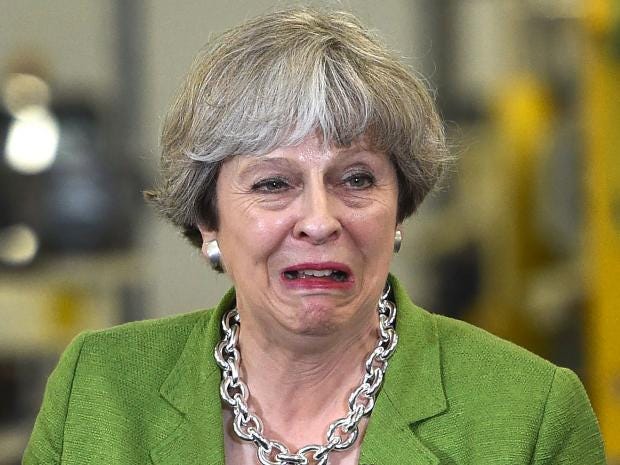
How low can Theresa May stoop , courting Britain's Jewish population

With just days before the election, British Prime Minister makes pledges on issues which matter most to the community including shechita, security and faith schools

Ha,ha, ha!

theresa-may.jpg

Theresa May's campaign has come unstuck in recent weeks

Labour is closing the gap with Tories and now stands just three points from Theresa May’s party, a new YouGov poll shows.

The poll, commissioned by The Times, found the Conservative lead has slipped dramatically in recent weeks and is now within the margin of error.

The figures show the Conservatives on 42 points but Labour are close behind on 39.


Syria and Turkey


Russian Special Forces Move Closer To US Forces in Syria


Situation grows ever more tense between US and Russian Forces in the region of Syria. Today Russia launched 4 cruise Missiles on ISIS positions near Palmyra, and at the same time Sputnik news release interview with Syrian Brigadier General claiming US forces have corroborated with Dash in the past. Regardless of the accusations the situation grows more tense by the day.

Links:


Following the liberation of six villages on two flanks yesterday, the Kurdish-led Syrian Democratic Forces (SDF) proceeded to capture a number of rural sites on Wednesday morning.

During clashes southwest of Raqqa, Kurdish forward units were able to wrestle control over the village of Hunaydi and established fire control over a section of the M6-highway, a jihadist supply road which runs vertically through ISIS’ territory in Syria.

Furthermore, fierce skirmishes erupted at the village of At-Tadiyah moments ago amid a pincer offensive cutting through ISIS turf on the southern bank of the Euphrates River.


On the eastern axis, the SDF recaptured the village of Raqqat as Samra overnight, thus advancing within two kilometers of Raqqa city’s eastern neighborhoods


Turkey blasts US for ‘extremely dangerous’ arming of Kurds in Syria

The US’ decision to arm Kurdish fighters in Syria is an “extremely dangerous” mistake that should be reversed, Turkey’s foreign minister has said. Earlier on Tuesday, the US announced that it was starting to deliver weapons to the Syrian Kurdish militia.

Such steps are extremely dangerous for Syria’s unity and territorial integrity,” Turkish Foreign Minister Mevlut Cavusoglu told the media on Wednesday.

If we are looking for stability in Syria, we should row back from those mistakes,” he told a press conference, while speaking alongside his Slovenian counterpart, Karl Erjavec

ISIS jihadists almost encircled in their last bastion in East Aleppo

Maskanah town, the last stronghold of the so-called “Islamic State” (IS, formerly ISIL/ISIS) in eastern Aleppo countryside is now encircled by Syrian Arab Army (SAA) from three flanks: north, west and east.

On Wednesday, SAA’s elite Tiger Forces division conducted fresh assault southwest of Maskanah striking IS positions in Khirbet Al-Far and ultimately capturing this village after several hours of firefights.

As a result of this advance, SAA’s frontline positions overlook Maskanah-Tabqa-Raqqa road which is now the only remaining way for IS jihadists to withdraw from Maskanah.

Preliminary reports have already emerged suggesting that IS militants retreated from the town, only leaving suicide squads behind to slow down and delay government forces advance in the are


The relations of Turkey to some members of NATO are also in turmoil. Last year’s failed military coup prompted Erdogan to accuse the West, including the US, to have designed the incident, that had military jets circling major cities, tanks in the streets and military helicopters shooting at people that tried to thwart their efforts.

Back then Incirlik airbase, which is used by many NATO members and also hosts US strategic nuclear weapons, was put in lock-down by Turkish authorities. Shortly after the airbase was back in normal operation, but ever since foreign politicians are not permitted to visit the base.

Still Germany and others insist, that their members of parliament must be allowed to inspect their respective country’s troops at Inrcirlik and threaten to otherwise pull out their military. German Defense Minister Ursula von der Leyen already announced,that an airbase in Jordan was determined to be a suitable replacement for Incirlik.


Last week NATO also altered it’s statutes in reaction to Turkey’s veto against a NATO partnership with Austria. Now Austria is still being blocked, but NATO can at least carry on the cooperations with other partner states, without having to discard Austria from a prior neccessary comprehensive adoption of all partnerships.

According to Die Welt, highranking diplomats within NATO explained the newest move as an attempt to distance NATO from Turkey’s domestic policies: “We do not want to upvalue Turkey internationally and want to avoid the impression, that NATO was supporting the Turkish government’s internal policies.”

Russia


A veteran Russian politician has suggested that Moscow could resort to nuclear arms to defend the nation if forces led by the U.S. or NATO moved against the Crimean Peninsula or eastern Ukraine.


Vyacheslav Alekseyevich Nikonov, a member of Russia's lower house of parliament and a political scientist involved with Russian politics since the 1970s, told attendees of the 2017 GLOBSEC Bratislava Global Security Forum in Slovakia on Sunday that Russian forces would need to utilize some form of nuclear warfare to deter U.S. or NATO forces from invading Russia should they decide to enter Crimea or eastern Ukraine

The United States

HILARIOUS & PAINFUL: Query on Saudi Democracy Causes Longest Awkward Pause in State Dept History


This could be the most uncomfortable State Department press briefing moment yet.

During a press conference about US President Donald Trump’s recent trip to the Middle East, AFP journalist Dave Clark asked a department official why the US criticizes the Iranian elections and its record on democracy, but not Saudi Arabia.

"How do you characterize Saudi Arabia’s commitment to democracy, and does the administration believe that democracy is a buffer or a barrier against extremism?" Clark asked.


Stuart Jones, acting assistant secretary for Near Eastern Affairs, took a full 19-second pause before responding with a brief comment, saying that during this trip, the US made “significant progress with Saudi and GCC partners in both making a strong statement against extremism”

Debbie Wasserman Schultz’s brother Steven Wasserman accused of burying Seth Rich case

From the sublime to the rediculous


The liberal left in America are quickly moving towards a fascist ideology that punishes any dissenting voices, especially voices that agree with US President Trump or doubt the Hillary induced Russiagate story


Thawing permafrst realeasing nitrous oxide

Another positive feedback.  I think Guy McPherson has given up counting the.

"N2O is a strong greenhouse gas, almost 300 times more powerful than CO2 for warming the climate. With an atmospheric lifetime of 110 years, nitrous oxide is recognized as a particularly robust contributor to climate change.

"It causes two types of atmospheric damage ~~ not only is N2O a greenhouse gas, but it's also an ozone destroyer, because the process that removes nitrous oxide from the atmosphere also depletes ozone."

Thawing permafrost will release powerful greenhouse gas nitrous oxide
New research shows nitrous oxide emissions from the warming Arctic are much greater than previously thought, and will add to climate change and damage the ozone layer. Andrew Masterson reports.


30 May, 2017

Thawing ground inside the Arctic circle could release as much nitrous oxide (N2O) into the atmosphere as tropical rainforests – previously the biggest known natural emitter of the powerful global warming gas.

Research by a team led by Carolina Voigt of the University of Eastern Finland reveals that N2O escape from subarctic peatlands is increasing as global warming prompts the thawing of permafrost.

N2O is recognised as a particularly robust contributor to climate change, because it causes two types of atmospheric damage.

Nitrous oxide has an atmospheric lifetime of 110 years,” wrote Australian global warming experts Peter Grace and Louise Barton in 2014.

The process that removes nitrous oxide from the atmosphere also depletes ozone. So nitrous oxide is not only a greenhouse gas, but also an ozone destroyer.”

In the latest research, published in the US journal Proceedings of the National Academy of Sciences, Voigt and her colleagues note that although carbon emission associated with Arctic climate change has been well studied, the potential role of N2O remains poorly understood.

This, they suggest, needs to be urgently addressed.

Vast stocks of nitrogen (more than 67 billion tons) in the permafrost, accumulated thousands of years ago, could now become available for decomposition, leading to the release of nitrous oxide to the atmosphere,” they write.

N2O is a strong greenhouse gas, almost 300 times more powerful than CO2 for warming the climate.”

To test the effects of permafrost thaw Voigt and her team established 16 peatland “mecocosms” – medium-sized experimental test plots – each around 80 centimetres long and 10 wide. Some of the plots were bare, while others contained either lichens, vascular plants or both.

141215 climatewatch 1.jpg?ixlib=rails 2.1
The subsurface regions of the test areas were then exposed to different concentrations of water, to simulate various permafrost thaw scenarios.
The researchers found that when the thaw exposes bare land – a common occurrence in the Arctic region – nitrous oxide emissions increased fivefold, matching the levels emitted by rainforest soils.

The presence of vegetation and standing water both decreased emission levels. However, the scientists suggest that climate change-induced permafrost thaw is likely to be a relatively dry process, one that doesn’t favour the retention of moisture or plants.

On present calculations, around one quarter of the Arctic region landmass is bare pet.

The researchers did not attempt to calculate the total amount of N2O likely to be released during a widespread permafrost thaw because, they noted, there was not enough data to allow them to accurately determine the levels of moisture present in all areas.

However, their conclusion – conservative and cautious – will worry climate change researchers and policy-makers like.

At a global scale, this [study] puts Arctic N2O emissions from thawing permafrost in the range of emissions from fossil fuel combustion, industrial processes, and biomass burning, the second largest anthropogenic N2O sources after agriculture,” they write.


Abrupt cliamte change on the indian subcontinent

For more news on the Indian subcontinent and how it is being affected GO HERE

South India's Drought Part 1: Five states face severe water crisis made worse by the onset of summer


20 May, 2017

Editor's note: This is the introductory article to a nine-part series of ground reports on the ongoing water crisis in south India. Firstpost will cover various aspects of the near-calamitous situation in Karnataka, Kerala, Tamil Nadu, Andhra Pradesh and Telangana, over the next eight days. 

South India is parched — Kerala, Karnataka and Tamil Nadu are already reeling under severe drought, and Andhra Pradesh and Telangana are on the brink — now the blistering heat waves will probably put more pressure on the existing water resources.
While Kerala and Tamil Nadu are facing an unprecedented drought – the worst ever in over a century, according to experts; Karnataka’s northern districts are without water for the third consecutive year.
In October 2016, Andhra Pradesh announced that 245 of its mandals were drought-hit due to a deficiency of 4 percent rainfall. Telangana, a perennially water-starved state, is engaged in water wars with its Telugu-speaking neighbour over allocations of Krishna and Godavari river water.

Tamil Nadu

The situation is grim in the southern-most part of the country. The North East monsoon, which is the main source of water for the state, was deficient by 62 percent last year. The year 2016 was uneventful despite the failed monsoon as the December 2015 floods filled up lakes and water bodies and recharged groundwater, bringing the water table up by 2-3 meters.

Tamil Nadu farmers during their agitation demanding loan waiver and compensation for crop failure, at Jantar Mantar in New Delhi on Wednesday. PTI
But summer has set in full force. Chennai has already experienced three days of heat wave, with temperatures crossing 40 degrees Celsius, a deviance of 3 degrees from the average at this time of the year. Experts warn that the state will reel under severe heat in the coming months, with temperatures expected to cross 50 degrees Celsius in an abnormally hot summer. Drought is adding to the state’s woes.
Authorities are at a loss as to what to do for water, considering that the neighbouring states are also reeling under drought. The state’s battle over Cauvery water has not come to much – there is hardly any water in the Cauvery for Karnataka to release. Andhra Pradesh yielded to the pleas of the then chief minister O Panneerselvam in February this year, but the 2 tmc-feet of water released was barely enough, even for Chennai. Water levels in the reservoirs of the state are at 5 percent of their total capacity, with the key reservoirs feeding Chennai – Chembarambakkam and Cholavaram – already at dead storage.
The state is now tapping water filled in mines and quarries, water released from Neyveli’s thermal power plant and desalination plants to somehow meet the needs of the thirsty population. Groundwater is being drawn at an alarming rate by the civic bodies, citizens and illegal water tankers alike. As a result, groundwater levels have fallen drastically – between 5 and 10 feet – across the state. Water supply has been rationed.
It is a drought we have not seen in 110 years. Extreme weather events are becoming more frequent and it is due to global climate change. We may see a repeat of 2015 (floods) next year or the rains may fail again like they did in 2016. We cannot figure the weather out. But we need to ensure that we are prepared,” said S Thirunavukkarasu, retired official of the Tamil Nadu Public Works Department which is in-charge of maintaining most of the reservoirs, lakes and rivers in the state.
Kerala

The rain gods have spurned God’s Own Country. The worst drought in the state in 115 years has made the residents very anxious. With the South West monsoon being deficient by 33.7 percent (July to September) and the North East monsoon short by 61 percent (October to December), the state is floundering.
Drought has meant that the power supply too has been hit as Kerala largely depends on hydroelectric power. The Idukki hydroelectric project, which is the largest producer of power in the state, has only enough water to generate 40 percent of its total capacity. While the state annually needs 24,000 Million Units (MU) of power, only 7,100 MU are generated at home while the rest is sourced from outside. The bad news is that as the rains cease and water storage decreases, internal generation will fall to 5,200 MU. This means that close to 2,000 MU of power will have to be again bought from outside. With all the power plants put together in the state, a stock taken on 22 December, 2016, shows that only 1,988 MU of power can be generated against the previous years. While in 2015, it was 2,754 MU; in 2014, it was 3,246 MU taken on the same date.

Representational image of the Cauvery River. Karnataka might face severe water shortage if the South West monsoon fails for the fourth consecutive year. Photo courtesy: Wikimedia.

Karnataka

This year is bound to be tougher because even the Cauvery basin districts in Karnataka have gone so dry that the state might face a gigantic crisis if the South West monsoon fails for the fourth consecutive year, beginning June. The shortage of water and unemployment have already made hundreds, if not thousands, of villagers move to the cities and towns of not only Karnataka but neighbouring states as well. The reservoirs fed by the Cauvery river are at dead storage as cities like Bengaluru thirst for water.
This is because of the heat wave in north Karnataka and the third consecutive year of drought. A rainfall deficit of 35 percent in the Malnad region, the catchment area for many perennial rivers emerging from the Western Ghats, has meant that the river water too has failed the state.
What is concerning experts is the lack of vision and long-term policy and planning by state governments across south India to tackle drought. “Nobody cares about migration,” said Professor Narendra Pani of the National Institute of Advanced Studies in Bengaluru. “The government is looking for a quick fix. There is a need to set up markets for farmers and we need to have a system of aggregation. You need to bring people together and, perhaps, set up sheds for sericulture to control quality. Unfortunately, we don't even think on the lines that China has succeeded in implementing.”
Andhra Pradesh and Telangana

Andhra Pradesh’s groundwater table has dropped to 14.34 metres, following a rainfall deficit of 23 percent last year. Ideal groundwater level should be between 3 and 8 metres, as per government recommendations and the state has begun an ambitious groundwater recharging programme called 'Neeti Samrakshana Udyamam'.
Chronically drought-prone areas like the Rayalaseema districts of Anantapur and Kadapa have become more arid, with crops failing. Andhra has got a drought relief package of Rs 2,816 crores from the Centre.
While Telangana received slightly higher rainfall than the average in 2016, the state is engaged in water wars with Andhra for river water from the Krishna and the Godavari. For now, the water situation is under control in Telangana. But with heat waves predicted in both the Telugu-speaking states, the respective governments are gearing up for the summer months.
Experts are criticising the knee jerk reactions of state governments to drought, rather than planned conservation. Chennai-based economist, Venkatesh Athreya said, “You need to promote sustainable water conservation and newer methods of irrigation. Yes, there has been a collective action in desilting tanks etc. Certainly inspiring but it doesn't absolve the state of its responsibility. It is the scale that matters which only the state can do it.”
Drought In South India

Social biases are adding to the trauma of scarcity. Take for instance the illiterate and the socially-backward sections in Tamil Nadu's Cauvery Delta region. The Dalit woman is left empty-handed because the landed gentry understand the problems between Tamil Nadu and Karnataka caused by the dispute over sharing of Cauvery waters.
Not that life in the cities is any better. The job-hunter from the village expects to get the most basic requirement — water. But it has become a traumatic experience in his effort to survive the summer. Many in Chennai are forced to pay 10 times the normal amount for a pot of water.
Scarcity of water has reached such levels that even Nandan Nilekani, perhaps, did not realise that the Unique Identity (UID) card called Aadhaar would be used as a tool to ration water. Based on the Aadhaar card, people are given water cards to become eligible for a pot of water in one district of Andhra Pradesh. But, then there is a price to pay after acquiring that water card. The citizen has to pay Rs 5 per pot of water from private water suppliers.
But, the story about scarcity of water or drought in some places is not all about at what price water is sold. It is about the impact that this precious commodity has on society and on all aspects of development for the future. The effort to deal with the problems of climate change has been such that there has been no concrete measures taken by any of the state governments to prepare for the summer months which have been becoming traumatic with each passing year.
For instance, a state like Tamil Nadu has not realised that it has the longest coastline among the Indian states and the consequential adverse situations. Such situations in the future, experts believe, could be even worse than the flood havoc it faced in December 2015. It appears the state is clueless about how to safeguard itself in the future from the ubiquitous climate change. The state has not understood that the changes in the seas impact the inland.
But, it must be said that not all governments are callous about the future. Kerala has adopted a mission mode approach to reclaim dried up lakes, canals, ponds and other water bodies. It is a start but, at least, one state has begun to look at something in a mission mode.
Firstpost brings to you a series on the impact of the harshness of the summer from each of the south Indian states which, incidentally, is the most developed zone of India, along with western India, with a hope that the powers-that-be, not only the government but the powerful civil society as well, will begin to look at initiating measures to provide mission-mode programmes to reduce the agony of summer.


Larsen C Iceberg Is on the Brink of Breaking off

For those New Zealanders who are insular enough to think that only local news is relevent (lik Radio NZ) this should be frightening.

I can see the spin when it happens – a “wonderful” spectacle and there will be tourist trips to see the iceberg.

The Larsen C Iceberg Is on the Brink of Breaking Off
The saga of the Larsen C crack is about reach its stunning conclusion.


31 May, 2017


Scientists have watched a rift grow along one of Antarctica’s ice shelves for years. Now it’s in the final days of cutting off a piece of ice that will be one of the largest icebergs ever recorded.

It’s the latest dreary news from the icy underbelly of the planet, which has seen warm air and water reshape the landscape in profound ways.
The crack has spread 17 miles over the past six days, marking the biggest leap since January. It’s also turned toward where the ice shelf ends and is within eight miles of making a clean break. There’s not much standing in its way either.
The rift has now fully breached the zone of soft ‘suture’ ice originating at the Cole Peninsula and there appears to be very little to prevent the iceberg from breaking away completely,” scientists monitoring the ice with Project MIDASwrote on their blog.

The growth follows reports from early May that the crack across the ice shelf had sprouted a branch, further underscoring how unstable the ice is becoming. Ice shelves float over water and essentially act as doorstops that hold back the vast Antarctic ice sheet.

The breakup is sure to be a spectacle both awe-inducing and horrifying. The iceberg on the verge of splitting off is estimated to be the size of Delaware, covering an area of 1,930 square miles. That’s equal to 10 percent of the ice shelf’s total area.
Once it breaks off, scientists are concerned that the rest of ice shelf could collapse afterwards, a fate that befell Larsen A in 1995 and Larsen B in 2002. In Larsen B’s case, the ice shelf collapsed in the span of a month following an influx of mild air.
In February, the New York Times reported that when the iceberg breaks off, it will weaken or destroy two key areas where ice overlaps islands. Those areas help keep the ice shelf from falling apart. Losing them could dramatically reduce the remaining ice shelf’s stability. Larsen C is substantially larger than its former neighbors Larsen A and B, and its loss would be a huge blow to ice on the Antarctic Peninsula.


he changes don’t just stop with the Larsen C crack or the Antarctic Peninsula in general. The vast majority of ice shelves are losing volume due to rising ocean and air temperatures. That’s helped prime parts of West Antarctica for what might be unstoppable melt that could raise sea levels at least 10 feet.

Researchers also recently found meltwater ponds are much more common than previously thought. They even discovered a roaring seasonal waterfall on the Nansen Ice Shelf.

These and other findings make clear that the Larsen C crack is just one of many changes happening to Antarctica. Global warming has pushed temperatures up to 5°F higher in the region since the 1950s and they could increase up to 7°F further by the end of the century, putting more stress on ice.

Though the changes are happening in the most remote part of the planet, they’re being felt thousands of miles away as ice turns to water and starts to lap against increasingly beleaguered coastal communities around the world. And the impacts will only grow more severe unless carbon pollution is reined in.


James Hansen 12 years ago: ""If we pass 1°C, It's a point of no return for global warming"

The real target, as pointed out by foremost climate scientist, James Hansen has always been 1 degree Celsius. Yet if you take the sleight-of-hand out of the equation (changing the measurements from comparisons with the pre-industrial age to the oeriod since 1950) we have already passed the 1.5 degrees target mentioned at Paris.

And yet at a talk I went to recently the message was that the climate is changing in a linear manner and we are on target for a 0.1C increase per decade.


This is not only wrong but it is fraud.

From Guy McPherson: 

"According to an analysis posted on the Arctic News blog on April 24, 2017 that assumes exponential temperature rise, rather than simply adding up the primary contributors of temperature rise, the planet will reach 23 C — some 9.5 degrees above the 1750 baseline — in 2021

"That’s in four years. 

"Lest you believe this is crazy, a similar analysis conducted in 2012 predicted only a global-average rise in temperature of 4 C above the 1750 baseline by 2030. The analysis from 2012 has proven wildly conservative."


As James Hansen Stated in 2005, "If we pass 1°C, It's a point of no return for global warming"


Perhaps we shouldn't be speculating but these off-the-cuff calculations give an indication of where we are.


17,944 km³ losing 2041/week ~18 losing 2/week = 9 weeks from now. That's one week into August in my book. (Daily losses of course suggest even earlier in the summer.)

Using the last couple of days for average, we get this math puzzle:


17,944 km³ – 515/day = 17944/515 = 35 days. I.e. July 4th @ Zero km³.


Guy McPherson on Press TV: "Paris Climate Agreement is 'irrelevant' because global warming is irreversible

I can hardly emphasise this enough. The Paris agreement, along with Trump’s withdrawal, is all a circus. None of the the commitments can be kept.

Gaia’s a bitch.She has a mind of her own after waiting for humans for far too long.

We live in the Age of Consequences.

Paris climate agreement can’t stop global warming: US scientist
US President Donald Trump’s decision that his administration would not be adhering to the Paris Climate Agreement is “irrelevant” because global warming is irreversible and will inevitably lead to the demise of human life on Earth, an American climate scientist says.

Listen to "Paris climate agreement can’t stop global warming: US scientist" on Spreaker.

31 June, 2017

Trump is expected to pull his country out of a global pact to fight climate change known as the Paris Climate Agreement, a move that would have profound effects on the planet and deepen a rift with American allies.


According to Axios news outlet, which first reported the withdrawal, Trump’s decision was influenced by a letter from 22 Republican senators, including Majority Leader Mitch McConnell, who have called for an exit from the landmark climate deal.

Axios said details of the pullout are being worked out by a team that includes Environmental Protection Agency (EPA) Administrator Scott Pruitt.

That comes as no surprise to anybody paying attention to global average temperature, the Trump administration, the deep state that operates within the United States or myriad of other factors associated with our near term demise as species,” said Dr. Guy McPherson, professor emeritus of natural resources - ecology - and evolutionary biology at the University of Arizona.

None of this matters anymore, this is all a show, the Paris Agreement, the Trump administration’s response to it,” McPherson said during an interview with Press TV on Wednesday.

All of these distractions, all of these irrelevant activities are merely a show to keep up from looking at the truth; to keep us from acknowledging that we as individuals are going to die and that our species is going to extinct and both of those are going to happen far faster than expected,” he added.

So we really don’t need much time analyzing the Trump administration’s response to the Paris Agreement. No United States presidential administration was ever going to honor the agreement because it couldn’t be honored.”

Trump had refused to endorse the landmark climate change accord at a G7 summit in Sicily last week, saying he needed more time to decide.

Trump has previously said climate change was a “hoax" to weaken US industry.

The decision would be a significant foreign policy break with nearly every other nation on earth and a major reversal of the Obama administration's efforts on climate change.