Showing posts with label share market. Show all posts

Monday, 15 October 2018

Saudi stock market crashes


Saudi Stocks Crash Most Since 2016 As Riyadh Threatens US With "Very Strong" Retaliation


13 October, 2018

Saudi Arabia warned on Sunday it would respond to any "threats" against it as its stock market crashed the most since 2016 after President Trump's warning of "severe punishment" over the disappearance of Washington Post contributor Jamal Khashoggi.

On Saturday, Trump said the U.S. could take “very, very powerful, very strong, strong measures” against the country if its leaders are found responsible for the Saudi citizen’s fate. The kingdom, which denies its involvement in Khashoggi’s disappearance, announced it would retaliate against any punitive measures with an even “stronger” response, the Saudi Press Agency reported, citing an official it didn’t identify.


"The kingdom affirms its total rejection of any threats and attempts to undermine it, whether through economic sanctions, political pressure or repeating false accusations," the kingdom's statement said. "The kingdom also affirms that if it is (targeted by) any action, it will respond with greater action."

Saudi Arabia has traditionally been one of Trump's closest foreign allies, the US president made a point of visiting the kingdom on his first overseas trip as president and has touted arms sales to Saudi Arabia. But both the White House and the kingdom are under mounting pressure as concern grows over the fate of the veteran journalist, who hasn't been seen since he entered the Saudi Consulate in Istanbul on Oct. 2.

The Saudi response came after Saudi Arabian stocks slumped the most since 2016 amid a broad selloff over collapsing relations with the US, with the Tadawul All Share Index, or TASI, plunging by 7% at one point during the week's first day of trading, the most since December 2014, with all but seven of the gauge’s 186 members fell, led by Saudi Telecom, which declined 6.2%, Jabal Omar lost 6% and Saudi Basic Industries Corp. retreated 1.9%. Selling volume soared, with the number of shares traded more than double the 30-day average.
At one point, the index fell more than 10% in four days and was virtually unchanged on the year at the close of trading.
The market clawed back some of the losses, closing down just over 4% later on. The Saudi benchmark fell 3.9% on Oct. 11, when the MSCI Emerging Markets Index plunged 3.2% following last week's S&P rout. While the MSCI EM index recovered part of that loss on Friday, when it gained 2.7%, the Saudi selloff has re-accelerated as a result of the latest threat from Trump.
 
The escalation in tension between the two allies, and growing calls for Saudi Arabia to explain what happened to the missing writer, have raised concerns whether the kingdom can attract foreign investors needed to overhaul its economy according to Bloomberg. The diplomatic spat comes as the nation has been reforming its financial markets and has won inclusion in FTSE Russell and MSCI Inc. indexes for emerging markets.

"You are talking about a geopolitical situation becoming even worse and Saudi Arabia is going to show its stubborn attitude again," said Naeem Aslam, chief market analyst at Think Markets UK. "This is not going to sit well with foreign investors. From where we sit, we don’t see any demand for Saudi equities at all."

Neighboring markets were not spared either, with stock markets in Kuwait and Dubai dropping 1.9% and 1.5%, respectively; the Abu Dhabi’s ADX General Index dropped 0.7%. In Kuwait, all but one of the 16 members of the Boursa Kuwait Premier Market Price Return Index fall, dragging the measure down the most in almost a year. In Dubai, Emaar Properties and Dubai Islamic Bank are the biggest drag on the index, which closes at the lowest level since January 2016.
* * *
Foreign capital is key to Saudi Arabia’s plans to diversify its economy beyond oil and cut a 12.9% jobless rate among its citizens.

But in response to Khashoggi’s disappearance, media firms and some technology executives have pulled out of a major Riyadh investment conference scheduled for next week. As we reported yesterday, numerous company leaders backed away from the “Davos in the Desert” event later this month intended to showcase Prince Mohammed bin Salman’s modernization plan for his nation. Still, Trump said the U.S. would be “foolish” to cancel large arms deals with the Gulf state.
 
This is happening at a time when Saudi Arabia is preparing for a big investment event and they don’t need people suspending or pulling out investments,” said Nadi Barghouti, head of asset management at Emirates Investment Bank in Dubai.

"Saudi is one of the world’s top oil producers, so one can’t sanction Saudi in the same way that one could sanction Iran,” Richard Sneller, the head of emerging-market equities at Baillie Gifford & Co. in Edinburgh, said last week. “Having said that, there are aspects of the Saudi regime that some people find less palatable and there are competing interests within Saudi as well. This is a very complicated country."

* * *
While Trump has not described what punishment Saudi Arabia might face, he did indicate that Washington does not want to harm close defence ties, saying the United States would be punishing itself if it halted sales of military equipment to Riyadh. But U.S. senators have triggered a provision of the Global Magnitsky Human Rights Accountability Act requiring the president to determine whether a foreign person is responsible for a gross human rights violation. The act has in the past imposed visa bans and asset freezes on Russian officials.

Also, anti-Saudi sentiment in the U.S. Congress could conceivably raise pressure to pass the so-called No Oil Producing and Exporting Cartels Act, which would end sovereign immunity shielding OPEC members from U.S. legal action. Past U.S. presidents have opposed the bill but the chances of it being passed may have increased because of Trump’s frequent criticism of OPEC, which he accuses of driving up oil prices.

Meanwhile, as Reuters notes, there is concern Khashoggi’s disappearance could add to a sense that Saudi policy has become more unpredictable and uninvestible under Crown Prince Mohammed bin Salman, who is pushing social reforms to modernize the kingdom but has also presided over a rise in tensions between Riyadh and several other countries.

A Gulf banker told Reuters that the Khashoggi case, combined with other events, had become a significant factor for some potential investors in Saudi Arabia and that her bank was receiving many queries from foreign clients on how to interpret it.

It’s cumulative – the Yemen war, the dispute with Qatar, the tensions with Canada and Germany, the arrests of women activists. They add up to an impression of impulsive policy-making, and that worries investors,” the banker said.

Monday, 31 August 2015

More warnings of global collapse

This Global Collapse Will Be Unlike Anything In Recorded History

WARNING: This Global Collapse Will Be Unlike Anything In Recorded History
30 August, 2015

John Ing:  “I am focused on the ramifications of the Chinese devaluation.  There is a lot of misinformation about this move but the reality and the point of the exercise is a product of the ongoing race to the bottom as far as currencies.  All of this is a result of unprecedented worldwide quantitative easing and liquidity….
Central planners feel bold because there have been not yet been any major consequences other than roaring stock markets.  The dollar is still the reserve currency of the world.  However, many currencies are locked to it and those countries are having difficulties.  Therefore, they are resorting to these devaluations in order to protect their economies.

The last country to participate, and that will be soon, will be the United States.  So when you look at the ripple effect, what the Chinese are doing is very strategic.  This is all part of a reserve currency plan. They already have a reserve currency and reserve swaps with 28 other countries.  But what the Chinese want is for their currency to become like the euro and the yen.  So the IMF discussions are also very important to China.
But the other important point is that the Chinese have something on the order of $4 trillion of foreign exchange reserves, of which more than $1 trillion is in U.S. Treasuries.  The Chinese have devalued their currency because they have more than $1 trillion worth of obligations.  There are two ways for them to pay those long-term obligations.  One is to run down their foreign exchange reserves.  So they chose to devalue.
Expect Even Greater Fireworks In September And October
In the process they have been drawing down their foreign exchange reserves by $400 billion.  At the same time the Chinese have been dumping U.S. Treasuries.  This has put pressure on yields.  The market reaction this week has been to experience enormous destabilizing volatility, and this should lead to even greater fireworks as the markets head into September and October.
This Global Collapse Will Be Unlike Anything In Recorded History
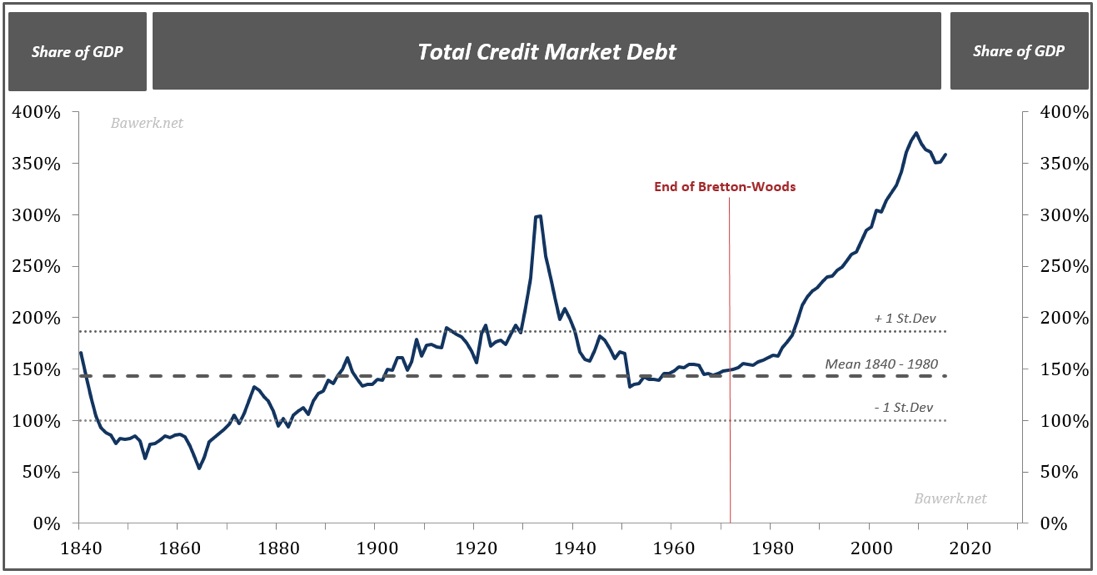
KWN note:  Meanwhile, in the United States it’s business as usual (see chart below).
KWN Ing I 8:30:2015
One Hell Of A Collapse
King World News note continues:  You can see from the chart above that despite the hiccup in 2008 – 2009, the central planners are determined to continue inflating the global Ponzi debt scheme.  The problem is that everything eventually hits the wall.  The recent turmoil in global markets suggests that the ability of the world to sustain such massive debt levels is coming to an end.  If so, the Total Credit Market vs Share of GDP is in for one hell of a collapse. 
If you look at a simple reversion to the mean (the median point from the years 1840 – 1980), that would suggest a collapse from the current level (over 350%) to under 150%.  That will be a much larger credit implosion than the one that triggered the Great Depression.  Buckle up and buy physical gold because it will be a terrifying ride as holders of paper assets such as stocks and bonds get destroyed and the recent chaos in global markets is seen as just a warm-up.
Massive Starvation During The Last Great Depression
Russian researcher, Boris Borisov, in his article titled “The American Famine” estimated the victims of the financial crisis in the US at over seven million people. The researcher also directly compared the US events of 1932-1933 with Holodomor, or Famine, in the USSR during 1932-1933.
In the article, Borisov used the official data of the US Census Bureau. Having revised the number of the US population, birth and date rates, immigration and emigration, the researcher came to conclusion that the United States lost over seven million people during the famine of 1932-1933.
According to the US statistics, the US lost not less than 8 million 553 thousand people from 1931 to 1940. Afterwards, population growth indices change twice instantly exactly between 1930-1931: the indices drop and stay on the same level for ten years. There can no explanation to this phenomenon found in the extensive text of the report by the US Department of Commerce “Statistical Abstract of the United States,” the author wrote.
The researcher points out the movement of population at this point: “A lot more people left the country than arrived during the 1930s – the difference is estimated at 93,309 people, whereas 2.960,782 people arrived in the country a decade earlier. Well, let’s correct the number of total demographic losses in the USA during the 1930s by 3,054 people.”
Analyzing the period of the Great Depression in the USA, the author notes a remarkable similarity with events taking place in the USSR during the 1930s. He even introduced a new term for the USA – defarming – an analogue to dispossession of wealthy farmers in the Soviet Union. “Few people know about five million American farmers (about a million families) whom banks ousted from them lands because of debts. The US government did not provide them with land, work, social aid, pension – nothing,” the article says.
Every sixth American farmer was affected by famine. People were forced to leave their homes and go to nowhere without any money and any property. They found themselves in the middle of nowhere enveloped in massive unemployment, famine and gangsterism.”
The then state of affairs in the US society can be seen in Peter Jackson’s movie King Kong. The movie starts with scenes of the Great Depression and tells the story of an actress who did not eat for three days and tried to steal an apple from a street vendor. There is food in the city, but many people had no money to buy it in unemployment-paralyzed New York. People starve in the streets against the background of stores selling a variety of foodstuffs.
At the same time, the US government tried to get rid of redundant foodstuffs, which vendors could not sell. Market rules were observed strictly: unsold goods should always be categorized as redundant and they could not be given away to the poor because it could cause damage to businesses. A variety of methods was used to destroy redundant food. They burnt crops, drowned them in the ocean or plowed 10 million hectares of harvesting fields. “About 6.5 million pigs were killed at that time,” the researcher wrote.
The consequences of those policies were predictable, the author of the article wrote. “Here is what a child recollected about those years: “We changed our usual food for something for available. We used to eat bush leaves instead of cabbage. We ate frogs too. My mother and my older sister died during a year.” (Jack Griffin).”
So-called public works introduced by President Roosevelt became a salvation for a huge number of jobless and landless Americans. However, the salvation was only a phantom, Boris Borisov wrote. The works conducted under the aegis of the Public Works Administration and the Civil Works Administration were about building channels, roads or bridges in remote, wild and dangerous territories. Up to 3.3 million people were involved in those works at a time, whereas the total number of people amounted to 8.5 million, not to count prisoners.
Conditions and death rate at those works are to be studied separately. A member of public works would make $30, and pay $25 of taxes from this amount. So a person could make only $5 for a month of hard work in malarial swamps.”
The conditions, under which people were working for food, could be compared to Stalin’s GULAG camp.
The Public Works Administration (PWA) bore a striking resemblance to GULAG. The PWA was chaired by “American Beria,” the Secretary of Interior Affairs, Harold Ickes, who threw about two million people into camps for the unemployed youth,” Borisov wrote. “Harold LeClair Ickes (1874–1952) later interned USA’s ethnic Japanese in concentration camps. The first stage of the operation took only 72 hours (1941-1942).
In 1940, the US population was supposed to make up at least 141.856 million people upon the preservation of previous demographic trends. As a matter of fact, the USA had the 131.409-strong population in 1940, of which only 3.054 million can be explained with changes in migration dynamics. Thus, 7.394,000 people simply do not exist as of 1940. There are no official arguments to explain the phenomenon,” Boris Borisov wrote.

Andrew Maguire: Whistleblower, Independent London Metals Trader & Analyst – Andrew has 35 years trading experience, both as an institutional and independent trader. He is an accomplished veteran of the markets. In 2010 Andrew Maguire went public in an exclusive King World News interview and disclosed his notification to the United States regulators at the Commodity Futures Trading Commission (CFTC) of fraud being committed and price manipulation in the international gold and silver markets. This put him at the center of a storm for exposing what could be the largest fraud in history involving countries, banks and government leaders

Thursday, 27 August 2015

The Financial Meltdown - Day Four - 08/26/2015

The Dow is up again, people will be feeling optimistic again. Here are the headlines of the day.


For a bit more realism on this we need to listen to Gerald Celente, Jim Sinclair and others.

The Dow leaps 619 points after two days of China woes


A currency trader at the foreign exchange dealing room of the Korea Exchange Bank headquarters in Seoul, South Korea


It was a long day of erratic trading in US markets today, with a rapid liftoff just after the bell and a close that marked biggest single-day gains in the Dow Jones Industrial Average and the S&P 500 since 2011.


Federal Reserve policymaker William Dudley walked back hints that an interest rate hike was imminent, calling the increase a safer bet for October than September, as previously indicated by Janet Yellen.

Still no respite from the falloff in Shanghai: that market closed down 1.3% today, making it the fifth consecutive session down for the Shanghai Composite. Chinese police also arrested two traders today on charges of insider trading and faking documents.

The Dow, the S&P 500 and the Nasdaq all close up
The Dow Jones Industrial Average is up more than 500 points
Fed’s Dudley says US rate hike unlikely in September
ECB might act to fight deflation
Shanghai stock market closed down 1.3%

Chinese police make arrests


This appeared today in King World News

Gerald Celente Just Warned This Is Not A Correction, It’s The Beginning Of A Total Market Meltdown And Global Collapse


Across the western world, financial fingers are pointing to China as the culprit for both sparking the global equity-market meltdown — and keeping it going

The first shot across the Dow — when it was trading some 2,000 points above Tuesday’s close — was blamed on the People’s Bank of China for cheapening its currency: “China risks clash with US as 1.9 percent devaluation surprises markets,” Financial Times, 12 August 2015.

U.S. Markets Trending Down Since Late July

Omitted from the headline blame game in FT and other business-news coverage was that US equity markets had been trending down since late July. Yet, as the global stock plunge accelerated over the next few weeks, and with the yuan devaluation story fading from the news, the business media blamed the selloff on China’s economic woes and how its slowing economy was impacting the global economy.

In fact, even Republican presidential front runner Donald Trump weighed in by warning that “China’s taking our jobs; they’re taking our money… they’ll bring us down… we have nobody that has a clue.”

Trump is wrong.

China is merely the canary in the collapsing global-equity mine.

Everything Is Collapsing Because The World Economy Is Imploding

Markets are tanking, currencies are collapsing and commodity prices, now at 16-year lows, are plummeting because the world is sinking deep into recession.

I Predicted A Global Stock Market Crash By Year End On King World News

And, not only do we have a “clue” regarding why markets are tanking, on 6 August, in our Trends in the News broadcast, before the market meltdown began, I forecast that global equity markets would crash by year’s end on King World News. And some two weeks before China devalued its currency, we predicted that action.

As we have noted, the formula is simple: When the US and Europe buy fewer consumer goods, China manufactures less of them. And the less China manufactures, the fewer raw materials and agriculture goods it imports from resource-rich nations. As resource-rich nations export fewer raw materials, their economies dramatically weaken, their currencies sink lower, inflation rises, unemployment rapidly grows… and out-of-work, cash-poor consumers consume less.

Indeed, it is not China’s economic woes or its currency devaluation that’s bringing down the markets.

As the famous slogan that was a centerpiece strategy in Bill Clinton’s 1992 race for the White House clearly summed up, “It’s the economy, stupid.”

And this time “it’s the global economy, stupid.”

This Is Much More Than A Correction, It’s A Global Market Meltdown

As we had forecast since Washington’s “too big to fail” bailout schemes, global central banks’ low interest-rate policies and massive quantitative-easing liquidity injections, these measures would merely relieve the symptoms of the Panic of ’08. They were not, however, the cure.

Now, that multi-trillion-dollar money-pumping bubble, which overinflated equity markets, is quickly deflating, so, too, are the economies and commodities pumped up with it. 

This is more than a market correction; it’s a global market meltdown. 


Here is Celente's wonderful rant on 'Black Monday'

Gerald Celente - Trends In The News - "Another Day, Another Diving Market" 


If you can filter out Jones this is actually quite a good discussion of the events from Tuesday


Here Charles Hugh Smith appears with Max and Stacy

Charles High Smith on the Keiser Report


Here is some more discussion - from Andy Hoffman (whom I don't know) and Jim Sinclair

BLACK MONDAY & THE FINAL BULLET: The FED Will HYPERINFLATE -- Andy Hoffman


Jim Sinclair-Silver Will Be Gold On Steroids In Coming Rally


While it is clear that China is not the cause, but the canary in the mine, here is some discussion from Paul Mason of Channel Four News

China stock market: Paul Mason explains


Wednesday, 26 August 2015

Financial meltdown - Day Three - 08.25/2015

Yesterday the Sydney Morning Herald was crowing. "What crisis?" they asked. The Sydney market was up and the gung-go Aussies were busy buying up bargains. \

The headline was -


This morning on a quick perusal I couldn't find anything on the subject. Go back to sleep.

This morning, turning on the radio the Radio NZ news was all about a rise in the market although a voice of caution about China's economy was added.

ASX rallies as bargain hunters jump in

RT (which is often up to the minute in its reporting) had this as its headline

Global stocks surge as China cuts interest rates


To which, Radio NZ chimed in - 


New Zealand deputy -PM and Minister of Finance (and pickpocket) Bill English thought it was all " a bit concerning" although everything is fine with the Chinese economy and there's an excuse for everything.

It's odd, I thought, that all the free market people are, all of a sudden, in favour of interventionism, especially by the Chinese. Go figure.


However, as I was taking all this in the trading day on Wall Street was ending with a surprise.

Dow Plunges Back Below 16,000 - Dead Cat Bounce Dying


"Off The Highs" - hope is fading fast as The Dow is now down over 350 points from its pre-open highs after the China rate cut and has broken back below the crucial 16,000 level...


Charts: Bloomberg


From the Guardian

US stock market gains wiped out to close second volatile day on Wall Street
Dow Jones ends day with big losses after initially appearing to bounce back from ‘Black Monday’ of global sell-offs, sparked by China economy fears


New York Stock Exchange
26 August, 2015

US stock markets continued to seesaw on Tuesday following a day of global sell-offs sparked by fears that China’s economic boom is slowing.

The Dow Jones industrial average initially appeared to be bouncing back from “Black Monday” – a day when it crashed more than 1,000 points before ending the day down 586 points.

By noon the Dow was up over 300 points as European markets closed up and investors reacted positively to China’s decision to cut interest rates. But the Dow closed 205 points down, or 1.29%. The S&P 500 ended the day down 25 points, 1.34%, and the Nasdaq closed 0.39% down.

The second day of drama came after investors continued to sell in China. The benchmark Shanghai composite index closed 7.6% lower on Tuesday following an 8.5% drop on Monday. Over three days the index has fallen 22%.

European markets reversed Monday’s losses but will be closely watched on Wednesday for reaction to the US news. In the UK, the FTSE 100 ended a 10-day losing streak to end up 3%, Germany’s Dax was up 5% and in France the CAC rose 4%.

US stock prices were initially buoyed by some positive economic news. The Conference Board’s consumer confidence index, which had declined in July, rebounded in August. The index now stands at 101.5, up from 91.0. The Commerce Department said new house sales rose 5.4% in July, slightly less than expected but still indicative of recovery in the housing market. Home resales jumped to a near eight-and-a-half-year high in July.

Ken Goldstein, economist at the Conference Board, said he expected more volatility to come in the financial markets despite Tuesday’s rally. “There’s nothing particularly new here,” he said. “China’s economy is slowing, we knew that.

Somebody woke up last Thursday and headed for the exit and a stampede was on. Now they are back again,” said Goldstein. “It doesn’t say much about our financial geniuses.”

Goldstein said consumers could be affected by the stock market wobble, which could trigger a lack of confidence ahead of the all-important holiday season despite relatively good economic data on housing, jobs and manufacturing. “The more we scare the bejeezus out of the consumer, the more risk we face,” he said.
The morning rise comes after three days of falls on stock markets around the world that erased close to $3tn globally.

China’s central bank cut interest rates and eased borrowing requirements for banks amid the continuing fall. It was the fifth rate cut since November. Earlier this month China devalued its currency in a move aimed at reviving its slowing economy.

A slowdown in the world’s second-largest economy has rattled investors worldwide. The White House sought to reassure investors on Monday as the selloff continued. “There is no doubt the global economy is more interconnected that than it ever has been,” Josh Earnest, Barack Obama’s chief spokesman, said. “What I would encourage people to evaluate is the ongoing strength and resilience of the US economy.”

The People’s Bank of China said: “Currently, there are persisting downward pressures on the country’s economic growth. There has also been quite large volatility in global capital markets recently, and monetary policy tools need to be applied more flexibly.”

Gus Faucher, senior macroeconomist at PNC Financial, agreed volatility was likely to continue but the recent falls had been “overdone”. “We’ve had a six-year bull market and I’m not surprised to see a correction, but the domestic fundamentals look pretty solid,” he said.

The fall in stock markets comes as the Federal Reserve weighs its first hike in US interest rates since the recession. Paul Ashworth, chief US economist of Capital Economics, said it was too early to speculate on whether the market turmoil would delay any rise.

There are no signs of any major downturn in the US economy, economic growth in China still appears to be slowing rather than collapsing and emerging markets are not about to endure a repeat of the 1997-98 Asian crisis. The current bout of market turmoil, if it continues, might persuade the Fed to hold off on raising interest rates in September. Since that volatility doesn’t reflect any genuine economic slump, however, we wouldn’t be surprised if it proved short-lived leaving the way open for the Fed to begin raising rates at some point this year,” he wrote in a note to investors. “Even a September rate hike is still a significant possibility if the turmoil abates over the remainder of this week.”


But it's the poor that lose out - ALWAYS.


How much did the world's richest lose yesterday?

Billionaire Bill Gates, chairman and founder of Microsoft Corp. Photo / Getty Images
26 August, 2015

The world's 400 richest people lost US$124 billion amid yesterday's global share market tumble, according to Bloomberg's Billionares Index.

Monday's decline in the 400's on-paper wealth follows last week's collective fall of US$182 billion, Bloomberg reported.

Bloomberg has reported that the wealth of 24 of these individuals - including Amazon founder Jeff Bezos and Microsoft's Bill Gates - fell by more than US$1 billion each on Monday.


Source: Bloomberg

Russian markets

The Russian ruble has fallen to its lowest level since February against major currencies, dragged down by both weak oil and Chinese stocks. The ruble was trading at over 71 rubles against the US dollar and 81.78 rubles against the euro as of 09:25 GMT.
RTS -6% Gazprom -7.4% Lukoil -6.4% Novatek -5% Sberbank -7.4% VTB -6.11% $Ruble 71.28 Is@GoldmanSachs still buying? pic.twitter.com/15hda3mHLJ
Russian Market (@russian_market) 24 августа 2015
Equity markets in Moscow are in the red with the RTS losing 5.51 percent and the MICEX down over two percent as of 09:25 GMT.


Listen to this nonsense from RT


Latin America

Latin American stock markets mirrored the downtrend, plunging to their lowest in 22 years, according to Bloomberg. The JP Morgan Latin America Currency Index (LACI) reached its lowest level since November 1922 on Monday.

Colombia’s peso suffered its most severe drop since 2009, falling 3.3%, to a record low of 3.2 against the US dollar. It was joined by Mexico’s currency, which decreased by 0.7 percent to 17.1. The Brazilian real weakened by 1.1%, sliding to a 12 year low of 3.5.

The Ibovespa Brasil Sao Paulo Stock Exchange Index (IBOV) continued last week’s decline, sliding 3.9 % on Monday to reach its lowest level since January.


RT on the Chinese economy

The real Chinese economy has been showing signs of slowing growth. In a report published last Friday by Caixin and Markit, it became clear that manufacturing has been losing momentum. The Purchasing Managers’ Index (PMI), its key indicator, saw a fall to 47.1 from 47.8 in July. This is the lowest level since March 2009 and shows a contraction.