Showing posts with label Austalia. Show all posts

Monday, 5 October 2020

How powerful pedophiles get away with their crimes

 Stunning claim cardinal ‘paid’ witnesses to convict George Pell using Vatican funds

An Italian cardinal allegedly used Vatican funds to pay witnesses 

to give damaging testimony in Australian cardinal George Pell’s 

sex abuse trial.


News.com.au,

5 October, 2020


A senior Italian cardinal has been accused of siphoning $1.14m of Vatican funds to pay witnesses in George Pell’s sex abuse trial to secure a conviction against his bitter rival.

Italian media are reporting allegedly corrupt Cardinal Giovanni Angelo Becciu is suspected of wiring the cash to people testifying in Cardinal Pell’s trial to ensure their hostile testimony.

This allegedly occurred during the 2019 trial of Cardinal Pell who was accused of molesting choir boys in Melbourne in the 1990s, convicted, sentenced, imprisoned and later cleared.

In a scandal gripping the Vatican, it was alleged this was a ploy to derail Cardinal Pell’s exposure of Cardinal Becciu, between whom it was reported there existed a “huge enmity”.

The 72-year-old Italian is allegedly suspected of funnelling Vatican cash to charities and businesses run by his three brothers.

Cardinal Pell, who returned to Rome on September 30, was freed after 18 months in jail when the High Court of Australia quashed his conviction in April.

Italian newspapershave reported that Cardinal Pell previously clashed with Cardinal Becciu when the Australian, as the Pope's finance minister, sought to expose alleged misappropriation of Vatican coffers.

La Repubblica and Corriere della Sera have quoted leaked documents that Vatican investigators suspected Cardinal Becciu of funnelling the money to Melbourne Supreme Court witnesses.

Investigators alleged Cardinal Becciu hoped the money would thwart Cardinal Pell’s transparency program which would have exposed Cardinal Becciu’s allegedly corrupt management of Vatican cash.

As finance minister before returning to Australian in 2017 to face trial, Cardinal Pell had been assigned by Pope Francis to clean up Vatican accounting practices.

But Cardinal Pell’s attempts were blocked by Cardinal Becciu, who had held an influential role in distributing and investing millions of euros of Catholic donations.

Cardinal Becciu had been deputy secretariat of state between 2011 and 2018 before Pope Francis removed him and placed him in charge of running the Holy See’s department responsible for making saints.

Last month, the Pope sacked Cardinal Becciu from that job and stripped him of the right to elect popes.

This happened as Vatican investigators began to sift through Cardinal Becciu’s secretariat of state spending record.

In question was a multi-million luxury property in Chelsea, London, which Cardinal Becciu oversaw and which allegedly lost the Vatican money while making millions for consultants.

In 2016, Cardinal Pell, whose right-hand man was Vatican’s auditor-general, Libero Milone, ordered an audit of Vatican finances by an external accountancy firm.

Cardinal Becciu overruled the move, blocking the audit, and a year later engineered the ousting of Mr Milone, who was accused of spying on officials.

“Milone was Pell’s right-hand man and the enmity between Pell and Becciu was huge,” said Massimo Franco, author of a new book about Pope Francis, The Enigma of Bergoglio.

That enmity had been fuelled by a comment from Cardinal Pell which Cardinal Becciu felt amounted to his being called dishonest in front of the Pope.

Following Cardinal Becciu’s sacking as secretariat, Pell had said: “The Holy Father was elected to clean up Vatican finances.

“He plays a long game and is to be thanked and congratulated on recent developments.”

Cardinal Becciu protested, saying, “I couldn’t allow him to say something like that.

“From the time I was a child, I had always been taught by my parents to be honest.”

The war between the cardinals has dominated news of the Vatican as Pope Francis, in a document released on Sunday, urged the world to rediscover its sense of charity as it battled COVID-19.

The Pope said the coronavirus pandemic confirmed his belief that political and economic institutions must reform to address the legitimate needs of the people.

Saturday, 5 September 2020

Prepaussie discusses the great depression of 2020

 Great Depression 2020 


ALASDAIR MACLEOD - US Economy Has Been In A Slump Ever Since The Great Financial Crisis


The US Economy has already been in collapse since the great financial crisis, and what happened this year has brought us to a point where it is no longer irreversible. The FED cannot reduce inflation rates.


Wednesday, 4 March 2020

Is Australia recognising reality while NZ sleepwalks into a pandemic and America is in full DENIAL


Australian officials admit it’s 

now impossible to keep 

coronavirus out of the 

country… while U.S. 

administration still lying to 

the public by claiming it’s all 

under control


https://www.dailymail.co.uk/news/article-8069315/Corona.html?ito=facebook_share_article-top&fbclid=IwAR3bINCLLz7dGB6nSAbOXKgTYa7iOhZRRjJa8_y0Hn2bI8tAlobEQoKSwfM


Quarantine doesn’t work. But there’s only one way to control the spread of coronavirus – and it’s a drastic step that goes against Australia’s way of life.
COVID-19 is a highly infectious disease. But we have a pretty good idea of how it works.
Cough droplets. Mucus. Sweat. Perhaps even faeces.
The virus isn’t, fortunately, airborne. But these little packets of contagion can be sprayed about to linger on surfaces for more than a week.
The big complication, however, is it can be contagious even before a sufferer begins to feel unwell. And that makes the only reliable way to stop its spread a problem.
Can we isolate people who aren’t even showing symptoms?
“I understand this whole situation may seem overwhelming, and that disruption to everyday life may be severe. But these are things that people need to start thinking about now,” says Dr Nancy Messonnier, director of the CDC’s National Center for Immunisation and Respiratory Diseases.
Last night, Attorney-General Christian Porter warned it may soon become necessary to activate drastic measures under the 2015 Biosecurity Act.
Most notably, the power to ban gatherings and impose lockdowns.
“There are two broad ranges of powers that people may well experience for the first time,” Porter said.
“It could require any Australian to give information about people that they’ve contacted or had contact with so that we can trace transmission pathways. It will also mean that Australians could be directed to remain at a particular place or indeed undergo decontamination.
“Secondly, a very important power that may be experienced for the first time — and that we will be monitoring very carefully — is the declaration of a human health response zone.”
https://www.news.com.au/lifestyle/health/health-problems/destined-to-fail-why-australia-is-unable-to-stop-the-spread-of-deadly-coronavirus/news-story/64670f2a50d8d643c77ea49a230a7bc7

Image: Australian officials admit it’s now impossible to keep coronavirus out of the country… while U.S. administration still lying to the public by claiming it’s all under control

The chief of medicine in Australia has come forward to admit that keeping the Wuhan coronavirus (CoVid-19) out of his country is no longer a possibility, and that it will just have to be dealt with when that time comes.

In a recent press conference, Professor Brendan Murphy explained to reporters that while Australia banned all air travel from virus-struck Iran, it did not ban travel from South Korea, Italy, or other travel hotspots where the Wuhan coronavirus (CoVid-19) is spreading, which is why Australia is now facing the strong possibility of a major outbreak.

“It is no longer possible to absolutely prevent new cases coming in, given the increasing changes in epidemiology around the country,” Murphy is quoted as saying.

Because Iran is considered a “high-risk” area for the Wuhan coronavirus (CoVid-19) with cases spreading all across the regime, the Australian government deemed a full-scale travel ban to be an effective deterrent strategy. Italy and South Korea, on the other hand, have only localized cases that, according to their respective governments, are localized and confined.

“In the case of Iran, it’s such a high risk that a travel ban is worth doing because it will slow down the number of cases,” Murphy added.

“In Italy and South Korea, where they have large outbreaks but they are confined and (have) been localized, the risk, the proportionality of putting in a travel ban was not justified in terms of its benefits to the health protection of the Australian community.”

Saturday, 7 December 2019

The reality of everyday life in Sydney in the midst of catastrophic bushfires

I do not feel like posting any more. This article expresses what it is like in Sydney right now in the midst of the fires. This article is devoid of both blame and hopium, which makes it so0 much more readable.

Read and weep.

From disbelief to dread: the 
dismal new routine of life in 
Sydney's smoke haze
There’s nothing like going to sleep with the taste of ash in your throat to give you an actual, physiological understanding of real fear

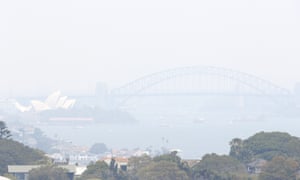
Smoke haze from wildfires fills the skyline in Sydney

 Smoke haze from wildfires fills the skyline in Sydney. ‘It feels like karma. This is what the scientists have warned us about, begged us to think of, all these years. It’s here. And it’s going to get worse.’ Photograph: Rick Rycroft/AP


November, 201

 https://www.theguardian.com/australia-news/2019/dec/07/from-disbelief-to-dread-the-dismal-new-routine-of-life-in-sydneys-smoke-haze?CMP=twt_a-environment_b-gdneco&fbclid=IwAR0Jw2oB0Makh7SeyKeIFO8AhSGocVyi_vmvos34hwj0UBf--vfJQrSW4ss


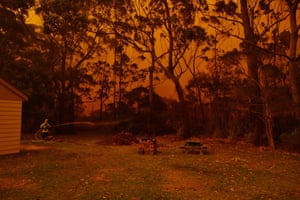
Here’s the dismal new routine of life in inner-city Sydney. I get up around 7am, sniffing the air. Sometimes even through closed windows you can smell how bad it is, but today it’s hard to tell. I pad through the quiet house to peer out of the glass kitchen door at the sky: it’s cloudless, a fine pale yellow. Some days the light is deep orange, a colour so striking that only a few weeks ago I’d be compelled to snap a photo – but now it’s horribly familiar. When it’s that colour, you don’t open the door. And you double back through the house to make sure every window is tightly sealed.

Today though, I step outside and take a (shallow) breath. Not too bad. In our tiny courtyard the smoke is not actually visible right now, but it still takes a few little forays, stepping back indoors and out again, to determine whether the smell is worse inside the house or out. This morning, outside seems marginally better, so it’s time to move through the house, opening all the windows and doors, turning the ceiling fans up high. With luck we’ll get a bit of “fresh” air throughout in the next hour or so, before the smoke returns.


The big smoke: how bushfires cast a pall over the Australian summer

Next, I check the wet laundry waiting in the basket – it smells mouldy now after a couple of days, so I shove it back in the machine for another wash. Maybe today we’ll be able to hang it outside. But even then we’ll likely have to wash it again anyway. The smell seems impossible to banish.


As I open our windows this morning, the birds are squawking like crazy in the eucalypts beyond our fence – another good sign. On the worst days there’s a menacing quiet. But I can still taste smoke in the back of my mouth, and the heaviness in my lungs remains. In recent years I’ve largely grown out of my lifelong asthma, using medication only once or twice a month. Now I’m using my reliever several times a day. The health department urges asthmatics to stay indoors, not to breathe outside if you can possibly help it, and warns everyone against exercising outdoors. 

It’s bizarre to see people ignoring this advice, keeping up their boxing routines in the park, cheerlessly punching at each other through the haze. Almost as surreal is walking past two men one evening outside a pub, standing in the thick smoke, smoking

A plane flies over Sydney on Thursday as residents don masks and crank air conditioners in the hope of respite.

I feel as though I’ve lost my ability to taste or smell anything but smoke. And oddly it doesn’t even seem to smell like smoke anymore; just an acrid, chemical, horrible odour in my clothes, my hair, the sofa, the pillows. One morning I dress in clean clothes and walk 300 metres to the shopping mall across the road from my house. The pharmacy, where I’m buying a new Ventolin, is deep inside, away from the entrance. But still the cashier wrinkles her nose. “I can smell it on you,” she says.


A Blue Mountains pal receives messages from concerned friends in the city. Her family lives 6km from one of the 150 fires burning throughout the state. Later we learn this fire has taken out 

20% of the world heritage-listed national park, but when I speak to her the wind direction is away from her town. Impossibly, their sky is pure blue. When her husband returns from an appointment in the city though, she texts me later: “He smells like a barbecue.


On one of the worst days, a friend tells me, Manly was filled with the noise of sirens as city fire trucks attended false emergencies: smoke alarms in houses and businesses were going off all day. Another friend swims daily at an eastern suburbs harbour beach famous for its crystal-clear water. Now she gets out of the water to find her skin flecked with fine ash.


We Sydneysiders are learning strange new symbols and language. Our weather apps now carry dotted lines across the shining sun: smoke haze. We learn the meaning of “temperature inversion”, in which warm air traps cool – and smoke – beneath it; our weather reports now carry air quality ratings. For the past month they’ve ranged from “poor” to well beyond “hazardous”. In news updates about the fires, it’s now commonplace to hear two horrific phrases: “seek shelter” and “too late to leave”.

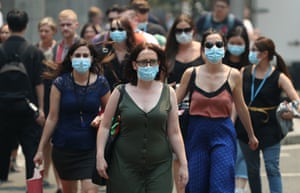
People wear face masks in response to smoke haze in Sydney.


In the inner city, people wear face masks to go about their business. In the first days of the smoke, a visiting tourist wearing a large black face mask was vox-popped on television. He’d bought the mask for his trip to China, the American explained, but didn’t need it there. He hadn’t expected to wear it peering through the haze at the Sydney Opera House.


Facebook chatter shifts from amused sightings of masks to suggestions of where to buy them, to resignation: they don’t work anyway. They might help your mood, but they’ll do nothing to stop the microscopic particles entering your lungs, unless they’re rated P2 and have super suction around the face. 


Despite this, I can’t help covering my mouth and nose for the few steps to and from the car. I haven’t taken a train or bus in weeks; too much walking involved.


The fire danger warnings have a new category. Colours at the low-danger end are green, moving through yellow and orange. The new one is a deep, malevolent red with black stripes, and it’s called “catastrophic”.
On the first catastrophic warning day there’s a palpable fear, because even expert firefighters have never seen anything like this. The winds are completely unpredictable. Nobody knows what will happen.


At first we watch the footage – those walls of orange flame storeys high – with our hands over our mouths. Money floods in to emergency relief funds to support “the fireys”, the koala rescuers. But as the days and weeks pass, here in Sydney the mood changes from disbelief to hypervigilant fear to a kind of WTF petulance. It’s still happening? We’re used to turning our attention briefly, intensely, to “those poor people” affected by climate change, then returning to normal life. Now those poor people include us.


Internet fights break out over whether it’s obscene to complain about the smoke. Of course it is; we’re lucky, we of the middle-class inner city. I can afford to buy a new Ventolin once a week, for example. I have time to do each load of laundry thrice before it smells clean. My work doesn’t force me to remain outside, breathing in this shit all day long. And of course, no fires have visited inner Sydney. None of ours are among the 600-plus homes burnt to the ground. None of us are among the dead.


But also: it isn’t obscene to find this intolerable. It is intolerable.


After our petulance comes a stoic, patient reasoning. It’s good for us to get this wake-up call. And it’ll be over soon. But that was weeks ago, and the patience has been replaced by a grim, creeping dread. A fear that it won’t be over soon, or ever. It feels like karma. This is what the scientists have warned us about, begged us to think of, all these years. It’s here. And it’s going to get worse.


We have the “Fires Near Me” app on our phones now, but I’m careful not to zoom out too far from our immediate 50km zone. If you do, it’s easy to panic. There are so many little fire symbols they overlap. Weeks after they began, almost half are still classed “out of control”. And zooming out brings the existential horror of what all this really means. It also brings shame, at how we city dwellers have managed to ignore what people in the regions have endured for years now. Even as we’ve written the letters, donated the money and attended the protests about the towns without water, the massive fish kills, the dust storms, the extinctions. Even if we’ve attended to all this in our minds, there’s nothing like going to sleep with the taste of ash in your throat to give you an actual, physiological understanding of real fear.

Firefighting crews battle a bushfire encroaching on properties near Lake Tabourie between Bateman’s Bay and Ulladulla south of Sydney.

A few days ago, on the worst day here, I lay on my bed in the afternoon. My lung cobwebs felt specially heavy, the sinus headache intense. Outside, despite daylight saving time, it was almost dark at 4pm. I’d taken to putting towels to the gap under the front door. My thoughts turned again, with fury, to our country’s leadership vacuum. The prime minister’s family lives here in Sydney; surely by now the man must be saying something? I checked his social media pages. Prime minister Morrison’s Instagram account carried grinning images of him – baseball cap in place - atop a ladder, draping his family home in twinkly Christmas lights. No matter what’s going on each year, says the PM of a burning nation, getting in the Christmas spirit has always been such an important part of our family life.

Outside parliament in Canberra, a woman sets up the burnt remains of her family’s destroyed house: a few iron sheets, a leaning section of charred wooden framework, twisted metal, black pots and pans. Her sign, painted on blackened corrugated iron sheet, reads: “Morrison your climate crisis destroyed my home.” Not very Christmassy, Melinda.

Back here in the Marrickville morning, it’s nine o’clock and the birds are growing quiet again. The smell is back. It’s astonishing how quickly it arrives; you sense it first in the back of the throat. I move through the house once more, closing all the doors and windows tight
going off


https://www.news.com.au/technology/environment/weird-weather-anomaly-making-sydney-choke/news-story/04b58864b2f835efee52cb07f0c36a79?fbclid=IwAR1LTk8JWlYMXlfHZw4mBreJNlXbx0Sv3eO0WoMeL2KYRpJCl3OYgwrPFiQ


https://www.abc.net.au/news/2019-12-06/nsw-bushfires-mega-fire-north-of-sydney/11772568?fbclid=IwAR0sdBUD7sRm4UbDH6nFO2p8g_r1nbLqhLIVhmAXXFyiZDF84PbNE-zPo3c

Tuesday, 12 December 2017

Australia's war against the Truth

Strange to see this coming from the liberal Buzzfeed. As one of the main publications pushing the Russiagate agenda I would see them as an enemy of Wikileaks and other truthtellers.

Australia Seeks New Gag Laws That Could See Journalists And Whistleblowers Jailed for 20 Years


Organisations such as WikiLeaks and disclosures from whistleblowers like Edward Snowden appear to be the target.


11 December, 2014

Australian government and intelligence whistleblowers – and potentially even journalists – may face up to 20 years in jail for disclosing classified information, under the most sweeping changes to the country’s secrecy laws since they were introduced.
The Australian prime minister Malcolm Turnbull has announced a broad package of reforms aimed at curbing foreign interference from countries including China and Russia.
The legislation was introduced by Turnbull in the House of Representatives immediately after marriage equality passed on Thursday evening, and the otherwise full House of Representatives was emptied as celebrations were underway.
While the reforms have been flagged for many months, they were only introduced on the last sitting day of parliament this year, and go much further than previously believed.
Unexpectedly, the reforms include sweeping changes to longstanding secrecy laws, which are modelled on Britain’s Official Secrets Act.
The regime raises fresh concerns for prospective whistleblowers, journalists, and also mass leak publication sites such as WikiLeaks. A series of “aggravating” offences will also hamper large-scale leaks like those from former US National Security Agency whistleblower Edward Snowden.
Currently, a single offence under the Crimes Act prohibits disclosures of almost any information by Commonwealth officers. This has been roundly criticised by news organisations and human rights groups, and the Australian Law Reform Commission (ALRC) has recommended changes to curb the scope of information captured by the offence. A further “official secrets” offence also potentially criminalises any disclosure, although the threshold for this offence is high and it has been rarely invoked.
Under the proposed new regime, both offences will be repealed entirely and replaced by several new offences inserted into the Commonwealth Criminal Code. While a seven-year jail sentence is the maximum available under the existing laws, this will be radically increased to up to 20 years for the most serious aggravating in the proposed laws.
The new laws will apply to anyone, not just government officials. They could easily apply to journalists and organisations like WikiLeaks that “communicate” or “deal” with information, instead of just government officials. They will also close a longstanding gap around contractors working on behalf of government agencies, who will also be subject to the new offences.
The bill’s explanatory memorandum highlights that it seeks to prevent the publication of almost any information from intelligence agencies, giving the example of salary information of officers.
“Even small amounts of such information could, when taken together with other information, compromise national security, regardless of the apparent sensitivity ... For example, even seemingly innocuous pieces of information, such as the amount of leave available to staff members or their salary, can yield significant counterintelligence dividends to a foreign intelligence service,” it said.
It lists an example of a set of circumstances particularly similar to Snowden for the aggravating offence.


APH
Journalists will have a defence available to them if publication of information is considered to be in the public interest and is “in the person’s capacity as a journalist engaged in fair and accurate reporting”.
However, they bear an evidential burden for proving their conduct satisfies the defence.
No definition of journalist is provided in the bill, and it is unlikely to capture organisations or individuals who play a less traditional role in news gathering, such as WikiLeaks, independent bloggers, or intermediaries who pass information along to journalists but are not the original source.
It places news organisations in the position of potentially having to justify their reporting in court if a prosecution is brought against them.
An aggravated offence will also be introduced that could see a journalist or whistleblower jailed for up to 20 years. Factors for this offence include whether the information is classified as secret, if it is marked with a codeword, or if it involves the dissemination of more than five records with a security classification. That classification could be as low as "protected", a marking used broadly across hundreds of Australian government agencies.
This offence appears to be squarely targeted at curbing organisations like WikiLeaks that publish large caches of documents. It would also capture whistleblowers like former NSA contractor Edward Snowden. While the laws will not apply retrospectively, they are likely to render any future attempts by news organisations to report on highly classified matters increasingly difficult.
At first glance the proposed laws do appear to limit the type of information that could lead to a prosecution of a journalist or a source. Several of the offences are focused on protecting “inherently harmful information”.
The explanatory memorandum of the bill mentions the confusion and uncertainty around the application of the existing offences, and cites approvingly the ALRC’s review into secrecy laws.
But the proposed regime goes substantially further than the ALRC’s recommendations to wind back and simplify the offences.
Conduct defined as “inherently harmful” is extremely expansive; it includes all security-classified information, information that would or could reasonably cause harm to Australia’s interest, and certain information provided to government agencies.
This poses particular problems because of the overclassification of information within Australian government agencies. Agencies such as the Immigration Department routinely classify large amounts of information as “protected” or “confidential”, with no clear basis and limited systems of review.
It could even include, according to the explanatory memorandum, information provided to the Australian Tax Office materials or Australian Securities Investments Commission.
Further offences will also criminalise the communication or dealing with information that “causes harm to Australia’s interests”, which won’t just include information about law enforcement operations but much broader types of information as well. This includes a broad suite of information about civil and criminal law enforcement that goes far beyond just law enforcement and intelligence agencies.
The explanatory memorandum of the bill acknowledges that this part of the new regime “goes beyond the ALRC’s recommendation”.
“The inclusion of the concepts of preventing, detecting, investigating, prosecuting and punishing Commonwealth criminal offences and contraventions of Commonwealth civil penalty provisions is intended to reflect the fact that the effective enforcement of the law and the maintenance of public order require the undertaking of a wide range of activities,” it said.
The definition of harming Australia’s interests is so expansive it could include disclosures that lessen the cooperation of law enforcement, cause “intangible damage” to Commonwealth and state relations, or cause a loss of confidence or trust in the federal government.
Whistleblowers who make disclosures to journalists or other individuals may be able to gain protection under the Public Interest Disclosure scheme. However, that scheme strongly favours internal disclosures and places substantial barriers and risks for people who are considering making external disclosures.
While the new regime purports to replace the offence for Commonwealth officers, it also preserves an almost identical mirror provision. The basis for this offence, according to the explanatory memorandum, is that it will take time to determine whether there is any separate information not covered by the new offences.
This means that the existing broad regime that criminalises disclosures of all criminal information will remain in place, and effectively be enhanced by the proposed offences.
Australia has faced criticism in the past for its hostility towards whistleblowers. The UN's special rapporteur for freedom of expression David Kaye has previously warned that Australians' rights and freedoms are at risk of being “chipped away.”
These secrecy offences have previously been used to target the sources of Australian journalists. Australia’s immigration department has referred journalists’ stories about the immigration detention regime on a number of occasions for investigation by the Australian Federal Police.
The Australian Federal Police has in turn admitted to accessing journalists' phone and email records without a warrant in order to attempt to track down their sources.