Showing posts with label la-Nina. Show all posts

Wednesday, 11 April 2018

Mass de-off of blue penguins in upper North Island of New Zealand

This was described by Kevin Hester in his discussion with Guy McPherson on NBL.

Of course the contention that the mass die-off could be a "one-in-20-year event that could partly be blamed on this summer's La Niña weather pattern" should be treated with the contempt it deserves.

Hundreds of blue penguins die off, starved by La Niña
Hundreds - potentially thousands - of little blue penguins have washed up dead on beaches along the east coast of the upper North Island in recent months.


11 April, 2018

The Department of Conservation said the mass die-off could be a one-in-20-year event that could partly be blamed on this summer's La Niña weather pattern.

Western Bay Wildlife Trust chairperson Julia Graham said it had received about 60 calls over the last two weeks about penguins that had washed up dead, or had died not long after they arrived on and.

Warmer ocean temperatures had meant there was a lack of food, or their food sources had changed, Ms Graham said.

The penguins were also trying to come ashore to moult at this time of year and if they didn't have enough fat reserves, they might not survive the two or three week process.

"They are coming out of it very, very weak and starving and then a combination of cyclones, offshore storms and bad weather has meant that they just don't have the energy to find food and fight the rough oceans anymore," Ms Graham said.
"By the time they're washing up, they're pretty far gone, they're emaciated, starving, no food, very, very exhausted."

Graeme Taylor from the Department of Conservation said they had had reports of penguins being washed up dead along the east coast of the upper North island, from the Bay of Plenty northwards.

A little blue penguinA little blue penguin Photo: Supplied / Western Bay Wildlife Trust

This sort of mass die-off event happened once or twice every decade in moderate numbers, and once every 20 years in very large numbers.

"I think this may be the one-in-20-year cycle," Mr Taylor said.

"The last really big die-off occurred in 1998, when about 3500 penguins washed up on beaches. The sort of numbers we're hearing about could indicate we're up around that several thousand range."

But, Mr Taylor said, they were natural events.

"When birds have been checked in the past, they've all found to be dying from starvation, rather than from diseases or some other more worrying thing that could be causing mortality," he said.

People who find the little blue penguins on beaches are being told to leave them alone, unless they are obviously injured. Dogs should also be kept on leashes and under control.


Wednesday, 21 February 2018

Arctic temperatures are soaring, and scientists are freaking out

Despite Stronger La Nina, January of 2018 was the Fifth Hottest in the 138 Year Climate Record


20 February, 2018

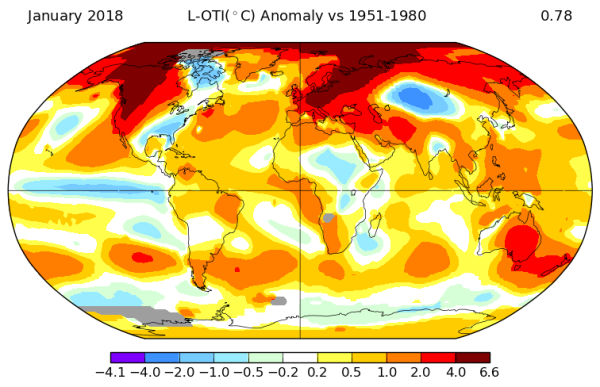
Major signals of on an ongoing and inexorable global warming trend continued to be apparent during January of 2018, according to NASA records.

The first month of this year saw global temperatures in the range of 0.78 degrees Celsius above NASA’s 20th Century baseline — or about 1 C warmer than 1880s averages when NASA record-keeping began.

Despite the influence of La Nina — which during 2018 is stronger than a similar 2017 Pacific Ocean cooling event — January was the 5th hottest such month in all of the 138 year global climate record. According to NASA, all of the top five hottest Januaries ever recorded have occurred since 2007, with four of those five occurring during the last five years.


(Arctic warming is the primary feature of the fifth hottest January in NASA’s 138 year climate record. Image source: NASA.)

Warm temperature departures for the month were most extreme over the Arctic, over western North America, and through North and Western Europe. This outlier warmth contributed to record low sea ice extent measures in the Arctic and helped to rapidly expand drought conditions across the U.S. In the Southern Hemisphere, Antarctica — recently seeing a series of glacial calving events in the west which hint at a quickening pulse of ice entering the world’s rising oceans — saw an abnormally warm austral summer month. Meanwhile, Australia experienced its own third hottest January even as concerns over renewed mass coral bleaching across the Great Barrier Reef were again on the rise.

The intervention that's needed to protect the is stopping new coal mines and subsidies for fossil fuels. https://twitter.com/krnanthony/status/963229825291841536 


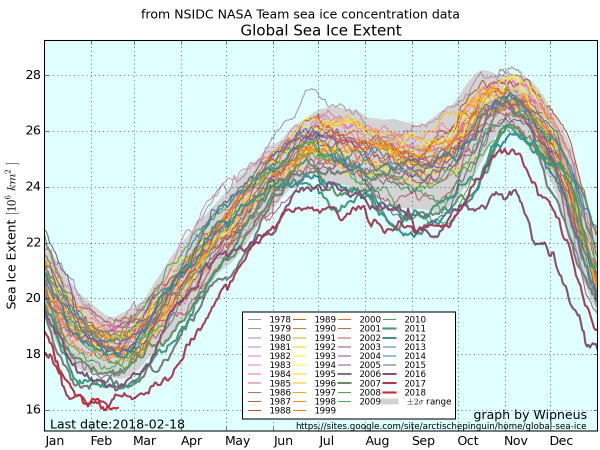
During La Nina, movement of warm air and water toward the polar region is enhanced. To this point, global sea ice extent measures are again in record low ranges even after receiving a serious hammering during the winter of 2017. In January, record to near record polar warmth helped to drive a rapid fall in global sea ice extent to today’s record low values in the range of 16 million square kilometers.
Record low sea ice coverage is a climate change amplifier in that it uncovers dark ocean surfaces that capture more of the sun’s rays than white, reflective ice. In addition, open ocean ventilates more heat into the polar atmosphere. Heat that would typically be sequestered beneath the ice. This warming amplification (polar amplification) can also have an impact on the polar circulation of the Jet Stream — causing it to meander more which results in increasing instances of extreme weather (hot, cold, wet, dry, stormy) in the middle latitudes.


(Global sea ice extent is again in record low ranges. This is a primary signal of a warming polar environment — which can have far-ranging harmful impacts. Image source: Global Sea Ice and NSIDC.)

Over the coming months, we should expect some continued stress to both Arctic and Antarctic sea ice — with the caveat being that cloudier late springs and early summers have tended to retard warm season ice loss during recent years in the Northern Hemisphere. That said, continued movement into record low ranges for the Arctic hint that rapid advance of melt during winter may eventually translate to summer.
The primary driver of these serious changes to the global environment is continued fossil fuel burning. And with atmospheric CO2 likely to hit between 411 and 412 parts per million this year (with CO2e ranging toward 493 ppm adding in all greenhouse gasses) the amount of warming already being locked in is starting to look quite dangerous in a number respects. That said, damage can still be greatly limited if the world works to rapidly transition toward renewable energy and keeps harmful fuels where they belong — in the ground.

2018 Starts With “Record Lows In Arctic Sea Ice Extent”


Sea ice fell to its lowest level since human civilization began more than 12,000 years ago.”

Arctic temperatures are soaring, and scientists are freaking out


Credit: Chase Dekker Wild-Life Images via Getty Images
The planet keeps heating up and melting ice at a "frightening" pace.

Tuesday, 5 December 2017

Contemptible lies and half-truths on New Zealand's drought

My anger is almost uncontainable as EVERYONE, from NIWA to the media to local councils lie through their teeth about this.

Residents in Napier are understandably livid that they were not even given 24 hours notice of their water crisis. Meanwhile they are told that because they forewent taking showers last night and the heatwave might soon be over the crisis will be over by next week.

Do I need to point out to these criminal idiots that we are 5 days into summer and have about 3 months to go.

Here, where I live (and where I have been keeping a watching brief for several years, the council is in similar denial and any warnings that water shortages and droughts are inevitable with abrupt climate change (along with terrible floods). Meanwhile people are being brainwashed into thinking there is not problem.

In the meantime the Hutt City is relying on emergency supplies, something we were told would not happen.

All of these organisations are guilty of wilful neglect of their constituents by not telling them even a small part of the truth.

Things will NEVER be normal again.

Neither is it a “new Normal” with the speed of change.

I shall be providing more data and photos from our local area tomorrow.

Napier residents demand answers Why weren't we warned


Napier residents are furious they were left in the dark over the town's water crisis, which left reservoirs so low yesterday it was feared they could run dry.


Another area of New Zealand has water problems where it was previously thought not to exist.

A general rule of media in this country is NEVER EVER PROVIDE ANY CONTEXT TO STORIES that might allow people to join the dots.

I suspect that people are starting to slowly wake up to their predicament


Clutha told to conserve water as reservoirs run low


Tapanui is at just 50 percent of capacity and officials say all the town needs is a major fire, which consumes 30 to 40 percent of the reservoirs, to run out of water.


Radio NZ have decided to wrap up their Q&A soon after they posted it so THERE IS NO WAY our questions will be addressed.

But NIWA is LYING (contemptuous lies)!

Also, what does this mean for the Pacific? Will this mean more tropicalcyclones?

"The pattern we are in now is actually somewhat typical for early in the summer season during La Nina years. Late 2010-early 2011 and late 2007-early 2008 are good examples of what we call 'analogue years,' or years with similar climatic patterns to the present.

"However, 2017 takes things up a few notches from those years. The air temperatures are warmer, the sea temperatures warmer, and we just broke several century plus old rainfall records in the South Island.

"The patterns we are dealing with are being driven by atmospheric patterns like La Nina -- think of it as the steering wheel. Climate change sits in the background and is responsible for the long-term upward temperature trend. Think of it as a foot on the accelerator, giving it a little bit more pressure with each passing year.

As for our cyclone season, our Facebook post covers it all. In summary, it might turn active about the north of the country later in the season. “

This is from their own material:

La Niña’s impacts on New Zealand

La Niña events have different impacts on New Zealand's climate. More north–easterly winds are characteristic, which tend to bring moist, rainy conditions to the north–east of the North Island, and reduced rainfall to the south and south–west of the South Island.
Therefore, some areas, such as central Otago and South Canterbury, can experience drought in both El Niño and La Niña. Warmer than normal temperatures typically occur over much of the country during La Niña, although there are regional and seasonal exceptions.”

New Zealand's sea temperature swing largest in world
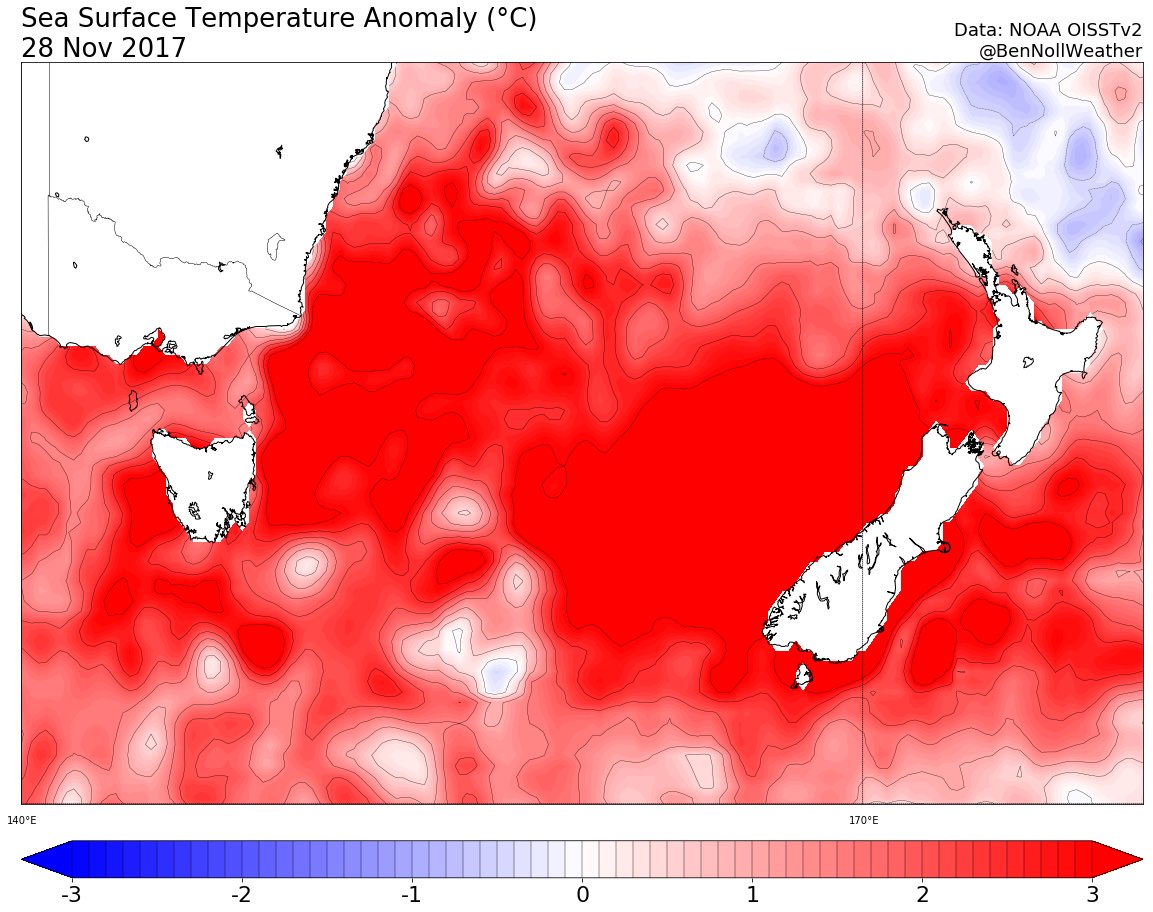
The water temperature in the Tasman Sea is well above normal - a whopping 6degC more than average for the start of December.

5 December, 2017

The increase has been driven by a La Nina climate system, and scientists say a continued warming of our ocean could permanently damage our fisheries and lead to tropical cyclones.

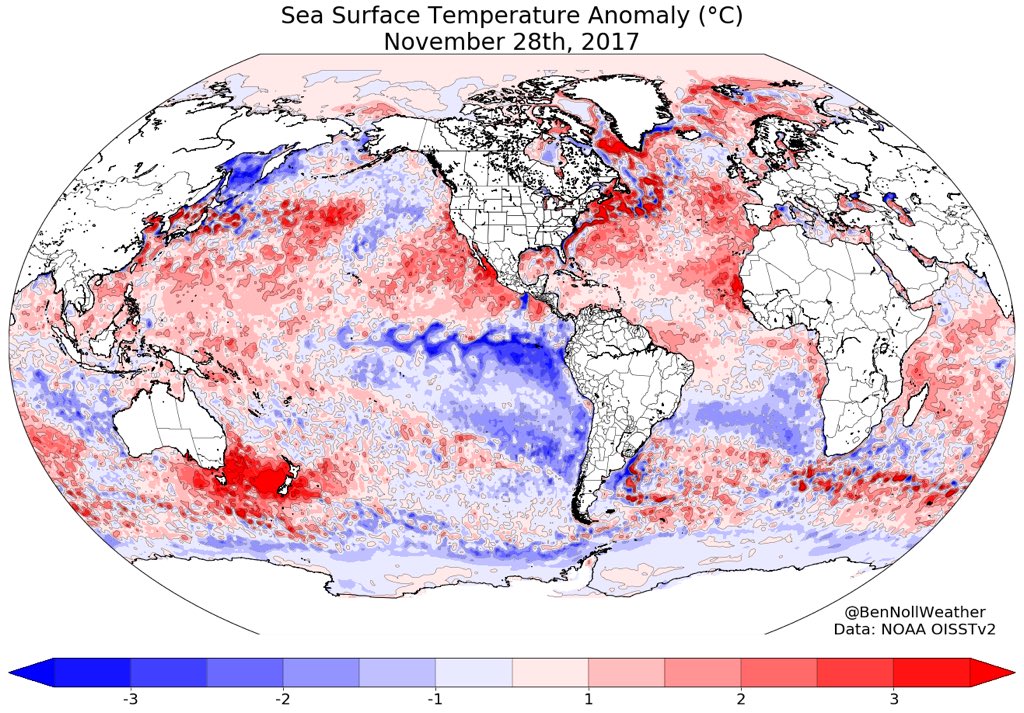
NIWA meteorologist Ben Noll says the "very impressive marine heatwave" has led to the largest deviation from normal temperatures in the world.
"The sea surface temperatures in the Australia-New Zealand region are presently the most anomalous on the globe," he says.
"Typical La Nina signature but intensity turned up many notches."

A very impressive marine heatwave is unfolding near the east coast of , across the Tasman Sea, and in New Zealand coastal waters ... average anomaly is +1.98°C and max anomaly is a gaudy +6.16°C off NZ's West Coast.
Global water temperature maps show the Tasman Sea between New Zealand and Australia stands out, both with the largest increase and largest area affected.

The warmth is more than just skin-deep. Temperature anomalies of 1degC to 3degC are being found in the top 200 meters.


NIWA climate scientist Nava Fedaeff says this is due to the lack of storms, which churn up the ocean and reduce temperatures.

However she warns that calm conditions now could increase the strength of tropical storms and cyclones when they do hit.

"Warm seas can act like fuel," she says. "If we do get a tropical storm this could add more moisture to the system."

NIWA marine biogeochemist Professor Cliff Law says this ocean warming is likely to continue, and could lead to more invasive species and possibly new diseases in our fisheries.

"The average warming around New Zealand is 2.5degC by the end of this century, which will affect how the ocean mixes and the nutrients available for plankton growth, with knock-on effects on the foodweb and fisheries," he says.

"All regions will see a reduction in food supply, because of a decrease in particulate material sinking from the surface - and that is what links climate change to our fisheries."