Showing posts with label deforestation. Show all posts

Monday, 20 January 2020

Scott Morrison is already saying we must log forest to stop it burning


"The EPBC act only to stop logging when endangered species are found. Scott Morrison is already saying we must log forest to stop it burning”
Australian Wood pellet 
energy snubbed here goes to 
Japan
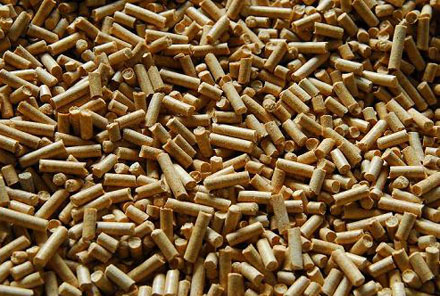


Image may contain: 1 person, smiling
While the federal government ponders subsidies to “clean up” coal, one Australian firm plans to spend $130 million to export a cleaner coal solution to Japan, after being snubbed domestically. Source: The Australian

Global forest manager New Forests and its Tasmanian subsidiary Forico are in the final stages of planning for an industrial wood pellet factory at Long Reach in Tasmania’s north.

The plant would produce about 250,000 tonnes of compressed, cooked wood pellets to export to Japan, where coal power stations are subsidised to substitute the product for black coal, to reduce carbon emissions.

New Forests managing director Mark Rogers said the densified wood pellets would be made from forestry residues from Forico timber plantations in Tasmania certified by the Forest Stewardship Council.

Replanting the tree, as is our intention in Tasmania, gives you an almost full carbon benefit; very strong decarbonisation,” Mr Rogers said. “The reason it’s going ahead in Japan is because the carbon component is being recognised in the feed-in tariff price. At the moment it’s 24 yen (27c) per kilowatt hour.

If Australia had a similar signal, then there is no reason why some of our black coal power stations could not use these pellets.”

The company was rebuffed by the Clean Energy Finance Corporation, which said the densified pellets did not meet its guidelines for subsidy.

However, federal Environment and Energy Minister Josh Frydenberg recently flagged a new mandate for the CEFC, including more efficient and lower emissions coal power, as the nation looks to shore up reliable base load energy while fostering renewables.

Mr Rogers said densified wood pellets, from well managed plantations, could assist with maintaining baseload while storage of renewable energy was improved.

The energy is stored in the pellets, which act as a battery,” he said. “Bioenergy could be one of those options, like gas, which is lower carbon — and bioenergy is sometimes zero carbon — but is still baseload.

It does seem to be a sensible part of the solution, so it’ll be interesting to see how that plays out in policy. Japan has taken a strong stand and Australia has been flip-flopping for 10 years.”

Forico chief executive Bryan Hayes said coal power plants could substitute up to 50% of their feedstock with the black wood pellets without major changes to plant and equipment.

The total (Japanese coal power) industry is looking to substitute about 10% but in any plant it could be 20% to 50%,” Mr Hayes said.

The pellets produced slightly less energy than coal.

The black wood pellets can produce about 15 to 16 gigajoules per cubic metre and hard, thermal coal is about 21,” he said.

An engineering and technical report on the plant is due by the end of next month and a decision is expected midyear.


The New South Wales government is poised to privatise the state’s plantation forests as part of a fresh round of sale and lease arrangements in 2020 to fund ambitious infrastructure projects.

The second half of Ausgrid, the second half of WestConnex and some water assets are also in the government’s sights.

The long-term lease of Forestry Corporation’s 230,000 hectares of softwood plantations is expected to be one of the first assets off the block in the new year.

The state forests produce about 14% of Australia’s timber, including much of the supply for the housing industry.

The transaction, expected to raise $1bn, is likely to be announced early in the new year and will involve a long-term lease of land and the right to grow timber, rather than the sale of land. The bank and financial services company UBS has undertaken a scoping study in the past three months while the accountancy firm KPMG has worked on the tax implications and the law firm Minter Ellison on the legal structures.

The sale will be controversial in regional areas such as Bathurst, Oberon, Bega, Tumut and the north-west, where large softwood plantations are important employers.

Forestry Corporation also manages 34,000 hectares of hardwood timber plantations and has stewardship of about 2m hectares of coastal native forests, cypress forests and red gum forests. These are not proposed to be part of the deal.

But their future could be uncertain once the money-making softwood division is sold or leased. Green groups want greater protections for native state forests, particularly after this summer’s fires, which have put pressure on habitats for koalas and other native animals.

It is understood the government would also like to sell its remaining half of NSW’s electricity distributor Ausgrid – the company which owns the poles and wires carrying power around the state – but the proposal is on hold.

This follows controversy over the sale of the initial 50% of Ausgrid in 2016, when the then federal treasurer, Scott Morrison, cited national security concerns to block a winning bid from a consortium made up of Chinese government-owned State Grid and Hong Kong’s Cheung Kong Infrastructure.

The stake was then sold for $16bn to an Australian consortium made up of the industry super investment vehicle IFM Investors and the nation’s biggest superannuation fund, AustralianSuper.


The investors are said to have sounded out the government about a further sale, but Morrison’s rhetoric on Chinese influence in Australia has caused investors to hit the pause button on a proposal for the remaining half.

Investors are looking to pay about $10bn to $11bn for the second part, because the grid is considered a wasting asset that is losing value, due in part to the uptake of solar panels.

There is also speculation that the government will move to sell the remaining 49% of the giant WestConnex road project during 2020. The 2018 sale of the first half to Transurban, the state’s largest private road operator, raised $9.3bn but sparked criticism about the risks of having one major operator controlling so many roads in the state.

Other holdings being sized up by the private sector include some of Sydney Water’s assets and the opportunity to build the extension to Sydney’s desalination plant and other new projects.

The existing plant was turned on last January and is operating at 100% capacity, providing 15% of the city’s water needs. An options paper has recommended 30% capacity of the dam system as the critical threshold on which to base planning for an extension. The Greater Sydney dam system is now at 44.3% capacity and falling.

Although investors are angling for Sydney Water’s assets to be considered for privatisation, the proposition is considered too politically contentious in a drought.

The most likely outcome will be to involve the private sector in new projects, which could include dams combined with pumped hydrogeneration opportunities.

The acting treasurer, Damien Tudehope, told Guardian Australia: “The NSW government has no current plans to undertake further privatisations at this stage, but will always act in the best interests of the people of NSW.

The asset recycling strategy, which was opposed by NSW Labor, has unlocked additional funding for infrastructure projects and enabled the government to accelerate the delivery of critical projects including the Sydney Metro City and Southwest, the More Trains, More Services program, regional road freight corridor and the Parramatta light rail.”

But it is clear that significant work has been done on the softwood plantations sale (there are contracts for the scoping study on the eTender site) and Guardian Australia understands up to 10 bidders have expressed interest.

Labor’s spokesman on natural resources, Paul Scully, said the ALP remained opposed to the sale of the state’s softwood plantations. He warned that privatisation would result in significant regional job losses and the loss of important assets such as the nursery at Blowering and firefighting expertise. He also raised questions about what would happen to the thousands of kilometres of roads maintained by the Forestry Corporation.

Victoria sold its softwood plantations in 1998, while Queensland reaped $603m when it sold Forestry Plantations Queensland in 2010. But NSW has by far the biggest timber assets.

James Tremain of the Nature Conservation Council warned of negative environmental impacts from privatisation.

Privatisation will most likely result in worse environmental outcomes for forests because a private company will always seek to maximise its profit by fully exploiting the resource,” Tremain said.

The NSW EPA has failed to make Forestry Corporation, a government-owned enterprise, comply with environmental laws. What hope would it have of making a private company abide by the law?


If the government proceeds with the sale, it should remove first the native forest logging division and use the money from the transaction to fund a just transition for affected communities and workers.”

https://www.theguardian.com/australia-news/2019/dec/27/nsw-poised-to-privatise-state-forests-to-raise-1bn-for-infrastructure-projects 

There is a parallel story that I wrote about 2 years ago. The recording I made of this story from UK TV has long been disappeared with my entire Vimeo account.


UK Is Cutting Down Huge Swaths Of American Forest To Fight Climate Change


Sunday, 19 January 2020

Australian forests would supply Japan's "energy needs"


This information comes from Mark Anning in Australia and Dr. Naomi Wolf.


Submission to Aus 

parliament states logging 

endangered forests would 

supply Japan's wood-fired 

energy needs.


The link 
https://www.parliament.nsw.gov.au/ladocs/submissions/65518/Submission%20-%20176.pdf
did not work on my iPad.... 


....but I found a way to the information on my desktop computer


Saturday, 24 August 2019

Bolsonaro's Plans for Amazon Rainforest revealed


Leaked Documents Show Brazil’s Bolsonaro Has Grave Plans for Amazon Rainforest
DemocraciaAbierta had access to PowerPoints from a meeting between members of the Bolsonaro government. The slides show that the current government intends to use the president's hate speech to diminish the power of minorities living in the region and to implement predatory projects that could have a devastating environmental impact for the Amazon.
By Manuella Libardi

Wildfires have raging through the Amazon rainforest for weeks. Satellite data show an 84% increase of fire outbreaks on the same period in 2018. (Photo: Pixabay)
22 August, 2019

Leaked documents show that Jair Bolsonaro's government intends to use the Brazilian president's hate speech to isolate minorities living in the Amazon region. The PowerPoint slides, which democraciaAbierta has seen, also reveal plans to implement predatory projects that could have a devastating environmental impact.

The Bolsonaro government has as one of its priorities to strategically occupy the Amazon region to prevent the implementation of multilateral conservation projects for the rainforest, specifically the so-called “Triple A” project.

"Development projects must be implemented on the Amazon basin to integrate it into the rest of the national territory in order to fight off international pressure for the implementation of the so-called 'Triple A' project. To do this, it is necessary to build the Trombetas River hydroelectric plant, the Óbidos bridge over the Amazon River, and the implementation of the BR-163 highway to the border with Suriname," one of slides read.


One of the tactics cited in the document is to redefine the paradigms of indigenism, quilombolism and environmentalism through the lenses of liberalism and conservatism.

In February, ministers Gustavo Bebianno (Secretary-General of the Presidency), Ricardo Salles (Environment) and Damares Alves (Women, Family and Human Rights) traveled to Tiriós (Pará) to speak with local leaders about the construction of a bridge over the Amazon River in the city of Óbidos, a hydroelectric plant in Oriximiná, and the expansion of the BR-163 highway to the Suriname border.


During the meeting, the ministers used a PowerPoint presentation that detailed the projects announced by the Bolsonaro government for the region. The presentation, which was leaked to democraciaAbierta, argues that a strong government presence in the Amazon region is important to prevent any conservation projects from taking roots.

The slides are clear. Before any predatory plan is implemented, the strategy begins with rhetoric. Bolsonaro's hate speech already shows that the plan is working. The Amazon is on fire. It's been burning for weeks and not even those who live in Brazil were fully aware. Thanks to the efforts of local communities with the help of social networks, the reality is finally going viral.

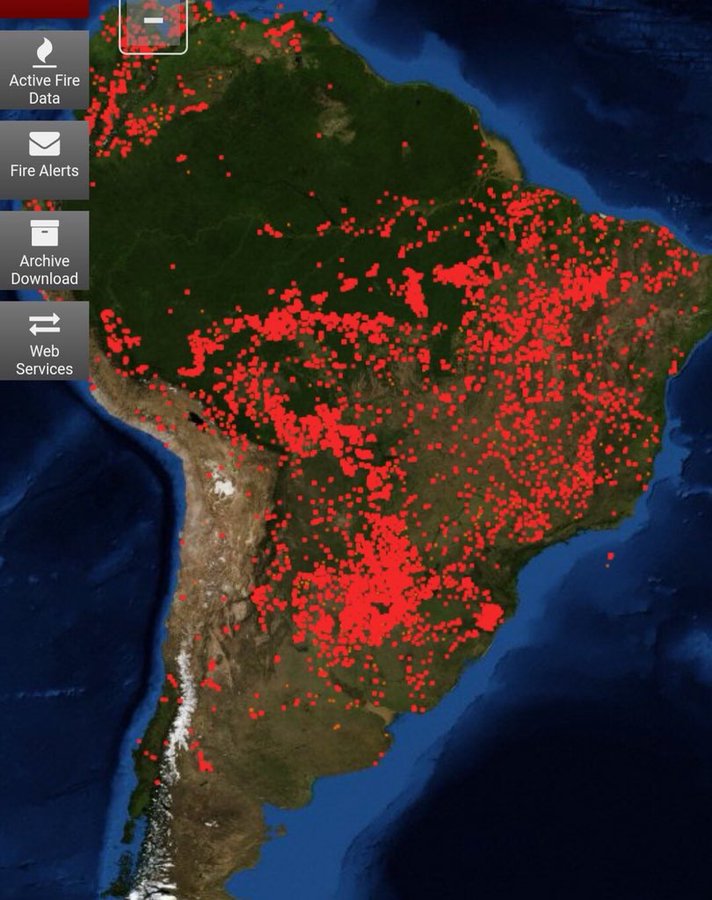
The online reaction is far from being sensationalist. This year alone, Brazil had 72,000 fire outbreaks, half of which are in the Amazon. The National Institute for Space Research (Inpe) reported that its satellite data showed an 84% increase on the same period in 2018.

Attacking non-governmental organizations is part of the Bolsonaro government's strategy. According to another of the PowerPoint's slide, the country is currently facing a globalist campaign that "relativizes the National Sovereignty in the Amazon Basin," using a combination of international pressure and also what the government called "psychological oppression" both externally and internally.

This campaign mobilizes environmental and indigenous rights organizations, as well as the media, to exert diplomatic and economic pressure on Brazilian institutions. The conspiracy also encourages minorities – mainly indigenous and quilombola (residents of settlements founded by people of African origin who escaped slavery) – to act with the support of public institutions at the federal, state and municipal levels. The result of this movement, they say in the presentation, restricts "the government's freedom of action".


Those are, according to a slide, "the new hopes for the Homeland: Brazil above everything!"


So it is unsurprising that Bolsonaro's response to the fires comes in the form of an attack on NGOs. On Wednesday, August 21, Bolsonaro said he believed non-governmental organizations could be behind the fires as a tactic "to draw attention against me, against the government of Brazil.".


Bolsonaro did not cite names of NGOs and, when asked if he has evidence to support the allegations, he said there were no written records of the suspicions. According to the president, NGOs may be retaliating against his government's budget cuts. His government cut 40 percent of international transfers to NGOs, he added.

Part of the government's strategy of circumventing this globalist campaign is to depreciate the relevance and voices of minorities that live in the region, transforming them into enemies. One of the tactics cited in the document is to redefine the paradigms of indigenism, quilombolism and environmentalism through the lenses of liberalism and conservatism, based on realist theories. Those are, according to a slide, "the new hopes for the Homeland: Brazil above everything!"


23 August, 2019
As news reaches around the world that the Amazon rainforest is burning at an unprecedented rate, people are beginning to ask questions about who is responsible. In the past week, since August 15, over 9,500 new forest fires were reported in Brazil, most of them spread across the Amazon basin.
According to Brazil’s National Institute for Space Research, over 74,000 forest fires were started in Brazil this year, which is more than double the 40,000 fires that were recorded in 2018. This represents an 83 percent increase in wildfires when compared to the same time last year, making it the most fires recorded in a single year since the Brazilian government started tracking such matters.
More than 20% of the world's Oxygen is produced by the Amazon Rainforest. This map shows the enormous scale of the fires raging across the Amazon Rainforest right now.


View image on Twitter


Even before this ominous development, things were looking pretty bleak for the Amazon. Last month, Truth Theory reported on new data from the National Institute for Space Research in Brazil, showing that the region’s rainforest saw an 80% reduction between 2006 and 2012. The report also noted that last year, deforestation increased to the highest levels seen in a decade, with a 13% increase that year alone.
Experts and activists have suggested a variety of reasons for the recent burning, but the common theme is that the government is allowing the rainforest to be ravaged by farmers and corporations for their own personal gain.
The Amazon rainforest provides 20% of the world's oxygen. People are deliberately starting fires in effort to illegally deforest land for cattle ranching. President Bolsonaro is letting this slide!!


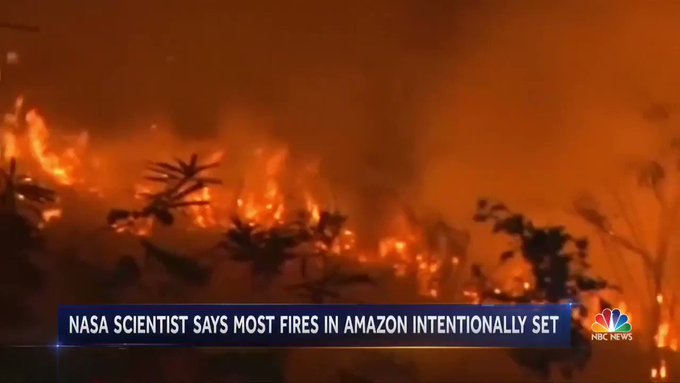
Christian Poirier, program director for the conservationist group, “Amazon Watch,” believes that these fires were started intentionally for the purpose of clearing space for cattle ranchers.
“The unprecedented fires ravaging the Amazon are an international tragedy and a dangerous contribution to climate chaos. This devastation is directly related to President Bolsonaro’s anti-environmental rhetoric, which erroneously frames forest protections and human rights as impediments to Brazil’s economic growth,”Poirier said in a statement.
The newly elected president Jair Bolsonaro campaigned on a misguided platform of stimulating economic growth by opening up the Amazon to industry. Since coming into office, his administration has significantly scaled back environmental protections, essentially giving a green light to loggers, miners, and ranchers to violently expel native tribes from their lands and destroy the local ecosystem.
Poirier believes that the current president’s rhetoric encourages ranchers  “to commit arson with wanton impunity.”
According to a Yale study, cattle ranching is responsible for roughly 80% of the Amazon’s deforestation, and much of the beef that is produced in the region is eventually shipped off to Europe and North America.
Amazon Watch believes that ranchers organized a coordinated “Fire Day” to set the Amazon on fire, CBS News reported.
Just a gentle reminder that the fires in the amazon are intentional. It’s not a forest fire type situation. It’s an intentional setting ablaze of the forest by the fascist brazilian govt + agrobusiness & ranching oligarchs. Wording matters. Don’t hide who is doing this & why.


Amazon Watch is not alone. Amnesty International secretary-general Kumi Naidoo also made a statement blaming the current condition of the Amazon on the controversial president.
“The responsibility to stop the wildfires that have been raging in the Amazon rainforest for several weeks now lies squarely with President Bolsonaro and his government. They must change their disastrous policy of opening up the rainforest for destruction, which is what has paved the way for this current crisis,” Naidoo said.
Ane Alencar, the scientific director of Brazilian NGO IPAM (Institute of Environmental Research in Amazonia), told Mongabay that these fires were exacerbated by the deforestation that had already taken place. This is because with fewer trees, the dry season in the Amazon become dryer, and thus more dangerous.
“The fire that we’re seeing today is a fire that’s directly related to deforestation,” Alencar said.
Bolsonaro has responded to the crisis by blaming NGO’s and “Indians” for the fires, and insisting that the problem is not important enough to deserve government resources.
“There aren’t the resources,” Bolsonaro told reporters, adding that, “This chaos has arrived.”
In another interview about the recent fires, Bolsonaro compared himself to the Captain Planet villain, “Captain Chainsaw.”
“I used to be called Captain Chainsaw. Now I am Nero, setting the Amazon aflame,” Bolsonaro said sarcastically.
Furthermore, documents leaked from the Brazilian government show that the current administration planned on building infrastructure projects through the Amazon as way of pushing back against international pressure to put protections on the forest.
A PowerPoint slide leaked from a government presentation about these infrastructure plans said that, “Development projects must be implemented on the Amazon basin to integrate it into the rest of the national territory in order to fight off international pressure for the implementation of the so-called ‘Triple A’ project. To do this, it is necessary to build the Trombetas River hydroelectric plant, the Óbidos bridge over the Amazon River, and the implementation of the BR-163 highway to the border with Suriname.”
One of the tactics listed in the document was framing the Amazon crisis as a wedge issue to divide liberals and conservatives. If the destruction of the Amazon can be reduced to a simple “political opinion,” the legitimate concerns from activists and experts can be easily dismissed as nothing more than a dissenting political opinion.

IMAGE CREDIT: pedarilhos

https://www.independent.co.uk/news/world/americas/amazon-rainforest-fires-jair-bolsonaro-ngo-san-paolo-a9075071.html?fbclid=IwAR38K4cKebdb3iUhCSr4zDiER3jQxSAztR-oR6S8DtZ1sPKmOSEuNttRcVc

Amazon fires: Brazilian president orders military to battle the blaze