Showing posts with label asset sales. Show all posts

Tuesday, 28 July 2015

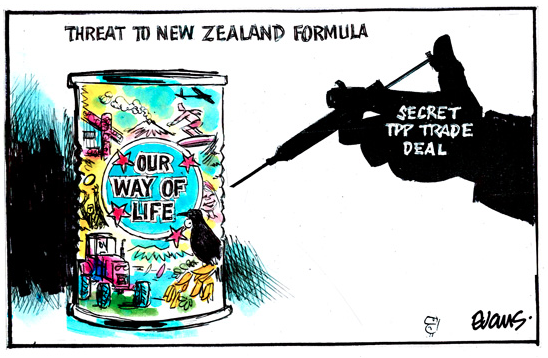
The TPPA

From this country’s #1 traitor

And all the rest that he’s NOT talking about.

This government is getting close to selling off this country's sovereignty.


TPP could allow foreigners to buy large assets without formal approval - John Key

Prime Minster John Key insists that on balance, Kiwis will benefit from signing up to TPP.

27 July, 2015

The Trans Pacific Partnership trade deal could allow foreign entities to buy large assets without Crown approval, Prime Minister John Key has signalled.

Key was asked on Monday whether the TPP agreement, the proposed Pacific Rim trade deal being negotiated between 12 countries, would make it easier for buyers to acquire large land holdings in New Zealand.

He said negotiations were ongoing so he could not give a definitive answer, but he signalled that the matter under consideration was not "sensitive land" which includes farmland, but the size of other investments which would trigger an approval process.

"The question is not so much about sensitive land, I think, from memory, I'm pretty sure it's about whether it triggers the threshold, and how much that increases."

Currently those who are not citizens or do not normally reside in New Zealand need Overseas Investment Office approval if they are buying large assets, classified as those costing more than $100 million.

Residents of some countries, including Australia, have a higher threshold because of clauses in free trade agreements.

Last week Labour announced a series of "non-negotiable" conditions before it would support the TPP, including New Zealand maintaining the right to restrict the sales of farmland and housing to non-resident foreigners.

Key described Labour's position as "crazy" and "schizophrenic", claiming that if it wanted to restrict sales to foreigners it should not have included a "most favoured nation" clause in the China free trade agreement.

"[Labour leader] Andrew Little's desperate to find a way to keep the left flank of his caucus in check," Key said.

While negotiations were still continuing, Key said he believed that overall New Zealand would benefit from signing the TPP.

"I'm pretty darn confident that on the balance of benefits New Zealand is going to do a lot better if they sign a free trade agreement with the United States than if they don't."


Jane Kelsey responds to Labour’s TPPA announcement
Labour’s attempt to spin this announcement to appear to take a principled position that meets its members’ concernsm is disingenuous at best. There is only one red line in this list. The rest you can drive a bus through

25 July, 2015

Screen Shot 2015-07-23 at 6.19.06 pm Screen-Shot-2015-03-13-at-7.09.10-am
Labour’s attempt to spin this announcement to appear to take a principled position that meets its members’ concernsm is disingenuous at best. There is only one red line in this list. The rest you can drive a bus through.
That one red line reflects David Parker’s obsession with the right to regulate foreign investment in land – a crucially important right of governments, but it has already been given away in relation to China through the recent Korea FTA, because China is entitled to the same treatment as NZ gives Korea. True, not including it in the TPPA would mean the US and Japanese investors don’t get it, but investors can re-locate themselves easily enough to take advantage of the existing FTAs.
Is Labour not equally concerned about protecting the right to introduce a capital gains tax (a question not answered by officials in relation to the Korea FTA and not mentioned by Labour)? Or not pouring more of the health budget down the trough of Big Phrma or its local offshoot (not some vague promise that ‘Pharmac must be protected” – what does that mean????)? Or ensuring the SOE chapter will allow Labour to establish their state-owned KiwiAssure or rebuild a genuine public broadcaster?
As for balancing the economic gains, they know the economics don’t stand up.
Moreover, Labour seems to be sticking to the ‘we can’t reach a final decision until we see the fine print’ – by which time they know they can’t change anything.
What really matters to National is to legitimise the TPPA by claiming bi-partisan support. Labour’s leader Andrew LIttle needs to have the guts to say to Phil Goff, Mike Moore protogĂ© Clayton Cosgrove, health minister Annette King (who has been super silent on the health impacts) and David Parker that this deal will place unacceptable handcuffs on future Labour governments and that Labour is going to oppose it – and he needs to do so before the TPPA ministers meet in Maui on Tuesday.

Tuesday, 19 November 2013

Selling the family silver - for a buck

Air NZ shares sold at $1.65
The sale of 20% of the Crown's shareholding in Air New Zealand has been completed, raising $365 million for the Government.


19 November, 2013


Some 221 million shares were sold at $1.65 each - the price that the the airline's shares closed at last Friday. Trading in the shares was suspended on Monday and Tuesday.

State Owned Enterprises Minister Tony Ryall said on Tuesday there was significant demand from New Zealand retail broking firms and New Zealand institutions.

The Government retains a 53% shareholding in the national carrier.

Meanwhile, Acting Prime Minister Bill English denied that Prime Minister John Key misled the public when he said last week that no immediate sale of Air New Zealand shares was planned.

The Government announced the sale on Sunday.

Labour leader David Cunliffe said on Tuesday that Mr Key must have known the sale process was just about to begin.

But Mr English told MPs that the final decision was not made until Friday, the day after the Prime Minister's comments, and said Mr Cunliffe's allegations were simply wrong

Welcome Aboard this Air NZ Asset Sale


What to do with an afternoon off, a paper bag, and poor government decisions.


Wednesday, 13 November 2013

Selling New Zealand


Air NZ asset sale tipped for next week
The Government is being tipped to sell down its stake in Air New Zealand early next week ahead of a referendum asking Kiwis if they support partial sales of state-owned assets.


13 November, 2013

The Government owns 73 per cent of the national carrier and has said it wants to reduce its stake to 51 per cent, but has yet to name a timeframe.

Several market sources spoken to today said there was an expectation that the deal would be done before a referendum asking Kiwis if they support the Government selling up to 49 per cent of Meridian Energy, Mighty River Power, Genesis Power, Solid Energy and Air New Zealand.

Postal voting for the non-binding referendum opens on Friday November 22 and closes on December 13. "The smart money is on something to kick off early next week," said one market source.

Another market player told the Herald that he had heard it could happen before the weekend.

The decision to sell is backed up by Air New Zealand's strong performance on the share market.

Its shares have had a good run in the last year rising 34 per cent.

Today they closed up 1c on $1.67 valuing the company at $1.833 billion.

At that share price the sell-down stake would be worth around $400 million.

Market players have said the shares would be snapped up because of strong appetite for the company.

The sale is expected to be done in the form of a block trade where one or more investment banks would buy up the stake and then on-sell it to others in an off market deal.

Those type of deals are typically not announced to the share market until after they have been completed.

New Zealand institutional investors and brokers are expected to be at the front of the queue for the shares because of the Government's promise to ensure at least 85 per cent of the assets are sold to New Zealanders.

Sources said the Crown had yet to appoint a company to manage the sales process.
Investment banks typically get up to two weeks to put together a pitch for selling an asset but that could be reduced to as little as two hours for Air New Zealand.

Government departments must follow a tender process but a source said that could overcome by the Government picking a company from its pre-selected panel.

That panel includes Goldman Sachs, Macquarie, First NZ Capital, Deutsche Bank, UBS, Craigs Investment Partners and Forsyth Barr.

Monday, 4 November 2013

New Zealand for sale


There go our assets built up carfelly over generations!

Overseas stake in Meridian increased


4 November, 2013

A London-based New York-owned fund manager has built a stake of almost 6.5 per cent of Meridian Energy within days of the company floating.

Today Bank of New York Mellon disclosed that last Thursday it acquired 27,534,053 shares in Meridian, increasing its stake from 5.41 per cent to 6.49 per cent.

The shares were purchased by its subsidiary, Newton Investment Management.

As well as acquiring shares in the initial book build, the bank has announced major purchases were made on the first three days that Meridian began trading on the NZX.

No shareholder apart from the Crown, can own more than 10 per cent of the companies floated under the mixed-ownership model programme.

Attempts to contact Bank of New York Mellon and Newton Investment Management have so far been unsuccessful


Meridian shares rated a 'buy'

The London-based fund manager which emerged as a major holder of Meridian Energy shares has bought another substantial stake.


1 November, 2013


It comes as new research from brokerage UBS rates Meridian Energy securities a 'buy' with an expected price in 12 months of $1.27.


Today, Bank of New York Mellon revealed that its London subsidiary, Newton Investment Management, bought another 36 million shares in New Zealand’s largest electricity company on Wednesday, increasing its stake to 138,765,947 shares. That saw its stake climb from just under 4 per cent to 5.41 per cent of the company.


No shareholder, aside from the Crown, can own more than 10 per cent of Meridian or any of the other companies in the mixed 

Thursday, 16 May 2013

NZ Budget - more asset sales

Here is the Pravda version.

Budget 2013 - Meridian Energy next off rank

The Government has announced Meridian Energy is the next State-Owned Energy company to be partially sold.


Radio NZ,
16 May, 2013

In unveiling Budget 2013, Finance Minister Bill English says Treasury has been instructed to ready the company for partial sale in the second half of this year, depending on market conditions.

Mr English confirmed a further $1.5 billion of new capital investment from the Future Investment Fund, which was established to invest proceeds from the government's partial privatisation programme.

That includes $426 million for the redevelopment of Christchurch and Burwood Hospitals, $80 million for irrigation projects and $94 million for the fourth year of KiwiRail's Turnaround Plan.

The Finance Minister also released details of how the Government intends to try to put a brake on rising house prices.

Legislation has been introduced to improve housing affordability by enabling local authorities to fast-track planning procedures for new housing developments. This will be subject to accords between the Government and councils in areas where housing is least affordable.

But if a local authority does not agree the Government will have the power to step in and override the council's planning authority.

Another bill has been introduced to extend income-related rents to community housing providers and bring in reviewable tenancies for all Housing New Zealand tenants.

Return to surplus signalled


Bill English says Budget 2013 confirmed the Government books will return to surplus in 2014/15.

Treasury forecasts show an operating surplus before investment gains and losses of $75 million in 2014/15.

Net core Crown debt is forecast to peak at 28.7% of gross domestic product - the measure of the country's annual economic output - in 2014/15, before falling to 17.6% by 2020/21.

The Government intends to further delay contributions to the New Zealand Superannuation Fund until net debt is no higher than 20% of GDP, which under current projections will be 2020/2021.

This year's Budget contains $900 million of new spending, $100 million more than indicated in the most recent Budget Policy Statement.

The Budget unveils a new $100 million-a-year internationally focused growth package.

This includes a $200 million boost over four years for science, innovation and research. This will be invested in expanding Research and Development business grants and a new repayable grant for start-up businesses to help them become ready for investment.

Accident Compensation Corporation levies are to be reduced significantly in future financial years.

In 2014/15 that reduction in levies will be $300 million, increasing to about $1 billion in 2015/16.

Social policy


The Budget also contains spending targeting vulnerable children and families.
This includes $100 million over three years for the Healthy Homes insulation programme, targeting low-income households. This is expected to insulate an extra 46,000 houses. $21 million over four years will be spent on rheumatic fever prevention, and an extra $1.5 million next year will go to budgeting services for low-income families.

The Government is also exploring a warrant of fitness programme for social housing, and will pilot a low and no interest loan scheme for low-income borrowers.

An additional $2.1 billion from this year's budget will go towards operating and capital spending in the Christchurch rebuild.

Education


The Government is reining in rises in student allowance costs by focusing on younger students.

This means people aged 40 and over will be restricted to 120 weeks' of student allowance and people aged 65 and over will not longer be eligible for an allowance.

The Government has reconfirmed its commitment to keeping student loans interest-free.

Total spending in education this budget has increased to $9.7 billion.
Extra spending over the next four years includes $173 million for early childhood education and $92.4 million for Greater Christchurch Education Recovery and Renewal and 21st Century Schools.

More than $130 million over four years will be spent on the expansion of Maori and Pasifika trades training, a boost in funding for science and engineering courses and to support an increase in the proportion of young people with higher-level qualifications.

Health and welfare


Health spending in this year's budget has risen to $14.7 billion, which includes $1.6 billion over the next four years for new initiatives and to meet cost pressures and population growth.

Another $92 million of new money over four years will be spent on paying family members who care for their disabled adult children.

The extra spending also includes $70 million for aged care and dementia services, $48 million for more elective operations, $35.5 million for diabetes and heart disease, $18.2 million for a new mothers and babies' initiative and $25 million to increase the number of people being screened for diseases, particularly breast cancer.

An additional $186.6 million over four years will be spent on the next stage of the Government's welfare changes.

This includes 354 extra Work and Income staff, funding to allow the agency to contract external providers to manage beneficiaries and services for particular groups of welfare recipients. Money will also be directed to further work on developing the investment approach to welfare.

Protecting the economy


The Finance Minister also confirmed a memorandum of understanding has been signed with the Reserve Bank Governor containing four new measures that aim to protect the economy and financial system from boom and bust cycles.

Those measures would require banks to hold additional capital on their balance sheets as a buffer during an economy-wide credit boom; hold additional capital against loans in specific sectors if risks emerge in those sectors; adjust their funding ratios to use more stable sources of funding to avoid short-term funding shortages; and, finally, apply quantitative restrictions on the share of high loan-to-value ratio loans in the housing sector.

House goes into urgency


Parliament moved into urgency on Thursday to debate legislation to enact changes announced in the Budget.

Five bills were introduced, three of which will be passed through all stages under urgency.

The other two will be sent to a select committee after they pass their first reading.


Tuesday, 23 April 2013

The NZ asset sales program

Radio NZ does it again – put Labour/Greens on the backfoot while the print media ignores the story

Labour denies aiming to ruin MRP float

Labour deputy leader Grant Robertson has denied the party's plan to set up a single purchaser for power is intended to spook investors in the Mighty River Power float.


23 April, 2013


The policy, announced by Labour and the Greens last week, forced the Government to temporarily halt the sale of shares.

Share sales resumed as of midnight on Monday, though shareholders have until 1 May to withdraw their application.

Mr Robertson told Morning Report that the timing of the policy announcement was designed to give New Zealanders 18 months notice of moves to relieve power prices, in the event of a change of Government.

The Government is not changing its estimate of how much money the partial sales will raise.

Finance Minister Bill English told Morning Report the estimate for the revenue from the sales remains at $5 - $7 billion.

For a slighly more informed (and balanced viewpoint) listen to the following segment – especially the interview with Geoff Bertram


Sunday, 21 April 2013

The Greek collapse

Greece's great fire sale
From pristine beaches to palaces, entire islands and its London embassy, a nation in crisis is selling its assets, writes Harriet Alexander.


20 April, 2013

As George Georgas drives his golf buggy along the sea front, the sprightly 80-year-old muses on why this is the best stretch of coast in the world.

The beach is the longest on the Greek island of Rhodes – four miles of crystal waters, flanked by a gently sloping pebble shore. The 18-hole golf course that flanks it is lined with olive trees and wild flowers, and there is scarcely a hotel or high rise in sight.

Mr Georgas has played here for over 30 years. And now he thinks the government should sell it.

"We are like a bankrupt housewife forced to sell the silver, to save the family," he said. "Greece has no choice."

The sale of the coast at Afandou is part of the Greek government's desperate attempts to raise money by privatising its vast portfolio of state-owned assets – the largest firesale in history. Some 70,000 lots are for sale, ranging from pristine stretches of coast through to royal palaces, marinas, thermal baths, ski resorts and entire islands. Only last Wednesday, bidding closed for a stake in the state gambling company.

On Monday Antonis Samaras, the prime minister, scraped through another round of negotiations with the Troika – the EU, IMF and European Central Bank – and managed to secure payment of the next EU 8.8 billion instalment of the bailout. But privatisation is a prerequisite for receiving the bailout funds.

On Rhodes, a mountainous island 50 miles long that was the mythical home of the sun god Apollo, huge chunks of prime real estate are now up for grabs. 

Beside the 1,850-hectare Afandou estate there is the peninsula of Prasonisi, a paradise for windsurfers, and the Mandraki marina in Rhodes Town, where the famous Colossus, a 100 foot high statue that was one of the seven wonders of the ancient world, once stood guard over the port entrance.

Rhodes is unique in having nearly a third of its land owned by the government, a legacy of being occupied during the Italian invasion in 1912 and later having ownership of that land passed over to Athens when it became part of the modern Greek state. Yet that hasn't stopped the inspectors from Athens fanning out across the country to see what else they could auction off.

The idea of snapping up a Greek island certainly has its appeal. In March the Emir of Qatar bought six for £7 million, while a Russian oligarch bought Skorpios – previously owned by the Onassis family – earlier this month for a reported £65 million, as a present for his 24-year-old daughter Ekaterina Rybolovlev. While both those sales were private, it showed there was a potentially lucrative market for chunks of scenic Greece.

To that end, the royal palace on Corfu, where Prince Philip was born, is now also for sale. So too is a large coastal estate which, the government boasts on its website, is next door to land owned by the Rothschild banking dynasty.

Officials refuse to discuss prices, saying that it depends on offers and the development proposals, but the Afandou coastline is looking for an investment of 150-250 million euros. The port of Poros, a pretty cobbled marina in southern Greece, is on the government books, as is the Athens police headquarters and the Ministry of Culture – a giant temple-like construction in the centre of the capital. So too are the buildings housing the ministries of health, education and justice. Even the Greek embassy in London's Holland Park: yours for £22 million.
However, not everyone supports the idea of so many places going under the hammer.

"We need to keep state ownership of all our assets – not sell them to the highest bidder," complained Yiannis Milios, chief economist for the opposition Syriza party, who would prefer to see more use of public-private partnerships, rather than sales.

"Experience shows that the privatisation of public goods is a very bad idea. With water, for instance, the quality falls but the price rises, which is totally wrong. The government is very good at finding legal formulas to work its way round supposed guarantees of public interest. It is not a good idea at all."

But others argue that Greece has no choice. Two bailouts from the European Union have failed to inject life into the economy, which has been in recession for the past six years. Unemployment is 27 per cent, and the deficit is forecast to grow to 189pc of GDP this year. Almost 1,000 jobs have been lost every day over the past three years in the private sector, and as part of Mr Samaras's deal made on Monday, 15,000 public sector workers are set to be made redundant as part of a Troika's programme for slimming the bloated public sector.

As well as political resistance, the other problem for privatisation programme is finding buyers. While the more picturesque islands might seem attractive busy, the same cannot be said of vast, loss-making behemoths like the Hellenic Railways Network and the Public Power Corporation. Both have militant unions that have vowed to fight privatisation tooth and nail, making them highly risky prospects for investors.

That partly explains why Greece has only raised about EU2 billion from privatisations since its first bailout loan in May 2010, missing its target of raising EU3 billion by last year. The country's longer-term aim of raising EU50 billion by 2019 has repeatedly been scaled back, and the best it now hopes for is to raise around EU 11 billion in privatisation proceeds by the end of 2016.

From his office overlooking the Mandraki marina in central Rhodes Town, Stathis Kousournas, mayor of Rhodes, sees no alternative.

"We want this investment – we actually fought for it to happen," he said. "We have to make sure that we are getting a fair price and respecting the environment, but those who have come to me with concerns are in the minority.

"It is not all being sold permanently – some of it is a long-term lease. We're all anxious to make the best of this – it is a development for all of us.".

Unemployment on the island is low compared to the mainland, averaging 17 per cent over the year thanks to the influx of tourists. But life is still hard.

Maria Karabini, a 40-year-old civil servant, has seen her salary drop by half over the past three years. Now, after paying her mortgage, she only has EU200 a month to live on.
"This sale of the land must happen," she said. "We need this now, quickly. Tell the Russians and the Qataris to hurry up!"

Across the island, almost everyone seems to embrace the proposals, so desperate are they for relief from austerity measures, although Lucas Georgas, a Bath University-educated businessman, sounded a note of caution.

"What I don't like is the 'sale' aspect of it," he said. "I would like to see the government renting it out for 20, 30, 40 years so that the business venture can make a profit, then return ownership to the state. This land does not belong to my generation to sell it."

In Athens, though, the man with the task of directing the firesale is convinced that there is no other way.

Stelios Stavridis, chairman of the Hellenic Republic Asset Development Fund, has only been in the job for three weeks – his predecessor resigned, reportedly before he could be sacked, over the slow pace of sales.

"I'm an entrepreneur, not a politician, and I have been screaming my head off that this is all about growth, job creation, wealth creation," said Mr Stavridis. "I am the anti-bureaucracy man: we need to bring in this money – there is no other way."
In Mr Stavridis's office in central Athens, not far from the parliament, a pair of American businessmen discuss in hushed tones their negotiating position. A ticker tape flickers above the head of the receptionist, detailing the latest hot offers: Afandou, Corfu lands, the disused Athens airport.

"We have been acting so stupidly for years, making rules against our own interest," Mr Stavridis added. "Being state-owned and well run is a contradiction in terms."

For those who do take the plunge, there are still myriad hurdles to overcome, despite the efforts of Mr Stavridis's team. Land registry is patchy at best, while investors must also promise to commit their own equity, but many foreign banks are wary of lending to Greek projects. Greece would appear to be only acting now because the Troika has forced its hand.

Back in Afandou, Vassilis Anastasiou, the manager of the golf course for the last 30 years, looks out every day on concrete proof of the "stupidity" of previous government programmes.

A grand breeze block clubhouse looms over the golf course; completed in 1973 and, strangled by bureaucracy, empty ever since.

"At least under the military junta it only took three years to build that site," said Mr Anastasiou. "Governments since would have taken 50 years to do the same."

His club has around 100 members, paying EU400 a year and with 60 of them playing regularly. But he is adamant that the land must be privatised – even if it means increasing the fees.

"Anyone who argues against it is either an idiot, or a state employee who doesn't think about economic reality and just likes to lounge on the beach," he said. "We have our heads in the noose."

Saturday, 6 April 2013

NZ asset sales


NZ govt looking for $1.5 billion from first asset sale
  • NZ govt to sell up to 49 pct stake
  • Indicative price within broad expectations
  • Local investors holding for 2 years to get bonus


4 April, 2013

WELLINGTON, April 5 (Reuters) - The New Zealand government said it is looking to get as much as NZ$1.8 billion ($1.5 billion) from its first partial asset sale in more than a decade, as it aims to return to surplus in the next two years, and pay down debt.

Official documents released on Friday showed the government would offer up to 686 million shares, a 49 percent stake, in Mighty River Power Ltd, and gave an indicative price of between NZ$2.35 and NZ$2.80 a share, valuing the company at up to NZ$3.9 billion ($3.28 billion).

"The desired bias towards New Zealand ownership will probably see the price go towards the middle of that range, in the sense that they want to limit the level of offshore participation in this," said Paul Harrison, head of equities at BT Funds, adding that the range was wide but not unexpected.

Mighty River is the first of three power companies, a coal miner, and airline, in which the New Zealand government wants to sell minority stakes to raise up to NZ$7 billion over the next three to five years to repay debt and get back into surplus.

The government has forecast a deficit of NZ$7.3 billion in the year to June, but expects that to halve next year, and has pencilled in a surplus of NZ$66 million by 2015. Its net debt is currently sitting at NZ$57.7 billion or 27.6 percent of gross domestic product, and is forecast to peak at 29.5 percent in 2015.

The government said New Zealand investors who held their shares for at least two years would get bonus "loyalty" shares. It has stated it wants 85-90 percent local ownership.

"We think the size of the loyalty bonus strikes a good balance between promoting widespread participation in the share offer, rewarding New Zealanders who decide to hold on to their Mighty River Power shares, and being prudent with the costs of the share offer," said Finance Minister Bill English.

The offer would open on April 15 with the final price to be decided on May 8 after a book build process with institutional investors, with listing scheduled for May 10.

More than 440,000 New Zealanders have registered their interest in buying shares in the company, and locals have been guaranteed a minimum of NZ$1,000 to NZ$2,000 worth of shares.

The documents said it was vulnerable to lack of water in dry years, potential land or resource claims from indigenous Maori people, and a slump in prices if a Rio Tinto owned aluminium smelter, the country's biggest power user, were to cut production or close down.

The company, which has nine hydro, five geothermal, and one gas fired station, produces just under a fifth of the country's power and has 390,000 retail customers.

In February, it reported a first half net profit of NZ$75.5 million from the previous year's NZ$17.6 million, although revenues were down 3 percent.

The last major state asset sale was the privatisation of Contact Energy in 1999, which saw 40 per cent of the electricity generator sold to the United States company Edison Mission Energy for NZ$5 a share.

The remaining 60 percent was sold to 220,000 New Zealand retail investors, and New Zealand and Australian institutional investors at NZ$3.10 a share after a book build, with an initial indicative range of NZ$2.40 and NZ$3.00 a share. ($1 = 1.1918 New Zealand dollars)