Showing posts with label Phillppines. Show all posts

Sunday, 18 January 2015

Extreme weather - 01/17/2015

Malawi faces 'unprecedented' flood disaster
Southern African nation struggles to cope with devastating floods that killed 176 people and displaced 200,000 others


17 January, 2015

The waters may be receding and the rainfall subsiding but Malawi is only now coming to terms with the "unprecendented" floods that hit the southern half of the country last week.

At least 176 people lost their lives and another 200,000 have been displaced when heavy rains submerged homes, schools, and in places, washing away an entire village. 

The Malawi Defence Force has reportedly rescued at least 4,000 people, but there are fears that many more still need help. At least 153 people are unaccounted for.

"It has shocked all of us: from government, to donors to the people," Robert Kisyula, national director of international NGO World Vision Malawi, told Al Jazeera on Saturday. "People hung on to trees,waiting for the waters to subside, as they usualy do, but water kept on coming and they were washed away.

"These were unprecedented floods, don't let anyone you otherwise," he said.

The heavy rains washed away plantations, roads and destroyed power lines in Malawi [AFP

Malawi isn't the only southern African country to be hit by floods last week. In neighbouring Mozambique, floods left at least 38 people dead and displaced tens of thousands as well.There is speculation that Mozambique's 2014 flood plan helped the country better prepare for a disaster, as compared to Malawi, which seemed to have been caught completely off-guard.

It is a charge Paul Chiunguzeni, Malawi's head of the department of disaster and relief, denies.

"We have had mixed success with the relief efforts because in the early days of the disaster, rescue efforts were hampered by bad weather," Chiunguzeni said.

He told Al Jazeera that his country "did not have the resources" to handle the aftermath of the massive floods. President Peter Mutharika has already declared 15 of the 28 national districts disaster zones and Chiunguzeni echoed his president's call for international assistance.

Malawi is already facing economic difficulties following the withdrawal of 40 percent donor funds in 2013 over a corruption scandal in the country.Even before the onset of the floods, there were concerns that the country would face food shortages.
In October last year, a news analyst in the Nation newspaper said that the new budget proposed by President Mutharika had failed to address the needs of ordinary Malawians.


Without international support, Malawi would be hard pressed to respond to this disaster.

Floods occur annually in Malawi, though the government said this year's rainfall was different. Chiunguzeni said warnings had been sent to communities, but the rains came before people could prepare. 
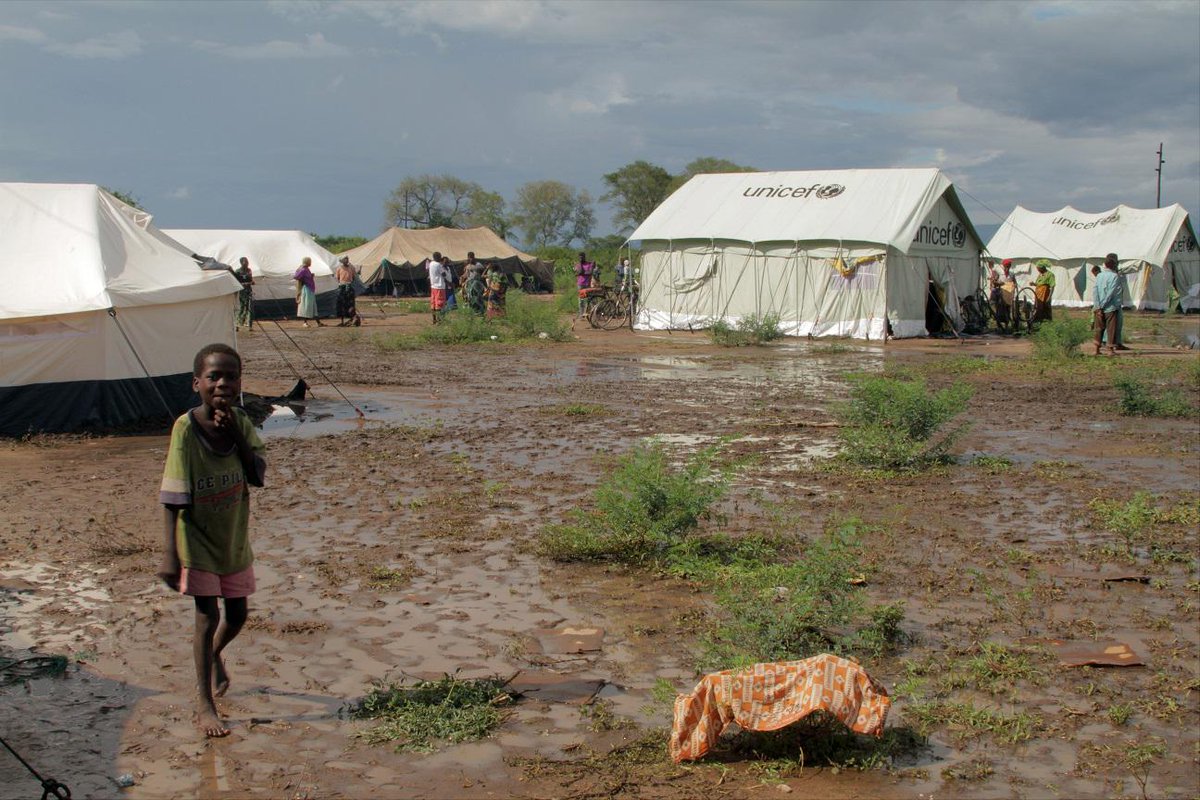
View image on Twitter
UNICEF camp for people who are displaced by , at Sekeni in Chikwawa district.


But many Malawians are angry with the slow response of the government. As late as Friday, in the district of Nsanje, there were families living without shelter or food, clean water or access to sanitation.

Those who were yet to be evactuated were sleeping in the rain for days, waiting for the waters to subside so that they might salvage what ever litte was left of their homes and belongings that had disappeared under the gushing streams. Aid agencies say that plantations have been washed away.

On Friday, the country's vice-president described the situation as "very bad". Kisyula, the World Vision offiicial, said that it will take months before people return to any semblance of normality.

For most, the biggest concern now, other than finding those who are still unaccounted for, is to provide the necessary infrastructure and prevent an outbreak of waterborne diseases, such as cholera. "Rain water, sewerage have all mixed with drinking water, and this is the next major concern," Kisyula said.

South African humanitarian organisation Gift of the Givers, which has sent a team to help in the relief operations, said on Saturday that the "massive destruction to agriculture; roads, bridges and general infrastructure, including power facilities, has complicated the situation".

The rainfall may have relented, and the skies partially cleared, but meteorologists are expecting more rains as Cyclone Chedza arrives on Sunday. Gift of the Givers said they had placed water rescue teams from South Africa on standby. 


Gift of the Givers
Non-Governmental Organization (NGO) · 7,756 Likes
 · January 16 at 4:19am · 
Malawi flood destruction pics. ‪#‎MalawiFloods‬

Alaska's toasty temperatures in 2014 worry observers


Anchorage

17 January, 2015

The biggest state in America, home to more ocean coastline than all others combined, has just set another record. This one, however, is nothing to cheer.
For the first time in recorded history, temperatures in Anchorage did not drop below zero once in an entire calendar year. In comparison, Alaska's largest city had 14 days below zero in the 2013 calendar year and 32 days in 2012. The average is 29 days.

-----------
For the record
Jan. 3, 10:22 a.m.: An earlier headline on this article incorrectly said Alaska had a record-warm year. The state's largest city, Anchorage, set a record for above-zero temperatures. Seven other cities in the state had record-warm temperatures as well.


At midnight Wednesday, Anchorage closed the book on its warmest year since 1926, according to the National Weather Service. The lowest temperature recorded in 2014 was zero degrees Fahrenheit on Feb. 11.

Sea ice has been disappearing. Polar bear populations have dropped. The state's storied dog race was a musher's mess, spurring headlines that fretted: "Warm weather, treacherous conditions — is the Iditarod in trouble?" The Bering Sea saw its warmest summer on record.

"I didn't put my downhill skis on at all last winter, and at the moment I'm still hoping for this winter, but the prospects are not good so far," said Henry Huntington, who lives in an Anchorage suburb and serves as senior officer for the Pew Charitable Trusts' international Arctic program.

The Last Frontier didn't exactly sweat through Death Valley-style temperatures. Anchorage's 2014 annual average was a chilly 40.6 degrees or so Fahrenheit, said Richard Thoman, climate science and services manager with the weather service in Fairbanks. Still, that was well above last year's annual average temperature of 37 degrees.

Environmentalists, policymakers and weather watchers are viewing the thermometer with concern.

"To me, the fact that Anchorage won't dip below zero degrees in calendar year 2014 is just one more signal — as if we needed another one — of a rapidly changing climate," said Andrew Hartsig, director of the Ocean Conservancy's Arctic program.

Hartsig said Anchorage's comparatively balmy weather is consistent with other long-term trends, including diminishing summer sea ice and increasing sea surface temperatures.

These are anomalies ... that show our climate system is off-kilter.- Chris Krenz, senior

"These are definitely red flags that are very consistent with climate change," said Chris Krenz, senior scientist at Oceana, an international conservation group. "These are anomalies ... that show our climate system is off-kÑ…lter."

James E. Overland, a research oceanographer with the National Oceanic and Atmospheric Administration, would agree with the off-kilter part. But he would add mysterious to the mix, too.

Overland argues that Alaska's very cool heat wave is not evidence of climate change but rather the next stage in a long-term weather pattern that began with six years of warming in the Bering Sea and southern Alaska, followed by six cold years.

"This year, then, was the breakdown of the string of cold years," Overland said. "What all the scientists are wondering now [is]: Is this just one warm year? Could we flip back to a cold sequence again, or is this the start of a warm sequence? ... We don't know, and it makes a big difference."

Especially to the Alaska pollock, which NOAA's FishWatch website describes as "one of the largest, most valuable fisheries in the world." Pollock don't like really warm or really cold temperature extremes, and their food source, small shrimp, do not fare well in heat.

"We really don't understand how these sequences occur, but they appear to be random and part of the chaotic climate system, rather than part of the global warming signal," said Overland, coauthor of NOAA's 2014 Arctic Report Card. "We've had one warm year here. Is this a sucker punch or not?"

Climate change or chaos aside, the warm temperatures are both real and worrisome.

The weather service's Thoman notes that a calendar year in the Northern Hemisphere contains chunks of two separate winter seasons: January, February and March, and November and December


No snow in Anchorage in November

In the last few months, the lowest temperature in Anchorage was 13 degrees Fahrenheit, recorded on Dec. 13, Thoman said.

One record Anchorage has yet to break is the longest stretch of consecutive days above zero. That record was set over 683 days in 2000 and 2001.
Still, Thoman said, "Anchorage has never had a winter when the temperature remained warm through the end of December."

Until now.

Just before Thanksgiving, Ned Rozell, a science writer for the Geophysical Institute at the University of Alaska Fairbanks, penned an online column with the headline "Snow-starved Alaska not the normal state."

Rozell worried that large swaths of Alaska remained "frozen, dusty and brown" through the first three weeks of November, threatening dozens of species that depend on snow cover.

"Each lovely flake joins spiked arms with others to create an air-trapping matrix above the ground surface," he wrote.

"The ground beneath the white blanket remains a consistent 27 degrees Fahrenheit no matter the temperature above," he continue.

"That relative warmth, the remnants of summer's heat released as the ground freezes, allows billions of small bodies to survive winter."

Among the species partial to snow are the bearberry shrub, yellow jackets and voles. Oil companies like it, too, said Larry Hinzman, director of the International Arctic Research Center at the University of Alaska Fairbanks.

The massive 49th state has remarkably few roads, and most of the land is accessible only by air or water. When there is frozen ground and good snow cover, he said, parts of the state "are suddenly open for travel," for hauling supplies and exploration.

"A good snow cover," Hinzman said, "is very important to us."

Pope Francis cuts short visit to typhoon-hit Tacloban
A storm has forced Pope Francis to cut short his visit to the Philippine city of Tacloban, which was devastated by Typhoon Haiyan just over a year ago.


17 January, 2015

Amid strong winds and pouring rain, he celebrated Mass with thousands of worshippers earlier on Saturday.

He was due to go on to meet survivors of the typhoon but had to leave early because of worsening conditions.
An audience at a cathedral gave an anguished gasp when he told them he would have to go.
A plane carrying government officials overshot the runway at Tacloban airport shortly after the Pope left

The typhoon, which remains the strongest storm ever recorded on land, created a 7m (23ft) high storm surge, destroying practically everything in its path when it swept ashore on 8 November 2013.
Around 90% of the city of Tacloban in Leyte province was destroyed and more than 14.5 million people were affected in six regions and 44 provinces. About one million people remain homeless.
The Pope said as soon as he saw the catastrophe caused by the typhoon, he had decided to go to the Philippines.
He is visiting the Philippines, where there are 80 million Catholics, as part of a six-day tour of Asia.

Tropical storm

Pope Francis was due to have lunch with survivors of Typhoon Haiyan later on Saturday but he left Tacloban four hours early because of the approaching storm and returned to Manila.
He apologised to the crowds gathered at the main cathedral in Leyte province and said: "I am sad about this, truly saddened, because I had something prepared especially for you."
Crowds at the papal Mass in TaclobanThe weather did nothing to deter the crowds attending Mass
The Pope said his pilots had told him that the weather was going to get worse. "We barely have time to get to the aeroplane," he said.
Tropical Storm Mekkhala, with winds of up to 130 km/h (80 mph), forced the suspension of ferry services to Leyte and stranded thousands of travellers, according to the Associated Press news agency.
One woman was killed after the mass, when scaffolding near the stage collapsed, local media report.
The storm was forecast to hit the shore of nearby Samar Island later on Saturday.
People pray for the victims of Typhoon Haiyan during the Mass in Tacloban
People prayed for the victims of Typhoon Haiyan during the Mass
Villagers stand as they pray next to an airfield during a mass held by Pope Francis in Tacloban on 17 January 2015Tropical Storm Mekkhala forced Pope Francis to cut short his visit after the Mass
During the Mass in Spanish, with a translation into English, the Pope spoke of the devastating impact of Typhoon Haiyan on people in Tacloban.
He told the faithful that "so many of you in Tacloban have lost everything. I don't know what to say - but the Lord does… He underwent so many of the trials that you do".
There was silence as the many thousands here in the deeply Catholic Philippines bowed their heads in prayer, the only noise the rain splashing onto the muddy ground beneath, reports the BBC's Caroline Wyatt.


Thursday, 14 November 2013

The Filoppino tragedy

Desperation grows among Philippine survivors of Typhoon Haiyan


12 November, 2013


MANILA — Drenched by rain and increasingly desperate, typhoon-stricken Filipinos rushed fences and pleaded with guards Tuesday at the battered airport serving as a tenuous lifeline to an international aid effort confronted at every turn by transport and logistics bottlenecks.

The United Nations launched an appeal for $301 million to help victims. The chief of its humanitarian operations, Valerie Amos, arrived in Manila, the capital, to coordinate the relief effort and quickly acknowledged the difficulties it faced.

"We have not been able to get into the remote areas," Amos said. Even in Tacloban, she said, the main city in the typhoon's path and the site of the airport, "because of the debris and the difficulties with logistics and so on, we have not been able to get in the level of supply that we would want to."

In its appeal for funds, the U.N. estimated that more than 11 million people had been affected by Typhoon Haiyan, one of the strongest storms ever to hit land, with 660,000 left homeless. The official death toll was nearly 1,800, and that figure is expected to rise substantially. More than 2,500 were injured.

Philippine President Benigno Aquino III downplayed widespread estimates that 10,000 or more people might have died, telling CNN that the figure was more likely 2,000 to 2,500 people.

The higher estimate came from local officials soon after the storm swept through early Friday, and may have been the result of "emotional trauma," Aquino said.

Still, it's clear that relief workers have not yet reached many outlying communities, and that it's proving difficult to move supplies from airfields and ports even into the main cities.

Tacloban's airport is the only major airfield on the hard-hit island of Leyte. Aid workers say the road from the airport into the city is so clogged with debris and the putrefying remains of the dead that the trip takes three hours. Roads leading inland are impassable.

Amos said money was needed for "food, health, sanitation, shelter, debris removal and also protection of the most vulnerable."

Before her arrival, the U.N. released $25 million in emergency funds. Other governments, including the United States, Britain, the United Arab Emirates, Japan, Australia and South Korea, pledged tens of millions more. Filipinos working overseas, who account for about 10% of the Philippine population, were also organizing efforts to send money and aid.

U.S. and British warships were moving into position off the Philippine coast to help with the relief effort. In addition to the aircraft carrier George Washington, Marine Brig. Gen. Paul Kennedy, head of the U.S. military relief effort, said he needed Navy amphibious ships to help deliver supplies.

Marines based in Okinawa were dispatched along with sailors and have begun to deliver aid.

The White House said President Obama spoke with Aquino by telephone Tuesday and that the United States would deliver "whatever help we can, as quickly as possible."

Katherine Manik, country director for ChildFund International, said a relief crew was able to reach the city of Ormoc on the other side of Leyte by boat, but couldn't move far from the dock.

"There is a critical need for fresh drinking water and food, but it is very difficult to get anything in. There aren't enough boats. There is no electricity," she said.

Even at the makeshift clinic next to the Tacloban airport, to which the Philippine air force's C-130 cargo planes have been making regular runs from Manila, aid workers said they had no medicine to treat emergency cases.

Among the many risks, medical workers say, are tetanus infections as people try to salvage items from their homes or build shelters. But there is no tetanus vaccine available, Capt. Antonio Tamayo of the Philippine air force told the Inquirer Daily News.

One difficulty is that the local government infrastructure has disappeared. Tacloban Mayor Alfred Romualdez told reporters that of 1,300 police officers, only 100 were coming to work.

Telephones are not working and local radio is out. One radio anchorman in Tacloban who stayed on the air during the storm using generators was presumed to have drowned. No one has heard from him since the program abruptly went off the air.

Although there were warnings for days about the typhoon and hundreds of thousands of people took heed and evacuated, many others didn't. The Philippines suffers frequent tropical storms, and some residents apparently thought they could survive this one as well.

Warner Passanisi, global emergency response coordinator at ChildFund, said the storm made landfall nine times at different locations in the archipelago nation. "You had not just the wind, but the tidal surges and the swelling of water," he said.

Those who survived the punishing winds and storm surge — estimated by some at 20 feet — have since dealt with pouring rain, which tapered off during the day Tuesday. Some were able to obtain tents sent by relief agencies.

Many crowded the airport, where Philippine and U.S. cargo planes were bringing in aid. But military officials said the airport could work only during daylight because of the lack of electricity. Mothers held their babies over their heads, hoping that would gain them a seat on a flight leaving the storm zone.

Philippine military officers said they had evacuated nearly 3,000 people. But many more were waiting, and local news reports said they twice tried to rush arriving cargo planes.

Just after dawn, several thousand rushed through a broken fence toward two Philippine air force C-130s, but they were held back by police and soldiers. Later, police held back another group that tried to rush a U.S. plane.

Bodies, some covered with sheets of galvanized metal or wrapped in blankets, had not yet been picked up from roads leading to the airport or at many other locations in Tacloban.

Narcissa Abordo, 65, was left to deal with the anguish of having survived the storm — even though she urged her son to let her die — while the grandchildren she tried to protect did not.

Abordo, who ran a boardinghouse, was caring for the children to help out a daughter who lives in Manila.

When the storm hit, there was a rushing sound and a "black whirlpool of water," she said. Abordo passed the boy and girl to her boarders, who took them to the second floor of a neighbor's house. The water, she said, rose more than 10 feet in 10 seconds.

Abordo and her son were swept past one tin roof after another, as they tried to grab on to whatever electric wires they passed. She can't swim, and she survived only because her son carried her on his shoulders.

She said she told him, "Please save yourself — I am already old. You can leave me. You are young." He refused.

Abordo said she would never understand what exactly happened to her grandchildren. She was told that one child was frightened and jumped into the rising water. Shortly after, the other did the same. The children, she was told, were crying and yelling, "Mama, Mama, Papa...."

Her grandson's body has been found; the granddaughter is still missing.

"But I think she is nearby," Abordo said, "because I saw her skirt when I walked down a street."


Wednesday, 21 August 2013

Extreme weather

High Alert: Flooding may get worse as Russia's Far East destroyed in deluge


Record rainfall: more than 60% of Philippine capital under water

Flooding caused by some of the Philippines' heaviest rains that submerged more than half the capital began receding Tuesday, but authorities evacuated thousands of residents along Manila's overflowing rivers and braced for more chaos in outlying provinces.


20 August, 0213


At least eight people have died, including four who drowned north of Manila. The dead included a 5-year-old boy whose house was hit by a concrete wall that collapsed, and a 3-year-old boy who fell into a swollen river in Mariveles town in Bataan province. Four people are missing.

Throughout the sprawling, low-lying capital region of 12 million people, offices, banks and schools were closed and most roads were impassable. People stumbled through waist- or neck-deep waters, holding on to ropes strung from flooded houses.

More than 200 evacuation centers were opened in Manila and surrounding provinces, filled with tens of thousands of people, Social Welfare Secretary Corazon Soliman said. Overall, more than 600,000 people have been affected by the floods.

"I had to wade through a waist-deep flood," said Esteban Gabin, a 45-year-old driver, who was plotting the best route to check on his family in Pampanga province, northwest of Manila. "But I may have to swim to reach my home because we live near the Pampanga River, and the flood there could reach up to neck deep."

The flooding that covered half of the capital receded to 20 percent, concentrated on Marikina and Paranaque cities, said Eduardo del Rosario, head of the national disaster council.

In Marikina, where the river breached its banks, authorities started evacuating some 12,000 people to schools and gymnasiums that were turned into emergency shelters.

As the weather gradually improved in Manila, the concern shifted to provinces outside the capital that were expected to be drenched as the monsoon travels north.

In Pampanga's rice-producing town of Minalin, more than 200 villagers fled after water from a swollen river spilled over a dike and began flooding communities amid pounding rain. Villagers scrambled to lay sandbags on the dike and in front of their houses, said Office of Civil Defense officer Nigel Lontoc.

"The villagers are afraid that the dike may collapse any time," Lontoc said by phone.

About 200 members of the Aeta tribe living near the foot of Mount Pinatubo left their homes for fear of being swept away by a raging river near Botolan township in Zambales province, said Elsa Novo, a leader of an Aeta federation in the province. She said other family members stayed behind to watch their property.

Evacuations were also under way around the La Mesa dam, north of Manila, which began overflowing. The waters from the dam flow into the Tullahan River, which passes through some of the densely populated areas of the capital.

The flooding followed two nights of heavy monsoon rains enhanced by Tropical Storm Trami. The storm hovered over the North Philippine Sea and drenched the main northern island of Luzon with up to 30 millimeters (just over an inch) of rain per hour. It was forecast to move away from the Philippines toward Taiwan on Wednesday.

In many coastal towns along swollen Lake Laguna, near Manila, and in food-growing riverside provinces, residents were trapped on rooftops, waded through the streets or drifted on makeshift rafts. Many chose to stay close to their homes for fear they would be looted if they left.

Flooding has become more frequent in Manila because of deforestation of mountains, clogged waterways and canals where large squatter communities live, and poor urban planning.

"We're surprised by the rainfall. Some areas experienced record levels," said Science Secretary Mario Montejo.

According to an assessment from the Department of Science and Technology, rainfall reached 600 mm (23 ½ inches) in and around Manila Bay on Sunday alone — more than a month's worth of rain in a day. That's compared to the disastrous 2009 Typhoon Ketsana, the strongest to hit Manila in modern history, when 455 mm of rain fell in 24 hours.

Many domestic and international flights at Ninoy Aquino International Airport were canceled. Key roads leading to the airport were flooded and passengers and crew were delayed.

The Philippine archipelago is among the most battered by storms in the world. About 20 tropical cyclones hit the country every year.


Tropical Storm and Monsoonal Flow Collide Over Super-Heated Pacific to Dump Two Feet of Rain on Manila


20 August, 2013
Yesterday, tropical storm Trami churned through an abnormally hot Pacific Ocean toward an inevitable date with downpour over Taiwan and Southeastern China. There, a procession of tropical storms and monsoonal moisture had set off record floods which, by Tuesday, had resulted in the deaths of over 200 people. The now saturated region expects the arrival of Trami today, but not after the tropical monster, loaded with megatons of moisture, clashed with an already amped monsoonal flow to drench the Philippines as it emerged from a broiling Pacific Ocean.
Throughout the past month, an ocean heat dome had caused surface water temperatures to soar above 86 degrees Fahrenheit (30 degrees Celsius) over a vast swath of the Pacific Ocean just to the east of China and to the south of Japan and Korea. This powerful pool of latent Pacific heat was a major factor in the delivery of record heatwaves to China, Korea and Japan which resulted in thousands of hospitalizations and at least 100 lives lost. But yesterday, the heat and moisture rising off the Pacific would play its highly energetic part in an entirely different anomalous weather event — the inundation of the Philippine capital city of Manila.
 Trami Collides with Monsoonal Flow to Produce Record Rainfall over Philippines
(Image source: NASA/Lance-Modis)
As Trami made her way over these hot and moisture rich waters, she grew in size until her cloud area covered a width of more than one thousand miles. Ocean temperatures soaring between 2 and 4 degrees (Fahrenheit) above average helped to pump its immense bulk full of moisture even as it became wrapped in a dense flow of monsoonal moisture proceeding from west to east off the continent.
By Monday, Trami was moving in from the east, lashing the Philippines with her dense, thunderstorm laden, spiral bands even as monsoonal storms came into collision with these bands from the west. The combination of a moisture rich tropical storm colliding with an equally rain dense monsoonal flow over a Philippines surrounded by anomalously hot water set off an extraordinarily intense rain event in which the capital of Manila was inundated by a powerful deluge.


Rainfall rates for this sprawling city hit a stunning 2 inches per hour and maintained that record shattering pace for almost twelve hours running. In total, more than 23.5 inches of rainfall was recorded at rain gauges across the capital. Many residents, whose homes were flooded in a rising rush of water, were forced to evacuate and initial reports indicate that at least 100,000 of Manila’s 12 million residents have now relocated to emergency shelters. So far, at least 8 deaths and millions of dollars in damages have been attributed to the storm. But with local levees and damns under threat of over-topping and collapse, the initial reports and estimates may just be the beginning.
Satellite and water vapor imagery taken on Tuesday showed rains continuing over the Philippines, albeit at a less intense rate, as Trami turned her great bulk of moisture northwestward toward the already soaked regions of Taiwan and southeastern China. Trami is expected to intensify into a category 1 Typhoon this afternoon and is likely to deliver severe rains and flooding to already soaked regions.
Trami Rakes Taiwan and Philippines
(Image source: NOAA)
You can see Trami raking both Taiwan and the Philippines with massive and rain-dense cloud bands in the most recent NOAA water vapor imagery. In this image, the storm appears to intensify as it bears down on the already storm-soaked shores of China and Taiwan.
Conditions in Context
The Philippines is hit by a total of 20 tropical cyclones each year. So heavy rainfall and floods are a regular aspect of life there. However, the nearly 24 inches of rainfall during a 12 hour period experienced yesterday is unprecedented, breaking even a number of Manila’s very high record rainfall totals. The conditions that led to these records, just one year after another severe rainfall event, include anomalous heating of the Pacific Ocean under a powerful Ocean Heat Dome during late July and early August, a rather strong and thick monsoonal flow that has tended to meander a bit further north than is usual, and a very large tropical cyclone fed by both the anomalous heat and added moisture.
Climate research has shown that we can expect more intense rainfall events worldwide as the hydrological cycle increases by 6% with a .8 degree Celsius temperature rise. Similar research has found evidence of more frequent tropical cyclones as oceans warm and seasons in which hurricanes may develop continue to lengthen. This region of the Pacific Ocean, in particular, has shown an increasing number of cyclones as Earth has continued its human-driven warming trend, with temperatures increasing by .2 degrees Celsius per decade over the last 30 years. Since the vast Pacific Ocean forms a kind of moisture trap in this steamy region, it is likely the area will experience some of the worst flooding and storm effects coming down the pipe due to human-caused warming.
Trami’s expected delivery of powerful storms to China and Taiwan will also, unfortunately, probably not be the last for this season. Water temperatures are still stunningly high and moisture flows from both the Indian Ocean and the Pacific are likely to churn out many more storms before the tropical cyclone season ends months from now.
Links, Credits and Hat Tips: