Showing posts with label Hassan Rouhani. Show all posts

Saturday, 20 February 2021

Iran Snubs Beijing Biden Overture

 Iran Snubs Biden Overture For Nuclear Talks: "LIFT Sanctions, We WILL Respond"


Zero Hedge,

19 February, 2021


Iran has snubbed the White House's signaling on Thursday that it's ready to sit down for EU-sponsored talks toward restoring the 2015 nuclear deal. For the first time in the Biden administration a senior US official said "We are ready to show up if such a meeting were to take place" - in what's clearly an invitation for Iran to signal the same. But Tehran has slapped it down, sticking with its line that Washington must begin dialing back sanctions first.

Bloomberg reports on the latest Friday after a flurry of statements out of the US administration which appeared to belatedly extend an open hand: "Iran said the U.S. must first return to the 2015 nuclear deal and lift sanctions if it wants talks with the Islamic Republic, appearing to snub an effort by the Biden administration to begin direct discussions before officially rejoining the accord."

Iran's foreign ministry then took the opportunity to remind the world that there was a perfectly good nuclear deal in place to which Iran was in full compliance but that "Trump left the room and tried to blow it up" - in reference to the US pulling out of the deal in May 2018.


"Because of US withdrawal from JCPOA, there is NO P5+1. It is now ONLY Iran and P4+1," government spokesman Saeed Khatibzadeh tweeted in response Friday.

"US must Act: LIFT sanctions. We WILL respond," he added. Biden's strategy has been to demand Iran return to conformity with uranium enrichment caps first - before there's any talk of sanctions relief - however, Tehran has been consistent in saying it's for Washington to move first (by lifting sanctions).

Time is running out and the Biden White House is suddenly realizing it's painted itself into a corner. Though there was big talk on the campaign trail about reversing Trump's Iran policies, the reality is nothing has changed. 

Iran has indicated it will begin blocking IAEA inspectors from its nuclear facilities starting Sunday, February 21st, hence this new scramble out of the Biden administration to find a way forward before this next escalation measure that many fear would be hard to roll back after it takes effect. Both the US and Europe are warning against such a step.

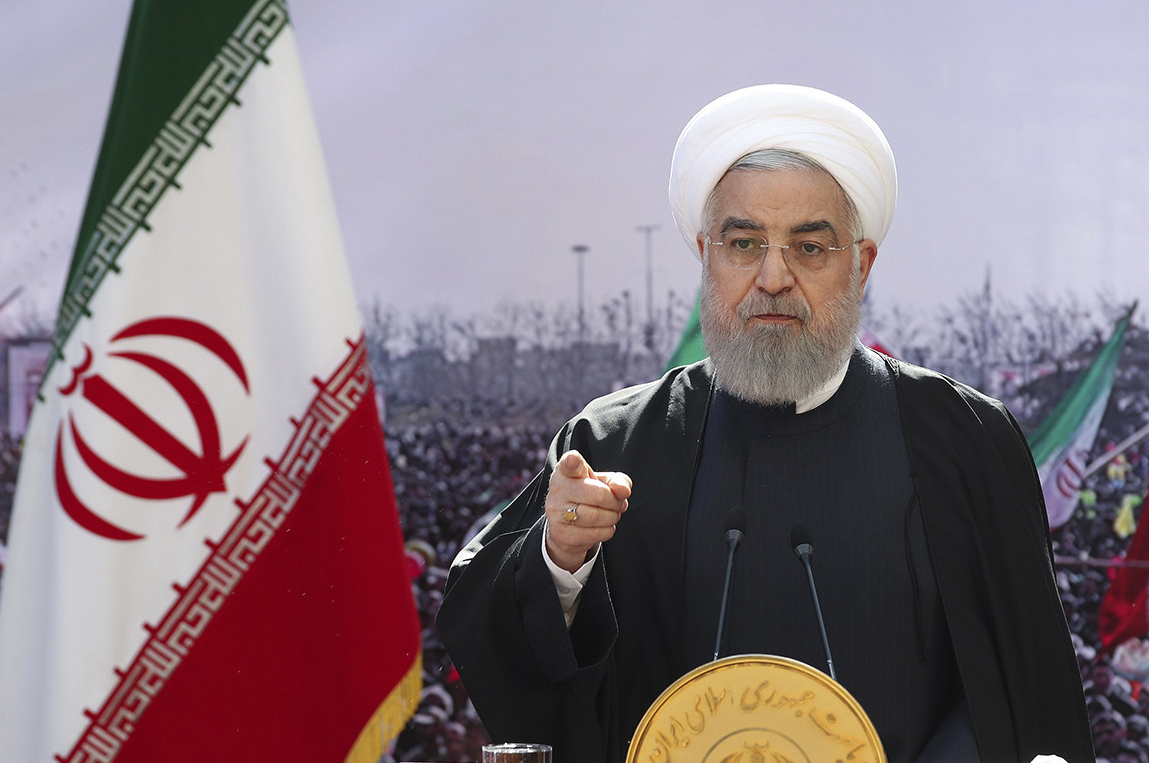
Iranian Presidency Office via AP/Politico 

So far the Biden admin has introduced meager steps such as dropping travel restrictions on top level Iranian diplomats Trump had enacted, as well as abandoning the push for "snapback" sanctions at the UN.

This appeared an initial step toward softening this major attempt at an overture:

On Thursday, the Biden administration said it would be willing to meet with Iran to discuss a "diplomatic way forward" in efforts to return to the nuclear deal, a first step toward easing tensions.

"The United States would accept an invitation from the European Union High Representative to attend a meeting of the P5+1 and Iran to discuss a diplomatic way forward on Iran’s nuclear program," State Department spokesman Ned Price said in a statement. The P5+1 refers to the participants in the nuclear deal with Iran: China, Russia, France, the U.K., the U.S and Germany.

The US has lately been in direct talks with allies Britain, France, and Germany - the key European signatories to the JCPOA - and it appears they've finally struck up a common strategy in getting the frozen communications between Tehran and Washington going again. 

But perhaps seizing upon the sense of confusion and raging policy debate within the Biden White House on the issue, the Iranians are seeking to be in the driver's seat after patiently enduring Trump's 'maximum pressure'.

Friday, 27 September 2019

Pressident Rouhani at the UNGA


Live: Iran's president Hassan
Rouhani holds press 
conference in New York

Friday, 22 September 2017

Rouhani: Tehran will boost its missile capabilities

They’d be mad not to.

Iranian president Rouhani says Tehran will boost its missile capabilities – state media


Iranian president Rouhani says Tehran will boost its missile capabilities – state media
A man looks at Iranian-made missiles at Holy Defence Museum in Tehran © Raheb Homavandi / Reuters

RT,
22 September, 2017

Iranian President Hassan Rouhani has vowed to strengthen the country’s missile capabilities, state media reported. The statement comes amid heightened tensions between Tehran and Washington after President Trump's speech at the UN General Assembly.
The Iranian leader addressed the military on Friday, during a parade marking the start of Muharram, the first month of the Islamic lunar calendar.

Rouhani said that the country will boost its military capabilities, from missiles to ground, air and sea forces. The military will be strengthened to the extent that Iran considers necessary, he added.


Trump may cite UN resolution to decertify Iran nuclear deal – US envoy to UN


"We will increase our military power as a deterrent. We will strengthen our missile capabilities...We will not seek permission from anyone to defend our country," Rouhani said, as cited by the Irna news agency.

The president stressed the defensive nature of their weapons. Their purpose is to defend the country and the region from “the invasion of the great powers” and from terrorism, he said.

He emphasized that, “like it or not,” Tehran will defend “the oppressed people” of Yemen, Syria and Palestine.

In his first speech at the UN on Tuesday, US President Donald Trump called Iran a “depleted rogue state whose chief exports are violence, bloodshed, and chaos,” accusing it of funding terrorists and undermining the stability of the entire Middle East. Trump also said that the milestone nuclear deal concluded in 2015 by Tehran and leading world powers, the Joint Comprehensive Plan of Action (JCPOA), is “one of the worst and most one-sided transactions” and “an embarrassment” to the US.


Tehran has blasted Trump’s choice of words, calling them “shameless and ignorant remarks,” that ignore “Iran’s fight against terrorism,”said Iranian Foreign Minister Mohammad Javad Zarif, who was among the negotiators of the document that restricts Iran’s nuclear program in exchange for a loosening of international sanctions. 


Saturday, 28 September 2013

Obama hints at end to sanctions

This the first time that a U.S. head of state has spoken with 
an Iranian head of state since 1979 (34 years).

Obama holds historic phone call with Rouhani and hints at end to sanctions
President says discussion with Iranian counterpart showed 'basis for resolution' of dispute over Tehran's nuclear programme


27 September, 2013


Barack Obama and Hassan Rouhani held the first direct talks between American and Iranian leaders since the 1979 Islamic revolution, exchanging pleasantries in a 15-minute telephone call on Friday that raised the prospect of relief for Tehran from crippling economic sanctions.

Speaking at the White House shortly after the historic call, Obama said his discussion with Rouhani had shown the "basis for resolution" of the dispute over Iran nuclear programme.

The conversation, in which Obama communicated his "deep respect for the Iranian people", capped a week of diplomatic breakthroughs. Rouhani ended a five-day visit to New York for the UN general assembly with a striking offer to work rapidly to defuse tensions with America, and hailed the US as "a great nation" – a dramatic shift in tone for an Iranian leader.

Both leaders expressed confidence their countries could reach a peaceful settlement to their standoff over Iranian nuclear programme. Obama, in his White House statement, said: "While there will be significant obstacles and success is by no means guaranteed, I believe we can reach a comprehensive solution. I do believe that there is a basis for a resolution."

Obama cautioned against over-optimism, however. "We're mindful of all the challenges ahead," he told reporters. "The test will be meaningful, transparent and verifiable actions which can also bring relief from the comprehensive international sanctions that are currently in place."

Minutes earlier, President Rouhani's English-language Twitter account broke news of the phone call in a series of tweets that hinted at a remarkably swift rapprochement between the two countries since the moderate cleric was elected in June.

One tweet said Rouhani had concluded the phone call by telling Obama to "have a nice day!" and Obama had thanked him and said goodbye in Persian – "Khodahafez", which means "God go with you".


In a phone conversation b/w #Iranian & #US Presidents just now: @HassanRouhani: "Have a Nice Day!" @BarackObama: "Thank you. Khodahafez."

Hassan Rouhani (@HassanRouhani) September 27, 2013


The tweets, which are published by Rouhani's aides, suggested the tone of the conversation was friendly, even punctuated by banter. Obama was quoted as saying: "I wish you a safe and pleasant journey and apologize if you're experiencing the [horrendous] traffic in NYC."

Earlier, at a press conference in New York, Rouhani made the most conciliatory remarks heard from Tehran in a decade and also offered to prepare a concrete plan for resolving the nuclear stalemate to a new round of negotiations in Geneva on 15 October.

He said Tehran might go even further, hinting at a possible confidence-building measure to be announced at the talks. But it was Rouhani's tone that was most remarkable, at the end of a week in which he sought to present Iran as a reborn country, following his June election.

"The environment that has been created is quite different from the past, and those who have brought the change was the people of Iran," he said. "The first step has been taken here which is a beginning for better relations with other countries and in particular, between the two great nations of Iran and US.

"So the understanding between our peoples will grow and our governments will first stop the escalation of tensions, and then defuse those tensions."

The conciliatory language marked a radical change from the presidency of his predecessor, Mahmoud Ahmadinejad, and a break from tradition dating to the 1979 revolution of referring to the US as the "Great Satan". It mirrored a change on the streets of Tehran, where the ritual chanting of "Death to America" has almost died out at public gatherings since the elections.

"Step by step, we will build confidence between our presidents and our countries," Rouhani said " With sufficient will on both sides – and I assure you that on Iran's side the will is 100% – the nuclear file will be resolved in a short period of time."

Rouhani rejected suggestions that his flexibility at the negotiating table was constrained by hardline forces back in Iran.

"My government has full authority in these negotiations with support from all three arms of government as well as the people of Iran. I have complete backing."

Nevertheless, in an indication of the precarious position in which Rouhani finds himself, the state news agency in Iran earlier this week disputed the translation of an interview he conducted with CNN. In the interview, Rouhani acknowledged that the Holocaust took place. CNN pointed out that the translator for the interview was provided by the Iranian government.

There were also suggestions that Obama and Rouhani might meet informally on the sidelines of the UN general assembly this week, but the prospect of a picture of the two leaders shaking hands appears to have been too much even for the new, moderate regime. A telephone call, however, was more palatable.

According to the White House, the idea to hold the call came at short notice from the Rouhani team. Having turned out the chance of a face-to-face meeting at the UN because it would be "too complicated", Rouhani said he wanted to talk to Obama before he left for Iran.

The call took place at 2.30pm ET, it lasted about 15 minutes and was conducted through an interpreter. A senior administration official confirmed that Rouhani's Twitter feed had accurately reflected the tone of the conversation, and noted: "We'll be continuing to watch that Twitter account."

"It was quite cordial in tone," the official said. "Both leaders expressed their determination to solve this [nuclear] issue expeditiously. Both leaders expressed that sense of urgency."

The official said that the Israeli government and congressional leaders, both sources of resistance to a rapprochement between Washington and Tehran, had been alerted before the call began. The official recalled that in his first inaugural address in January 2009, Obama declared, in a phrase directly aimed at Tehran: "We will extend a hand if you are willing to unclench your fist." The official added: "What we are have seen here is a unclenching – hopefully – of that fist."

In his White House press conference, Obama acknowledged the historic nature of the call. "The very fact that this was the first communication between an American and Iranian president since 1979 underscores the deep mistrust between our countries but it also indicates the prospect of moving beyond that difficult history," he said.

Describing the sequence of events that led to the talks, Obama added: "Iran's supreme leader has issued a fatwa against the development of nuclear weapons. Rouhani has indicated that Iran will never develop nuclear weapons. I made clear that we respect the right of the Iranian people to access peaceful nuclear energy."


'Iran's threat propaganda dangerous for world security' - Rouhani to UN Assembly 2013 (FULL SPEECH)

'Iran's threat propaganda dangerous for world security' - Rouhani to UN Assembly 2013 (FULL SPEECH)


Thursday, 19 September 2013

Iran

Iran’s president on nuclear issue: ‘Problem won’t be from our side’
Iran’s new president has said his country will never attempt to develop nuclear weapons and that, two months after being elected, he has the stature to make a deal with Western leaders regarding Iran’s atomic program.


RT,
19 September, 2013

President Hassan Rouhani told NBC News on Wednesday that Iran has stated multiple times that “under no circumstances would we seek any weapons of mass destruction, including nuclear weapons, nor will we ever.”

In its nuclear program this government enters with full power and has complete authority,” he said. “The problem won’t be from our side. We have sufficient political latitude to solve this problem.” 
Since succeeding the polarizing Mahmoud Ahmadinejad this summer, Rouhani indicated a reluctant willingness to meet and negotiate with US leaders. He told NBC that he traded letters with US President Obama in which the two discussed “some issues” after decades of political hostility between the two nations.
From my point of view, the tone of the letter was positive and constructive,” Rouhani said of a congratulatory note from Washington after the election. “It could be subtle and tiny steps for a very important future. I believe the leaders in all countries could think in their national interest and they should not be under the influence of pressure groups. I hope to witness such an atmosphere in the future.”  
Nasrin Sotoudeh hugs get son on September 18, 2013, after being freed after three years in prison. (AFP Photo / Behrouz Mehri)

Nasrin Sotoudeh hugs get son on September 18, 2013, after being freed after three years in prison. (AFP Photo / Behrouz Mehri)


Iran releases political prisoners


Rouhani also ordered the release of Nasrin Sotoudeh, an Iranian human rights lawyer, and a number of other political prisoners on the eve of a visit to the United Nations. Sotoudeh was in the midst of a six-year prison sentence for allegedly endangering national security and misusing her duties as a lawyer. Obama specifically mentioned her case during his annual message to Iran in 2011, saying she had been jailed “for defending human rights.” 

Several journalists were also freed, although dozens remain imprisoned for their roles in a 2009 anti-government protest. 
Psychologically, my condition is very good but my experience – with all the psychological pressure, the tense security atmosphere, and not have access to make phone calls – was very tough,” she told AFP following her release.  
Whether the White House will be receptive to Rouhani’s gestures remains to be seen. 
We should hear him out but see what the actual deal is on the nuclear dossier and Iranian support on Syria. We will judge Iran on its actions, not just its words,” a diplomatic source told The Telegraph. 

'We consider war a weakness'


Rouhani was also questioned on his stance regarding a possible military strike against Syria, a close ally to Iran. 
We are not the government of Syria,” he told NBC. “We are one of the countries of this region which is asking for peace and stability and the elimination of all weapons of mass destruction in the entire region.” 
Rouhani did not explicitly voice his support for Syrian President Bashar Assad. However, he did respond when asked whether he viewed Obama’s decision to back away from an air strike as a sign of weakness. 
We consider war a weakness,” he said. “Any government or administration that decides to wage a war, we consider a weakness. And any government that decides on peace, we look on it with respect to peace.”