Showing posts with label Fort McMurray. Show all posts

Wednesday, 19 July 2017

Canada's wildfires

Bigger, Hotter, Faster: Canada’s Wildfires are Changing and We’re Not Ready


18 July, 2017

While doing research for a book I was writing on wildfire, I posed two questions to a number of experts: “Do you think there will be another Fort McMurray-like fire in the future? If so, where do you think it will happen?”

Everyone agreed on the first question. Fort McMurray was not an anomaly. It will happen again, sooner rather than later, and likely with deadly consequences.

The responses to the second question varied. University of Alberta wildfire scientist Mike Flannigan had many First Nations communities, Prince George in British Columbia and Timmins in northern Ontario high on his list.

Cliff White, a former Parks Canada scientist and one of the architects of the agency’s wildfire management program, suggested that Sulphur Mountain in Banff could burn, endangering thousands of hikers and tourists.

Wildfire scientists Brian Stocks and Marty Alexander cast a broader net. They suggested that hundreds of communities are at risk.

Glenn McGillivray, the managing director of the Institute for Catastrophic Loss Reduction, offered the most surprising response. He had Victoria and Vancouver on his list. (If you think McGillvray is exaggerating, consider the fact he predicted in a blog that a fire would threaten Fort McMurray two years before it happened.)

As this year’s fire season in British Columbia has demonstrated, the experts I talked to were right in answering the first question. Time will tell whether they will be right in answering the second. But they will almost certainly be.

The province of B.C. declared a state of emergency on July 7, 2017 due to wildfires. Photo: Province of B.C.

Bigger, Hotter, Faster

The last decade has been the warmest continent-wide. Hotter weather dries the forest and produces more lightning. Lightning is responsible for most of the biggest wildfires that occur in Canada, although people cause more wildland fires than lightning strikes.

More people are living, working and recreating in the forest. There are more mature trees in the forest landscape as a result of decades of aggressive firefighting efforts. Tens of millions of these trees are dead or dying thanks to insects and disease that strike aging trees and the warming that is taking place.
It all adds up to fires burning bigger, hotter, faster and more often.

Everyone agrees that this will result in more evacuations, more homes and businesses being burned, more roads and recreation areas being closed, more smoke imperilling the health of people, especially the young, the elderly and those with respiratory problems. First Nations, which represent only four per cent of the population, will be hit especially hard. They are already affected by a third of the evacuations that take place in a given year.

Water quality will also suffer. The carbon that spills into the river systems can seriously compromise water treatment facilities, especially in places such as Victoria that do not filter water because the high quality water supply does not require them to do so.

Members of the RCMP search the wreckage of the Fort McMurray wildfire in 2016. Photo: RCMP

Fort Mac Sparked Little Change

Fort McMurray should have been the catalyst for changing the way we deal with wildfire. That blaze sent approximately 88,000 people fleeing their homes, offices, hospitals, schools, and seniors’ residences. By the time rains and cooler temperatures helped firefighters contain the fires, 2,800 homes and buildings were destroyed. Nearly 1.5 million acres burned. Insurance losses were expected to amount to $3.77 billion. The total cost of the fire, including financial, physical, and social factors, is likely to be $8.86 billion.

But has anyone in government been listening?

The government of Ontario has embarked on a policy that will allow some fires to burn themselves out so long as they don’t threaten people and commerce. This policy, which preceded Fort McMurray, will go a long way toward making forests there resilient.

But that’s just about it for the bold strategies that outgoing B.C. Premier Christy Clark and her provincial colleagues seemed to call for last year when they supported the idea of a national wildfire strategy. That’s gone nowhere.

The government of Alberta’s response so far to recommendations from an expert review panel that investigated the Fort McMurray fire has been muted at best. 

More money has been allotted to the FireSmart Program, which helps communities thin urban-edge forests, remove burnable fuel on the ground and around homes, and create defendable boundaries from which fires can be fought.

But it’s not nearly enough. And as Marty Alexander points out, a good chunk of the funding was given to Fort McMurray where the fires of 2016 have already removed most of the dangerous fuels from the ground.

Alberta has strengthened some wildfire protection laws but not those that matter most. The government has been reluctant to enforce existing laws (closing forests in times of extreme drought and heat) that minimize the chance of fires igniting. Alberta has promised to improve fire weather forecasting, but has offered few details.

Image of raging fire 16 kilometres south of Fort McMurray in 2016. Photo: CTV News Youtube screenshot 

Instead of recognizing the dangers that lie ahead, the Alberta government has chosen to treat Fort McMurray as an “extreme event.” It’s not the only government that is guilty of doing this.

Lost in the collective memory of the politicians who rotate in and out of office are the so-called extreme wildfire events of the recent past which are not so rare anymore: Salmon Arm, B.C. and Virginia Hills, Alberta in 1998; the Chisholm and House River fires of 2001 and 2002 in Alberta; West Kelowna, Okanagan Mountain Park, Kootenay, Banff, Jasper, Crowsnest Pass in 2003; the Yukon in 2004; La Tuque in northern Quebec in 2010; Slave Lake and the Richardson fires in 2011; northern Quebec in 2013; the Northwest Territories in 2014; the 2015 fire season, which was the most intense fire season of the century in western North America.

As the current situation in B.C. is demonstrating once again, these extreme events are now the new normal. In Canada, wildfires that burned more than 200,000 hectares of forest happened only four times between 1970 and 1990. Since then they have done so 12 times.

The provinces are not totally at fault. The federal government has done little to support forest science. The Canadian Forest Service used to employ 2,400 people. It now employs about 700. Most of the service’s research money goes to the study of insect infestations that impact the timber industry. The total funding is justified given the nature of the problem and the value of the industry. But less than eight per cent goes to fire research.

Given the relative importance of fire and insects in Canadian forests, how is this disparity possible?” asks Brian Stocks, who had a long career in the forest service.
 
People in and out of government kept telling me that the important thing about Fort McMurray was that no one died. They are right to an extent, but they are also wrong because loss of life is not necessarily the best way of measuring success. 

Fort McMurray was the worst natural disaster in Canadian history. It could have been much worse if so many things — wind, demographics (Fort Mac has relatively few elderly people), safety training (most everyone in the oil sands industry knows what to do in an emergency), quick and creative thinking, heroism and outright luck — hadn’t aligned in the manners they did.

Fort McMurray dodged a lot of bullets, as the town of Slave Lake did in 2011 when everyone had to evacuate at the last minute. Those in the line of fire in the future may not be so fortunate if the provinces and the federal government fail to come to grips with the mounting challenges.

The blueprint for the future was spelled out in 2005 when Brian Stocks and a veritable who’s who of wildfire experts were asked by the Canadian Council of Forest Ministers to come up with a new wildlands fire strategy. Most of those recommendations have been ignored.


Wednesday, 31 May 2017

Record heat predicted for Fort McMurray

Record Heat Predicted for Fort McMurray Wednesday as Fire Danger Spikes


30 May, 2017

Just a little more than one year after freakish global warming-spurred wildfires forced a near complete evacuation of the tar sands production town of Fort McMurray, Alberta, record heat and extreme fire hazard are again settling in over this subarctic region.

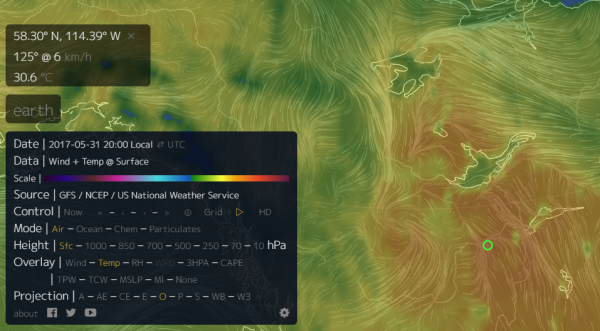
(Subarctic sections of Alberta are expected to experience temperatures in the upper 80s and lower 90s [F] tomorrow. Such heat is expected to spike fire dangers throughout the region. Image source: Earth Nullschool.)

The weather forecast for Wednesday, May 31, 2017 tells a story of predicted extreme heat for a typically cool region of Northwest Canada. High temperatures for the day are expected to range from 86 to 90 F (30 to 32 C). That’s a hot day anywhere. But it’s particularly impressive for a region that shares a common climate with places like historically cold Alaska and Hudson Bay.

Average high temperatures for Fort McMurray in Alberta, Canada for this time of year typically top out at a rather cool 64 degrees Fahrenheit (18 C) — closer to the expected Wednesday morning low of 62 F (17 C). Wednesday’s forecast high, meanwhile, is quite considerably outside the normal range and exceeds 30 year averages by fully 22 to 26 degrees F. If such heat does emerge, it will tie or break the 2007 all-time record for May 31 of 86 F (30 C).  Such record heat is now predicted to occur after today’s expected, well above average, high of 80 F (26 C).
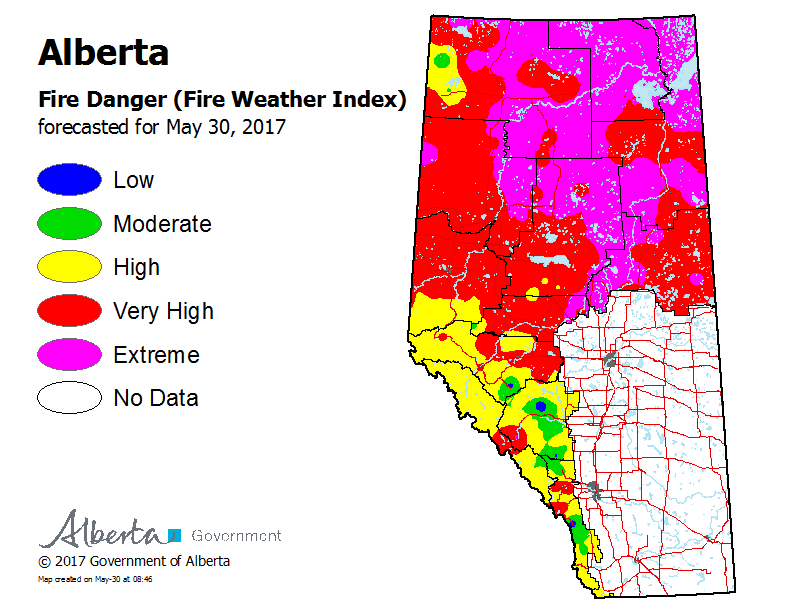
(A spike in fire hazard early this week coincides with predicted record temperatures across Alberta. Image source: Alberta Fire.)

Unseasonable warmth — which deepened over the weekend and is expected to peak by Wednesday — is presently resulting in spiking fire dangers for the region. 

According to the government of Alberta, fire risk for Fort McMurray is now listed as very high through Wednesday due to above average to near record high temperatures and low humidity. Fire hazard for a large swath of Northern Alberta is now also rated very-high-to-extreme.

It is worth noting that the overall fire situation for Canada to-date is presently much-improved from 2016. Last year, extreme warmth combined with high winds and dry conditions to fuel an unusually large fire outbreak over Central and Northwestern Canada during mid-to-late May. This year, wetter than normal conditions have suppressed fire activity over much of Canada over the same seasonal period. And we have some regions in British Columbia that are now experiencing evacuations due flooding rivers.

(Wildfires are flaring over British Columbia even as rapidly rising temperatures are causing large snow packs to melt far more swiftly than normal. Such heat and rapid melt is producing a dual threat of flood and fire at the same time. Image source: BC Wildfire Service.)

Rising fire risks coinciding with hot and dry conditions are coming at the same time that this year’s moisture-engorged snow packs are melting at far faster than normal rates. Large fires are thus breaking out in British Columbia and along the Alberta border as heat and dryness spread northward even as creek and lake levels in places like Okanagan, BC are facing the highest flood stages ever recorded.

Overall, despite 2017’s rainy spring weather, the tale is still one of unusual warmth. May temperatures have ranged from 2 to 6 degrees Celsius above average over Northern and Central Canada during 2017. Such departures are in keeping with the ongoing trend of rapid warming in the upper Latitudes of the Northern Hemisphere. A trend that has considerably worsened overall fire hazard by lengthening the fire season, by adding new fuels for fires, and by increasing the number of lightning strikes which help to provide ignition sources for wildfires. A warming that is directly caused by ongoing human fossil fuel burning and by related activities such as the tar sands extraction that continues unabated in Alberta.

Links:


About a year ago Paul Beckwith and I had a discussion on the fires at Fort McMurray


Listen to "Paul Beckwith on the fires at Port McMurray" on Spreaker.

Monday, 30 May 2016

The Fort McMurray fires -05/29/2016

Fort McMurray Blaze Still Raging Out Of Control Nearly A Month After It Started


Credit NASA

29 May, 2016

Clear skies during the Suomi NPP satellite's pass over the Fort McMurray Fire area show the blaze is still raging in the Canadian Province of Alberta.

The Alberta Ministry of Agriculture and Forestry reports that the wildfire is now estimated to be over 522,892 hectacres in size (or 1,292,094 acres-- an area larger than the entire state of Rhode Island). There are currently 1,267 wildland firefighters, 57 helicopters, and 186 pieces of heavy equipment being used to battle the blaze, with more expected to arrive over the next few days.

In total, the province plans to add an additional 1,000 firefighters over the next two weeks.

The Fort McMurray wildfire continues to grow, and now covers over 580,663 hectares including 3,200 in Saskatchewan.

That's grown nearly 4,000 hectares since Friday.

Right now there are 17 wildfires burning in Alberta, but the Fort McMurray blaze is still the only one out of control.

There are also 2,267 firefighters battling the blazes in Alberta, thanks to reinforcements from around the world this week.

Those include 298 from South Africa and 199 from the United States.

Temperatures in Fort McMurray are expected to be moderate over the weekend, with some possible showers, which should give firefighters a bit of a break.


Fires around Ft McMurray, Alberta, Saskatchewan and elsewhere. A lot of fire season left. A warmer climate is enhancing fires. 
--- Harold Hensell


Friday, 27 May 2016

The Alberta wildfires - update - 05/26/2016

Thanks, Harold Hensell
Fires around Ft McMurray


Fires around Ft McMurray, Alberta, Saskatchewan and elsewhere. A lot of fire season left. A warmer climate is enhancing fires

Alberta fires push oil prices to seven-month high


26 May, 2016

Thursday, May 26, 2016, 5:02 PM - Earlier this week, the Bank of Canada announced that recent wildfires in Alberta and Saskatchewan will push the nation's GDP into the negative this quarter amid slowing oil production.

Now, it has been revealed the fires have also contributed to a seven-month high for oil, with prices hitting $50 a barrel for the first time since October 2015.
Though starting off high Thursday, prices ultimately settled lower on the day, Reuters reports.

In addition to the Fort McMurray fires, which significantly slowed oil production in Canada, unrest in Nigeria and Libya and economic woes in Venezuela have resulted in a loss of nearly four million barrels per day in production.

CANADA'S GDP EXPECTED TO SINK TO RED

"Fire-related destruction and the associated halt to oil production will cut about 1¼ percentage points off real GDP growth in the second quarter," the central bank said in a statement, via the CBC, Wendesday.

1 per cent in an April forecast, but the fires are likely to cause a negative drop.
Still, the bank is confident the economy will rebound in the third quarter.

WILDFIRES CONTINUE TO GROW

As of Tuesday morning, wildfires in Alberta had grown to more than 522,000 hectares, with 40 new wildfire starts on Monday.


In Saskatchewan, 2,496 hectares of land have been scorched.

The fire is now being fought on both sides of the border,” wildfire manager Chad Morrison told reporters at a press conference, adding the impacted region has not seen significant rain for two to three months.

We expect the potential for extreme wildfire conditions to occur,” he said “We expect weeks, if not months, fighting this fire in the forested areas.”


Earlier this month, insurers predicted the Fort McMurray wildfires will be the costliest disaster in Canadian history, far surpassing the Calgary-area floods in 2013 and the 1998 ice storm in Quebec.

Current estimates suggest total losses could climb to $9 billion.


Wednesday, 25 May 2016

Alberta wildfires update - 05/24/2016

Smoke clears over Fort McMurray wildfire and it's bigger than previously thought


22 May, 2016

Rain and cooler temperatures have allowed firefighters to better assess the size of the Fort McMurray wildfire, and it’s bigger than previous estimates suggested.

The latest estimates peg the wildfire at 522,894 hectares on the Alberta side, and 2,496 hectares across the border into Saskatchewan, Laura Stewart, an Alberta wildfire information officer, confirmed Sunday afternoon.

While the fire was reported to be 504,443 hectares yesterday, Stewart said it hasn’t grown, rather the weather helped to clear smoke in the area allowing firefighters to better assess the size.

Firefighters are making really great progress, taking advantage, of course, of these cooler temperatures,” she said, noting more rain is expected in the Fort McMurray area.

Fire conditions in northeastern Alberta remain extreme and the wildfire in Fort McMurray remains out of control, even with the cooler weather.

But that cooler, wet weather has allowed firefighters to reclassify the fire near Janvier, which was also reported as out of control on Saturday.

A lot more rain fell in the Janvier area and the 146-hectare fire is now being held, Stewart said, adding that it isn’t expected to grow any further.
Sixteen other fires are also burning in the province.

There are 1,880 firefighters, 104 helicopters, 29 air tankers and 295 pieces of heavy equipment being used to fight wildfires across the province.

Random camping on public lands in the Regional Municipality of Wood Buffalo has been banned to prevent the need for firefighters to respond to other emergency situations.

On Saturday mandatory evacuation orders were lifted for seven oilsands sites including, Millenium, Borealis, Hudson, Noralta, and Ruth Lake lodge, as well as Suncor Base Plant and Syncrude Mildred Lake Plant.

Oilsands camps south of Anzac, including Nexen Long Lake, HML Lodge, Gregoire River, Nexen Kinosis, PTI Kinosis, PTI Anzac, Surmont and Cheecham Lodge, will begin a phased re-entry so assessment work can begin. Guest occupancy is not permitted until safety inspections are completed, the Regional Municipality of Wood Buffalo said in a news release Sunday. 

Fort McMurray residents are expected to be able to start returning home on June 1 on a voluntary, phased basis.

The municipality has released a timeline and map outlining the phased re-entry plan.

Atco employees are in the city working to restore critical utility infrastructure. As of Sunday afternoon gas service had been restored to 90 per cent of undamaged areas in Fort McMurray and more than 90 per cent of the city had electricity.

A boil-water advisory remains in effect for the Fort McMurray area and any work camps that draw water from the Regional Municipality of Wood Buffalo water treatment plant.

An air quality advisory has also been issued for the Fort McMurray area due to the wildfires.

While debit-card locations are now closed, financial assistance is still available through Alberta Works offices. Evacuees, who do not have insurance, or sufficient insurance, can also apply for financial assistance for temporary housing at Alberta Works office.


Alberta rallies international help for Fort McMurray wildfires
More than 1,000 firefighters from around the world on their way to Alberta


CBC,
24 May, 2016

Alberta's fire boss hopes fresh feet at the perimeter of Fort McMurray's massive fire will save some of the province's most valuable assets.

More than 1,000 firefighters from across Canada, the U.S., South Africa and other countries will soon join the roughly 1,200-member fire crew already in Fort McMurray.

Provincial wildfire manager Chad Morrison said his team made the decision to order them up last week — around the time the fires swept to the edges of oilsands sites, forcing a mandatory evacuation of 19 facilities north of Fort McMurray.
Those evacuation orders have since been lifted, but caution continues as flames keep raging and growing. 


"This fire is not under control by any means," Morrison said in a news conference Tuesday, when asked if the oilsands are in the clear.

He said there is no immediate threat, but added it's early yet, both in the life of this fire and the fire season in general.

And with no significant rain in two to three months — combined with warm forecast this week — it's going to stay tough.

"There always is that potential," that flames could cross the firebreaks around the Suncor and Syncrude facilities, that firefighters patrol, Morrison said. 

"That's why we're investing thousands of resources," he said. "We continue to secure the sites around there. We expect to hold it as best we can over the next coming days."

'Qualified, certified and highly trained'

Morrison called the new crews "qualified, certified, and highly trained" and said they are coming from as far away as Alaska and South Africa.

The North American reinforcements will arrive this week, while some 280 South African firefighters will get here next week.

Their "critical priority" will be securing the oilsand sites in the north, he said.
It's estimated roughly one million barrels per day have been lost due to the fire, which amounts to about half the typical daily output.

smoke cop
An RCMP officer adjusts his face mask at the northern road block outside Fort McMurray. Air quality, which has fluctuated as high as a 51 on the 1-10 risk scale, was at six Tuesday morning. (Marion Warnica/CBC)

Not all of that loss was attributed to threat from fires, but rather loss of workforce. Many oilsands employees are residents of Fort McMurray were evacuated from town.

Lately, dozens of oil workers have reported being evacuated from housing two or three times through a combination of precautionary and mandatory evacuation orders in the north, and the original exodus from the town itself.

Suncor and Syncrude, the two oilsands plants shuttered under mandatory evacuation orders last week, are now working with the province on a phased re-entry plan for some of those employees. 

Provincial officials say they're overseeing plans from affected companies, testing air quality and making sure labour regulations are met before staff are allowed to come back.

Re-entry rehearsal

Inside the town, the focus swivels to preparing for the return of evacuees.
It's a process that Scott Long with the Alberta Emergency Management Agency calls "an awful lot of work." And it continues day and night.

This week, they'll run a rehearsal to look more closely at their planning.

"If there's any gaps that we have not thought of, we will quickly address those," Long said.

fire map

This map from the provincial government shows the large perimeter of the fire on May 24. (Government of Alberta)

A detailed booklet telling evacuees what to expect, if they decide to return to Fort McMurray during the voluntary re-entry starting June 1, is now available online.
The province has also made significant progress on basic services.

Restoration of the hospital restarted on Sunday, electricity service has been restored to more 90 per cent of the community, and natural gas have been restored to 99 per cent of homes, outside the worst-hit neighbourhoods of Abasand, Waterways, and Beacon Hill.

Fort McMurray's commercial airport also announced Tuesday it plans to re-open June 10. And the RCMP detachment has now restarted its local office, with the majority of personnel returned.

Weekend rain skips northern flames 

The wildfires, which continue to burn out of control, grew over the weekend and have now consumed 522,892 hectares.

Rain and snow that hammered most of the province over the weekend largely skipped the wildfire area.

The Fort McMurray region saw at most 5 mm of rain, compared to the more than 100 mm seen in some parts of Edmonton.

But despite the many challenges, officials found some positive news to share.

Three weeks of warm, dry-as-dust conditions since the fire roared through town, mean even small showers and minor temperature dips seem like big victories.
Morrison said the break allowed crews to finalize 178 km of fire guard around the fire's perimeter.

That fire guard will make it easier for those new support crews to fight the fire on the ground.

Morrison said Tuesday will be another "challenging" day, though he remained, as ever, optimistic.

"We continue to make great progress."


This map from the provincial government tracks rain levels in Alberta over recent days. (Government of Alberta)


Canada loses quarter of crude output as result of wildfires


Conditions today indicate cool, windless conditions but no rain


Canada and Siberia on fire