Showing posts with label Davos. Show all posts

Wednesday, 23 January 2019

NZ globalist PM Adern hobnobs with the elite at Davos

Hypocrisy comes to mind quickly.

This article accurately points out the policies of this government. Adern is hobnobbing with spome of the worst sociopaths on the planet who have flown in on private jets to listen to what the hoy-polloy should do to “save the planet” (read: save the globalist economy)


In the meantime the Green Party leader and minister of Climate Change, James Shaw is missing-in-action.
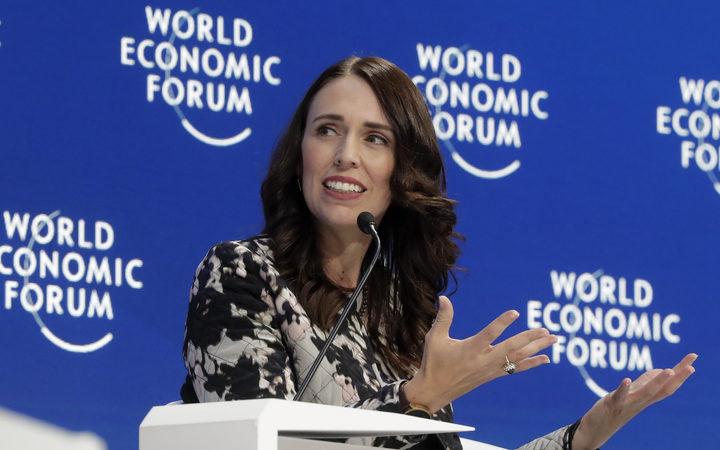
Ardern's plea for climate change action: Be 'on the right side of history'

Prime Minister Jacinda Ardern speaks during the Safeguarding the planet session at the World Economic Forum in Davos, Switzerland.
RNZ,
23 January, 2019


Prime Minister Jacinda Ardern, in a panel alongside Sir David Attenborough, has discussed the challenges of tackling climate change and encouraged world leaders to take on kaitiakitanga.

Prime Minister Jacinda Ardern speaks during the Safeguarding the planet session at the World Economic Forum in Davos, Switzerland.Prime Minister Jacinda Ardern speaks during the Safeguarding the planet session at the World Economic Forum in Davos, Switzerland. Photo: AP Photo/Markus Schreiber
The Safeguarding Our Planet panel in Davos also included former US vice-President Al Gore as an interviewer and panel members Mahindra Group chair Anand Mahindra and Japan's Zero Waste Academy chair Akira Sakano.

Ms Ardern's panel visit is part of her trip around Europe with Finance Minister Grant Robertson.

Environmental threats have dominated the World Economic Forum's Global Risks Report, which surveyed leaders, for the third year in a row.

After last year's heatwaves, storms and floods across the globe, extreme weather events top the list of most likely risks and come third for impact in the global risks report.
"Failure of climate-change mitigation and adaptation" is in second place on both lists, reflecting respondents' increasing concerns about environmental policy failure," the report stated.
"The results of climate inaction are becoming increasingly clear. The accelerating pace of biodiversity loss is a particular concern."
Ms Ardern also acknowledged the risk by saying: "What greater threat to our wellbeing is there than the current threat of climate change."
While the hottest five years ever had been the past five years, Mr Gore said there was a solution for climate change but posed the question if people were willing to commit to change.
Ms Ardern responded by saying politicians had a short time in power, and the challenge was to embed in that time the infrastructure for long-term change.
She said kaitiakitanga (guardianship of the environment) played an important role in this.
"One of the biggest threats I think that we have ... [are] political cycles.
"This needs to be something that we embed in our national cycles, in our political cycles, and in our actions and it needs to endure beyond us as individuals.
"So if we can do anything, we will be creating legislation which embeds those targets, that ambition we need, and then right through to the basic pragmatic things. Like planting a billion trees over 10 years, creating investment funds, doing each of the things that will set us on a long-term path for guardianship [kaitiakitanga], because that's what we all have to take the responsibility for."
Sir David said he could not imagine a situation more serious. He said things were getting worse faster, and the maddening thing was that we knew how to deal with it, we just needed to do it.
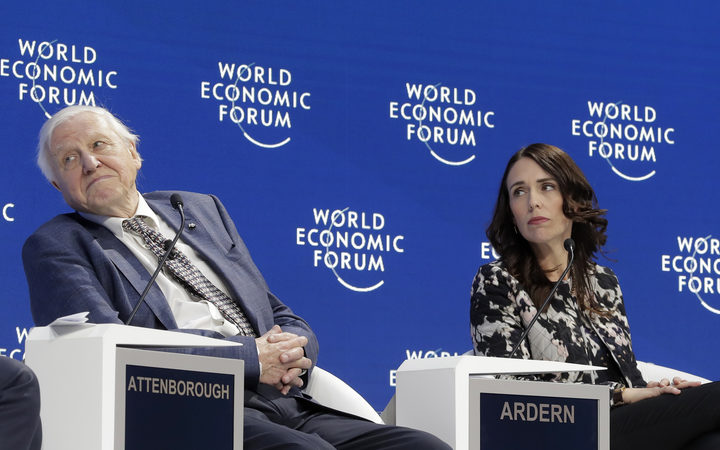
Sir David Attenborough, broadcaster and natural historian, and Prime Minister Jacinda Ardern participate in the Safeguarding the planet session at the World Economic Forum in Davos, Switzerland.


Sir David Attenborough, broadcaster and natural historian, and Prime Minister Jacinda Ardern participate in the Safeguarding the planet session at the World Economic Forum in Davos, Switzerland. Photo: AP Photo/Markus Schreiber

However, Ms Ardern said there was cause to remain optimistic about change for the better.
"Ten years ago, when I first came to parliament I remember standing at a town hall meeting and speaking passionately about the issue of climate change and being roundly booed, including I think by members of my own family," she said.

"But even in that 10-year period, how dramatic the shift has been. No longer do you have the significant questioning of the science that we had perhaps even in that period of time."

She said in the face of resistance towards change, there needed to momentum for it.

"We build a movement with us and I want to acknowledge the work of Sir David - a voice of authority, trust and respect and to all those leaders that use the platform they have - it creates the space for us as politicians to do the right thing."

Mr Gore asked what the prime minister had to say to other world leaders who did not believe in climate risks or were not taking them seriously.

Ms Ardern responded by saying that the best method was to show rather than tell.

"It only takes a trip to the Pacific to see that climate change isn't a hypothetical, and you don't have to know anything about the science or even have an argument about the science to have someone from one of the Pacific Island nations take you to one of the places they used to play as a child on the coast and show you where they used to stand and now where the water rises."

She also said it was about being on the "right side of history".

"Do you want to be a leader that you look back in time and say that you were on the wrong side of the argument when the world was crying out for a solution?"

Sir David encouraged those leaders to think of future generations and the consequences they would have to deal with if leaders failed to act.

"Think of the children. Think of your children and your children's children, and what we are doing to the planet at the moment. Can you look them in the eye and say 'I knew what could be done to stop the degradation of the environment and climate, but it was too difficult and rather boring and you are now going to take the consequences'?"

Ms Ardern said that young people had done a good job.
"Young people have been the leaders that we need. Now everyone is looking to us. We've got the rulebook, we know what's required, it's about a matter of getting on and doing it and turning what has been seen as a threat with a great deal of pessimism and fear into an opportunity."
Climate activists gather in November, 2018 in London, blocking the traffic in a pacific protest, asking for the British Government to take action against climate change.Photo: AFP / Gail Orenstein/NurPhoto

She said it was a chance to transition and future-proof economies as well.
"That might be jarring if we do it quickly [future-proof economies] or if we take a longer track it can be something that we prepare our people for. So I think it's our only option.

"What we're inclined to believe is that any economy needs to start thinking about our measures of success beyond just our economic success, and our traditional forms of measuring that of course tended to be GDP and growth and for us that doesn't tell an entire story."

She used the ban on new deep-sea oil and gas exploration permits as an example of transitioning economies.


"That was a significant move but that was for us about anticipating where we need to move ... and saying unless we anticipate that change, make that decision now, there will be a very jarring experience for the people currently employed in those industries and that's what transition is all about."

She also discussed how the wellbeing budget would play a role in embedding needed changes too.


"This year for the first time... we will be undertaking a wellbeing budget where we're embedding that notion of making decisions ... how are people, how's their overall wellbeing and their mental health for instance, how's our environment, the clean and fresh waterways faring in our state of growth.

"These are the measures that I think can give us a sense of success and within that of course we need to then factor in, as we transition our economy, how are our people faring in terms of their economic wellbeing and capacity."
Cities in northeast China were blanketed in thick smog, with the weather bureau issuing orange smog alerts – its second-highest warning – for seven areas in the region.Cities in northeast China were blanketed in thick smog, with the weather bureau issuing orange smog alerts – its second-highest warning – for seven areas in the region. Photo: AFP / Bian peng - Imaginechina

An editorial by the prime minister featured in the Financial Times yesterday where she also mentioned the wellbeing budget and climate change.

"In May, my government will present the world's first "wellbeing budget". This is not a concept we came up with ourselves. The OECD and the IMF have, for a while now, have urged countries to look beyond a strong balance sheet and a strong economy to redefine success.

"This isn't woolly but a well-rounded economic approach - the same kind we will use to confront the challenges posed by climate change, digital transformation, social exclusion, poor health, housing and domestic violence.

"We must accept that the race to grow our economies makes us all poorer if it comes at the cost of our environment, or leaves our people behind."

Sir David had earlier also warned of the dangers of losing touch with the natural world in an interview with Prince William at the forum.

"It's not just a question of beauty or interest or wonder, it's the essential ingredient, essential part of human life is a healthy palate," he warned.

"We are in the danger of wrecking that".


5 MILLION - HOW NEW ZEALAND IS RAPIDLY DESTROYING ITS WELFARE SYSTEM AND ENVIRONMENT.

Via Facebook

As of January 2019 our population is 4,934,000.

Senior demographer Kim Dunstan said that, given the current trends, our population could hit the five million mark by the end of this year.

New Zealand's population increases by one person every five minutes and 26 seconds, based on births, deaths and net migration.

The greatest period of population growth in our history occurred between 2008 - 2017 as John Key's government used immigration to create a building boom to provide employment to protect their popularity. 

A boom that has been funded with debt as total debt in New Zealand closes in on 550 billion dollars - a figure the Reserve Bank is now worried about.


Along with a record population, New Zealand is also setting a number of other records.

Auckland City has now recorded over 8 billion of debt for the first time in our history as it struggles with infrastructure and services for a booming population.


Tauranga Council is also struggling with record debt ( $301 million net- 2017) and has reached out to the government for funding to help with infrastructure pressure.

Jacinda Ardern has stated she is going to borrow billions to help infrastructure keep up with the rising demands of one of the fastest growing populations of any country in the developed world. 

Hospitals and Schools, in particular, are struggling to meet a demand that was never planned for just a short 10 years ago.

Arderns government inherited a 59 billion debt from the previous National government.

We continue to be in the top 5 of the OECD's list for homeless as the Ardern/ Peters government appear to have reneged on their promise to stop immigration and instead signed the UN Migration pact.

And mortgage debt levels in New Zealand are now at record highs for those who have purchased homes in the last 7 years.

In 2017 the National government under increasing pressure finally relented and raised the retirement age to 67 by 2040. ( A peculiar move considering it was Key and English who contributed to the unaffordability of superannuation with their immigration strategy) But an independent analysis done in late 2017 of super affordability found that with our increasing population there is no way this would be achievable, and the report predicted a minimum age of 74 by 2040.

On top of the bleak economic data, the environmental data is just as bad if not worse as the environment is proving much harder to fix.

Auckland's beaches are recording record levels of pollution due to urban buildup, and air quality in Auckland is the worst on record due to the massive increase in vehicles over the last 10 years. 

Auckland councillors, reticent to jeopardise their popularity with another rates hike, are presently selling council assets in an effort to control skyrocketing costs. Mayor Phil Goff has indicated they want to dispose of 650 million of assets by 2025.

Queenstown the jewel in the crown of New Zealand tourism is being used as a housing estate as developers and speculators rush to accommodate the thousands arriving here under the government's immigration policy.

A leading researcher on our rivers Professor Russell Death from Massey University stated in a speech last year - "We have the highest percentage of endangered freshwater fish in the world, we have some of the most polluted rivers in the western world,"

Meanwhile, both political parties are under pressure from business groups like the banking sector - who are large donors - to carry on with immigration as it's a boon for their balance sheets.

Business analyst Richard Williams when spoken to by NZNews made the comment - ''Like most countries around the world, our welfare system and environment will continue to collapse as we continue to be fooled that immigration and a large population are a good thing.

New Zealand is primarily a farming economy, that is how we create wealth. If we continue to build houses on the land we need for crops, cattle and forestry we will continue to destroy the standard of living, both environmentally and economically, we've enjoyed in the past.''


When it comes down to it Adern is just a globalist and a neo-liberal. The Greens are "neo-liberals on bicycles".

No photo description available.

Two truth bombs that blow the mythology out the window

These two article confirm what I have been saying for a while.

I leave it to readers to decide which is the more deplorable, the politician who refuses to accept the science or the politician who accepts the science but then behaves as if the science is a hoax.  There is, however, clearly a different kind of climate change denial going on here; one that plays dangerously to the narrative of right wing false populists.”


Climate change denial (the other sort) is alive and well
22 January, 2019

There is broad agreement that 2018 was the worst year yet for the environment.  According to the New York Times “The Story of 2018 Was Climate Change;” while the Washington Post informed us that: “Extreme weather in 2018 was a raging, howling signal of climate change.”  Meanwhile on this side of the Atlantic EuroNews warned us that “Europe’s chaotic weather in 2018 is a wake-up call for climate change.”

Not that any of this made much impression on the world’s climate change denier-in-chief, Mr Trump; who has recently been berated (again) for failing to understand the difference between climate and weather.  In response to the wave of winter weather that has descended on the USA this week, Trump decided to troll environmentalists on his Twitter feed:


Be careful and try staying in your house. Large parts of the Country are suffering from tremendous amounts of snow and near record setting cold. Amazing how big this system is. Wouldn’t be bad to have a little of that good old fashioned Global Warming right now!”
The tweet was no doubt designed to antagonise Trump’s democrat opponents who are currently engaged in their own version of denial.  New Congresswoman Alexandria Ocasio-Cortez swept into the House of Representatives demanding that her Democrat colleagues put tackling climate change front and centre now that they have taken control of the House from the deniers in the Republican Party.  This went down like a lead balloon in the office of the new Speaker, Nancy Pelosi; who quickly co-opted Ms Ocasio-Cortez’s support for a microwaved version of the all-talk-but-no-action climate policies adopted in the Obama era.  As Anthony Adragna and Zack Colman at Politico note:


Moderate and establishment Democrats largely prevailed in their first showdown with liberals over the select committee. Whereas protesters, joined by Ocasio-Cortez, stormed Pelosi’s office last November demanding the panel be empowered to issue subpoenas and write legislation, the committee that Democrats will establish Thursday can do neither of those things. It is only authorized to conduct investigations and develop policy recommendations to reduce the effects of climate change. Any legislation would be drafted by standing committees such as Energy and Commerce.”

No sooner had the corporate wing of the Democrat Party succeeded in turning the Select Committee on the Climate Crisis into talking shop (albeit one with a more urgent-sounding name) than Speaker Pelosi and her corporate Democrat followers revealed their true feelings about climate change by dashing off to the airport to fly off on a jolly with the corporate lobbyists down in Puerto Rico. The climate crisis, it would appear, is not quite urgent enough to cause anyone to cancel a flight to a corporate beano… at least, not someone who was booked on a flight.

The ongoing manifestation of “Al Gore Syndrome” – in which the rich fly around the planet lecturing the rest of us on how we (i.e. not them) have to do something about climate change – is also on display in Davos this week.  As Rebecca Ratcliffe at the Guardian reports:


David Attenborough might have urged world leaders at Davos to take urgent action on climate change, but it appears no one was listening. As he spoke, experts predicted up to 1,500 individual private jets will fly to and from airfields serving the Swiss ski resort this week.
Political and business leaders and lobbyists are opting for bigger, more expensive aircrafts, according to analysis by the Air Charter Service, which found the number of private jet flights grew by 11% last year.”
Worse still, an outbreak of penis envy among wealthy delegates has led to a ramping up of the size (and thus the weight and carbon emissions) of private jets similar to the “my yacht is bigger than your yacht” competition that the (largely male) global elite has engaged in for decades.
The sheer hypocrisy of a wealthy elite whose lifestyles do more to undermine the environment flying off to a luxury sky resort to discuss environmental policy has not been lost on the increasingly strident right wing populist movement that is snowballing across the western states.  Michael Bastasch at the right-wing Daily Callerlists the series of climate policy defeats that were inflicted on the neoliberal elites during 2018:

Despite increasingly apocalyptic warnings from U.N. officials, 2018 has seen a number of high-profile defeats for policies aimed at fighting global warming. Politicians and voters pushed back at attempts to raise energy prices as part of the climate crusade.”
The list of defeats includes:
  • Ontario Premier Doug Ford revoking a carbon tax in June
  • Australian Prime Minister Malcolm Turnbull failed to pass a carbon reduction bill and was forced to resign in August
  • Washington state governor Jay Inslee failed to get a carbon tax adopted during the November elections
  • A group of Republicans who do not deny climate change, the House Climate Solutions Caucus, were also voted out in November
  • Toward the end of November, French President Emmanuel Macron made his ill-fated attempt to impose a climate levy on diesel fuels; sparking the massive yellow vests protests.
According to Bastasch, the political fallout in France has persuaded the Pelosi wing of the Democrat Party to tone down their stance on climate change:
France’s carbon tax revolts sent a clear message to Democratic lawmakers across the Atlantic Ocean. Democrats will take control of the House in 2019 and want to make global warming a central part of their agenda.
Democrats and even environmentalists distanced themselves from carbon taxes in the wake of French riots…”
I leave it to readers to decide which is the more deplorable, the politician who refuses to accept the science or the politician who accepts the science but then behaves as if the science is a hoax.  There is, however, clearly a different kind of climate change denial going on here; one that plays dangerously to the narrative of right wing false populists.


There was a time when I wondered whether it would be different, if only there was someone idolised by the political right who accepted the science and stood up to call for action.  Indeed, if only there was such a figure who also had a solid background in the physical sciences.  Surely that would have done away with denial; allowing us to have a sensible debate about how to reverse or at least mitigate the growing climate emergency.  And then I remembered that there once was such a person…


On November 8th 1989, British Prime Minister Margaret Thatcher – the nearest you can get to a secular saint among the political right – gave a speech to the United Nations General Assembly, calling on world leaders to take action on climate change while there was still time:


For two centuries, since the Age of the Enlightenment, we assumed that whatever the advance of science, whatever the economic development, whatever the increase in human numbers, the world would go on much the same. That was progress. And that was what we wanted.
Now we know that this is no longer true.
We have become more and more aware of the growing imbalance between our species and other species, between population and resources, between humankind and the natural order of which we are part.
In recent years, we have been playing with the conditions of the life we know on the surface of our planet. We have cared too little for our seas, our forests and our land. We have treated the air and the oceans like a dustbin. We have come to realise that man’s activities and numbers threaten to upset the biological balance which we have taken for granted and on which human life depends.
We must remember our duty to Nature before it is too late. That duty is constant. It is never completed. It lives on as we breathe. It endures as we eat and sleep, work and rest, as we are born and as we pass away. The duty to Nature will remain long after our own endeavours have brought peace to the Middle East. It will weigh on our shoulders for as long as we wish to dwell on a living and thriving planet, and hand it on to our children and theirs.”
Thatcher even broached issues surrounding the climate crisis that today’s activists shy away from even thinking, still less mentioning in polite conversation:
The real dangers arise because climate change is combined with other problems of our age: for instance the population explosion; — the deterioration of soil fertility; — increasing pollution of the sea; — intensive use of fossil fuel; — and destruction of the world’s forests, particularly those in the tropics.”
This outline of the crisis – obvious enough to people three decades ago – could have come out of the mouth of any of today’s climate activists.  But coming from one of the most revered neoliberals – and a doctor of chemistry to boot – it should have been followed by a serious, worldwide programme of action.  It wasn’t; and for good reason.  At the end of the speech, Thatcher threw in the one condition that condemned us:

We have to recognise the importance of economic growth of a kind that benefits future as well as present generations everywhere. We need it not only to raise living standards but to generate the wealth required to pay for protection of the environment.
It would be absurd to adopt polices which would bankrupt the industrial nations, or doom the poorer countries to increasing poverty…”
This was to effectively argue that “we have to destroy the environment in order to save the environment.”  World leaders could take whatever action they decided upon… provided that it didn’t interfere with the free market.  And so it was that we entered into a thirty year stupor based around two proposals that Thatcher mentioned in the speech:

We [the UK government] now require, by law, that a substantial proportion of our electricity comes from sources which emit little or no carbon dioxide, and that includes a continuing important contribution from nuclear energy… [and] It is sensible to improve energy efficiency and use energy prudently; it’s sensible to improve energy efficiency and to develop alternative and sustainable sources of supply; it’s sensible to replant the forests which we consume; it’s sensible to re-examine industrial processes; it’s sensible to tackle the problem of waste.”
A combination of mendaciously named “renewables,” energy efficiency, recycling and planting trees to act as a carbon sink was all we needed to win the day.  Except, of course, that this was denial too.  Thatcher could not bring herself to the glaringly obvious conclusion that if the debt-based and fossil fuel enabled global economy that produced the carbon (and other greenhouse gases) was the problem, then the global economy would have to go.  Thatcher was not about to sacrifice the neoliberal consensus that she had given birth to in the previous decade.
In this way we can draw a straight line from Thatcher, through Al Gore all the way to the Pelosis of today.  Each, whatever their pronouncements on the climate emergency, determined to maintain the global corporate order whatever the cost.  Meanwhile, those within the 99 percent who are not still somnambulant as a result of the opioid promises of windmills and solar panels, have cottoned on to the con-trick.  As distrust in politicians and mainstream media gathers pace, a growing mass of ordinary people are standing up against policies that place the cost burden of patently inadequate (renewable energy harvesting technologies account for less than three percent of the world’s energy) responses to climate change on the shoulders of those who can least afford it; while the elites continue to fly around the planet spewing greenhouse gases into the upper atmosphere.
The danger of the false populism of the political right is that it will win the public over to the belief that climate change is a hoax.  If they do so, equal fault must be laid at the door of those on the political left and centre who profess to want action on climate change but act as if it wasn’t a problem.  Which is, of course, another way of saying what Thatcher should have said at the end of her otherwise ground-breaking speech – if we want to do anything about the climate emergency (and at this stage, mitigation is the best we can hope for) then we need to radically shift away from further economic growth into a managed spiral of de-growth… something that Mother Nature will likely impose upon us anyway if we choose not to act.

Electric cars will not stop rising oil demand, says energy agency chief
Trucks, petrochemicals and air travel driving global oil use, Fatih Birol of the International Energy Agency says
By Natalie Sauer

22 January, 2019

Electric car use may be growing exponentially, but they are doing little to curb rising carbon emissions and oil demand, the head of the International Energy Agency (IEA) said on Tuesday.

To say that electric cars are the end of oil is definitely misleading,” economist Fatih Birol told a panel at the World Economic Forum in Davos.

This year we expect global oil demand to increase by 1.3 million barrels per day. The effect of 5 million cars is [to diminish that demand by] 50,000 barrels per day. 50,000 versus 1.3m barrels.”

Last year, the IEA predicted that the number of electric cars globally would grow from 3 million today, to 125 million by 2030. But Birol said the number paled in comparison to the 1 billion cars powered by internal combustion engines.

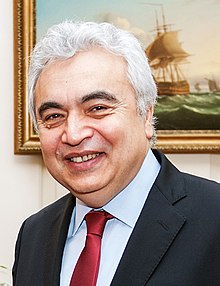
Image result for fatih birol

Davos elite looks to ‘Globalisation 4.0’ to stem climate change

Besides, he said, it was not cars that were driving oil demand – “full stop”.

Drivers are trucks, the petrochemical industry, planes. Asia is just starting to fly,” he said, referring to the agency’s 2018 energy outlook report that also cites shipping as a major source of oil demand.

Birol also highlighted the problem of powering electric cars when two thirds of global generation comes from fossil fuels.

Where does the electricity come from, to say that electric cars are a solution to our climate change problem? It is not,” Birol said.

Even if there were 300 million [electric cars] with the current power generation system, the impact in terms of CO2 emissions is less than 1% – nothing. If you can’t decarbonise [the power sector], C02 emissions will not be going down. It may be helpful for the local pollution, but for global emissions it is not.”

Environmentalists have repeatedly accused the Paris-based IEA of skewing its research in favour of the oil and gas industry, including by underestimating the growth of the renewables sector. Research and advocacy group Oil Change International believes that this is encouraging governments to overshoot their Paris climate pledges.

Greg Archer, UK director of Transport&Environment, a European umbrella group focusing on transport sustainability, said Birol’s comment revealed the IEA’s bias.

It took over 20 years to sell the first million electric cars globally, and just a year to sell the second million,” Archer wrote to Climate Home News. “Now well over a million are sold every six months and the growth is continuing to accelerate. Just as the IEA continually has to upgrade its annual forecasts for solar and wind power, so it is for electric cars too.”

Arched said that electric vehicles would increasingly drive down demand for fossil fuels, while we could expect trucks, ships and planes to prioritise hydrogen, advanced biofuels and e-fuels.

Eventually oil will remain in the ground because it is too expensive to pump it out,” he concluded.

Saturday, 27 January 2018

Trump at Davos


I do NOT share the rosy view of Trump. I am only reporting


Jill Klein is right and Karl Marx even more so.


However, it is not about Trump. You could easily say that Bush (pl), the Clintons, Obomber all are symbols of late-stage capitalism.

Trump is merely the latest iteration and I believe he is the Chosen One to bring the whole pack of cards.

Where Stein gets it so wrong is there is no glorious workers’ revolution at the end of it. Only the collapse of Empire, collapse of the USA and the end of civilisation (at the vey least).


Energy decline, abrupt climate change and the cannabalistic use of remaining resources mean this is terminal.
Donald Trump rocks Davos summit with ‘America First’ platform

The American President’s straight talk charms many at Davos and creates an air of optimism amidst the storm of negative rhetoric


26 January, 2017

President Donald Trump flew to Davos for the World Economic Forum, and completely electrified it, according to reports.

Although the “America First” slogan had raised concern in the global economic community that this meant the United States would disregard the needs and concerns of other world economic powers, the President dispelled this worry handily.  Members of his cabinet had been in Davos a bit before his arrival, and were involved in interview and panels already, and when he arrived, he and his assistants were able to explain more what this philosophy actually means.
America first is not America alone”, said Gary Cohn, the president’s economic adviser.  The point of this idea is not for the United States to dominate and control the world, but in Trump’s view, to make better deals and better trade agreements around the world, and to also cement and strengthen the diplomatic relations between the USA and her allies, most notably England and Israel.


The President met with both Prime Ministers Netanyahu of Israel and Theresa May of the United Kingdom.  In each meeting he affirmed the very close ties between nations, and also waved away the rumors that the US and Britain were in a fractious state with one another in his meeting with PM Theresa May.

The American president also gave a firm, but inviting message to the Palestinian Authority to return to the negotiations needed to secure a peaceful relationship between both Palestine and Israel. Since the United States historically provides aid to both countries, and since the Palestinians were demonstrably upset with the Americans’ formal recognition of Jerusalem as the capital city of Israel, Trump gave a strong, direct push in his statements on the issue.


Predictably, there is resistance to Trump’s approach in the global community. As shown in the clip above, the common claim is “you cannot do it alone” and this is the thought that is often ascribed to Trump, and to the United States as a whole, that the country acts like an Empire and not a brother player in world affairs.

While there is certainly food for this thought, most notably in foreign policy structures regarding Syria, Ukraine and Israel, it appears that when one has a direct encounter with the American president, much of the fear of this is dispelled. One is led to a bit of optimism at these times, that maybe this leader really is trying to fix a broken set of policies from within, piecemeal. It has certainly looked this way at the Davos conference thus far.