Thursday, 2 July 2020

The Arctic fires worsen - Russian media

Arctic fires worsen and threaten world famous park set up to recreate flora of woolly mammoth era

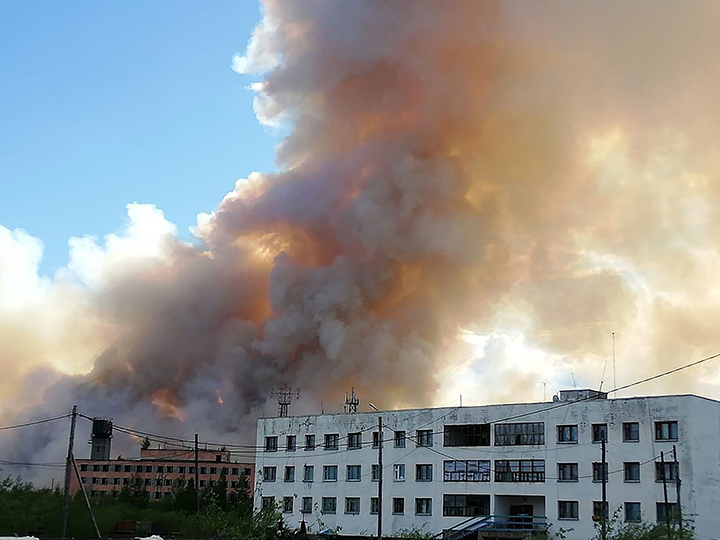
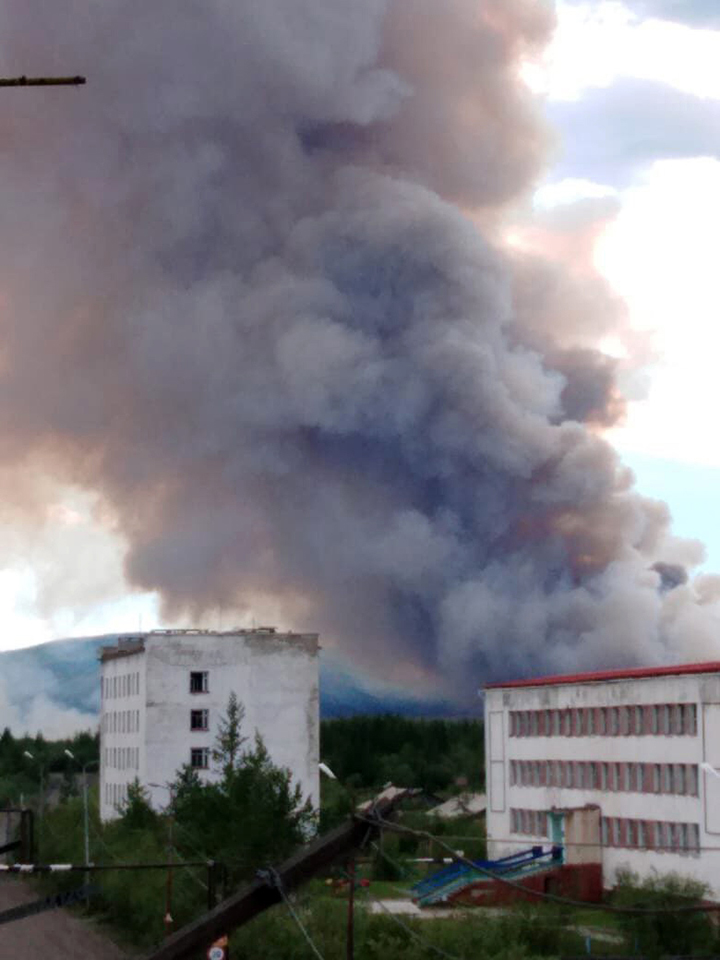
Worrying videos and pictures show how the pristine polar region of northern Yakutia is ablaze.
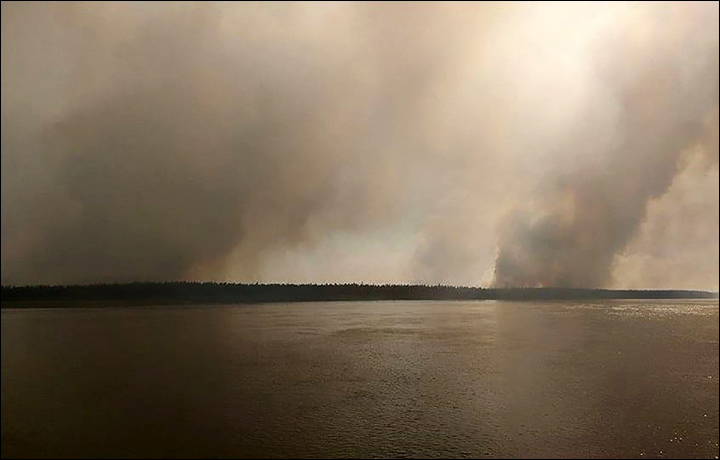

Banks of mighty Siberian River Kolyma are hardly visible through the clouds of smoke from wildfires. Picture: Vera Salnitskaya
Siberian Times,
1 July, 2020


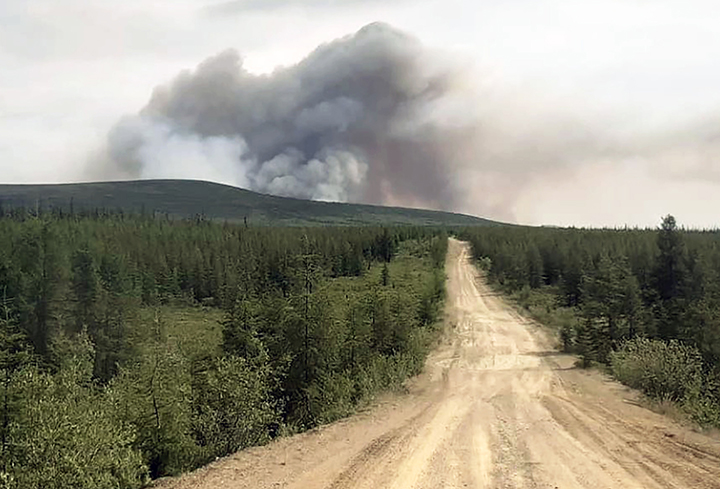
A major fire is burning right now outside the Arctic town of Chersky, around 
Mount Rodinka, loved by the locals for weekend trips.
The fire started around 10 days ago, threatening a major power line that feeds the remote town. 
There was a hope that the fire was stopped some 10km from Chersky, but today 
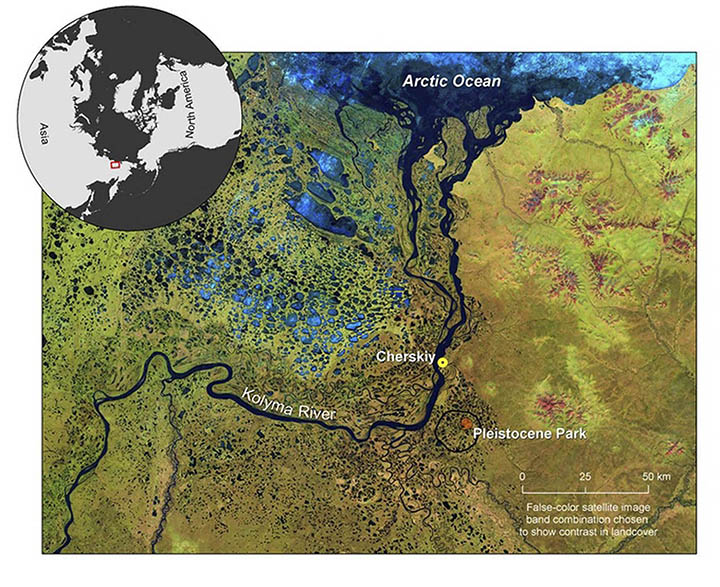
the director of Pleistocene Park Nikita Zimov said that the blaze was back. 
He shared a video of clouds of smoke blanketing the sun around the park deep  
 in eastern Siberia. 
Arctic fires worsen and now threaten world famous park set up to recreate flora of woolly mammoth era

Arctic fires worsen and now threaten world famous park set up to recreate flora of woolly mammoth era


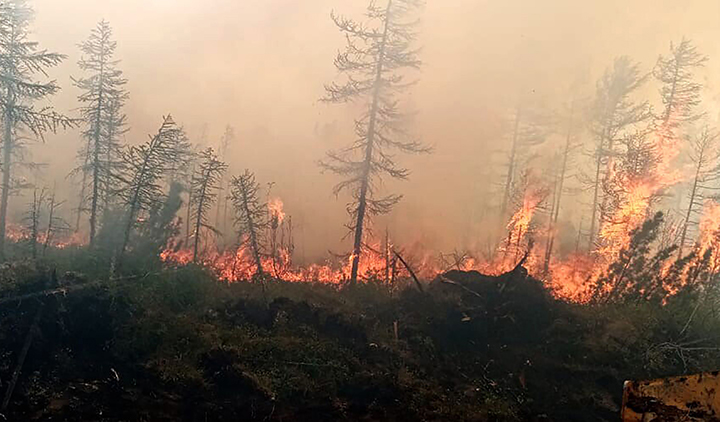
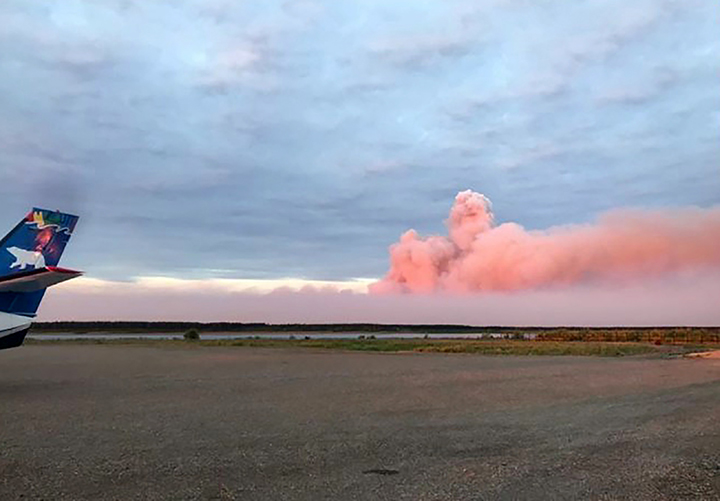
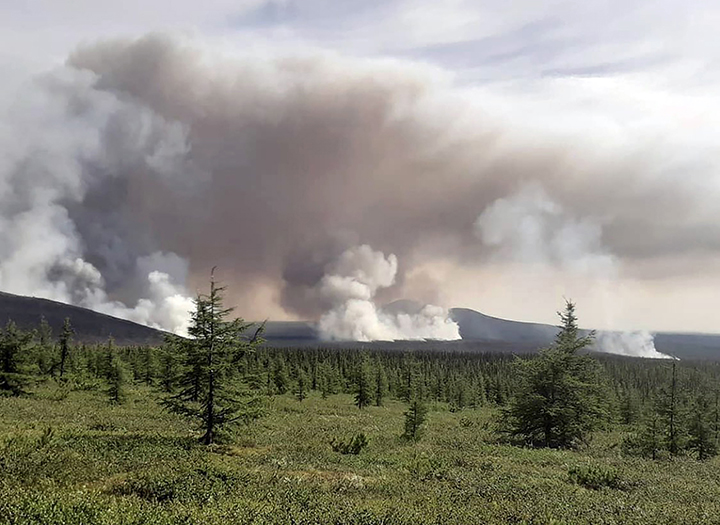
Arctic on fire. Wildfires around the town of Chersky, a gateway to the Pleistocene Park pictured and filmed by Nikita Zimov and Alexei Kurilo

The park is a major ecological experiment recreating the northern subarctic steppe grassland ecosystem that flourished in the area during the last glacial period.
Its supporters say such a back-to-the-future change by restoring grassland and 
creating an Arctic Serengeti can show the world how to significantly slow the 
release of dangerous carbon gases into the atmosphere in regions where 
permafrost is thawing after being frozen for tens of thousands of years.  
The park is also seen as the perfect home for woolly mammoths if scientists 
succeed in current efforts to bring the species back to life by genetic cloning from remains preserved in the permafrost in the region. 


Worrying pictures came this week from aboard a ship moving along Kolyma River 
from the town of Srednekolymsk, with banks of the mighty Siberian river barely 
visible because of smoke from wildfires. 


People from Yakutsk said that while they don't see the fires around the city yet, 
they certainly begin to feel the smoke. 
Arctic fires worsen and now threaten world famous park set up to recreate flora of woolly mammoth era

Arctic fires worsen and now threaten world famous park set up to recreate flora of woolly mammoth era

Arctic fires worsen and now threaten world famous park set up to recreate flora of woolly mammoth era

Arctic fires worsen and now threaten world famous park set up to recreate flora of woolly mammoth era

Arctic fires worsen and now threaten world famous park set up to recreate flora of woolly mammoth era
Pictures of wildfires in the extreme north of Yakutia from around the towns of Chersky, 
Srednekolymsk and Nizhnekolymsk. Pictures: Nikita Zimov, social media

Lena Pillars Park in Yakutia south from Yakutsk said earlier today that they had to postpone re-opening despite coronavirus restrictions being lifted because a state 
of emergency was introduced at Khangalassky Ulus due to the extremely high 
number of wildfires.  

'A very strange' July was forecast for Yakutia by Russian weather specialists. 
Average temperature will stay for at least seven, ten degrees C above the norm, 
with rains not coming until around 20 July. 

The end of the month will 'cool down' to about +20C, while the first 20 days of 
July might be as hot as +30C - and dry.  

Arctic fires worsen and now threaten world famous park set up to recreate flora of woolly mammoth era
Residents of Yakutia enjoy hot summer days in Yakutia’s desert of Tukulany. 
Picture: Ilma Sevostyanova

Massive wildfires in the extreme north of Siberia will continue more and more often, warned Russia's chief weather specialist Roman Vilfand. 

'Forests are on fire all along the Arctic territory including Alaska and Canada,’ he 
said.

It's linked to changes in circulation and to the increasing number of meridional processes that lead to forming of stationary anticyclone’., 

Vilfand explained that two other key factors contribute to a current massive spike 
of Siberian and Arctic wildfires: the sun doesn't set during Arctic summers and 
ground doesn't cool down, and secondly it keeps getting heated by clear weather 
with little or no clouds. 


Currently wildfires rage in the remote areas of Siberia at the combined territory of 
more than 1.5 million hectares, according to Russian Aerial Forest Protection 
Service. 


The pole of cold town of Verkhoyansk experienced a ‘fantasical’ temperature of 
38C on 17 June, he said. 


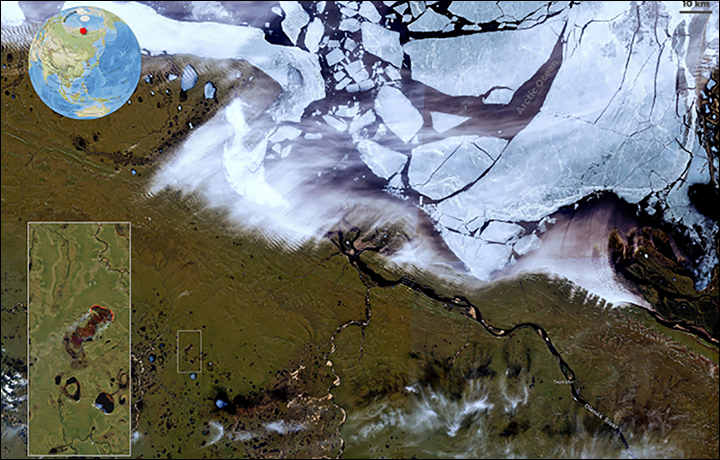
The northernmost fire of 2020 to date caught by satellites above the Arctic 
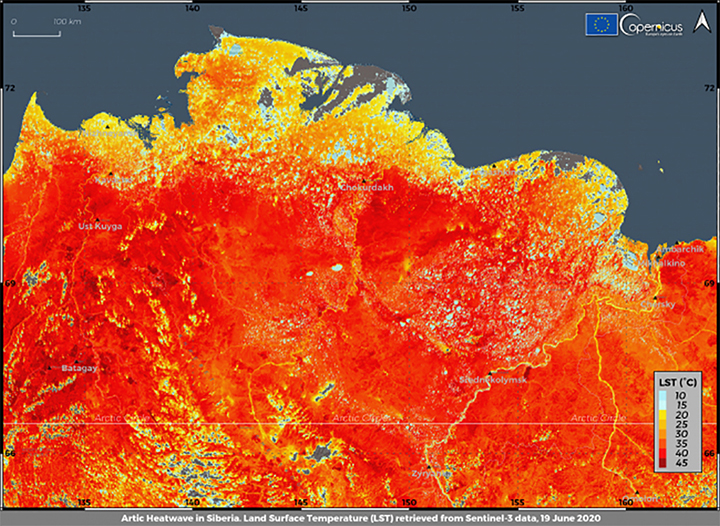
circle, and the mid-June 2020 Arctic heatwave. Pictures: European Union , Copernicus Sentinel-2 imagery
Arctic fires worsen and now threaten world famous park set up to recreate flora of woolly mammoth era

Arctic fires worsen and now threaten world famous park set up to recreate flora of woolly mammoth era


Arctic wildfires burning 
further north than previously 
spotted from space, satellite 
shows
Blazes raging just 50km from the Arctic Ocean in Yakutia.
27 June, 2020

The northernmost fire of 2020 to date caught by satellites above the Arctic circle. Picture: European Union , Copernicus Sentinel-2 imagery
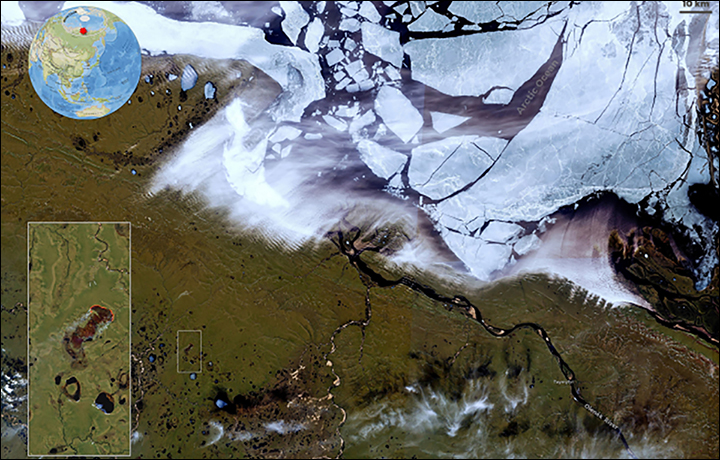
An inferno has been spotted at Latitude 72.723° N, Longitude 118.12° E by the European Union’s Copernicus Sentinel-2 satellite, in the Anabar district, 
southwest of the Olenyok River estuary into the Laptev Sea.

The fire is believed to be ‘the most northernmost in recent years within the Arctic 
Circle’, according to the EU’s Earth Observation Programme. 

While fires are common at this time of year, record temperatures and strong winds are making the situation particularly worrying,’ said a statement.

The fire is 12 km further north of an inferno registered last year by the same 
programme which uses infrared sensing capabilities to detect active fires.

The Aviation Forest Protection Agency in Yakutia, also known as the Sakha 
Republic, the largest region in the Russian Federation, reported 127 natural fires covering 822,724 hectares.

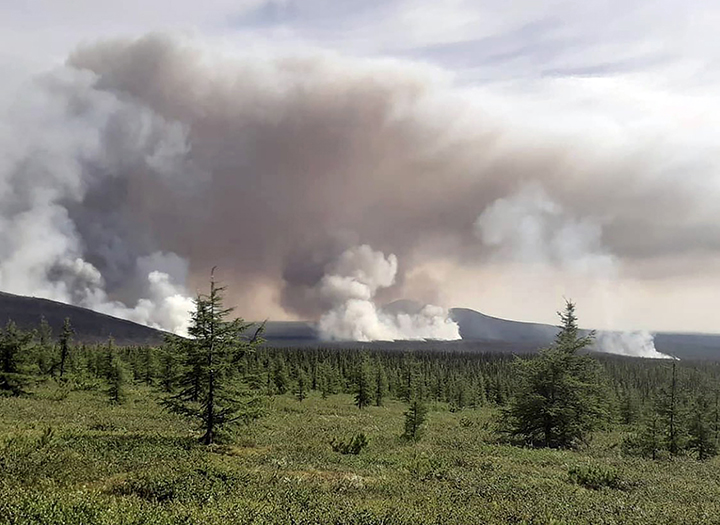
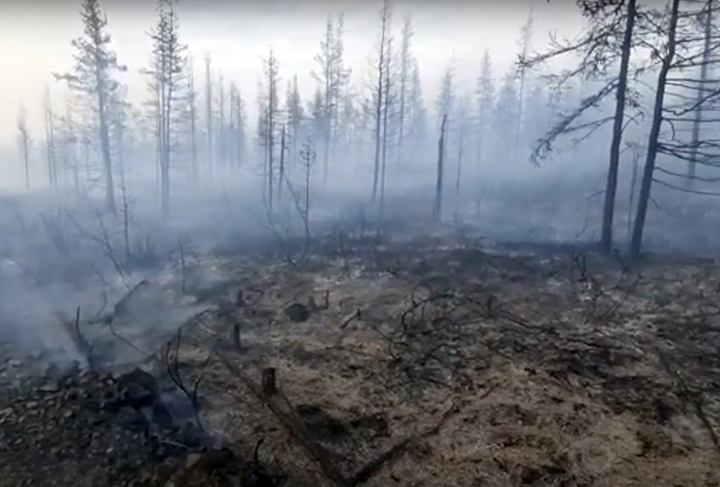
Pictures and video here shows fires burning in the far north around Chersky in the north of Yakutia.
Arctic on fire

Arctic on fire
Arctic on fire
Pictures and video here shows fires burning in the far north around Chersky in the north of 
Yakutia. Pictures: Nikita Zimov, video credit Ulus media
A major effort is underway to protect remote settlements with main concern in 
Abyisky, Verkhnekolymsky, Verkhoyansk, Zhigansky, Mirninsky, Srednekolymsky, Tomponsky and Eveno-Bytantaysky districts.

The fires are burning both north and south of the Arctic Circle. 

Pleistocene Park - a project to recreate the flora of the woolly mammoth age - 
was under threat with fires 20km away. 

Director Nikita Zimov said: “It’s a good thing the weather changed and the fire 
(here has) pretty much stopped by now." 

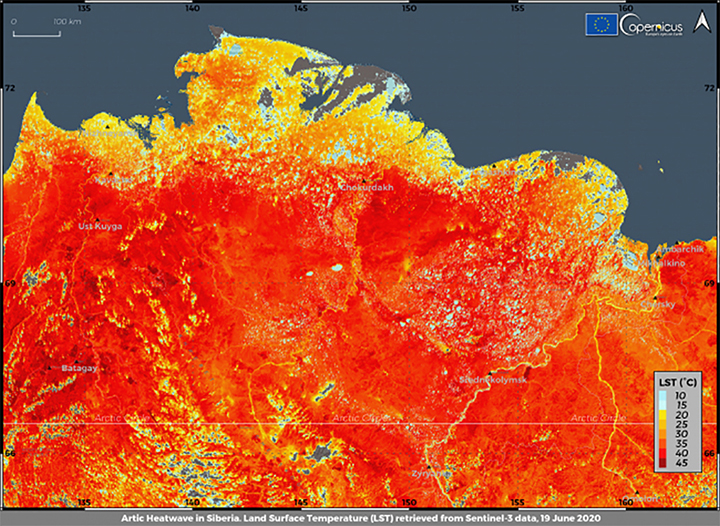
Recent reports include soaring temperatures in one of two poles of cold in Siberia, Verkhoyansk, within the past week. 

Thermometers hit 38C(100.4 degrees Fahrenheit).

The Arctic is figuratively and literally on fire — it’s warming much faster than we 
thought it would in response to rising levels of carbon dioxide and other 
greenhouse gases in the atmosphere, and this warming is leading to a rapid 
meltdown and increase in wildfires,’ said University of Michigan environmental 
school dean Jonathan Overpeck, a climate scientist, reported AP.

The record warming in Siberia is a warning sign of major proportions.’
Arctic on fire
Arctic heatwave in Siberia, picture from 19 June 2020. Picture: European Union , Copernicus Sentinel-2 imagery
Such prolonged Siberian warmth’s not been seen for thousands of years ‘and it is another sign that the Arctic amplifies global warming even more than we thought’, he said. 

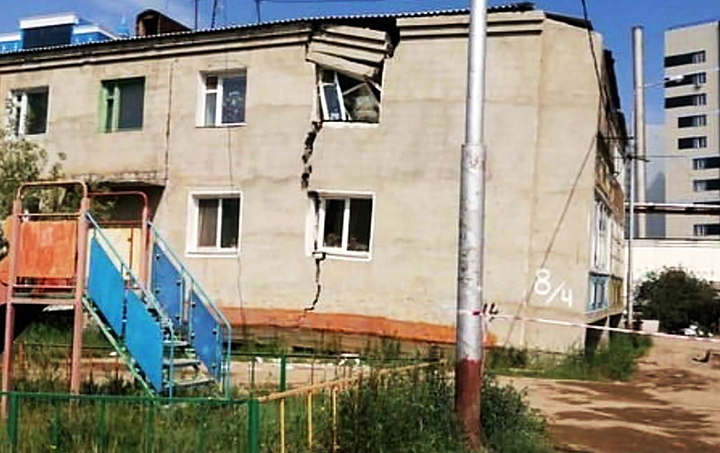
Pictures highlighted this week by The Siberian Times showed the impact of thawing permafrost on a building in regional capital city Yakutsk.

Cracks suddenly appeared as the frozen foundations caved in. 

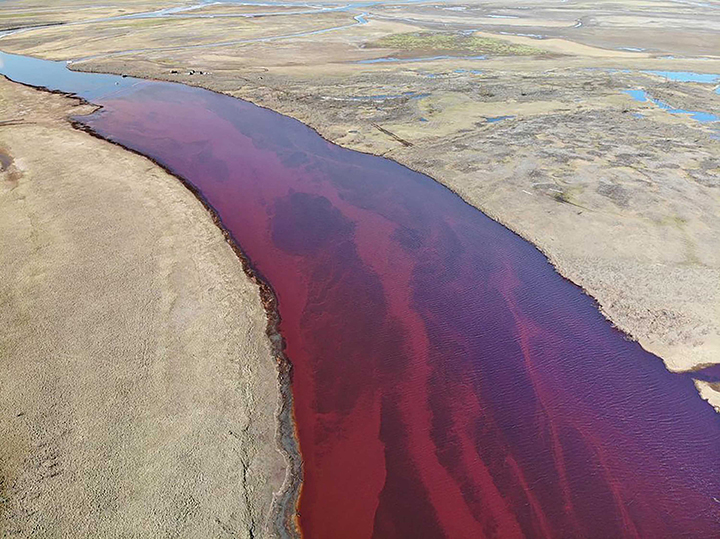
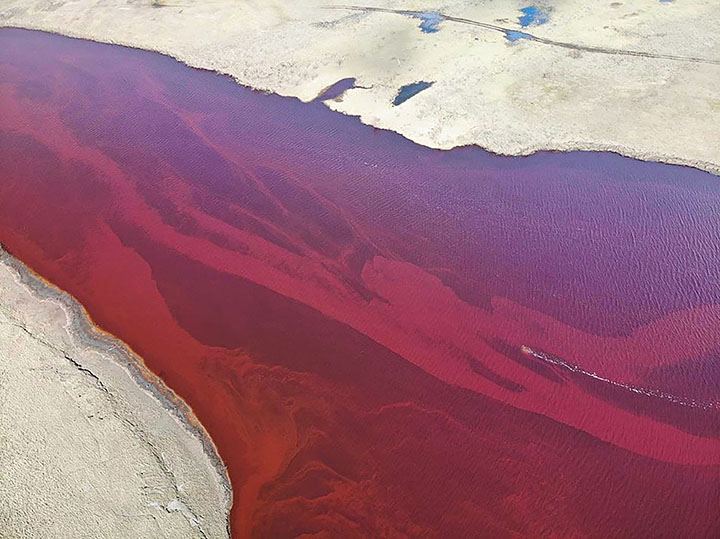
A major 21,000 ton diesel leak occurred near Norilsk, in Krasnoyarsk region, due to permafrost thawing. 

Another oil leak came in Yakutia region.
Arctic on fire

Arctic on fire
2100 tonnes of diesel leaked on 29 May 2020 into a system of rivers ourside Norilsk that lead to the Arctic Ocean. Pictures: Vasily Ryabinin
Russian Academy of Sciences’ President Alexander Sergeyev said: ‘We should organise a total monitoring of both industrial and housing buildings on the 
permafrost.

If the permafrost degrades, all those building will begin to slide. 

This task is of the highest importance.

I hail the idea, which has been supported by President Vladimir Putin, to have a 
new programme to monitor the climate and consequences from the climate changes.’
Arctic on fire
Cracks 10cm wide appeared inside three flats and on the outer walls of the residential block at 8/4 Avtodorozhnaya Street in the outskirts of Yakutsk. Picture: News Ykt

Abnormal heat is predicted in Yakutia and Krasnoyarsk regions until the end of 
June. 

The scientific director of the Hydrometeorological Centre of Russia, Roman 
Vilfand, said temperatures range 12 to 14 degrees above normal. 

This is due to a stationary anticyclone, the meteorologist noted.

Wednesday, 1 July 2020

Conditions in the Arctic Ocean

Weather forecast for the North Pole


Sea ice concentration


Methane


Why was Gen. Flynn targeted

Why Flynn was targeted: "He 

knew about the billions 

Brennan and company were 

running off the books"


SOTT.net,
30 June, 2020

General Michael Flynn had to be removed. He knew too much. He had to be shut down and silenced. He was the primary Deep State target.

Sidney Powell was on the Vicki McKenna radio show and she dropped another bomb. Per a report from Lifezette, General Michael Flynn's attorney Sidney Powell shared the following: "He was going to audit the intel agencies because he knew about the billions Brennan and company were running off the books," Powell said, referring to former CIA Director John Brennan.

Powell began her interview noting at the 1:00 mark that when she took over the Flynn case three things were very, very troubling and egregious:

One - he was not properly informed of what the government had even disclosed to his defense lawyers prior to the plea.

Secondly, the government didn't disclose a fraction of what it should have disclosed (i.e. the whole case was made up).

And three, he was prosecuted and threatened with the prosecution of his son. That's how they coerced the guilty plea. It was just unconscionable conduct to threaten to indict him and his son the very next day and give them the Manafort treatment if he didn't enter his plea right then, and I'm convinced it's because they knew right then the press was going to explode with the Strzok-Page text messages and everything.
Then Powell drops the bomb at the 5:50 mark where she discloses that Flynn was going to audit the Intel agencies because he knew about the billions former CIA Director John Brennan was running off the books. To hear Sidney Powell's interview on 1310 News Talk, go here.

Hong Kong security law comes into effect


China passes Hong Kong 

security law, will go into force 

July 1
Sott.net.
30 June, 2020
China's President Xi Jinping has signed into law a controversial national security legislation for Hong Kong that Beijing says is necessary to deal with separatism and foreign interference but critics say will outlaw dissent and destroy the autonomy promised when the territory was returned to China in 1997.

Details of the law - which comes in response to last year's often-violent pro-democracy protests in the city - are due out later on Tuesday.

The legislation will come into effect when it is gazetted in Hong Kong - bypassing the semi-autonomous territory's own legislature - and is expected to be in force by July 1, the anniversary of the former British territory's return to Chinese rule.

"We hope the law will serve as a deterrent to prevent people from stirring up trouble," said Tam Yiu-Chung, Hong Kong's sole representative on the Standing Committee of the National People's Congress, which approved the law on Tuesday morning. "Don't let Hong Kong be used as a tool to split the country," he said.

Al Jazeera's Katrina Yu, reporting from Beijing, noted the passage of the law had been fast-tracked.
"It's very symbolic that this law has been passed just a day before the anniversary of Hong Kong's handover from Britain back to mainland China. It seems to be Beijing telling the people that at the end of the day it is China that is in charge in Hong Kong and China's leaders will do whatever they deem necessary to protect Hong Kong."
Hong Kong leader Carrie Lam, speaking via video link to the United Nations Human Rights Council in Geneva, said the law would fill a "gaping hole" and would not undermine the territory's autonomy or its independent judiciary. Lam said Hong Kong had been
"traumatised by escalating violence fanned by external forces" and added: "No central government could turn a blind eye to such threats to sovereignty and national security."
'End of Hong Kong'

Authorities in Beijing and Hong Kong have repeatedly said the legislation is aimed at a few "troublemakers" and will not affect rights and freedoms, nor investor interests.

After the law passed Standing Committee of the National People's Congress earlier on Tuesday, prominent Hong Kong pro-democracy activists Joshua Wong, Agnes Chow and Nathan Law issued statements on Facebook saying they would withdraw from the pro-democracy organisation Demosisto.

Wong said "worrying about life and safety" has become a real issue and nobody will be able to predict the repercussions of the law, whether it is being extradited to China or facing long jail terms. The legislation marked
"the end of the Hong Kong that the world knew before. From now on, Hong Kong enters a new era of reign of terror. With sweeping powers and ill-defined law the city will turn into a secret police state."
Demosisto then announced on Facebook it was disbanding, saying the loss of top members made it difficult to continue.

China first announced its plan to impose the legislation on the eve of the National People's Congress last month, after nearly a year of protests in the territory that began over a now-withdrawn extradition bill with the mainland.

The security bill gave renewed momentum to the protests, which had calmed as the coronavirus pandemic made it more difficult to hold mass gatherings, and triggered condemnation from countries including the United States and the United Kingdom.

On Tuesday, more than 100 protesters gathered at a luxury mall in Hong Kong's Central business district, chanting slogans including "free Hong Kong, revolution now", with several holding up a flag representing an independent Hong Kong as well as posters condemning the law.

Activists are calling for fresh protests on July 1 even though police have said rallies cannot happen because of the coronavirus. Some 4,000 police are expected to be on standby on Wednesday when an official ceremony also takes place.

Al Jazeera's Adrian Brown, reporting from Hong Kong, said the mood in the city was sombre. The passage of the law has
"had an immediate and chilling impact. We went out on the streets at lunchtime to speak to ordinary people at lunchtime to try and gauge their opinions and none of them wanted to comment - that's very unusual here in Hong Kong.

"People are now going to vote with their feet and leave in droves."
Life imprisonment

This month, China's official Xinhua news agency unveiled some of the law's provisions, including that it would supersede existing Hong Kong legislation and that interpretation powers belong to China's parliament's top committee.

Beijing is expected to set up a national security office in Hong Kong for the first time and could also exercise jurisdiction in certain cases. Judges for security cases are expected to be appointed by the city's chief executive. Senior judges now allocate rosters up through Hong Kong's independent judicial system.

It is not known which specific activities are to be made illegal, how precisely they are defined or what punishment they carry.

The South China Morning Post said only a handful of Hong Kong's delegates to China's parliament saw the draft before it was approved unanimously by the standing committee's 162 members earlier on Tuesday. The vote came within 15 minutes of the meeting starting at 9am local time (01:00 GMT), the paper added.

Hu Xijin, the editor-in-chief of the state-run Global Times, said on Twitter that the law's heaviest penalty was life imprisonment.

The legislation pushes Beijing further along a collision course with the US, the UK and other Western governments, which have said it erodes the high degree of autonomy the city was granted at its handover.

The US, already in dispute with China over trade, the South China Sea and the novel coronavirus, began eliminating Hong Kong's special status under US law on Monday, halting defence exports and restricting technology access.

Meanwhile, Dominic Raab, the British foreign secretary, called the passing of the law on Tuesday a "grave step", while Charles Michel, president of the European Union Council, said the bloc "deplores" the decision.

Japan described the move as "regrettable", while Taiwan's President Tsai Ing-wen said she was "very disappointed" at the outcome.

And Joshua Rosenzweig, head of Amnesty International China, said Beijing's "aim is to govern Hong Kong through fear from this point forward".

China has hit back at the outcry, denouncing "interference" in its internal affairs.

Comment: Doom and gloom? Or an overblown reaction to anything Beijing? Something had to give.
The new suite of powers radically restructures the relationship between Beijing and Hong Kong, toppling the legal firewall that has existed between the city's independent judiciary and the mainland's party-controlled courts. It empowers China to set up a national security agency in the city, staffed by officials who are not bound by local laws when carrying out duties.

Details of the Law:

Crimes of secession, subversion, terrorism and collusion with foreign forces punishable by up to life in prison.

Companies or groups that violate national security law will be fined and could have operations suspended.

Damaging certain transportation vehicles and equipment will be considered an act of 'terrorism'.

Anyone convicted of violating security legislation will not be allowed to stand in any Hong Kong elections.

The activities of a new national security agency and its personnel in Hong Kong will not be under the jurisdiction of local government.

Authorities can surveil and wiretap persons suspected of endangering national security.

The law will apply to permanent and non-permanent residents of Hong Kong.

The law says the management of foreign NGOs and news agencies in Hong Kong will be strengthened.

Dr. Fauci: Cameras off, Mask Off!!


Cameras Off, Mask Off? Dr. Fauci is shown removing his mask when the network cameras go off during congressional hearings. Watch on PlutoTV Channel 247, Dish Channel 219, Roku, Apple TV, 

Obama admits the riots are to elect Biden

There are those that think that Obama is masterminding the entire thing.

Obama admits it: Riots and 
protests are 'tailor-made' for 
electing Joe Biden

30 June, 2020

Joe Biden is hiding in his basement, but maybe that's because the rabid-left looters, rioters, and protesters are carrying out his presidential campaign just fine for him.
What else can be concluded but that, given that President Obama has cynically admitted that the civil unrest covering the U.S. is "tailor-made" for electing Joe Biden?
Here's a report from National Review:
Former President Barack Obama told aides this month that the nationwide protests following the death of George Floyd are "a tailor-made moment" to help his former vice president Joe Biden defeat Donald Trump in November.
According to a New York Times story based on interviews with more than 50 Obama confidants, the former president was made anxious after riots and looting rocked many American cities in the days following Floyd's death and Trump began trumpeting "law and order" in response.

"Let's not excuse violence, or rationalize it, or participate in it. If we want our criminal justice system, and American society at large, to operate on a higher ethical code, then we have to model that code ourselves," Obama wrote in a Medium post earlier this month.
But Obama's confidence has since grown as the protests have continued and Trump's polling numbers have dipped
So in other words, more riots, more votes for Biden.  Perhaps the idea is to beat the public down to such an extent that it feels that only a Democrat can solve it.  Perhaps he sees in the polls that the public is blaming Trump.
The New York Times reported just a couple days ago that Obama is obsessed with ousting President Trump.  That being the case, it's not unlikely that he will continue with his old Alinsky training, to oust Trump by any means necessary.
If riots will do it, Obama and his Democrats will be happy with more riots.  Even the New York Times admitted that the riots excited him:
That calculus, though, may be changing in the wake of George Floyd's killing by the police in Minneapolis. As America's first black president, now its first black ex-president, Mr. Obama sees the current social and racial awakening as an opportunity to elevate a 2020 election dictated by Mr. Trump's mud-wrestling style into something more meaningful — to channel a new, youthful movement toward a political aim, as he did in 2008.
Opportunity?  Elevate?  That sounds a lot like "tailor-made."
This ought to be a wake-up call to voters, who are the only ones who can stop this cynical, diabolical plan on property-owners.  Obama has a stake and interest in perpetrating riots and lootings, regardless of the cost to the little guy, because it advances his political aims.  That's in characters, from the words of his former chief of staff, Rahm Emanuel, to "never let a crisis go to waste."
It's also amazingly cynical, given that nobody should be rooting for rioters as a means of benefiting politically.  Yet here we are, and Obama is being lionized.  It calls to mind that the Obama legacy can't be hosed out soon enough by Trump in his second term. 
Image credit: Drummkopf via Flickr.

“Alinsky's techniques and teachings influenced 
generations of community and labor organizers, 
including the church-based group hiring a young 
[Barack] Obama to work on Chicago's South Side in the 
1980s.... Alinsky impressed a young [Hillary] Clinton, 
who was growing up in Park Ridge at the time Alinsky 
was the director of the Industrial Areas Foundation in 
Chicago.” —Chicago Sun-Times