Thursday, 2 February 2017

Riots at UC Berkeley against Milo Yiannopoulos

Right now I’m wondering who the violent fascists are. Yannopoulos is provocative in his views - anti-immigation and anti-Muslim but I've yet to be shown that he is a nazi.


I am largely in agreement with these sentiments of Vladimir Golstein,a Russian Jew:

Back in the day, Nazis would march, intimidate, and torch Jewish businesses. Things changed, of course. Somewhat.

Now they study at Berkeley, and pretend to fight fascists by the same Nazi methods. Like setting cars on fire, closing the place down, and shutting down the free speech. At least Germans Nazis knew deep inside that all they want is loot and rob and kill and rape. But today's zealots would never acknowledge it. They use violence and intimidation for noble purposes only. It would not hurt for these guys to learn something about the Stanford experiment. It happened not far from Berkeley, you know.

Of course, LA Times is full of sh.t as usual. Milo is a libertarian, not a conservative firebrand, as they characterize him, to implicitly condone the a...holes at Berkeley.”

Riot breaks out at UC Berkeley amid protest of Breitbart editor's speech (VIDEO)


Riot breaks out at UC Berkeley amid protest of Breitbart editor's speech (VIDEO)
RT,
2 February, 2017

A protest turned violent at the University of California at Berkeley, resulting in the cancellation of a talk from conservative provocateur Milo Yiannopoulos.

Yiannopoulos, an editor of Breitbart News, was expected speak against “sanctuary campuses,” which promised to protect undocumented students in wake of President Donald Trump's tough stance on illegal immigration.

In response to the violence, UC Berkeley Police have warned students to "leave the area immediately," as they are bringing in "additional resources."

Hours after a lockdown was declared across campus by police, many orders of dispersal, including several five-minute warnings went largely ignored.


PD now warning crowd they may use chemical agents + batons to get crowd at protest to leave. Didn't go over well.

Once those backup forces arrived, police used a bullhorn to warn protesters they would be subject to force, "including but not limited to chemical agents, batons and less lethal munitions."
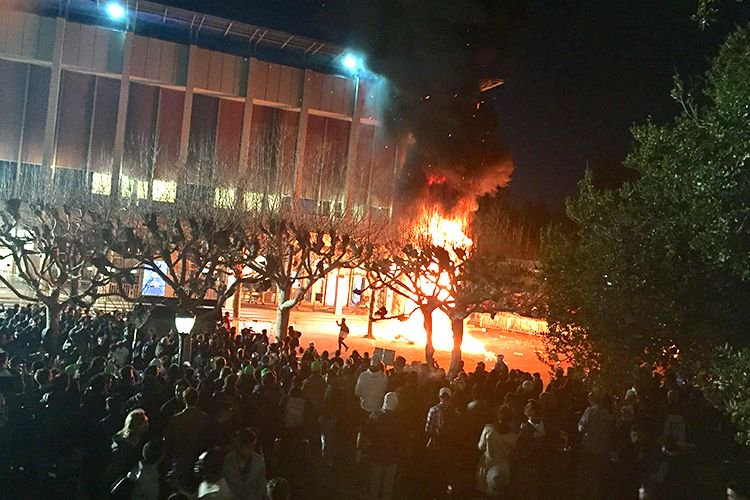

Yiannopoulos event canceled


KTVU reported that there were no police present when the riots began. College Republicans paid a mandatory security fee but are now asking what good it did.


Around 8:00pm local time, protesters moved off campus, onto surrounding streets including Telegraph Avenue.

Rioters attempting to block traffic did not appear to stop a white BMW that sped off with at least one person still clinging to the vehicle. The unruly crowd then chased the car down the street, but Michael Bodley of the San Francisco Chronicle reported that a different, unrelated driver was then attacked with pepper-spray while his vehicle was struck with stakes. "It was a white car," Bodley reported someone yelling.

A female Trump supporter was attacked with pepper-spray by a rioter during an interview with local TV media. Others were struck with flag poles hoisted by black-clad anarchists.

Another woman was seen being hit with a black flag and pole before being pepper-sprayed.

A rioter dressed in black was captured on video reportedly striking an attendee in the head with a bike lock.

There were also reports of punching, as well as fireworks thrown and a tree being set on fire.

Just toppled a light pole. Craziest protest I've seen in Berkeley by far. Crowd fast turning violent.

Hundreds of protesters, some covered in masks, also broke windows and pulled down metal barricades that police set up, the San Francisco Chronicle reported.

There are reports of outbreaks of physical violence and rioters attempting to surround attendees, whom they deemed "fascists."

Berkeley Police reported their officers were targeted with projectiles, including bricks and smoking objects. The university's police locked down campus buildings and ordered the public to shelter in place.

Tear gas was deployed after many calls from police for the crowd to disperse or face arrest for unlawful assembly. There were several five-minute warnings proclaimed from police PA systems.

"We condemn in the strongest possible terms the violence and unlawful behavior that was on display and deeply regret that those tactics will now overshadow the efforts to engage in legitimate and lawful protest against the performer’s presence and perspectives," UC Berkeley's Public Affairs office said in response to the riots.

Students were not the only ones to have objected to Yiannopoulos event at the university.

After the editor accepted the invitation, a group of faculty members urged Chancellor Nicholas Dirks to cancel the event. More than 100 Berkeley faculty blamed the editor for provoking “incitement, harassment, and defamation.”

Although we object strenuously to Yiannopoulos’s views — he advocates white supremacy, transphobia, and misogyny — it is rather his harmful conduct to which we call attention in asking for the cancellation of this event,” read the first of two letters from faculty members.


The College Republicans issued a statement, saying, "The Free Speech Movement is dead. Today, the Berkeley College Republicans' constitutional right to free speech was silenced by criminals and thugs seeking to cancel Milo Yiannopoulos' tour. Their success is a defeat for civilized society and the free exchange of ideas on college campuses across America. We would like to thank UCPD and the university administration for doing all they could to ensure the safety of everyone involved. It is tragic that the birthplace of the Free Speech Movement is also its final resting place."


From CNN


Milo Yannopoulis speaks for himself on MSM

Helen Caldicott on nukes

For a whole new generation that has to relearn the dangers of nuclear war


Helen Caldicott interviwed in the 1980’s

Australia's deadly relationship with heat

January was hottest month on record in Sydney and Brisbane, says weather bureau
Sydney’s average maximum temperature was 29.6C and Brisbane’s was 27.2C, with spell of hot weather continuing in February

1 February, 2017


Sydney and Brisbane residents have just sweated through the hottest month on record.

Sydney’s average maximum temperature for January was 29.6C, beating the previous mark of 29.5C recorded in 1896, the Bureau of Meteorology said on Wednesday.

Last month Sydney had 11 days when the temperature topped 30C and five days above 35C, smashing not only all previous records for the month but for any month since records began in 1858.

Anyone that’s been feeling really uncomfortable can feel 100% justified in their complaints,” Bureau of Meteorology climatologist Agata Imielska said. “It’s the warmest month for Sydney.”

January’s average minimum was 21.6C, breaking the previous January record of 21C in 1991 and the previous average minimum for any month which had been 21.2C in February 2010.

Only three days dropped below 25C as a maximum in January 2017 and that’s the equal fewest on record with January 1994,” Imielska said.

Brisbane also experienced its hottest January on record as temperatures climbed almost two degrees above the monthly average.

Data released by the Bureau of Meteorology showed Brisbane’s temperature average maximum of 27.2C, well above the mean of 25.4C and breaking the previous record of 27C set in 2004.

The average minimum temperature topped 23C throughout January, breaking the 22.8C recorded in 1973.

Logan City and Brisbane Airport also broke records for the hottest January since data collection in both areas began more than 20 years ago.

The latest bureau statistics showed why so many southeast Queenslanders struggled to sleep over the past month.

Brisbane also recorded its equal hottest minimum daily temperature on 21 January 21. The mercury only went as low as 28C, last recorded on 29 January 1940.

Bureau spokesman Michael Knepp warned the hot weather was set to continue into this month. The temperature is expected to climb to 35C in Brisbane on Thursday, with a minimum of 24C.

Imielska said Sydney’s record-breaking temperatures were due to a combination of strong westerly winds, unusually dry conditions, less than average rainfall and climate change.

One factor is the ongoing warming trend – we’ve warmed by a degree in the past century and it’s not just about averages, we see increases in these extreme temperatures as well,” Imielska said.

It doesn’t just go for land temperatures, it also goes for ocean temperatures. In 2016 we saw the warmest ocean temperatures on record.”

The persistent heat has been aggravated by dry conditions since October caused by a high-pressure system sitting over the Tasman Sea, which has increased westerly winds moving over southern Australia.

We’ve also had warm offshore sea surface temperatures – that also keeps conditions warmer, particularly at night,” Imielska said. “As a result we have seen that back-to-back heat and the lack of relief – the surprising thing is that there haven’t been any really cool days.”

Sydney conditions are due to heat up again over the next few days with the mercury expected to hit 37C in the city and 43C in the west on Sunday.


Australia's deadly relationship with heat
Phil Mercer


BBC,
31 January, 2017


As a homesick teenager in Britain in the early 1900s, the writer Dorothea Mackellar yearned for the "pitiless blue sky" of Australia.
"I love a sunburnt country," she declared in her timeless poem My Country, and more than a century after those famous words were crafted, parts of Australia have endured another savage summer of heat. Sydney has had its hottest December and January nights on record and there have been new year heatwaves in Queensland, Victoria and South Australia.

The bursts of scorching conditions are not only uncomfortable, they can be a silent killer. Doctors are worried that many Australians are underestimating the dangers posed by the heat, the nation's deadliest natural hazard.

Deadlier than fires


In 2009, 173 people died in the Black Saturday bushfires in the state of Victoria, one of the most fire-prone regions in the world. However, more than twice as many victims lost their lives in a heatwave that preceded the fires.
"What we are seeing increasingly is weather that really pushes us to our limits," Dr Tessa Kennedy from the Australian Medical Association of New South Wales told the BBC. "Many people don't know that heatwaves are actually more harmful to human health than bushfires and floods."

Mackellar's epic love of the bush was forged in sun-baked rural New South Wales where her family owned land near Gunnedah. About 200km (124 miles) to the north, the people of Moree have been sweltering through an unprecedented heatwave. The temperature in the farming town that sits atop rich black-soil plains exceeded 35C every day in January, a record in New South Wales, beating the previous benchmark of 17 consecutive days.
Meteorologists believe it could near another record this week - seven successive days above 40C.
"We are sick of it," said Katrina Humphries, the mayor of the Moree Plains Shire Council. "Our son Robert and daughter-in-law Jacqueline moved back to Norfolk [in England] a couple of years ago because the heat here was so horrific.
"We slow down a lot though the middle of the day and look forward to the day when it cools down and we get some rain."

Who is at risk?
It's the very young, infirm and those over the age of 75 who are most risk from searing temperatures.
Heat-related illness, which can occur when body temperature exceeds 37.8C, includes dehydration, cramps, heat exhaustion and heat stroke. The consequences can be catastrophic, resulting in heart attacks, brain damage and death. Finding out exactly how the heat has killed an individual is often hard because many victims have pre-existing medical conditions, which can be exacerbated when it is very hot.
In early January, a Virgin Australia pilot died of dehydration and exhaustion while quad-biking in the Beerburrum State Forest, north of Brisbane. It was reported that 30-year old Matthew Hall's body temperature had reached 42C, which caused his organs to shut down. He died of critical heat stroke, two weeks before his wife was due to give birth to their first child.
More than 500 people die of heat stress across the nation each year, according to the Australia Medical Association. The symptoms of heat exhaustion include a rapid heart rate, headaches, nausea and fainting.
As the mercury climbs, spare a thought for those workers who have to endure roasting conditions on roofs, building sites or fuel depots, although they should be protected by strict health and safety laws.
"If it is 38C you are supposed to be not working," Tony Sheldon, the head of the Transport Workers Union, told the BBC. "There are a number of precautions that should be taken; hydration, proper clothing, rest periods. It is critical that people have those opportunities to get out of the heat and they have a legal right to do that."
Lifestyle under threat?
Australia's Bureau of Meteorology defines a heatwave as "three days or more of high maximum and minimum temperatures that is unusual for that location".
Jump media playerMedia player helpOut of media player. Press enter to return or tab to continue.
Media captionDr Angie Bone of Public Health England offers some tips and dispels some myths on staying cool
Conservationists have argued that Australia's fabled alfresco lifestyle could be in jeopardy because more severe heat could restrict the amount of time people can safely spend outside. Scientists, too, believe that the world's driest inhabited continent is becoming hotter.
"There is clear evidence that heatwaves are intensifying in Australia. The overall trend in heatwaves is caused by global warming," said Andy Pitman, the director of the ARC Centre of Excellence for Climate System, a collaboration of various universities and research organisations.
"I was recently in southern Sicily and no-one was out and about in the extreme heat - activities took place in the morning and evening. One can imagine… problems for sports that take all day [cricket, for example]. There are also major economic risks - human productivity drops off in the heat, so construction is already at risk. Agriculture is threatened by extreme heat, too."
As the latest blanket of oppressive heat and humidity smothered Sydney, the city seemed to slip into slow-motion to cope, although there were some die-hard runners pounding the pavements.
"Ah, I'm not too bad, mate," said one man, his face lobster-red and shirt dripping with sweat. "Us Aussies grew up with it, so it is not a big deal."


Scientists in disbelief at extreme warmth in the Arctic

Beyond the extreme’: Scientists marvel at ‘increasingly non-natural’ Arctic warmth

Jason Samenow


1 February, 2017

Arctic temperature difference from normal during January. (WeatherBell.com)

The Arctic is so warm and has been this warm for so long that scientists are struggling to explain it and are in disbelief. The climate of the Arctic is known to oscillate wildly, but scientists say this warmth is so extreme that humans surely have their hands in it and may well be changing how it operates.
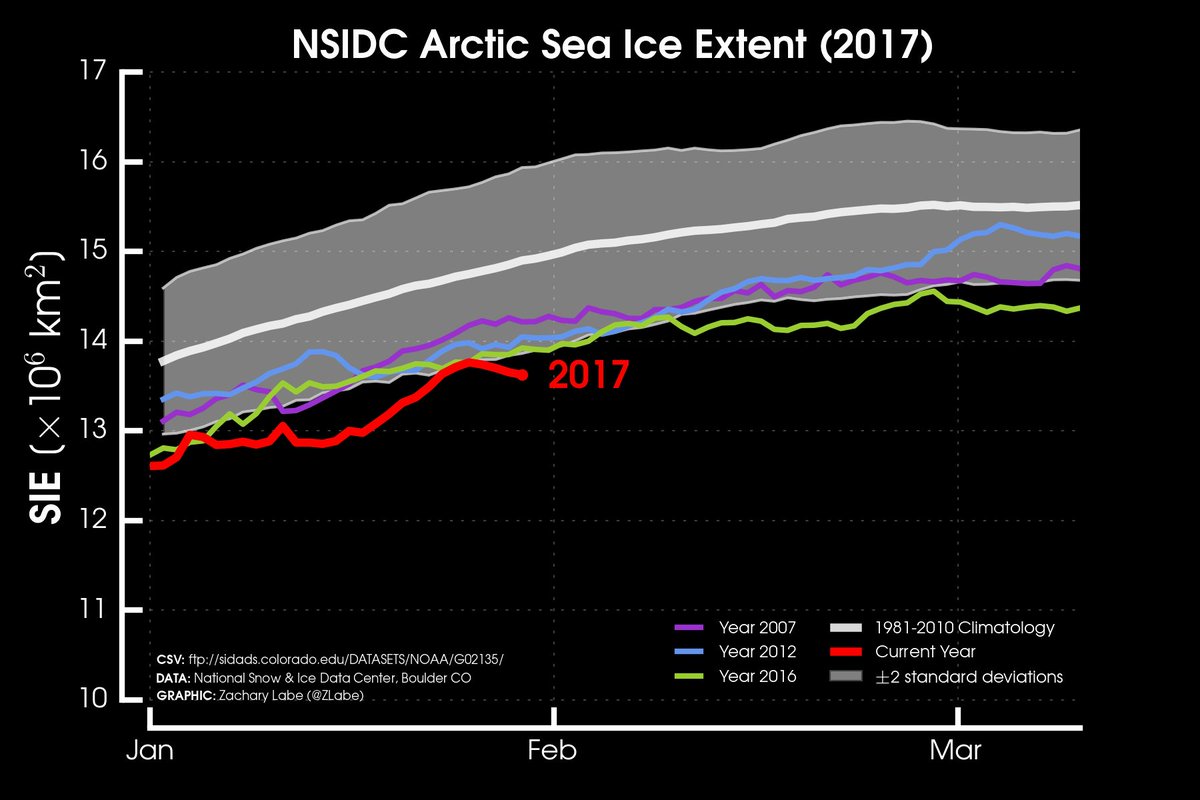
Temperatures are far warmer than ever observed in modern records, and sea ice extent keeps setting record lows.

Unfortunately, influxes of "warm" air from both the Pacific/Atlantic Oceans this week will likely continue preventing sea ice growth
2016 was the warmest year on record in the Arctic, and 2017 has picked up right where it left off. “Arctic extreme (relative) warmth continues,” Ryan Maue, a meteorologist with WeatherBell Analytics, tweeted on Wednesday, referring to January’s temperatures.
Veteran Arctic climate scientists are stunned.
[A]fter studying the Arctic and its climate for three and a half decades, I have concluded that what has happened over the last year goes beyond even the extreme,” wrote Mark Serreze, director of the National Snow and Ice Data Center in Boulder, Colo., in an essay for Earth magazine.
At the North Pole, the mercury has rocketed to near the melting point twice since November, and another huge flux of warmth is projected by models next week. Their simulations predict some places in the high Arctic will rise over 50 degrees above normal.

GFS model temperature forecast difference from normal next Feb. 8 over Arctic. (WeatherBell.com)

One chart, in particular, is a jaw-dropping and emblematic display of the intensity and duration of the Arctic warmth. It illustrates the difference from normal in the number of “freezing degree days,” a measure of the accumulated cold since September.

Averaged over the Arctic north of 80 degrees, this chart displays the difference from normal in the cumulative number of freezing degree days September to January. Freezing degree days accumulate according to the number of degrees Celsius below freezing. Minus-5 Celsius would represent five freezing degree days. (Nico Sun)

The number of freezing degree days is far lower than any other period on record. Eric Holthaus, a meteorologist and science writer who first posted the chart to Twitter, remarked it illustrated a “stunning lack of freezing power” over the Arctic. “This is happening now,” he added. “Not in 50 or 100 years — now.”
The chart was created by Nico Sun, a citizen scientist, using temperature data from the high Arctic, north of 80 degrees latitude, furnished by the Danish Meteorological Institute.
Because data is sparse in this region, David Titley, a professor of meteorology at Penn State and Arctic climate expert, suggested “a little” caution in interpreting the chart but said he considers it “basically right” given other data. “This is another ‘smoking gun’ pointing to rapid climate change,” he said.
Jason Furtado, a professor of meteorology at the University of Oklahoma, called the chart an “incredible” depiction of the Arctic warmth. “While the magnitude of the Arctic warmth is extraordinary in and of itself, the duration of the warmth has been astounding,” he said.
Climate scientists say there is no single cause for the remarkable warmth, but posit it is due to natural variations in the Arctic climate superimposed on a long-term warming trend resulting from human activity.
Walter Meier, a research scientist at NASA’s Goddard Space Flight Center and an expert on Arctic sea ice, explained that the recent lack of sea ice and warmer-than-normal ocean temperatures have “kept air temperatures higher than normal, especially in the Barents and Kara Seas” between Greenland and Siberia. “A series of storms tracking from the south has led to repeated influx of warm air and ocean waters into the region,” he said. Such an influx is predicted next week.
Sun, the chart’s creator, pointed to a recent lack of cold polar high pressure systems over the Arctic, which block heat and moisture transfer from mid-latitudes. “Now Atlantic and Pacific storms blow right into the central Arctic and transform the area from a cold, dry desert into a wet and stormy ocean,” he said.
But it’s unclear and perhaps unlikely that this set of conditions, which has essentially opened the floodgates for an onslaught of warmth into the Arctic, represents a permanent state.
Zack Labe, a PhD student at the University of California at Irvine who is studying Arctic sea ice and extreme weather, said that while greenhouse gases will continue leading to a warmer climate and less ice in the long run, the Arctic will probably continue to experience significant year-to-year fluctuations.
I think we should be cautious, especially considering the resiliency of sea ice, when discussing the warming trend,” Labe said. “It remains uncertain the role natural variability may be having in individual years such as this one.”
Yet the human influence on climate in the Arctic may be redefining the so-called natural variability, said Chip Knappenberger, a climate scientist at the Cato Institute. “Natural variability is itself is becoming increasingly ‘non-natural’ as it includes influences which themselves are shaped by anthropogenic activities,” he said.
Such a statement is notable coming from Knappenberger,who some consider a climate change skeptic and is unconvinced climate change is a serious problem.
What happens next in the Arctic is anyone’s guess. But Penn State’s Titley, who said we are “headed into a new unknown” is concerned: “Science is still trying to figure out the details. We do know that 2017 will almost certainly start with the weakest, thinnest, smallest arctic ice pack in recorded history. So we are one step closer to living with an ice-free arctic in the summer, and probably sooner than we think.”