Saturday, 1 October 2016

Mikeand I were right: we came a hairsbreadth from war with Iran

This makes my blood boil. 

Back in 2012 I was angrily dismissed by the head of CollapseNet because Mike Ruppert and I both insisted on sounding the alarm on the danger of war with Iran on the spurious grounds that it wouldn't happen "because Obama needn't need it to win the election".

Turns out that Mike and I were absolutely right in our assessment and Wes Miller was wrong, wrong, wrong.

We were closer to war back then than we knew.

The only thing between us and Armageddon back then turns out to be Shimon Peres if Israel, and, later on, Vladimir Putin for his intervention over Syrian chemical weapons.


Peres bombshell: I stopped an Israeli strike on Iran

"Prime Minister Benjamin Netanyahu and defense minister Ehud Barak were pushing ahead with their plans to attack Iran."


30 Septermber, 2016

If not for Shimon Peres’s intervention, Prime Minister Benjamin Netanyahu was planning to bomb Iran, the former president revealed confidentially to The Jerusalem Post over two years ago.


In a meeting at the Peres Center for Peace in Jaffa on August 24, 2014, Peres dropped the bombshell in a conversation with me and Jerusalem Post Managing Editor David Brinn.


Be the first to know - Join our Facebook page.


I have thought long and hard about whether to publish it, and reached the conclusion that he wouldn’t have told us if he didn’t want us to.


I was editor-in-chief of The Jerusalem Post at the time and had established a close relationship with Peres, who had retired a month earlier as president.


During the course of the conversation (in which just the three of us sat and chatted over coffee), Brinn asked Peres what he considered the greatest achievement of his presidency. He responded by saying that he had personally intervened to stop Netanyahu from ordering a preemptive strike on Iran’s nuclear sites.


The following is based on my notes:


Peres: I stopped Netanyahu from attacking Iran.


Me: Can you tell us more?


Peres: I don’t want to go into details, but I can tell you that he was ready to launch an attack and I stopped him. I told him the consequences would be catastrophic.


“Can we report this?” I asked.


“When I’m dead,” Peres replied, with a wry smile.


Almost a year later, on June 7, 2015, I moderated a security panel at The Jerusalem Post Fourth Annual Conference in New York in which Senior Contributing Editor Caroline B. Glick got into a heated argument with former IDF chief Lt.-Gen. (res.) Gabi Ashkenazi and the late Mossad director Meir Dagan, charging that they had refused an order from Netanyahu to prepare for an attack against Iran.


In 2010, Glick said, citing a report from the investigative journalism TV program Uvda, “we learned that two of the gentlemen on this panel were given an order to prepare the military for an imminent strike against Iran’s military installations and they refused.”


While pointedly not denying that the order had been given, Dagan insisted: “It was an illegal order. We were always willing to obey any legal order by the prime minister. We never refused an order.”


“You were ordered by the security cabinet,” Glick retorted.


“You were not there. You don’t know what happened there,” said an indignant Dagan.


“There was never a decision about it,” Ashkenazi added, although he acknowledged that he had opposed a unilateral Israeli strike on Iran.


At the Herzliya Conference the following day, Maariv columnist Ben Caspit raised the issue with Peres.


“That journalist [Glick] wasn’t there! How would she know?” Peres raged. “These are issues that should be discussed in the cabinet, not in the media and not in public.”


“Peres had good reason to be angry,” Caspit later wrote on the Al-Monitor media site. “He was one of the key players in that drama, which played out between the summer of 2009 and the summer of 2011. These were some of the tensest times for Israel’s defense establishment. Prime Minister Benjamin Netanyahu and defense minister Ehud Barak were pushing ahead with their plans to attack Iran, while the IDF, headed by Ashkenazi, and the heads of the other defense establishments opposed the move. Ashkenazi and Dagan had the support of none other than the president at the time, Peres, who joined their efforts to thwart the attack.”


Was it in fact Peres, the architect of Israel’s nuclear program, who ultimately foiled an Israeli attack on Iran’s nuclear sites? He thought so, although he didn’t say how he did it.

This is what I wrote back then.


CollapseNet
Today I have found that my 'lifelong' subscription to CollapseNet has been blocked.


I therefore feel freed up to reveal some of the thigns I have kept silent about for some time.

….

I first encountered Michael C Ruppert in 2010 when I found some of his talks on the web and watched the movie Collapse Very soon I joined Mike's new site CollapseNet.

Immediately I found a resonance with what he was saying and its rock-hard logic.

I started sometime early in 2011 to collect stories myself and to put this on this very blog.

Because (due to health constraints) I had plenty of time to research and have the advantage of the time zone I often found stories before CollapseNet and sent these stories on, usually to Mike and his Facebook page.

Mike approached me asking me to join CollapseNet and I started contributing stories to the website every day.

After a month or so after coming on board with the company there was a sudden shock. I started reading criticism of Mike Ruppert for his adoption of the views of Greg Brayden and others.

This quickly led to the resignation of Mike from CollapseNet.

It became clear that Mike was tired after 30 years of battling and wanted to move on to other things. This, however does not change the fact that this was a pretty nasty, backroom coup.

There was some rejoicing in (some of) the ranks at Mike's departure.
  
CollapseNet could be remolded into a company witout Mike Ruppert.

I will not repeat some of the things that were said about Mike Ruppert, but they shocked me at the time.

However, I stayed on, contributing as normal to the daily Newsdesk.

Very soon there were criticisms (that I thought quite valid) from members who did not like the change and whose emails were left unanswered. The response was always that these were troublemakers.

They along with many others seem to have disappeared (or been removed) from the site

At some stage I had a particularly nasty email interaction with one individual from the company who responded to something I had offered by economist Steve Keen with an email saying that Steve Keen was a 'total fake' and he was 'outing' him. When I challenged him on this and later on, some time later compounded my sin by disagreeing with him a second time he became quite abusive and even accused me of being a 'plant'

Being a fair-minded person, sitting at the bottom of the planet, I am not accustomed to such paranoia.

Basically I faded away and stopped my daily contributions to concentrate my energies on this site.  

Since then, I have not heard anything from the editorial board, but I have continued to check up with CollapseNet.

I have been noticing of late that the editorial policy had changed and was completely ignoring the geopolitical events that so bothered and unnerved me.

Indeed the line went that a war with Iraq was off the table because “Obama does not need it to win the election”. Anybody who thought there was going to be a war was a 'fearmonger'. Behind this was a deep criticism of Mike Ruppert who, back last northern winter was concerned about war and then changed his mind based on changing conditions.

This is the well-thought-out position of CollapseNet;

"Am I going to fall for the psy-op and propaganda games the Israelis and neo-cons would like us to bite into? No. And I won't help them promote their fear products, either.

When the Big "E" comes home and gets de-commissioned, CollapseNet's credibility will still be intact, too. The same won't be said of all of the wolf-criers out there."


I take it I am a 'wolf-crier'
 

….

One Sunday a couple of weeks ago I was sufficiently alarmed at the news that was pointing towards war, that I posted articles on Mike Ruppert's Facebook page.

This was the email that I received as a result from Wesley Miller, CEO of CollapseNet.

"I do not appreciate the attempt to back-door us on Iran with Mike. I am right, and CollapseNet's editorial position will not change change unless real information changes, regardless of what you or Mike want to think about it. You appear to want to scare people, and that's not what we're about.

Please be careful what you post on our website and stop wasting my time and effort needed to undo your injections of unnecessary fear. This is a proprietary website not owned by you, and this is your last conduct warning."


Well, you know what I post because it is no different to what I post onto this site.

My response was I am a free agent and will post on Mike's Facebook page if I like but would not post that material on CollapseNet.

…..

After making a positive response to another member's post supporting Mike Ruppert and it seems I'm out!

"Login denied! Your account has either been blocked or you have not activated it yet. Did you not get an activation e-mail and follow the validation link?"

I'm not sure what you call it when you are warned off for posting articles from the world media, albeit if it contradicts a strongly-held view.

I suspect it's called censorship.

I thought that debate was good. Apparently not in some circles. Apparently it is troublemaking and any information that challenges those strongly-held views is mis-information.

If these are the attitudes those who would lead us through a transition away from the infinite growth paradigm then I hold grave fears for our future.

....
My position is that I continue to support Mike Ruppert in what he does although I do not always agree with everything he says - I continue to hold him in great esteem and respect.

I continue to appreciate the work of CollapseNet, especially that of Rice Famer and J.O. who spend many hours selflessly to filter the news and bring the stories that matter.

I have observed that the headlines posted on CollapseNet increasingly do not reflect the importance of stories contributed.

CollapseNet has completely distanced itself from the name Michael Ruppert.

I do not appreciate attempts to stifle criticism and mild dissent - "proprietory" company or not?


What is happening at Deutsche Bank?


Deutsche Bank Slips Below 10 Euros as Options Traders Bet on 8
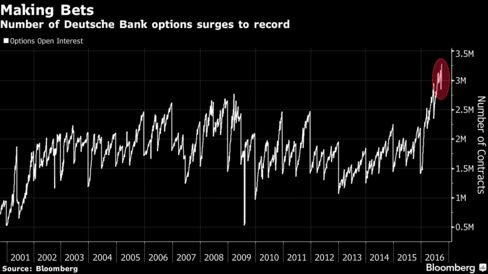
  • Number of options on the shares surges to record high
  • Deutsche Bank’s woes spill over to rest of the industry

1 October, 2016

For the first time ever, Deutsche Bank AG’s share price dipped below 10 euros. Traders are preparing for it to fall even lower.

The most-owned bearish option on the German lender is a put with an exercise price of 8 euros. While investors started piling into the position in June, the fact that it’s so popular shows they’re seeking to hedge for further declines. The stock sank as much as 9 percent to 9.90 euros intraday, before paring its slide.

Trading in Deutsche Bank options has surged this month as the lender fell to a fresh record low on growing concerns about its ability to withstand mounting legal costs. Put volume reached a seven-year high on Monday, while the number of outstanding contracts on the firm has climbed to its highest ever.


“A very psychological barrier has been breached,” said Michael Hewson, an analyst at CMC Markets in London. “For a bank such as Deutsche Bank, whose share price in 2008 was light years away from being a single digit stock, to become a single-digit stock -- it changes people’s perceptions. If it can drop through 10 euros, then what’s the next target? For Deutsche Bank’s share price to go towards 8 euros -- I think that’s perfectly feasible.”


Since their peak in May 2007, Deutsche Bank shares have tumbled 90 percent. More than 83,000 of the 8-euro put that’s the most owned exist, up from about 32,000 in June. The open interest on the contract, which expires in December of next year, has climbed 14 percent since Sept. 6.

On Friday, Deutsche Bank options were among the most traded on Deutsche Boerse AG’s Eurex exchange. June puts with a 10 euro strike and 7.60 euro puts expiring in March were the bearish contracts on the stock that changed hands the most. A 10,000 block of the March options changed hands at the same time as an equal number of March 12.50 euro calls, data compiled by Bloomberg show.

Deutsche Bank spokesman Don Hunter declined to comment on the stock and options trading.

In the latest turn of events, about 10 hedge funds that do business with Deutsche Bank have moved part of their listed derivatives holdings to other firms. Chief Executive Officer John Cryan’sreassurances that the lender has never had as safe a balance sheet in the past two decades wasn’t enough to stop the decline in shares.

As the stock tumbled and investors piled into options, bond traders also increased hedging. The cost of insuring the company’s subordinated debt reached a record this week, while that of credit-default swaps on its senior hit the highest since February, before paring their advance.

Deutsche Bank’s woes have spilled over to the rest of the industry, with a gauge tracking lenders for the region heading for its lowest level since Aug. 22. Commerzbank AG, which said on Thursday it will cut jobs and suspend dividends, dropped 6.1 percent

As of 1:05 p.m. in Frankfurt, Deutsche Bank shares traded at 10.37 euros, down 4.6 percen

“If it doesn’t close back above 10 euros today, I would be concerned that we could fall quite a bit lower,” Hewson said.

“If it doesn’t close back above 10 euros today, I would be concerned that we could fall quite a bit lower,” Hewson said.


One year of Russian military operations in Syria


Russian operations in Syria: one year on


30 September, 2016

Whatever criticism Russia has faced so far and may still hear in the future, most leading Western media did not hesitate to put its operation in Syria on the list of last year’s top events.

Regardless of their attitude to the air campaign Western politicians, pundits and journalists agree the Russian military has changed beyond recognition.

In particular, they pointed to smooth coordination, advanced hardware and effective strikes against the terrorists. All that was unanimously interpreted as evidence the military reform has borne fruit.

In Syria, many Russian air pilots have gained combat experience. Long-range strategic aircraft and submarine- and surface ship-launched missiles were used in real combat for the first time. The fire power of Russian weaponry impressed potential customers.

Until just recently it had been maintained that Russia was unable to conduct any major military operations far away from its borders.

In March 2016, the overall value of weapons export contracts soared to $56 billion - a record-high since 1992.


In February 2016, US President Barack Obama claimed that Russia would get bogged down in Syria precisely the way the Soviet Union in its day was stalled in Afghanistan.

A large-scale operation on the ground and such adverse side effects as soaring costs and casualties and undesirable political developments at home were said to be more than guaranteed. A month later, though, the Russian president ordered the withdrawal of the bulk of the Russian contingent from Syria.

Gloom prophecies the involvement of a ground contingent would ensue turned out wrong. Russia had derived proper lessons from the Soviet Union’s Afghan experience and also the experience of the United States and its allies in Afghanistan and Iraq.

It confined itself to air support, while the presence and role of special operations forces and military advisers remained limited. The task of the commando units was to conduct reconnaissance of potential targets for air strikes and to direct planes to targets in remote areas, while the Syrian army was fighting on the ground.

With Russian air support it managed to launch a counteroffensive. In the meantime, the United States has failed to identify any reliable allies on the ground in Syria. The armed opposition it supports is patchy and uncontrollable.

With Russia’s involvement in the military operation in Syria the diplomatic process went into high gear. In February 2016, a ceasefire agreement was concluded but the Islamic State and Jabhat al-Nusra were identified as parties that remaining outside its framework.

The United States and Russia pledged to monitor the situation. Two weeks later Moscow made a decision to remove its main forces from Syria.

The Russian operation lasted five months and fourteen days to have cost an estimated $2.8 million a day. In contrast the United States is spending about $11.9 million a day to fight against the Islamic State in Syria and Iraq.

Putin has restored Russia to the position of a key actor in the region and he did so at a very moderate cost, analysts say.

Russia’s Rambo


The name of Russian officer Alexander Prokhorenko featured in Western media headlines last spring probably more often than in Russian ones.

Senior lieutenant of the special operations force died a hero near Palmyra on March 24, 2016 while directing strikes by Russian aircraft against terrorist targets.

When he realized he had been spotted and surrounded, Prokhorenko called in an airstrike on himself as the enemy was about to seize him.

A real hero, Russia’s Rambo, as many media said.

Career military around the world did not hesitate to pay their last respects to Prokhorenko and his courage. In a Facebook community for US military there appeared a transcript of Prokhorenko’s last conversation with his commander seconds before the surrounded officer urged an air strike on the position he was taking.


The transcript appeared in the world web through unofficial channels.

Praying for Palmyra

Three days after Prokhorenko’s death the Syrian Army’s command said the Syrian military and people’s militias had regained full control of Palmyra. Russian planes flew about 500 sorties during the battle for that city.

On the same day President Putin told UNESCO’s Director-General Irina Bokova by telephone the Russian contingent would participate in a mine-clearing operation in the city featuring on UNESCO’s world heritage list.

By the end of April the road to Palmyra reopened to UNESCO’s researchers and specialists, who had for more than a year been watching Palmyra’s horrible plight.

On May 5, in the ancient outdoor theater the IS terrorists had been using as a site for mass executions, the Mariinsky Theater’s orchestra under conductor Valery Gergiyev gave a unique performance titled Praying for Palmyra.


Although many Western media reported the concert with a great deal of skepticism, few doubted that Palmyra’s liberation was Russia’s major military and image-bolstering victory.

Some watched the performance with tears in their eyes. Italian Prime Minister Matteo Renzi said the concert demonstrated that Russia and Europe shared common values, such as the greatness of human dignity.

Russia casts a protective veil over Syria’s Christians

Russia’s efforts to protect the Christian population of Syria drew the European media’ special interest.

While the Russian operation was still in the early phase, Western media made attempts to lend a negative flavor to Russia’s role in the Middle East, prompting allusions to the era of crusades.

In due course, though, Moscow began to be referred to as the sole force in the whole world that threw the spotlight on the need for taking care of Syria’s Christians.

Local residents – Christians, experts and Western and Syrian priests – unanimously express this opinion to the media.

The rendezvous Patriarch of Moscow and All Russia Kirill and Pope Francis had in Cuba played an important role to draw worldwide attention to this issue.

What has Russia achieved?

Has the situation in Syria changed to any significant extent over the twelve months since the military operation began?


On the one hand, the Islamic State’s onslaught has been thwarted. The process of local reconciliations is proceeding. Armed opposition members achieve more negotiated solutions with the authorities on leaving the zone of combat operations and laying down part of their armaments.

On the other hand, the fundamental truce agreements continue to be violated.

One year after the question of concerted action by all forces involved in the war on terror in Syria is still relevant. The main problem is the mediators distrust each other.

Washington has groundlessly accused Russia and the Syrian army of attacking a humanitarian UN convoy near Aleppo. It is noteworthy this happened just a couple of days after the United States erroneously hit the Syrian army’s positions near Deir ez-Zor.

Both incidents caused another disruption of ceasefire. As Russia’s UN envoy Vitaly Churkin has said, now it would be possible to discuss the restoration of truce only on the collective basis.

In a situation like this the chances of prompt stabilization in Syria look slim.

The Russian military has coped with its task and helped the Syrian army stop a major Islamic State offensive. But if no diplomatic backup follows and if the US-Russian agreements on coordinating the struggle with terrorists in Syria remain just a sheet of paper, the march of events may turn for the worse again.


The conflict in Syria admits of no solution from the position of strength. Only joint efforts can succeed. Russia has been saying this all the time from the very first day the Syrian conflict flared up.

The 9/11 JASTA Bill and the US Deep State

Saudi bill could expose US deep state behind 9/11: Scholar


White House Chief of Staff Andrew Card whispers into the ear of President George W. Bush to give him word of the plane crashes at the World Trade Center, during a visit to the Emma E. Booker Elementary School in Sarasota, Florida, on September 11, 2001. (Photo by AP)

30 September, 2016


The US legislation against Saudi Arabia could expose the real deep state structure behind the September 11, 2001 terrorist attacks, says Dr. Kevin Barrett, an American academic who has been studying the events of 9/11 since late 2003.
Dr. Barrett, a founding member of the Scientific Panel for the Investigation of 9/11, made the remarks in a phone interview with Press TV on Thursday, a day after the US Congress overwhelmingly voted to override President Barack Obama’s veto of legislation allowing relatives of the victims of the 9/11 attacks to sue Saudi Arabia.
On Wednesday, Senators voted 97-1 in favor of the “Justice Against Sponsors of Terrorism Act (JASTA),” which was vetoed by Obama last week. Only Senate Minority Leader Harry Reid, Democrat of Nevada, voted to sustain the president’s veto.
Hours later, the House of Representatives overwhelmingly voted against the presidential decree, 348 to 77. Only 18 Republicans and 59 Democrats voted not to override the veto.
The September 11 attacks, also known as the 9/11 attacks, were a series of strikes in the US which killed nearly 3,000 people and caused about $10 billion worth of property and infrastructure damage.
US officials assert that the attacks were carried out by al-Qaeda terrorists but many experts have raised questions about the official account. They believe that rogue elements within the US government orchestrated the 9/11 attacks in order to accelerate the US war machine and advance the Zionist agenda.
9/11 was attack by enemies of Islam
Dr. Barrett said “the US Congress had been intimidated into complete silence on all issues involving what may have really happened on September 11, 2001.”
“And the only way they were able actually to do anything was with this bill, by pretending that the people they are going after are evil Muslims over in Saudi Arabia, when of course 9/11 was an attack by the enemies of Islam, a false flag designed to falsely blame Muslims and to paint Islam in bad light to trigger one hundred years of war on Islam and Muslim countries, especially in the Middle East, on behalf Israel,” he said.
“So Congress of course cannot say that, because the media and the financial establishment in the United States are dominated by Zionists, which is of course the group that did 9/11. So instead they’re doing a sort of end-run around that Zionist power configuration, as James Petras calls it, and they are pretending that this really about Saudi Arabia,” the analyst said.  
“So this JASTA bill will allow the families of victims of the 9/11 attacks to sue Saudi Arabia, overriding the traditional sovereign immunity that prevents people from suing governments.”
On Wednesday, Obama said the JASTA bill sets a "dangerous precedent" in international law that could have repercussions for the United States.
"If we eliminate this notion of sovereign immunity, then our men and women in uniform around the world could potentially start seeing ourselves subject to reciprocal loss," he said.
9/11 bill to open floodgates of lawsuits against US
US President Barack Obama speaks to American troops at Fort Lee, Virginia, September 28, 2016. (Photo by AFP)
Dr. Barrett said “the Obama administration’s reaction against this is quite telling. They claim that this bill is a disaster, because it will open the floodgates for people in other countries who have been victimized by US-sponsored state terrorism, to sue the United States’ government.”
“So essentially Obama and his allies who are against the JASTA bill are admitting that the United States government commits massive amount of state terrorism all over the world, which is in fact the case,” he stated.
“According to the book by Noam Chomsky and Andre Vltchek On Western Terrorism, the Unites States government has murdered between 50 to 60 million people around the world in terrorist attacks since World War II -- 50 to 60 million people! No wonder Obama and his friends are afraid of losing sovereign immunity, and the lawsuits that will come pouring in against the United States as soon as this suit against Saudi Arabia commences,” the scholar said.
Why is JASTA bill ‘wonderful’?
US President George W. Bush meets with Prince Bandar bin Sultan, the Saudi Ambassador to the United States, on August 27, 2002, at Bush's ranch in Crawford, Texas. (Photo by Getty Images)

“From the perspective of those of us who care about justice and making a better world, this is wonderful,” said Dr. Barrett, the author of Questioning the War on Terror.  
“The lawsuit against Saudi Arabia for 9/11 has a chance of exposing the real deep state structure behind 9/11 – which did involve elements of the Saudi government including Bandar bin Sultan, who smoked a celebratory cigar with George W. Bush right after the 9/11 attack on the White House balcony – but also more importantly the neoconservative faction here in the United States and its masters in Tel Aviv, that’s the Israelis who were the real force behind 9/11, which was designed to destroy seven countries in five years as General Wesley Clark said,” he explained.
“Those seven countries are the so-called enemies of Israel. I hope that the entire truth will come out. I hope that the millions of survivors of US terrorist attacks around the world will sue the US government. And I am hoping that that this JASTA bill will open the door for a better world,” the researcher said in his concluding remarks.


Reality Check: Saudi Arabia Terrified of Release of "28 Pages" in 9/11 Report

Ben Swann


US, Israel using Saudi Arabia to cover up own role in 9/11: Analyst

IMF Announces The Yuan as additional Global Reserve Currency

IMF sets new SDR currency amounts to reflect yuan entry


30 September, 2016

The International Monetary Fund said on Friday it set new relative amounts of the currencies in its Special Drawing Rights currency basket, reflecting the entry of China's yuan for the first time on Saturday.

The IMF said each SDR, the Fund's unit of account, will be made up of 0.58252 U.S. dollars, 0.38671 euros, 1.0174 Chinese yuan, 11.900 yen and 0.085946 pounds sterling. The relative amounts reflect weightings determined last year based on average exchange rates over the past three months. The amounts are now fixed for five years.


IMF Announces The Yuan as additional Global Reserve Currency

Israeli News

IMF announces a new reserve currency and more evidence surfaces that indeed US, Turkish, Saudi, Qatar, and Israeli special officers were working in Syria at the time that Sputnik Arabic claims that a Russian Missile struck and killed a secret bunker where these groups were directing attacks on Syrian Army.

Links To our New Channels:


Sergei Lavrov interviewed by BBC Hardtalk

Instead of waiting for the edited hightlights from the BBC we can listen to the interview verbatim

Russia Foreign Minister Sergei Lavrov tells BBC that US Plan B ‘was to spare Al Nusra’ in Syria
Russian Foreign Minister Sergei Lavrov told the BBC that the US is trying to spare jihadist groups in its attempts to overthrow Syria's Bashar al-Assad.

30 September, 2016


It has been one year since Russia was invited, legally, by the internationally recognized government of Syria. What is the US doing in Syria, uninvited?
Russia Foreign Minister Sergei Lavrov spoke with Stephen Sackur on BBC World News TV on the first anniversary of the beginning of the Russian air campaign in Syria.

You can sense the panic from Sackur, as he realises the Al Qaeda jihadists, the BBC has been backing in its media reporting, are facing defeat in Aleppo.
Lavrov is his usual professional self…beating down all of Sackur’s ridiculous, propaganda filled questions.

Here are some highlights of what Lavrov said during the interview…
  • “They [the US] pledged solemnly to take as a priority an obligation to separate the opposition from Nusra.”
  • “They still, in spite of many repeated promises and commitments…are not able or not willing to do this andwe have more and more reasons to believe that from the very beginning the plan was to spare Nusra and to keep it just in case for Plan B or stage two when it would be time to change the regime.”
  • “We believe that the Russian-American deal must be put into effect. For this the only thing which is necessary is to separate the opposition from Nusra. If it is supported by the United States, not on paper but in real life, and then we will insist on an immediate cessation of hostilities.
  • “Humanitarian things are very important and we are doing everything now together with the Syrian government to help the United Nations to get weekly pauses in Aleppo to deliver humanitarian goods. It’s the Nusra-controlled people in eastern Aleppo who refuse to do this.”
  • “We had many pauses, many humanitarian pauses during this year… 48 hours, 72 hours at the request of the United Nations. Every time these pauses have been used by Nusra to get from abroad more fighters, more ammunition and more weapons. There must be some first step and we have to get our priorities right.

Here is the BBC's 12 minutes (compared with 22 minutes from the Russian Ministry of Foreiegn Affairs