Showing posts with label trade. Show all posts

Sunday, 31 May 2020

BaCK IN 2017 NZ'S Five Eye partners had difficulty with NZ's tilt towards China

For a bit of historical perspective

New Zealand says it will find a 'win-win' situation in China's Belt and Road strategy

  • New Zealand's leaders made the comments at a China-focused business summit
  • Wellington has fostered close economic ties with Beijing, including a free-trade agreement
  • But some have voiced concern about New Zealand's increased reliance on Chinese trade
  • The trade and investment policy — championed by Chinese President Xi Jinping — has become mired in controversy, with some partner nations bemoaning the high cost of projects.


SMH,
7 May, 2019

New Zealand is willing to work with China on its Belt and Road initiative (BRI) and can offer its expertise in areas such as regulation and the environment, its Trade Minister says.

But China's recent efforts to put a greener face on its infrastructure initiative could smoothen ties with some countries.

China's new 'Silk Road'

"It seems more likely that we can find a win-win situation with China, whether it's greening the Belt and Road, or helping address some of the issues… around transparency, or whether it's using our regulatory systems, which are amongst the best in the world," New Zealand Trade Minister David Parker said at an annual China-focused business summit in Auckland.

Mr Parker had travelled to Beijing for the BRI summit in April at which New Zealand had joined Russia and four developing nations to coordinate accounting standards for countries participating in the program.

Amid Western scrutiny and a US backlash towards the BRI, New Zealand's stance could be a litmus test on how other governments respond to the BRI.

"The fact that we've taken a little bit of pause as we've worked to really flesh out that arrangement has been no bad thing, because Belt and Road has really evolved," Prime Minister Jacinda Ardern told the summit, adding that the infrastructure program was changing to involve sectors such as service industries.

New Zealand has long been touted by Beijing as an exemplar of its "firsts" with Western countries, most recently becoming the first Western nation to join the Chinese-spearheaded Asia Infrastructure Investment Bank (AIIB) and helping to usher in other developed nations.

But in recent months, New Zealand's security agencies have expressed concerns about the country's vulnerability to foreign interference at the hands of Beijing.

Its Security Intelligence Service said in its 2018 annual report that the country was "a target of espionage and foreign interference activity".

Across the Tasman, the Victorian Government has been the only Australian government to sign up to the BRI, despite senior national security figures citing "strategic" consequences for Australia if it signed up formally.

New Zealand's Deputy Prime Minster Winston Peters, who served as foreign minister under the government of Helen Clarke from 2005 to 2008, told reporters in November that it would be "naive" to think that citizens were free from espionage.

He added that the Chinese diaspora did not speak up against Beijing as they feared the Government's global reach.

His comments came after allegations from the University of Canterbury's Professor Anne-Marie Brady, who reported that her home was broken into, her car was being tampered with, and she was the recipient of threats through the post and via phone after the publication of her 2017 paper into China's alleged interference in New Zealand.

But the relationship has hit a stumbling block in recent months under Ms Ardern's coalition government.

New Zealand has criticised China's lending to the Pacific, and rejected a bid to allow Chinese technology giant Huawei to take part in the country's planned 5G network.

A BRI agreement — one of the first with a Western nation and penned under the previous centre-right National government in 2017 — had languished months past its 18-month expiry date.

Australia's strategic concerns over Belt and Road

China's controversial push to dominate global trade is being resisted by senior national security figures, who warned the Government of "negative strategic consequences" if Australia signed up.

But Ms Ardern, who recently returned from her first trip to Beijing as Prime Minister, said that disagreements were normal and the relationship with China was one of New Zealand's most important.

Two-way trade between the two countries had topped $NZ30 billion ($28.3 billion), and the Government hoped it would grow further once negotiations were completed on an upgrade of their historic free trade agreement.

Mr Parker said that taking part in the BRI could improve the relationship between the two nations because it was "very important" to the Chinese administration, "which then creates a space for trade".

China's ambassador to New Zealand, Wu Xi, welcomed New Zealand's offering up its regulatory expertise to Belt and Road, but encouraged a bold idea proposed by some businesses and trade experts to develop New Zealand into a transport and trade hub between Asia and Latin America.

"[Belt and Road] needs New Zealand's ideas, New Zealand's creativity and New Zealand's energy," Ms Wu said.

Air New Zealand was among the businesses backing the proposal.

"We're a little country...we've got to step into this space," said the airline's chief executive, Christopher Luxon.

But Mr Luxon also admitted the carrier, which is 53 per cent owned by the New Zealand Government, had lost over $100 million after 13 years of operating in China due to Beijing's preferential treatment for Chinese airlines.

But, he said that Ms Wu's proposal would be one of the ways that New Zealand "can have relevance and participate in joining up to emerging parts of the world".

Friday, 22 February 2019

BIG,BIG trouble for Austraiia (as well as New Zealand)


AUSTRALIA'S ECONOMY WILL COLLAPSE SOON - I WARNED YOU


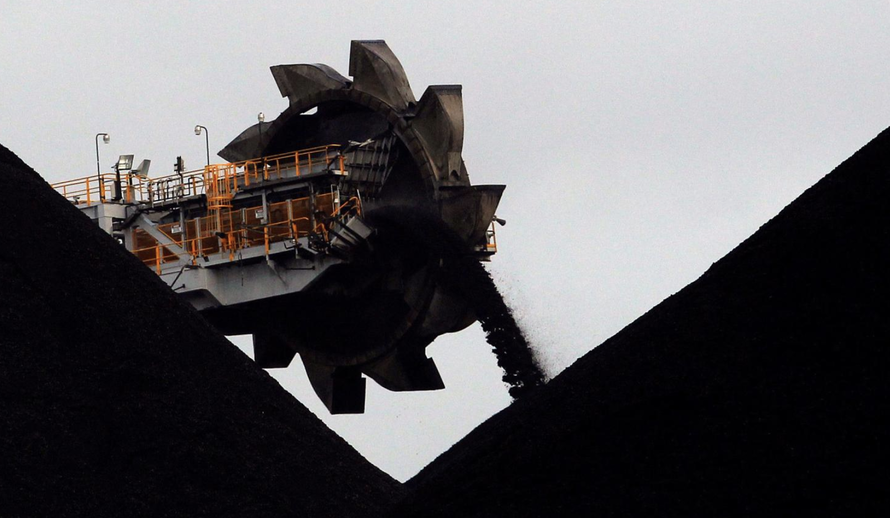
Trade War Goes Global: China "Indefinitely" Bans Australian Coal Imports
Aussie
21 February, 2019
Just days after it warned its citizens against traveling to New Zealand, Beijing has reportedly cracked down on imports of coal from Australia, cutting off the country's miners from their biggest export market and threatening the island nation's economy at a time when it and its fellow "Five Eyes" members who have sided with the US by blocking or banning Huawei's 5G network technology.
Customs agents at the port of Dalian have banned imports of Australian coal "indefinitely" while reportedly capping all coal imports from all sources at 12 million tonnes per day, Reuters reported overnight. Elsewhere in China, Australian coal - the combustible rock is the country's biggest export - has faced customs delays of up to 40 days, just as Rabobank analyst Michael Every anticipated when he pondered earlier this month whether Australian coal might face "bureaucratic delays" at Chinese ports following the country's "Huawei moment." This is what Every said two weeks ago:
Billionaire political donor Huang Xiangmo, Beijing's former top lobbyist/fixer in Australia has just had his long-standing application for Aussie citizenship rejected and his permanent residency cancelled while travelling overseas, leaving him stranded and locked out of his USD10m Sydney mansion. The citizenship application refusal apparently comes on both character grounds and concerns about the reliability of his answers in interviews and correspondence with authorities including ASIO, the Australian intelligence service. Note that Mr. Huang has donated AUD2.7m to both major political parties over the last five years and also funds former foreign minister Bob Carr’s Sydney think tank - Carr himself having made several recent public statements arguing for Australia to side with China due to their economic links.
Does this smell like a real US-China trade deal is on the cards? And is this Australia’s Huawei momentMight Aussie exports to China suddenly run slap-bang into bureaucratic delays or boycotts? And should we add Australia to the list of nationalities that might want to rethink visits to China? But silly me: China is already holding one captive. Germany might be about to push the EU onto that China hit-list too, as it is apparently setting the following standard for Huawei to operate: “A guarantee its data will not be shared with Beijing”. So that’s nein then, nicht war
And while at least one Wall Street analyst had anticipated some form of retaliation, the ban apparently took Australian diplomatic officials by surprise. Here's more from Reuters:
Five harbors overseen by Dalian customs - Dalian, Bayuquan, Panjin, Dandong and Beiliang - will not allow Australian coal to clear through customs, said the official. Coal imports from Russia and Indonesia will not be affected.
"I’m aware of unconfirmed and unsourced media reports and have asked our Ambassador in Beijing to urgently clarify their veracity," said Australia’s Minister for Trade Simon Birmingham.
"We continue to engage closely with industry on matters of market access...China is a valued partner of Australia and we trust that our free trade agreement commitments to each other will continue to be honored."
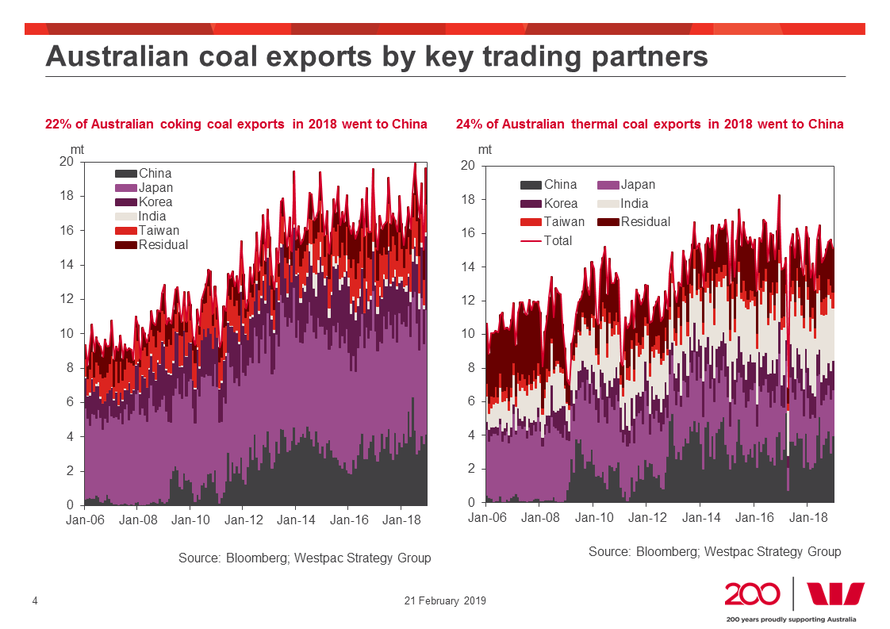
It would be hard to understate how big of a problem this is for Australia. The ramifications will be felt, not only by the country's miners, but by the broader Australian economy, and as economist Robert Rennie notes, a ban would have a major impact on Australian exports as 22% of Australian coking coal exports  in 2018 went to China (39mt). 24% of Australian thermal coal exports  in 2018 went to China (49mt).
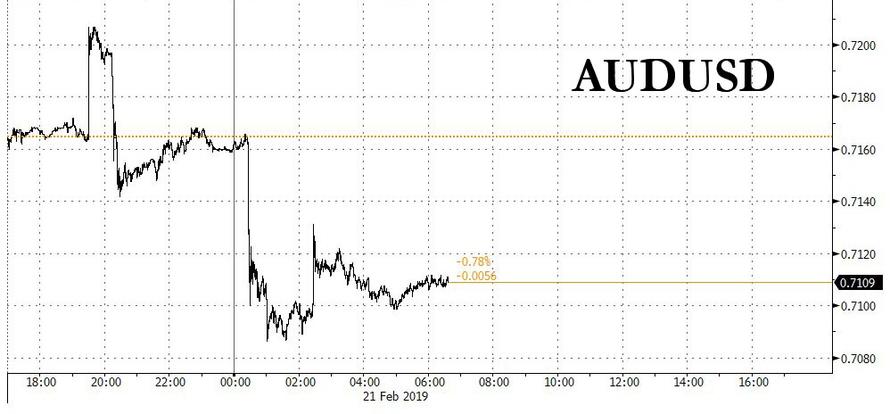
... which is why the Aussie, and shares of Australian miners, tumbled on the news...
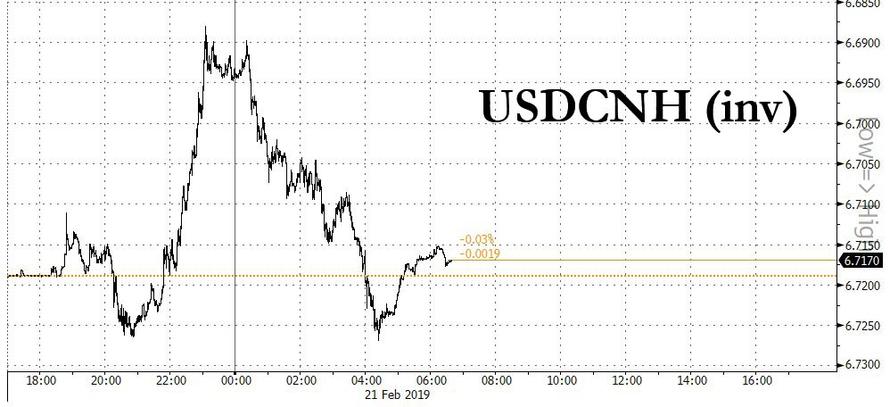
... while the Chinese Yuan dropped as well, which prior to the report had hit a 7 month high.
Meanwhile, shares of Chinese coal miners climbed.
Which brings us to our next point. Aside from showing the international community what they stand to lose if they side with the US in the dispute over Huawei (the DOJ recently filed two criminal indictments against the company alleging both IP theft and sanctions violations, and the US has been pressing its allies to ban Huawei 5G network equipment over security concerns), Beijing may have an ulterior motive in cracking down on coal imports: Support domestic prices.
As Reuters adds, Beijing has been trying to restrict imports of coal more generally to support domestic prices. A Beijing-based coal trader said Dalian had cleared about 6 million tonnes of coal in January that had been delayed since late 2018 as China slowed customs clearance to curb imports.
The delayed cargoes would not be included in the 12 million tonnes under the 2019 quota, he added, citing customs information. Dalian handles both thermal and coking coal imports but the clamp down is expected to have a bigger impact on coking coal, used in steel making, than thermal coal, used to generate electricity.
Spot Australian coking coal at the northern Chinese port of Jingtang is 200 yuan ($29.85) cheaper per tonne than domestic prices, according to data tracked by Orient Futures. The price difference for thermal coal is about the same.
"It is hard to find a replacement for Australian coking coal since its sulfur content is very low," said a purchasing manager at a large plant in Hebei province that produces coke, used in the steelmaking process, from coking coal. "Current inventory at ports should be sufficient to support usage for one or two months, but it could be a problem in the long term, especially if other ports also tighten imports," he added.
So far, at least, the ban has apparently had the desired effect. Diplomats in Canberra don't know what the hell is going on. The Aussie is sliding, as are shares of the country's miners. Soon enough, we will probably hear from economists and maybe even the RBA for an analysis of what the impact might be on Australian GDP.
So will Australia capitulate on its decision to ban Huawei from building a 5G network in the country on national security grounds. Given Germany and the UK's decisions to begrudgingly allow Huawei access following demands from their telecoms industries, and with the threat of losing one of its biggest trading partners, it at least has a convenient excuse.

    Sunday, 10 June 2018

    Trump refuses to endorse G7 joint statement


    Trump won't endorse G7 joint statement, attacks 'weak & dishonest' Trudeau


    RT,
    9 June, 2018

    Hours after the G7 summit, US President Donald Trump is attacking Canadian Prime Minister Justin Trudeau again for "false statements," and he is refusing to endorse the summit's communique that called for reducing tariff barriers.

    On Saturday, Trump lapsed into his pre-summit rhetoric again, calling Trudeau "dishonest and week" in a fresh series of angry tweets. He reiterated that the recently imposed US tariffs on metal imports from Canada and other nations are a response to what he believes is trade inequality.


    PM Justin Trudeau of Canada acted so meek and mild during our @G7 meetings only to give a news conference after I left saying that, “US Tariffs were kind of insulting” and he “will not be pushed around.” Very dishonest & weak. Our Tariffs are in response to his of 270% on dairy!

    Trump lashed out at "Justin's false statements" at a press conference following the summit. There, Trudeau repeated his earlier description of US trade tariffs as "insulting" and vowed retaliatory measures would come in July.


    Based on Justin’s false statements at his news conference, and the fact that Canada is charging massive Tariffs to our U.S. farmers, workers and companies, I have instructed our U.S. Reps not to endorse the Communique as we look at Tariffs on automobiles flooding the U.S. Market!

    A few minutes later, Trump changed his Twitter profile header picture from the G7 family photo to a photograph of himself singing the anthem with members of US military in Atlanta in January this year – apparently another jab at his summit-mates, considering how far back he had to dig to find that one.

    Trudeau’s office responded to the verbal attack in a statement saying that the PM did nothing to provoke an outburst from Trump.

    The Prime Minister said nothing he hasn’t said before — both in public, and in private conversations with the President,” it stated, adding that the Canadian government remains “focused on everything we accomplished here at the summit.”


    Statement from the Prime Minister’s Office:

    We are focused on everything we accomplished here at the summit.

    The Prime Minister said nothing he hasn’t said before — both in public, and in private conversations with the President.

    "We strive to reduce tariff barriers, non-tariff barriers and subsidies," the post-summit statement by the G7 leaders, which was released about an hour before Trump's fresh rant, read. For that hour, it seemed like a step toward reconciliation: French President Emmanuel Macron, also at dagger's point with Trump over tariffs, called the document "good news," though on a more cautious note he added: “Nevertheless, I do not consider that with a declaration all is obtained and it is obvious that we will have in the coming weeks, the next months, to continue to work.”

    On Twitter, the French leader was more assertive about the summit’s success, claiming that “our exchanges have made it possible to restore the truth over trade between Europe and the United States.”

    Before Trump's turnaround, British Prime Minister Theresa May, who Trump snubbed at the summit, strove to reinforce the image of the "special" US-UK relationship. “We work closely with President Trump, and the UK has a very good relationship with the United States,” she said, noting that the two-day summit was filled with “some difficult discussions and strong debate.”

    In the run-up to the summit, Trump riled up his fellow world leaders with accusations of unfair trade practices, earning him some flak from both Trudeau and Macron, who even suggested that the G7 could fare as the G6, without the US if need be. During the summit itself, Trump's behavior seemed almost deliberately disdainful: coming late, leaving early, contradicting others on Russia and suggesting that Canada lift all tariffs on US goods (which elicited a nervous laugh from Trudeau).

    From the Hill

    Trump takes hard line with US allies at G-7 summit


    President Trump exited the Group of Seven (G-7) summit on Saturday with a stark warning to some of Washington's closest allies: reduce trade barriers or face consequences.

    As he prepared to depart early from the G-7 summit in Charlevoix, Canada, to head to Singapore ahead of his planned meeting with North Korean leader Kim Jong Un, Trump delivered an ultimatum to foreign leaders, demanding that their countries reduce trade barriers for the U.S. or risk losing market access to the world's largest economy

    "They have no choice. I'll be honest with you, they have no choice," Trump told reporters at a news conference, adding that companies and jobs had left the U.S. to escape trade barriers abroad. "We're going to fix that situation. And if it's not fixed, then we're not going to deal with these countries."


    We’re the piggy bank that everybody is robbing,” Trump added at one point. “And that ends.”

    He also warned the countries against trying to hit back against the steel and aluminum tariffs his administration recently announced, adding that he would continue to pursue such trade measures until other countries relented and agreed to "fair" trade deals with the U.S.

    "The European Union [EU] is brutal to the United States. And they understand that. They know it," he told reporters at a news conference ahead of his departure from Canada. "When I'm telling them, they're smiling at me, like, the gig is up."

    "They can't believe they got away with it. Canada can't believe it got away with it," he continued. "Mexico — we have a $100 billion trade deficit with Mexico, and that doesn't include all the drugs that are pouring in."

    In leaving the G-7 summit early, Trump avoided sessions on climate change and the world's oceans, underscoring the stark divide in his priorities and those of traditional U.S. allies.

    Going into the summit on Friday, Trump had already cast himself as the odd man out among G-7 leaders.

    He sparred on Thursday with French President Emmanuel Macron and Canadian Prime Minister Justin Trudeau over his administration's decision to impose stiff tariffs on steel and aluminum imports from the EU, Mexico and Canada.

    The White House announced Thursday night that Trump would leave Charlevoix on Saturday morning and travel directly to Singapore ahead of his planned meeting with Kim on Tuesday — an early departure widely seen as a snub to G-7 allies.

    And as the summit began, Trump called on the group to readmit Russia to the G-7 — a call that was swiftly shot down by most of the other members' leaders. Russia was kicked out of the group in 2014 after it annexed Crimea from Ukraine.

    Despite that pushback, Trump continued to insist in his remarks on Saturday that Russia should be allowed back into the group of nations. Doing so, he said, would be a "positive thing."

    "I would say the G-8 is a more meaningful group than the G-7," he said, referring to the group's name prior to Russia's suspension.

    Trump also made a veiled reference to Russia's annexation of Crimea, alluding to the fact that "something happened a while ago" that prompted Moscow's suspension from the G-7. He later placed blame on his predecessor, former President Obama, for allowing Russia to take control of the territory.

    At several points in his news conference, Trump appeared to take a friendlier tone toward North Korea than he did toward many of Washington's G-7 allies. He spoke about the North's potential to be a "great" country, and said he looked forward to meeting with Kim on Tuesday.

    "I really feel confident," he said. "I really feel that Kim Jong Un wants to do something great for his people and he has that opportunity and he’ll never have that opportunity again."

    With Trump's early departure on Saturday, speculation swirled that the U.S. would be excluded from the traditional joint communique issued by the G-7 nations at the close of the summit.

    Trudeau ended that speculation on Saturday afternoon, hours after Trump departed Canada, saying in closing remarks at the summit that all seven countries had signed on to the statement.

    Asked at his news conference on Saturday about the state of U.S. relations with other G-7 member states, Trump insisted that they had never been better.

    "The level of relationship is a 10. Angela [Merkel], Emmanuel [Macron], Justin [Trudeau]. I would say the relationship is a 10,” he said, after haranguing the CNN reporter who asked the question as "fake news."

    He added: "The relationship that I've had is great, so you can tell that to your fake friends at CNN."

    In a series of tweets issued hours after he left the summit on Saturday, Trump touted what he called "great meetings and relationships" with the six other G-7 leaders. But he insisted that his foreign counterparts understood his gripes about trade imbalances.

    "Just left the @G7 Summit in beautiful Canada. Great meetings and relationships with the six Country Leaders especially since they know I cannot allow them to apply large Tariffs and strong barriers to U.S.A. Trade," he tweeted. "They fully understand where I am coming from. After many decades, fair and reciprocal Trade will happen!"

    But, hours later, Trump seemed to pivot on his feelings toward the summit's outcome.

    Based on Justin’s [Trudeau] false statements at his news conference, and the fact that Canada is charging massive Tariffs to our U.S. farmers, workers and companies, I have instructed our U.S. Reps not to endorse the Communique as we look at Tariffs on automobiles flooding the U.S. Market!” Trump tweeted.


    The snub came just hours after Trudeau had confirmed that all G-7 members had signed the joint statement at the summit's conclusion, as is customary.


    During the summit, Trudeau had issued a stinging rebuke of U.S. tariffs, asserting that Canadians “will not be pushed around” by Washington.


    In a second tweet issued a minute after Trump announced the United States's withdrawal from the communique, the president defended the tariffs and accused Trudeau of acting “meek and mild” during the G-7 meetings.


    PM Justin Trudeau of Canada acted so meek and mild during our @G7 meetings only to give a news conference after I left saying that, “US Tariffs were kind of insulting” and he “will not be pushed around.” Very dishonest & weak. Our Tariffs are in response to his of 270% on dairy!” Trump wrote.

    Saturday, 26 May 2018

    Putin warns of financial crisis

    The only sober voice out there...

    Putin warns of financial crisis the world ‘has not yet seen’


    Putin warns of financial crisis the world ‘has not yet seen’

    RT,
    25 May, 2018

    The global economy is facing a threat of a spiraling protectionist measures that can lead to a devastating crisis, Vladimir Putin warned. Nations must find a way to prevent this and establish rules on how the economy should work.

    The Russian president spoke out against the growing trend of using unilateral restrictions to achieve economic advantage, as he addressed guests of the St. Petersburg International Economic Forum (SPIEF) on Friday.

    The system of multilateral cooperation, which took years to build, is no longer allowed to evolve. It is being broken in a very crude way. Breaking the rules is becoming the new rule,” he said.

    In addition to traditional forms of protectionism such as trade tariffs, technical standards and subsidies, nations are increasingly using new ways to undermine their competition, like unilateral economic sanctions. And nations which thought they would never be targeted by such measures for political reasons are now being proved wrong, Putin said.

    The ability to impose sanctions arbitrarily and with no control fosters a temptation to use such restrictive tools again and again, right and left, in every case, regardless of political loyalty, talks about solidarity, past agreements and long cooperation,” he said.

    Putin called for a change of course, for free trade to be defended, and for rules-based regulation of the global economy, which would alleviate the chaos resulting from the rapid technological transformations arising from the development of digital technology.

    The disregard for existing norms and a loss of trust may combine with the unpredictability and turbulence of the colossal change. These factors may lead to a systemic crisis, which the world has not seen yet,” he said.

    He stressed that there is a need for transparent universal rules as well as an inclusive mechanism, which would allow those rules to be amended in a way that would be accepted by the international community.

    We don’t need trade wars today or even temporary trade ceasefires. We need a comprehensive trade peace,” the president stressed.

    Competition, clash of interests, has always been, is, and will always be, of course. But we must be respectful towards each other. The ability to resolve differences through honest competition rather than by restricting competition is the source of progress,” Putin dded.

    The speech comes amid turbulent times for the global economy, in which the nationalist policies of US President Donald Trump have pitted America against other nations which his administration believes to be enjoying unfair advantages in trade. Trump has threatened China, European nations, Canada, and Mexico with trade restrictions, demanding the perceived misbalances be fixed.

    The US has also intensified its use of economic sanctions, targeting Russia, Iran, North Korea, and other nations with various punitive measures.