
 Posts
Posts


Should we be grateful they weren't raided by heavily-armed SWAT teams?
Charges laid against nine raw milk suppliers after 12-month investigation

11 December, 2020
Nine raw milk suppliers accused of putting consumer health at risk are facing criminal proceedings.
The Ministry for Primary Industries laid charges against the suppliers this week, following a 12-month investigation.
During a co-ordinated sting in December 2019, ministry staff shut down sales of raw milk from dairy farms in Manawatū, Horowhenua, Auckland, Hawke's Bay, Nelson and Southland.
During the raids, 62 compliance officers seized everything from client lists to computer hard drives.
READ MORE:
* Lawyer questions legality of raw milk raids
* Raw milk raids: Unregistered suppliers costs ministry $70k a year
* Raw milk providers seek to fund fight against MPI regulations
* Horowhenua raw milk company defends practice following ministry raid
Of the farms raided, five had partnership or heard share agreements and two were selling raw milk as cosmetic or bath milk.
The distribution methods used via these agreements are illegal under rules that came into effect in 2016.
They require dairy farmers to register if they want to produce raw milk, and follow hygiene rules for bottling, storing and distributing the milk.

That's because unpasteurised milk that hasn't been treated carries more risk of food poisoning and has been linked to gastrointestinal outbreaks.
Gary Orr, the ministry’s director of compliance services, confirmed the charges in a statement to Stuff on Friday.
The charges vary from supplier to supplier, but relate to failing to comply with the Animal Products Act, breaches of notices and obstruction.
In some cases it is alleged the failure to comply was with the knowledge they could create a risk to human health.
Phillippa Martin, who owns MannaMilk with husband John, is defending their operation, south of Levin, as safer than what the law mandates.
She was unaware the charges had been laid when Stuff contacted her on Friday morning.
Martin was shocked the ministry had released the information publicly without notifying the affected suppliers.
A ministry spokesman said charges were filed in the courts before defendants were notified. This could take days or weeks.
Martin said lawyers had advised them the ministry didn't have jurisdiction over a limited partnership model. But the system is untested in court.
The distribution methods used via these agreements are illegal under rules that came into effect in 2016.
They require dairy farmers to register if they want to produce raw milk, and follow hygiene rules for bottling, storing and distributing the milk.

Earlier in the week, Rangitīkei MP Ian McKelvie said he was surprised the ministry took 12 months to conduct its investigation.
Meanwhile, farmers were left in limbo.
“It must be very frustrating for the farmers concerned. I also find it interesting MPI are not keeping the farmers up to date with their decision-making progress."
The new regulations came about after raw milk was responsible for a significant gastro outbreak in Timaru in 2014.
It resulted in seven people contracting campylobacter, New Zealand's most notified gastrointestinal disease.
In response, the Government tightened hygiene standards, while any milk delivered off-farm required customers to sign for it and volumes to be recorded.
Farms were required to store milk in ministry-registered vending machines or secure fridge depots, where the milk could be picked up by customers.
However, it’s alleged some suppliers found a loophole to avoid the associated compliance costs, which are said to be between $10,000 and $20,000.
A briefing to former Food Safety Minister Damien O'Connor, obtained by Stuff earlier this year, stated the ministry was losing about $60,000 and $75,000 a year since the new regulations came into play.
Covid-19: Ministry outlines resurgence plan in case of summer outbreak
New Zealanders need to be prepared to stay put if caught up in Covid-19 outbreak over summer, but ready to return home if outbreak has spread widely, the government says.
16 December,2020
Covid-19 Response Minister Chris Hipkins and Dr Bloomfield are outlining to the public what planning is in place, and what New Zealanders may have to do if there is another outbreak.
Hipkins says the summer holiday period poses some unique challenges in responding to an outbreak.
"Large numbers of us will be travelling for holidays or seasonal work, there are more social gatherings and large events such as festivals - and, like other Kiwis, there will be health system workers taking well-deserved leave," he says.
"Although we can't predict exactly where or how a community case might emerge, New Zealanders can be reassured planning has been extensive, and has included scenario testing and understanding actions that might be needed, including, as a last resort, alert level changes."
Hipkins says people need to be prepared for their plans to change and carry extra supplies, including hand sanitiser and face coverings.
He says people need to continue to wash their hands, use the Covid tracer app, including the Bluetooth function, and get tested and stay home if they are sick.
The government's planning is based on three broad scenarios, ranging from the best to worst case scenario in the event of a community case.
Three scenarios:
- Scenario 1, border worker tests positive: Contact tracing, testing, and isolation systems come into effect, New Zealand likely remains at alert level 1.
- Scenario 2, person tests positive while on holiday, linked to border: Local or regional testing is ramped up, targeted restrictions and alert level changes possible. Campers asked to follow official advice.
- Scenario 3, person tests positive after attending large music festival with no link to border: High risk of transmission across the country, testing capacity ramps up nationwide and national alert level changes possible. Events may be cancelled, NZers asked to stay in their bubble and wait for official advice.
Hipkins says if there is an outbreak at a campsite or music festival, people would need to initially stay where they were while officials assess the situation.
This could lead to targeted restrictions or alert level changes, and people would be asked to follow official advice.
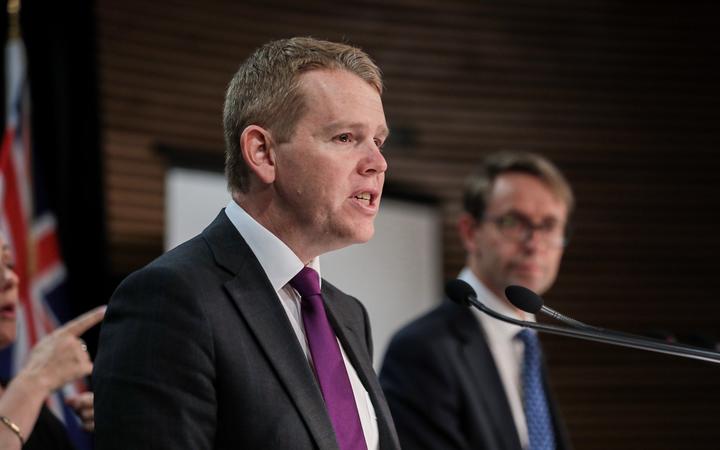
Minister for Covid-19 Response Chris Hipkins and Director-General of Health Dr Ashley Bloomfield Photo: RNZ / Samuel Rillstone
Scenario planning also includes someone testing positive after they had travelled home from a music festival and investigations finding no clear link to the border.
"In a worst-case scenario, if it became clear there was a high risk of widespread transmission, you'd need to stay where you are and in your bubble until you get official advice," Hipkins says. "We don't want people rushing home and possibly taking the virus with them."
He said people would also need to be prepared for such a scenario triggering a change to alert level 3, meaning people may have to return home.
"It's important to remember that this is a worst-case scenario. After a long, hard year, we all deserve to enjoy our summer - including those who are working hard through the holidays to keep us safe. Let's thank them by each and every one of us doing our bit to stop the spread of Covid-19," Hipkins said.
Dr Bloomfield says we are coming to the end of a year that has felt longer than most and although New Zealanders and ministry staff alike will be looking forward to a break, we need to be prepared for an outbreak of Covid-19 for our first summer with the virus.
"In each of these scenarios ... there are extensive contingency plans across the wider government," he says.
"We do know what to do, our DHBs do all have summer preparedness plans in place."
He said the core systems of testing, isolating and contact tracing were established, "and we know they work".
He said he was confident in the planning across government and the contact tracing systems.
Dr Bloomfield acknowledges it is possible testing will drop off over summer, but says the most important testing is at the border.
The usual bullshit headlines from back in June

New Zealand has reported no new Covid-19 cases for more than two weeks.
Prime Minister Jacinda Ardern told reporters she did "a little dance" when she was told the country no longer had any active virus cases.
"While we're in a safer, stronger position, there's still no easy path back to pre-Covid life, but the determination and focus we have had on our health response will now be vested in our economic rebuild," Ms Ardern said.
"While the job is not done, there is no denying this is a milestone. So can I finish with a very simple, 'Thank you, New Zealand'."


