Showing posts with label bank. Show all posts

Wednesday, 18 March 2020

A witness to the start of financial and economic collapse


Headed for Disaster: US 

banks are running out of cash


This Week: Medical Collapse, 

Food Shortages, and 

Anarchy, Begin . . .


The events this week will be so many, and so fast, that things can go downhill really quick. There will be A LOT of fake news, from governments.
We are on the last legs, as a society, and the governments will have their last stand this week, in postponing the panic. It might work, or not, but it will be irrelevant, because they cannot avoid SHTF for long, probably, in many countries, SHTF will start this week anyway.
This week, we can expect things to unfold on two main paths :
- widespread epidemic, with collapsed hospitals and generalized panic.
- full on martial law, before the epidemic is widespread.

Regardless, the panic will start in the Western countries.
When this happens, nobody can predict the outcome, short or long term.
What can be predicted, and what I can predict, are the following:
1. In Europe and the U.S., the number of infected people, the REAL NUMBER, is in TENS OF MILLIONS. In other words, the virus reached the point where NOTHING, no matter what, will be able to stop it.
*(Lock-downs are necessary, and even martial law, in order to slow down the contagion. Sadly, the tens of millions ALREADY infected across the U.S. and Europe will simply be too much for the society to cope with, by the end of this month).
**(Governments reacting too late, and too soft. When martial law will come, in Europe and the U.S., will make things worse, not better. This is NOT our 10 years pandemic, that can be dealt with. This is a 100 years pandemic, that will most likely, lead to a societal collapse, in a matter of weeks).
***(As I predicted many weeks ago, the worst case scenario is a widespread global pandemic taking place simultaneously with an economic and financial collapse. This worst case scenario is rapidly becoming the only probable scenario).
2. There will be shortages of food and basic necessities, and these shortages will be felt in a matter of days, in certain countries, and by the end of the months, in most countries.
3. The healthcare systems will collapse this week, in most countries in Europe and the U.S. War-like triage will start this week in Europe, and by the end of next week, in the whole U.S.
4. Power outages will start in April, once SHTF will be full-blown in many, MANY countries across the world.
5. At least ONE country will fall to partial anarchy this week. At least 10 countries will be under martial law this week. Tons of social protests will take place this week, mostly small scale, and containable. But it will be just the start.
6.The peak of the first wave will be reached in May/June, in most countries, but the second wave will start in September/Orctober.Sadly, this peak will be the small one, and if the society will somehow be able not to totally collapse (it will at least partially collapse, the big cities will be virtually no-man's land), it will collapse in November, when the second wave will be the knock-out blow, to a society already on its knees.
7. Medical staffing will suffer big losses in human lives, making things worse each day, every day. The armed forces and the police forces are already affected by the virus, and will be much more affected in the coming weeks, with society losing the last line of defense in front of anarchy and criminality.
8.Some (hopefully) good news. I hope that my numbers are wrong, and the number of already infected people is much lower, making the lock-downs and even martial law drastically slowing down the contagion. If so, WE CAN, as society, go past 3-4 weeks of hardship (2020-type of hardship), and be able to keep things relatively normal.
My advice, for anyone who is reading this : the best thing to do now, is simply to avoid, 100%, ANY TYPE OF CONTACT.
If you still think you need to buy some more extras, do it PROPERLY: best mask you can have, eye protection, gloves, and , if possible, any sort of clothing that can be disinfected outside (even rain coats work).
Prepare for the worst, even if, as we all hope, will not happen. If this thing just fizzles out, at least you will have the knowledge of what to do when the real deal is taking place. Which can happen anytime.
People are scared...but STILL not scared enough. Almost EVERYONE in the European and U.S. cities, is NOT wearing masks, is not wearing gloves, is STILL riding the fucking subway, still going to work.
This is why I am advocating for DICTATORIAL MEASURES, because I know for a fact, that people are STUPID, people still eat the TV shit (just a flu, 80% aren't affected, young people are virtually unaffected) and they ACT like this is nothing, making the contagion (which is already widespread) spread even more, leading to massive shocks for hospitals in a week or so, basically KILLING people, because there is not bed and no free medical staff.
But when facing a pandemic, with a western population that is stupid, with western governments that are STILL propping the fucking economy instead stopping the pandemic, being unable to realize that this is not SARS, or MERS, or Ebola, or other joke, I know that we are lost.  God Will-it that lock-downs and martial law will work, because clearly, the governments CANNOT (or WILL NOT) help us.
Get ready.
Things are about to go medieval.


Received this from a Listener/Reader in Tennessee regarding what happened to him when he tried to ship a package to his mom in Indiana:
"This is from Tennessee and Indiana.    Monday 10 am tried to mail packages to parents in Indiana  through Fedex or ups or dhl here in Tennessee.  I was told that all package shipping would be stopped where it is midnight tonight Monday 16th. 
I asked even if i overnighted it.  He said your wasting your money as it will be sitting in a warehouse for the foreseeable future.   
My mother in Indiana tried today as well to send me a package.  She was told the same thing.   
While i was talking to the shipping guy in Tennessee he said they were also told that interstates will be shut down by friday.  Now whether that means interstate travel or all interstate traffic i dont know. 
A Friend has a pilot he knows through southwest airlines and they were told to be at the home area of operations by midnight wednesday.   They may be grounding all domestic flight by wednesday at Midnight.  Stay safe and get the word out.  
This is the first I have heard about package deliveries being stopped nationwide.  Thought you should know. . .


Goldman Sachs slashed its oil forecast on Tuesday as the COVID-19 outbreak continues to pressure demand.

Demand losses across the complex are now unprecedented,” Goldman’s global head of commodities research Jeffrey Currie wrote in a note to clients Tuesday. The firm said that oil use has fallen by eight million barrels per day as the coronavirus has led to a near standstill in travel, among other things.

Goldman now sees U.S. West Texas Intermediate crude and international benchmark Brent crude both averaging $20 per barrel in the second quarter. Earlier on Tuesday the firm said WTI would average $22, before revising the forecast to $20 just a few hours later.

Goldman has cut estimates multiple times in the last few weeks. The firm previously lowered its target for WTI to $29 and Brent to $30 after the breakdown in OPEC talks earlier in March.

WTI settled at $28.70 on Monday, so the new target implies an additional 30% downside ahead. This would be on top of WTI’s 53% drop this year. Goldman’s Brent target is 33% below the contract’s Monday settle of $30.05.

The drop in demand comes as powerhouse producers Saudi Arabia and Russia get set to ramp up production beginning April 1, which is when the OPEC+ production cuts currently in place expire.

The firm said that the sudden drop-off in demand, which began in January when the virus started hitting Chinese fuel demand, aided the price war that’s broken out between OPEC and its allies, which includes Russia.

While it is tempting to view the COVID-19 oil demand shock and the oil ‘price war’ as separate events, we like to emphasize that OPEC+ pursuing a market share strategy is simply a second-order effect of the virus made possible by extremely weak demand, pushing the market far down the global supply curve,” Currie said.

Goldman said that the virus will likely lead to far worse outcomes than previously thought — even below estimates from just a month ago — for both the commodities and equity market from just last month.

On Sunday, Jan Hatzius, Goldman’s chief economist, lowered his first-quarter GDP growth forecast to zero from 0.7%. The economist also sees a 5% contraction in the second quarter, followed by a sharp snapback for the remainder of the year.

But unlike equities, which the firm believes will swiftly rebound, oil will likely stay lower for longer.

While financial markets are forward-looking and are likely to rebound once the contagion stabilizes, commodity markets are spot assets and must clear the surpluses developing today from weak demand and rising supply,” Currie said.

Longer term, however, Goldman believes lower prices will lead to a beneficial re-balancing of the market.

The industry is likely to emerge in a much more healthy position with many of the zombie companies that were a dead weight on returns removed,” the firm said.


US Equity Futures Are Plunging... Again


https://www.zerohedge.com/markets/us-equity-futures-are-plunging-again

It is unclear what the immediate catalyst is this time - aside from the fact that we are now outside of the stock-trading-machines reach - but US equity futures are plunging in early Asia trading.
Dow futures are down 650 points...
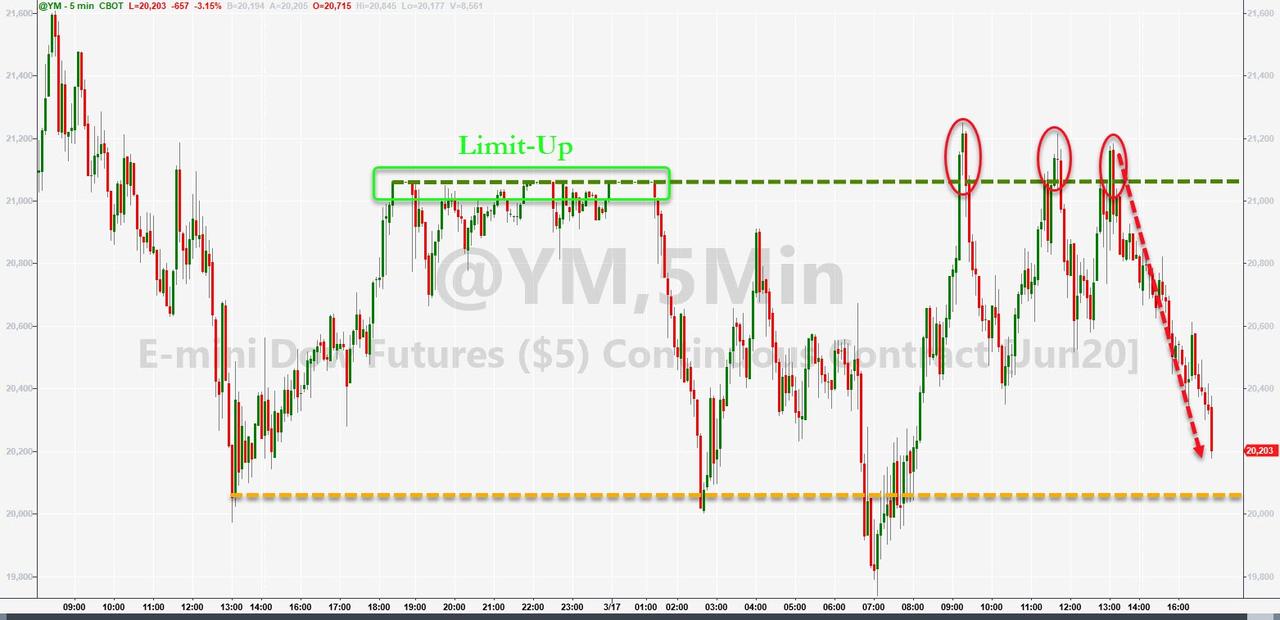
Erasing most of the day's gains...
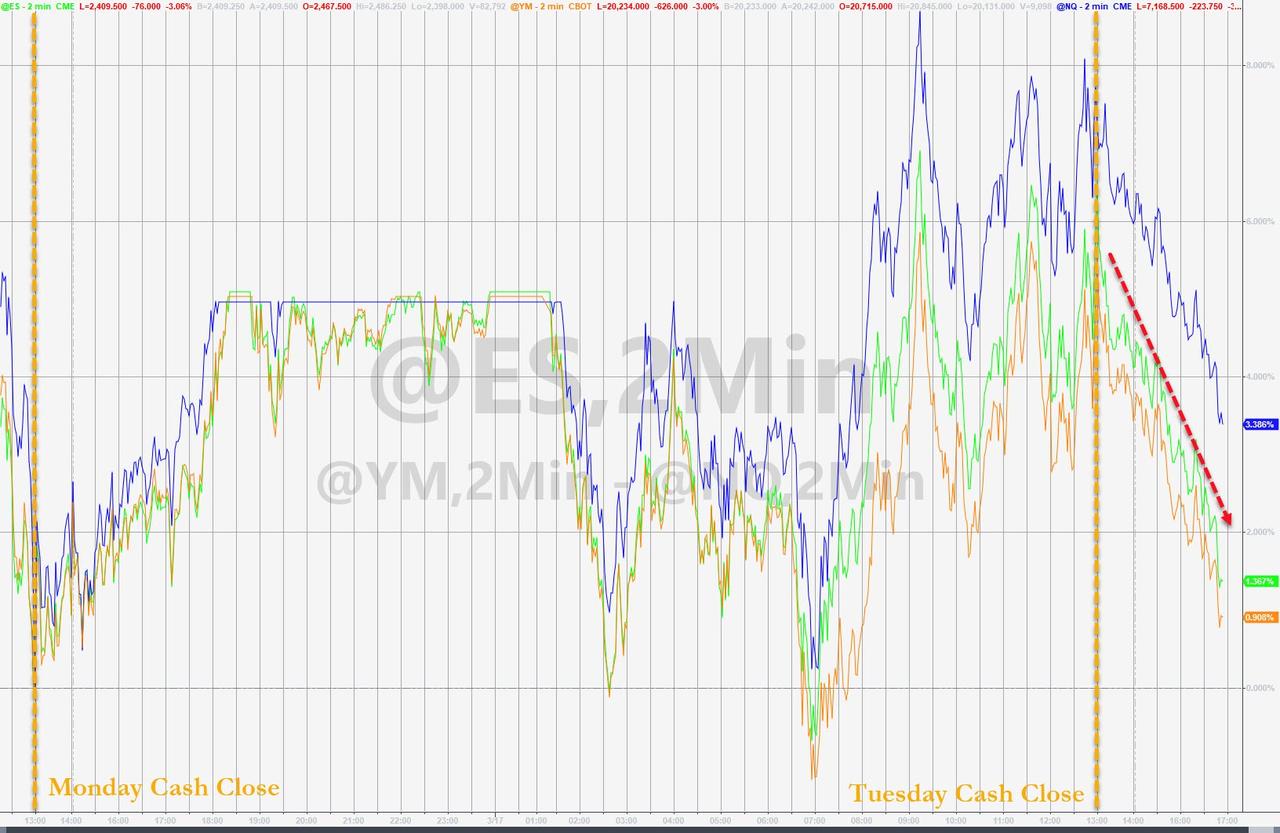
"...and suddenly millions of bailout-demanding voices cried out in terror and were suddenly silenced. I fear something terrible has happened."

Monday, 3 June 2019

SECOND Chinese bnak on verge of collapse


Domino #2: Chinese Bank 

With $105 BN In Assets On 

Verge Of Collapse

2 May, 2019

While the western world (and much of the eastern) has been preoccupied with predicting the consequences of Trump's accelerating global trade/tech war, Beijing has had its hands full with avoiding a bank run in the aftermath of Baoshang Bank's failure, scrambling to inject massive amounts of liquidity last week in the form of a 250 billion yuan net open market operation to thaw the interbank market which was on the verge of freezing, and sent overnight funding rates spiking and bond yields and NCD rates higher.
Unfortunately for the PBOC, Beijing is now racing against time to prevent a widespread panic after it opened the Pandora's box when it seized Baoshang Bank two weeks ago, the first official bank failure in a odd replay of what happened with Bear Stearns back in 2008, when JPMorgan was gifted the historic bank for pennies on the dollar.
And with domino #1 down, the question turns to who is next, and will they be China's Lehman.


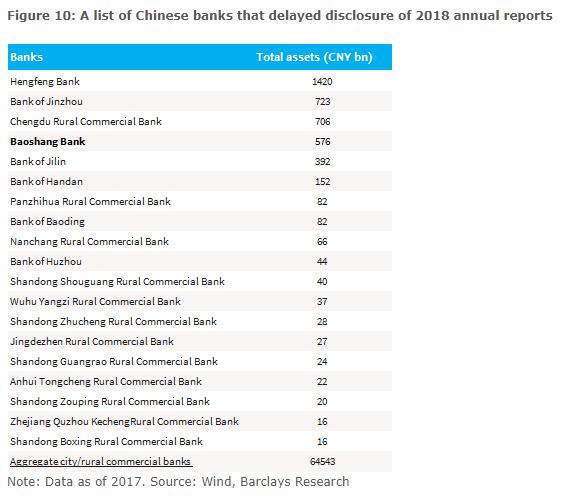
This was the question we asked last Thursday, when we published a list of regional banks that have delayed publishing 2018 reports, the biggest red flag suggesting an upcoming bank solvency "event."

One day later we may have gotten our answer, when the Bank of Jinzhou,  a city commercial bank in Liaoning Province, the second name in the list above, and with some $105 billion in assets, notably bigger than Baoshang, announced that its auditors Ernst & Young Hua Ming LLP and Ernst & Young had resigned, not long after the bank announced it would delay the publication of its annual reports.
For those confused, the delay of an annual report and the resignation of an auditor, means a bank failure is not only virtually certain but practically imminent.
As the bank - which first got in hot water in 2015 over its exposure to the scandal-ridden Hanergy Group - writes in a filing on the Hong Kong Stock Exchange, E&Y was first appointed as the auditors of the Bank at the last annual general meeting of the Bank held on 29 May 2018 to hold office until the conclusion of the next annual general meeting of the Bank. That never happened, because on 31 May 2019, out of the blue, the board and its audit committee received a letter from EY tendering their resignations as the auditors of the Bank with immediate effect.
The reason for the resignation: the bank refused to provide E&Y with documents to confirm the bank's clients were able to service loans, amid indications that the use of proceeds of certain loans granted by the Bank to its institutional customers were not consistent with the purpose stated in their loan documents.
As a result, "after numerous discussions and as at the date of this announcement, no consensus was reached between the Bank and EY on the Outstanding Matters and the proposed timetable for the completion of audit." As a result, after a clear breakdown in relations with its own auditor, the Board decided to appoint Crowe (HK) CPA Limited as the new auditors of the Bank to fill the casual vacancy following the Resignation and to hold the office until the conclusion of the 2018 annual general meeting of the Bank (we are taking the under with lots of leverage as Crowe will likewise quit in the coming weeks if not days).
And confirming that not even the bank's management believes this "justification" will be enough to avoid a rout in the stock, the bank reported that it has requested the trading in the H shares (which was frozen on April 1) on The Stock Exchange of Hong Kong Limited to be suspended until the publication of the 2018 Annual Results. For anyone who hopes that these shares will ever be unfrozen for trading, there are a few bridges in Brooklyn that are for sale.
The real question facing Beijing now is how quickly will Bank of Jinzhou collapse, how will Beijing and the PBOC react, and what whether the other banks on the list above now suffer a raging bank run, on which will certainly not be confined just to China's small and medium banks.
Source: Bloomberg/HKex.

Wednesday, 18 March 2015

Moving away from the dollar

America's European "Allies" Desert Obama, Join China-led Infrastructure Bank


Zero Hedge,
17 March, 2015


It appears the sea of de-dollarization has reached the shores of Europe. With Australia and UK having already moved in the direction of joining the China-led AIIB, The FT reports that France, Germany, and Italy have now all agreed to join the development bank as 'pivot to Asia' appears to be Plan B for Europe. As Greg Sheridan previously noted, "the saga of the China Bank is almost a textbook case of the failure of Obama’s foreign policy," but as The FT concludes, the European decisions represent a significant setback for the Obama administration, which has argued that western countries could have more influence over the workings of the new bank if they stayed together on the outside. As Forbes notes, this leaves Obama with 3 uncomfortable options...


As The FT reports,
France, Germany and Italy have all agreed to follow Britain’s lead and join a China-led international development bank, according to European officials, delivering a blow to US efforts to keep leading western countries out of the new institution.
The decision by the three European governments comes after Britain announced last week that it would join the $50bn Asian Infrastructure Investment Bank, a potential rival to the Washington-based World Bank.
...
The European decisions represent a significant setback for the Obama administration, which has argued that western countries could have more influence over the workings of the new bank if they stayed together on the outside and pushed for higher lending standards.
The AIIB, which was formally launched by Chinese President Xi Jinping last year, is one element of a broader Chinese push to create new financial and economic institutions that will increase its international influence. It has become a central issue in the growing contest between China and the US over who will define the economic and trade rules in Asia over the coming decades.
This follows Australia and UK...
Australia, a key US ally in the Asia-Pacific region which had come under pressure from Washington to stay out of the new bank, has also said that it will now rethink that position.
When Britain announced its decision to join the AIIB last week, the Obama administration told the Financial Times that it was part of a broader trend of “constant accommodation” by London of China. British officials were relatively restrained in their criticism of China over its handling of pro-democracy protests in Hong Kong last year.
Britain tried to gain “first mover advantage” last week by signing up to the fledgling Chinese-led bank before other G7 members.
Britain hopes to establish itself as the number one destination for Chinese investment and UK officials were unrepentant.
*  * 

Which, as Forbes explains,
leaves Obama with three options...
1)      Continue to press its allies not to join the AIIB until governance procedures for the bank are assured;
2)      Join the AIIB itself; or
3)      Drop the issue.
Option one is clearly a losing proposition. There is no sense expending further political capital trying to persuade regional and other actors not to join the bank. It is a small-potato issue that is making the United States look weak at a time when U.S. influence in the region is otherwise quite strong.
Option two, which I—along with virtually every other China analyst outside the U.S. government—supported back in October is that the United States join the AIIB. There are several reasons why this is a good idea. It would allow the United States a seat inside the tent where it could be both a positive force for best governance practices and an internal critic if things go awry. It also would likely help ensure that U.S. companies have fair access to the bidding opportunities that will arise from the AIIB’s investment financing. Joining now will be hard to accomplish in a face-saving manner, but the United States could begin by publicly recognizing the need for the financing capabilities in Asia that the AIIB can provide and by moving quickly to work with Australia, South Korea, and Japan to work out common principles of accession.
Option three is for the United States to back away from the AIIB, release other countries from any pressure they might feel from the United States not to join, and let the AIIB rise or fall on its own merits. Chinese-led resource and infrastructure investment has encountered significant difficulty in a number of countries, including Zambia, Myanmar, Vietnam, Brazil, and Sri Lanka, among others. If the AIIB does not do a better job than China’s own development banks, it will be a stain not only on Beijing but also on all the other countries that are participating. If it does operate at the same standard as the World Bank and Asian Development Bank, then it will be a welcome addition to the world of development financing. The United States does not have to be in every regional organization in the Asia Pacific; it is not in the Shanghai Cooperation Organization, for example, and it is only an observer in the Conference on Interactions and Confidence-Building Measures in Asia. It can sit out the AIIB or assume observer status as well.
Washington’s priority should be on advancing U.S. ideals and institutions through the pivot or rebalance rather than blocking Chinese initiatives unless absolutely necessary. (Let’s not confuse China’s effort to develop the AIIB with its push to implement an Air Defense Identification Zone, for example.) Opposition to the Asian Infrastructure Investment Bank has become a millstone around Washington’s neck. It is time to remove it one way or another.
*  * *
De-dollarization continues... As Simon Black recently concluded, now we can see words are turning into action...
[The Allies] might be too polite to tell the US straight up– “Look, you have $18.1 trillion in official debt, you have $42 trillion in unfunded liabilities, and you’re kind of a dick. I’m dumping you.”
So instead they’re going with the “it’s not you, it’s me” approach.
But to anyone paying attention, it’s pretty obvious where this trend is going.
It won’t be long before other western nations jump on the anti-dollar bandwagon with action and not just words.
*  *  *
Bottom line: this isn’t theory or conjecture anymore. Every shred of objective evidence suggests that the dollar’s dominance is coming to an end.


Moscow Launches Ruble-Renminbi Futures To "Facilitate Trade Between China And Russia"


Zero Hedge,

17 March, 2015


While the west huffs and puffs, and threatens to unleash even more "costs" on Russia in the form of additional sanctions which will assure that Europe's latest deflationary recession is even more acute, an "isolated" Russia is looking to outside, and to the east, and as part of its most recent de-dollarization initiative, the Moscow Exchange announced it has started trading Chinese Renminbi-Russian Ruble currency future.

From the press release:

From 17 March the Moscow Exchange has started trading in a futures contract on the currency pair Chinese Renminbi — Russian rouble
The launch has been driven by a substantially increasing Renminbi turnover on the Exchange, growing volume of settlement in the currency between Russia and China as well as newly arising demand for hedging of such transactions.
Andrey Shemetov, First Deputy CEO of Moscow Exchange, said:
"The launch of the CNY/RUB futures is the next step made by the Moscow Exchange to offer a full range of Renminbi instruments and hedging tools to participants. We expect that the new contract will be liquid and in-demand as other Exchange's derivatives, and facilitate the trade turnover between China and Russia" 
The contract is cash-settled against the Moscow Exchange CNY/RUB fixing.
The contract's expiry dates are every 15th day of March, June, September and December
IM size is 12%.
Metallinvestbank will act as the market maker for the contract.
Moscow Exchange's turnover in the Chinese Renminbi grew 700% in 2014 to RUB 395 bln (CNY 48 bln). The record average daily trading volume of CNY 541 mln was seen in October.
Currently, the Moscow Exchange's derivatives market offerings include nine FX futures: USD/RUB, EUR/RUB, EUR/USD, AUD/USD, GBP/USD, USD/JPY, USD/CHF, USD/UAH, USD/CAD, and USD/TRY, as well as three options: USD/RUB, EUR/USD, and EUR/RUB.
And in other news, US Treasury Secretary Jack Lew wonders why America's "international credibility and influence is being threatened"...