Showing posts with label aitstrikes. Show all posts

Wednesday, 19 June 2019

Washington's plans for aitstrikes against Iran

Report: US Planning “Massive” Airstrike On An Iranian Facility


18 June, 2019

According to a new article from English-language Israeli publication The Jerusalem Post, the Hebrew-language Israeli publication Maariv has reported that diplomatic sources in the UN are assessing a US plan to conduct a “massive” airstrike on “an Iranian facility linked to its nuclear program” in response to alleged attacks on two sea vessels in the Gulf of Oman.
“The sources added that President Trump himself was not enthusiastic about a military move against Iran, but lost his patience on the matter and would grant Secretary of State Mike Pompeo, who is pushing for action, what he wants,” The Jerusalem Post reports.
This news comes after public statements by Pompeo that the US is considering a “full range of options” against Iran. It also comes as 1,000 additional US troops are being sent to the Middle East to “address air, naval, and ground-based threats” there. It also comes amid sightings of depraved war criminal Henry Kissinger at the Pentagon.
So that’s great.
Many comparisons are being made today between the unforgivable Iraq invasion and the agendas that this administration is attempting to advance in Iran, and rightly so. But make no mistake, Iran is not Iraq. A full-scale war against Iran would be many times more deadly, costly and destabilizing than Iraq; the UK’s Admiral Lord West told The Daily Star Online last month that winning such a war would require no less than a million troops. And it’s not difficult to imagine how the Trump administration’s brinkmanship could lead to all-out war.
If the US does decide to attack Iran over the highly suspicious Gulf of Oman allegations, for example, it’s not difficult to imagine a scenario in which Iran defends itself or retaliates and kills US servicemen. Once you’ve got the names and faces of US military personnel blaring on news screens all across America, you’ll see the war hawks converge and demand far more aggressive retaliations against Iran, and if the pressure works we could easily see an all-out war between the two nations. It just takes the right spark to land in the right place at the right time for the whole thing to go up in flames, and there are a lot of people trying to create sparks.
It would not be difficult for Trump to find himself in such a situation.
“This is actually a line that both the Saudis and the Israelis have been making to Washington for quite some time,” Iranian foreign policy analyst Trita Parsi told CNN International in response to the question of whether Iran would just allow an attack without retaliation. “This is essentially saying that Iran is no different from Syria. You can strike yet they won’t have the guts to respond. We actually know that that’s not true because just two weeks ago when there was a ratcheting up with tensions the US intelligence itself picked up that as US warships were heading towards the middle east, the Iranians started putting some of their missiles on boats and started moving them around, appearing as if they were either wanting to protect those missiles or preparing for counter strikes.”
“So the idea that this will just be a limited strike and the Iranians won’t respond seems extremely unlikely, but this is how you sell a big war: you pretend that you are selling a small war,” Parsi continued. “Because that’s much more digestible. That’s something perhaps that Trump could agree to. If you actually try to say ‘Look, let’s have a big war,’ not only would the American public be strongly against it, I personally think that Donald Trump himself would not be in favor of it.”
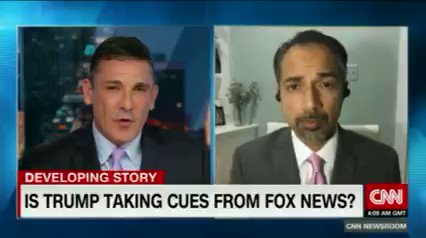
My interview on @cnni regarding Trump's escalation with Iran and the idea that you can have a small, limited war with Iran.

"But this is how you sell a big war. You pretend you're selling a small war because that is much more digestible."
169 people are talking about this
As proof of its Gulf of Oman claims against Iran, the US has circulated a grainy, Loch Ness Monster-quality video which shows nothing whatsoever and which one analyst attests has been edited in a misleading way, as well as a few photographs which prove absolutely nothing.
It is worth noting, however, that some typically reliable anti-imperialist voices have been saying it’s likely that Iran was indeed behind the attacks, including Moon of Alabama, Elijah J. Magnier, and former UK ambassador to Syria Peter Ford. They argue that Iran has been backed into a corner with economic sanctions, so now it’s fighting dirty to force the Trump administration to either end the sanctions in order to come to the negotiating table or enter into a costly, unpopular war right before election time. Magnier claims to have sources in Tehran who confirm this, saying that we can expect more such incidents in the future.
I’m not taking a position either way, but I do think it would be a mistake to make the possibility of a false flag into the entire argument against attacking Iran for the Gulf of Oman incident. If Iran did indeed attack a Japanese and a Norwegian vessel to obstruct trade in accordance with Tehran’s pledge that “if Iran cannot export oil through the Persian Gulf, no-one will do this,” it’s important to recognize that Iran would only be doing this in response to extremely aggressive economic warfare by the United States. As we discussed recently, sanctions are an act of war, and if Iran is behind this and any other attacks, the US will have been the aggressor.
In any case, things could get very, very ugly, very, very fast, and if it does it will be entirely the Trump administration’s fault.
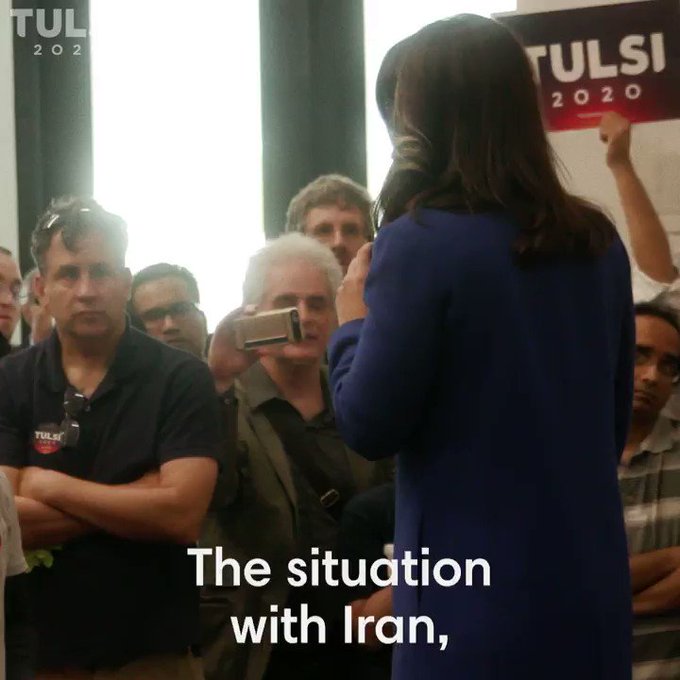
Here we go again! The US sending more troops to Middle East for what will be disastrous war with Iran. To prevent Trump and future presidents from waging war illegally (without Congress approval) we must sign my No More Presidential Wars Act. Join me: http://tulsi.to/iran10 
2,284 people are talking about this
Our one saving grace through all this has been Trump’s incompetence in manufacturing any kind of coalition or broad support for increased aggressions against Iran. EU foreign ministers have joined Japan and Germany in demanding further proof of Washington’s Gulf of Oman claims, and China is now denouncing US pressure on Iran and cautioning against “opening Pandora’s box” in the Middle East with further escalations. At home, the political/media class has been far less eager to help manufacture consent for war in this case than it generally is, with even virulent neocon Max Bootadvocating for diplomacy and a return to the Iran deal, and Congresswoman Tulsi Gabbard actively plugging her No More Presidential Wars Act in response to the administration’s Iran brinkmanship.
I don’t know exactly what’s going on with Washington’s plans for Iran, but what I do know that 30 million people marched worldwide against the war in Iraq and it didn’t make a whit of difference. The same dangerously evil people who bullied, lied and cheated their way into getting their war with Iraq are pretty much the same bunch of assholes who are attempting to do the same with Iran today. Not only did none of them go to jail for that diabolical crime against humanity, most of them are still in positions of influence, and most of them are using that influence to push the world again into another war that nobody wants. How long do we put up with this crap?

Do you want to know the truth about what’s going on with Iran? The real truth? The real truth is that there’s an ever-growing, globe-spanning, oligarch-run power alliance with the United States at its center, an alliance which functions as a single empire and works relentlessly to bully other nations into either joining it or collapsing. Iran is by far the strongest nation in the region that has refused to allow itself to be absorbed into the blob, so its government has found itself in the imperial crosshairs  being commanded to either submit or be toppled. That’s all that’s going on here. Everything else is camera-friendly window dressing.

Tuesday, 15 March 2016

The Saker on the Russian troop withdrawal

Analysis of the Russian military pullout from Syria

The Saker

Saker drawing from community
14 March, 2016


“I consider the objectives that have been set for the Defense Ministry to be generally accomplished. That is why I order to start withdrawal of the main part of our military group from the territory of the Syrian Arab Republic starting from tomorrow,” Putin said on Monday during a meeting with Shoigu and Russian Foreign Minister Sergey Lavrov.
“In a short period of time Russia has created a small but very effective military group in Syria. The effective work of our military forces allowed the peace process to begin,” Putin said, adding that “Russian government troops and [Syria’s] patriotic forces have changed the situation in the fight with international terrorism and have ceased the initiative.”

The first question which needs to be asked is whether this is correct: have the Russians achieved their objective or not?  To answer this question, we need to look at what the initial Russian objectives were.  I did that in my article “Week Thirteen of the Russian Intervention in Syria: debunking the lies” where I wrote: (emphasis added)
The key issue here is what criteria to use to measure “success”. And that, in turns, begs the question of what the Russians had hoped to achieve with their intervention in the first place. It turns out that Putin clearly and officially spelled out what the purpose of the Russian intervention was. On October 11th, he declared the following in an interview with Vladimir Soloviev on the TV channel Russia 1:
Our objective is to stabilize the legitimate authority and create conditions for a political compromise
That’s it. He did not say that Russia would single-handedly change the course of the war, much less so win the war. And while some saw the Russian intervention as a total “game changer” which would mark the end of Daesh, I never believed that. Here is what I wroteexactly one day before Putin make the statement above:
Make no mistake here, the Russian force in Syria is a small one, at least for the time being, and it does not even remotely resemble what the rumors had predicted (…) There is no way that the very limited Russian intervention can really change the tide of the war, at least not by itself. Yes, I do insist that the Russian intervention is a very limited one. 12 SU-24M, 12 SU-25SM, 6 SU-34 and 4 SU-30SM are not a big force, not even backed by helicopters and cruise missiles. Yes, the Russian force has been very effective to relieve the pressure on the northwestern front and to allow for a Syrian Army counter-offensive, but that will not, by itself, end the war.
I was harshly criticized at that time for “minimizing” the scope and potential of the Russian operation, but I chose to ignore these criticisms since I knew that time would prove me right.

Today’s declaration finally puts to rest the “most anticipated showdown” and other “game changer” theories.  At least I hope so :-)
Виктор Бондарев
Colonel General Viktor Bondarev, C-in-C of the Russian Aerospace Forces

The Russian intervention is a stunning success, that is indisputable.  Vladimir Putin and the Russian military ought to be particularly praised for having set goals fully commensurate with their real capabilities.  The Russians went in with a smallforce and they achieved limited goals: the legitimate authority of the Syrian government has been stabilized and the conditions for a political compromise have been created.  That is not an opinion, but the facts on the ground.  Not even the worst Putin-haters can dispute that.  Today’s declaration shows that the Russians are also sticking to their initial exit strategy and are now confident enough to withdraw their forces.  That is nothing short of superb (when is the last time the USA did that?).
Still, this leaves many unanswered questions.
A partition of Syria?
By withdrawing their forces the Russians could be giving the signal to the USA that they are free to have their “little victorious war” against Daesh.  But this could also be a trap.  If you consider the complete failure of the US military in Afghanistan and Iraq, you could wonder why they would suddenly do so much better in Syria, especially considering that besides Daesh they might also come face to face with Iranians and Hezbollah fighters.  Furthermore, unlike the Russian Aerospace forces, the Americans will be committing ground forces and these have a much bigger tendency to get bogged down in long counter-insurgency operations.    If I was a US military advisor I would caution my commanders against a ground operation in Syria even if the Russians are gone.
Still, what if the Americans are successful?  After all, Daesh has taken a bad beating any maybe they can be at least pushed out of Raqqa?  Maybe.  But if that happens then the question will become whether the Americans will try to achieve a de facto partition of Syria (de jure they cannot, since a UNSC Resolution specifically called for a unitary state).
Partitioning Syria has been, and still is, the longterm Israeli goal.  Considering the immense power of the Neocons today (nevermind a Hillary Presidency!) the chances that the US will be trying to partition Syria are immense.
And what if the Americans either fail or don’t even take the bait and stay out of Syria?  Does the Russian withdrawal not risk leaving eastern Syria in Daesh hands?  Would that not be just another de factopartition of the country?  Maybe.  Again, this is a real risk.
Finally, if the Turks and their Saudi allies do invade, that would almost certainly result in a partition of Syria as it is doubtful that the Syrian government could take on Daesh and Turkey and the Saudis at the same time.  Iran, of course, might, but this would result in a major escalation threatening the entire region.
I think that the risk of a partition of Syria is, alas, very real.  However, that being said, I would like to remind everybody that Russia does not have any moral or legal obligation to single-handedly preserve the territorial integrity of Syria.  In purely legal terms, this is an obligation of every single country on earth (because of the UN Charter and the recent UNSC Resolution) and in moral terms, this is first and foremost the obligation of the Syrian people themselves.  I think that it would be praiseworthy for Russia to do everything she can to prevent a partition of Syria,and I am confident that Russia will do her utmost, but that does not mean 
that this is a Russian obligation.
Future Russian options and operations?

I want to draw your attention to the following words by Putin: “I consider the objectives that have been set for the Defense Ministry to be generally accomplished“.  For those unfamiliar with the context (evaluation of a military operation) this might sound like a total approval.  It is not.  In Russian military terminology “generally accomplished” is better than “satisfactory” and roughly equivalent to “good” but not “excellent”.  Putin is not saying that the performance of the Russian forces was less than perfect, but what he is saying is that the goals set out initially have not been fully/perfectly reached.  In other words, this leaves the door open for a “objectives completion” operation.
The second interesting moment in today’s statement is that Putin added that “to control the observation of ceasefire agreements in the region, Moscow will keep its Khmeimim airbase in Latakia province and a base at the port of Tartus“.
To me the combination of these two statements points to the high probability that the Russians are keeping their options open.  First, they will continue to supply the Syrians with hardware, training, intelligence and special operations and, second, they will retain the option of using military power if/when needed.  Not only will Russia retain the capability to strike from the Caspian, the Mediterranean or with her long-range bombers, but she is likely to leave enough pre-positioned supplies and personnel in Tartus, Khmeimim and elsewhere in Syria to be ready to intervene at very short notice (say in case of a Turkish attack towards Latakia, for example).
Finally, I am confident that when speaking to the (newly created) “moderate opposition” the Russians will carefully but regularly drop hints about the need to achieve a negotiated agreement with the Syrian government “lest the war resume again with a new intensity” (or something along these lines).  Keep in mind that, unlike their US counterparts, the Russian diplomats and intelligence officers truly understand their counterparts, not only because they are fluent in the local languages and understand the culture, but because the single important quality expected from a Russian diplomat or intelligence officer is the ability to understand the real, profound, motives of the person you are speaking to, to put yourself into his/her shoes.  I have had enough personal experience with Russian diplomats and intelligence officers to be sure that they are already patiently talking to all the key figures in positions of power inside the so-called “moderate resistance” to maximize the stake each one of them might have in a negotiated solution.  Oh sure, there will be beautiful speeches in the plenary meetings and conferences, but they key effort will be made in informal conversations happening in restaurants, back-rooms and various hotels where the Russians will make darn sure they convey to their interlocutors that he/she have a very personal interest in a successful negotiation.  There will be a lot of bargaining involving promises and hinted threats and while some will, of course, resist such “gentle pressures”, the cumulative effect of such informal meetings will be crucial.  And if that means preparing 500 different approaches and negotiation techniques for 500 different contacts, the Russians will put the manpower, time and effort to make it happen.
Evaluation
It is way too early right now to give a categorical evaluation of the timing and consequences of the Russian withdrawal from Syria.  Let us also keep in mind that there is a lot we don’t know.  What we do know is that Sergei Lavrov has had an absolutely crazy schedule over the past month or so and that Russian diplomats have been holding intense negotiations with all the regional powers.  I am confident that the Russians planned their withdrawal at least as carefully as the planned their intervention and that they have left as many open options as possible.  By the way, the big advantage of a unilateral decision is that, unlike one taken as part of an agreement with other parties, it can be unilaterally rescinded too.  It took the Russian just days to launch their initial operation even though they had to execute it all in difficult conditions and under the cloak of secrecy.  How long would it take them to move back into Syria if needed?
When all is said and done, I simply trust Vladimir Putin.  No, no just because I am a Putin fanboy (which, of course, I am!), but because of his record of being right and taking difficult, even risky, decisions which eventually yielded Russia yet another unforeseen success.
Like any good chess player, Putin knows that one of the key factors in any war is time and so far Putin has timed his every move superbly.  Yes, there were times in the past when I got really worried about what looked to me as either too much waiting or as dangerous risk-taking, but every single time my fears ended up being unfounded.  And yes, I can easily muster up a long list of potentially catastrophic scenarios for Syria, but I think that this would only make sense if Putin had, like Obama, a long and impressive list of failures, disasters, miscalculations and embarrassing defeats on his record.  But he does not.  In fact, what I see is an amazing list of successes achieved against very difficult odds.  And they key to Putin’s success might well be that he is a hardcore realist.
Russia is still weak.  Yes, she is stronger than in the past and she is rising up very fast, but she still is weak, especially in comparison to the still immense AngloZionist Empire whose resources simply dwarf Russia’s in most categories.  However, this comparative weakness also forces the Kremlin to be very careful.  When an empire is rich and powerful being arrogant and over-estimating your own capabilities is not nearly as bad as when a much weaker country does it.  Just look at the USA under Obama: they went from one humiliating and costly defeat to another – yet they are still here and still powerful, almost as powerful as they used to be 10 years ago.  While in the long run the kind of hubris and gross incompetence we nowadays observe in US decision-makers will result in the inevitable collapse of the Empire, in the medium to short term there is no truly painful price to pay for failure.  Just one example: just think of the US military interventions in Afghanistan and Iraq.  They are absolute and total failures, abject disasters of incalculable magnitude.  They will go down in history as amongst the worst foreign policy failures ever.  And yet, walking around in downtown New York or San Fransisco you would never think that you are visiting a country which just lost two major and long wars.
Russia does not have such a “luxury of power”, she has to make every bit count and she has to plan each move with utmost precision.  Just like a tightrope walker with no safety harness, Putin knows that a single misstep can have catastrophic consequences.
To withdraw the bulk of the Russian military task force in Syria right now is a gutsy and potentially risky move for sure, but I am confident that it is also the right one.  But only time will tell if my confidence is warranted or not.

The Saker