
 Posts


Tuvalu's
fight to stay above the waves
Tuvalu,
the canary in the coal mine for climate change, is shouting for more
help as it battles rising seas and sweltering temperatures. But the
small Pacific island country is refusing to be dragged down below the
waves and sees plenty of hope for its people and its culture. Sally
Round travelled to Tuvalu to investigate.
Listen to the podcast HERE
Radio NZ,
4 August, 2019
In a bright blue building on the dusty main street of Tuvalu's capital, white-haired Siliga Kofe sits behind a large table, tracing his finger over a map of the lagoon which is lapping lazily on the coral strewn foreshore outside. The chief of of the tiny capital, Funafuti, is studiously leafing through sheafs of paper setting out plans he hopes will save his nation from being washed into the Pacific Ocean.
The council of elders, the Falekaupule, is thinking big, refusing to submit to the overpowering forces of climate change. They dream of sucking up sand from the lagoon and building a large new land mass, Dubai-style, in a pocket of shallows in the far south of the atoll. And it's not just for a handful of homes. The plans show a runway, port, solar farm, new villages for up to 5000 and a reservoir which could be used for farming fish.
But the price tag is high. It will cost in the region of $300 million and take five years to build.
But the Ulu refuses to be daunted. "We hope and pray it comes to pass," he says.
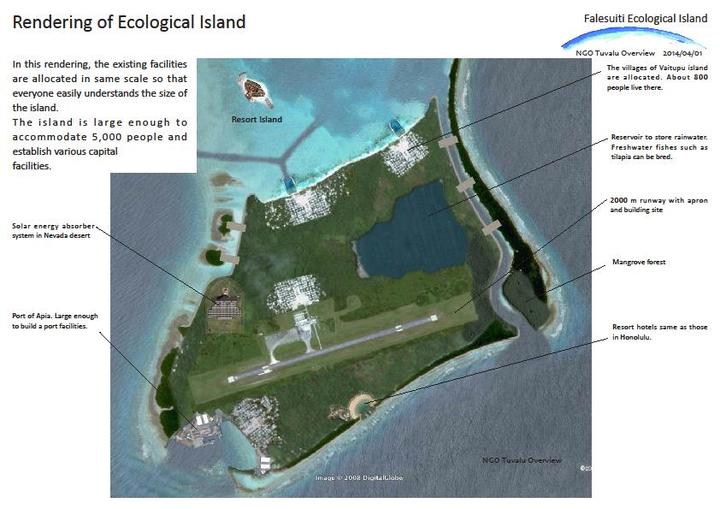
Impression of plan for new island to help Tuvalu cope with climate change Photo: Supplied
But the forces of nature they are trying to counter are relentless and Tuvalu's ability to fight is small. The nation is a low-lying group of atolls and reef islands a three hour plane ride away from Fiji. The atoll of Funafuti is a narrow circle of land around the lagoon, about 20 metres wide at its narrowest point, and not much more than 400m across at its widest. Land is already being washed away by higher tides, people have to cope with sweltering days and nights and the growing land is poisoned by seeping salt water. But scientists say it is going to face continued sea level rise, hotter temperatures, less frequent but more intense cyclones and increased ocean acidification as the century progresses.
For some time the fight has been to hold back the waves with measures such as sea walls to ensure Tuvalu's people and its culture services. But those ideas are now not the only plan. According to their glossy presentation, which has already been shown at climate meetings overseas, the elders' aim is to create "a new land where Tuvaluan people, who may become environmental refugees, can live safely in peace".
The elders are proposing speeding up the deposit of sand and gravel in the south, which is already taking place naturally, helped by currents from the north of the lagoon.
The Ulu believes the new land would be "a sanctuary."
What is definitely going ahead is the government's own reclamation plan.
Work has been approved by the Green Climate Fund (GCF), an international funding facility, to extend the foreshore out by about a hundred metres along a kilometre stretch of the lagoon edge.
The $53m given by the GCF will also be used to reclaim land washed away on two outer islands.
Save Tuvalu, save the world
Finding solutions in Tuvalu has wider implications than just the survival of this tiny nation of about 11,000 people. To save Tuvalu is to save the world, is the mantra pushed at global climate talks by Tuvalu's prime minister Enele Sopoaga; and he has support at home.
"The prime minister is doing a good job in that respect - in advocating - almost a bit rude at times," Kofe says.
A large desk heaving with paperwork takes pride of place in the prime minister's home, which lies on the edge of the Funafuti airfield. A large "talofa" sign hangs above the gate to greet visitors. Traditional woven mats line the walls and two large pink sofas form a U-shape around the place where the Prime Minister immerses himself in his work bringing home to others the very real threat of climate change.
In defending his robust call to polluting nations for both help at home and for action against climate change, Sopoaga is unapologetic. "It's not a selfish call. It's a very practical call. It is a humanitarian call," he says.
"It's basically reminding everyone ... if we allow this planet to be burned down ... it will be a disgrace to humanity."
Poisoned land
A boat ride away across the lagoon, Tianamo Lusia is doing his best to farm his plot of land on Papaelise, one of the smaller islets of Funafuti.
But the coconut and breadfruit trees are sickly, bananas and pawpaw won't grow and the advice from agricultural officers is to let his pigs run wild to try to invigorate the salty soil.
His family have moved to Fogafale for school and jobs, but he prefers to eke out a living on the motu.
A pathway which used to run along the edge of the islet has washed into the lagoon and the roots of deformed and dying trees lie upturned and exposed to the storm surges and king tides.
"I'm really unhappy because I can't earn any money from the land," he says, taking a break from his chores.
"It's too difficult to plant. Life is getting hard because the weather is changing."
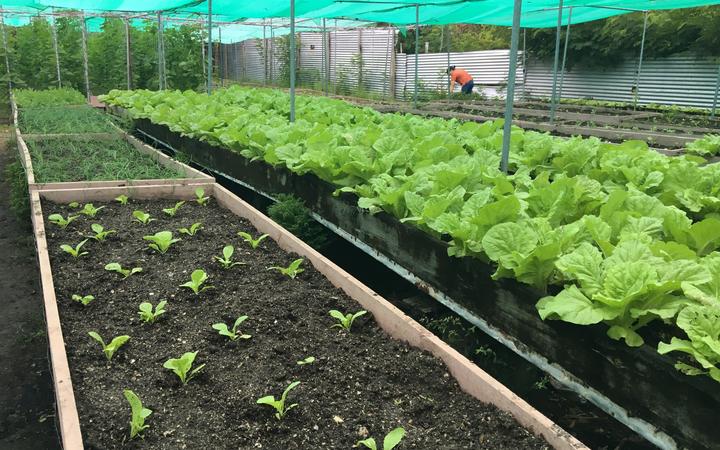
A Taiwan-funded agricultural project helps provide leafy greens in Tuvalu where saltwater inundation is affecting crops Photo: RNZ/Sally Round
And the difficulty to eke out a life isn't restricted to tiny islets like Papaelise. On the main island Fogafale, people are queuing for their orders at the Taiwan-funded horticultural centre, a quasi-commercial project which distributes seedlings, experiments with new plants and sells leafy greens and other vegetables to the locals.
Food security weighs heavily on the minds of Tuvaluans as salt water inundates crops, invasive species take hold in the changing climate and at the same time there's increased pressure on fisheries and the number of people living in the capital grows.
Villagers are trying to find their own solutions. The local staple pulaka or swamp taro is now grown in concrete lined pits, but unlike in the past, not everyone is now lucky enough to have a healthy breadfruit tree.
Traditional gardening has become a trial for many, like Tafiti Kisona, who lives in a ramshackle house just metres from the lagoon.
He is up to his neck cooling off in the water, with a line out trying to catch a fish.
Fishing further out is no longer in reach for him, as his boat was smashed in a recent unexpected storm.
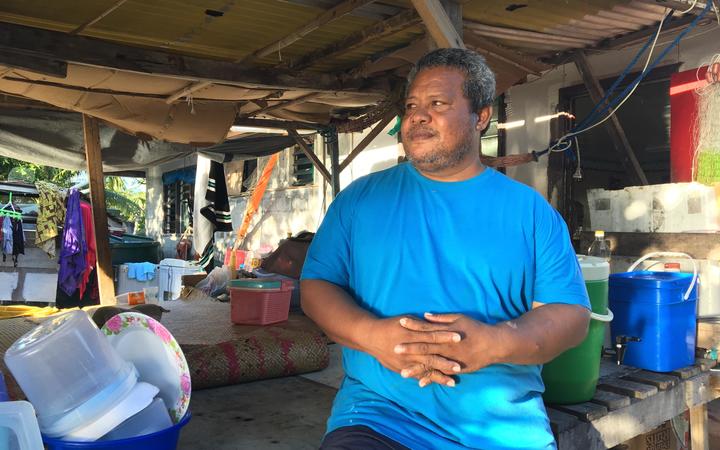
Tafiti Kisono is struggling to trying to provide healthy food for his family Photo: RNZ/Sally Round
"No fish today," he chuckles as he comes up the beach, keen to show off his attempts to grow food to feed his family.
"I've been trying many different ideas from people, like collecting seaweed and other things," he says, pointing out the drooping seedlings that he's trying to protect from the belting sun.
"Everything here is just to survive and not for future." But despite his efforts, they're not always a success.
"No good fruit this last month, all the trees died," he says. "The coconut trees, their fruit just fall on the ground at the wrong time because of that sickness."
To help feed his family, the pastor makes money renting out his washing machine and making pancakes.
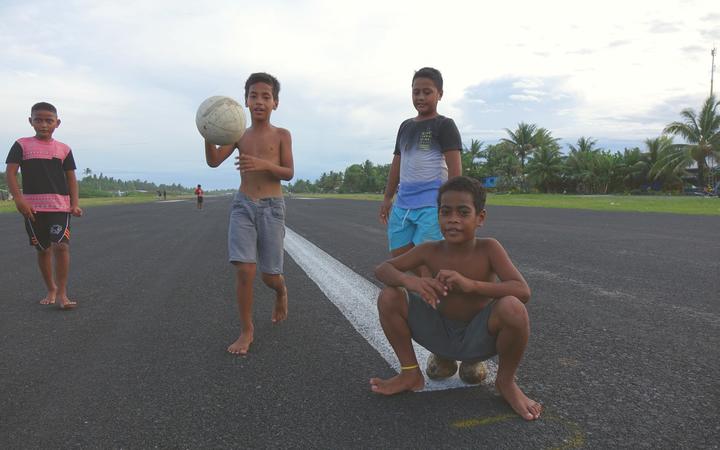
Boys play on the runway, whih takes up most of the space on narrow Fogafale, Tuvalu Photo: RNZ/Sally Round
As the temperature drops slightly in the early evening, children play on the airport runway, a popular gathering place in land-poor Funafuti.
The pastor is concerned not only about the ability to grow food as climate change bites, but also about one of his children, who is constantly sick. He sees his future and that of his family abroad, perhaps in Fiji.
Health is a worry for many. The main island is in the midst of a dengue outbreak, and two children have died since March from the mosquito-borne disease.
The reasons for the outbreak are still uncertain, but unseasonal heavy rain could be a contributing factor, according to Clare Whelan - an advisor with Tuvalu's Ministry of Health.
"At this point, we can't categorically say that that's due to climate change. It's happened before.
"But yes, certainly, temperatures are rising and between the wet and dry season, rainfall has been at its highest for 10 years, according to some data that we received from the meteorological office."
Experts have been on the island catching mosquitoes, training staff and helping to control the mosquito breeding sites.
But building up wider health plans from the data they're collecting to deal with climate change is a work in progress, she says.
"We have limited capacity to actually go back and extrapolate that information from the very basic data systems we have but that's something that we're working on."
Tuvaluans can draw on their own traditions and cultural knowledge to deal with the impacts of climate change, says academic Rosiana Lagi, who heads up the local branch of the University of the South Pacific.
She has written a children's book to spread the word, concerned at Tuvaluans' lack of awareness about the issue.
"The drive is to make people aware and appreciate and be more responsible, because if they're not, then there'll be more trouble to come," she says.
On the tiny campus on Funafuti, doors open and students flow out into the shady courtyard.
On the tiny campus on Funafuti, doors open and students flow out into the shady courtyard.
Their classes are mostly virtual ones, hooked up to lecture theatres in Fiji via satellite.
"So while we prepare them, while we try to educate them to understand the impacts of climate change and what they can do to remain, we are also preparing them in case they have to leave," Dr Lagi says.
"They have to leave with dignity, they have something to take with them and be able to find a job wherever they go," she says, although she found most want to return to the relaxed life in Tuvalu.
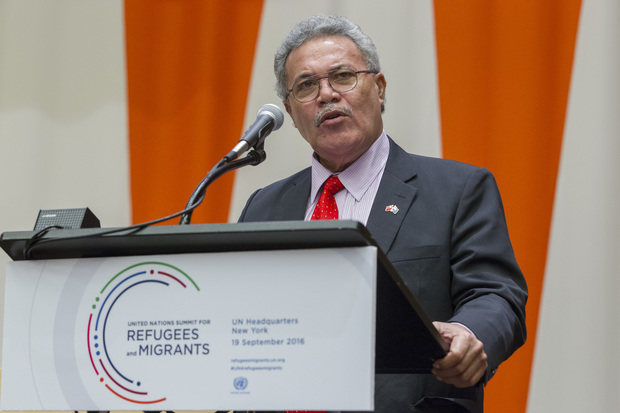
Tuvalu Prime Minister Enele Sopoaga addressing a UN summit in 2016 Photo: UN Photo/JC McIlwaine
But education is key to driving more opportunities for Tuvaluans, according to Prime Minister Enele Sopoaga.
He points to schemes in place to "ensure a stepping stone for the future" that include a skills training centre and scholarships that don't bond people to having to return to Tuvalu to work.
"We have our visions, and I certainly hope that our friends ... could help us in attaining that vision. But don't close the doors on Tuvalu."
*Sally Round travelled to Tuvalu on a Pacific journalism grant funded by the NZ Ministry of Foreign Affairs and Trade


