Showing posts with label Tsipros. Show all posts

Monday, 21 September 2015

Syriza given another chance in Greek snap election


Greek snap election: New Democracy concedes defeat to Tsipras’s leftist Syria

RT,
20 September, 2015

The Greek left-wing party Syriza is expected to take 145 seats in the 300-member parliament, the Interior Ministry said after counting 66 percent of the vote cast in the snap election Sunday. The leader of New Democracy, Syriza’s main rival in the polling, has already conceded defeat.

The electoral result appears to be concluding with Syriza and Mr Tspiras in the lead,” New Democracy leader Vangelis Meimarakis said. “I congratulate him and urge him to create the government which is needed and come to parliament.”

The conservatives themselves have so far secured 75 seats


Syriza is still falling short of an outright majority, meaning it will need coalition partners to form a government. The party hopes to complete this task within three days.

I want to repeat what Tsipras said, which is that a government will be formed within three days,” a source within Syriza told Reuters.

Greece’s leftist Syriza party is most likely has turned to its former coalition partner – the right-wing Independent Greeks. The move will restore the state of affairs that brought Alexis Tsipras to power in the first place nine months ago.
Independent

From tomorrow morning, with Alexis Tsipras as Prime Minister we will form a government,” Independent Greeks president Panos Kammenos told reporters.

With 3.6 percent of the vote Kammenos’ party secured 10 seats.

The bailout agreement reached by Tsipras and EU leaders will be implemented, the newly-elected party promised. However, “tough negotiations” on the subject will continue, party spokeswoman said, Reuters reported.

This will be a four-year term government with a strong parliamentary majority, which will implement the program it promised,” the news agency cited Olga Gerovassili as saying.

It will continue the tough negotiations with the lenders, realizing that this is the beginning of a battle,” she added.

In Europe today, Greece and the Greek people are synonymous with resistance and dignity, and this struggle will be continued together for another four years,” Tsipras said to cheering crowds, standing in a central Athens square.

We have difficulties ahead, but we are also on firm ground,” he added. “We won’t recover from the struggle by magic, but it can happen with hard work,” he dded

The Syriza’s closest pursuer New Democracy is standing at 28.12 percent so far.

The far-right Golden Dawn party, led by Nikolaos Michaloliakos, came in third with 7.09 percent and only 19 seats in Parliament. The party, labeled as “neo-Nazi” and “fascist” by the media, has attracted voters with its strong anti-refugee and anti-austerity stance.

The snap elections were triggered by the former Greek Prime Minister Alexis Tsipras who resigned last month after he managed to reach an agreement with the EU and kept Greece in the eurozone, followed by a split within Syriza.


Thursday, 16 July 2015

More from Greece

Protests Erupt in Athens As Greece Approves Eurozone Bailout


The Real News

TRNN's Jaisal Noor speaks to protestors in Athens, Greece about why they oppose the $96 billion dollar Eurozone bailout the Greek Parliament passed late Wednesday by a vote of 229 to 64


Having heard Paul Craig Roberts speaking about this I agree with him that whatever the EU intentions the United States for its own geopolitical interests in keeping NATO and the EU intact for its war against Russia, will not allow a Grexit to happen.

Here is commentary from Channel 4's Paul Mason


Decoding the IMF: Greek deal doomed, exit likely


14 July, 2015

It’s easy to get drawn in to the detail. I spent some of yesterday in the hot corridors of the Greek parliament where the various factions and groupings within Syriza, the radical left party, were working out their postures on today’s vote.


No to the rescue deal, says the left. Abstain, say others. Vote yes while declaring it’s been done at gunpoint, says Alexis Tsipras in a live TV interview. But step away from the argument, bitter as the black coffee served in the parliament’s canteen, and the bigger picture is: the deal will pass, Syriza will vote for it.
13 greece r w  Decoding the IMF: Greek deal doomed, exit likely


Step back further and take in the implications of the IMF’s secret report, leaked yesterday, into the dynamics of Greece’s debt. The IMF says – after the weeks of dislocation caused by the relentless bank run and the capital controls – that the austerity deal is pointless. Greece needs a massive debt write-off or large upfront transfers of taxpayers money from the rest of Europe. It needs a 30 year grace period in which it will stop repaying the loans.

Yet the entire deal done on Sunday night was premised on not a single cent worth of debt relief. Vague commitments to “reprofile” debt – pushing repayment times backwards and lowering the interest rates – were all Angela Merkel could be persuaded to do.

What this means is very simple: the third bailout agreed in principle on Sunday night is doomed to fail. First because the IMF cannot sign up to it without debt relief; second because, without debt relief it will collapse the Greek economy. This is even before you factor in issues like mass resistance to its details, or the total lack of enthusiasm for execution of the deal by the Syriza ministers who will have to do it.

IMF report

But on both sides of the Greek political class there is cognitive dissonance, and it’s being generated by the same thing: a blindness to what the Euro has become.

The Greek centre and centre right will keep Syriza in power today on the grounds of being good Europeans. Syriza will vote for a deal it opposes, and which anybody who’s read even a summary of the IMF report now understands is doomed. Again on the grounds that it is demonstrating commitment to Europe and that, as Alexis Tsipras argues, “rules out Grexit”.

The implication of the IMF report is that Grexit is inevitable. Without debt relief the Greek debt to GDP ratio will rise to 200%. It will be using 15% of its GDP simply to make interest payments and payments coming due.

So we go back to the old problem that has dogged Greece since 2010. Yes it has an inefficient, state-dominated economy that needs to be reformed; yes it has antiquated and corruption-inducing restrictions on who can run certain businesses. But you can’t modernise a place like Greece amid the relentless downward pressure on growth that austerity measures produce.

By saying this – albeit in a secret document the Europeans wanted suppressed – the IMF has shown it is a learning organism. It has abandoned the dogma that predicted austerity would bring a 4% fall in GDP and drawn conclusions from the 25% fall in GDP that actually occurred.

One of the recurrent features of this crisis is the mismatch between the speed at which political parties learn things and how people do.

I’ve found, among ordinary people who were passionate supporters of the No vote in the referendum, the widespread acceptance that – to go forward with measures on social justice or alternatives to austerity – Greece will have to leave the Euro. Most people I talk to want it done in a controlled manner, consensually and with some kind of mandate from the people.

They’ve realised that Angela Merkel’s absolute refusal to countenance debt write-offs inside the Euro, alongside the IMF’s absolute insistence that they should happen, have created a cul-de-sac no Greek government can get out of without reversing out of Euro membership.


Syriza – which was always a coalition of left social democrats, New Left marxists and a harder left communist group – is finding it institutionally hard to accept this logic.

Opponents of exit argue that, with the Euro question “solved” they can get on with prosecuting a domestic crusade against corruption, poor police methods and the dysfunctional judiciary and the state.

What nobody knows is how much of its absolute sovereignty over domestic law the Eurozone would actually use if, for example, Syriza tried to cleanse the judiciary. Would this be deemed as “politicising the state?” Nobody knows – because the European Commission and ECB have never had to have policies on such things before.

Third bailout will be a Ð½disaster’

Equally uncertain is: what kind of party does Syriza now become? Right now it is still, basically, an expression of the desire of large numbers of Greek people to stay in the Euro with less austerity.

The Greek electorate’s pattern over the past 5 years has been to put parties into power who say they will mitigate austerity but stay in the Euro. First Papandreou, then New Democracy – who also, now barely remembered – once opposed an austerity memorandum – and now Syriza. By throwing successive parties into the European mincing machine, the outcome has been to shred party politics. Pasok was shredded, New Democracy was shredded and it’s possible that Syriza too will split, be vilified, denounced as traitors etc.
21 greece protest w  Decoding the IMF: Greek deal doomed, exit likely


We know from opinion polls that about 35% of Greeks want to leave the Euro but that a further 25% of those who voted No in the referendum probably fear what Alexis Tsipras spelled out last night: €250bn has left the country over the past 5 years and if Greece leaves the Euro this “drachma lobby” would be able to return to Greece and buy out everything and everybody.

But listen to the IMF report – which implies the third bailout will be a disaster; and to the intransigence of Angela Merkel – who says no debt relief within the Euro. The more I look at it, logically and dispassionately, that €250bn waiting outside Greece for Grexit now looks like very smart money. And you the highly logical and dispassionate investment community is drawing that conclusion too.

The levels of economic pain and dysfunctional borrowing set to be inflicted on Greece mean that at some point in the next 12-18 months there is a chance that centrist 20-30% of public opinion will flip to a policy of controlled, or maybe temporary exit from the Eurozone. The only question then is: which party will offer a convincing narrative and lead it.

Follow @paulmasonnews on Twitter.


Friday, 3 July 2015

A question of democracy: Towards the referendumin Greece

Prime Minister Alexis Tsipras’ message


Greek citizens,

 We are at a critical juncture regarding the future of this country.

Sunday’s referendum is not about whether our country will stay in the Eurozone.
This is a given and no one should question this.

On Sunday we will choose whether to accept the institutions’ agreement or whether, with the strength of the people’s verdict, we will seek a viable solution.

In any case, I want to reassure the Greek people of government’s firm intention to reach an agreement with its partners, with conditions that are sustainable and will provide for the long-term.

Since we announced our decision to hold a referendum, better proposals have been offered concerning the debt and its necessary restructuring than those that were on the table on Friday.

We did not ignore them. We immediately submitted our counterproposals asking for a viable solution, and for this reason an extraordinary Eurogroup meeting was convened yesterday, which will continue this afternoon.

Should there be a positive outcome, we will respond immediately. In any case, the Greek government remains willing to negotiate and will do so until an agreement is reached. The government will be at the negotiating table on Monday as well, immediately after the referendum, seeking better terms for the Greek people.

A popular verdict is always so much stronger than the will of a government alone. And I would like to reiterate that democratic choice is a core European tradition. During very important moments in European history, the people have made important decisions through referenda.

This happened in France, and in many other countries, concerning the referendum on the European constitution. This happened in Ireland, where the referendum temporarily voided the Treaty of Lisbon and led to a renegotiation, that resulted in better terms for Ireland. Unfortunately, in Greece’s case, we’ve been subjected to different standards.

Personally, I would have never expected that democratic Europe would not understand the need to give some space and time to a people to sovereignly make a choice about their future.

The prevalence of extreme conservative forces led to the decision to asphyxiate our country’s banks–with the obvious aim of blackmailing not just the government, but each each citizen individually.

It is unacceptable in a Europe of solidarity and mutual respect to have these disgraceful images:

For the banks to be closed, exactly because the government decided to give the people the opportunity to express their will;

And for thousands of elderly people to be deeply inconvenienced. However, the Greek government, despite the financial asphyxiation, took the appropriate measures and made sure that pensions were paid and deposited into the accounts.

We owe an explanation to these people who have been so inconvenienced:

We have been fighting all these months in order to protect your pensions.

To protect your right to a decent pension and not a miserly “tip”.

The proposals that they tried to blackmail us in order to accept demanded huge pension reductions.

And we refused to go along with this.

And this is why they are retaliating today.

The Greek government was given an ultimatum to implement exactly the same austerity measures, and all the outstanding aspects of the memorandum that had not been implemented.

And, in fact, without any provisions on the debt and financing.

This ultimatum was not accepted.

The self-evident alternative was to reach out to the people.

And this is what we have done.

I am well aware that during this period the sirens of destruction have been blaring.

They are trying to blackmail you as well, and ask that you vote YES on all the measures requested by the institutions, without any prospect of exiting the crisis.

They want you to side with those in Parliament who have repeatedly said YES to all the measures that have burdened the country.

To become one with them.

Complicit in perpetuating the memoranda.

It is important to understand, NO is not just a slogan.

NO is a decisive step towards a better deal that we aim to be signed immediately after Sunday’s result.

It constitutes the clear choice of the people concerning how their lives will be going forward.

NO does not mean breaking with Europe, but rather, returning to a Europe of values.

NO means: strong pressure for an economically viable agreement that will solve the debt issue, that will not increase the debt so that it continuously undermines our efforts to rebuild the Greek economy and society.

A socially just agreement that will allocate the burdens to those that can shoulder them, and not the workers and the pensioners.

An agreement that will allow the country, in a short period of time, to access the international financial markets, and thus end the supervision and guardianship.

An agreement containing reforms that will punish, once and for all, those who enable corruption and that have been fueling the political system all these years.

And at the same time, it will address the humanitarian crisis, create a comprehensive safety net for those who are marginalized–precisely because of the policies that have been implemented in our country for so many years.
Greek citizens,

I am fully aware of the difficulties.

I personally pledge that I will do everything possible so that these difficulties are temporary.

Some insist on linking the referendum’s result to the country staying in the euro.

They claim that I have a hidden agenda, if the NO vote prevails, to remove the country from the EU.

They are knowingly lying.

These are same people who used to say the very same thing in the past.
And they do a great disservice to the people and to Europe.

As you are aware, a year ago during the European elections, I was a candidate for the Presidency of the European Commission.

I stood before the Europeans then, just as now, and I argued that austerity policies must stop, that the memoranda will not lead to an end to the crisis.
That the program implemented in Greece failed.

That Europe must stop behaving in an undemocratic manner.

A few months later, in January 2015, the Greek people confirmed these sentiments.

Unfortunately, certain people in Europe refuse to understand this, refuse to admit this.

Those who want a Europe of authoritarianism that fails to respect democracy, those who wish for Europe to be a superficial union with the IMF being the “glue” that binds, are not visionaries for Europe.

They are timid politicians, unable to think as Europeans.

They stand side by side with those in our domestic political system, who are responsible for leading our country to bankruptcy, and that now have the gall to attempt to dump the burden on us–even as we’ve been trying to put an end to the country’s course of destruction.

They dream, indeed, of being restored to power.

This is what they’ve been hoping for—and still hope for, irrespective of whether we accepted the ultimatum–as they have blatantly sought an unelected Prime Minister who would implement it– or whether we gave our people the opportunity to express their will.

They talk of a coup. But democracy is not a coup. Unelected governments intent on manipulating circumstances—that is a coup.

Greek citizens,

I want to wholeheartedly thank you for the calmness and composure you’ve shown during every hour of this difficult week.

I want to assure you that this situation will not drag on.

It will be temporary.

Salaries and pensions will not be lost.

The deposits of citizens who did not withdraw their money or place it abroad will not be sacrificed on the altar of expediency and extortion.

I personally assume responsibility for reaching a solution immediately after the democratic process.

I urge you to strengthen this negotiating effort with your support, I invite you to say NO to the memorandum measures that are destroying Europe.

I invite you to respond positively to the prospect of a viable solution.

To turn a page, that calls for upholding democracy.

With the certain hope that we will reach a better deal.

We owe this to our parents, our children, ourselves.

It is our duty. We owe this to history.

Thank you.


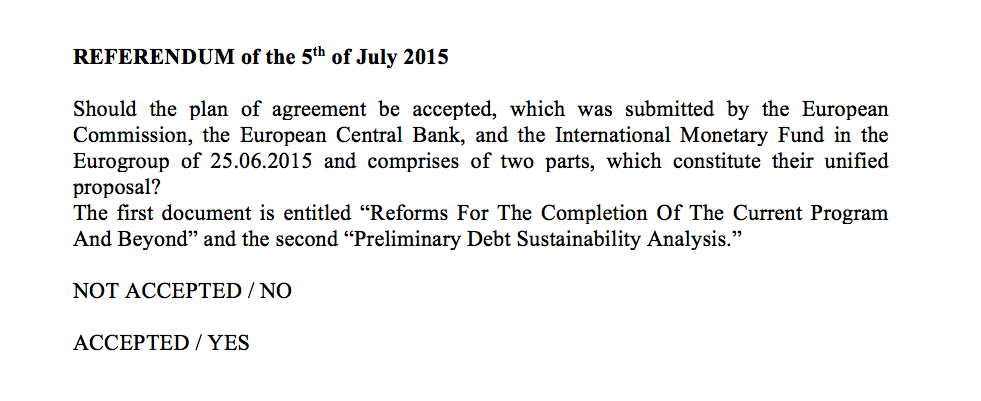
The following is an English translation of the referendum question circulating on Twitter

The ballot paper of the question upon which the Greek people are called to vote on. (Translated)