Showing posts with label Qatar. Show all posts

Thursday, 28 November 2019

Jared Kusher threatens to unleash the dogs of war unless they pay his $1.4 billion debt


Ilhan Omar deposition text also names Sarsour and Kushner as Qatari assets
"We recruited both, Republicans and Democrats, but that's not good enough. We want to rule the White House," the Qataris allegedly said.
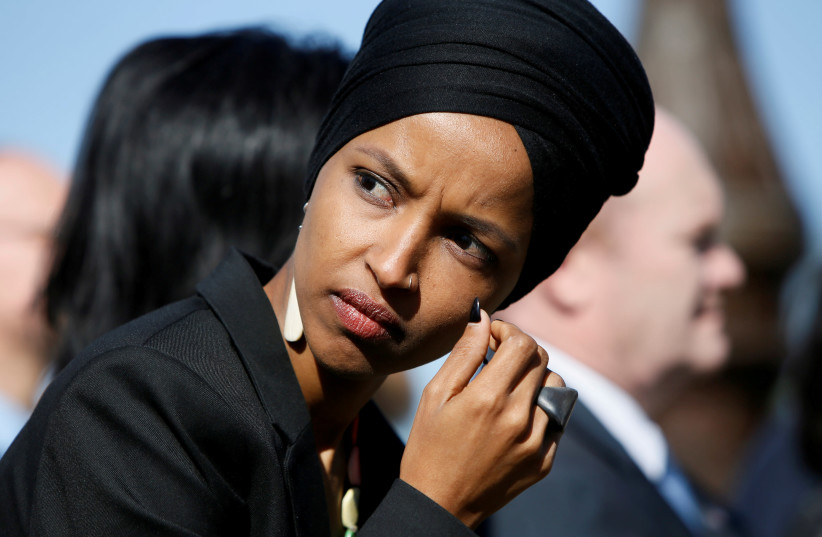
Rep. Ilhan Omar (D-MN) participates in a news conference outside the U.S. Capitol in Washington, US, April 10, 2019 (photo credit: JIM BOURG/ REUTERS)

JPost,

27 November, 2019


Explosive testimony given in a Florida court naming Ilhan Omar as a Qatari asset, also implicated a number of other prominent American citizens, including political activist Linda Sarsour and senior advisor to United States President Donald Trump, Jared Kushner.

Yesterday, the Jerusalem Post reported on court testimony given by Canadian businessman Alan Bender in the trial of Sheikh Khalid bin Hamad al-Thani, who stands accused of ordering his American bodyguard to murder two people.

Bender told the court that Omar had been recruited by Qatar and had also pledged allegiance to Turkey's President Erdogan. Speaking to the Post earlier today, Bender confirmed that the report was an accurate representation of what was said in court.

Now the Jerusalem Post can reveal:

- That, according to Bender, Qatar aimed to 'take down' Imam Tawhidi, known as the Imam of Peace, for his criticism of Omar, using their contacts in American newspapers to publish smear stories that would lead to legal charges against the Imam.

- That Qatar's alleged assets include politicians on both sides of the House, and journalists.

- And that Senior Advisor to the President of the United States Jared Kushner is also alleged to have taken money from Qatar.

In testimony given in the Florida court, a copy of which was sent to the Jerusalem Post, Bender claimed that both Omar and Linda Sarsour were members of the Muslim Brotherhood.

"They [the Qataris] called her Sister Ilhan, which is a term you only use when you're a member of the Muslim Brotherhood. So Abdullah al-Athbah, he refers to Ilhan Omar as Sister Ilhan, and Sister Linda, which is Linda Sarsour, another activist who is now going to run for Senate," Bender told the court.

"Somebody recommended her to the Qataris. They had several names, several options to pick from, to appoint - 'they call her winning the elections is an appointment.'"

Omar was chosen, Bender said, because her father had a history of carrying out "very violent interrogations," as a high ranking officer in the Somalian army, "and they thought that would be very suitable because the more dirt you have on your candidate, the easier it is to control the candidate."

She also said to have had other perceived weaknesses which made her a suitable recruit. Bender told the court he questioned why a devout Muslim such as Omar would take bribes, only to be told, "don't be fooled by her head scarf. She's a sex maniac, and she's very weak when it comes to money and sex. And we got both."

The claims are being supported by London-based Kuwaiti activist Abdullah al-Saleh, who on Tuesday evening tweeted: "My name is Dr. Abdullah al-Saleh and I was the guest of the Qatari government and Prime Minister for 6 months. I learned of their operations in the West and can testify and confirm that everything Alan Bender said in his deposition regarding Rep. Ilhan Omar and Qatar is true."


Mr al-Saleh, who has a following of 123,000 people on Twitter, sent the 
Post a photograph of himself posing with members of the Qatari royal family to support his claim.
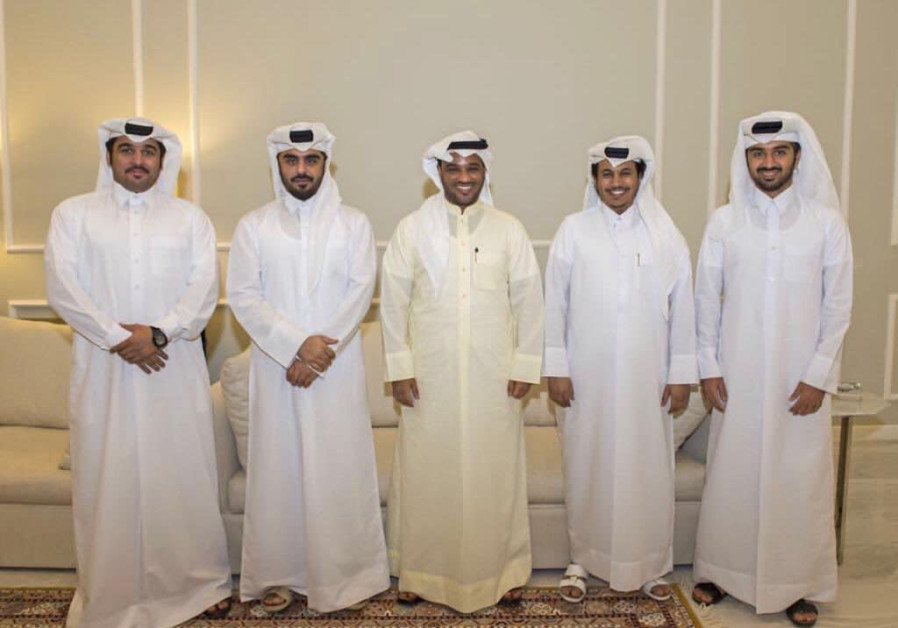
Abdullah al-Saleh poses with members of the Qatari royal family (Photo credit: supplied)

Abdullah al-Saleh poses with members of the Qatari royal family (Photo credit: supplied)

Indeed, so "obedient" was Omar, according to Bender, that the Qataris "wanted to make sure that nobody can go after her reputation ... and that's how they brought up the name of Imam Tawhidi ... A social activist who was exposing a lot of that."

The Qataris, Bender said, asked "if I could arrange for a lawsuit against Tawhidi that it will allow Ilhan Omar to capitalize on and sue him for defamation of character.

"Their plan was to drum up information about Imam Tawhidi that are not true ... and then turn it into a media report in one of the prominent newspapers in the US. And then that turns into a possible lawsuit, which they asked me if I'm willing to sponsor the legal action part."


"Everything [Alan Bender] said in the deposition about me has happened," Imam Tawhidi told The Post. "I believe in the deposition and await an investigation. All I want is to be treated fairly," he added.

However, Omar was not the only prominent American named in the Bender testimony.

"They [the Qataris] said: 'We recruited both, Republicans and Democrats, but that's not good enough. We want to rule the White House.' So they will," he told the court.

Indeed, if Bender's testimony is accurate, they are already close.
Explaining that Qatar uses western companies to effectively launder the money they paid to American citizens, Bender cited a $1.4 billion payment which he claims was passed to Jared Kushner from Qatar, via a Canadian company named Brookfield, which he says they have invested heavily in.

Despite knowing that it was a failing investment, Qatar leaned on Brookfield to buy 666 Fifth Avenue from Kushner, to write off his debts.

"Why didn't they pay Kushner directly?" the lawyer for the plaintiffs, Ms. Castenda, asked.

"Too risky," Bender replied.

"Jared Kushner approached the government of Qatar for a bailout of 666 Fifth Avenue?" Castenda clarified.

"Correct. That's what they told me. ... And they did it. And Kushner is happy with them because, according to them, I don't know Kushner personally, but the Qataris said Kushner told them: 'Choose one of two. You pay what I tell you to pay, or I unleash my dogs.'"
"The dogs being who?" she asked.

"Saudi Arabia and the UAE," Bender replied.

The Qataris were aware that as an investment the pay-off was a write-off, but told Bender, "'We just paid it to pay off his debt. And as long as he's in the White House, we have to do what he wants until we control the White House.' We as in Qatar," Bender clarified.

The Jerusalem Post has reached out to Mr Kushner's office for a response. However, no comment has been received as of yet.
Among other claims made by Mr. Bender were that:

- The real power in Qatar is Mohammed Al-Masnad, known as 'the CEO.' "After a couple of hours, I was convinced that the Emir of Qatar does not run the show and Mohammed Al-Masnad is in charge of everything. He is also the Emir's uncle. [...] And the Emir's mother is the real king of Qatar."

- The second most powerful man in Qatar is a Palestinian, Azmi Bishara.

- That Jamal Khashoggi was set up by Qatar to be killed by the Saudis after he was found to have been "playing both sides." "Jamal Khashoggi and Prince Al-Waleed bin Talal were very close friends," Bender said. "[Khashoggi] would receive sensitive secrets ... and he leaks them to the Qataris. The Qataris would leak them to media outlets ... and he was a member of the Muslim Brotherhood. I got that confirmation from the Qatari officials."

- that "they [Qatar] finance almost 99 percent of Saudi dissidents in the US and the UK. They pay them." Bender named Ghanem al-Dosari, a well known YouTuber, as one such individual.

- Three Italians, known as 'the engineers' were paid by Qatar to hack the accounts of Saudi Arabian and the United Arab Emirates's citizens. "E-mails, text messages, regular phone calls, laptops. Anything you can think of. They hacked into all that."

- American officials are the cheapest to recruit. "British officials, they demand millions to be recruited. American politicians, some of them accept $50,000."

- The Qataris refer to Trump as "the orange man," and to Kushner as the "descendant of pigs and apes," because he is Jewish. "And they refer to other American Senators and Congressmen who are Christians as 'Crusaders'."

Aaron Reich contributed to this report.


https://www.jpost.com/American-Politics/Ilhan-Omar-working-for-Qatar-Florida-court-hears-609003


Listen to "666 Fifth Avenue Shakedown: Jared Kushner Accused of Squeezing Millions from Qataris to Pay off Debts - TruNews 11 27 19" on Spreaker.

Thursday, 2 August 2018

It may have been his efforts to stop invasion of Qatar that got Til;erson fired

SAUDI ARABIA PLANNED TO INVADE QATAR LAST SUMMER. REX TILLERSON’S EFFORTS TO STOP IT MAY HAVE COST HIM HIS JOB.

Alex Emmons


1 August, 2018


THIRTEEN HOURS BEFORE Secretary of State Rex Tillerson learned from the presidential Twitter feed that he was being fired, he did something that President Donald Trump had been unwilling to do. Following a phone call with his British counterpart, Tillerson condemned a deadly nerve agent attack in the U.K., saying that he had “full confidence in the U.K.’s investigation and its assessment that Russia was likely responsible.”
  
White House Press Secretary Sarah Sanders had called the attack “reckless, indiscriminate, and irresponsible,” but stopped short of blaming Russia, leading numerous media outlets to speculate that Tillerson was fired for criticizing Russia.

But in the months that followed his departure, press reports strongly suggested that the countries lobbying hardest for Tillerson’s removal were Saudi Arabia and the United Arab Emirates, both of which were frustrated by Tillerson’s attempts to mediate and end their blockade of Qatar. One report in the New York Times even suggested that the UAE ambassador to Washington knew that Tillerson would be forced out three months before he was fired in March.

The Intercept has learned of a previously unreported episode that stoked the UAE and Saudi Arabia’s anger at Tillerson and that may have played a key role in his removal. In the summer of 2017, several months before the Gulf allies started pushing for his ouster, Tillerson intervened to stop a secret Saudi-led, UAE-backed plan to invade and essentially conquer Qatar, according to one current member of the U.S. intelligence community and two former State Department officials, all of whom declined to be named, citing the sensitivity of the matter.
In the days and weeks after Saudi Arabia, the UAE, Egypt, and Bahrain cut diplomatic ties with Qatar and closed down their land, sea, and air borders with the country, Tillerson made a series of phone calls urging Saudi officials not to take military action against the country. The flurry of calls in June 2017 has been reported, but State Department and press accounts at the time described them as part of a broad-strokes effort to resolve tensions in the Gulf, not as an attempt by Tillerson to avert a Saudi-led military operation.
Tillerson made a series of phone calls urging Saudi officials not to take military action against Qatar.

In the calls, Tillerson, who dealt extensively with the Qatari government as the CEO of Exxon Mobil, urged Saudi King Salman, then-Deputy Crown Prince Mohammed bin Salman, and Foreign Minister Adel al-Jubeir not to attack Qatar or otherwise escalate hostilities, the sources told The Intercept. Tillerson also encouraged Defense Secretary Jim Mattis to call his counterparts in Saudi Arabia to explain the dangers of such an invasion. Al Udeid Air Base near Doha, Qatar’s capital city, is the forward headquarters of U.S. Central Command and home to some 10,000 American troops.

Pressure from Tillerson caused Mohammed bin Salman, the de facto ruler of the country, to back down, concerned that the invasion would damage Saudi Arabia’s long-term relationship with the U.S. But Tillerson’s intervention enraged Mohammed bin Zayed, the crown prince of Abu Dhabi and effective ruler of that country, according to the U.S. intelligence official and a source close to the Emirati royal family, who declined to be identified, citing concerns about his safety.
Later that June, Mohammed bin Salman would be named crown prince, leapfrogging over his cousin to become next in line for the throne after his elderly father. His ascension signaled his growing influence over the kingdom’s affairs.
Qatari intelligence agents working inside Saudi Arabia discovered the plan in the early summer of 2017, according to the U.S. intelligence official. Tillerson acted after the Qatari government notified him and the U.S. embassy in Doha. Several months later, intelligence reporting by the U.S. and U.K. confirmed the existence of the plan.

The plan, which was largely devised by the Saudi and UAE crown princes and was likely some weeks away from being implemented, involved Saudi ground troops crossing the land border into Qatar, and, with military support from the UAE, advancing roughly 70 miles toward Doha. Circumventing the U.S. air base, Saudi forces would then seize the capital.
On June 20, State Department spokesperson Heather Nauert told reportersthat Tillerson had “more than 20 calls and meetings with Gulf and other regional and intermediate actors,” including three phone calls and two meetings with Jubeir. “The more time goes by, the more doubt is raised about the actions taken by Saudi Arabia and the UAE,” she said.

A spokesperson for the State Department told The Intercept last week that “throughout the dispute, all parties have explicitly committed to not resort to violence or military action.” Tillerson, reached through a personal assistant, did not respond to interview requests.

Pentagon spokesperson Lt. Cmdr. Rebecca Rebarich told The Intercept that although Mattis meets regularly with the secretary of state, the “details and frequency of those meetings are confidential.”

“The Department of Defense has made clear that the persistent Gulf rift puts at risk mutual regional security priorities and has encouraged all parties seek resolution,” Rebarich said. “It is critical that the [Gulf Cooperation Council] recovers its cohesion as the proud Gulf nations return to mutual support through a peaceful resolution that provides for enhanced regional stability and prosperity.”

Spokespeople for the Saudi and UAE embassies did not respond to multiple requests for comment. A spokesperson for the Qatari embassy in D.C. also did not respond to interview requests from The Intercept. None of the information in this story was provided by Qatari government officials or the country’s paid public relations consultants.

THE INVASION PLAN raises questions about interventionist tendencies on the part of two of the U.S.’s closest allies and largest weapons clients. In recent years, both countries have demonstrated a willingness to use military force to reshape politics in the Gulf, intervening in Bahrain to suppress an Arab Spring uprising in 2011 and waging a three-year, U.S.-backed war that has devastated Yemen.

Robert Malley, president and CEO of Crisis Group and a former top Middle East adviser to President Barack Obama, said that since the summer of 2017, Qatari officials have consistently told him that their country had been threatened with invasion.

“There is little doubt that senior Qatari officials with whom I spoke were convinced — or at least acted as if they were convinced — that Saudi Arabia and the UAE had been planning a military attack on their country that was halted as a result of U.S. intervention,” Malley told The Intercept.

Tillerson’s attempts to de-escalate the conflict in the Gulf diverged from the signals sent by the White House. Trump offered a full-throated public endorsement of the blockade, tweeting that “perhaps this will be the beginning of the end to the horror of terrorism.” As Tillerson called on the Gulf countries to lift their embargo, Trump told reporters that “the nation of Qatar, unfortunately, has historically been a funder of terrorism at a very high level.”

According to one news report, Tillerson was frustrated with the White House for undercutting him, and his aides suspected that the line in Trump’s prepared Rose Garden remarks had been written by UAE Ambassador Yousef Al Otaiba, a powerful D.C. player who maintained “almost constant phone and email contact” with Trump’s son-in-law Jared Kushner, according to Politico.
“Senior Qatari officials with whom I spoke were convinced — or at least acted as if they were convinced — that Saudi Arabia and the UAE had been planning a military attack on their country.”

At the time, Kushner was personally handling much of the administration’s diplomacy with the Gulf states, and the leaders of Saudi Arabia and the UAE were choosing to go through him instead of the U.S. defense or intelligence establishments. Kushner communicated directly with the crown princes of Saudi Arabia and the UAE using the encrypted messaging service WhatsApp.


Some Gulf watchers speculate that the incentive for the planned invasion may have been partly financial. Saudi Arabia’s “cradle to grave” welfare system relies on high oil prices, which plummeted in 2014 and have not fully recovered. Since the current king came to power in 2015, the country has spent more than a third of its $737 billion in reserves, and last year, the Saudi economy entered a painful recession. In response, the government has looked for ways to raise money, including by selling shares in the state-owned oil company, Saudi Aramco.


“It’s unsustainable,” said Bruce Riedel, a senior fellow at the Brookings Institute and 30-year CIA officer, in a lecture last November. “In the three years since [King Salman] ascended to the throne, one third of Saudi Arabia’s reserves have already been spent. You don’t need to have an MBA from the Wharton school to figure out what that means six years from now.”

If the Saudis had succeeded in seizing Doha, they would potentially have been able to gain access to the country’s $320 billion sovereign wealthfund. In November of last year, months after the plan collapsed, the Saudi crown prince rounded up and detained dozens of his relatives in the Ritz-Carlton Riyadh, forcing them to sign over billions in privately held assets. The government justified the detentions as a corruption crackdown, but it allowed the state to recoup billions in assets for government use.

Beginning in the fall of 2017, the crown princes in Riyadh and Abu Dhabi began lobbying the White House for Tillerson’s removal, according to the source close to the Emirati royal family and another source who is close to the Saudi royal family.


None of the current or former officials interviewed by The Intercept had direct insight into why Trump decided to fire Tillerson. But one source told The Intercept that the timing — a week before the Saudi crown prince arrived for a much-publicized visit to Washington — was significant. During that visit, MBS, as the crown prince is known, was set to discuss the Qatar crisis and future arms sales with the administration.

Four of the sources interviewed by The Intercept also pointed to an ongoing campaign by the UAE to try to provoke Qatar into escalating the crisis. Qatar has continued to complain about violations of its airspace by UAE aircraft, detailing its accusations in a letter to the U.N. earlier this year.

The UAE’s harassment of Qatar also includes crude public insults lodged by UAE leadership against the Qatari royal family. The jibes frequently emanate from the verified Twitter account of Hamad al Mazrouei, a high-level Emirati intelligence official and righthand man to Crown Prince Mohammed bin Zayed. Mazrouei’s account frequently tweets sexually suggestive content directed at Mozah bint Nasser, the mother of the emir of Qatar. Just last week, Mazrouei tweeted a video of a man and woman – with Mazrouei and Sheikha Mozah’s faces photoshopped onto their bodies – doing a raunchy bump-and-grind.

The content and audacity of Mazrouei’s tweets have led to speculation in Qatari media that the account is actually controlled by the crown prince of Abu Dhabi himself.


Sunday, 29 October 2017

Qatar confirms what was already known about the war on S

In Shocking, Viral Interview, Qatar Confesses Secrets Behind Syrian War

Zero Hedge,
29 October, 2017


A television interview of a top Qatari official confessing the truth behind the origins of the war in Syria is going viral across Arabic social media during the same week a leaked top secret NSA document was published which confirms that the armed opposition in Syria was under the direct command of foreign governments from the early years of the conflict.
And according to a well-known Syria analyst and economic adviser with close contacts in the Syrian government, the explosive interview constitutes a high level "public admission to collusion and coordination between four countries to destabilize an independent state, [including] possible support for Nusra/al-Qaeda." Importantly, "this admission will help build case for what Damascus sees as an attack on its security & sovereignty. It will form basis for compensation claims."
A 2013 London press conference: Qatari Prime Minister Sheikh Hamad bin Jassim bin Jabr Al Thani with U.S. Secretary of State John Kerry. A 2014 Hillary Clinton email confirmed Qatar as a state-sponsor of ISIS during that same time period. 
As the war in Syria continues slowly winding down, it seems new source material comes out on an almost a weekly basis in the form of testimonials of top officials involved in destabilizing Syria, and even occasional leaked emails and documents which further detail covert regime change operations against the Assad government. Though much of this content serves to confirm what has already long been known by those who have never accepted the simplistic propaganda which has dominated mainstream media, details continue to fall in place, providing future historians with a clearer picture of the true nature of the war.
This process of clarity has been aided - as predicted - by the continued infighting among Gulf Cooperation Council (GCC) former allies Saudi Arabia and Qatar, with each side accusing the other of funding Islamic State and al-Qaeda terrorists (ironically, both true). Increasingly, the world watches as more dirty laundry is aired and the GCC implodes after years of nearly all the gulf monarchies funding jihadist movements in places like Syria, Iraq, and Libya.


The top Qatari official is no less than former Prime Minister Hamad bin Jassim bin Jaber al-Thani,who oversaw Syria operations on behalf of Qatar until 2013 (also as foreign minister), and is seen below with then-Secretary of State Hillary Clinton in this Jan. 2010 photo (as a reminder,Qatar's 2022 World Cup Committee donated $500,000 to the Clinton Foundation in 2014).
In an interview with Qatari TV Wednesday, bin Jaber al-Thani revealed that his country, alongside Saudi Arabia, Turkey, and the United States, began shipping weapons to jihadists from the very moment events "first started" (in 2011).
Al-Thani even likened the covert operation to "hunting prey" - the prey being President Assad and his supporters - "prey" which he admits got away (as Assad is still in power; he used a Gulf Arabic dialect word, "al-sayda", which implies hunting animals or prey for sport). Though Thani denied credible allegations of support for ISIS, the former prime minister's words implied direct Gulf and US support for al-Qaeda in Syria (al-Nusra Front) from the earliest years of the war, and even said Qatar has "full documents" and records proving that the war was planned to effect regime change.

"We argued over the prey and that prey run away".Ladies and Gentleman: To these people   was nothing but a f....ing hunting game https://twitter.com/walid970721/status/923825448324345858 …

According to Zero Hedge's translation, al-Thani said while acknowledging Gulf nations were arming jihadists in Syria with the approval and support of US and Turkey: "I don't want to go into details but we have full documents about us taking charge [in Syria]." He claimed that both Saudi Arabia's King Abdullah (who reigned until his death in 2015) and the United States placed Qatar in a lead role concerning covert operations to execute the proxy war.
The former prime minister's comments, while very revealing, were intended as a defense and excuse of Qatar's support for terrorism, and as a critique of the US and Saudi Arabia for essentially leaving Qatar "holding the bag" in terms of the war against Assad. Al-Thani explained that Qatar continued its financing of armed insurgents in Syria while other countries eventually wound down large-scale support, which is why he lashed out at the US and the Saudis, who initially"were with us in the same trench."
In a previous US television interview which was vastly underreported, al-Thani told Charlie Rosewhen asked about allegations of Qatar's support for terrorism that, "in Syria, everybody did mistakes, including your country." And said that when the war began in Syria, "all of use worked through two operation rooms: one in Jordan and one in Turkey."
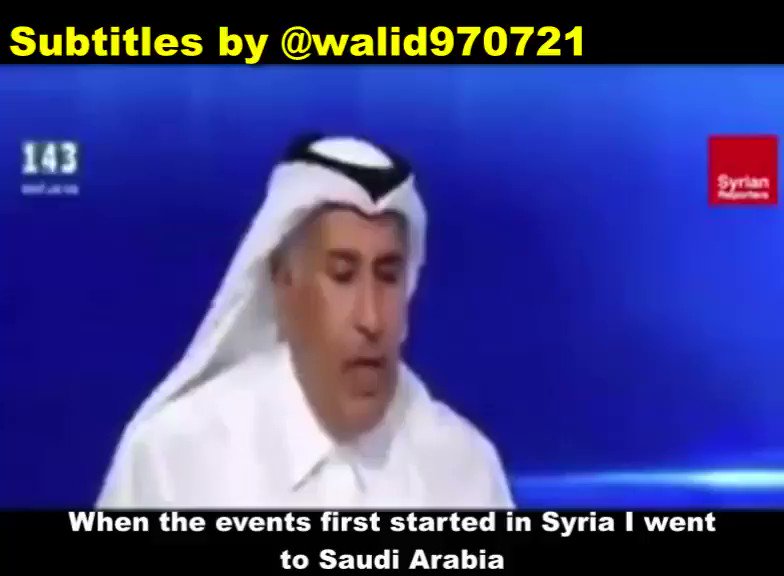
Below is the key section of Wednesday's interview, translated and subtitled by @Walid970721. Zero Hedge has reviewed and confirmed the translation, however, as the original rush translator hasacknowledged, al-Thani doesn't say "lady" but "prey" ["al-sayda"]- as in both Assad and Syrians were being hunted by the outside countries.


's ex PM says that Qatari support for jihadists including Nusra in  was in coordination w/ KSA, Turkey & the US via @BBassem7

The partial English transcript is as follows:
"When the events first started in Syria I went to Saudi Arabia and met with King Abdullah. I did that on the instructions of his highness the prince, my father. He [Abdullah] said we are behind you. You go ahead with this plan and we will coordinate but you should be in charge. I won’t get into details but we have full documents and anything that was sent [to Syria] would go to Turkey and was in coordination with the US forces and everything was distributed via the Turks and the US forces. And us and everyone else was involved, the military people. There may have been mistakes and support was given to the wrong faction... Maybe there was a relationship with Nusra, its possible but I myself don’t know about this… we were fighting over the prey ["al-sayda"] and now the prey is gone and we are still fighting... and now Bashar is still there. You [US and Saudi Arabia] were with us in the same trench... I have no objection to one changing if he finds that he was wrong, but at least inform your partner… for example leave Bashar [al-Assad] or do this or that, but the situation that has been created now will never allow any progress in the GCC [Gulf Cooperation Council], or any progress on anything if we continue to openly fight."
As is now well-known, the CIA was directly involved in leading regime change efforts in Syria with allied gulf partners, as leaked and declassified US intelligence memos confirm. The US government understood in real time that Gulf and West-supplied advanced weaponry was going to al-Qaeda and ISIS, despite official claims of arming so-called "moderate" rebels. For example, a leaked 2014 intelligence memo sent to Hillary Clinton acknowledged Qatari and Saudi support for ISIS.
The email stated in direct and unambiguous language that: 
"the governments of Qatar and Saudi Arabia, which are providing clandestine financial and logistic support to ISIL and other radical Sunni groups in the region."
Furthermore, one day before Prime Minister Thani's interview, The Intercept released a new top-secret NSA document unearthed from leaked intelligence files provided by Edward Snowden which show in stunning clarity that the armed opposition in Syria was under the direct command of foreign governments from the early years of the war which has now claimed half a million lives.
The newly released NSA document confirms that a 2013 insurgent attack with advanced surface-to-surface rockets upon civilian areas of Damascus, including Damascus International Airport, was directly supplied and commanded by Saudi Arabia with full prior awareness of US intelligence. As the former Qatari prime minister now also confirms, both the Saudis and US government staffed "operations rooms" overseeing such heinous attacks during the time period of the 2013 Damascus airport attack. 
No doubt there remains a massive trove of damning documentary evidence which will continue to trickle out in the coming months and years. At the very least, the continuing Qatari-Saudi diplomatic war will bear more fruit as each side builds a case against the other with charges of supporting terrorism. And as we can see from this latest Qatari TV interview, the United States itself will not be spared in this new open season of airing dirty laundry as old allies turn on each other.