Showing posts with label Kurds. Show all posts

Tuesday, 29 September 2020

Fake news? Armenia using PKK forces

 Turkey could use fake news of Kurdish PKK operating in Artsakh to attack Armenian forces


Paul Antonopoulos


Greek City Times,

28 September, 2020

Conflict sparked up again yesterday in Artsakh, or more commonly known as Nagorno-Karabakh, when Azerbaijan launched an offensive against Armenian forces. Although the Republic of Artsakh is not recognized by any state, including Armenia, and it is still internationally recognized as occupied Azerbaijani territory, it achieved a de facto independence in 1994.

As acting Commissar of Nationalities for the Soviet Union in the early 1920’s, future Soviet leader Joseph Stalin granted the Armenian-majority region of Artsakh to the Azerbaijani Soviet Socialist Republic. The Azeris, the dominant ethnic group of Azerbaijan, are cultural and linguistic kin with the Turks. It is said that the Turks and Azeris constitute “one nation in two states.” The defining difference is that Azeris are Shia Muslims unlike Turks who are mostly Sunni. The Soviets had hoped that by granting Artsakh to Azerbaijan instead of Armenia, they could court the newly founded Republic of Turkey to closely align with Moscow, or perhaps even become a Soviet Republic, by appeasing their ethnic Azeri kin.

In 1921, it was estimated that Artsakh was 94% Armenian. However, according to the 1989 census, Artsakh’s population was approximately 75% Armenian and 25% Azeri. Former Soviet Azerbaijani leader Heydar Aliyev, father of current President Ilham Aliyev, said in 2002: “I tried to change demographics there […] I tried to increase the number of Azerbaijanis in Nagorno-Karabakh and the number of Armenians decreased.” The collapse of the Soviet Union unsurprisingly led to the Artsakh War, which only ended after a ceasefire in 1994 when Armenian forces achieved a decisive victory.

Despite Azerbaijan’s defense budget ($2.267 billion) being about five times larger than Armenia’s, they have failed to capture Artsakh on numerous attempts, particularly during the 2016 April War and another major attempt in July of this year. Azerbaijan’s resumption of hostilities yesterday could be passed off as just another skirmish that will subside in a few days. However, the current conditions are far different and much more dangerous than in previous situations.

Although it is well established that the Turkish economy is struggling, President Recep Tayyip Erdoğan is maintaining a policy of constant crises in the vain attempt to distract the public from the Turkish lira as it continues breaking new record lows to the US dollar and Euro, even as recently as this morning. As the military provocations and rhetoric of war against Greece and Cyprus in the East Mediterranean begins to subside in Ankara, it only took a few days for a new crisis to emerge.

Reports began emerging last week that Turkey was transferring terrorists from northern Syria to Azerbaijan. The Azerbaijani leadership in Baku flatly denied the allegations last week and today. However, despite the denials from Baku, it must be remembered that Ankara openly announced its transfer of Syrian fighters to Libya earlier this year and the Azerbaijani’s have undoubtedly used international terrorists from Afghanistan, Chechnya and Turkey during the first Artsakh war in the 1990’s. Photos, videos and voice recordings have emerged that show Syrian terrorists on their way to or already in Azerbaijan. Vardan Toghanya, the Armenian Ambassador to Moscow, said in a statement today that 4,000 militants from Syria already arrived in Azerbaijan, while according to the Armenian intelligence agency, 80 fighters from Syria have already been killed or wounded.

Turkey’s transfer of militants in support of Azerbaijan, which was also done in the 1990’s, is not what makes the current conflict more dangerous compared to previous battles and skirmishes. Starting from last week, Turkey and Azerbaijan have increased their campaign in claiming that the Kurdistan Workers Party (PKK), considered a terrorist organization by both Ankara and Baku, was operating in Artsakh. Neither Ankara and Baku provided any evidence for their claims. This sets a dangerous narrative as it could be used as a way for Turkey to “legitimize” a direct intervention against Armenia and in support of Azerbaijan.

Erdoğan justified his invasion and occupation of large areas of northern Syria and northern Iraq in 2018, 2019 and this year on the pretense that they were fighting against the PKK. Although Armenia denies PKK are operating in Artsakh, this will be ignored by Ankara and Baku.

However, unlike Syria and Iraq, Armenia is a member state of the Collective Security Treaty Organization (CSTO), alongside Belarus, Kazakhstan, Kyrgyzstan, Russia and Tajikistan. A direct Turkish attack on Armenia could activate the CSTO. This would be a dangerous scenario as in turn this could activate NATO in defense of Turkey. It is highly unlikely that the situation in Artsakh will dissolve into a CSTO-NATO faceoff. But the risk still remains, especially if Erdoğan decides to directly intervene under the guise of expelling the PKK from Artsakh.

Just as Erdoğan unleashed a migrant crisis in February and March of this year against Greece, sent Syrian terrorists to Libya in May, conducted a military operation in northern Iraq against the PKK in June, and created a new crisis with Greece by sending warships into its territorial waters in August and for most of September, it appears the new crisis to dominate headlines for the next few weeks will revolve around Artsakh.

Although it is unlikely that Turkey will directly militarily intervene, a dangerous precedent has already been established by pushing the narrative, without publicly available evidence, that the PKK are operating in Artsakh alongside Armenian forces. With the Turkish economy and lira collapsing, Erdoğan in the future may very well use the narrative that the PKK are in Artsakh to ferment public furor and distract them from the declining economic situation.

Source: InfoBRICS

From Turkish media (the Daily Sabah)


Armenia brought terrorist groups, including the PKK and the so-called Armenian Secret Army for the Liberation of Armenia (ASALA) to the occupied Nagorno-Karabakh region and provided them with weapons, Azerbaijan's envoy to Turkey told Anadolu Agency (AA).

"They (Armenia) adopted a new national security strategy which specifically indicated that they want to occupy new territories of Azerbaijan," Azerbaijan Ambassador to Turkey Khazar Ibrahim said in an interview amid the weekend eruption of violence along the Armenia-Azerbaijan frontier.

Previously on Friday, reports stated that many YPG/PKK terrorists who received training in Iraq and Syria were transferred to Azerbaijan's Nagorno-Karabakh region, which is occupied by Armenia, to train Armenian militias against Azerbaijan and ultimately open a new front against Turkey.

Wednesday, 23 October 2019

Assad from Idlib frontline: Erdogan is a thief and a slave to the US

Bashar al-Assad looks less like a "murderous dictator" than a real leader to his people.

Syrian President makes first visit to Idlib province since start of the war: photos, video


22 October, 2019


BEIRUT, LEBANON (4:00 P.M.) – Syrian President Bashar Al-Assad was pictured on Tuesday greeting Syrian Arab Army (SAA) soldiers inside the southern region of the Idlib province.


According to an army source, the Syrian President visited several areas that were previously controlled by the jihadist rebels, including Khan Sheikhoun and Al-Hobeit in southern Idlib.
The Syrian President was given a tour of the area before he met with the commander of the 25th Special Mission Forces Division (formerly Tiger Forces), Major General Suheil Al-Hassan, in Al-Hobeit.
The Syrian President Bashar Al-Assad meets with the commander of the 25th Special Mission Forces Major General Suheil Al-Hassan in the Idlib province town of Al-Hobeit.Al-Masdar NewsTuesday’s trip to the Idlib province marks the first time during this war that the Syrian President has visited the area, as it has been a war zone for much of the conflict.

A source from the army said the Syrian President’s visit to southern Idlib was a surprise to the soldiers there. He would provide them words of encouragement and thank them for their service during his brief speech to the soldiers.

Syrian President discusses military plans with the Syrian Arab Army’s commanders in southern Idlib.Al-Masdar News
Syrian President Bashar Al-Assad greets a soldier on a tank in the town of Al-Hobeit in southern Idlib.Al

Friday, 18 October 2019

SyriaGirl talks about the Kurds


SyrianGirl interviewed on 

TruNews

This is my video


Kurdish-Israeli Alliance: Solomon’s Genies, Jewish Mamas & Nephilim Babies


U.S.: Turkey agrees to five-day ceasefire


Turkey to halt military operation against Kurds in N. Syria, ceasefire will last for 120 hours


US Military Unlikely To Withdraw From Syria's Key Oil Fields: Report


https://www.zerohedge.com/geopolitical/us-military-unlikely-withdraw-syrias-key-oil-fields-report


Pence Says US, Turkey Reach Ceasefire Deal In Syria; Lira Soars On "Agreement To Withdraw Sanctions"


Elijah Magnier on the Turkish attack on the Kurds in Syria

WINNERS AND LOSERS IN 

THE TURKISH ATTACK ON 

THE KURDS IN SYRIA 

(PART 3 OF 3)


17 October, 2019


By Elijah J. Magnier: @ejmalrai


The United States of America emerged victorious from the Second World War, and came out stronger than any other country in the world. The allies- notably the Soviet Union- won the war but emerged much weaker. They needed to reconstruct their countries and rebuild their economies, with the US demanding huge retrospective payments for its support. The US became a superpower with nuclear bomb capability and an imposing power of dominance. Industrial countries rebuilt in what the Germans called their Wirtschaftswunderand the French les Trentes Glorieuse, the thirty years of post-war prosperity. Meanwhile the US leveraged its prosperity to spread its hegemony around the world. US power was enhanced with the beginning of Perestroika
and after the fall of the Soviet Union. In the new millennium the US establishment declared the “War on Terror
” as justification to occupy Afghanistan and Iraq, while attempting to subdue
 Hezbollah in Lebanon, changing the régime in Libya and attempting to destroy Syria, all with the goal of reshuffling and forming a “New Middle East
”
In the Levant, the US has dramatically failed to reach its objectives, but it has succeeded in waking Russia from its long hibernation, to challenge the US unilateral hegemony of the world and to develop new forms of alliance. Iran has also challenged the US hegemony incrementally since the 1979 “Islamic Revolution”. Iran has planned meticulously, and patiently built a chain of allies connecting different parts of the Middle East. Now, after 37 years, Iran can boast a necklace of robust allies in Palestine, Lebanon, Syria, Iraq, Yemen and Afghanistan- who are all ready, if necessary, to take up arms to defend Iran. Iran, in fact, has greatly benefited from US mistakes.  Through its lack of understanding of populations and leaders around the world, it has universally failed to win “hearts and minds” in every Middle Eastern country where it imposed itself as a potential ally.

The arrival of President Donald Trump to power helped US allies and the anti-US camp to discover, together, the limits and reach of US sanctions. Russia and China took the lead in offering a new, softer model of an alliance, which apparently does not aim to impose another kind of hegemony. The offer of an economic alliance and partnership is especially attractive to those who have tasted US hegemony and wish to liberate themselves from it by means of a more balanced alternative.

During this period of Trump’s ruling, the Middle East became a huge warehouse of advanced weapons from varied sources. Every single country (and some non-state actors) has armed drones- and some even have precision and cruise missiles. But superiority in armaments by itself counts for very little, and its very balance is not enough to shift the weight to one side or another. Even the poorest country, Yemen, has done significant damage to oil-rich Saudi Arabia, a country highly equipped, militarily, and with the most modern US hardware in the Middle East.

US President Trump was informed about the evident failure to change the régime in Syria and the equal impossibility of dislodging Iran from the Levant. He most probably aimed to avoid the loss of lives and therefore decided to abandon the country that his forces have occupied for the past few years. Nonetheless, his sudden withdrawal, even if so far it is partial (because he says, a small unit will remain behind at al-Tanf, to no strategic benefit since al-Qaem border crossing is now operational) – came as a shock to his Kurdish and Israeli allies. Trump proved his readiness to abandon his closest friends & enemies overnight.

Trump’s move offered an unexpected victory to Damascus. The Syrian government is now slowly recovering its most important source of food, agriculture and energy. North-East Syria represents a quarter of the country’s geography. The northern provinces have exceptional wealth in water, electricity dams, oil, gas and food. President Trump has restored it to President Bashar al-Assad. This will also serve Trump’s forthcoming election campaign.

Assad trusts that Russia will succeed in halting the Turkish advance and reduce its consequences, perhaps by asking the Kurds to pull back to a 30 km distance from the Turkish borders to satisfy President Erdogan’s anxiety. That could also fit the Turkish-Syrian 1998 Adana agreement (5 km buffer zone rather than 30 km) and offer tranquillity to all parties involved. Turkey wants to make sure the Kurdish YPG, the PKK Syrian branch, is disarmed and contained. Nothing seems difficult for Russia to manage, particularly when the most difficult objective has already been graciously offered: the US forces’ withdrawal.

President Assad will be delighted to trim the Kurds’ nails. The Kurds offered Afrin to Turkey to prevent the Syrian government forces controlling it. The Kurds, in exchange for the State of their dreams (Rojava), supported US occupation and Syria’s enemy, Israel. Prime Minister Benyamin Netanyahu bombed hundreds of targets in Syria, preferring ISIS to dominate the country and pushing Trump to give him the Syrian-occupied Golan Heights as a gift- although the US has no authority over this Syrian territory.

Hundreds of thousands of Syrians were killed, millions of refugees were driven from their homes and hundreds of billions of dollars were spent on destroying Syria. Nonetheless, the Syrian state and President Assad have prevailed. Notwithstanding the consequences of the war, Arab and Gulf countries are eager to return to Syria and participate in reconstruction. Whoever rules Syria, the attempt to destroy the Syrian state and change the existing régime has failed.

Russia is one of the most successful players here, on numerous fronts, and is now in a position President Putin could only have dreamed about before 2015. Numerous analysts and think tanks predicted Moscow would sink into the Syrian quagmire, and they mocked its arsenal. They were all wrong. Russia learned its lesson from the 1979 invasion of Afghanistan. It offered air and missile coverage and brilliantly cooperated with Iran and its allies as ground forces.

President Putin skillfully managed the Syrian war, striking a balance and creating good ties with Turkey, a NATO ally- even after the downing of his jet by Ankara in 2015. Russia wanted to collaborate with the US but was faced with an administration with persistent “Red-Soviet” phobia. Moscow proceeded without Washington to solve the Syrian war and defeat the jihadists who had flocked to the country with support from the West (via Turkey and Jordan) from all over the world.

Russia showed off its new arsenal and managed to sell a lot of its weapons. It has trained its Air Force using real battle scenarios, fought alongside the Syrian and Iranian armies, and a non-state actor (Hezbollah). It defeated ISIS and al-Qaeda 40 years after its defeat in Afghanistan. President Putin has distinguished himself as a trustworthy partner and ally, unlike Trump- who abandoned the Kurds, and who blackmails even his closest ally (Saudi Arabia).

Russia imposed the Astana process instead of Geneva for peace talks, it offered countries to use their local currencies for commerce rather than the dollar, and it is dealing pragmatically with Iran and Saudi Arabia, and with Assad and Erdogan. The Americans, by their recklessness, showed themselves incapable of diplomacy.

Moscow mediated between the Syrian Kurds and the central government in Damascus even when these had been under US control for years. Putin behaved wisely with Israel even when he accused Tel Aviv of provoking the killing of his officers, and stayed relatively neutral in relation to the Iran-Israel struggle.

On the other hand, Tel Aviv never thought Syria would be reunited. Today Damascus has armed drones, precision and cruise missiles from Iran, supersonic anti-ship Russian missiles- and has survived the destruction of its infrastructure and so many years of war.

Israel has lost the prospect of a Kurdish state (Rojava) as an ally. This dream has gone now for many decades to come and with it the partition of Syria and Iraq. The “Deal of the Century” makes no sense anymore and the non-aggression deal with the Arab states is a mirage. Everything that Trump’s close advisor, Prime Minister Netanyahu, wanted has lost its meaning, and Israel now has to deal with the Russian presence in the Middle East and bear the consequences of the victory achieved by Assad, the Russians, and the Iranians.

After the Kurds, Israel is the second biggest loser- even if it has suffered no financial damage and no Israeli lives have been lost in combat. Netanyahu’s ambitions can no longer be used in his election scenario. Israel needs to prepare for living next door to Assad, who will certainly want back Syria’s Golan- a priority for Damascus to tackle once domestic reconstruction is on its way. He has been preparing the local resistance for years, for the day when Syria will recover this territory.

Proofread by: Maurice Brasher and  C.G.B

This article is translated for free to many languages by volunteers so readers can enjoy the content. It shall not be masked by Paywall. I’d like to thank my followers and readers for the confidence and support. If you like it, please don’t feel embarrassed to contribute and help fund it for as little as 1 Euro. Your contribution, however small, will help ensure its continuity. Thank you.


Part one is HERE


Part two is HERE

Wednesday, 16 October 2019

Turkey’s Awkward Hand in Syria


Analysis: US Abandons 

Kurds + Turkey’s Awkward 

Hand in Syria


Tony Cartalucci


IMAGE: Retreating US forces pass Syrian Army soldiers on the road to Manbij (Image: Ruptly)
Tony Cartalucci
21st Century Wire
US troops are in the middle of an apparent withdrawal from Syria’s northeast. This leaves the door open to a variety of possibilities – the most dangerous being Turkey having cut a backroom deal with Washington to occupy eastern Syria.
The most ideal being Turkey having reached an agreement with Moscow and Damascus to create a temporary buffer zone – handing control incrementally over to the Syrian government until Ankara’s security concerns regarding Kurdish fighters are fully addressed.
Which possibility along this spectrum turns out true – time will soon tell.
Background 
The moment Russia intervened in Syria the US proxy war to divide and destroy the nation was effectively derailed. Syrian forces with the backing of Russian air power and under the umbrella of Russia’s political support – first stopped – then rolled back US-Saudi-Turkish backed proxies.
Russia’s military presence in Syria also confined the expansion of US military aggression within and along Syria’s borders. While Russia’s resolve was repeatedly tested, it never broke and thus Washington’s only options were to either wait for its proxy war to fade or trigger a much more serious conflict directly with nuclear-armed Russia itself.
The defeat of the bulk of America’s proxy forces – primarily Al Qaeda, the so-called “Islamic State” (ISIS), and their various affiliates – left Washington with only its Kurdish proxies.
The idea of creating a sustainable Kurdish “statelet” in Syria’s sparsely populated east was always unrealistic. The vast majority of Syria’s most populated cities along with their economic power reside either west of the Euphrates or directly on its eastern bank – most of which are fully controlled by the Syrian government.

Turkey’s President Recep Tayyip Erdogan holds up a map as he addresses the 74th session of the UN General Assembly at UN headquarters, New York, US, Sept. 24, 2019 (REUTERS/Carlo Allegri)
A Syrian “Kurdistan” would have been an entirely artificial construct, propped up entirely by the US militarily, politically, and economically. Despite the region’s vast resources – a separatist “Kurdistan” would have been cut off from its traditional markets in western Syria – cut off from any prospect of trade via Turkey – and left with unpredictable prospects via Iraq.
Syrian Kurds attempting to carve off Syrian territory would never possess the economic and thus political or  military power required to stand on their own. With Russia’s long-term and very sustainable position to the west of the Euphrates – no US proxy however strong would be able to reverse the outcome of America’s failed regime change war.
Enter Turkey 
A Turkish occupation of Syria’s east would be much more sustainable than a US-backed “Kurdistan.”
Turkey – upon consolidating hordes of leftover extremists from 8 years of US-led proxy war – would possess a sizable mercenary force for controlling large swaths of territory along the Syrian-Turkish border. Moving refugees into these regions could possibly transform regional demographics in Turkey’s favor.
However, this would require vast amounts of resources from Turkey. While it is “more sustainable” than a US-backed “Kurdistan” it still falls short of being sustainable in and of itself. It would also put Turkey at odds with Syria and its allies – including Russia and Iran.
Sustainability is Key 
Syria and its allies have prevailed in this conflict because they pursued a vastly more sustainable strategy – holding together an existing nation-state with existing, functional institutions, along with an existing economy – however tattered by war they may be.
In order to invade and displace the Syrian state – the US and its allies are required to expend vast amounts of resources creating new institutions, rebuilding local economies then connecting them with alternative markets, rebuilding and maintaining infrastructure, and all other matters required to administer territory in the long-term.
Idlib is a case study of just how difficult it is to accomplish all of this – and if Idlib still exists today as a dysfunctional and precarious foothold – with Syrian forces having already worked their way into the governorate – even by-passing Turkish forces along the way – the prospect of Turkey succeeding in any of this east of the Euphrates is less likely still.
Despite the difficulty of administering Idlib, it at least had preexisting demographics that worked in Turkey’s favor. East of the Euphrates, Turkey faces all the challenges it did in Idlib with the addition  of overcoming concentrations of ethnic Kurds.
For Turkey – the vast amount of resources required to transform its border with Syria into a dysfunctional buffer zone may seem like an attractive option to finally solve its “Kurdish problem,” yet removing people is rarely an effective solution to any problem.
The Kurds will simply relocate and continue their perceived struggle from elsewhere. Only a deal – most likely reached in partnership with the Syrian government – can guide Kurdish militants away from armed separatism and toward constructively contributing to whatever country they reside in.
Turkey’s Choice: Ending the War or Taking on the Torch of US Failure 
Ultimately – Turkey faces a conflict that is not concluding in Washington’s favor and efforts by Washington to hand the torch of this failure over to Ankara – either through a backroom deal or through the baited trap of storming the Kurds – come with it only negative consequences.
Russia is in Syria indefinitely – even if after the conflict comes to an end and it reduces the size of its force there. Russia’s investment in Syria is an indefinite and insurmountable wall standing in the way of all future regime change wars. Russia along with Iran have become formidable power brokers in the region – meaning that Turkey’s actions in Syria will always unfold under the scrutiny of not only Damascus but also of Moscow and Tehran.
For Turkey – the most sustainable option is to broker a deal with Damascus and its allies regarding the Kurds. The door of diplomacy has been left wide open by Moscow and Tehran – offering Ankara the same sort of sustainable strategy into the future Syria and its allies used to overcome America’s proxy war.
Only time will tell if Turkey decides to walk through that door.
***
Author Tony Cartalucci, Bangkok-based geopolitical researcher, writer and special contributor to 21st Century Wire. See more of his work at Tony’s archive. Over the last decade, his work has been published on a number of popular news and analysis websites, and also on the online magazine “New Eastern Outlook”. Also, you can follow him on VK here.

Tuesday, 15 October 2019

Who are the Kurds?

If you want to know about the Kurds this MAY be a good place to start. I cannot vouch for the accuracy or the degree of cultural/imperial bias.


The Kurds: The Most Famous Unknown People in the World 

Stephen Mansfield | TEDxNashville


The Kurds are an ancient and noble people who are now the primary “boots on the ground” against ISIS in the Middle East. They are 35 million strong worldwide, the largest people group on earth without their own homeland. In this stirring talk, Stephen Mansfield tells the story of the Kurds and does so, surprisingly, through the lives of three women.

Stephen Mansfield is a New York Times bestselling author who first rose to global attention with his groundbreaking book, The Faith of George W. Bush, a bestseller that Time magazine credited with helping to shape the 2004 U.S. presidential election. He has written celebrated biographies of Barak Obama, Booker T. Washington, George Whitefield, Winston Churchill, Pope Benedict XVI, and Abraham Lincoln, among others. Mansfield’s latest book, The Miracle of the Kurds, is a timely introduction to the Kurdish people that reached bookstores just as Kurdish troops began standing heroically against the evils of ISIS in the Middle East. The book has been named “Book of the Year” by Rudaw, the leading Kurdish news service.

Monday, 14 October 2019

The mother of all battles ahead in Syria

Mother of all Battles? Syrian 

Arab Army (the real one) 

Moving to Face Turkish 

Aggression

By Carol Duff, MSN, BA, RN


Veterans Today,
13 October, 2019


Russia Today: Tensions are mounting in northern Syria as Damascus started moving its forces to face the Turkish troops that are carrying out an operation against the Kurds in the area, state news agency Sana reports.
The Kurdish-led administration in northern Syria said in a statement that an agreement has been reached with Damascus for the Syrian government troops to be deployed along the border with Turkey.
The Syrians will deploy to the strategic Kurdish-held border town of Kobani within 48 hours, Lebanese broadcaster al-Mayadeen reported. RT’s sources in the region also confirmed the reports.
The Syrian army already entered the city of Manbij in the northern province of Aleppo late on Sunday, al-Mayadeen reported. The Kurd militiamen let the government troops pass through their checkpoints unhampered.The distance between Manbij and Kobani is around 60 milometers, a one-hour car drive.
Turkey is going to come under intense pressure now that Syrian troops are heading to the north, believes Joshua Landis, director of the Center for Middle East Studies at the University of Oklahoma.
“The Syrian government is going to try to go across and get the oilfields, the gas fields that are so crucial for Syria’s economic well-being. Also, this is prime agricultural land as the Euphrates River flows down here. The Tabqa Dam that the Americans and the Kurds held, the Syrian government is going to want to take that back as well,” he listed.
Turkish President Recep Tayyip Erdogan and his Syrian counterpart, Bashar Assad, would have to show off their best diplomatic skills to avoid an all-out war between their countries, Landis believes.
Earlier this week, the Turkish military entered northern Syria without consent from Damascus in order to fight the Kurdish militia in the Kobani region, whom Ankara regards as terrorists.
Turkey says the aim of the operation is to create a “safe zone” near its border to prevent the Kurdish fighters from making incursions into the country.
Before the start the Turkish operation, the US called back several dozen of its servicemen, who were embedded with the Kurdish forces. On Saturday, Donald Trump authorized a withdrawal of the remaining 1,000 US troops from Kobani so that they don’t get caught up between the warring sides.
The Kurds, who had been Washington’s main allies in fighting Islamic State (IS, formerly ISIS/ISIL) before, called the US move a betrayal.
Syrian Army to Seize Kurdish-Held Town in Aleppo
TEHRAN (FNA)- The Syrian military is reportedly poised to take over Manbij from Kurdish militants in an attempt to prevent the Northern city’s fall to the Turkish army.
Turkish army forces have begun ground operations in Northeastern Syria, and crossed into the country’s territories on the Eastern bank of the Euphrates River, hours after kicking off a major military operation against Kurdish militias in the war-torn country on Wednesday. Tens of thousands of people have been displaced from the area due to the bombardment, acording to local and international organizations, while tens of civilians killed and wounded in recent days.
A source told Sputnik news agency on Saturday that Syrian government forces will enter Manbij in Aleppo Province under an agreement reached between Russia and Syria on the one side and Russia, the US and the Syrian Democratic Forces (SDF) on the other.
The deal includes the deployment of Syrian army units with heavy and medium weapons in Manbij, where they would raise the national flag over government buildings as well as entrances to the city, he revealed.
The Syrian army build-up in Manbij is meant to prevent the invasion of the city by Turkish forces and their allied militants, who have been attacking Syria’s Northeast over the past few days. Earlier on Saturday, the US reportedly withdrew its last military equipment from Manbij.
Manbij was liberated from the ISIL (ISIS or Daesh) terrorist group in 2016. Since then, it has been controlled by Washington-sponsored SDF, led by the Kurdish People’s Protection Units (YPG).
Damascus has censured Turkish President Recep Tayyip Erdogan’s latest remarks concerning his keenness to protect Syrian people and their rights as far from reality, emphasizing that the Damascus government will respond to Ankara’s offensive into the Northeastern part of the country through all available legal means.
Syria’s Deputy Foreign Minister Faisal Mekdad has also attacked Kurdish fighters, saying they had betrayed their country. He accused US-backed Kurdish militants of following a separatist agenda that gave Turkey a pretext to violate his country’s sovereignty.
The Turkish military had launched two cross-border incursions in Northern Syria, namely “Euphrates Shield” in August 2016 and “Olive Branch” in January 2018 with the declared aim of eradicating Kurdish militants and ISIL terrorists near Turkey’s borders.
Addressing the 74th session of the United Nations General Assembly at UN headquarters in late September, Syrian Foreign Minister Walid al-Muallem lashed out at Turkey for providing “terrorists with all forms of support, including weapons that are more sophisticated”, stating that Ankara’s action undermines all agreements reached during the Astana talks in Kazakhstan.
“If Turkey is truly committed to the security of its borders and the unity of Syria, as it claims, it must choose whether to respect the Astana understandings and the bilateral agreements on counter-terrorism to secure the borders and to withdraw its forces from Syria, or to be the aggressor and the occupier – and to face the consequences,” he noted.
Muallem stated that Syria is resolved to rid the entire Arab country of foreign-sponsored Takfiri militants.
In a recent interview with Al-Mayadeen television news network, the top Syrian diplomat said “every inch” of the Syrian territory will be liberated from terrorists very soon.
Sputnik News: Ankara is pressing forward with its military operation in northern Syria despite harsh criticism from the EU, the United States and the Arab League, who are considering possible sanctions and diplomatic measures against the country.
The Turkish military and local fighters supported by Ankara continue to move ahead with “Operation Peace Spring” in Syria, aimed against the Daesh* terrorist group and the US-backed Syrian Democratic Forces (SDF). A day earlier saw battles in the border city of Ras al-Ayn, as both Turkey and the SDF claimed they had gained control over its centre. According to Ankara, its forces have neutralised 415 militants since the start of the op.
The ground offensive was announced earlier this week by President Recep Tayyip Erdogan, who vowed to continue it despite major pushback from the EU, the US, and Arab States.
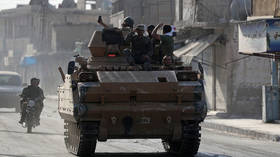
Local residents applaud as a convoy of Turkish forces trucks transporting tanks is driven in Sanliurfa province, southeastern Turkey, at the border with Syria
© AP PHOTO / LEFTERIS PITARAKIS
Local residents applaud as a convoy of Turkish forces trucks transporting tanks is driven in Sanliurfa province, southeastern Turkey, at the border with Syria
According to his Foreign Minister Mevlüt Çavuşoğlu, the op was launched under Article 51 of the UN Charter and UN Security Council Resolutions regarding the fight against terrorism because Turkey considers the Kurdish troops to be affiliated with Kurdistan Workers’ Party (PKK) that Ankara has blacklisted as a terror organisation.
Damascus, however, stressed that the operation is another violation of Syria’s sovereignty. The Arab League also opposed Ankara on the issue and is considering halting military cooperation and lowering of diplomatic ties with Turkey. At the same time, France and Germany have already halted arms exports to Ankara, urging the Middle Eastern country to stop the offensive.

Dozens Rally in DC Calling for Recognition of Kurdish-Led Forces in Syria as Terrorists – Video

Dozens of people on Sunday, 13 October 2019, gathered in the vicinity of the White House in Washington DC to protest the Trump administration's stance on the ongoing Turkish military offensive in northern Syria.

Video: Dozens Rally in DC Calling for Recognition of Kurdish-Led Forces in Syria as Terrorists

00:14 14.10.2019
Dozens of people on Sunday gathered in the vicinity of the White House in Washington DC to protest the Trump administration’s stance on the ongoing Turkish military offensive in northern Syria.
  • 23:36

    US Observation Post in Syria’s Aleppo Evacuated

    According to the Turkish military, one of the US observation points in southern Ayn Al-Arab district of Syria’s Aleppo has been evacuated. There has been no statement issued on the reason for the evacuation so far.
  • 22:28

    Russian Military Warns Daesh Terrorists May Flee SDF Detention Amid Turkey’s Operation

    Daesh (IS, ISIS banned in Russia) terrorists, who are held at seven prisons controlled by the Kurdish-led Syrian Democratic Forces (SDF), may flee the detention facilities amid Turkey’s offensive in northern Syria, provoking a sharp escalation of the situation in the entire Middle East, Maj. Gen. Alexey Bakin, head of the Russian center for Syrian reconciliation said on Sunday.
    According to the official’s data, SDF guards seven Daesh prisons and at least eight camps housing temporarily displaced persons, including terrorist families.
    “The possible exit of terrorists from detention can provoke a sharp deterioration of the situation in the entire Middle East region. All parties to the Syrian settlement must take measures to prevent this scenario,” Bakin said.
    The official also estimates that lives of at least 120,000 people, who are staying at eight SDF-controlled camps for temporarily displaced persons in northern Syria, are at risk amid the Turkish offensive.
  • 22:16

    Kurdish-Led Administration, Damascus Agree to Deploy Syrian Troops Along Turkish Border, Repel Ankara’s Offensive

    The Syrian army conducts mine clearance outside the town of Khan Sheikhoun after its liberation, Idlib province, Syria

    Kurdish-Led Administration, Damascus Agree to Deploy Syrian Troops Along Turkish Border

    22:08 13.10.2019
    Kurdish-led authorities in the northern part of Syria have reached an agreement with the Syrian government in Damascus to deploy Syrian forces along the entire Turkish border to assist in repelling an ongoing military invasion by Damascus.
  • 21:26

    Syrian Army Enters Manbij, North of Aleppo, to Take it Under Control – Reports

  • 21:07

    ‘What Is This Sh*t?’: Syrian Kurds Learnt About US Pull-Out From Twitter – Report

    Members of the special forces of the Kurdish-led Syrian Democratic Forces (SDF) are pictured during preparations to join the front against Turkish forces, on October 10, 2019

    ‘What Is This Sh*t?’: Syrian Kurds Learnt About US Pull-Out From Twitter – Report

    20:04 13.10.2019
    Two days ahead of the start of the Turkish military operation against Syrian Kurds, the US announced that it would be withdrawing its troops from the area in order to avoid getting caught in the cross-fire between the warring parties. Some, however, including the Kurds, saw this as a “betrayal” of groups that had helped the US fight Daesh*.
  • 20:51

    US Army Leaves Ain Issa Area in Syria

    A Sputnik correspondent has reported that the US Army has temporarily left the Ain Issa area east of Tell Abiad because of the Turkish offensive against Kurdish groups in north-eastern Syria. The troops were withdrawn in order to avoid coming under Turkish fire. According to the reporter, the troops were evacuated to military bases in the Syrian province of Raqqa.
    The United States has also evacuated its military base in Jalabiya in the Syrian province of Raqqa, Syrian state TV reported.
  • 20:35

    Macron to Hold Emergency Cabinet Meeting to Discuss Turkey Offensive – Elysee

  • 20:25

    Free Syrian Army Raises Their Flag at Entrance to Tell Abiad

    © Sputnik / Hikmet Durgun
  • 20:17

    French President Macron Says He Made it Clear to Erdogan, Trump That Turkish Operation in Syria ‘Must Stop’

    “We have a common desire that this offensive ends”, Emmanuel Macron said, standing alongside Germany Chancellor Angela Merkel. “This offensive risks creating an unsustainable humanitarian situation and help Daesh re-emerge in the region”.
  • 20:16

    Syrian Army Begins to Move Troops to Face ‘Turkish Army Aggression’ in Northern Syria – Reports

    © Sputnik / Hikmet Durgun
    The Syrian government has started moving troops to the country’s north, where the Turkish military operation Peace Spring is underway, in order to confront Turkey’s aggression, the Syrian news agency SANA reported.
  • 19:47

    Erdogan Says Turkey Has No Problems With Russia on Situation in Syria, Maintains Constant Contact With Putin

    “The Sochi Agreement [with the Russian Federation on Syria’s Idlib] is being successfully implemented as a result of our meetings in Tehran and Ankara. We are not talking about any problems with Russia. We are in touch with President Putin. If there is a question, we can negotiate and accept within 24 hours a joint decision on the steps to be taken”, Erdogan told reporters in Istanbul, as quoted by Anadolu.
  • 19:13

    Reports of Daesh Prisoners Escaping Are ‘Disinformation’ – Erdogan

    “They continuously broadcast disinformation about Daesh terrorists having fled the prison. They do it to incite the United States and the West. The leaders with whom I am in touch ask me about it all the time”, Erdogan said at a press encounter in Istanbul.
    The camp, located seven miles south of the Turkish border, is home to 7,000 displaced persons, among whom 785 are suspected members of Daesh. On Friday, the Kurdish administration announced plans to evacuate the camp’s residents and move them to al-Arisha camp, south of the city of Hassakah.
  • 18:53

    Syrian Army Will Enter SDF-Held Town of Ain Arab and Manbij in 48 Hours – Lebanese Broadcaster

  • 17:58

    Erdogan Says 18 Civilians Killed in Shelling of Turkish Settlements Near Border With Syria

    “The total number of terrorists that have been neutralised during Operation Peace Spring is 490, of them 440 were killed. The near-border settlements of Turkey have been targeted by mortar and rocket attacks from Syria 652 times. During the shelling of our towns by terrorists, 18 civilians have been killed and 147 injured”, Erdogan said in a television statement to the NTV broadcaster.
    Two Turkish servicemen and 16 militants with the opposition Syrian National Army were killed during the military operation, Erdogan added.
  • 15:55

    Merkel Urges Erdogan to Immediately End Turkey’s Offensive in Syria

    In a phone call with Turkish President Recep Tayyip Erdogan, German Chancellor Angela Merkel “spoke in favour of an immediate end to the military operation”, her office said in a statement.
  • 15:52

    Ankara Says it Has Taken Control of Major Highway in Northern Syria After Battles With Kurdish Forces

    Turkish forces have seized control of Syria’s M4 highway, some 30-35 kilometres (19-22 miles) inside Syrian territory, as part of their offensive against Kurdish militants in north-eastern Syria, Turkey’s Defence Ministry said on Twitter.
  • 15:46

    Washington Says Reports of Female Kurdish Politician Being Killed in Northeast Syria ‘Extremely Troubling’

    “We find these reports to be extremely troubling, reflecting the overall destabilisation of northeast Syria since the commencement of hostilities on Tuesday”, a State Department spokesman said in a comment. The official added that Washington denounces any abuse and extrajudicial execution of civilians or prisoners, and is looking further into the circumstances of the incident.

    Kurdish Female Leader Ambushed and Killed in Syria Amid Turkish Offensive – Report

    14:21 13.10.2019
    Ankara’s forces and its allied fighters have been moving ahead with an operation in Syria targeting Daesh* and the Syrian Democratic Forces (SDF) despite criticism from the EU, the US, and the Arab League. According to the Syrian Observatory for Human Rights, at least 38 civilians have been killed since the fighting started five days ago.
  • 15:42

    US President Orders American Troops to Relocate in Syria Amid Turkish Offensive – Pentagon Chief

    US Defence Secretary Mark Esper stated that Donald Trump has ordered US forces in Syria to move south of Turkey’s attacks against Kurdish forces, but not to leave the country.
    Washington Says Reports of Killing of Kurdish Politician in Northeast Syria ‘Extremely Troubling’
    In this photo taken from the Turkish side of the border between Turkey and Syria, in Suruc, southeastern Turkey, a U.S forces outpost is seen on a hilltop outside Ayn Al Arab or Kobani, Syria, Saturday, Oct. 12, 2019.

    US to Pull About 1,000 Troops From Syria’s North Due to Turkish Offensive – Pentagon

    16:00 13.10.2019
    The Pentagon earlier confirmed that some Turkish shelling near the city of Kobani in northern Syria was in close proximity to American troops stationed at an observation post there. Washington insists that Ankara was aware of where its troops were located, while Turkey insists that it never intended to attack American forces.
  • 14:45

    Turkish Offensive to Go 30-35 Kilometres into Syrian Territory – Erdogan

    Turkish forces have seized control of Syria’s M4 highway, some 30-35 kilometres (19-22 miles) inside Syrian territory, as part of their offensive against Kurdish militants in north-eastern Syria, Turkey’s Defence Ministry said on Twitter.
  • 14:22

    Kurdish Fighters Say 800 Daesh Terrorists Have Escaped From Camp

    According to the Kurdish administration in northern Syria, several “mercenaries” (which could mean Turkish-backed militants) attacked the facility, while “Daesh elements” assaulted the guards and left the camp.
  • 13:09

    Turkish Army Enters Syria’s Tell Abiad, Clashes With Kurdish Self-Defence Forces – Reports

    According to recent reports, Turkish troops, backed by Free Syrian Army (FAS) militants, have entered the city. At the same time, Turkish artillery is firing on Kurdish self-defence fighters.
  • 12:13

    Video From Syrian Border Amid Turkish Military Operation Against SDF

    Turkish artillery fires toward Syrian Kurdish positions in Afrin area, Syria, from Turkish side of the border in Hatay, Turkey, Friday, Feb. 9, 2018

    Video From Syrian Border Amid Turkish Military Operation Against SDF

    12:12 13.10.2019
    During the previous day of battles, the Turkish military and the Syrian Democratic Forces (SDF) clashed in the city of Ras al-Ayn. The militants claim they have hit 7 tanks and killed 75 soldiers, while Turkey claimes that it has neutralised 415 SDF fighters since the start of the op.
  • 10:32

    Turkish Forces Seize City of Suluk in Raqqa – Reports

    According to Syrian broadcaster Ikhbariya, on Sunday Turkey occupied the border city of Suluk, which is located in the northeastern part of Raqqa Governorate.
  • 10:21

    Erdogan Tells UK PM Johnson Ankara to Continue Offensive Until Removal of Daesh and PKK Threats

    “Turkish President Recep Tayyip Erdogan has held a telephone conversation with UK Prime Minister Boris Johnson. The president told Johnson about the goals of Operation Peace Spring and said that it would continue until the terrorist threat posed by the PKK — Syrian Kurds’ self-defence forces — and the IS [Daesh] in northern Syria is completely eliminated, allowing the voluntary and safe return of Syrian refugees”, the official statement read.
  • 10:00

    Kurdish-led SDF Says Killed 75 Turkish Soldiers, Destroyed 7 Tanks in Ras al-Ayn – Reports

    According to the Firat news agency, the Kurdish-led Syrian Democratic Forces (SDF) said that they had attacked the Turkish Army in the Syrian city of Ras al-Ayn, leaving 75 soldiers dead and seven tanks destroyed, while 19 more Turkish troops were injured.