Showing posts with label Iceland. Show all posts

Monday, 15 March 2021

Iceland has had 34,000 earthquakes

I have just moved my blog to Iceland!! 

Looking at Iceland’s Recent 34,000 EQ’s, Methane, Sea Ice & Climate with Margo (Mar. 14, 2021)


Margo reviews methane data from CAMS & NOAA for Saturday, 3/13/21. She also shows the current state of the Arctic and Antarctic sea ice and looks at Climate Reanalyzer and recent earthquakes. Margo shares an article about Iceland’s recent earthquakes and elevated volcano threat.


Wednesday, 6 April 2016

Iceland PM resigns

Iceland PM resigns following Panama Papers leak – media

Icelandic Prime Minister Sigmundur David Gunnlaugsson has been seen running from the country's parliament, with some reports suggesting the politician has resigned.
RT,
5 April, 2016

The PM held a meeting at the parliament on Tuesday, where he announced his decision, local media reported.

The resignation still needs the approval of his coalition Independence Party and President Olafur Ragnar Grimsson.


The news of the PM's departure was delivered to the press by Minister of Agriculture and Fishing Sigurour Ingi Johannsson, who is reportedly in line to take over the position, according to the Financial Times.

Gunnlaugsson first tried to seek the dissolution of parliament, but his request was turned down by President Grimsson.

PM running out of the parliament. News expected soon.


The Icelandic politician is believed to be the first victim of the massive offshore holdings leak known as the Panama Papers. According to the revelations, Gunnlaugsson concealed millions of dollars worth of family assets when he and his wife set up a company in the British Virgin Islands, reportedly in an attempt to evade paying taxes.


In the light of the massive leak, Iceland's left-wing opposition has presented a motion of no confidence in the center-right coalition government headed by Gunnlaugsson.


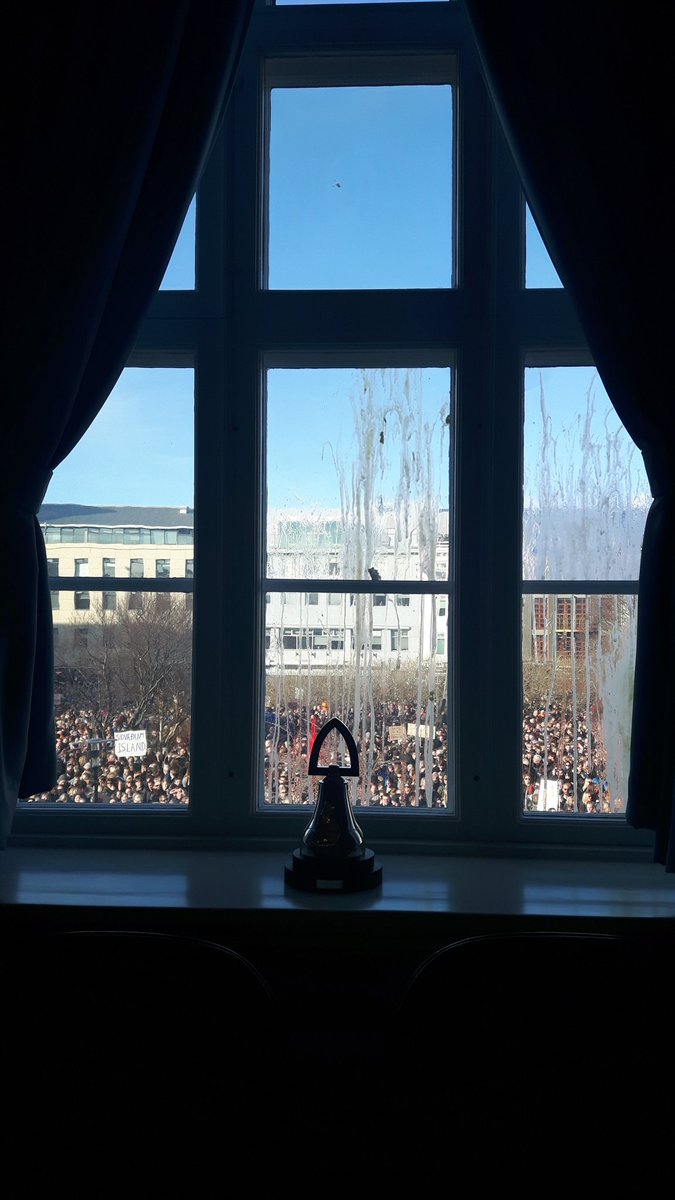
Thousands of people took to the streets in the capital Reykjavik on Monday, demanding impeachment and new elections. The protest in front of the parliament was said to be the biggest in the country's history, with more mass demonstrations having been planned for later on Tuesday.

Earlier on Monday, Gunnlaugsson told the parliament he would not resign amid the protests linked to his alleged financial affairs, which potentially represent a conflict of interest.


"I have not considered quitting because of this matter nor am I going to quit because of this matter," the PM told parliament, as quoted by AP. The defiant politician then added that his government "has had good results... and it is important that [it] can finish its work."

Another resignation linked to the leaked data was announced this week, when a regional head of Transparency International, an organization that seeks to monitor and root out corporate and political corruption worldwide, stepped down. Gonzalo Delaveau, the president of the NGO’s Chilean branch, has resigned, Reuters reported. Although he was not directly implicated in illegal activity by the Panama Papers, the documents showed Delaveau was linked to at least five offshore companies.


Tuesday, 5 April 2016

Mass demostration in Iceland

Panama Papers leak leads to ‘largest protest’ in Iceland’s history

People demonstrate against Iceland's Prime Minister Sigmundur Gunnlaugsson in Reykjavik, Iceland on April 4, 2016 © Stigtryggur Johannsson

RT,
5 April, 2016


Thousands of people have taken to the streets of Iceland’s capital, Reykjavik, outraged by their Prime Minister’s alleged offshore accounts that were brought to light in the so-called Panama Papers.

Wow! I don’t think I remember seeing the place this packed during the economic collapse!
 

Icelandic Prime Minister Sigmundur David Gunnlaugsson reportedly failed to declare his stake in an offshore company based in the British Virgin Islands. The revelation has made Icelanders “mad” at their government, with some demanding a no-confidence vote and the PM’s resignation.


Banners reading “Elections Now” could be seen in the capital, Ice News reported, adding that other posters around the city encourage drivers to honk their horns in protest.

Over 10,000 Facebook users expressed their intent to attend Monday’s protest in Reykjavik. “Over 22,000 protesters [were] confirmed in the square” as the demonstration near the Parliament building grew, reports on Twitter suggested.

Whistleblower Edward Snowden suggested in a retweet that the protest might be the “largest by percentage of population in history.”

The population of Iceland is only 330,000. Largest protest by percentage of population in history?
 
According to the Iceland Monitor, people were angered not only by the revelations of their PM’s unreported accounts, but also by his reaction to the protest. “It’s not like everyone is going to attend,” Gunnlaugsson said in an interview, sparking even more fury.

When asked by the reporter of Icelandic Channel 2 News if he had, at any point, considered resigning in light of the latest revelations, Gunnlaugsson said that he would not resign due to this or any other matter, because his government had achieved “amazing results in very important issues,” and “it’s important that it gets to finish that work.”

He also rejected an idea of stepping aside during the course of the investigation, saying “Simply accusing someone of something in order to force them to resign is not in harmony with how we want our society to function.”

Responding to the accusations against his wife, Anna Palsdottir, the PM stressed that she had always paid taxes in Iceland, even while owning a “foreign” company. According to Gunnlaugsson, it would be wrong to label the firm an “offshore company,” as “it has always been taxed in Iceland.”

People throwing eggs at . The view from the inside.
 
There have been a number of online streams broadcasting the Reykjavik protest, but some were cut off as “the networks are overloaded,” some users reported. One Periscope transmission suggested that the gathering was “one of the biggest in Icelandic history,” while other users commented, “Icelandic people always make me proud,” “Well done Iceland, leading the way,” and even calling the Nordic country “the hope of mankind.”

Documents known as the Panama Papers were published on Sunday. Said to be “the largest leak in offshore history,” the data claims to reveal the offshore holdings of over a hundred international politicians and public officials, including 12 current and former world leaders.


Wednesday, 16 March 2016

Temperature extremes


Like Hot Weather? Go to North Iceland


Siglufjörður.
From the old herring harbor in Siglufjörður. Photo: Páll Stefánsson.
14 March, 2016

Yesterday, an Icelandic heat record for the first 26 days of March was broken in the northernmost town of Iceland, Siglufjörður, when the temperature reached almost 18°C (65°F), mbl.is reports.

The second warmest town in Europe yesterday was Alicante, southern Spain, with 16°C (61°F).
Yesterday, the temperature in Athens, Greece, reached 8°C (46°F), as in London and Stockholm. The temperature in Berlin was 5°C (41°F), and it was only 1°C (34°F) in Moscow. ​


Thursday, 31 December 2015

Storms from the Mississipi to the North Pole - THE BIG PICTURE

Jeff Masters writes about the Big Picture

Historic Unseasonable Flood Begins on Mississippi River; 928 mb Low Hits Iceland


30 December,2015

By: Jeff Masters , 5:13 PM GMT on December 30, 2015
   
  
A historic and unseasonable flood has begun on the Mississippi River and its tributaries, thanks to heavy rains that fell from Oklahoma to the Ohio Valley during Christmas week. Never before has water this high been observed in winter along the levee system of the river. The Father of Waters began over-topping its levees just north of West Alton, Missouri (population 500) on Tuesday, forcing evacuations. West Alton lies at the confluence of the Missouri and Mississippi Rivers, about 7 miles upriver from St. Louis. The river is still rising at West Alton, and is expected to crest on Thursday morning at the second highest level ever recorded, about 5' below the disastrous flood of 1993. On Friday, the massive Mississippi River flood crest will reach St. Louis, bringing the second highest waters levels ever recorded there (flood records extend way back to 1785 in St. Louis.) The three river gauges downstream from St. Louis--at ChesterCape Girardeau, and Thebes--are expected to see their highest water highest levels ever recorded on Friday and Saturday. The latest flood forecasts for the Mississippi River issued Tuesday evening by NWS River Forecast Center predicted that Thebes would be the last location to see an all-time record crest in this flood; below Thebes, flood crests between the 2nd and 4th highest on record are expected along most of the Mississippi and the lower portions of two main tributaries, the Ohio and Arkansas Rivers. As with weather forecasts, the margin of uncertainty in river-crest predictions increases over longer time periods. According to a Wednesday morning summary by TWC's Jon Erdman, the following flooding and flood impacts can be expected farther down river:

• Memphis: Crest late next week higher than 1997 and 1973 floods, but well below 2011 and 1937 floods.

• Vicksburg, Mississippi: Crest in mid-January expected to exceed 1973 flood, but well below 2011 and 1927 floods. Some flooding of city streets and businesses possible.

• Natchez, Mississippi: Crest around MLK holiday may top 1937 flood, but should remain below 2011 record flood. Flooding of Ft. Adams likely.

• Baton Rouge, Louisiana: Crest during MLK week comparable or just below May 2011 flood possible. Areas outside of levee protection may flood. Shipping and industrial activities may be significantly impacted.


Figure 1. The Mississippi River downstream of St. Louis at Thebes was at major flood stage on Wednesday morning, and was forecast to crest on Friday at the highest level ever observed. Flood records at this location extend back to 1844. Image credit: NOAA/AHPS.

On January 20, the flood crest is expected to arrive in New Orleans, bringing the Mississippi River to its 17-foot flood stage in the city, just 3 feet below the tops of the levees. In past years, though, when the river has been forecast to rise to 17 feet in the city, the Army Corps of Engineers has opened up the Bonnet Carré Spillway in St. Charles Parish, which diverts water into Lake Pontchartrain and keeps the river from reaching flood stage in New Orleans. The Corps may also be forced to open the Morganza Floodway in Pointe Coupee Parish, which would divert water down the Atchafalaya River. Opening this spillway has a considerably higher cost than opening the Bonnet Carré Spillway, due to the large amount of agricultural lands that would be flooded below the Morganza Floodway. The Corps also has the option of increasing the flow of Mississippi River water into the Atchafalaya at the Old River Control Structure in Concordia Parish. Operating the Old River Control Structure in this way, though, puts stress on the structure, as I explained in my 2011 blog post, 
America's Achilles' heel: the Mississippi River's Old River Control Structure

The Tuesday evening forecast from the NWS River Forecast Center predicted that the Mississippi River would crest at Red River Landing, where the Old River Control Structure is located, on January 19. The predicted crest of 62.5' is just 0.9' below the all-time record crest of 63.39' set on May 18, 2011. A water level this high has a good chance of forcing the Army Corps to open the Morganza Floodway in order to relieve pressure on the Old River Control Structure. Both the Bonnet Carré Spillway and Morganza Floodway were opened in May 2011, when the highest flood crests ever observed on the Lower Mississippi arrived. This flood cost approximately $3 billion; $1 billion was required just to repair the damage done to the levee system and various other components of the flood control system damaged by the flood, according to Charles Camillo's book, Divine Providence: The 2011 Flood in the Mississippi River and Tributaries Project. I expect the damage from the December 2015 - January 2016 Mississippi River flood will run into the hundreds of millions. According to aWednesday news story in The Advocate, the Army Corps will make a decision by January 9 on whether or not to open the Bonnet Carré Spillway. The last time the spillway was opened in January was back in 1937, its first year of operation. In a Wednesday morning Press Release, the Army Corps of Engineers indicated that they are mobilizing people, barges and operational equipment to open a third floodway on the Mississippi River near its confluence with the Ohio River--the Birds Point - New Madrid floodway. Opening up this floodway would help relieve pressure on the levees near Cairo, Illinois, something the Corps was forced to do in May 2011. However, the Corps said that they do not anticipate operating the floodway during the current flood, if current flood height predictions hold.

Figure 2. Existing flood stage on December 28, 2015 (inner colored square) and predicted maximum flood stage (outer colored square region around the inner colored square) for the Lower Mississippi River and two tributaries (the Arkansas and Ohio Rivers) near where they join the Mississippi. I've added numerical ranking on the right side of the squares to indicate where a top-ten flood crest in recorded history is expected. Two gauges are expecting their highest floods on record (Cape Girardeau and Thebes), and most of the Lower Mississippi is expecting a top-five highest flood crest on record. Where the Ohio River joins the Mississippi at Cairo, Illinois, the Ohio River is forecast to crest on January 5 at the third highest level on record; downstream from Little Rock, Arkansas, the Arkansas River is predicted to crest on Friday at the third highest level on record near its confluence with the Mississippi. Image credit: NWS River Forecast Center.
Massive 928 mb storm pummels Iceland and the UK

A massive North Atlantic low pressure system dubbed "Frank" bombed to a central pressure of 928 mb on Wednesday morning and moved over Iceland, bringing heavy rains to Iceland and the UK and hurricane-force winds to the ocean waters between. According to Weather Underground's weather historian Christopher C. Burt's 2011 post, 
World and U.S. Lowest Barometric Pressure Records, the storm missed setting a lowest pressure for Iceland; the lowest pressure measured on the island is probably the 923.6 mb reading on December 2, 1929. Chris also notes that there are two storms in the North Atlantic that likely had a minimum pressure below 920 mb:1) Storm of January 10, 1993 deepened to a central pressure of 912-915 mb (26.93”-27.02”) between Iceland and Scotland near 62°N, 15°W2) Storm of December 15-16, 1986 deepened to at least 916 mb southeast of Greenland near 62°N, 32°W. A ship in the vicinity actually made a measurement of 920.2 mb on December 15th while still some distance from the center of the storm. The British Meteorological Office assessed the central pressure of the storm at this time as being 916 mb (27.05”), but the West German meteorological service proposed a pressure possibly as low as 912-913 mb (see Stephen Burt article in Weather magazine Vol. 42 pp. 53-56, February 1987).

Some links to more info on Frank, courtesy of wunderground member barbamz:
Extreme Weather Causes Damage in East Fjords
Iceland Review, By Vala Hafstad Nature & Travel about 2 hours ago 
The severe weather in the East Fjords is among the worst residents have ever experienced, RUV reports. The situation is the worst in Eskifjordur, where a high sea level land hurricane-force winds have threatened the marina. Part of the dock came loose, but rescue workers managed to fasten it. The surf has inundated all docks and the whole harbor area. Roof sheets have blown off several houses. There was high tide at 5:30 am, but since then, water levels have subsided somewhat. Boats that came loose in the marina were successfully tied down. Basements have flooded and tidal waves have reached cabins, never before affected by sea water. Some homes are without power...

VIDEO: "Absolutely crazy" storm in East Iceland

Iceland Monitor | Wed 30 Dec 2015 | 9.56 GMT
BBC Live: Storm Frank hits UK
Guardian: Storm Frank: further floods expected as gales and rain batter British Isles - live


BBC live report especially for Cumbria.


Figure 3. Surface analysis from 06 UTC December 30, 2015 showing intense Winter Storm Frank with a central pressure of 928 mb over Iceland. mage credit: NOAA Ocean Prediction Center.
Incredibly warm air flowing to the North Pole

The counter-clockwise flow of air in advance of Wednesday's Icelandic low is following an unusually contorted kink in the jet stream and pumping relatively warm air all the way to the North Pole, where temperatures near freezing may be occurring. According to Rick Thoman of the National Weather Service in Fairbanks, Alaska, a buoy (64760) just 180 miles from the Pole, at 87.4°N, 154.4°E, reported a 1200 UTC December 30, 2015 temperature of -0.1°C with a -1.6°C dewpoint. Looking at the obs available for the past few days, there is nothing obviously bogus: the buoy was reporting -25°C two days ago. Bob Henson 
tweeted this fact on Tuesday:reanalysis maps dating back to 1948 (courtesy Steven Cavallo, University of Oklahoma) show only three cases where the North Pole Temperature reached the freezing mark or above in December (and no cases in January - March.) Andrew Freedman of Mashable has more on this freak Arctic warm wave in a Tuesday post.

Figure 4. Temperature analysis from the 00 UTC December 30, 2015 run of the GFS model, showing temperatures near freezing (aqua colors) penetrating very close to the North Pole. These temperatures are about 20°C (36°F) above average. Image credit: University of Maine Climate Reanalyzer.