Showing posts with label Hamas. Show all posts

Thursday, 15 November 2018

Israeli FM Liebermann resigns over "surrender to Hamas"


Political Crisis In Israel: Defense Minister Resigns, Slams Netanyahu For "Surrendering to Hamas"


14 November, 2018


"If Lieberman resigns, Netanyahu will dissolve the Knesset" — report senior Israeli government sources following a formal announcement by Lieberman confirming he has quit his post as defense minister. 

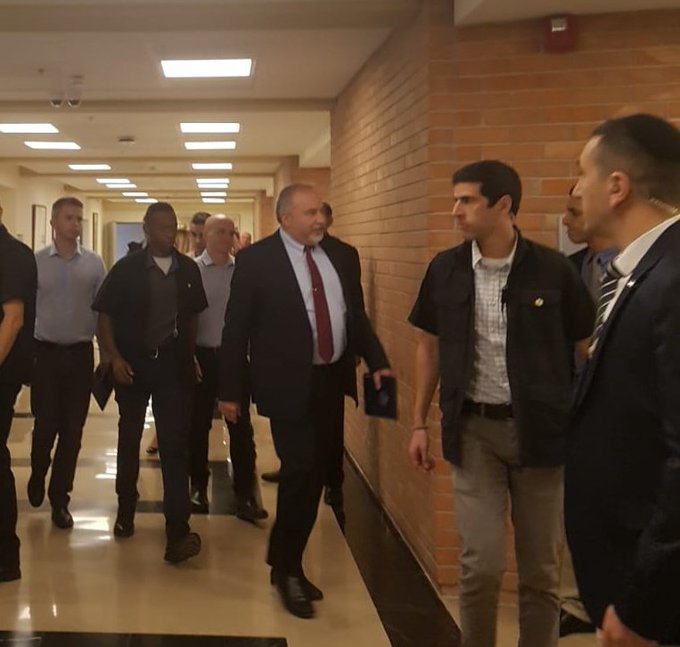
Minister of Defense Avigdor Lieberman resigned his post after a dramatic escalation in Gaza since Sunday's controversial Israeli special forces assassination raid on a top Hamas commander, sparking a political crisis in Israel. He made a formal announcement of his exit Wednesday during a televised news conference.

In a rare public fissure over defense strategy Lieberman slammed Prime Minister Netanyahu for "surrendering to Hamas terror" over the prime minister agreeing to a ceasefire deal with Hamas on Tuesday. The ceasefire went into effect after two days of a record number of rockets fired out of Gaza, with the AP reporting 460 rockets and mortars in a 24-hour period, and an Israeli response of pummeling 160 Gaza targets.

Israel's Haaretz further indicated Lieberman was enraged over a recent statement from Netanyahu's office, which falsely indicated that he was fully behind the prime minister's push for a ceasefire with Hamas. 


Lieberman has also lately clashed with other officials over allowing Qatar to transfer $15m in humanitarian funds to Gaza, and granting Qatar access to supplying fuel operations in the strip. According to the outgoing defense chief, he was the only minister who took a stance against transferring funds to Hamas in a security cabinet meeting two weeks ago. He's competed with others within his own governing coalition over who's more hawkish on Gaza. 


"If I were to continue as defense minister I wouldn't be able to look the residents of the south in the eye," he said, according to the The Jerusalem Post, referencing Tuesday's ceasefire with Hamas. "This will severely harm our security in the long term," he added in comments directed at Netanyahu and his supporters.


"What we're doing now as a state is buying short-term quiet, with the price being severe long-term damage to national security," Lieberman said.


Lieberman announced further that his Yisrael Beitenu (Israel Our Home) party, which holds five seats in the 120-seat parliament, would leave the governing coalition and requested that new elections be held: "We should agree on a date for elections as early as possible," he said.


It's a major blow to Netanyahu and Israel's ruling coalition that's being described as nothing short of a huge crisis. It's further the domestic blowback of the weekend's adventurism in Gaza which led to Hamas successfully destroying an IDF bus with an anti-tank rocket. 


View image on Twitter

An anti-tank guided missile (Kornet) and an IED fired by hit the heart of @netanyahu and is bringing down his government: defence minister Liberman resigned.
58 people are talking about this

Hamas meanwhile is claiming victory after breaking news of the defense minister's impending resignation, calling it in an official statement a "political victory for Gaza."


Hamas spokesman Sami Abu Zuhri described Avigdor Lieberman's resignation Wednesday as the "recognition of defeat and failure to confront the Palestinian resistance." He said "Gaza's steadfastness sent a political shockwave" in Israel.

It's certainly a rare moment when it's the Palestinian side that can sit back and watch political chaos unfold in Tel Aviv. It's also rare to see Netanyahu get out-hawked by his own former allies and defense officials.
 
Chaos In Israel: Are Bibi's Days Numbered?

RonPaulLibertyReport


Sunday, 11 January 2015

Islam vs Takfirism

Israel, the US, and the West are turning this into a "war of civilisation" while giving rise to, and succouring the very forces they clim to be fighting

"ISIS is Hamas and Hamas is ISIS," , says Netanyahu.

This is a totally false dichotomy, as repeatedly made clear by the Saker - this is something I totally agree with.

"Appreciate the difference between the Islam of Hezbollah and Iran, on the one hand, and that of the Saudis, Qatar, ISIS, FSA etc on the other - and no, it isn't mainly to do with Sunni and Shia …


Here are the responses to Hamas, Hezbollah and Chechen leader, Kadyrov.

This is often painted as a Shi'ia vs Sunni thing. Both Hamas and Kadyrov are Sunnis, not Shi'a

Hezbollah leader on Charlie Hebdo: ‘Extremists more offensive to Islam than cartoons’


RT,
10 January, 2015

Islamic extremists following a ‘takfiri’ ideology are more offensive to the Prophet Mohammed than Western satirical cartoons, chief of the Lebanese military faction Hezbollah, Hasan Nasrallah, said following the Charlie Hebdo terrorist attack.

"The behavior of the takfiri groups that claim to follow Islam have distorted Islam, the Koran and the Muslim nation more than Islam’s enemies ... who insulted the prophet in films... or drew cartoons of the prophet," the Hezbollah leader said in a televised speech to mark the birthday of the Prophet Mohammed, according to Lebanon’s Daily Star.

Militant Islam practices a ‘takfiri’ doctrine that allows it to brand other Muslims apostates for allegedly going against the faith’s true teachings.
A tragic attack on Wednesday took the lives of 12 people, when armed gunmen stormed the offices of satirical magazine Charlie Hebdo in Paris, prompting a citywide manhunt. The magazine had printed cartoons that mocked the Prophet.

Nasrallah went on to say that “Takfiris are the biggest threat to Islam, as a religion [and] as a message.”

The Charlie Hebdo terror attack should be taken as “revenge for the honor” of Islam’s prophet, according to a source allegedly belonging to Yemen’s branch of Al-Qaeda, who wrote to several news outlets with the message.

French riot police block the avenue Kleber after an alert in Paris, January 9, 2015.(Reuters / Philippe Wojazer )

The reaction to the attack was one of global outrage, both in the Christian and Muslim worlds. Egypt’s President Abdel Fattah al-Sisi sent his condolences to President Hollande, saying, “terrorism is an international phenomenon that should be faced and terminated through joint international effort.”


Israeli leader Benjamin Netanyahu also spoke out against radical Islam, calling the incident “a murderous attack on free expression” and an indication “of the disdain of radical Islam for the values we hold dear.”

The Israeli PM drew parallels between the Paris massacre and rocket attacks on Israeli cities by the Palestinian Islamist group, Hamas.
Hamas released a statement in French on Saturday, in which it also condemned the Charlie Hebdo attack.
“Differences of opinion and thought cannot justify murder," the group said in a statement, cited by AFP.

Hamas also slammed Netanyahu for his “desperate attempts… to make a connection between our movement and the resistance of our people on the one hand and global terrorism on the other.”

Similar comments came from the Palestinian authority, who called the attack a “heinous crime.”

As for Lebanon’s own government, Prime Minister Tamman Salam has condemned Wednesday’s actions as an “unacceptable and unjustifiable terrorist act.”

The manhunt for the Charlie Hebdo terror attack suspects, Cherif and Said Kouachi, ended dramatically on Friday. Both were killed in a shootout with police in Dammartin-en-Goele northeast of Paris, while one policeman was injured. A worker who was taken hostage by the attackers was freed.
However, other hostage situations in France arose promptly, with at least one carried out by accomplices of the Kouachis.
French Prime Minister Manuel Valls said on Friday that he is not ruling out the possibility of more terrorist attacks against the country.

Hamas condemns deadly attacks on French weekly


10 January, 2015

Palestinian resistance movement Hamas has condemned the recent terrorist attack on the French satirical magazine, Charlie Hebdo.

The group issued a statement in French on Saturday, condemning last Wednesday's deadly shooting on the weekly, which left 12 people dead.

“Difference of opinion and thought is no justification for killing,” the statement said.

The statement also slammed Israeli Prime Minister Benjamin Netanyahu for drawing a parallel between attacks in Paris and Hamas’ resistance against Israel.

Netanyahu on Wednesday rushed to issue a statement on Paris attacks, by claiming that Israel has experienced similar attacks by Hamas and Hezbollah.

Hamas criticized Netanyahu for making “such connection” and described the move as “disparate.”

Terrorist groups in the Middle East, including ISIL and al-Qaeda branches, have claimed responsibility for the attacks in France, threatening to target the United States and Britain next.

Ramzan Kadyrov on Takfiri 


terrorism


Ramzan Kadyrov on fighting terrorism from Oceania Saker on Vimeo.


Netanyahu's recruitment of the Hebdo attack


9 January, 2015

On Wednesday two gunmen attacked the office of Charlie Hebdo, the French satirical magazine, killing eight of the publication's journalists, including its chief editor, along with four other people, including a maintenance worker, a visitor and two police officers. Paris is mourning the tragic incident, and condolences have flooded in from across the globe.

Israeli Prime Minister Benjamin Netanyahu offered his condolences to the French president shortly after news of the attack. He stressed that Europe should stand alongside Israel in the fight against "radical Islam". In a meeting with the Norwegian foreign minister on Thursday, Netanyahu stated: "Israel is being attacked by the very same forces that attack Europe. Israel stands with Europe. Europe must stand with Israel."

The goal of Islamic terror "is not agreement or borders or even Israel", Netanyahu said on Wednesday night in response to the attack. "Not mainly Israel and not primarily Israel. The key goal of Islamic terror is to destroy our societies and our countries." In a separate comment he said: "The terrorists want to destroy our freedoms and our civilization therefore all free countries and all the civilized societies have to band together to fight this scourge."
He stressed: "These extremists are part of a global movement and this necessitates a global response." The "terror" of Hamas, Hezbollah, ISIS and Al-Qaeda won't end "unless the West fights it physically, rather than fighting its false arguments."
Netanyahu has repeatedly attempted to widen the threat Hamas and other Palestinian militant factions pose beyond Israel to Western nations in order to garner support. The rise of the Islamic State (ISIS) was capitalised upon by Netanyahu for exactly this; it rallied support as criticism over the summer's relentless bombing of Gaza grew. In an address to the United Nations General Assembly, Netanyahu sought to justify the bombardment, dubbed "Operation Protective Edge", by tying Palestinian militant resistance to ISIS and painting Israel's battle against the resistance groups as a "microcosm of the fight against global jihad".
"ISIS is Hamas and Hamas is ISIS," he said. By uniting Palestinian militant groups such as Hamas with organisations like Al-Qaeda under the umbrella of radical Islamic terrorism, he is hoping to unite Israel with the leaders of the US and Europe.
France voted in favour of a Palestinian resolution at the UN Security Council at the end of December. The resolution demanded an end to the Israeli occupation of the Palestinian territories within three years. In response, Israel summoned its ambassador to Paris. Aside from the resolution, there was also a vote in the French parliament calling on the government to recognise the Palestinian state, as well as the French initiative to formulate a Security Council resolution setting a timetable for an permanent peace treaty with a framework for the negotiations on the core issues such as borders and Jerusalem.
France's vote, and other moves, will have aroused concern in Netanyahu. Israel is embroiled in a battle for public opinion. After "Operation Protective Edge", people and politicians started to question Israel's argument of self-defence in the face of such high Palestinian civilian causalities. Moves within parliaments in various European countries reflected that, even if they were merely symbolic.
Netanyahu will attempt to capitalise on the incident in Paris as much as possible. By pitting states such as France against one global enemy: radical Islam, he is grasping for unity. The vision of this enemy is one which fails to distinguish between Palestinian militants attempting to resist occupation and two gunman not yet affiliated with any group or faction who shot people who worked for a magazine which published cartoons that they presumably found offensive. It is a vision which hankers for an "us" versus "them" or "Islam" versus the "West" mentality, a vision which divides more than it unites.


PressTV's The Debate: How 


Muslims can counter 


Takfirism?


Muslim scholars and pundits from different parts of the world have participated in a conference in Iran’s holy city of Qom in a bid to find ways of countering the threat of Takfiri ideology and extremism.

Iran’s Grand Ayatollah Nasser Makarem Shirazi, the chairman of the conference, emphasized during the opening ceremony that Takfiris harm both Islam and the human society, adding, that there must be serious efforts in order to root out the extremist ideology of the Takfiris.

Iraqi Foreign Minister Ibrahim al-Jafari, a participant of the conference, also called on Muslim scholars to enlighten the world that how much ISIL is un-Islamic, saying that the issue of Takfiris is not sectarian as both Sunnis and Shias have been targeted.

In this edition of The Debate, Press TV has conducted an interview with Kevin Barrett, Islamic scholar form Madison, and Anjem Choudary, Salafi cleric from London, to delve into Takfirism, its causes, and the ways of countering it.

Sunday, 27 July 2014

News from the Middle East - 07/26/2014

Israel-Gaza conflict: Death toll hits 1,000 amid 12-hour ceasefire

The number of people killed in the conflict between Israel and Gaza has reached 1,000 as a 12-hour humanitarian ceasefire to allow civilians to seek aid and evacuate to safer areas of the region continues today.


26 July, 2014


An Israeli government official has since been quotes as saying Israel is "leaning toward" extending the 12-hour humanitarian truce by at least four hours.


At least 85 bodies have been pulled from the rubble during the lull in fighting, bringing the Palestinian death toll to an estimated 985 since the conflict began 18 days ago.


Over 5,700 have been wounded and tens of thousands have been left displaced by shelling, according to officials. Forty Israelis have also been killed in cross-border fighting.


In the southern town of Khan Younis, 20 members of the same extended family, including at least 10 children, were killed by tank fire that hit a building on the edge of town, according to Palestinian health official Ashraf al-Kidra.


Hundreds of men marched in a funeral procession in Khan Younis Saturday afternoon, chanting "there is only God" while carrying the bodies.


The Israel Defence Forces (IDF) says the 12-hour pause began at 8am local time (5am GMT). During this time, it said it will continue to "locate and neutralise" tunnels used by Hamas and warned the military "shall respond if terrorists choose to exploit" the lull to attack Israeli troops or civilians.

Hamas said that the group had agreed to the 12-hour lull to allow civilians to receive aid and find safer areas. Hundreds of Palestinians poured into the streets in the minutes after the truce took force, with many heading to banks which have briefly re-opened. Others inspected damage and stocked up on supplies.


Turkey lifted a ban on flights to Tel Aviv's Ben Gurion airport three hours after the truce was announced, according to an announcement on Twitter.


The ceasefire was agreed upon by both sides after US Secretary of State John Kerry, currently visiting the region, failed to broker a seven-day truce as a first step toward a broader deal.


It comes as 19 Palestinians were killed in airstrikes overnight and two Israeli soldiers were also killed in Gaza.


Israel on Friday rejected international proposals for an extended ceasefire, a government source said, but Mr Kerry, speaking in Cairo, said no formal proposals had yet been put forward.


Britain's United Nations ambassador had earlier said there may be "an extremely short" humanitarian pause in the conflict in Gaza between Israel and Hamas today lasting several hours


Mark Lyall Grant told reporters that Britain is very disappointed at the failure to reach agreement on a sustainable ceasefire but suggested a humanitarian pause could "open up a little bit of space to work on a more sustainable ceasefire".
He said foreign ministers from the US, UK Turkey and other countries are meeting in Paris today "to decide precisely on the next steps".

But there were fears that after the temporary ceasefire, there could be an escalation in the fighting.

Israel's defence minister warned on Friday Israel might soon expand its Gaza ground operation "significantly".

The temporary lull was unlikely to change the trajectory of the current hostilities amid ominous signs that the Gaza war is spilling over into the West Bank.

In a "Day of Rage," Palestinians across the territory, which had been relatively calm for years, staged protests against Israel's Gaza operation and the rising casualty toll there.

On Thursday night, 10,000 demonstrators marched in solidarity with Gaza near the Palestinian administrative capital Ramallah - a scale recalling mass revolts of the past.

In the West Bank, at least five Palestinians were killed by Israeli fire, hospital officials said.

Israel wants more time to destroy Hamas military tunnels and rocket launching sites in Gaza, while the territory's Hamas rulers want international guarantees that a Gaza border blockade will be lifted before they cease fire.

Overnight, militants fired a barrage of rockets out of Gaza, triggering sirens across much of southern and central Israel. No injuries were reported, with the Iron Dome interceptor system shooting down some of the projectiles.

Meanwhile, heavy Israeli shelling was reported in the town of Beit Hanoun in the northern Gaza Strip, an area where ground troops are operating.

One shell hit near the emergency department of Beit Hanoun hospital, wounding six people, including a foreign national who was not identified further, the Red Crescent said. Two of the wounded were in critical condition.

Residents returning during the ceasefire encountered widespread destruction across the area.


Shells also hit an ambulance in Beit Hanoun, killing a paramedic and wounding two people, the Red Crescent said.

US Evacuates Libya Embassy Following Biggest Local Violence Since Gadhafi Ouster


26 July, 2014


The Middle East is burning again: first it was the fascinating ascent of the brutal Al-Qaeda spinoff ISIS, creating its own Caliphate in northern Iraq and in the process taking over a third of Syrian territory as well as all of its oil infrastructure. Then, the latest iteration of the Israel vs Gaza conflict has now claimed over 1000 lives and is dragging virtually all neighboring countries into it as well. And the cherry on top is that the Libyan "liberation" by the US has just gone full circle, as the country is is now witnessing one of its worst spasms of violence since Gadhafi’s ouster. End result: nearly two years after the deadly attack on the US embassy in Benghazi, moments ago the US once again shuttered its embassy in Libya, this time in Tripoli, evacuating more than 150 Americans to Tunisia.  This is happening just 24 hours after the US Secretary of State was literally next door in Egypt, assuring the region that peace and stability are just around the corner.


From NBC:


More than 150 Americans have been evacuated from the U.S. embassy in Tripoli, Libya, amid spiraling militant violence aimed at the Libyan government. "The U.S. together with other countries have decided that because of the freewheeling militia violence that is taking place particularly around the embassy ... it presents a real risk to our personnel," Secretary of State John Kerry told reporters during a trip to France.
American officials told NBC News that the 158 Americans, including 80 heavily armed U.S. Marines, left the embassy compound early Saturday in a caravan of SUV's and buses and drove west toward neighboring Tunisia. Besides the Marines who were the embassy’s security force, the caravan was also protected overhead by two American F-16 fighter jets and unmanned drones that shadowed the group on their drive.
At least two American warships, a guided-missile destroyer, the USS Ross and a guided-missile cruiser, the USS Vella Gulf, were nearby in the Mediterranean in case additional military protection was needed, officials told NBC News.
While there appeared to be no direct threat of an attack against the embassy, the rising violence in Libya recently prevented delivery of food and other vital supplies to the embassy over roads now largely controlled or threatened by rebel militant forces, the officials added.


While it needs no reminding, CBS does so nonetheless, that  "the move marks the second time in a little more than three years that Washington has closed its embassy in Libya. In Feb. 2011, the embassy suspended operations amid the uprising that eventually toppled longtime leader Moammar Gadhafi. After the formation of a transitional government in July, 2011, the embassy reopened in September. Gadhafi was killed in October of 2011."


The Obama administration has been particularly sensitive about security of U.S. government employees in Libya since the Sept. 11, 2012, attack on the U.S. mission in the country’s second largest city of Benghazi that killed ambassador Chris Stevens and three other Americans. The administration is still fending off criticism from Republicans and others that it did not either enhance security in Benghazi or evacuate the mission due to rising violence in that city in the months prior to the attack.
The Benghazi mission was abandoned after that attack and never reopened. The embassy In Tripoli has been operating with reduced staff since but has remained open even as the violence intensified.


But wait, didn't Brent drop recently because the political situation in Libya was getting better? Recall from Goldman:


On July 2, federalist rebels handed the central oil terminals of Ras Lanuf and Es Sider back to the Libyan government, with a combined capacity of 560 thousand barrels per day. The government lifted the force majeure on July 6, allowing the NOC to start marketing crude from the ports. This development points to a potential sharp ramp-up in Libyan oil production from its current 320 thousand barrels per day level as well as a ramp-up in exports that have been erratic so far this year. This has led to a decline in crude oil prices, with Brent prices down nearly $2.00/bbl since Reuters first reported this deal and currently trading near $110/bbl, although the lack of further deterioration in Iraq, where exports remain undisrupted, has also contributed to the broader decline in prices over the past two weeks.

Apparently not.


In Tripoli, the militias are fighting mostly for control of the airport. They are on the government’s payroll since authorities have depended on them to restore order.
The U.S. is just latest in a number of countries to have closed down their diplomatic operations in Libya. Turkey on Friday announced that it had closed down its embassy and militia clashes in Benghazi have prompted the United Nations, aid groups and foreign envoys to leave.
In Tripoli, clashes near the international airport have forced residents to evacuate their homes nearby after they were hit by shells. On Friday, the official Libyan news agency LANA reported that explosions were heard early in the day near the airport area and continued into the afternoon.
The battle in Tripoli began earlier this month when Islamist-led militias — mostly from the western city of Misrata — launched a surprise assault on the airport, under control of rival militias from the western mountain town of Zintan. On Monday, a $113 million Airbus A330 passenger jet for Libya’s state-owned Afriqiyah Airways was destroyed in the fighting.
The rival militias, made up largely of former anti-Gadhafi rebels, have forced a weeklong closure of gas stations and government offices. In recent days, armed men have attacked vehicles carrying money from the Central Bank to local banks, forcing their closure. 
Libyan government officials and activists have increasingly been targeted in the violence. Gunmen kidnapped two lawmakers in the western suburbs of Tripoli a week ago and on Friday armed men abducted Abdel-Moaz Banoun, a well-known Libyan political activist in Tripoli, according to his father.

Finally, there is of course the obligatory spin:

To be clear, our embassy in Tripoli is not closed. We have temporarily suspended operations. Difference is an important one.

Full statement from the State Department on the evacuation:


Due to the ongoing violence resulting from clashes between Libyan militias in the immediate vicinity of the U.S. Embassy in Tripoli, we have temporarily relocated all of our personnel out of Libya.
We are committed to supporting the Libyan people during this challenging time, and are currently exploring options for a permanent return to Tripoli as soon as the security situation on the ground improves. In the interim, staff will operate from Washington and other posts in the region.
Securing our facilities and ensuring the safety of our personnel are top Department priorities, and we did not make this decision lightly. Security has to come first. Regrettably, we had to take this step because the location of our embassy is in very close proximity to intense fighting and ongoing violence between armed Libyan factions.
This relocation was done over land, with our personnel arriving in Tunisia this morning, and traveling onward from there. We are grateful to the Government of Tunisia for its cooperation and support.
We will continue to engage all Libyans and the international community to seek a peaceful resolution to the current conflict and to advance Libya’s democratic transition. We reiterate that Libyans must immediately cease hostilities and begin negotiations to resolve their grievances. We join the international community in calling on all Libyans to respect the will of the people, including the authority of the recently-elected Council of Representatives, and to reject the use of violence to affect political processes. Many brave Libyans sacrificed to advance their country toward a more secure and prosperous future. We continue to stand solidly by the Libyan people as they endeavor to do so.

Turns out "it does make a difference after all."


The story that is being ignored

ISIS ‘beheads scores of Syrian soldiers’ after daring assault on army base

Jihadist group ISIS published photos of the beheadings of soldiers and officers at a Syrian government base near the eastern city of Raqqa after rebel forces reportedly breached a stronghold that had not been captured since the start of the conflict.


RT,
26 July, 2014


Conflicting reports have emerged regarding the outcome of the attack, which began when two Saudi suicide bombers simultaneously detonated their payload at different points of the Division 17 base perimeter on Thursday.
Hours of intense firefights followed. The jihadists – who already control much of the northeastern province – attacked from the ground, while government forces used helicopters to strike back while holding fortified positions.
“Our brothers stormed the building where dozens of soldiers were inside. We lost 13 martyrs in these battles,” a self-proclaimed ISIS fighter told The New York Times anonymously through Skype.

By Friday evening, the Sunni jihadists began to post video and photo evidence from inside the Division 17 living quarters, in which its fighters burned the portrait of Syrian President Bashar Assad while displaying alcohol and other forbidden items that they purportedly found in soldiers' lockers. They also claimed that government troops had scattered to nearby villages. Those who were caught were summarily executed. ISIS posted a picture of beheaded officers on Twitter, their heads placed in the central town square.“I could see only bodies; there were, like, 70 scattered everywhere. Now our brothers with their trucks will bury them in a mass grave,” said the anonymous ISIS fighter.

Photo from www.liveleak.com

The government claimed that the base had not been taken over, but that its troops withdrew tactically, awaiting reinforcements ahead of a counter-attack.

The UK-based Syrian Observatory for Human Rights said at least 85 government soldiers died (50 through executions), along with nearly 30 ISIS fighters. It added, however, that the government's losses may be heavier than initially believed.
"Hundreds of troops surviving withdrew on Friday to safe places – either to nearby villages whose residents oppose IS or to nearby Brigade 93 – but the fate of some 200 remains unknown," said the group's director, Rami Abdel Rahman.

The Observatory also said that 90 people died in a concurrent attack on a government oil field in Homs.


Photo from www.liveleak.com

ISIS, which has declared an Islamic caliphate that stretches from the Mediterranean coast to eastern Iraq, has captured several oil and gas fields, both as an attempt to boost its own earning capacity and to impede its enemies.

The group, which has positioned itself in antagonism to more moderate opposition factions, was long thought to be tactically cooperating with the Syrian government. But events of the past week, in which more than 1,000 combatants have died in clashes between ISIS and Syrian loyalists, have proved otherwise.

On Saturday, the UN commission on Syrian war crimes said it was planning to put ISIS on the list of war criminals in the three-year conflict, which has resulted in at least 170,000 deaths.


Photo from www.liveleak.com


Iraq crisis: End 'very near' for Christianity after Isis takeover, says Bishop of Baghdad
The vicar of the only Anglican church in Iraq has warned the end for Christians in the country appears “very near” as he appealed for help after a deadline set by Islamic militants to convert or be killed expired.


26 July, 2014

Canon Andrew White, dubbed "the bishop of Baghdad" for his work at St George's church in the capital, spoke after the ultimatum handed to Christians in the northern city of Mosul by the Islamic State of Iraq Levant (Isis) to convert, pay a tax or be put to death passed last week.

For those Christians who did not comply with the decree by 19 July, Isis warned that "there is nothing to give them but the sword.” Many have since fled their homes and Rev. Andrew-White told BBC Radio 4 Today desperate Christians were trapped in the desert or on the streets with nowhere to go.

"Things are so desperate, our people are disappearing," he said. "We have had people massacred, their heads chopped off.

"Are we seeing the end of Christianity? We are committed come what may, we will keep going to the end, but it looks as though the end could be very near."

A report by Human Rights Watch (HRW) found that from 14 July homes in Mosul were painted with the letter “N” for Nasrani (the Arabic word for Christian). Others were painted with the letter “R” for Rafidah, a word commonly used by Sunni to describe Shia.

The vicar is in London to speak about the crisis and raise awareness of the urgent need to provide more help to the persecuted minority.

"The Christians are in grave danger. There are literally Christians living in the desert and on the street. They have nowhere to go," he told the programme.

"We do not want Britain to forget us. We - and I'm saying 'we' talking like an Iraqi Christian - have always been with the British because they have already been with us.

"Individual churches, individual Christians in Britain, have been a bigger help than anybody around the world."

Up to a million Christians lived in Iraq prior to the US-led invasion in 2003, with many residing in areas such as Mosul where the communities date back to the first centuries of Christianity.

There are now thought to be fewer than half that number.