Showing posts with label Dunedin. Show all posts

Tuesday, 16 January 2018

More hot weather in South Island and in Lower Hutt

Unmentioned anywhere in the media but I'm sure Lower Hutt has seen a record, certainly in weather that goes down.

It has not gone down lower than 18C (about the average) in almost two months.

You know what they say about the English and the weather. Now it's almost a taboo story.

Climate certainly is.

Here's what they say:

“Throughout the month of January daytime temperatures will generally reach highs of around 20°C that's about 69°F. At night the average minimum temperature drops down to around 14°C, that's 57°F.


"In recent times the highest recorded temperature in January has been 28°C that's 82°F, with the lowest recorded temperature 1°C, about 33°F.


Weather: Sweltering sun brings record heat above 30C


Our weather station at Dunedin Airport recorded 35C at 3.12pm today (minute data), which would make this the hottest day on record for Dunedin Airport since records began in 1972. ^Lisa
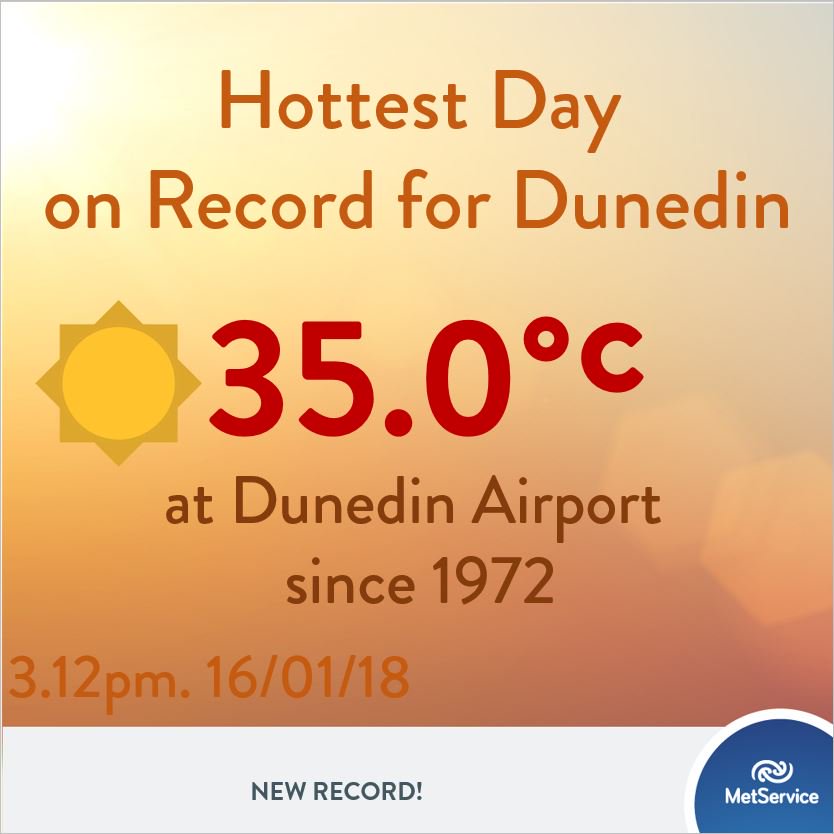

16 January, 2018

Southern New Zealand cities sweltered in temperatures above 30C yesterday but cooler temperatures are forecast in the coming days as rain and windy weather sweep the country.

However, eastern regions of the South Island will have little reprieve as the heat continues to bear down. A total fire ban is in force for Otago and Southland, among other areas.

In the north, Lower Hutt hit a sweltering 31.5C yesterday, with the capital at a more balmy 27.8C, which MetService meteorologist Brian Mercey called unusually high for this time of year.
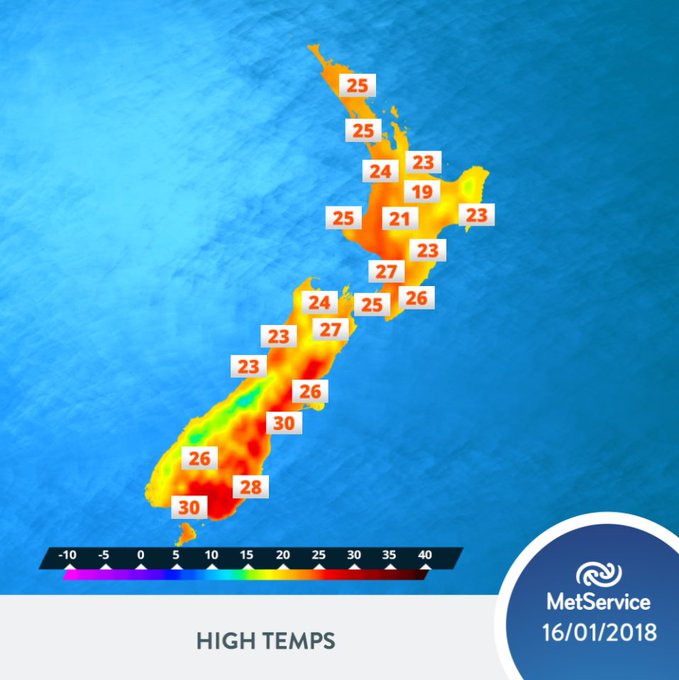


Down south, Dunedin Airport soared to a high of 33.9C, the fourth-highest recorded temperature for the city. The record was set in 2004 at 34.6C.

Alexandra hit 31.3C and Wanaka hit 30C yesterday. The tiny settlement of Edievale, south of Roxburgh in Otago, was absolutely scorching at 35C.

Auckland and Hamilton were much cooler at 26C, Tauranga at 24C, and Rotorua a "chilly" 22C.

Mercey said the south would have temperatures in the 30s again today but it would feel cooler thanks to a breeze and it would cool down even further tomorrow.

The hot weather resulted in a significant drop in the flow of the Whitestone River in Fiordland, prompting Fish and Game Southland to rescue fish including brown and rainbow trout, adult lampreys, upland bullies and long-fin eels yesterday afternoon which were marked to be released further down the catchment, Fairfax Media reported.

MetService meteorologist Tui McInnes said once a low pressure system reached the country it would spread a "front across the country bringing plenty of moisture and decent amounts of rainfall for some places". Tomorrow western parts of both islands are expected to have rain, with Nelson, Westland and Taranaki the wettest.

A severe weather watch is in place for heavy rain for Westland and Nelson, with the possibility of more regions being added.

While it looked to be a wet week for many, eastern regions in the South Island remained sheltered by the Southern Alps, McInnes said.

Fire and Emergency New Zealand rural regional manager Mike Grant said conditions had been incredibly dry in the south, and soil moisture levels were very low.

"We've had a few millimetres of rain here and there over the past six weeks, but the grass and vegetation is still tinder dry.

"That coupled with the extremely hot weather we've been having means the fire danger is really high. We had an unprecedented run of hot weather lately, certainly for Invercargill the heat has been record-breaking," Grant said.

A total fire ban remained in place for Gisborne, Horowhenua, Rangitikei and Marlborough.

On Thursday most of the North Island will have rain but the wet weather will begin to ease by Friday.

Today's forecast

Whangarei:

Cloudy with showers, High 25C Low 20C.

Auckland: Cloudy with showers, High 25C Low 19C.

Hamilton: Fine with morning cloud, High 24C Low 17C

Tauranga: Cloudy with showers, High 23C Low 19C

Wellington: Cloud with showers then fine, High 25C Low 16C

Christchurch: Morning cloud then fine, High 26C Low 16C

Dunedin: Fine then showers in afternoon, possibly heavy, High 28C Low 18C


Dunedin's hottest day

Dunedin is officially having its hottest day on record, hitting 35 degrees celsius.


16 January, 2018


MetService forecaster Cameron Coutts said the heat was recorded at the airport at 3.12pm today.

The city's previous hottest day was 34.9°C, and its previous hottest January day was 34.7°.

Records go back to 1972.

Mr Coutts said Dunedin was the hottest place in the country today, but noted the city would be slightly cooler than at the airport.

Southern District Health Board made a plea yesterday for people to keep cool, when 30 people went to hospital after the mercury hit 32.3° in Invercargill, its hottest on record.

Deputy chief medical officer Dr Tim Mackay said Invercargill had another eight people show up in hospital because of the heat today, mostly children with sunburns.

"So it's just about making sure that kids get some sunscreen on," he said.

"One of the other problems that tends to happen now when you've had a couple of hot nights is it can start to affect the elderly so it's best to keep an eye on older people."

The hot and dry weather is driving river levels in Otago to new lows, with one site in the region at its lowest since records began in 1982.

NIWA's drought index shows the district is "extremely dry", with temperatures hitting 33° in Alexandra today.

Otago Regional Council manager of environmental services Martin King told RNZ the low flows were starting to hurt the environment and the local community.

MetService is predicting some rain for Thursday but Mr King said the region needed a more sustained downpour to help replenish the rivers in a sustainable way.

Compulsory restrictions may be enforced if residents did not conserve water, the council said.

Council water manager Tom Dyer said water levels in the city's catchments were dropping while demand was increasing.

If rain did not fall this week and demand continued, the city would need to move to the first level of compulsory restrictions before the weekend.

Voluntary restrictions have been in place in the city since early December, but water use is now more than 35 percent above normal.

Dr Mackay urged people to drink at least two litres of water per day, use their heat pumps for air-conditioning or get cool, damp towels on the backs of people's necks to cool them down.

"Dehydration can occur quite quickly, and with these hot conditions being less common in Southland, it's possible people are not as quick to pick up on the symptoms," he said.

"We ask people to de particularly careful about the effects of drinking alcohol in the hot weather. Far from quenching your thirst it will speed up dehydration, and can be quite serious."


Fire and Emergency have imposed a total fire ban across Otago from midnight on Monday.

Saturday, 22 July 2017

Reflections on NZ's "weather bomb" and denial


A weather bomb hits New Zealand

Seemorerocks


Flooding at a service station in Timaru.

In the last 24 hours New Zealand has been hit by what can only be called a “weather bomb”, not for the first time this winter.

An indication of what hit New Zealand can be gained from the following weather map in which the whole country can be seen.


Also listening to a report on Radio NZ this morning it was reported that a rain gauge had indicated rain of 200 mm (8 inches) had fallen overnight whereas the average for the whole of July is 45 mm (1.8 inches).

A state of emergency has been declared for Dunedin and Timaru in the South Island and the army has been called in to help.


  • Dunedin, Timaru, Waitaki, Selwyn and the wider Otago region have all declared a state of 
  • emergency.
  • About 100 homes have been evacuated from Outram, a rural town west of Dunedin. Residents have been evacuated from Mosgiel and Henley.
  • The NZ Army has been called in to assist Civil Defence in Timaru and to take a sick Oamaru child to Dunedin.
  • South Cantabrians living near flood-prone areas have been urged to prepare for evacuation.
  • Homeowners have decided to leave some properties in North Otago after rising floodwaters submerged streets and bridges.
  • Wastewater was overflowing into some streets in Dunedin.
  • Civil Defence were preparing to evacuate some parts of Mosgiel if required.
  • Access to Milton, south of Dunedin, has been closed with State Highway 1 blocked north and south of the town.
  • Homes in Ashburton and eastern Christchurch were flooded on Friday morning.
  • Drivers were trapped in their cars in floodwaters near Rakaia in Canterbury.
  • Power is out in following roads in Dunedin: Old Brighton Road, Green Island Bush Road, St Leonards Drive, Berwick, Henley, Anzac Ave
  • Dunedin is expected to get the most rain - up to 200mm over a 27-hour period. Parts of Canterbury could receive up to 180mm of rain before noon Saturday.
  • The flooding has closed roads throughout Canterbury and Otago, including State Highway 1. The only highway connecting Canterbury and Otago is SH8 between Twizel and Omarama, but chains are essential.
  • SH7 Lewis Pass has reopened.
  • Up-to-date road conditions - full list.
  • The storm in pictures.
  • How to prepare for a storm.
Send your weather pics and videos to: newstips@stuff.co.nz
UPDATED JUL 22, 2017 10:48 AM


You’d think that people would be getting the idea that this is linked with, not just climate change but climate change happening “faster than previously expected”.

Instead Ms. Kim Hill said “this is not just weather – it’s a weather event, isn’t it?”

Wow, Kim, that’s radical, isn’t it?

It's possible to say anything when you just look at what is happening on your doorstep and you are unaware (or purposefully ignore) the evidence of what is happening on a global scale.

Typical of reactions is from a friend who was supposed to visit but put off his visit on account of the weather forecast despite my saying that the rain wasn’t that bad.

It turns out that Wellington was one of the few places in the country that was spared.

Rather than just be grateful my friend is saying “you can’t trust the weather forecasters”

What I can forgive in my friends I can't in public figures such as RNZ broadcaster who, in theory at least, are paid to bring us the NEWS, not pull the wool over our eyes.

****

I spend quite a lot of my time observing the weather in my locality and looking for patterns.  One thing I have observed in the last few years is a drought that never quite goes away in winter, despite periods of wet weather, illustrated by the fact that one of our friends living on the land had to get a water truck in, not in the middle of a summer drought but in the first half of winter.

There is no doubt that this has been a extraordinarily cold winter in New Zealand (certainly in comparison with previous years).

What I have noticed, above all, is that it has not been so much cold as damp. Here in Wellington we have not seen the sun for many days on end. It is as if we have a constant and complete covering of thick cloud that obliterates the sun.

Most importantly the winds that we are usually buffeted with (from the north and from the south alternately) have been missing and frequently there simply isn't any air movement in "Windy Welly".

Take this, from NZ Metservice:

DEVELOPING NEWS 9:20AM – SYSTEM ‘STALLS’ OVER PARTS OF CANTERBURY.
Our major winter storm will continue to cause challenges and problems through the day, with heavy rain, gales and snow lowering to low levels. This is significant event & people should keep up to date, through radio, news and social media.

I have observed that frequently, instead of moving quickly across the country as has historically been the case, weather systems STALL, so that even after a major weather event the usual clear, sunny weather that is typical is absent.

Look at this forecast for Dunedin (the epicentre of the weather bomb) for the next week.   Not much let up here for the poor people of Dunedin!

No automatic alt text available.

Now look at the weather map in the lead-up to yesterday's rain (from 36 hours ago)....


And compare that with the situation as of an hour ago (after the weather event). 

No "calm-after the- storm" for New Zealand!


The present pattern (if there is one) is completely different from what I have experienced for the previous 60 years of my life.

I have never seen weather getting "stuck" like this at any time before this.

The reactions I get from people is either people going around with their eyes shut and thinking dualistically ("isn't it 'nice' weather today" or "isn't the weather horrible?"). 

A good proportion of society, aged 40 or less, have no idea what more-or-less stable weather is like.

The weather I experienced growing up in the 60's has more in common with the weather my father experienced growing up in the 20's than anything we have now.

When I point out my observations people's responses are like my friend who pointed out that there was a frost a couple of days ago - so somehow that made my observations invalid, despite the fact that this may have been the first or second frost in a winter that is theoretically half over.


That brings me back to denial.....

When I started to realise that climate change is happening "faster than previously expected" and that many positive feedbacks later we have passed numerous trigger points that weren't supposed to happen until 2100 so that, at the very least, human civilisation is doomed - or, if you have any understanding of conservation biology and habitat - we are headed for the precipice, not in 2100 but in short order.

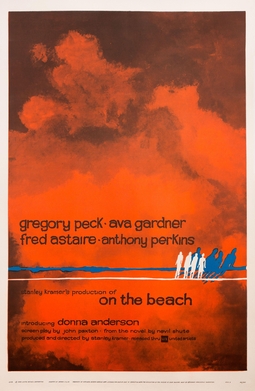
I have always seen Nevil Shute's  On the Beach as being, not only about a nuclear holocaust but about denial and how people respond to their inevitable, short-term demise.

Onethebeach.jpg
In this piece, "Dr. Doom", scientist  Julian Osborn is telling a few home truths about background radiation when he encounters the inability of c Holmes, wife of an Australian naval officer to deal with the truth.

In the past I was also a party pooper by insisting  on telling the truth like the character in the film.  The responses have often been similar to those in this scene.


By the end of the film, when the radiation cloud reaches Melbourne and people are directly confronted by their near-term mortality Julian Osborn commits suicide with carbon monoxide poisoning after doing what he wanted to do most in his life - win a race with his racing car, while the chief denier, Mary, ends her life, and those of her children, with cyanide while Cmndr Towers and the crew of the submarine Sawfish decide to "go back home" - to a home that no longer exists, to families that are long dead.

Acceptance.


This has set me thinking about my own position now that the news on every front gets worse and worse and our demise (either as a species or as a civilisation - take your pick) it may in fact be better to just inform those "with little dust in their eyes" and not insist that we are all doomed (which I believe with every cell in my body).

To those people who say that because I don't have any "solutions" I'd better not tell the truth I have very little to say.

I also have zero respect.

All this brings back an interaction with Nigel, a Green Party wallah who tried to convince me there was "scientific proof" (his words, not mine - I kid you not), that to be successful a "message" had to be 80% "positive" - one of the most blatant justification for LYING.

People like Nigel, or the liars at Radio NZ and elsewhere, will always feel the lashing of my tongue while I have breath in my body.  They are responsible and don't have the privilege of being deluded.

As for the rest I am rapidly coming to the conclusion that it does little good to disturb the illusions of those who are incapable, or unwilling to see things as they are although, with my restricted lifestyle I am quickly running out of things to say to such people.

Like the characters in On the Beach they will come to a realisation - in the end.

In the meantime my main wish is that people live their lives fully.

Saturday, 9 January 2016

Extreme weather in New Zealand

Most particularl, this article omits any mention to Hokitika and the West Coast

NZ's year of extreme weather


26 December, 2015

It may be hard to believe - especially for the thousands who have had their homes and businesses flooded this year - but 2015 was actually drier than normal.

According to MetService, total rainfall at 1 December was only 80 percent of the annual norm, and yet some areas experienced intense rain and flooding.

John McBride digging silt left by floods in late June.The June floods in the lower North Island stranded stock and left behind thick slabs of silt.
Photo: SUPPLIED / Philipa McBride

In Whanganui, Geoffrey Bunker reckons he could be dead, if he had not decided to sleep at his parents' house on 20 June.

The rain was still coming down in thick sheets and the Whanganui River was rising higher and higher when the glass artist made the call to abandon his studio on his family's property and take refuge in the main house.

The storm, which burst the banks of the river, cut a swathe of destruction from coastal Taranaki through Manawatu to the Kapiti Coast north of Wellington, triggered a state of emergency and caused $50 million worth of damage to insured property.

The total economic impact of the floods is hundreds of millions of dollars.

Farmers continue to feel the aftermath of severe flooding in the western lower North Island in June.Flooding devastated farmland in the western lower North Island in June.
Photo: SUPPLIED

The Bunker family has lived on Whanganui's riverfront Anzac Parade for about 25 years, and they have weathered a few floods in that time.

Mr Bunker is annoyed they did not get the usual warning to evacuate before it was too late, despite ringing the council four times between 6pm and midnight to check whether they should leave.

"I had friends who could have evacuated my gear. They [Civil Defence] said: 'No, you should be fine'. We waited and waited until finally at midnight we self-evacuated."

He, his parents and brother packed into one car but almost immediately got stuck.

Lewis Bunker's lovingly restored VW Beetle is a write-off following the flood.Lewis Bunker's lovingly restored VW Beetle is a write-off following the flood.
Photo: RNZ / Robin Martin

"The car started filling with water, and that's when we started to panic. Neighbours helped us push it while a Civil Defence guy stood on a bank and asked us what we were doing."

They were finally allowed in to see the house a month after the floods, but only moved back in properly about a month ago.

And it will be next year before Mr Bunker can afford to replace the $12,000 of uninsured glassblowing equipment that was ruined - but at least he is live.

The high-water mark in the studio was higher than his head. "If I hadn't left when I did, I could have drowned."

Despite the threat from the river, Mr Bunker said he had no plans to move. "I love the river, I've grown up with it.

Anzac Parade Whanganui 22 JuneAnzac Parade, Whanganui, 22 June.
Photo: RNZ / Tom Furley


South Dunedin under water


The threat from climate change was brought home to the people of Dunedin earlier that month, with a massive rain dump drowning the low-lying southern suburbs.

Dunedin City Council estimates 1250 properties were damaged in the flooding, which began on 2 June. Of those, 280 were "seriously damaged" including the home of Julie Myers and her husband Jim Baird.

The sunroom/ living space in their St Kilda home was inundated with contaminated water.

Once the waters had receded and builders had removed the sodden boards, they found a bedroom off the sunroom had actually separated from the house.
"We could see the outside through the crack," said Ms Myers.

Since then, their insurance company has sent a succession of builders, engineers and technicians to inspect the property.

Six months after the flood, the couple are still waiting for work to start and Ms Myers suspects they are "looking for a reason not to pay out".

"When it rains, we end up with a waterfall that comes down into the sunroom and then that dries and it gets hot. We've twice had the cleaners come at the insurance company's expense because there were jelly fungi growing on the wall."

MP for Dunedin South, Labour's Clare Curran, said other people were still not back in their homes and some were living in substandard conditions in flood damaged houses.

Surrey St, South Dunedin.Photo: RNZ / Ian Telfer

"Schools report a lot more sickness this winter."

South Dunedin is built on swampland and its water table goes up and down with the tide.

The Commissioner for the Environment has identified nearly 3000 homes just 0-50cm above the spring high-tide line.

Ms Curran said Dunedin by itself could not deal with a "slow rolling disaster" of this magnitude. "Central government can't stick its fingers in its ears and look way."

Dunedin's mayor, David Cull said the council might need to go cap in hand to the government at some point, but it had a lot more work to do first.

"We know that whatever happens, it's going to cost us a lot. If we do nothing, ground water continues to rise, then parts of it will have to be vacated. That will cost a lot of money. If we put in more bores, more infrastructure, that will cost a lot of money too."

He said until the council scoped that, it was not certain if Dunedin had the capacity to finance it.

Wet Welly


In Wellington, heavy downpours on 7 March led to flash flooding, the eerie sight of cars floating down the street and drain covers shooting into the air on geysers of water.

It was the opening volley of two months of very wet weather.

The peak was to come in May when fierce localised downpours caused massive flood damage to homes and businesses and widespread transport chaos, with trains out of action and major roads blocked by slips and flooding.

Four classrooms at [http://www.radionz.co.nz/news/regional/276086/wellington-council-urged-to-tackle-flooding Tawa School were flooded, and some children had to be evacuated by kayak.

Tawa school The flooding at Tawa School     Photo: Supplied

The children only got back into their refurbished classrooms a few weeks before the end of term.

One person drowned in Lower Hutt - police divers found the body of Dr Paul Hill, 80, a short distance from his submerged car in Sladden Park, Petone.

MetService meteorologist Georgina Griffiths said the deluge in Lower Hutt, which peaked at more than 40mm in one hour, was "very nasty".

But overall the rain gauge total - 44.8mm in the 24 hours to 9am on 14 May - was a drop in the bucket compared with the standing record: 152.4mm in one 24-hour period in December 1936.

A very dry year - MetService


Nationally, 2015 was a very dry year, she said.

"Yes, hard to believe, but it is true, helped along by the drier months of January, February and October.

"But for all that, we didn't lack extreme weather, especially during the particularly sodden months of April, May and June when we had several flooding events back-to-back."

Costas Kotsapas, who has lived in Wellington's Owhiro Bay for nearly 40 years, is not worried about rising sea levels.

While he has witnessed erosion gobble 2-3m from the waterfront over the years, he reckons that is "minimal".

The thundering 9m swells that blasted the South Coast at the end of May were not the worst he had weathered.

"I remember when my wife was expecting our daughter, we had to be evacuated because there were huge boulders littering the road.

"These days it's just shingle, sand and seaweed, but they [storms] do seem to have become more frequent in the last three or four years.

"Other houses have had roofs blown away, garage doors pushed in... at least it stabilises prices for first-home buyers."

Debris washed up in front of south coast properties.Debris washed up in front of Wellington's south coast houses in 2013. Photo: RNZ

Insurance excess soars


Insurance Council data show extreme weather caused $115m in damage to insured property over the year.

The biggest chunk was the Whanganui floods in June, while the May floods in Wellington and the Kapiti Coast cost about $22 million.

Council chief executive Tim Grafton said it was hard to say whether individual insurance premiums would rise as a result.

"It comes down to frequency of risk and the extent of damage that occurs - and that takes time to unfold," he said.

In parts of Christchurch, land sank in the earthquakes - "a bit like climate change in fast motion" - and properties flooded several times over three years.
Insurance companies responded by increasing the excess from about $400 to up to $10,000.

The council has produced a 15-point plan to better protect New Zealand from natural hazards, Mr Grafton said.

With impending climate change and about $20bn worth of assets within 150cm of the mean high tide (as calculated by the Commissioner for the Environment), it was time for the country to get serious about mitigating risk, he said.

"Councils are the decision makers at local level, but do they have sufficient resources to do what's necessary?

"There are things that central government can be and is doing, such as making risk reduction a key focus for the Civil Defence Ministry and including natural hazards in draft Resource Management legislation."

Individual home-owners needed to face up to the risks they faced and people buying property must be fully informed, he said.

Flood protection


Flood protection systems for the Greater Wellington Waikanae and Hutt rivers were extensively upgraded recently and are now expected to stop everything below a 1-in-100 year food.

Greater Wellington Regional Council's flood protection manager, Graeme Campbell, said the May event in particular proved it was money well spent.

No council-managed rivers or streams broke their stopbanks, despite Porirua Stream peaking at 66 cumecs, an amount not seen since 1980.

However, Mr Campbell said the council was predicting a couple of years of wild weather head.

On top of La Nino and El Nina weather patterns, which tend to switch the weather around year by year, there was also the inter-decadal Pacific Oscillation, which influences rainfall in 10-20 year cycles.

"The last time we saw frequent floods of that sort of order was the late 1990s and early 2000 ... we could get more of these events over the next couple of years."

Overlay that with the less predictable effects of climate change, and the likelihood was more intense rainfalls, bigger flows more frequently down rivers, and higher sea levels.

Boosting defences further looks like a very good investment, with higher stop banks and wider river channels planned, and Mr Campbell said work done in central Hutt "should provide protection into the next century".

However, Mr Campbell said it was vital to ensure people understood the flood risks were, so when planning development could "avoid the need for the community to have to pick up the tab for more and more expensive flood repairs".