This
is a very interesting interview. First, it basically confirms
everything the Novorussians were saying. But secondly, the officer
speaking, Andrei Vysota, CO of 25th "Kievan Rus" battalion,
declares at the end that even though Poroshenko awarded the title and
medal to Commander Sergei Shaptala of the 128th Mukachevo mountain
infantry brigade just to make him shut up, Shaptala did deserve that
medal for having had the courage to order a retreat.
From
the point of view of the Russian military ethos, this is an amazing
statement for the following reasons:
1)
Russian officers always are at the frontline with their soldiers.
This is why a Russian General was seriously wounded in South Ossetia,
and this is why we have all seen Givi, Motorola, Mozgovoi and even
Zakharchenko right on the very front line, a few hundred yards from
the junta forces. In contrast, Shaptala himself fled the Debaltsevo
Cauldron and he gave his order from afar.
2)
What risk did Shaptala actually take? He took the risk of being
demoted, possibly face insubordination or even (let's worst case)
treason charges. Although, in reality, all he risked was basically
to damage his future career. But even if he did face demotion or
court martial, this is *nothing* compared to what his men faced and
for that *nothing* he deserves the title of Hero of the Ukraine?!
From a Russian point of view this is totally crazy.
3)
Finally, Vysota openly admit that Shaptala got the medal of Hero of
the Ukraine as a bribe to make him shut up directly implying that all
it takes to make a Hero of the Ukraine shut up about the truth about
the death of his own man is to give him a medal he does not even
deserve in the first place!
I
am absolutely amazed by all this. Apparently, the Ukrainian forces
have not only failed to develop their own ethos, they were not even
capable of maintaining even a little of the ethos of the Soviet
military where to get a medal of "Hero of the Soviet Union"
one had to do something quite heroic indeed.
If
Shaptala is the best the junta has, then no wonder that their forces
are losing every battle and that they get beat by men like Bezler,
Mozgovoi, Motorola, Givi, Kononov, Zakharchenko and all the other
Novorussian commanders every single one of which personally fought on
the front line and many of whom were wounded in battle.
I
will be honest with you, every time I see one of the Novorussian
commanders on the frontline, I am personally horrified and appalled.
I got all my military training in the West were a general belongs
into a hardened bunker packed with advanced communication gear and
protected from pretty much anything short of a nuclear strike. But I
also have to admit that having the commanders in the front lines
makes a huge difference. This has always been a Russian military
tradition for many centuries, and this has also been a German one
(during WWII German general did fight with their men in the front
lines). I recognize the superiority of that approach, but it still
horrifies me (-: This is what you get for being born in old Russian
military family but having been trained in western Europe: a strong
cognitive dissonance when your two cultures take radically different
positions :-)
Lastly,
I really feel sorry, from the bottom of my heart, for the men
uselessly killed in Debaltsevo. Did you get the part when Vysota
said that when the Ukies tried to evacuate their *wounded* they all
got killed by the Novorussian artillery? Can you imagine being
wounded in a battle you cannot win, then being evacuated in trucks
only to die being ripped into shreds or incinerated by artillery
strikes?
May
God rest the souls of these poor men who suffered and died in
horrible circumstances and for nothing other then the political
arrogance, ambitions and incompetence of a junta of Nazi freaks.
The
Saker
PS:
one more thing. Under Stalin every single junta officer responsible
for this outrageous disaster would have been summarily executed.
Just saying...
The
Novorussians are in control of most of Debaltsevo (officially
90% officially 100% as
of midnight GMT). More relevantly, there is no more organized
resistance. Russian sources say that about 1000 junta soldiers
have refused to surrender and are hiding in the outskirts or have
fled to the south end of the cauldron. The Novorussians are
not even bothering to hunt them down or return their sporadic (and
inaccurate) fire: they are waiting for hunger and cold to force them
to give up. A spokesman for the Novorussians has reported that
all communications between the junta forces in the cauldron and
their commanders have been suppressed. Russian TV stations are
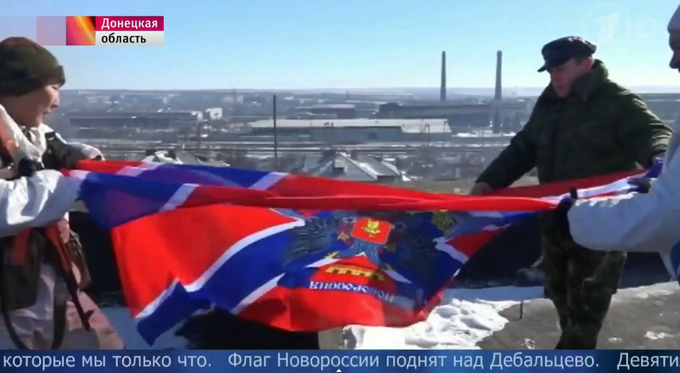
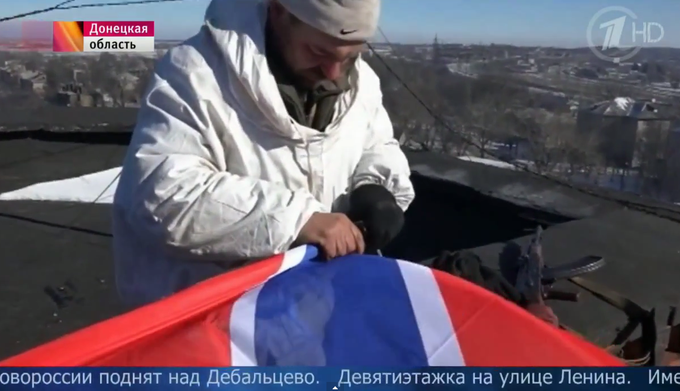
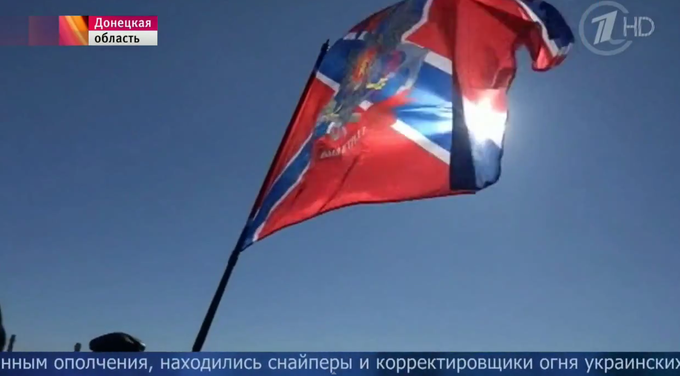
showing footage of Novorussian soliders raising their flag over the
center of the city.
That the forces in the Debaltsevo
cauldron were doomed was pretty clear for a while already, but what
is still amazing is the speed at which the collapse has taken
place. Clearly, we are dealing with a catastrophic collapse of
combat capability of the junta forces.
Novorussian
flag over Debaltsevo
The
Russian media is also showing many footages of surrendering junta
soldiers in and around Debaltsevo. Those who surrender are
treated for their wounds, washed, clothed, fed and they will be sent
home as soon as possible.
During his recent press conference
in Hungary, Vladimir Putin has confirmed that the Ukrainian forces
in Debaltsevo has been defeated. He also confirmed that the US
has been sending weapons to the junta and he added that he was
absolutely sure that while this could kill more people, it would
make no difference at all because the Ukrainian soldiers have no
desire to fight whereas the morale of the Novorussians was extremely
strong.
Debaltsevo
cauldron
The
most amazing event of the day though is Petro Poroshenko's continual
denial that there is any Debaltsevo cauldron at all.
Apparently the junta is in such a shock from the recent events that
the freaks in Kiev has decided to simply completely deny the reality
of it all. This is an extremely misguided strategy because
even though the Russian media has now been banned on Ukrainian cable
and radio stations, and the entire Russian press corps has
had its accreditation in the Ukraine canceled, it is still
accessible on the Internet and information about the current events
is easily transmitted simply by phone (including phone calls from
junta forces inside the cauldron). So while the freaks in the
Rada and the government can go into the "deep denial"
mode, the population is informed about the reality and rumors will,
if anything, only amplify the magnitude of the disaster.
[I
would not be most surprised at all if the hardcore crazies à la
Iarosh & Co. now turn against Poroshenko. It will be
interesting to see how "Iats" and Turchinov will position
themselves - my feeling is that they will all turn against
Poroshenko next.]
Gorlovka
- Debaltsevo AO
I
think that what we are witnessing these days is truly a historical
event. While the defeat in Debaltsevo is tactical in its
dimension, it will most definitely have serious operational
consequences and possibly even strategic ones. Though I
cannot say that with any degree of confidence I am getting the
strong feeling that the entire Ukrainian military has reached the
famous "breaking point" I often mentioned here in the
past: the point were regardless of your remaining capabilities the
entire organization of your military suddenly and rapidly breaks
down. Yes, I know, the rest of the front is currently stable,
but I think that the defeat in Debaltsevo will have a crippling
effect on the morale of all the junta forces. Not only that,
but as soon as the cauldron is fully eliminated, the Novorussian
forces who took it will be available for operations
elsewhere.
Think about it: a number of key locations absorbed
a huge amount of Novorussian forces, especially the Donetsk airport
(which was used to shell Donetsk), the Debaltsevo pocket
(which was used to shell Gorlovka, which threatened the
Donetsk-Gorlovka-Lugansk axis and which could be used to mount an
attack on either Donetsk or Lugansk) and the town of Peski which was
used to support the junta forces at the Donetsk airport. They
are now all in Novorussian hands. The question now is where
can they turn next?
For the time being, the Novorussians are
playing it very "good boys". They have even begun to
withdraw their heavy weapons even though the junta has not (they
were supposed to do that simultaneously). But let's not be
naive here: they are doing so because they know that it is safe for
them to do it, not because they have any trust in the Minsk
Agreement 2 (MA2) or, even less so in the junta. The
Novorussian infantry (and armor) is so superior to the junta's that
they can afford to do so at very little cost to themselves.
But since everybody understands that MA2 is impossible to comply
with, it is obvious for all the parties involve that the conflict
will resume. When that happens, it will be in a dramatically
different context from the one this winter.
First, the
Novorussians are, for the first time, adequately armed, equipped and
supplied. Second, the Debaltsvo operation has shown that for
the first time the LNR and DNR forces are capable of working
together. Even Mozgovoi, who has less then good things to say
about Zakharchenko or Plotnitsky in political terms, is playing it
by the same book militarily and all the Novorussian forces appear to
have finally been placed under a single command. Third, the
two major weaknesses of the Novorussian positions have now been
removed and that is freeing a lot of crack troops for other fronts.
Mariupol
AO
Take
the case of Mariupol for example. The junta forces there have
tried to built an attack in the general direction of Novoazovsk.
All they did was to penetrate a couple of kilometers into the no
mans land between the two sides and then they were rather easily
stopped. Now that Novorussian crack forces will soon become
available, a Novorussian counter-offensive in Mariupol becomes a
very real threat to the junta forces in the city. Until now,
any such attack by the Novorussians was risky due to the possibility
of a junta flanking maneuver the the danger to be cut off from the
rest of the Novorussian forces, but that danger has now receded not
only due to the availability of Novorussian forces, but also due to
the crushed morale of the junta units.
An other interesting
option has been mentioned by anti-maidan's (very good) military
specialist Andrei Basketok who predicts a Novorussian attack along
the M4 and N20 in the direction of Karlovka and Avdeevka followed by
a pincer attack to surround the junta forces once again (shown in
red on this map):
Possible
Karlovka-Avdeevka offensive
The
real problem for Kiev is that more or less all of the current line
of contact can become a potential counter-offensive point for the
Novorussians who, by the way, have never concealed their desire to
get back all of the historical Novorussian lands. So while the
current (relative) cease-fire is all nice and dandy, I think that by
this spring, when the Novorussians will have reinforced their
infantry with up to 100'00 more men the situation for the Kiev
regime will become absolutely horrific and no amount of US weapon
deliveries will change that. This might well be the beginning
of the end for the Nazi experiment in Kiev.
The implications
for the AngloZionist empire are rather clear: if the 1%ers have any
kind of sense of reality left, they should toss out Poroshenko and
the rest of the crazies and foster some kind of government of
technocrats in charge of drafting a new constitution and organizing
a referendum on federalization simply because the folks in Kiev
better negotiate while there still is something left to negotiate
then to way to be hiding in a surrounded bunker like their hero
Hitler did. Alas, I don't think Uncle Sam or the Eurocretins
have any common sense left in them.
Whatever may be the case,
by the ballot or by the bullet, but we *are* winning.
The
Saker
PS: to fully measure the level of delusional insanity
of the junta in Kiev here is the full transcript of the latest
statement by Poroshenko about
the Debaltsevo situation:
I
can inform now that this morning the Armed Forces of Ukraine
together with the National Guard completed the operation on the
planned and organized withdrawal of a part of units from Debaltsevo.
We can say that 80% of troops have been already withdrawn. We are
waiting for two more columns. Warriors of the 128th brigade, parts
of units of the 30th brigade, the rest of the 25th and the 40th
battalions, Special Forces, the National Guard and the police have
already left the area.
We can assert that the Armed
Forces of Ukraine have fulfilled their tasks completely. This
position and success were urgently necessary for us in the course of
the Minsk negotiations and after them. We managed to show to the
whole world the true face of bandits-separatists backed by Russia,
which acted as guarantor and direct participant of the Minsk
negotiations.
We were asserting and proved: Debaltseve
was under our control, there was no encirclement, and our troops
left the area in a planned and organized manner with all the heavy
weaponry: tanks, APCs, self-propelled artillery and
vehicles.
Commanders are working with their personnel.
We are waiting for one more column, one more company. Having
withdrawn the combat patrol posts to the new defense line, we have
preserved the bridgehead for the defense of the state.
It
is a strong evidence of combat readiness of the Armed Forces and
efficiency of the military command. I can say that despite tough
artillery and MLRS shelling, according to the recent data, we have
30 wounded out of more than 2,000 warriors. The information is being
collected and may be clarified.
I would like to say
that Russia, which yesterday required the Ukrainian warriors to lay
down arms, raise the white flag and surrender, was put to shame by
the given actions. Ukrainian warriors honorably approved the high
rank of the Ukrainian Defender of the Homeland. As I promised, they
repelled those who tried to encircle them and left Debaltsevo
pursuant to my command, which I gave yesterday, when Russian
servicemen forbade the OSCE representatives to come to Debaltsevo to
reaffirm our readiness to begin the withdrawal of heavy weaponry and
demonstrate the absence of encirclement. They knew it was not true.
We demonstrated and proved that with our operation.
We
are holding the new defense lines. In the course of my negotiations
with leaders of the United States and the EU, I demanded a firm
reaction from the world to Russia's brutal violation of the Minsk
agreements, the ceasefire regime and the withdrawal of heavy
weaponry. We will prepare organized and coordinated actions
together.
I have convened the NSDC meeting for this
evening. Now, I am departing to the front to meet those who left
Debaltsevo. I am honored to shake hands and thank Ukrainian
heroes.
Today, my Decree on awarding the high title of
Hero of Ukraine to commander of the 128th Mukacheve mining-infantry
brigade Serhiy Shaptala will be proclaimed. Ukraine is proud of such
heroes. Internal stability will not be undermined by the battalions
"everything is lost" and "this is the end", lies
about a lot of soldiers murdered yesterday, encircled roadblocks and
Ukrainian warriors without ammunition, food and water. It is not a
Ukrainian scenario. I am confident that those who were spreading it
expected a different result. Fortunately, we successfully completed
the operation and will have an opportunity to further defend the
state. UPDATE: interestingly,
the NYT had a very different view of what has really taken place. In
an article entitled "A
Bloody Retreat From Debaltsevo as Ukrainian Forces Suddenly
Withdraw" the
NYT wrote that "Mr.
Poroshenko sought to cast the retreat in a positive light, but the
loss of the town was clearly a
devastating setback for the army".
The fact that even the NYT has a more realistic assessment of what
happened then Poroshenko is a powerful indicator of how totally out
of touch the junta propaganda really is.
The
Ukrainian forces, after their rout, have announced “an orderly
retreat” from Debaltsevo – they have “achieved all their
plans”.
Even
the BBC and the Guardian had to acknowledge that soldiers were coming
out on foot in a sorry state.
On
the other hand, RT reported Poroshenko’s words without irony.
The
western media is now having to report a crushing defeat in a
battlezone that a few short weeks ago they didn’t even recognise
existed, and wasn’t included into the Minsk talks.
Here
is the RT report followed by some reactions from mainstream western
media as well as by the Junta’s propaganda channel, Ukraine Today.
More on this later.
Kiev
says troops withdrawn from Debaltsevo, rebels claim military
‘surrender en masse’
Kiev
troops surrounded in the city of Debalstevo have started to surrender
en masse, Ukrainian rebels have said. President Poroshenko announced
a complete withdrawal from the contested city.
Ukrainian
President Petro Poroshenko confirmed in a video statement that he has
given an order to withdraw troops from Debaltsevo on Wednesdsay.
“We
stated and proved that Debaltsevo was under our control and that
there was no encirclement. Our units withdrew according to plan in an
organized manner. They took military hardware with them – tanks,
APCs, artillery pieces, tow-tracks, cars,” the president said.
He
added that some 80 percent of the troops have already left the city.
Reuters
cited a witness who saw the troops, some of them injured, arriving in
Artemyevsk, a city northwest of Debaltsevo, through which a road
leading to Kiev-controlled areas goes.
Poroshenko
will visit eastern Ukraine later in the day and chair a security
council session in the evening, Ukrainian media reported.
Earlier
Semen Semenchenko, MP and commander of one of Kiev’s volunteer
battalions, reported that the troops were being withdrawn from the
contested city. He added that Kiev should now attack in other parts
of the frontline, which had been weakened by the rebels to lay siege
on Debaltsevo.
“They
are empty and we have troops. One strike and the frontline would
crumble,” he assured, adding that withdrawal is “beyond
comprehension.”
However,
DPR spokesman Denis Pushilin has denied Poroshenko’s statement,
saying Kiev troops are not being evacuated, but are giving themselves
up.
“Most
of these formations, which Poroshenko referred to, were defeated by
the militia forces, and some of these units surrendered or are
surrendering now,” Pushilin said as cited by the Donetsk news
agency.
Maksim
Leshchenko, a senior official in the self-proclaimed Donetsk People’s
Republic, also told journalists on Wednesday that the Ukrainian
troops are laying down their arms “in their hundreds.”
Earlier
on Tuesday, Eduard Basurin, a military spokesperson for the rebels,
confirmed taking some 300 soldiers prisoner.
Debaltsevo
was Kiev’s stronghold deep inside the rebel-held territories in
eastern Ukraine, a military asset portrayed in the media as a site of
a heroic last stand of the Ukrainian military. The rebels said they
had some 3,000 troops encircled in a pocket and had been calling on
them for days to lay down their arms and surrender. Kiev rejected the
claims, insisting that Debalstevo supply lines were intact and that
the city would remain under their control.
The
fate of Debaltsevo was arguably the biggest debating point at last
week’s peace talks in Minsk, which resulted in a ceasefire
agreement. The continued violence around the city contrasts the
virtually uninterrupted truce in other parts of eastern Ukraine.
On
Wednesday, anti-government forces started pulling back heavy weapons
from the frontline in quiet areas of the conflict zone.
“Five
152mm self-propelled artillery pieces are being withdrawn from the
village of Yelenovka to their permanent base,” Basurin told the
media.
Under
the Minsk agreement, Donetsk has 14 days to withdraw heavy weapons
completely, but if everything goes “as planned, we can handle it
faster,” the Donetsk Defense Ministry said.
“We
intend to start artillery withdrawal in those areas, where the
ceasefire is observed,” Basurin said.
On
the line of contact, where there is no military actions, weapons will
be pulled back “within 3-4 days,” the ministry stressed.
RIA
Novosti confirmed the pullout, saying that its correspondent
witnessed withdrawal of Grad multiple rocket launchers and tanks from
the disengagement line.
According
to Basurin, Debaltsevo is currently fully controlled by
anti-government troops, but there are groups of Kiev soldiers in the
south of the city trying to resist.
“DNR
troops are now conducting a search operation in Debaltsevo aimed at
locating and blocking those groups,” Basurin said.
He
also stressed the situation in the so-called 'Debaltsevo cauldron'
should not become a pretext for either Kiev, or militia to violate
the Minsk agreements..
The
OSCE confirmed the pullback of heavy weaponry from the line of
contact by Lugansk self-defense forces, the Russian representative to
the organization, Andrey Kelin told TASS.
"The
OSCE is receiving reports on an ongoing pullback of armaments by the
Lugansk republic," he said, adding that the organization doesn’t
have information on Donetsk weaponry withdrawal at the moment.
"The
OSCE doesn't have reports on it right now, although they've placed
about 20 patrol teams along the line of contact and these patrols are
expected to send in reports," he said.
EU
Foreign Policy Chief Federica Mogherini demanded an end to
hostilities around Debaltsevo and threatened Russia with more EU
sanctions.
"The
EU stands ready to take appropriate action in case the fighting and
other negative developments in violation of the Minsk agreements
continue," she said.
The
ceasefire also dominated Wednesday’s phone conversation between
Russian Foreign Minister Sergey Lavrov and US Secretary of State John
Kerry.
"Minister
[Lavrov] pointed out the importance of direct dialogue between Kiev,
Donetsk and Lugansk, including a speedy end to armed clashes in the
area of Debaltsevo, and reiterated the obligations of the Ukrainian
authorities to (conduct) constitutional reform and provide Donbass
with a special status," the Russian Foreign Ministry said in a
statement.
The
US State Department believes both sides in the Ukraine conflict need
more time to implement the Minsk peace plan, spokesperson Jen Psaki
said on Wednesday. US authorities haven’t taken a decision on arms
supplies to Ukraine yet, she added.
On
Tuesday, Russian President Vladimir Putin called on Kiev and the
rebels to do whatever they can to resolve the issue without loss of
life.
“I
really hope that the decision-makers in the Ukrainian leadership
won’t prevent the Ukrainian troops from laying down arms, if they
cannot take such an important decision themselves and order it. Or at
least they shouldn’t harass people who want to save their lives,”
he said.
“On
the other hand, I expect the militias not to detain those people and
allow them to leave the conflict zone and go back to their families,”
he added.
However,
there are some figures in Poroshenko’s government, who are “very
much pro-military,” political analyst and founder of Global
Political Insight Alexander Clackson told RT. Moreover, with the
Ukrainian population feeling that Kiev “is failing,” Poroshenko
can’t show weakness when it comes to eastern Ukraine.
“There
is an inner circle within Poroshenko’s government who are very much
pro-military if you like. They hate to see Ukraine being defeated
over and over again. We’ve seen it prior to the talks in September
in Minsk. And we have seen that again this time as well,"
Clackson said. "There is a general feeling among the Ukrainian
population that the Ukrainian government is failing in this conflict
in eastern Ukraine. So Poroshenko wasn’t able to come across as
weak during the last Minsk talks. Because if he came to these talks
saying ‘Listen, I’m ready to give up Debaltsevo,’ that would
cause a huge uproar in his own country, which is precisely why he had
to argue that Debaltsevo was not lost.”
Here is how the Guardian reported events, as well as an editorial
Retreat
from contested railway hub connecting Donetsk and Luhansk marks
strategic victory for rebels
The
Guardian view on Debaltseve and the Ukraine ceasefire
The
best response to Russian policy in Ukraine is to play the economic
card
Picture reportedly showing Ukrainian government forces pulling out of the strategic eastern city of Debaltseve. 'The fundamental aim must be to transform the conflict into a contest in which force is at the far end of the spectrum.' Photograph: Anastasia Vlasova/EPA
It
was obvious as soon as the Ukraine ceasefire was agreed last week
that both sides would fight hard in the time before it came into
force to either seize or deny territory, particularly in Debaltseve.
Such down-to-the-wire efforts are a feature of ceasefires everywhere,
and they often go beyond the wire, as they have at Debaltseve, where
the separatists have been able to squeeze the battered town so hard
in the last few days that Ukrainian forces are now withdrawing, in
what sort of order is not clear. Such land grabs are violations but
they may also demonstrate an expectation that the truce will last.
Why expend men and materiel to gain an advantage unless you expect to
be able to lock it in? So the Russians and the separatists probably
thought they could get away with it and then transform themselves
into supposedly dutiful observers of the agreement afterwards.
So
far that seems a correct calculation. In spite of protests and
late-night phone calls to Moscow, the line seems to be that the
ceasefire is damaged but not dead, in the words of Chancellor Angela
Merkel’s spokesman. President Petro Poroshenko, for his part, is
presenting Debaltseve as a something akin to Dunkirk, a heroic battle
against the odds and an orderly withdrawal under fire, but not as a
reason for entirely denouncing the ceasefire.
The
phrase “you can’t win” must often, and bitterly, come to mind
in Ukraine. The Russians can always up the ante when the Ukrainians
do well on the battlefield. The way the struggle for Debaltseve went
is only the latest reminder that the military situation in Ukraine is
asymmetrical, and almost entirely favours Russia and the separatists.
The economic confrontation, however, is also asymmetrical, and almost
entirely favours Ukraine and its friends in Europe and North America.
At the most local level, the rebel-held part of the Donbass region,
although slightly more coherent after the capture of the Debaltseve
rail junction, is not big enough or well-connected enough to be a
viable economic entity even if its run-down and now war-damaged
industries could be revived. Keeping Donbass on life support is not a
burden that Russia, staggering under the double impact of sanctions
and falling oil prices, wishes or is able to assume. It would prefer
that Ukraine and its western allies pick up most of that tab.
Potentially that hands some leverage to Kiev, particularly if Kiev
begins to prosper economically.
The
economic, social and political reform of Ukraine is indeed the top
card in the hand events have dealt Kiev and its allies. But, as
George Soros has said in a recent essay, that demands much more focus
by Europe, the United States and international institutions on
economic aid and fiscal assistance to the republic. Sanctions, he
argues, are a necessary evil because, while they keep up the
political pressure on Moscow, they damage both Russia and western
countries. The economic collapse of Russia, it should be noted, is in
no way desirable. The Russian default of 1998 was disastrous for
everybody. Greater help for Ukraine, on the other hand, would not
hurt Russia and would have only positive consequences for both the
Ukrainian and the European economies. Economic relations within and
with a prosperous western Ukraine might also help in time to soften
the antagonism between nationalists and separatists and make
President Vladimir Putin rethink his regional ambitions.
If
that is on the outer edge of optimism, and it is, it is still the
best way to go, making the most of Europe’s and America’s
economic advantages and pulling away from the dangers of military
escalation. That does not mean that some military preparations and a
more consistent signalling of Nato resolve are not appropriate, but
they are very much secondary. The fundamental aim must be to
transform the conflict into a contest in which force is at the far
end of the spectrum. Mr Putin could of course at any time revert to
the war option. The ceasefire, which Mrs Merkel rightly described as
offering only a glimmer of hope, could break down again, for example
in a push to take Mariupol. But Mariupol would be a city too far and
would lead to enhanced sanctions. So there is still a chance that the
ceasefire will lead not to peace – that would be too much to
suppose – but to a period when divergent objectives are pursued by
non-warlike means.
"An orderly and planned withdrawal" - This is how Ukraine Today covers the events. This propaganda reel shows a truck without tyres and a truck deck soaked in blood.
The guy receiving the medal from Poroshenko doesn't have much to say, or even acknowledge him

 Posts