Excerpted from the book: ‘Hidden Hand: Exposing How the Chinese Communist Party Is Reshaping the World’
In 2018 the well-connected Washington Post columnist Josh Rogin pointed out that China had been building networks of influence in the United States over many years, and that the U.S. government “is preparing for the possibility that the Chinese government will decide to weaponize” them to get what it wants.(Although Beijing is not known to use Russian-style “active measures” in the West, deploying them is only a matter of political calculation.)
One of the CCP’s most audacious penetration operations, Chinagate in 1996, saw a top intelligence operative meeting a naive President Clinton in the White House, along with donations to the Clinton campaign made through people with ties to the Chinese military.
Beijing has been working to gain influence in the U.S. Congress since the 1970s. Through the activities of the CCP’s International Liaison Department, and Party-linked bodies like the China Association for International Friendly Contact, China has made some influential friends. Nevertheless, Congress has for the most part remained skeptical of China, although its voice has been muted at times by the influence of “pro-China” members. The president, the White House, the bureaucracy, think tanks, and business lobby groups have all been targeted by Beijing, to good effect.
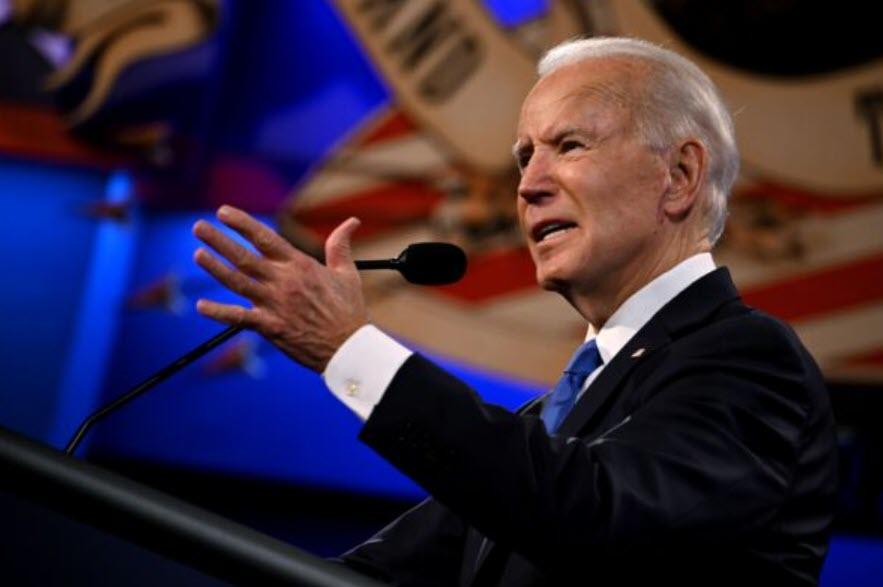
Democratic Presidential candidate and former Vice President Joe Biden gestures as he speaks during the final presidential debate at Belmont University in Nashville, Tenn., on Oct. 22, 2020. (Jim Watson/AFP/Getty Images)
Until recently, almost all players in Washington D.C. and beyond were convinced by the “peaceful rise of China” trope, and the value of “constructive engagement.” The common belief was that as China developed economically, it would naturally morph into a liberal state. This view was not without foundation, because the more liberal factions within the CCP did struggle with the hardliners, but in the U.S. it reinforced a kind of institutional naivety that was exploited by Beijing. Many of those who stuck to this view even after the evidence pointed firmly to the contrary had a strong personal investment in defending Beijing.
The billionaire businessman and former New York mayor Michael Bloomberg was a late entrant in the contest to become the 2020 Democratic Party candidate for U.S. president. He is the most Beijing-friendly of all aspirants. With extensive investments in China, he opposes the tariff war and often speaks up for the CCP regime.
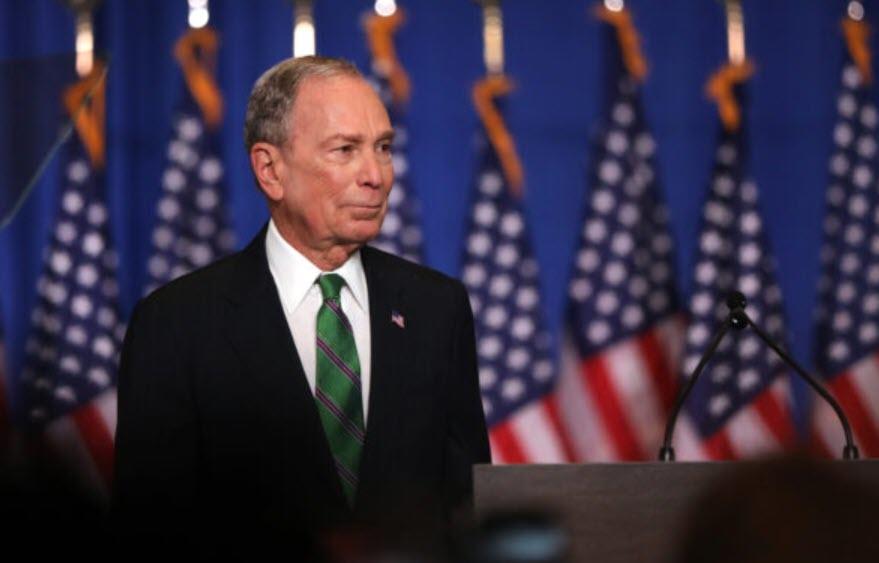
Former Democratic presidential candidate Mike Bloomberg addresses his staff and the media after announcing that he will be ending his campaign, in New York City, on March 4, 2020. (Spencer Platt/Getty Images)
His media company has suppressed stories critical of CCP leaders, and Bloomberg himself claimed in 2019 that “Xi Jinping is not a dictator” because he has to satisfy his constituency.
The Washington Post’s Josh Rogin argued that “his [Bloomberg’s] misreading of the Chinese government’s character and ambitions could be devastating for U.S. national security and foreign policy. He would be advocating for a naive policy of engagement and wishful thinking that has already been tried and failed.”
In May 2019 Joe Biden distinguished himself from all of the other candidates for the Democratic Party’s presidential nomination by ridiculing the idea that China is a strategic threat to the United States. “China is going to eat our lunch? Come on, man,” he told a campaign crowd in Iowa City. Biden had for years adopted a soft approach to China. When President Obama’s secretary of state, Hillary Clinton, was taking a tougher position towards China’s adventurism in Asia, Vice President Biden was urging caution. Biden had formed a warm personal relationship with Xi Jinping when Xi was vice president and president-in-waiting.
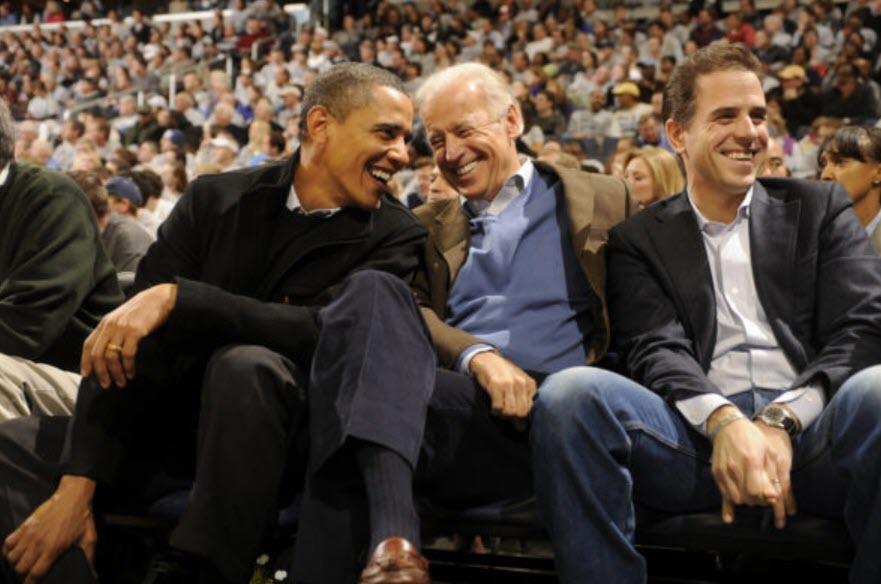
Hunter Biden (R) with then President Barack Obama (L) and Vice President Joe Biden during a college basketball game at the Verizon Center in Washington on Jan. 30, 2010. (Mitchell Layton/Getty Images)
In his second term, Obama replaced Clinton as secretary of state with the more accommodating John Kerry. The dynamics help to explain why Obama’s 2012 “pivot to Asia” was a damp squib. The United States stood back while China annexed islands and features in the South China Sea and built military bases on them, something Xi had promised Obama he would not do. Breaking the promise has given China an enormous strategic advantage.
Joe Biden cleaves to the belief, now abandoned by many China scholars and most Washington politicians, that engagement with China will entice it into being a responsible stakeholder. The University of Pennsylvania’s D.C. think tank—named, for him, the Penn Biden Center for Diplomacy and Global Engagement—aims to address threats to the liberal international order, yet China is absent from the threats identified on its website: Russia, climate change and terrorism. Biden has spoken about China’s violation of human rights but still clings to the idea of China’s “peaceful rise.”
So does it matter if Joe Biden has a different view of China? It does, because there is evidence that the CCP has been currying his favor by awarding business deals that have enriched his son, Hunter Biden. One account of this is given by Peter Schweizer in his 2019 book “Secret Empires.” Some of his key claims were subsequently challenged and Schweizer refined them in an op-ed in the New York Times (famous for fact-checking). In short, when Vice President Biden travelled to China in December 2013 on an official trip, his son flew with him on Airforce Two. While Biden senior was engaging in soft diplomacy with China’s leaders, Hunter was having other kinds of meetings. Then, “less than two weeks after the trip, Hunter’s firm … which he founded with two other businessmen [including John Kerry’s stepson] in June 2013, finalized a deal to open a fund, BHR Partners, whose largest shareholder is the government-run Bank of China, even though he had scant background in private equity.”
The Bank of China is owned by the state and controlled by the CCP. Hunter Biden’s exact role in the company is disputed, but one expert has said that his share in it would be worth around $20 million.
However, the point here is not the ethics of the Bidens (as the news media have framed it) but the way in which the CCP can influence senior politicians. This “corruption by proxy,” in which top leaders keep their hands clean while their family members exploit their association to make fortunes, has been perfected by the “red aristocracy” in Beijing.
Cover of the book “Hidden Hand” by Clive Hamilton and Mareike Ohlberg.
In the crucial years 2014 and 2015, Beijing was aggressively expanding into the South China Sea while Obama, Kerry, and Biden were sitting on their hands...
"The
Harvard experiment may fly in the face of a moratorium on
geoengineering adopted in 2010 by the United Nations Convention on
Biological Diversity, which was reaffirmed in December in Mexico. The
United States is one of the few countries to not ratify the UN
convention, creating a potential loophole for experiments."
This
is one of the multitude of mad cap outcomes of runaway abrupt climate
change I'm dreading.
We've
destroyed the biosphere, this will make it worse according to the
referee journal literature.
I
suspect they will choose the nuclear winter option.
Under
the Trump administration, enthusiasm appears to be growing for the
controversial technology of solar geo-engineering, which aims to
spray sulphate particles into the atmosphere to reflect the sun’s
radiation back to space and decrease the temperature of Earth.
Sometime
in 2018, Harvard engineers David Keith and Frank Keutsch hope to test
spraying from a high-altitude balloon over Arizona, in order to
assess the risks and benefits of deployment on a larger scale.
Keith
cancelled a similar planned experiment in New Mexico in 2012, but
announced he was ready for field testing at a geoengineering forum in
Washington on Friday.
“The
context for discussing solar geoengineering research has changed
substantially since we planned and funded this forum nearly one year
ago,” a forum briefing paper noted.
While
geoengineering received little favour under Obama, high-level
officials within the Trump administration have been long-time
advocates for planetary-scale manipulation of Earth systems.
David
Schnare, an architect of Trump’s Environmental Protection Agency
transition, has lobbied the US government and testified to Senate in
favour of federal support for geoengineering.
He
has called for a multi-phase plan to fund research and conduct
real-world testing within 18 months, deploy massive stratospheric
spraying three years after, and continue spraying for a century, a
duration geoengineers believe would be necessary to dial back the
planet’s temperature.
Geoengineers
argue that such methods would be an inexpensive way to reduce global
warming, but scientists have warned it could have catastrophic
consequences for the Earth’s weather systems.
Scientific
modelling has shown that stratospheric spraying could drastically
curtail rainfall throughout Asia, Africa and South America, causing
severe droughts and threatening food supply for billions of people.
“Clearly
parts of the Trump administration are very willing to open the door
to reckless schemes like David Keith’s, and may well have quietly
given the nod to open-air experiments,” said Silvia Riberio, with
technology watchdog ETC Group. “Worryingly, geoengineering may
emerge as this administration’s preferred approach to global
warming. In their view, building a big beautiful wall of sulphate in
the sky could be a perfect excuse to allow uncontrolled fossil fuel
extraction. We need to be focussing on radical emissions cuts, not
dangerous and unjust technofixes.”
A
White House report on climate change research submitted to Congress
in January called for the first time ever for research into
geoengineering.
Within
Republican ranks, former House speaker and Trump confidant Newt
Gingrich was one of the first to start publicly advocating for
geoengineering.
“Geoengineering
holds forth the promise of addressing global warming concerns for
just a few billion dollars a year,” he said in 2008, before helping
launch a geoengineering unit while he ran the right-wing think tank
American Economic Enterprise. “We would have an option to address
global warming by rewarding scientific innovation. Bring on American
ingenuity. Stop the green pig.”
US
Secretary of State Rex Tillerson has also appeared to support
geoengineering, describing climate change as an “engineering
problem.” ExxonMobil’s funding of the climate denial industry is
under investigation by attorney generals in the United States, but
it’s less well known that ExxonMobil scientists under Tillerson’s
reign as CEO were leading developers of geo-engineering technologies
like carbon dioxide removal.
Asked
about solutions to climate change at an ExxonMobil shareholder
meeting in 2015, Tillerson said that a “plan B has always been
grounded in our beliefs around the continued evolution of technology
and engineered solutions.”
“We
are not unalterably committed to doing the experiment,” said David
Keith on Friday. “We’re headed down the road of doing that, but
depending on what an advisory committee says and what we learn
technically we’re certainly willing to stop. Our long term goal is
to build a sustainable effort in solar geoengineering research that
allows us to say more about ways it might actually provide public
benefit.”
Critics
like Riberio point out that those who don’t believe in
human-induced climate change may still support geoengineering, which
can be presented as a method to deal with the consequences of a
warming planet without stopping the burning of fossil fuels.
The
Harvard experiment may fly in the face of a moratorium on
geoengineering adopted in 2010 by the United Nations Convention on
Biological Diversity, which was reaffirmed in December in Mexico. The
United States is one of the few countries to not ratify the UN
convention, creating a potential loophole for experiments.
The
experiment’s site in Tucson, Arizona may also invoke issues of
jurisdictional controversy with Mexico – stratospheric winds can
blow up to 200 miles per hour, and the border is only 75 miles away.
Other
geoengineering experiments like cloud whitening may go ahead in the
United States, as well as experiments supported by the governments of
China and Russia, though both are signatories to the UN moratorium.
Read geoengineers David Keith and Gernot Wagner’s response to this story HERE
Fear
of solar geoengineering is entirely healthy. Its mere prospect might
be hyped by fossil fuel interests to thwart emissions cuts. It could
be used by one or a few nations in a way that’s harmful to many.
There might be some yet undiscovered risk making the technology much
less effective in reality than the largely positive story told by
computer models.
Yet
that healthy fear can distort discussion in unhealthy ways. A reader
glancing at recent coverage in the Guardian, especially a piece by
Martin Lukacs, might assume we were capitalistic tools of Donald
Trump, eager to geoengineer the planet, democracy and justice be
damned.
Naomi Wolf reveals real geoengineering program - Scopex
I
was alerted to this talk by progressive journalist and feminist, Naomi Wolf in
which she talks about geoengineering.
She
reveals a geoengineering program that, it turns out, is very real. By
fudging this with a putative geoengineering program (“chemtrails”)
has she put on her tin foil hat?
Frank Keutsch, David Keith, John Dykema, and Lizzie Burns, all Harvard Professors. Burns and Keith head the Harvard Solar Geoengineering Research Program.
Budget:
$20 million ($7m raised as of Oct. ‘17)
Summary:
The Stratospheric Controlled Perturbation Experiment (SCoPEx) is a planned experiment in a form of geoengineering known as Solar Radiation Management (SRM). SRM techniques aim to block or reflect sunlight before it reaches the earth’s atmosphere, which would hypothetically slow down global temperature rise. SCoPEx aims to develop a form of SRM known as Stratospheric Aerosol Injection.
The SCoPEx project would spray water, finely-ground chalk and sulfur particles into the upper atmosphere from a high-altitude balloon and measure how effectively the resulting clouds block sunlight, while also tracking any effects on the air in the upper atmosphere. While the environmental impacts are currently unknown, the political effects of the project, however, are the most consequential: if the experiments are allowed to proceed, they would legitimize geoengineering and move us one step closer to a global sun-block and more geoengineering in the region.
Funding:
Funding comes from Harvard University and its Solar Geoengineering Research Program, which is funded by Bill Gates, several venture capitalists and hedge fund higher-ups, a former senior VP at Google, the Hewlett and Alfred P. Sloan foundations (among other philanthropic organizations), and a foreign policy research centre with military ties.
Key dates:
Project initiated: 2015
Research activities: 2017-2024
First field tests programmed: 2018
Regulatory status:
The UN Convention on Biodiversity has passed a moratorium on ocean fertilization (2008) and on geoengineering (2010) that cover SRM and experiments like this. However, the US is not a party to the CBD. The UN Environmental Modification Convention (ENMOD) prohibits military use of weather modification technology globally.
Under US Federal law (National Weather Modification Policy Act of 1976), any modification of the weather is required to be reported to the National Oceanic and Atmospheric Administration, and the results of research must be made public.
The O’odham Nation, represented by a handful of tribal governments, have lived in the area around the World View Spaceport for thousands of years. The reservations where the tribal governments exercise extra-constitutional sovereignty under US law cover a vast area of southern Arizona, with traditional territories extending into Mexico. For example, the Pascua Yaqui Tribe’s offices are a 20 minute drive from the Spaceport that will be the SCoPEx staging area.
While the sovereign rights of tribal governments over airspace is an emerging legal area, the Air Force and others have signed Memoranda of Understanding with the tribal governments about their use of O’odham airspace, indicating that government agencies are aware that they have some rights. One lawyer has made a persuasive case that tribal governments have sovereignty over what happens in the airspace over their lands.
Possible impacts:
The environmental effects of SCoPEx are mostly unknown. The project’s web site claims that the amounts released by the project will be “very small compared to other routine releases of material into the stratosphere by aircraft, rockets, or routine balloon flights.”
However, the political effects of the project are easier to predict. As governments continue to fall short of climate targets, David Keith and other geoengineers will be able to point to research findings to bolster the case for larger geoengineering experiments. However, these are not dispassionate scientists, but entrepreneurs backed by venture capitalists who stand to become fabulously wealthy if governments should opt to move forward with an SRM project in the future.
If SCoPEx moves forward, it will contribute to entrenching technology, capital and public relations power of geoengineering and divert resources away from real climate solutions.
Project details:
David Keith, among others, has proposed a suite of field experiments, some to test the effectiveness and risks of geoengineering and others to develop technologies for larger-scale deployment. The closest to execution is SCoPEx. This experiment would try to understand the microphysics of introducing particles into the stratosphere to better estimate the efficacy of different materials to reflect sunlight as part of an effort to develop SRM techniques. They first plan to spray water molecules into the stratosphere from a balloon 20km above the earth, to create a massive icy plume to be studied from the flight balloon. They then aim to replicate it with limestone or calcium carbonate, followed by sulphates.
David Keith’s Earlier Attempts
In 2012, news broke that David Keith and Harvard engineer James Anderson were planning the first outdoor experiment in solar geoengineering. This would have involved the release of particles into the atmosphere from a balloon flying 80,000 feet over Fort Sumner, New Mexico. Their stated aim was to measure how releasing sulfate would impact ozone chemistry, and to test ways to make the aerosols the appropriate size.
The announcement came soon after a controversial proposed field test of another SRM scheme – the British government-funded Stratospheric Particle Injection for Climate Engineering (SPICE) – was cancelled after a global outcry. Keith bemoaned its fate: “I wish they’d had a better process, because those opposed to any such experiments will see it as a victory and try to stop other experiments as well.”
After media revealed Keith’s own experiment, it too was cancelled, and Keith shifted energies to a new incarnation of the project. In early 2017, he helped launch Harvard’s Solar Geoengineering Research Program, backed by several million in funding by billionaires and private foundations.
Now, Keith is covering his bases politically: he claims the amounts of particles released will be small, and in an attempt to win support among civil society, the project says it will have an independent advisory process for the experiments. This is in keeping with what constitutes a problem with all small-scale experiments like this: the slow and careful accumulation of mainstream legitimacy for large-scale experiments in solar geoengineering in the media, scientific bodies, and institutions of governance, both regionally and globally—ultimately leading toward full deployment.
SCoPEx Funders include:
William and Flora Hewlett Foundation; The Open Philanthropy Project; Pritzker Innovation Fund; The Alfred P. Sloan Foundation; VoLo Foundation; The Weatherhead Center for International Affairs; G. Leonard Baker, Jr.; Alan Eustace; Ross Garon; Bill Gates; John Rapaport; Michael Smith; Bill Trenchard.
–November 2017 , info@etcgroup.org
And here is an explanation from one of the engineers.
The creepy David Keith
One
of the key figures in the program is geoengineer, David Keith who is
one of the biggest advocates of geoengineering. whose views (even if discusses in the most modulated tones) gives me the creeps.
Here he is, back in 2010, explaining why using aluminium in solar radiation management is preferable to sulphur.
This video hones in on where he admits that thousands could die from the Harvard
Solar Geoengineering Program
This provides more context
Clive Hamilton exposes geoengineering
If
I find David Keith ‘creepy’ then Australian, Clive Hamilton is
very clear in his message as to why he thinks geoengineering is a
very, very bad idea.
Here he is being interviewed by Democracy Now!
Luke Rudkowski has a different agenda and asks different questions from the liberal Democracy Now!
Geoengineering in the past and present? All of the above is predicated on the premise that geoengineering is a "theoretical option" in the future, although the material above indicates that is rapidly moving beyond the 'theoretical' What Naomi Wolf is saying (along with Dane Wigington) is that this is fake and there has been a secret program for years that encompasses attempts to mitigate rapid climate change as well as weather warfare and weather modification. To say this is controversial would be an understatement. As I have pointed out previously I am increasingly agnostic about this although my concern about it distracting from the very real rapid, global warming leading to catastrophic climate change.
However,
as I have stated I am dead against reductionism and ‘either-or’
dichotomous thinking. It does not take much imagination for those
that have a deeper understanding of how the world actually works to
come to the conclusion that something could be happening and it will
have covered up.
On
the other side of the coin someone has put together a collection of
photographs from the past that would indicate that contrails have
always lingered.
Here is one example:
1967 – Plate 113 from Cloud Studies in Colour, Richard Scorer and Harry Wexler. Shows over 30 contrails, some criss-crossing:
One
of the ways I have of determining where truth might lie amidst all
the contradicttory information (and disinformation) is to listen to
the subject being debated and looking at the quality of argument from
both sides.
Listen to entire podcast HERE The
evidence is everywhere: forests retreating, glaciers melting, sea
levels rising. Droughts, floods, wildfires and storms have increased
five-fold over the past 50 years. And we're only just beginning to
feel the strain of climate change. It's estimated that rising sea
levels will threaten 30 million people in Bangladesh alone. Miami
could disappear within a generation. Despite all of these dire events
and projections, the attacks continue — on climate scientists. Part
1 of 2-part series. Part 2 airs Thursday, September 14.
Australian
public intellectual Clive Hamilton describes how he’s been attacked
for telling the truth about climate change.
Clive
Hamilton is an Australian public intellectual who's written books
about global warming, among them: Requiem for a Species and Defiant
Earth. His books were intended to enlighten the public. But as he
says: "anyone who engages publicly in the climate change debate
has been subject to threats and abuse from a global army of climate
science deniers. There are a lot of disturbed, angry people out
there, which is, of course, socially worrying."
The
denial about climate change is widespread and profound. In fact, a
term has been coined for it: "climate change denial disorder".
So how did we get here? That's where Naomi Oreskes enters the
picture. She's a Harvard professor and historian of science. In her
book, Merchants of Doubt, she traces the people behind what has
become a global industry of climate change denial. There are the
American billionaire Koch brothers, who continue to finance "doubt"
campaigns. Some observers put their contribution to climate change
denial at $120 million, with the result that many now believe that
stories about climate change are "fake news" or a "Chinese
hoax". According to the Pew Research Center, almost half of
Americans surveyed do not believe climate change is caused by humans.
And 20% of Australians don't believe in climate change at all.
Canadians are divided on the issue, too; however, public opinion
research in 2016 shows that two-thirds of Canadians want federal
leadership to tackle the crisis.
The
journal, Global Environmental Change, refers to a study that lists
the factors which connect climate change deniers to each other, no
matter their country of origin: overwhelmingly, they're politically
conservative, male and hold the environment in low regard. Some
far-right groups do agree humans cause climate change but they
maintain it's immigrants who are to blame.
Why
does climate science face such an intractable problem? Naomi Oreskes
concludes that, "it's not about the facts, not about the
science. Underneath all of this is a fear that capitalism has
failed. That new rules and regulations and carbon taxes to fight
climate change are somehow an assault on our freedom and liberty —
that we'll become Communists. That's why environmentalists are called
"watermelons", green on the outside, red on the inside.
Hard to believe, but that's the core of the resistance."
In
parts one and two of this IDEAS series, Are We F--ked? we decode the
resistance to climate change and learn what's at stake in the
process. Part 2 airs Thursday, September 14.
This
episode features Clive Hamilton, an Australian public intellectual
who has written books about climate change: Requiem for a Species and
Defiant Earth. He is also author of the widely-acclaimed, Affluenza.
He is a Professor of Public Ethics at Charles Sturt University in
Canberra, Australia.
Further
reading:
Merchants
of Doubt: How a Handful of Scientists Obscured the Truth on Issues
from Tobacco Smoke to Global Warming by Naomi Oreskes and Erik M.
Conway, published by Bloomsbury Press, 2011, New York.
Black
Earth: The Holocaust as History and Warning by Timothy Snyder,
published by Tim Duggan Books, 2015, New York.
Affluenza:
How Overconsumption Is Killing Us--and How to Fight Back by Clive
Hamilton, Berrett-Koehler Publishers, Inc., San Francisco, 2014.
Defiant
Earth: The Fate of Humans in the Anthropocene by Clive Hamilton,
published by Polity Press, Cambridge, 2017.
Requiem
for a Species: Why We Resist the Truth about Climate Change by Clive
Hamilton, published by Earthscan, Oxfordshire, 2010.
Storms
of my Grandchildren: The Truth About the Coming Climate Catastrophe
and Our Last Chance to Save Humanity, by James Hansen, published by
Bloomsbury, 2010, New York.
Six
Degrees: Our Future on a Hotter Planet by Mark Lynas, published by
National Geographic, 2008, U.S.
Eaarth:
Making a Life on a Tough New Planet by Bill McKibben, published by
St. Martin's Griffin, 2011.

 Posts
Posts