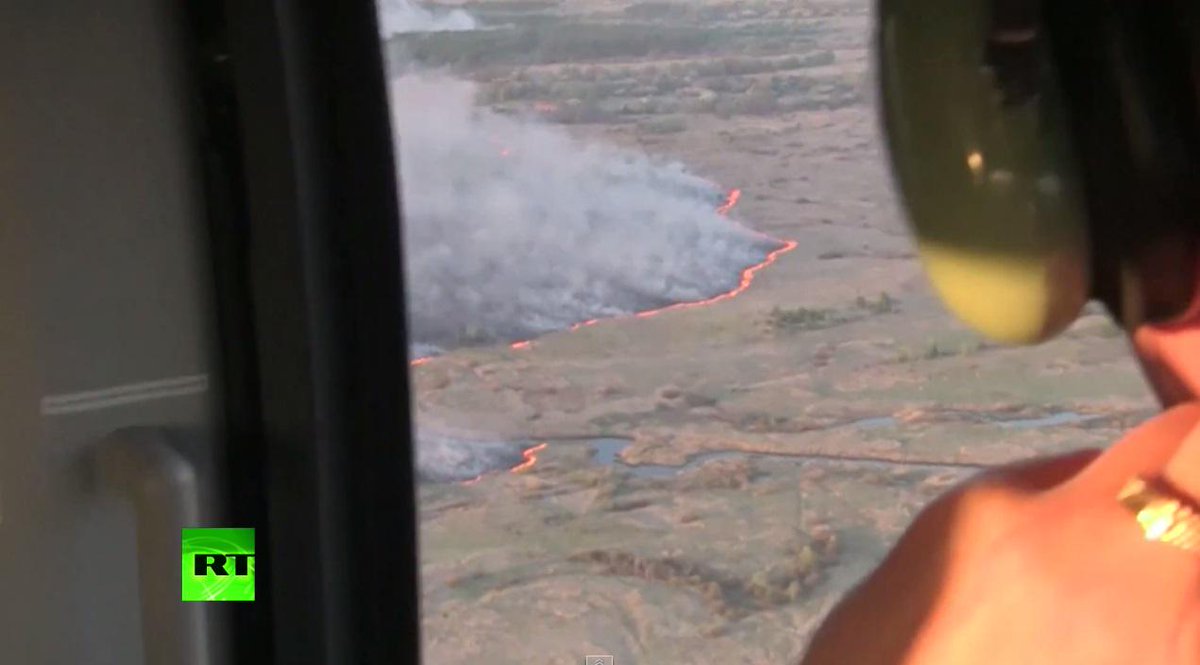
This has to be about the most unreported disaster in the world right now. I came across this quite by accident. I wee time ago this would have demanded people's attention but in the midst of a pandemic lockdown it hardly featrues.
Ukraine forest fires dangerously close to Chernobyl nuclear plant | DW News
Fires
rage in Chernobyl, radiation spikes in the area: Witnesses accuse the
government of covering up the severity of blaze as it nears the site
of the nuclear disaster.
TOXIC
fumes could soon sweep across vast swathes of Europe from Ukraine,
experts have warned, as firefighters battle to contain raging
wildfires in the Chernobyl Exclusion Zone.
Witnesses
accuse the government of covering up the severity of blaze near the
site of the nuclear disaster.
Wildfires
in Ukraine have spread less than a mile from the defunct Chernobyl
nuclear power plant and a disposal site for radioactive waste,
according to activists, as more than 300 firefighters work to contain
the blaze. A video posted by a Chernobyl tour operator showed flames
and a cloud of smoke rising within sight of the protective shelter
over the carcass of Chernobyl's Unit 4 nuclear reactor, the site of
the worst nuclear disaster in history. The tour operator, Yaroslav
Yemelianenko, wrote that the fire had reached the abandoned city of
Pripyat and was just 2km (1.24 miles) away from the nuclear power
plant and the Pidlisny radioactive waste disposal site.
"The
situation is critical. The zone is burning," he wrote in a
Facebook post accompanied by a video of the blaze. Yemelianenko, a
member of a public advisory board to Ukraine's emergency service,
also accused the government of covering up the severity of the fires.
Ukraine's emergency service on Monday said the fire was "difficult"
but called for calm, saying all radiation levels in Kyiv, Ukraine's
capital, were normal and urging people not to listen to "apocalyptic
messages".
"The
main thing we can say is that there is no threat to the nuclear power
station, the spent fuel storage, and to other critical sites in the
exclusion zone," the agency said. The agency said 310
firefighters and dozens of fire trucks, as well as three aircraft and
three helicopters, had been deployed to extinguish the fire. The
agency did not say exactly how far the fire was from the site of the
former reactor or other sensitive sites. On Monday, a member of
Greenpeace's Russia branch told Reuters that the fires were larger
than Ukraine's official estimates and could pose a health risk.
"A
fire approaching a nuclear or hazardous radiation facility is always
a risk," Rashid Alimov, head of energy projects at Greenpeace
Russia, told the agency.ires have been burning since 4 April in
Chernobyl's exclusion zone, the 30-kilometre (18.6-mile) area around
the former nuclear reactor where authorities have barred people from
living. The fires were a result of locals setting fire to grass,
police said. Ukraine's parliament on Monday raised fines for grass
arson to more than £4,500, an 18-fold increase adopted amid
considerable public anger over the fires.
The
fires gained strength over the weekend due to strong winds. "At
the moment, we cannot say the fire is contained," Kateryna
Pavlova, the acting head of the agency that oversees the area, told
the New York Times on Saturday. A huge forest fire in Ukraine that
has been raging for more than a week is now just one kilometre from
the defunct Chernobyl nuclear power plant and poses a radiation risk,
Greenpeace Russia warned on Monday, citing satellite images.
Ukraine’s Emergency Situations Service said it was still fighting
the fires, but that the situation was under control. Video footage
shot by Reuters on Sunday showed plumes of black smoke billowing into
the sky and trees still ablaze, with firefighters in helicopters
trying to put out the fires.
Natural fires burn through the Chernobyl Exclusion Zone on a regular basis. When flames were spotted on April 4, they looked like more of the same. By the next day, however, the fire had covered almost 50 acres, and background radiation levels in the area had spiked. The fire destroyed part of the Red Forest as well as 12 abandoned villages and the Chernobyl-2 military settlement on its way to the outskirts of Pripyat and the Podlesny nuclear waste dump. Intentional grass burns are thought to have caused the fire, and two suspects have been arrested. On April 14, first responders were able to contain the fire thanks to overnight rainfall in the disaster zone. Now, there are no more open flames in the area, and radiation levels have returned to normal.
Friday night into Saturday morning, 15 volcanoes around the world had either ash expulsion, eruption, or the launch of incandescent material, including the Popocatépetl.
Here is the list of the volcanoes that showed activity:
-Klyuchevskoy, on Kamchatka; threw ash to a height of 6,100 meters.
- Shiveluch, on Kamchatka; ejected volcanic ash at an altitude of 36,000 feet.
-Aso, central Kyushu.
-Kuchinoerabu-jima, located in Ryukyu Islands
-Sakurajima, located in Kyushu, Japan.
-Ibu, in Halmahera, Indonesia
-Krakatoa, located in the Sunda Strait, Indonesia. It recorded a "discrete eruption," according to the Darwin Volcanic Ash Advisory Center (VAAC).
-Merapi, in Central Java, Indonesia. He emitted a column of ash that rose to an altitude of 6,100 meters.
-Semeru, located in East Java, Indonesia
-Dukono, is in Halmahera. Emitted volcanic ash.
-Kerinci, in Sumatra
- Popocatépetl , in central Mexico. At 22:15 an explosion was registered that generated an eruptive column close to 1 km in height and the emission of incandescent fragments at a short distance.
- Sangay, Ecuador. He expelled Ceiniza at a height of 5,800 meters.
- Sabancaya, located in Peru. The volcano emitted ash that reached a height of 7,300 meters.
-Nevados de Chillán, is located in Chile.
Most of them expelled ash, but the strongest eruption was in Krakatoa, which launched an eruptive column up to 15 km high, generating a volcanic ray.
So far, risks to population have been ruled out. In 1883 the volcano erupted and killed nearly 40,000 people.
Given the fact that COVID-19 is presently a plague attacking the human race, gigantic swarms of locusts are a pestilence ravaging huge portions of entire countries from Africa to the Middle East, earthquakes are taking place in areas where they generally do not, and now volcanoes all over the planet are erupting, I think it might be a good guess that something really big is going on. Perhaps the kind of thing that makes folks maybe want to pay attention and get right with God.
A
wall of smoke was seen rising over the exclusion zone around the
crippled Chernobyl nuclear power plant on Tuesday as Ukrainian
emergency services scrambled helicopters to extinguish a wildfire.
Some
130 hectares of grassland is ablaze, emergency service officials say.
“In
the zone of exclusion and mandatory relocation near the village of
Kovshilovka and Polesskoye, in the Uzh river flood basin there was a
fire outbreak in dry grass and rushes, which spread in separate
flashpoints across an area of about 130 hectares,” the statement on
the emergency ministry’s website says.
People
were relocated from the area around the Chernobyl nuclear power plant
after the 1986 incident, when an explosion and fire at one of the
reactors triggered a massive release of radioactive particles in the
worst ever nuclear disaster in terms of casualties and clean-up
costs. Radiation contaminated the surrounding area, seeping into the
ground and vegetation.
This
is not the first wildfire in the area over the recent weeks. An
indication of how wide a fire can spread in the untamed wilderness of
the exclusion zone can be gleamed from the events of early May.
Read
more Chernobyl fire: Kiev claims no radiation threat, experts ring
alarm bells
Then,
some 400 hectares of forests were burning near Chernobyl, the fire at
some points reaching as close as 20 kilometers from the sealed,
crippled Reactor No. 4. Then, some 300 personnel and 51 vehicles,
including airplanes and helicopters, were involved in putting out the
fire.
According
to officials in Kiev, the fire did not result in an increase of
radiation levels. However, it did highlight “a catastrophic lack of
equipment in Ukraine,” Prime Minister Yatsenyuk said at the time.
Although,
according to the emergency ministry’s spokesperson in Kiev region,
the new blaze does not pose any threat so far, uncontained wildfires
in contaminated areas can lead to a disastrous spread of radiation,
experts have warned in May. “The amount of radioactivity
potentially released from wildfires could be the equivalent of a
major nuclear accident,” a Greenpeace representative told radio
Govorit Moskva.
The
potential danger comes from the radioactive particles that the plants
in the area have absorbed over the years, ecologist Christopher Busby
told RT.
“Some
of the materials that were contaminating that area would have been
incorporated into the woods,” said Busby, who is the scientific
secretary of the European Committee on Radiation Risks. “In other
words, they land on the ground in 1986 and they get absorbed into the
trees and all the biosphere. And when it burns, they just become
re-suspended. It's like Chernobyl all over again."
The
message about the fire on the territory of the Polesie state
radiation and ecological reserve was received by the MOE on the
morning of 13 June.
The
place was eliminated rescuers in the air was raised aviation: as a
result of the visual evaluation was able to identify the horse that
burns a forest on an area of about 60 hectares in the area of former
settlements Koushki and Lomacy.
"To
extinguish the fire all personnel involved in Khoiniki Department of
emergency, a crew entered all backup technique works aviation of
EMERCOM. Three helicopters, two Mi-8 and one Mi-26" made 75
water discharges, said TUT.BY the press service of the emergencies
Ministry. - Just to extinguish the fire involved 11 vehicles, 3
aircraft, 165 people".
Aviation
is also found on the territory of the fire people were evacuated by
air 16 people.
As
at 14 June 09.00 rescuers continue to fight the fire. For monitoring
and assessing the situation involved a helicopter "Mi-2".
Threats to human settlements no.
We
will remind, more than 60 districts are closed for visits to forests.
In the list of the 54 districts, which TUT.BY reported on June 12,
added forest Sharkovshchina, Dubrovno, Vitebsk region, Polotsk,
Dokshitsy and Tolochin districts of the Vitebsk region and the
Berezinski district, Minsk region.
For
violation of the ban on visits to forests provides responsibility in
the form of a fine of 25 basic units (4.5 million rubles). If it
entails destruction or damage of forests or peatlands, it is subject
to a fine in the amount from 25 to 50 basic units (from 4.5 to 9
million). For kindling fires in prohibited areas provided
responsibility in the form of a warning or a fine of up to 12 base
units (2,16 million).
Aviation
is also found on the territory of the fire people were evacuated by
air 16 people.
As
at 14 June 09.00 rescuers continue to fight the fire. For monitoring
and assessing the situation involved a helicopter "Mi-2". There are no threats to human settlements.
We
will remind, more than 60 districts are closed for visits to forests.
In the list of the 54 districts, which TUT.BY reported on June 12,
added forest Sharkovshchina, Dubrovno, Vitebsk region, Polotsk,
Dokshitsy and Tolochin districts of the Vitebsk region and the
Berezinski district, Minsk region.
For
violation of the ban on visits to forests provides responsibility in
the form of a fine of 25 basic units (4.5 million rubles). If it
entails destruction or damage of forests or peatlands, it is subject
to a fine in the amount from 25 to 50 basic units (from 4.5 to 9
million). For kindling fires in prohibited areas provided
responsibility in the form of a warning or a fine of up to 12 base
units (2,16 million rules). To get a sense of where this is happening, Kiev (Kyiv) is at the bottom of the screen; Pripyat (Chernobyl) is up by the Belarus-Ukraine border and Gomel is a little further to the north. The distance is 200 km by road
As
opposing views on the Chernobyl fires persist, nuclear waste expert
Kevin Kamps believes the problem is now an international one,
requiring multi-faceted efforts. The region is a tinderbox, as each
fresh calamity rearranges the deadly poisons.
RT:How
serious are the wildfires in effecting the radiation levels in the
region?
Kevin
Kamps: It
is significant and it is not a one-time affair. There have been many
fires over the years, and with climate change, with drought, with the
death of the forest from the radioactivity in the first place, the
fact that the litter, the leaves and the dead tress will not decay
properly, again because of radioactivity.
This
is a tinderbox and there is always potential for a catastrophic
radioactive wildfire. Each of these fires is remobilizing poison,
cesium 137 and strontium 90, plutonium of different isotopes into the
air. So the firefighters are in harms’ way. Anyone down wind who
breathes it, could ingest these poisons and that can result in cancer
or other diseases.
RT:You
have been in Chernobyl yourself. What was your impression and how is
the area reacting to what had happened in the original нdisaster?
KK: I've
flown to Ukraine and Belarus a number of times in the years and
decades, all related to Chernobyl activities. And this is an ongoing
catastrophe in so many ways. Every spring thaw, with the snow and the
ice, the very water solvable cesium will wash into the waterways, the
surface waters. It could contaminate drinking water supplies. So
unfortunately the radioactive ecosystem, the radioactive environment
that people live in is an ongoing risk.
RT:What
you're saying is contrary to what they're saying. Their claim is
there is no radiation threat. What do you make of that?
KK: First
of all, you need very significant radiation detection equipment to
know what is going on. And every different approach in trying to
figure out what is happening in the environment requires different
equipment, whether it is in the air, the water, or food supplies.
You
have to have the right equipment to even know what is going on. Our
senses aren't really geared toward detecting radioactivity. Although
it is very telling that the firefighters testified about tasting
metal and feeling a tingling on their skin due to these radioactive
fires. That is an indication of significantly high levels of
radioactive contamination.
RT:Locals
are claiming they didn’t have any evacuation instructions at all...
KK: This
is an international issue and Ukraine should not be left alone with
it. Because the risks are international down wind and down stream,
resources should be made to deal with those threats. So certain areas
of the forest may need clear cutting to prevent this from happening.
Certainly,
firefighting equipment sufficient to meet this challenge has to be
put in place. And of course the firefighters themselves need to have
respiratory protection.
RT:Can
these fires at the moment reignite the original levels of radiation?
KK: To
give some idea, there have been scientific studies done by Timothy
Mousseauat at the University of S. Carolina and a team of colleagues.
Their determination is that the fires of 2002, 2008 and 2010, just
three of these fires, excluding 1992 and 1996, have remobilized 8
percent of the original cesium 137 contamination back into the
atmosphere, which is really significant because it was a such a large
amount of contamination.
So
for eight percent to go back up into the air just because of three of
these fires, not to mention any of the others, is very significant
indeed.
From the Russian meteorological service a map showing the location of the fires/. To the immediate right is Pripyat' and to the right (and down) is Chernobyl'
Ukrainian
firefighters have said flames in the forests around Chernobyl’s
exclusion zone have been put out and there is no radiation threat.
However, locals recall the 1986 catastrophe and fear that just as
then officials are concealing the truth.
“No
one tells us the truth,” a
local woman, Olga, told RT’s Paula Slier. “Nobody
told us when there was a disaster in 1986. We will never hear the
truth from the government.”
On
Saturday, Ukrainian emergency services said that firefighters have
managed to extinguish the fire that has been raging through forests
in the Chernobyl exclusion zone since Tuesday.
“The
fire was localized at 10:30 April 29. The fire was extinguished at
9:00 May 2,” said
a statement from the emergency service.
The
forest blaze that came within 30 kilometers of the abandoned
Chernobyl power plant, triggered an emergency operation, with police
and National Guard mobilized to bring the flames under control.
RT video screenshot
The
level of background radiation where the fire was reported has been
registered to stand at 21 microroentgen per hour, with the safe level
up to 50 microroentgen per our.
However,
people in the area are concerned that the fumes from the fire are
radioactive.
“Nobody
has warned of anything. Everybody is working, children are on the
streets. There have been no warnings at all,” a
local man from the village near the Chernobyl exclusion zone told RT.
“We
have no information. We don't know how dangerous it is. We have two
kids, they are 6 and 10 years old. We don't know if it's dangerous or
if we have to run...” another
local dded.
While
officials assured the villagers that there is no radiation threat in
the area, an expert has confirmed to RT that such fears are
justifiable.
RT video screenshot
The
fires in the exclusion zone are dangerous and everyone understands
this, Yury Bandazhevsky, a scientist working on sanitary consequences
of the Chernobyl disaster, said.
“The
territory is contaminated, the soil is contaminated by radioactive
elements. And not only soil, but plants, trees.”
If
the trees, which have been absorbing radioactivity for almost 30
years, are on fire, then radioactive elements “may
spread with wind over long distances,” he
said.
Chernobyl
Nuclear Power Plant’s reactor exploded on April 26, 1986. As a
result of the explosion and fire, a huge radioactive cloud spread
into the atmosphere, covering thousands of miles of Soviet and
European territories.
Not
only was Ukraine affected, but also adjoining areas in Russia and
Belarus. Radiation spikes were recorded in Sweden, Norway, Austria
and Finland. Approximately 100,000 square kilometers of land was
significantly contaminated.
Ukraine’s
emergency services battling the wildfire in Chernobyl have claimed
almost complete victory, but people are extremely wary. Moreover, a
much more serious potential disaster could be in the making: the
spread of radioactive fumes.
“Firefighters
are liquidating the last of the hotbeds,” a statement said
as of 9:00 am on Friday, adding that some work remains at three
separate smoldering spots. A radiological lab is on site performing
tests. A check is reportedly carried out automatically every three
hours by 39 automated testing posts, the statement from the State
Emergency Service of Ukraine also reads.
Most
of the 400-hectare forest had been engulfed by the flames. The
closest point to the abandoned Chernobyl reactor is only about 20km
(about 12.5 miles), inside the exclusion zone, abandoned and cordoned
off almost 30 years ago, when the worst disaster of its kind struck.
It started on Tuesday and triggered an emergency alert, with police
and the National Guard mobilized to bring the flames under control.
“No
increase in radioactivity has been registered”in
the area outside the factory complex ‘Chernobylskaya Pushcha’,
the statement adds, issuing non-alarming radiation readings from
other areas including Kiev.
But
not everyone’s doubts have been dispelled. Greenpeace and a host of
experts in the field are ringing alarm bells: “The
amount of radioactivity potentially released from wildfires could be
the equivalent of a major nuclear accident,” it
told Govorit Moskva radio shortly after the situation became started.
The potential danger in this fire comes from the radioactive
contaminants the burning plants have absorbed, ecologist Christopher
Busby told RT.
“Some
of the materials that were contaminating that area would have been
incorporated into the woods. In other words, they land on the ground
in 1986 and they get absorbed into the trees and all the biosphere.
And when it burns, they just become re-suspended. It's like Chernobyl
all over again."Busby
is the scientific secretary of the European Committee on Radiation Riss.
Numerous
other experts in the field share these concerns. Randall Thompson
warns: “If
it rains on that cloud of smoke… once it gets inside you in any way
– nose, mouth, hands, through your orifices – then you are being
radiated.” Thompson
participated in the cleanup of the 1979 Three Mile Island Incident in
Pennsylvania – a partial nuclear meltdown at a nuclear reactor, the
worst such accident in US power plant history.
Kevin Kamps of Beyondnuclear.org warns that “Cesium-137
is hazardous for 300-600 years, so these forests and grass that
absorb Cesium-137 will remain a hazard for centuries to come in this
circumstance, with wildfires redistributing the hazard.”
While
Kiev also pronounces itself safe from harm, alternate views are being
voiced: “There
are winds carrying the smoke north, towards Kiev,” Noam
Segal with the Israel Energy Forum says. So “there’s
a certain danger for people living in the area.”
The
Ukrainian government has been going back and forth with statements.
Official updates were posted online by the Interior Minister and
later the prime minister.
Despite
the clear alarm being voiced by Avakov and Yatsenyuk, the latter was
heard backtracking on this view in the same statement:
“First
of all, I’d like to calm everyone down. Everything is under
control, the fire is 23km away from the plant. Our emergencies
ministry is working at its best to prevent the spread of the
blaze,” the
PM told journalists on Tuesday evening.
But
local residents, who endured the panic before the 1986 catastrophe at
the Chernobyl plant, have their doubts.
One
resident, Olga, tells RT that if smoke is in the air and in close
proximity to the reactor, there’s no doubt people are breathing in
radioactive waste.
“The
authorities won’t tell us anything. They will simply keep us in the
dark, even if something happens. We’ll only find out in time…
their only concern is avoiding panic,”she
says. “I
think it’s very dangerous.”
“When
we had the catastrophe [in 1986], we were in the city. They were
saying that radiation was low back then as well, when in fact it was
way off the scale… So, we’re not the type of people to believe
this.”
Nearly
30 years ago, an explosion and fire in Chernobyl's Reactor 4 caused a
release of radioactive particles into the air, which contaminated the
surrounding area and caused an increase in radiation levels in
Russia, Ukraine, Belarus and across Europe. It was the worst ever
nuclear disaster in terms of casualties and clean-up costs. The
crippled reactor itself was sealed under a sarcophagus of reinforced
concrete.
But
in the initial hours of that crisis, authorities moved to reassure
the nation.
Pyotr
Popov, one of the liquidators working at the scene at the time told
RT the protective gear used was simply inadequate. “No
matter how much you washed it, the radiation remained. Conditions
were hard. We all got a strong dose in the end.”
Popov
was one of 800,000 people who risked their lives so that others could
live. Of the above number, 25,000 were lost.
HAZMAT
in Ukraine on Thursday, 30 April, 2015 at 08:36 (08:36 AM) UTC.
Radioactive
ashes and dust caused by the forest fire in exclusion zone of
Chernobyl nuclear power plant is expected to fall today in Kiev -
during the previous days of the fire the radioactive precipitation
fell in Belarus. Today, the wind will change and precipitation
will fall on Kiev, whose residents will feel cinder of the fire
already by dinner. The ashes of burning trees and dust the wind
raises is considered hazardous. In this regard, the radiation
level in Kiev will be measured every half hour. It has not
exceeded the natural values yet. "Speech is now about
isotopes of caesium. The ash itself can accumulate and concentrate
these isotopes. If the wind changes direction, the radiation level
can grow few-fold," said Dmitry Bazyka, the director of the
Ukrainian Institute of Radiology. The fire in the "Chernobyl
forest" can harm to grain crop - in case radioactive fallout
on crop fields, there is a high threat of contamination of the
soil within a radius of 120 km away from the seat of fire. Back in
2013 Russian television commentator Dmitry Kiselyov (Kiever by
birth) promised that in the event of a victory of the Ukrainian
Maidan ("the revolution of dignity", as it is referred
by its participants) the layer of nuclear ashes in Europe.
As the world media keeps silent about this catatrophe, quoting the "Kiev authorities", this is what we are getting as "news" from Chernobyl. Welcome to our Brave New Orwellian World!
Massive
fire ‘dangerously close’ to Chernobyl plant: Just 3 miles from
nuclear waste
— Official: “Risks are high”
— Evacuations
underway
— Experts: “Smoke is heavily contaminated… could see
dispersion of very significant component of original radiation”;
“Capable of spreading great distances” (VIDEO)
ENE News, 29 April, 2015 Reuters (emphasis
added): Forest
fire threatens Ukraine’s Chernobyl nuclear zone…
Earlier, the interior ministry had warned that high winds were
blowing the fire in northern Ukraine towards Chernobyl…
international experts warned that a large amount of dangerous
isotopes remained in the forests near Chernobyl, which could be
spread by forest fires.
Interfax: Arson
attack could be behind massive wildfire around Chornobyl…
Ukrainian Interior Minister Arsen Avakov… said that the forecast
was positive. “But! It’s too important and risks
are high…
Therefore – maximum attention… There shouldn’t be any ground
for fear and panic at the moment. Everything is under control.”
Bloomberg:
Avakov said… “It got to 20 kilometers of the reactor and five
kilometers from buried nuclear waste.”
FOCUS
News Agency:
The fire near Chernobyl NPP brought under control somefive
kilometres from the places of burial of radioactive waste,
UNIAN reported…
ITV: Ukraine’s
largest forest fire for 23 years is spreading
rapidly –
and travellingtowards the
abandoned Chernobylnuclear
power plant…
Prime Minister Arseny Yatseniuk insisted that “the situation is
under control… serious
forces… are
being used to prevent fires from spreading.”
Interfax: Police
evacuating people over
fire not far from Chernobyl NPP —
“At 1830 (1530 GMT) the situation with the forest fire around the
Chernobyl plant escalated”. The National Guard and the Interior
Ministry’s troops
were also put on alert in
case the fire worsened… The fire is described as the largest
of its kind to hit Ukraine in more than two decades.
WSJ:
Ukrainian emergency services have stopped the advance of a forest
fire which was getting dangerously
close to
the remains of the Chernobyl nuclear power plant, officials said…
AP:
Ukrainian officials warned Tuesday evening that the situation could
be complicated by the strong winds blowing
the fire in the direction of the plant…“Patrols
have been stepped up. National Guard and Interior Ministry units have
been placed on high
alert,”
[Avakov] said…
RT:
Smoke from burning forests in the Chernobyl exclusion zone is capable
of spreading contaminants across great distances, even after the fire
has been stopped, ecology experts told RT… New
hot spots were discovered [Wednesday],
but they are outside the exclusion zone… [C]ontaminants could still
be released and travel far and wide, borne aloft by the smoke,
nuclear safety expert John H. Large told RT: “… fires
were the greatest concern in terms of the means by which you can
disperse a secondary radiological impact“…
high temperatures and volumes of smoke produced in a forest fire can
take contaminants hundreds of kilometers away… “Radiation really
doesn’t respect any international boundaries.”
Dr.
Timothy Mousseau, Univ. of South Carolina:
“The smoke
is heading directly towards Minsk,
Belarus… Clearly
you would not want to be downwind in the main plume… this smoke is
heavily contaminated…
The simulations that our group undertook last year indicated
that previous
forest fires in
the area had re-released, re-dispersed
about eight percent of the radiation from the original catastrophe.
Certainly the fire
that we’re seeing today seems to be on a much larger scale.
So we
could see a re-dispersion of a very significant component of the
original radiation.”
Chernobyl
fires send radiation particles in atmosphere
Christopher
Busby Discusses Chernobyl Situation on RT International

 Posts


 RT