*Correction,
Dec. 2, 2014: This
post originally misstated that the Arctic is facing a gap in sea ice.
This gap is expected by scientists to occur by midcentury, but is not
occurring now
14
of Earth's hottest 15 years
have occurred in this century
1
December, 2014
With
2014 headed toward a record for one of the warmest years since
instrument records began in 1880, the World Meteorological
Organization (WMO) said Wednesday that 14 of the planet's warmest 15
years have all occurred since the year 2000.
The WMO
report,
which includes data on increasing heat content in the oceans, rising
greenhouse gases, and melting Arctic sea ice and land-based ice
sheets around the world, rebuts claims that global warming has
stalled, which is known in the climate science community as the
warming "hiatus."
There
are five scientific institutions around the world that maintain
independent data sets on global surface temperatures, along with
others that estimate temperatures via computer models and satellites.
Collectively, they all are showing the year tracking toward the
warmest on record, but it may come in a few hundredths of a degree
shy of the record, depending on global average surface temperatures
in December.
The
warmest years on record in the U.K. Met Office database.
IMAGE:
UK MET OFFICE
The
WMO, which is a United Nations agency, used an average of three
leading global average surface temperature datasets to arrive at the
conclusion that from January through October, the 2014 global average
temperature was running 1.03 degrees Fahrenheit above the 1961-1990
average. This is 0.16 degrees Fahrenheit above the average
temperature of the past decade, the WMO says.
The
WMO released its preliminary findings on the climate of 2014 in Lima,
Peru, which is the site of ongoing U.N. climate negotiations aimed at
paving the way forward toward a new global climate agreement. The
potential agreement, which would be finalized by the end of 2015 and
enter into force in 2020, would commit countries to make significant
cuts in planet-warming greenhouse gases.
The report details "exceptional" heat and precipitation extremes around the world during the year, which the WMO and other scientific organizations say will only worsen as the climate warms and more moisture is added to the atmosphere.
Global average surface temperature anomaly, seen using four global data sets.
IMAGE: WMO
Such gases, including
carbon dioxide from burning fossil fuels like coal and oil, hit a new
high in 2014, slipping past the symbolic milestone of 400 parts per
million.
As
for the full year, the WMO report says:
If
November and December maintain the same global temperature anomaly
value, the best estimate for 2014 according to this measure would
place it as the warmest year on record. The year, however, is not yet
over. Comparing January to October 2014 to the same period in earlier
years, 2014 is so far tied for warmest with 2010
“The
provisional information for 2014 means that fourteen of the fifteen
warmest years on record have all occurred in the 21st century,”
said WMO Secretary-General Michel Jarraud in a press release. “There
is no standstill in global warming,” he said.
It's
noteworthy that this year's record, or near record, is likely to take
place without a full-blown El Nino event. Such events tend to warm
the oceans, thereby boosting global average temperatures, and
although the Pacific Ocean flirted with an El Nino event for much of
the late summer and fall, none has been declared yet. To have a
record warm year without an El Nino would be unusual in the context
of the other most recent record warm years.
Global
annual average temperature anomalies (relative to the 1961-1990
average) for 1950-2013, based on an average of the three data sets.
The January to October average is shown for 2014.
IMAGE:
WMO
The
coloring of the bars in the image above indicates whether a year was
classified as an El Nino year (red), an ENSO neutral year (grey) or a
La Nina year (blue). 2014 may become the warmest ENSO-neutral year.
September
had the highest global average ocean temperatures on record, for any
month, since 1880, according to the National Oceanic and Atmospheric
Administration (NOAA), with a global average temperature of 61.1
degrees Fahrenheit. This was warm enough to set another milestone
that had already been set two previous times this year; the average
global sea surface temperature was so warm in September that it broke
the all-time record the average global sea surface temperature was so
warm in September that it broke the all-time record for the highest
departure from average for any month since 1880, at 1.19 degrees
Fahrenheit above average.
Although
instrument records only date back to 1880, there are many ways for
scientists to discern temperatures for centuries before that. A study
published last year found that global temperatures are warmer now
than anytime in at
least 4,000 years,
and it's no coincidence that carbon dioxide levels are the highest
they've been in at least 800,000 years. Carbon dioxide is the main
long-lived greenhouse gas.

The
WMO report provides further justification for negotiators in Lima to
push forward with arduous talks designed to reach a new climate
accord after decades of frustrating failures. The report cites a
greenhouse gas index maintained by the U.S. that shows that the
warming influence of greenhouse gases, also known as "radiative
forcing," increased by 34% since 1990, with 80% of that increase
coming from carbon dioxide alone. Scientists have warned governments
that if dramatic emissions cuts are not made within the next decade
and continued thereafter, it is unlikely that the world will meet its
target of limiting global warming to less than 2 degrees Celsius, or
3.6 degrees Fahrenheit, above preindustrial temperatures.
“Record-high
greenhouse gas emissions and associated atmospheric concentrations
are committing the planet to a much more uncertain and inhospitable
future," Jarraud said.
The
report contains new data on how the oceans are absorbing more heat
from the atmosphere
The
report contains new data on how the oceans are absorbing more heat
from the atmosphere, noting that oceans take up "the majority of
the energy that accumulates in the climate system." A system of
floats has allowed scientists to estimate ocean heat content
departures from average from January to June of this year, from about
2,300 feet down to about 6,500 feet below the surface.
"In
2014, the ocean heat content anomalies estimated for both layers were
approximately equal to, or higher than, in 2013 and higher than any
earlier year in the record (from 1955 for measurements down to 2,300
feet, and from 2005 for measurements down to 6,500 feet).
Separately,
the U.K. Met Office released statistics Wednesday showing that 2014
is on track to be the warmest year on record in their dataset, but
that it's more important to look at longer-term trends and the likely
causes of the warm years.
"Our
research shows current global average temperatures are highly
unlikely in a world without human influence on the climate. Human
influence has also made breaking the current UK temperature record
about ten times more likely," said Peter Stott, a climate
scientist at the Met Office, in a press release
A usually unreliable source comes up with the goods
Alarm bells toll for human
civilization as world's 12h
largest mega-city to run out
of water in just 60 days
3 December, 2014
The city of Sao Paulo is home to 20 million Brazilians, making it the 12th largest mega-city on a planet dominated by shortsighted humans. Shockingly, it has only 60 days of water supply remaining. The city "has about two months of guaranteed water supply remaining as it taps into the second of three emergency reserves," reports Reuters. [1]
Technical reserves have already been released, and as the city enters the heavy water use holiday season, its 20 million residents are riding on a fast-track collision course with severe water rationing and devastating disruptions.
But this isn't a story about Sao Paulo; it's a report that dares to point out that human societies are incredibly shortsighted and nearly incapable of sustainably populating planet Earth. In numerous regions around the world -- including California, India, Oklahoma, Brazil, China and many more -- human populations are rapidly out-growing the capacity of their local water systems. Even though keeping populations alive requires food... and growing food requires water... almost no nation or government in the world seems to be able to limit water consumption of local populations to levels which are sustainable in the long term.
Instead, the endless greed of the "grow-consume-profit" business model that dominates the global economy leaves no room for any hint of balance with nature. The overriding philosophy of modern business is to dominate nature with chemicals, mining and monoculture to maximize profit while kicking any really large problems down the road for the next generation to deal with.
The result is a world where nobody thinks about the long-term implications of today's trends because everybody's too busy trying to extract a buck or two out of the very system that will destroy their future.
Vegas, Phoenix and Tucson will also run dry
Consider Las Vegas while you ponder all this: Here's a city with no water future whatsoever, continuing to build new casinos and grow its population even as the water level of Lake Mead has already dropped to emergency levels (and continues to plummet). What do the people of Las Vegas imagine they will drink when all the cheap, easy water is gone? Will they swallow dust and pretend it's water?
The sobering truth is that nearly everyone who lives in Las Vegas doesn't think about this. By definition, anyone who realized the truth about the disappearing water throughout Nevada, Arizona and California would have already sold their property and moved away. Those who still inhabit regions with unsustainable water supplies -- such as Sao Paulo -- are choosing to make believe the problem doesn't exit.
This delusional psychology is, of course, reflected across modern human civilization and its governments, where delusional rhetoric and make believe fantasies about "endless economic growth" keep the obedient masses toiling away day after day, hoping they are securing a future which has already been mortgaged away.
Dwindling water supplies are like government debt spending
We're often tricked into believing the government will solve all these problems for us. Yep, some Americans foolishly believe the same government which just issued $1 trillion in new debt to pay the interest on its existing debt is somehow really, really good at planning for the future instead of mortgaging it away. [2]
If fresh water were a bank account, the world's spending deficit against that account would be deeply in the red and approaching a tipping point of default. And in precisely the same way the U.S. government borrows money to cover today's expenses with no intention of ever paying it back, human society is also borrowing water to cover today's water demands with no intention or capability of ever paying it back.
Right now in California and around the world, farmers are pumping water out of the ground that should have remained there until the year 2030. As they keep pumping the aquifers dry, they'll be reaching ever more precariously forward into the future, using up water in 2015 that should have lasted until 2050 (or beyond).
In this same way, aquifers that should have lasted 100 - 200 years will be bone dry in the not-too-distant future. Farms that once produced food will instead produce a new Dust Bowl. Populations that depended on cheap food to afford basic living expenses will find themselves starving and bankrupt (and living on government food stamps, with the accompanying loss of freedom that always follows government handouts). The world's governments -- all of which rely on food affordability to keep populations relatively docile -- will find themselves facing mass revolts and social chaos.
You are about to watch a milestone event in the history of our world
Unless some miraculous rain reverses the extreme drought, the city of Sao Paulo is about to experience a literal "dry run" of this scenario in as little as 60 days. The history of human civilization has never witnessed a city of 20 million people run out of water before, and no one knows exactly how such a scenario might play out. But whatever happens, a far worse rendition of the crisis will inevitably unfold across Las Vegas, Southern California, North Texas and the Arizona cities of Phoenix and Tucson. (In Tucson, they still wishfully call dry water channels "rivers" even though water almost never flows through them.)
Modern humans will not acknowledge reality until it slaps them hard in the face. Whether the subject is the chemical contamination of the world, the mass over-fishing of the world's oceans, the pharmaceutical contamination of waterways, the using up of world oil reserves, the genetic pollution of crops with GMOs, the deep well pumping of water aquifers or the unsustainable government debt spending that props up fraudulent government regimes everywhere, few people have the will to honestly acknowledge the future implications of today's actions. Most people prefer to just "get by" with the status quo. Besides, isn't there a holiday sale going on at Best Buy?
It's also more convenient to believe the lies told to us all by government and mass media. "Everything is under control" is the biggest lie of all, repeatedly uttered by governments that are almost universally bankrupt and incompetent. The really big lie almost everyone believes is the idea that no radical and sudden changes can ever happen -- that things will continue on the way they've always been for the simple (illogical) reason that they've always been that way. Few people can imagine a world without fossil fuels; without a functioning power grid; without a 911 emergency responder system that functions; without cheap and easy food magically appearing on grocery stores shelves, etc.
And so the citizens of the world will greedily drink down the very last drop of water remaining. They will fill their fuel tanks with the last gallon of gas; clear-cut the last remaining forest; fish the oceans into mass marine extinction; mine the last remaining rare earth elements out of the ground; and dam up the last free-flowing river on the planet. The appetite of Earthlings for immediate satiation and quick-turnaround profits can only lead to self-destruction.
Have no illusions that if oxygen in the atmosphere could be turned into solid gold, people everywhere around the world would be incessantly mining the atmosphere for profit until the entire global population died of asphyxiation. With their very last breath, they'd be saying, "But I'm RICH!"
When Sao Paulo -- the world's 12th largest city -- collides with reality in the next few months, it will be following in the footsteps of Easter Island, the Anasazi Indians, ancient Assyrians and other failed civilizations which collapsed and died out long ago.
If you are reading this, you are living in a time of great historical significance: You will be witness to the unfolding of the "era of collapse" across human civilization. This era has already begun, and although it may take a century to see it all unravel, future historians will view this era as a time of unbridled destruction of the planet at the hands of over-extended human societies grounded in self-delusion.
Sources for this story include:

 Posts
Posts


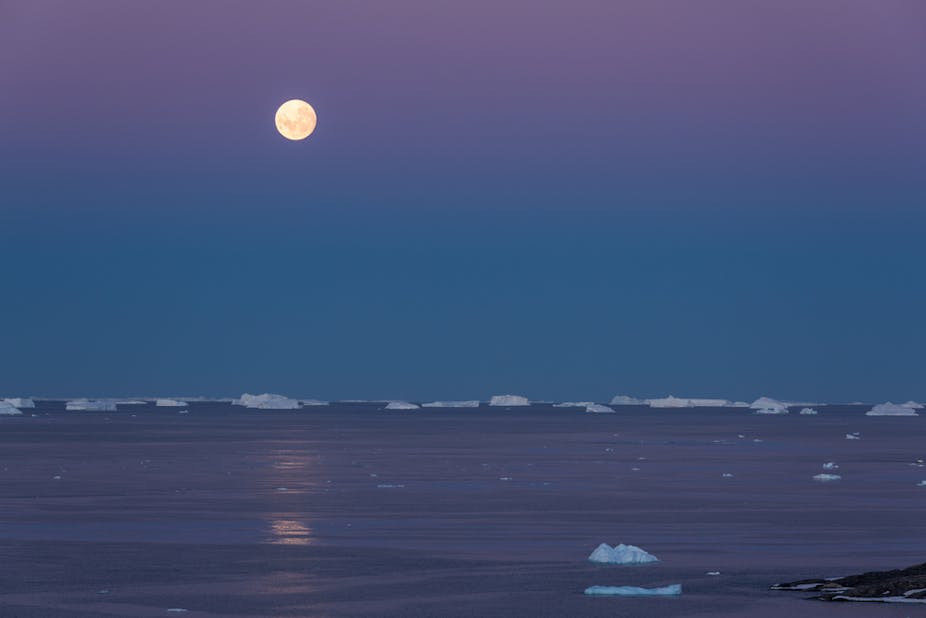
 Electron
microscope images of planktonic foraminifera N. pachyderma from Pine
Island Bay. Scale bar: 100µm equals 0.1mm. Nature
Publishing Group
Electron
microscope images of planktonic foraminifera N. pachyderma from Pine
Island Bay. Scale bar: 100µm equals 0.1mm. Nature
Publishing Group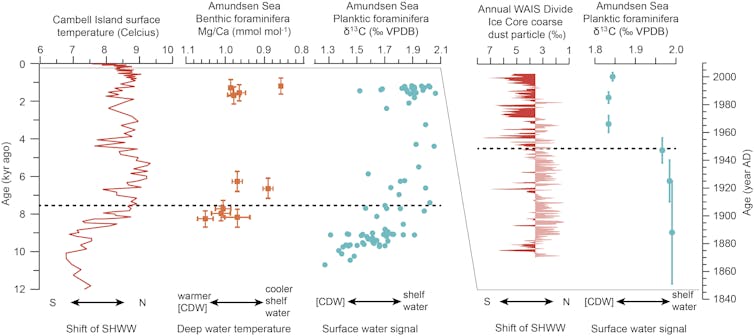 Data
llustrating the apparent link between winds and ocean around western
Antarctica. The migration of the southern hemisphere westerly winds
(SHWW) coincide with upwelling of Circumpolar Deep Water (CDW) in the
Amundsen Sea.
Data
llustrating the apparent link between winds and ocean around western
Antarctica. The migration of the southern hemisphere westerly winds
(SHWW) coincide with upwelling of Circumpolar Deep Water (CDW) in the
Amundsen Sea.