Showing posts with label euthanasia. Show all posts

Saturday, 27 August 2022

Trevor Mallard's terminally-ill victims


Check through the archives and you will find that there is no one more in favour of voluntary euthanasia.

And I mean VOLUNTARY - if people make their own decisions and take responsibility for their decision.

I was never in favour of any top-down system coming from governments, especially the fascism we are living through.

That only leads to the sort of outrage that is described here/

See this:

MOH SAYS KIWIS WITH COVID-19 CAN BE ELIGIBLE FOR EUTHANASIA

EXCLUSIVE: Disabled and terminally ill among first victims of Trevor Mallard, but media refused to tell the story

By Henoch Kloosterboer, Editor of The Defender.

Defend NZ

With the welcome departure of former Speaker of the House Trevor Mallard, there’s been a lot of talk about the public scandals that have plagued his tenure.

Everything from the highly questionable use of trespass notices, to dubious accusations against Parliamentary staffers, to his turning loudspeakers and sprinkler systems on protesting citizens.

There is one very serious incident, however, that you probably aren’t aware of – that #DefendNZ were one of the first victims of Trevor Mallard’s authoritarian excesses at Parliament.

Despite our best efforts at the time, the media refused to report what had happened to us, and so our story has remained largely untold to the public until now.

Back in May 2019, the second reading of the then End of Life Choice Bill, attempting to legalise assisted suicide and euthanasia, was due to take place in Parliament.

In preparation for this, we collaborated with a sitting MP to host a special event at Parliament which involved our #DefendNZ heroes – courageous Kiwis with terminal illnesses and disabilities who became public ambassadors to highlight the harms the Bill would bring about.

The day after this event, when the second reading of the Bill was thought to be highly likely, we were invited back to Parliament by a sitting MP. This is when we came face-to-face with the unforgiving wrath of Trevor Mallard.

Our small party of mainly disabled and terminally ill New Zealanders were not there to protest, disrupt or engage in illegal activity. We were simply there to attend pre-arranged meetings with MPs, observe proceedings from the public galleries of Parliament, and be silent advocates for vulnerable Kiwis.

We faithfully adhered to the rules which had been stipulated to us, including the fact that we were not to wear our #DefendNZ shirts in the public gallery. (The shirts simply said, “Vote no to assisted suicide”)

Over the course of the day, we began to sense that even our silent presence was becoming too challenging for the pro-euthanasia MPs, and around lunchtime, we discovered just how cruel those in power can be to a dissenting presence.

Without any prior warning, a Parliamentary security guard began rudely demanding that we leave the Parliament building immediately under the urgent order of Trevor Mallard.

Remember, we had not done anything illegal, we had not done anything disruptive, and we were there as guests of a sitting MP.

None of that mattered to Trevor Mallard, who quickly appeared in person to reinforce his eviction of a small and peaceful group of disabled and terminally ill New Zealand citizens.

I watched stunned, as Trevor Mallard stood over a woman with terminal brain cancer, and berated her with a raised voice, threatening her with a trespass notice as she sat in her wheelchair, made powerless and with eyes watering.

Here’s how disability advocate, and Anglican priest John Fox, who was one of those evicted, described the incident at the time:

“We were wearing our ‘Vote No to Assisted Suicide’ t-shirts (or some of us were) in the Parliamentary Cafe and the hallways: (we knew we couldn't wear them in the Public Gallery and we didn't). We were clustered around the lift because there are only two disabled lifts in Parliament; they're tiny, and we had a bunch of wheelchairs… Next thing you know, two pro-assisted-dying Ministers are complaining that we are there and accosting people, (which we didn't, we spoke to the people who spoke to us, or people we knew) so security arrived. They shouted at us (really), they were extremely aggressive, and refused to tell us what we did wrong, then they got increasingly demanding and aggressive, a couple of us on meds got upset, and demanded to know why he was being so aggressive and confrontational, and the wonderful [terminally ill] Vicki Walsh demanded to know why he was being so angry. 

Then the Speaker [Trevor Mallard] appeared and said we're not allowed political t-shirts, and that we shouldn't have been in the Cafe. We said we were invited specially, followed all the instructions we were given (we did, I was there, we were extremely careful to be respectful), the security man had another go at us because Ministers have complained, we asked why, and he explained to us [later, after we were escorted] outside that the rules have changed because of March 15 [Christchurch Mosque attack] and no one told us. We said that wasn't our fault, I explained to him the physical logistics of negotiating the damned difficult building and that we did nothing wrong, he said he didn't really care. 

In essence, the other team got sick of looking at us.” 
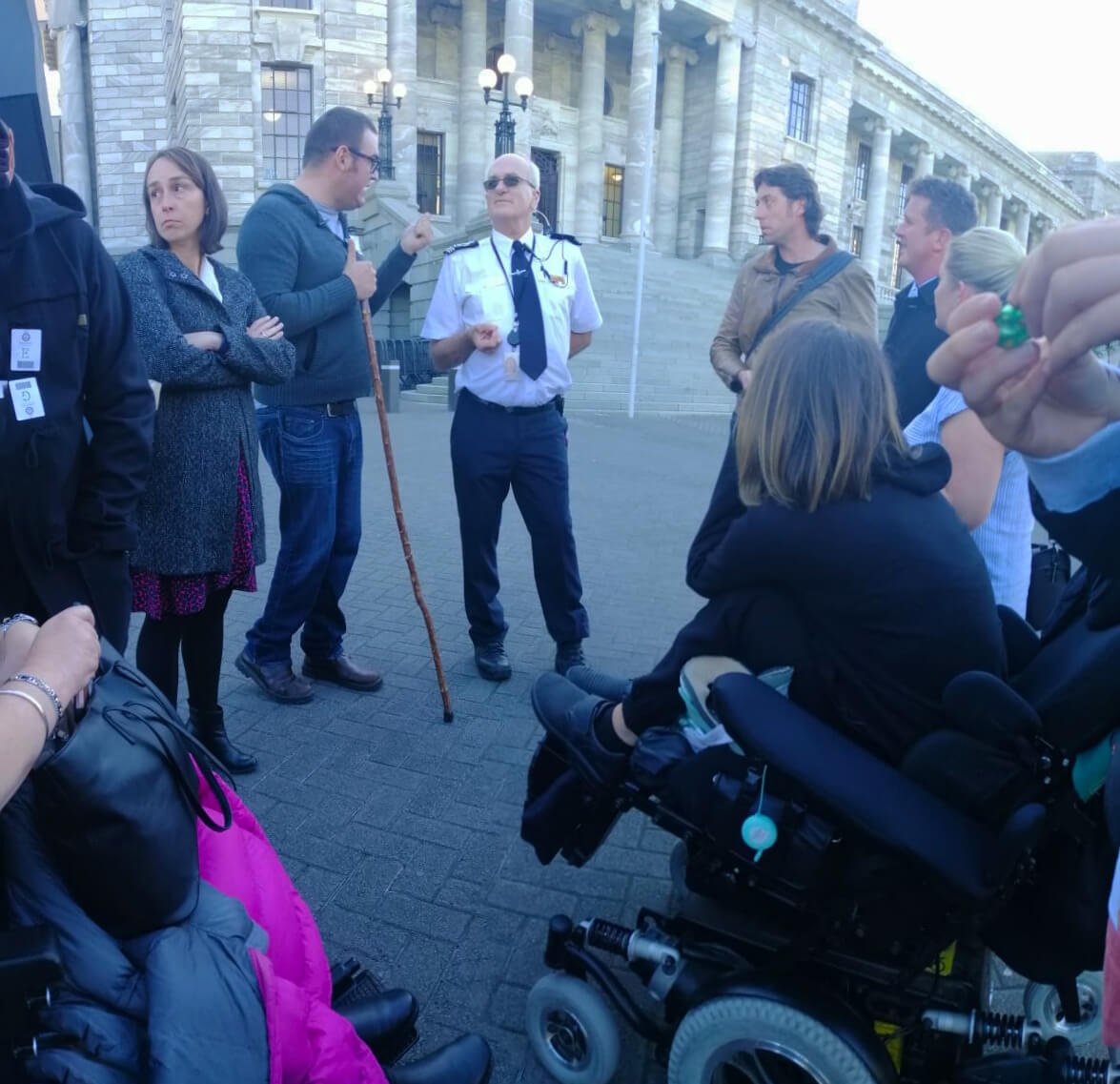
After the eviction: Vicki Walsh can be seen in her wheelchair bottom left, and Kylee Black in her wheelchair bottom right. Rev. John Fox can be seen at left of the security guard with Henoch Kloosterboer at right. This photo was taken after we had been removed. We are seen here outside Parliament’s entrance.

After the incident, Vicki Walsh (RIP), contacted her local MP to alert him to what had happened. She received this reply:

“I have now heard the whole story and am a little sorry I wasn’t there with you as I think you were done an injustice by our speaker.”

In the immediate aftermath of our unjustified eviction from Parliament under threat of trespass notice by Trevor Mallard, we felt we had to alert the public to what had happened.

The forceful removal of peaceful and non-disruptive New Zealand citizens from our nation’s Parliamentary buildings was too serious an incident to stay silent about.

As we were being forcefully removed by no less than three security guards, I immediately made phone contact with journalists from 1NEWS and the NZ Herald, both of whom indicated that the Parliamentary press gallery was aware that something serious had just transpired in Parliament.

They also told me that they were keen to come down and interview us, but they would just need to clear it with their editors first.

An hour later, after hearing nothing further from either journalist, I contacted them for a second time. It was then that I was told that their editors had refused them permission to report on the incident.

I was dumbfounded, as I can’t ever recall any other incident involving peaceful advocates, who were at Parliament by invitation, having been then threatened with trespass notices and evicted by the Speaker of the House. 

To say that this wasn’t something even mildly newsworthy beggars all belief.

At that stage, we chose not to take the issue any further because we didn’t want to create a sideshow, nor undermine our profoundly important advocacy work for vulnerable New Zealanders.

Don’t forget, the End of Life Choice Bill was still alive in Parliament at that stage, and we did not want to take any course of action that would jeopardise the possibility of a good outcome for those Kiwis the Bill would harm if it became law.

Later that same year, the Francis Review, which was an investigation into bullying at Parliament, was published. Among other things, it found the following:

“Bullying & harassment are systemic [at Parliament].” “Unacceptable conduct is too often tolerated or normalised.” “There is low accountability, particularly for Members, who face few sanctions for harmful behaviour.” “The identities of many accused are an open secret, and there are alleged serial offenders.”

We can definitely attest to having been targeted by that toxic culture, and it wasn’t good.

You might be wondering why we’ve chosen to speak publicly about our story now.

No, it’s not simply the fact that Trevor Mallard is departing, and it’s not an attempt to re-litigate old grievances. 

Instead, the important issue here is that of the public accountability of those who are elected to serve us in public office. 

This was just one of many incidents where the media performance during the passage of the assisted suicide and euthanasia Bill was highly questionable. 

One of the untold stories of that whole period was the way in which some journalists and media outlets went from being unbiased observers of the parliamentary process, to biased advocates and cheerleaders of a Bill.

This might have suited the supporters of legalised euthanasia, but it resulted in an extremely bad outcome for the people of New Zealand.

Even if you are pro-assisted suicide, the final End of Life Choice Act we ended up with has some very serious flaws in it. This means that vulnerable New Zealanders are now at greater risk of a wrongful death than they were before this Act was passed.

These flaws could, and more than likely would, have been addressed if the media had maintained a proper standard of journalistic ethics and ensured a greater degree of accountability.

The media’s decision to turn a blind eye to our unjust treatment at the hands of Speaker Mallard was just one example of many questionable media actions during that period.

Trevor Mallard may be departing Parliament, but the issues that allowed him to operate with impunity for many years while in office, culminating in the incidents of the last 12 months, remain unaddressed.

This is precisely why the public accountability aspect of the work we are engaged in at #DefendNZ is so fundamentally important.

If we can’t rely on the fourth estate to ensure a level playing field for vulnerable Kiwis, then it’s up to us to do our best to be a beacon of light, shining the uncomfortable light of accountability at the times and places where it is most needed.

Saturday, 13 February 2021

Instead of cruel animal experiments they are experimenting with children as young as 6 yo.

 COVID-19 vaccine trials to include participants as young as 6 months


HOUSTON, Texas (KTRK) -- If you want the COVID-19 vaccine and aren't in line to get it, there are still a number of vaccine trials- some involving kids.

Lakshy Patel is in the eighth grade and going to school virtually hasn't been easy.

"The WiFi problems, so I really get stressed out. I really want to go back to school," said Patel, who is also a vaccine trial participant.

Getting the vaccine could help him get back to school in person. It's one reason Patel is participating in the Moderna trial for adolescents. It's a two to one ratio of vaccine to placebo.

SEE ALSO: Teenagers could be compensated for vaccine trial in Houston

"I just want to be safe in this pandemic. My family wanted me to stay safe," said Patel.

There are 100, 12 to 17-year-olds participating in the Moderna adolescent trial through Houston Fights COVID. There are more trials coming, and the groups are now seeking participants as young as six months old.

"In about 30 days, we're going to start another trial that is six months to 17 years old, but that's about 30 days away," said Elizabeth Hoff, the executive director at DM Clinical.

While that trial is 30 days away, Hoff is encouraging people to sign up now. She's expecting a lot of interest in trials for children.

SEE ALSO: Houston mom, teen son taking part in COVID-19 vaccine trial

Children weren't a part of the initial large phase three trials so this is a big step in getting closer to getting kids vaccinated.

Wednesday, 3 February 2021

Vaccine Deaths in Nursing Homes: Conspiracy Theory or Deadly Reality?

 Perhaps some should show this to Ms. 'Whooping Cough'?

Here is the "vaccine voice of reason" for New Zealand, Helen Pertousis-Harris, fount of all wisdom and knowledge when it comes to these affairs.


This is what Helen Pertousis-Harris opined in articles in the NZ media over the weekend.

"Serious vaccine reactions do happen, but they’re rarer than being struck by lightning"

Older people usually get off lightly, she says, because their immune system is "old" and doesn't respond to antigens in vaccines.

https://www.stuff.co.nz/national/health/coronavirus/124085915/covid19-a-guide-for-the-vaccinehesitant

So let us just review a few of many headlines. You can look them up on Google if you (or Ms. Pertousis-Harris) are doubtful.

When you look at the articles below bear the following (plus Ms.Pertousis-Harris) in mind.

I think this is the same article.

https://www.stltoday.com/lifestyles/health-med-fit/coronavirus/anti-vaccine-activists-peddle-theories-that-covid-shots-are-deadly-undermining-vaccination/article_329c991e-12e3-5eaf-936f-cd67c092dae7.html

So let's dive in.


Since then the figures have been updated.

From Robert F Kennedy's site.


From a notorious conspiracy theory website, Business Insider citing another conspiracy theory organisation the Center for Disease Control (CDC).

Interestingly none of the links in the article worked.


https://markets.businessinsider.com/news/stocks/government-database-shows-7-844-injuries-and-181-deaths-following-covid-vaccine-as-of-jan-15-says-children-s-health-defense-1030014860?op=1

Could this be because, as Ms. Pertousis-Harris says, old people usually (sic) get off lightly?


Ditto


Again, Ms. Pertousis-Harris,  elderly patients who "usually get off lightly"


How can this be, Ms. Pertousis-Harris?


They "usually" only experience 'muscle pain reported as severe', don't they


"But they were going to die anyhow"

Have we forgotten that "every life counts"... "one death from covid-19 is one death too many"

But when it comes to vaccines death no longer seems to matter.


Is this the start of compulsory euthanasia or is it all part of a "virus of disinformation"?

You be the judge.

P.S. Just in case you missed it here is Ms. Pertousis-Harris' wisdom.


Might New Zealand have its own Dr.Mengele?

P.S. No doubt Ms. Pertousis-Harris and PM Jacinda Adern will look down their noses at the candour and caring attitude of this American nurse.

Tuesday, 3 November 2020

Discussing New Zealand's euthanasia referendum

 New Zealand has had two referenda - one on voluntary euthansia, the other on marijuana ( the first passed the second did not).

I have had ongoing concerns about the State interfering in something that should be a personal decision (when it relates to marijuana I mean the medical variety).  They do not need to pass legislation; they just need to stop police repression.

Now they have their OK for legislation my concern that the vast majority of people who do not fit into the tiny minority who meet the criteria will once again be subject to police repression on both accounts.

When it comes to euthanasia, now that they have excluded the vast majority of people who might have made a decision for themselves my concern is about the State and how they might use this in the future.

It is a bit like with abortion - where a piece of progressive legislation was passed to allow for abortion - that has now been  extended to allow for the abortion of foetuses at 9 months, something that in my mind is nothing less than murder.

This is from Philip Nitschke of Exit International.

New Zealand Votes Yes to Voluntary Euthanasia, but …

Philip Nitschke


the Peaceful Pill Handbook,

November 1, 2020


On Saturday 17 October 2020, New Zealand held its most recent federal election.

Coupled with the election were 2 referenda.

One on euthanasia, the other on cannabis.

In counting to date, around 65% of voters voted in favour of legalising assisted suicide/ assisted dying for the terminally ill. The final result will not be known until 6 November.

This is perhaps, in part, the legacy of NZ lawyer, Lucretia Seales, who died of a brain tumour in 2015.

The new law will not take effect until 12 months after the result is know (so that is 6 November 20201 – if they world does not end first).

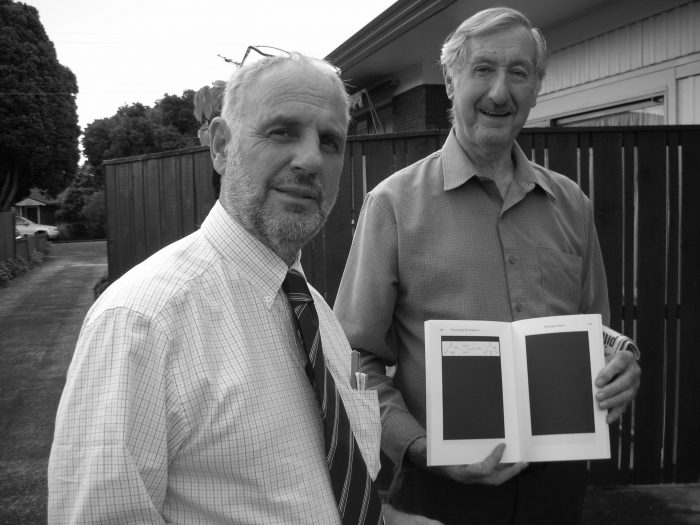
This is a bit of a major step for a country whose Chief Censor (yes such a post exists in New Zealand), 12 years ago, banned and then approved (with heavy redactions) an early edition of The Peaceful Pill Handbook. Censorship is alive and well in this country.

Philip Nitschke & Former VE Society of NZ President Jack Jones (dec) with a redacted Peaceful Pill Handbook in Auckland, 2008.

Voting ‘yes’ is also a major step for a country that continues to harbor such conservative anti-choice groups such as the Society for the Protection of Community Standards.

It is a major leap forward for a country who, in the 1950s, eagerly classified one of its most famous writers, Janet Frame, as an antipodean madwoman with schizophrenia, while her diagnostic conclusion in the UK was that she was ‘just different’; a shy woman who preferred to be alone.

And in case readers were at risk of forgetting, this is the country where in 2016 Police set up an unlawful roadblock, known as Operation Painter, not far from Suzy Austen’s potluck Sunday lunch to trick the Exit Members who attended into handing over their name and addresses; so as they could be put under police surveillance and later visited and compelled to hand over any end of life drugs they may have illegally acquired.

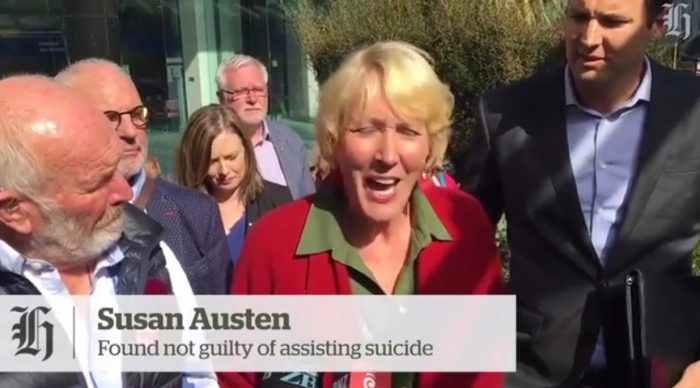
Suzy Austen defeats Operation Painter

Suzy Austen outside the Wellington High Court, 23 February 2018


(SMR - I was caught up in this - I attended the pot-luck lunch he talks about)

WHAT IS IT THAT NEW ZEALANDERS HAVE VOTED FOR?

As with the Australian state of Victoria, when voluntary euthanasia/ assisted suicide/ assisted dying becomes the law in NZ, it will be situated within the medical model.

Those assisting must be medical professionals.

Those receiving the assistance must be terminally ill with < 6 months to live.

People of advanced old age are excluded from eligibility as are those with a disability (eg. quadriplegia) or a mental illness, such as dementia.

THE END OF LIFE CHOICE ACT

  • be aged 18 years or over
  • be a citizen or permanent resident of New Zealand
  • suffer from a terminal illness that is likely to end their life within 6 months
  • have significant and ongoing decline in physical capability
  • experience unbearable suffering that cannot be eased
  • be able to make an informed decision about assisted dying.

A treating doctor may also NOT suggest voluntary euthanasia as an option.

A request for voluntary euthanasia may NOT be included in an advance directive.

Interestingly, the Act DOES provide for the administration of a lethal injection, instigated by either the person or the medical professional.

MEDICAL PROFESSION OVERSIGHT

As with all medical model end of life laws, doctors will play a central role in the End of Life Choice Act.

In this regard, if a  doctor decides that the person requesting assisted dying is eligible, they must seek a second opinion from an independent doctor.

The independent doctor must also agree that the person meets all the criteria, which includes being competent to make an informed decision about assisted dying.

If either doctor is unsure of the person’s ability to make an informed decision, a third opinion from a psychiatrist is required.

AVAILABLE METHODS

1. Ingestion, triggered by the person.

2. Intravenous delivery, triggered by the person.

3. Ingestion through a tube, triggered by the doctor or a nurse practitioner.

4. Injection, administered by the doctor or a nurse practitioner.

Oversight will be via the ‘Support and Consultation for End of Life in New Zealand (SCENZ) Group’ and an End of Life Review Committee.

This SCENZ Group will ‘make and maintain a list of doctors who are willing to act as replacement and/or independent doctors’.

A Summary of the End of Life Choice Act

As with all medical model legislation, there are considerable hurdles that must be completed before one is able to use the law.

This type of regime of so-called safeguards makes the society that has voted in the law feel much more comfortable with their decision.

However, it harks back to the question raised by Bob Dent in Darwin in 1996 when he became the first person in the world to receive a legal, lethal voluntary injection under the Rights of the Terminally Ill Act (NT).

Bob questioned the fact that as a dying man he was forced to undergo so much final testing, just to be able to die in peace. He always maintained that had he had the drugs at home in the cupboard he would have simply gone quietly to the cupboard and taken them. He did think it fair or reasonable to have been seemingly persecuted by the burden of proof.

AND THEN THERE ARE THE ISSUES OF OLD AGE & AWFUL DISEASES THAT KILL SLOWLY

A law that expressly excludes people of advanced age, people like 104-year old Australian ecologist Professor David Goodall, who was not sick but was old (enough), are not laws for everyone.

And a law that mandates certain death within 6 months is simply cruel. Such a law would never have served Melbourne firefighter Troy Thornton who had multiple system atrophy (and was becoming slowly but surely completely paralysed, and who chose to die in Switzerland) or New Zealanders like Rachel Rypma who has Huntington’s Disease, one of the most cruel and degrading genetic conditions ever invented.

Indeed, with this exclusion they make themselves laws for the very few.

For Exit this remains a needless restriction. Perhaps the most meaningless restriction; especially given the fact that we are likely to live longer in poorer health than any generation preceding us.

WHAT ABOUT THE COLONISATION OF DYING AND DEATH BY THE MEDICAL PROFESSION?

The one aspect of New Zealand’s End of Life Choice Act must be the central role of the medical profession in the operation of the Act.

Unlike in Switzerland where a person does NOT need to be terminally ill (or even sick), but only needs to have the capacity to understand and initiate the act themselves and the person providing assistance only does so for altruistic reasons, like so many other countries New Zealand has created a framework that inserts a medical professional into an area of human existence which is not intrinsically medical in nature.

As British public health specialist, Dr Lucy Thomas, wrote recently (30 September) in the British Medical Journal:

… giving people access to the means to end their life is not, in itself, a medical procedure, and there is no practical need to involve a medical professional. More fundamentally, it becomes difficult to reduce something as profoundly complex as the desire to end life to a medical problem.

All of us experience suffering in our lives, and at times we all ponder the meaning of our existence in the context of our personal histories, social relationships, and wider circumstances. Many of us have occasions when we question whether our lives are worth living, and some go as far as to consider ending life, either in a moment of desperation or after lengthy, considered deliberation. The underlying existential struggle is not fundamentally different in the presence or absence of illness or disability; nor is it determined by how long or short a remaining life is predicted to be.

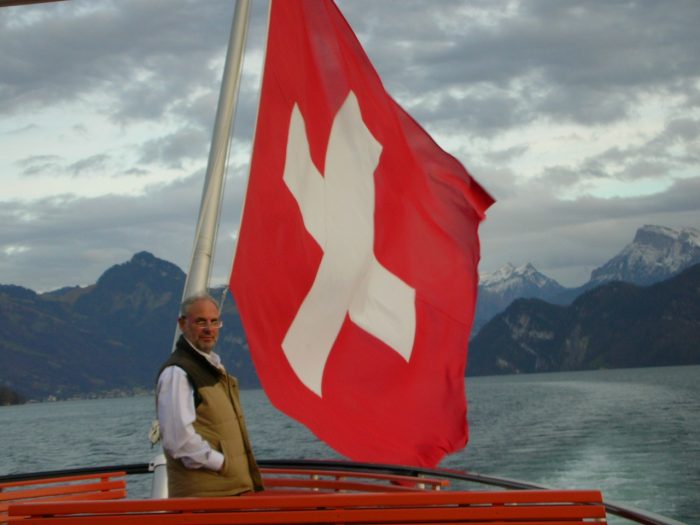
Philip Nitschke in Zurich

In doing so, medical professionals become the gate-keepers of this most private and intimate of all life’s decisions.

And, in being the gate-keepers, they are the wielders and arbiters of power over the lives (and deaths) of others.

Exit congratulates New Zealand on their great leap forward but with these reservations in mind, we wonder how great a leap it truly is, and the perspective of forward and backward can surely only be understood from one’s unique standpoint?


Wednesday, 16 May 2018

Dr. David Goodall's warning to humanity

It would decimate us’: David Goodall’s final warning to humanity hours before death


14 May, 2018

There is one topic David Goodall felt he was not questioned on before choosing to end his 104-year life at an assisted dying clinic in Switzerland.

As one of Australia’s most esteemed scientific minds, Dr Goodall received global attention for wanting to die.

But his views on science went unnoticed.

As he lay in bed eagerly awaiting his death, Dr Goodall ensured Ruedi Habegger, cofounder of the Eternal Spirit clinic, recorded his final thoughts on the future of humanity.

And they are grim.

Without a strong global commitment to address the threat of climate change, the world could become uninhabitable, Dr Goodall warned hours before his death on May 10.

That would decimate the populations greatly and might make the planet a very hostile place up to the point of a reset situation.”

Dr Goodall described a situation where life on Earth could no longer be sustained, everything would be wiped out, and the world would need to be rebuilt from scratch – a process that would take “a few million years”.

David Goodall at his desk

David Goodall, aged 102, working at Edith Cowan University in Perth. Photo: ABC
The renowned botanist and ecologist produced more than 100 research papers throughout his career spanning 70 years and edited a 30-volume book series written by more than 500 authors titled Ecosystems of the World.

In 2016, aged 101, Dr Goodall was awarded the Order of Australia for his contributions to science.

It is too late to revert back to the relatively calm and evenly balanced systems we had enjoyed up to the 1950s,” he said.

All we can do now is to adapt to the resulting changes and the damages we caused, us in the first world to an overwhelming degree being responsible for this [climate change].”

The Paris agreement on climate change is most likely doomed to fail because the self-interests of signatory countries have always taken priority, he said.

It will be hard enough to curb the further effects [of climate change] by abiding to such ideas as the Paris climate agreements.

I am not very optimistic if we are even going to do that.

Too many particular short-term interests are involved. But it is worth giving it a good try.

We might prevent the changes spiralling out of control.”

Ashes to be sent to France’


Dr Goodall will be cremated in Switzerland, and his ashes will be flown to Bordeaux in France, where a number of his grandchildren reside, Eternal Spirit’s Mr Habegger told The New Daily.

According to the clinic’s brochure, those from abroad should “accept a cremation” because “the urn can easily be transferred home”.

Dr Goodall originally wanted to his ashes to remain in Switzerland “so they don’t travel and use up any fuel”, Mr Habegger said.

His mind was very much set on that but then a few minutes before his death … his grandchildren begged him to have the ashes sent to Bordeaux so they would have a little ritual among themselves.”


Monday, 14 May 2018

When compassion becomes a crime


"Good people, driven by compassion, are compelled to break the law when that law is inadequate. This is Suzy's story.

"She is deeply compassionate and unusually brave and has been convicted on two charges of importing a lethal drug. How is it that someone who has demonstrably been a pillar of our society can be, on the surface, a convicted drug importer?"

---Maryan Street, ex- Labour MP

Upstanding 67-year-old turned into a criminal for upholding moral values
Seemorerocks


Now that an 18 month saga is behind us I would like to talk about something that has been sitting on my shoulders.

Euthanasia advocate fined for importing suicide drug


Suzy Austen, who was arrested by police for "aiding and abetting" a suicide, was found not guilty of the main charge by a jury of her peers but guilty of two counts of importing a class-C drug, pentobarbitone.

Despite the fact that this was a slap-over-the-wrist misdemeanour for which only about five people have received a warning.

However, it seems obvious to me that the State, having failed to get their conviction despite the wasting of police time and the huge cost of an investigation and court case to the taxpayer, was going to get its punishment and make an example of someone who is leading a campaign for freedom-of-choice when it comes to End of Life.

In short, the sentencing was a political act.

One would think the Law is there to provide protection to those who need it. In fact, we know this is not the case (rather the opposite; try to get the police interested in investigating the burglary of your house) and that the law is there to protect the property interests of the privileged.

Politically, I am not a libertarian. In fact, I am a great fan of the Law protecting those who need protecting - the weak, the vulnerable and the exploited. However, in my mind there is no crime where there is no victim.  Is the law, in this case, there to protect the moral sensibilities of a vociferous minority in a country where a sense of morality has been all but flushed down the toilet?

When it comes to two issues dear to my heart I am definitely a libertarian - the right to decide when and how we are going to die and the right to use medical marijuana to counter pain and disease.

You would be hard-pressed to convince me that there is a victim in these "crimes".

All of us will be aware how the police are short of resources when it comes to investigating real crimes with real victims, such as burglary or assault. And yet we see how the Police appears to have unlimited resources to go after people with a high level of moral integrity and those who are elderly, sick and vulnerable.

And I wouldn't mind wagering that instructions for this came from on-high. I doubt that the police would have decided to waste their limited resources were there not the political resolve to do so.

In 2016 I was at a meeting of Exit International which, it turned out, was being bugged by the police. On the way home many of the attendees (not me – I took another route home) were stopped by an illegal police road block, designed to get the identities of those attending.

I myself got a visit from the police at 9 am on a Saturday morning. Amidst the questions they asked was the quip from one of the young policemen that I can remember as if it were yesterday: “we are going to put Suzy (they used a different surname) out of action”.

I have heard since of others' experiences. 

One friend had her home searched and material confiscated. Another was told by the police, in a manner that could only be described as intimidation: “we know everything about you. There is nothing we don’t know”.

Imagine the effect of this on a senior citizen who has never put a foot wrong in her life suddenly being treated like a criminal.

This same friend had the presence of mind to say: “the law’s an ass”. Came the reply: “I’m here to uphold the law”. “Well I’m here to change it”, she replied.

Pretty gutsy, but our friend was shaking after the police left and suffered what she described as post-traumatic stress symptoms.

All of this happened towards the end of the last government which used similarly repressive methods against journalists and whistleblowers (out of spite and vengeance by the prime minister).

It seemed pretty symbolic to me that the power of the State should be used against older, upstanding citizens for exercising their rights and advocating for a change in the law (which is indeed an ass) as regards End of Life choices, which the media calls euthanasia, to create the most negative possible impression.

As for Suzy Austen, I can do no better than the following, put together by the author of the article below. 


The Susan Austen interview - from teacher to campaigner to unlikely criminal
TOM HUNT


Austen says Harris has been by her side through every step of the trial.

14 May, 2018

Suzy Austen's mother was an active, vibrant woman who, in the end, was barely a person. She had dementia for thirteen years and finally closed her eyes for the last two and a half.


Sitting in Suzy​ Austen's house high in Lower Hutt's hills on a drizzly Sunday, it's hard to believe you are in the presence of a criminal.

A 67-year-old criminal – a drug importer, no less – tried, convicted, and sentenced in the High Court in Wellington. The drug was pentobarbitone, commonly used for euthanasia.

Her sentence, handed down on Friday, was a $7500 fine. More than the discharge without conviction sought, but less than what could have been.

Euthanasia campaigner Suzy Austen, with her motorcycle enthusiast husband Mike Harris.
Euthanasia campaigner Suzy Austen, with her motorcycle enthusiast husband Mike Harris. - ROSS GIBLIN/STUFF

Euthanasia campaigner Suzy Austen, with her motorcycle enthusiast husband Mike Harris.

It is two days later and Austen is preparing for a Sunday afternoon thank you party to all those who have supported her since October, 2016.

That was when police caught the retired school teacher in a car in a Lower Hutt car park – with a friend in her 80s – wearing rubber gloves and repackaging pentobarbitone.

The past 18 months have been hard. She lost weight and her sleep patterns changed. Sunday morning, when she woke up at 7.15am, was a sleep-in, thanks to the fact the ordeal is finally over.

Austen says Harris has been by her side through every step of the trial.

"In many ways I feel stronger because I know this is something I can campaign for all my life."

Her husband, Mike Harris, "Jolly Mike" to his friends, has been beside her through every court appearance. He sits with her through Sunday's interview.

As the chicken drumsticks heat in the oven, he heads off to the supermarket to get supplies.

He nods, smiles, rarely-interjects as Austen tells her life story – a story that begins as an adopted baby and has now seen her become one of New Zealand's most high-profile campaigners for a change to euthanasia laws.

She moved from Dunedin to Wellington when she was 13 and grew up in Hutt Valley, where she now lives. She became a teacher, initially at Parkway Primary in Wainuiomata then Martinborough in Wairarapa.

Suzy Austen with a photo of her with her mother.
Suzy Austen with a photo of her with her mother. - ROSS GIBLIN/STUFF


Austen was 35, the mother of two young boys, when she began the search for her birth parents.

She eventually tracked down her birth mother, Iona Potter. They reconnected but Potter died six months later and the clues to her father were vague. He was Welsh, tall, and from a visiting sports team.

That sports team was the British Lions and that sportsman was Don Hayward. Hayward had since moved to New Zealand and was running a butcher's shop in Wainuiomata that Austen, unknowingly, bussed past each day for a good portion of her life.

"I think you are my father," she said when they finally met in ÅŒtaki. It was then she saw where she got her height, her looks, her big hands.
Suzy Austen with a photo of her with her mother.
ROSS GIBLIN/STUFF
Austen was 35, the mother of two young boys, when she began the search for her birth parents.

She eventually tracked down her birth mother, Iona Potter. They reconnected but Potter died six months later and the clues to her father were vague. He was Welsh, tall, and from a visiting sports team.

That sports team was the British Lions and that sportsman was Don Hayward. Hayward had since moved to New Zealand and was running a butcher's shop in Wainuiomata that Austen, unknowingly, bussed past each day for a good portion of her life.

"I think you are my father," she said when they finally met in ÅŒtaki. It was then she saw where she got her height, her looks, her big hands.
Supporters of Susan Austen outside Wellington District Court ahead of her sentencing.
Supporters of Susan Austen outside Wellington District Court ahead of her sentencing. - TOM HUNT/STUFF


"He said, 'I have always wanted a daughter', which was just magical and it was just open arms. It was such a wonderful experience of so much joy to everybody. Mum and Dad supported me..."

Austen got to know her biological father – a generous man who talked a lot and was kind to everyone. Austen reckons her enjoyment of getting to know people, of wanting to know more about them, comes from him.

She is equally kind of her adopted parents.

It was her father who gave her the book Jean's Way by Derek Humphry, the tale of a terminally-ill woman suffering from incurable cancer who ends her life with drugs supplied by her husband.

For many involved in the euthanasia cause, the catalyst is the prolonged, painful death of a loved one. For Austen, it was a book.


Suzy Austen at her home in Lower Hutt, the same one police used to bug an Exit International meeting. - ROSS GIBLIN/STUFF


"Dad firmly believed in end-of-life choice ... I always knew that this was what he would choose – to end his own life if he found it was unbearable. But, dare I say it, fortunately and gracefully, he faded away very quickly."

By the time her mother took years to die, Austen was already involved in the euthanasia movement.

She gave up her teaching job, "which I absolutely loved," and had time to study more and joined the Wellington branch of the Voluntary Euthanasia Society.


Susan Austen leaves Wellington High Court with her husband Mike Harris after being sentenced for importing euthanasia drugs. - KEVIN STENT/STUFF


She watched the slow withering of her mother – her eating stopped, interests vanished, eyes closed and foot stopped tapping to music.

There was an advance-directive not to give life-prolonging medication but her heart was strong and went on for 13 more years.

"I don't believe she suffered .... but it was cruel for her because she was an active vibrant, generous woman."

Austen's own death would appear to be a long way off. She still rides side-car in her 87-year-old husband's motorbike and has the energy of a young woman. But we all die. Have her own adult sons, who recently gave her a grandson and granddaughter, been given instructions?

"Not specifically. I know they know what I believe. I know they would do whatever they could do legally."

But for now death is far from anyone's mind.

The guests on this wet Sunday include her legal team and supporters who turned out court date after court date. Austen is now famous but insists she is still the same person.

"I just feel so grateful," she says.

In this house – the same one police bugged to record an Exit International meeting then set up a road block nearby to get names and addresses – the chicken drumsticks need cooking and Jolly Mike is off to the shops.

FROM HER SUPPORTERS:


World Federation of right-to-die societies President Sean Davison.

"Suzy's fine of $7500 is peanuts compared to the huge cost of the police investigation and High Court trial to the New Zealand taxpayer.

"If a real crime had been committed I believe the police should leave no stone unturned in bringing the perpetrators to justice, but on this occasion I feel the investigation was misdirected and their resources could be better utilised."

Exit International director Philip Nitschke:


Head of Exit International Philip Nitschke. - DAVID MARIUZ
.

"[Austen's sentence] could have been worse, but she will be disappointed ...

"It was also of interest how the New Zealand politicians (like the Australian ones) have been quick to distance themselves from any legislative solution."

Voluntary Euthanasia Society president Maryan Street​:


Maryan Street, assisted-dying campaigner and former Labour MP. - ROSS GIBLIN/STUFF

"Good people, driven by compassion, are compelled to break the law when that law is inadequate. This is Suzy's story.

"She is deeply compassionate and unusually brave and has been convicted on two charges of importing a lethal drug. How is it that someone who has demonstrably been a pillar of our society can be, on the surface, a convicted drug importer?"