Showing posts with label John Pilger. Show all posts

Tuesday, 15 December 2020

"A new Pearl Harbour

 I think it is very important to keep a historical perspective on how the world came to be what it is now.

John Pilger reveals the American plan: a new Pearl Harbour

Two years ago a project set up by the men who now surround George W Bush said what America needed was a “catastrophic and catalysing event”.


Some important reflections from Dane Wigington of geoengineeringwatch.org.


New Statesman,

16 December, 2002


The threat posed by US terrorism to the security of nations and individuals was outlined in prophetic detail in a document written more than two years ago and disclosed only recently. What was needed for America to dominate much of humanity and the world’s resources, it said, was “some catastrophic and catalysing event - like a new Pearl Harbor”.


The attacks of 11 September 2001 provided the “new Pearl Harbor”, described as “the opportunity of ages”. The extremists who have since exploited 11 September come from the era of Ronald Reagan, when far-right groups and “think-tanks” were established to avenge the American “defeat” in Vietnam. In the 1990s, there was an added agenda: to justify the denial of a “peace dividend” following the cold war. The Project for the New American Century was formed, along with the American Enterprise Institute, the Hudson Institute and others that have since merged the ambitions of the Reagan administration with those of the current Bush regime.


One of George W Bush’s “thinkers” is Richard Perle. I interviewed Perle when he was advising Reagan; and when he spoke about “total war”, I mistakenly dismissed him as mad. He recently used the term again in describing America’s “war on terror”. “No stages,” he said. “This is total war. We are fighting a variety of enemies. There are lots of them out there. All this talk about first we are going to do Afghanistan, then we will do Iraq . . . this is entirely the wrong way to go about it. If we just let our vision of the world go forth, and we embrace it entirely and we don’t try to piece together clever diplomacy, but just wage a total war . . . our children will sing great songs about us years from now.”


Perle is one of the founders of the Project for the New American Century, the PNAC. Other founders include Dick Cheney, now vice-president, Donald Rumsfeld, defence secretary, Paul Wolfowitz, deputy defence secretary, I Lewis Libby, Cheney’s chief of staff, William J Bennett, Reagan’s education secretary, and Zalmay Khalilzad, Bush’s ambassador to Afghanistan. These are the modern chartists of American terrorism.


The PNAC's seminal report, Rebuilding America’s Defences: strategy, forces and resources for a new century, was a blueprint of American aims in all but name. Two years ago it recommended an increase in arms-spending by $48bn so that Washington could "fight and win multiple, simultaneous major theatre wars". This has happened. It said the United States should develop "bunker-buster" nuclear weapons and make "star wars" a national priority. This is happening. It said that, in the event of Bush taking power, Iraq should be a target. And so it is.


As for Iraq’s alleged “weapons of mass destruction”, these were dismissed, in so many words, as a convenient excuse, which it is. “While the unresolved conflict with Iraq provides the immediate justification,” it says, “the need for a substantial American force presence in the Gulf transcends the issue of the regime of Saddam Hussein.”


How has this grand strategy been implemented? A series of articles in the Washington Post, co-authored by Bob Woodward of Watergate fame and based on long interviews with senior members of the Bush administration, reveals how 11 September was manipulated.


On the morning of 12 September 2001, without any evidence of who the hijackers were, Rumsfeld demanded that the US attack Iraq. According to Woodward, Rumsfeld told a cabinet meeting that Iraq should be "a principal target of the first round in the war against terrorism". Iraq was temporarily spared only because Colin Powell, the secretary of state, persuaded Bush that "public opinion has to be prepared before a move against Iraq is possible". Afghanistan was chosen as the softer option. If Jonathan Steele's estimate in the Guardian is correct, some 20,000 people in Afghanistan paid the price of this debate with their lives.


Time and again, 11 September is described as an "opportunity". In last April's New Yorker, the investigative reporter Nicholas Lemann wrote that Bush's most senior adviser, Condoleezza Rice, told him she had called together senior members of the National Security Council and asked them "to think about 'how do you capitalise on these opportunities'", which she compared with those of "1945 to 1947": the start of the cold war.


Since 11 September, America has established bases at the gateways to all the major sources of fossil fuels, especially central Asia. The Unocal oil company is to build a pipeline across Afghanistan. Bush has scrapped the Kyoto Protocol on greenhouse gas emissions, the war crimes provisions of the International Criminal Court and the anti-ballistic missile treaty. He has said he will use nuclear weapons against non-nuclear states “if necessary”. Under cover of propaganda about Iraq’s alleged weapons of mass destruction, the Bush regime is developing new weapons of mass destruction that undermine international treaties on biological and chemical warfare.


In the Los Angeles Times, the military analyst William Arkin describes a secret army set up by Donald Rumsfeld, similar to those run by Richard Nixon and Henry Kissinger and which Congress outlawed. This "super-intelligence support activity" will bring together the "CIA and military covert action, information warfare, and deception". According to a classified document prepared for Rumsfeld, the new organisation, known by its Orwellian moniker as the Proactive Pre-emptive Operations Group, or P2OG, will provoke terrorist attacks which would then require "counter-attack" by the United States on countries "harbouring the terrorists".


In other words, innocent people will be killed by the United States. This is reminiscent of Operation Northwoods, the plan put to President Kennedy by his military chiefs for a phoney terrorist campaign - complete with bombings, hijackings, plane crashes and dead Americans - as justification for an invasion of Cuba. Kennedy rejected it. He was assassinated a few months later. Now Rumsfeld has resurrected Northwoods, but with resources undreamt of in 1963 and with no global rival to invite caution.


You have to keep reminding yourself this is not fantasy: that truly dangerous men, such as Perle and Rumsfeld and Cheney, have power. The thread running through their ruminations is the importance of the media: “the prioritised task of bringing on board journalists of repute to accept our position”.


Our position” is code for lying. Certainly, as a journalist, I have never known official lying to be more pervasive than today. We may laugh at the vacuities in Tony Blair’s “Iraq dossier” and Jack Straw’s inept lie that Iraq has developed a nuclear bomb (which his minions rushed to “explain”). But the more insidious lies, justifying an unprovoked attack on Iraq and linking it to would-be terrorists who are said to lurk in every Tube station, are routinely channelled as news. They are not news; they are black propaganda.


This corruption makes journalists and broadcasters mere ventriloquists’ dummies. An attack on a nation of 22 million suffering people is discussed by liberal commentators as if it were a subject at an academic seminar, at which pieces can be pushed around a map, as the old imperialists used to do.


The issue for these humanitarians is not primarily the brutality of modern imperial domination, but how “bad” Saddam Hussein is. There is no admission that their decision to join the war party further seals the fate of perhaps thousands of innocent Iraqis condemned to wait on America’s international death row. Their doublethink will not work. You cannot support murderous piracy in the name of humanitarianism. Moreover, the extremes of American fundamentalism that we now face have been staring at us for too long for those of good heart and sense not to recognise them.


With thanks to Norm Dixon and Chris Floyd


Sunday, 4 October 2020

John Pilger on Julian Assange's ordeal

 EYEWITNESS TO THE AGONY OF JULIAN ASSANGE

ARENA ONLINE

JOHN PILGER

2 OCT 2020

Journalist John Pilger has spent the last three weeks watching Julian Assange’s extradition trial at London’s Old Bailey. He spoke with Arena Online’s editor, Timothy Erik Ström:

Q:  Having watched Julian Assange’s trial firsthand, can you describe the prevailing atmosphere in the court?

The prevailing atmosphere has been shocking. I say that without hesitation; I have sat in many courts and seldom known such a corruption of due process; this is due revenge. Putting aside the ritual associated with ‘British justice’, at times it has been evocative of a Stalinist show trial. One difference is that in the show trials, the defendant stood in the court proper. In the Assange trial, the defendant was caged behind thick glass, and had to crawl on his knees to a slit in the glass, overseen by his guard, to make contact with his lawyers. His message, whispered barely audibly through face masks, was then passed by post-it the length of the court to where his barristers were arguing the case against his extradition to an American hellhole.

Consider this daily routine of Julian Assange, an Australian on trial for truth-telling journalism. He was woken at five o’clock in his cell at Belmarsh prison in the bleak southern sprawl of London. The first time I saw Julian in Belmarsh, having passed through half an hour of ‘security’ checks, including a dog’s snout in my rear, I found a painfully thin figure sitting alone wearing a yellow armband. He had lost more than 10 kilos in a matter of months; his arms had no muscle. His first words were: ‘I think I am losing my mind’.

I tried to assure him he wasn’t. His resilience and courage are formidable, but there is a limit. That was more than a year ago. In the past three weeks, in the pre-dawn, he was strip-searched, shackled, and prepared for transport to the Central Criminal Court, the Old Bailey, in a truck that his partner, Stella Moris, described as an upended coffin. It  had one small window; he had to stand precariously to look out. The truck and its guards were operated by Serco, one of many politically connected companies that run much of Boris Johnson’s Britain.

The journey to the Old Bailey took at least an hour and a half. That’s a minimum of three hours being jolted through snail-like traffic every day. He was led into his narrow cage at the back of the court, then look up, blinking, trying to make out faces in the public gallery through the reflection of the glass. He saw the courtly figure of his dad, John Shipton, and me, and our fists went up. Through the glass, he reached out to touch fingers with Stella, who is a lawyer and seated in the body of the court.

We were here for the ultimate of what the philosopher Guy Debord called The Society of the Spectacle: a man fighting for his life. Yet his crime is to have performed an epic public service: revealing that which we have a right to know: the lies of our governments and the crimes they commit in our name. His creation of WikiLeaks and its failsafe protection of sources revolutionised journalism, restoring it to the vision of its idealists. Edmund Burke’s notion of free journalism as a fourth estate is now a fifth estate that shines a light on those who diminish the very meaning of democracy with their criminal secrecy. That’s why his punishment is so extreme.

The sheer bias in the courts I have sat in this year and last year, with Julian in the dock, blight any notion of British justice. When thuggish police dragged him from his asylum in the Ecuadorean embassy—look closely at the photo and you’ll see he is clutching a Gore Vidal book; Assange has a political humour similar to Vidal’s—a judge gave him an outrageous 50-week sentence in a maximum-security prison for mere bail infringement.

For months, he was denied exercise and held in solitary confinement disguised as ‘heath care’. He once told me he strode the length of his cell, back and forth, back and forth, for his own half-marathon. In the next cell, the occupant screamed through the night. At first he was denied his reading glasses, left behind in the embassy brutality. He was denied the legal documents with which to prepare his case, and access to the prison library and the use of a basic laptop. Books sent to him by a friend, the journalist Charles Glass, himself a survivor of hostage-taking in Beirut, were returned. He could not call his American lawyers. He has been constantly medicated by the prison authorities. When I asked him what they were giving him, he couldn’t say. The governor of Belmarsh has been awarded the Order of the British Empire.

At the Old Bailey, one of the expert medical witnesses, Dr Kate Humphrey, a clinical neuropsychologist at Imperial College, London, described the damage: Julian’s intellect had gone from ‘in the superior, or more likely very superior range’ to ‘significantly below’ this optimal level, to the point where he was struggling to absorb information and ‘perform in the low average range’.

This is what the United Nations Special Rapporteur on Torture, Professor Nils Melzer, calls ‘psychological torture’, the result of a gang-like ‘mobbing’ by governments and their media shills. Some of the expert medical evidence is so shocking I have no intention of repeating it here. Suffice to say that Assange is diagnosed with autism and Asperger’s syndrome and, according to Professor Michael Kopelman, one of the world’s leading neuropsychiatrists, he suffers from ‘suicidal preoccupations’ and is likely to find a way to take his life if he is extradited to America.

James Lewis QC, America’s British prosecutor, spent the best part of his cross-examination of Professor Kopelman dismissing mental illness and its dangers as ‘malingering’. I have never heard in a modern setting such a primitive view of human frailty and vulnerability.

My own view is that if Assange is freed, he is likely to recover a substantial part of his life. He has a loving partner, devoted friends and allies and the innate strength of a principled political prisoner. He also has a wicked sense of humour.

But that is a long way off. The moments of collusion between the judge—or magistrate, a Gothic-looking Vanessa Baraitser, about whom little is known—and the prosecution acting for the Trump regime have been brazen. Until the last few days, defence arguments have been routinely dismissed. The lead prosecutor, James Lewis QC, ex SAS and currently Chief Justice of the Falklands, by and large gets what he wants, notably up to four hours to denigrate expert witnesses, while the defence’s examination is guillotined at half an hour. I have no doubt, had there been a jury, his freedom would be assured.

The dissident artist Ai Weiwei came to join us one morning in the public gallery. He noted that in China the judge’s decision would already have been made. This caused some dark ironic amusement. My companion in the gallery, the astute diarist and former British ambassador Craig Murray wrote:

I fear that all over London a very hard rain is now falling on those who for a lifetime have worked within institutions of liberal democracy that at least broadly and usually used to operate within the governance of their own professed principles. It has been clear to me from Day 1 that I am watching a charade unfold. It is not in the least a shock to me that Baraitser does not think anything beyond the written opening arguments has any effect. I have again and again reported to you that, where rulings have to be made, she has brought them into court pre-written, before hearing the arguments before her.

I strongly expect the final decision was made in this case even before opening arguments were received.

The plan of the US Government throughout has been to limit the information available to the public and limit the effective access to a wider public of what information is available. Thus we have seen the extreme restrictions on both physical and video access. A complicit mainstream media has ensured those of us who know what is happening are very few in the wider population.

There are few records of the proceedings. They are: Craig Murray’s personal blog, Joe Lauria’s live reporting on Consortium News and the World Socialist Website. American journalist Kevin Gosztola’s blog, Shadowproof, funded mostly by himself, has reported more of the trial than the major US press and TV, including CNN, combined.

In Australia, Assange’s homeland, the ‘coverage’ follows a familiar formula set overseas. The London correspondent of the Sydney Morning Herald, Latika Bourke, wrote this recently:

The court heard Assange became depressed during the seven years he spent in the Ecuadorian embassy where he sought political asylum to escape extradition to Sweden to answer rape and sexual assault charges.

There were no ‘rape and sexual assault charges’ in Sweden.Bourke’s lazy falsehood is not uncommon. If the Assange trial is the political trial of the century, as I believe it is, its outcome will not only seal the fate of a journalist for doing his job but intimidate the very principles of free journalism and free speech. The absence of serious mainstream reporting of the proceedings is, at the very least, self-destructive. Journalists should ask: who is next?


How shaming it all is. A decade ago, the Guardian exploited Assange’s work, claimed its profit and prizes as well as a lucrative Hollywood deal, then turned on him with venom. Throughout the Old Bailey trial, two names have been cited by the prosecution, the Guardian’s David Leigh, now retired as ‘investigations editor’ and Luke Harding, the Russiaphobe and author of a fictional Guardian ‘scoop’ that claimed Trump adviser Paul Manafort and a group of Russians visited Assange in the Ecuadorean embassy. This never happened, and the Guardian has yet to apologise. The Harding and Leigh book on Assange—written behind their subject’s back—disclosed a secret password to a WikiLeaks file that Assange had entrusted to Leigh during the Guardian’s ‘partnership’. Why the defence has not called this pair is difficult to understand. 

Assange is quoted in their book declaring during a dinner at a London restaurant that he didn’t care if informants named in the leaks were harmed. Neither Harding nor Leigh was at the dinner. John Goetz, an investigations reporter with Der Spiegel, was at the dinner and testified that Assange said nothing of the kind. Incredibly, Judge Baraitser stopped Goetz actually saying this in court.

However, the defence has succeeded in demonstrating the extent to which Assange sought to protect and redact names in the files released by WikiLeaks and that no credible evidence existed of individuals harmed by the leaks. The great whistle-blower Daniel Ellsberg said that Assange had personally redacted 15,000 files. The renowned New Zealand investigative journalist Nicky Hager, who worked with Assange on the Afghanistan and Iraq war leaks, described how Assange took ‘extraordinary precautions in redacting names of informants’.

Q: What are the implications of this trial’s verdict for journalism more broadly—is it an omen of things to come?

The ‘Assange effect’ is already being felt across the world. If they displease the regime in Washington, investigative journalists are liable to prosecution under the 1917 US Espionage Act; the precedent is stark. It doesn’t matter where you are. For Washington, other people’s nationality and sovereignty rarely mattered; now it does not exist. Britain has effectively surrendered its jurisdiction to Trump’s corrupt Department of Justice. In Australia, a National Security Information Act promises Kafkaesque trials for transgressors. The Australian Broadcasting Corporation has been raided by police and journalists’ computers taken away. The government has given unprecedented powers to intelligence officials, making journalistic whistle-blowing almost impossible. Prime Minister Scott Morrison says Assange ‘must face the music’. The perfidious cruelty of his statement is reinforced by its banality.

‘Evil’, wrote Hannah Arendt, ‘comes from a failure to think. It defies thought for as soon as thought tries to engage itself with evil and examine the premises and principles from which it originates, it is frustrated because it finds nothing there. That is the banality of evil’.

Q: Having followed the story of WikiLeaks closely for a decade, how has this eyewitness experience shifted your understanding of what’s at stake with Assange’s trial?

I have long been a critic of journalism as an echo of unaccountable power and a champion of those who are beacons. So, for me, the arrival of WikiLeaks was exciting; I admired the way Assange regarded the public with respect, that he was prepared to share his work with the ‘mainstream’ but not join their collusive club. This, and naked jealousy, made him enemies among the overpaid and undertalented, insecure in their pretensions of independence and impartiality.

I admired the moral dimension to WikiLeaks. Assange was rarely asked about this, yet much of his remarkable energy comes from a powerful moral sense that governments and other vested interests should not operate behind walls of secrecy. He is a democrat. He explained this in one of our first interviews at my home in 2010.  

What is at stake for the rest of us has long been at stake: freedom to call authority to account, freedom to challenge, to call out hypocrisy, to dissent. The difference today is that the world’s imperial power, the United States, has never been as unsure of its metastatic authority as it is today. Like a flailing rogue, it is spinning us towards a world war if we allow it. Little of this menace is reflected in the media.

WikiLeaks, on the other hand, has allowed us to glimpse a rampant imperial march through whole societies—think of the carnage in Iraq, Afghanistan, Libya, Syria, Yemen, to name a few, the dispossession of 37 million people and the deaths of 12 million men, women and children in the ‘war on terror’—most of it behind a façade of deception. 

Julian Assange is a threat to these recurring horrors—that’s why he is being persecuted, why a court of law has become an instrument of oppression, why he ought to be our collective conscience: why we all should be the threat.

The judge’s decision will be known on the 4th of January.


John Pilger: Julian Assange’s Crimes Are Truth Telling & Making War Criminals Look in The Mirror!

Tuesday, 10 September 2019

Sage words from John Pilger on the war with China


Director John Pilger: 
Disastrous consequences if 
US proceeds with “policy of 
provocation”


CGTN

"The Coming War on China" is Australian director John Pilger's 60th film. 

He said a movie that challenged the stereotypes and myths that undermined our understanding of the rise of China is long overdue, motivating him to spend two years filming this documentary across five potential flashpoints in the Asia Pacific. 

These places include the Marshall Islands, US military bases in Okinawa and Jeju islands, and cities in China. 

Through rare archives and powerful interviews, the two-hour documentary tries to make the point that after losing its economic prowess, Washington has turned almost obsessively to its military might, and the prospect of nuclear war is no longer unthinkable.

John Pilger - We Are in a 
WAR SITUATION with 
China!


RT

On this season finale special episode of Going Underground, we speak to legendary journalist and film-maker John Pilger on a round-up of all the latest issues. John describes the current state of global affairs as in a state of world war, warning that the ‘coming war on China’ he warned about…has now arrived, he also discusses the Hong Kong protests and why they have grown, along with US involvement in the unrest. 

He discusses the collapse of the global nuclear arms control framework with the end of the INF Treaty and the beginning of a new arms race with Russia, amid a situation where he describes it as Washington’s goal to break up the Russian Federation under Putin. 

He also warns of the increased risk of nuclear war as nuclear superpowers such as Pakistan and India are also entering major tensions between each other. John Pilger also discusses his concern with John Bolton being at the ear of Donald Trump, how Brexit has created mass-distraction in the UK from the most pressing of issues at home (such as austerity and the NHS) and abroad. 

He slams sanctions on Venezuela and Iran and also updates us on the condition of Wikileaks founder and publisher Julian Assange, after he visited him recently in Belmarsh prison.

Saturday, 15 June 2019

Assange extradition hearing POSTPONED until February, 2020


From RT

Full US extradition hearing for WikiLeaks' Assange will take place in February 2020 – UK court

Full US extradition hearing for WikiLeaks' Assange will take place in February 2020 Ă¢€“ UK court

RT,
14 June, 2019


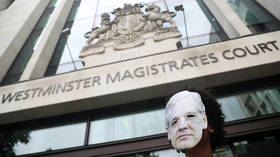
WikiLeaks co-founder Julian Assange will face a new, full US extradition hearing in February that is expected to last five days, Westminster Magistrates' Court in London has ruled.

The hearing date was set after British Home Secretary Sajid Javid revealed on Thursday that he had signed and certified the US extradition order papers.

Assange's lawyer, Mark Summers, said the case represents an “outrageous and full-frontal assault on journalistic rights.''

Responding to the new hearing date outside the court, another lawyer representing Assange, Jennifer Robinson, said that Assange is "in a healthcare ward in Belmarsh Prison due to his ill-health."

The US Justice Department has filed 18 charges against the 47-year-old Australian journalist, including one count of conspiring with Chelsea Manning, the former intelligence analyst and whistleblower, to gain access to the US Pentagon network.

Assange is currently serving a 50-week prison sentence in the UK for jumping bail in 2012. He was too ill to appear at the last hearing at Westminster Magistrates' Court regarding the US request in May.

The journalist spent over six years living under asylum in the Ecuadorian Embassy in London, out of fear that Britain would hand him over to the US. He was forcibly dragged out of the building in April after the South American nation decided to evict him.

The WikiLeaks co-founder’s health has been of particular concern to his supporters. His lawyer, Per Samuelson, told reporters after visiting Belmarsh at the end of May that “

Assange’s health situation... was such that it was not possible to conduct a normal conversation with him.”

The UN Special Rapporteur on Torture, Nils Melzer, who visited Assange in Belmarsh, claimed that he showed clear signs of suffering "
cruel, inhuman or degrading treatment or punishment, the cumulative effects of which can only be described as psychological torture."


Assange to Face 5-Day Extradition Hearing in February 2020

By Joe Lauria

Special to Consortium News

14 June, 2019


A decision on whether Julian Assange will be extradited to the United States to face charges under the Espionage Act will not come until the end of February 2020 at the earliest, the Westminster Magistrate’s Court ruled on Friday.
Tristan Kirk, the London Evening Standard‘s courts reporter, tweeted:

Julian Assange will not face a full extradition hearing until next year, court hears. Five day hearing to be listed on a date after Feb 24.


Kirk said he argued his way into the court room after he and the rest of the media had been barred by a security guard from entering the public hearing that lasted under 30 minutes.
Reuters reported:
As Ben Brandon, the lawyer representing the United States, ran through a summary of the accusations against him including that he had cracked a U.S. defence network password, Assange said: “I didn’t break any password whatsoever.”
The WikiLeaks publisher told the court that “175 years of my life is effectively at stake,” according to Sky News. He addressed the judge as Lady Arbuthnot, saying: “WikiLeaks is nothing but a publisher.”  Mark Summers, a lawyer representing Assange, told the court there are a “multiplicity of profound issues” with the extradition case, Sky News reported. 
We say it represents an outrageous and full-frontal assault on journalistic rights,” he said.
Assange spoke to the court via video link from Belmarsh prison where he is serving a 50-week sentence for skipping bail on a Swedish sexual assault investigation.  Assange sought refuge in the Ecuadorian embassy in London in June 2012 to avoid onward extradition from Sweden to the United States. He was arrested on April 11 when Ecuador allowed British police to enter the embassy.
The British home secretary signed the extradition request from the U.S. on Wednesday. Sajiid Javid said Thursday: “I want to see justice done at all times and we’ve got a legitimate extradition request, so I’ve signed it, but the final decision is now with the courts.”
Both sides in the extradition battle will now have about eight months to prepare their case.
Assange’s Belmarsh sentence will end at the end of March 2020, meaning he will remain in the maximum security prison until the extradition hearing. 


The case is about shutting down investigative journalism and public inquiry, says John Pilger, outside the Westminster Magistrates Court https://www.youtube.com/watch?v=jrjVOedHS4o 

John Pilger: Julian Assange Extradition Case is a WAR ON 

JOURNALISM!