Posts
Posts


First of all, the lamestream media
Hong Kong police arrest
more than 300 protesting
China's 'birthday gift' of
security law

1 July, 2020
HONG KONG (Reuters) - Hong Kong police fired water cannon and tear gas and arrested more than 300 people on Wednesday as protesters took to the streets in defiance of sweeping security legislation introduced by China to snuff out dissent.
Beijing unveiled the details of the much-anticipated law late on Tuesday after weeks of uncertainty, pushing China’s freest city and one of the world’s most glittering financial hubs on to a more authoritarian path.
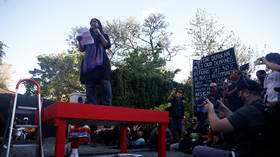
As thousands of protesters gathered for an annual rally marking the anniversary of the former British colony’s handover to China in 1997, riot police used pepper spray and fired pellets as they made arrests after crowds spilled into the streets chanting “resist till the end” and “Hong Kong independence”.
“I’m scared of going to jail but for justice I have to come out today, I have to stand up,” said one 35-year-old man who gave his name as Seth.
Police said they had made more than 300 arrests for illegal assembly and other offences, with nine involving violations of the new law.
The law punishes crimes of secession, subversion, terrorism and collusion with foreign forces with up to life in prison, will see mainland security agencies in Hong Kong for the first time and allows extradition to the mainland for trial.
China’s parliament adopted the law in response to protests last year triggered by fears that Beijing was stifling the city’s freedoms, guaranteed by a “one country, two systems” formula agreed when it returned to Chinese rule. Beijing denies the accusation.
Hong Kong police cited the law in confronting protesters.
“You are displaying flags or banners/chanting slogans/or conducting yourselves with an intent such as secession or subversion, which may constitute offences under the ... national security law,” police said in a message displayed on a purple banner.
Authorities in Beijing and Hong Kong have repeatedly said the legislation is aimed at a few “troublemakers” and will not affect rights and freedoms, nor investors’ interests.
‘HEARTBREAKING’
But critics fear it will end the pro-democracy opposition and crush freedoms, including an independent legal system and right to protest, that are seen as key to Hong Kong’s success as a financial centre.
U.S. Secretary of State Mike Pompeo said the new law was an affront to all nations and Washington would continue to implement President Donald Trump’s directive to end the territory’s special status.
Britain said it would stand by its word and offer all those in Hong Kong with British National Overseas status a “bespoke” immigration route.
British Foreign Secretary Dominic Raab described Wednesday’s protests as heartbreaking and reprimanded HSBC and other banks for supporting the new law, saying the rights of Hong Kong should not be sacrificed for bankers’ bonuses.
Britain and Canada also updated their travel advisories for Hong Kong, saying there was an increased risk of detention.
A former employee of the British consulate in Hong Kong, Simon Cheng, said he had been granted political asylum by the British government after being beaten by Chinese secret police last year in mainland China during 15 days of detention.
In a post on Facebook after the enactment of the national security law, he said he hoped other Hong Kong people would be offered protection by Britain.
Police fired water cannon to try to disperse the protesters. A game of cat and mouse reminiscent of last year’s often violent demonstrations followed, with protesters blocking roads before running away from riot police charging with batons, only to re-emerge elsewhere.
Police posted pictures on Twitter of an officer with a bleeding arm saying he was stabbed by “rioters holding sharp objects”. The suspects fled while bystanders offered no help, police said.
On July 1 last year, hundreds of protesters stormed and vandalised the city’s legislature to protest against a bill that would have allowed extraditions to mainland China.
Those protests evolved into anti-China demonstrations and calls for democracy, paralysing parts of the city and paving the way for Beijing’s new law.
In Beijing, Zhang Xiaoming, executive deputy director of Beijing’s Hong Kong and Macau Affairs Office, told reporters suspects arrested by a new Beijing-run security office could be tried on the mainland.
He said the new office abided by Chinese law and that Hong Kong’s legal system could not be expected to implement the laws of the mainland. Article 55 of the law states that Beijing’s security office in Hong Kong could exercise jurisdiction over “complex” or “serious” cases.
“The law is a birthday gift to (Hong Kong) and will show its precious value in the future,” Zhang said, adding the law would not be applied retroactively.
Speaking at a flag-raising ceremony to mark the handover, the city’s Beijing-backed leader, Carrie Lam, said the law was the most important development since 1997.
“It is also an inevitable and prompt decision to restore stability,” Lam said at the harbour-front venue where the last colonial governor, Chris Patten, a staunch critic of the security law, tearfully handed back Hong Kong to China.
Some pro-Beijing officials and political commentators say the law is aimed at sealing Hong Kong’s “second return” to the motherland after the first failed to bring residents to heel.
Luo Huining, the head of Beijing’s top representative office in Hong Kong, said at the ceremony the law was a “common aspiration” of Hong Kong citizens.
Some pro-democracy activists gave up membership of their groups just before the law came into force on Tuesday, though they called for the campaign to carry on from abroad.
“I saw this morning there are celebrations for Hong Kong’s handover, but to me it is a funeral, a funeral for ‘one country two systems’,” said pro-democracy lawmaker Kwok Ka-ki.

Here is the other side
New Law Liberates Hong Kong From U.S. Interference
1 July, 2020
After the U.S. instigated riots in Hong Kong last year the central government of China saw a necessity to intervene. In sight of other anti-China measures the U.S. has taken the reputational costs of doing so had become less important.
Yesterday the Chinese parliament, the Standing Committee of the National People's Congress, added a national security law to the Basic Law that governs Hong Kong's special status. The law is designed to end foreign interference in Hong Kong.
The Basic Law already had an article that stated that Hong Kong's independent parliament, the Legislative Council or Legco, must create such a national security law on its own. But 23 years after Hong Kong again became ruled by China, Hong Kong's parliament had still not done so. The foreign instigated violent riots last year, which had paralyzed Hong Kong's economy, demonstrated that such a law is necessary. The central government finally acted and did what the Legco was supposed to do.
The new law, which was put into effect today, is banning secession, subversion, terrorism, and collusion with a foreign country or external elements to endanger national security. Its 66 articles also ban support in any form for such acts. The offenses are punishable in several degrees up to life in prison. The law includes guarantees for human rights and due legal process.
A mainland 'Office for Safeguarding National Security' will be set up in Hong Kong to take care that the law is followed. While regular cases against the law will be handled by a new national security department within the Hong Kong police, significant cases, like those including foreigners, can be taken over by the mainland office and can be prosecuted by mainland courts.
The law has some extraterritorial power. It does not matter where the crimes are committed:
Article 38 This Law shall apply to offences under this Law committed against the Hong Kong Special Administrative Region from outside the Region by a person who is not a permanent resident of the Region.
People who break the new law while in some other country can be arrested and charged as soon as they step onto Chinese grounds which evidently includes Hong Kong. Members of Congress should consider that when they enact laws in support of the rabble rouser in Hong Kong. A later casino vacation in Macao could otherwise end in a lengthy unplanned stay.
The full text of the law in English is available here. Its promulgation in Hong Kong and the original Chinese text are here.
The new law has already shown results. Several of the U.S. supported student organizations which led the 'pro democracy' clashes last year have shut down days before the law was put into force. 'Pro-democracy' lawmakers have moderated their tone:
The national security law is already having its desired effect, even before its enactment. So far as Beijing is concerned, it has achieved far more with much less than rolling in the tanks.
Consider the recent statements of some leaders of the anti-government protest movement. They are either quitting or making U-turns.
...
Claudia Mo Man-ching (opposition legislator): “If we win more than 35 seats [a majority in the Legislative Council elections in September], we can all sit down and negotiate at a moderate pace.”
Mo’s statement may be the least sensational but most significant, assuming she represents the views of other “moderates”.
Early this year, the big plan was to force Chief Executive Carrie Lam Cheng Yuet-ngor to quit. To do so, they would have to win a majority, veto all government bills, including the annual budget, and force Lam to dissolve the Legco session and call for new elections. If Lam still couldn’t get the budget approved in the new Legco, she would have to resign under the Basic Law.
No one talks about the plan any more. Mo is ready to negotiate if she wins again in September.
Suddenly, everyone sounds so reasonable and moderate. I wonder why.
Not everyone will submit peacefully to the new rules. The rabble rouser Joshua Wong, Senator Marco Rubio's special friend, has set himself up as a martyr. He has called for demonstrations today which were not sanctioned by the police:
Joshua Wong 黃之鋒 @joshuawongcf - 7:52 UTC · Jul 1, 2020
We are on street to against national security law. We shall never surrender. Now is not the time to give up.
About a thousand students protested today against the law and the police arrested 370 of them. Some will be prosecuted under the new law. One policeman was stabbed when some demonstrators tried to free an arrested person.
The U.S. had financed some of the protester groups through the CIA aligned National Endowment for Democracy and the Open Technology Fund. If the U.S. wants to continue instigating unrest in Hong Kong it must now move those programs to the CIA and distribute the money secretly. The OTF funds for Hong Kong have already been frozen.
The British government has promised to give British passports to the 3 million Hong Kongers who were born while the city was still under British rule. One wonder what Brexiters think about such a potentially huge new inflow of people from abroad.
The U.S. Congress will do some huffing and puffing over the new law and Trump will issue some more sanctions but that will be likely it. The CIA's infrastructure to create another 'color revolution' in Hong Kong will not be easy to replace. The U.S. has lost its supremacy and its meddling in Hong Kong will no longer have any effect.
Hong Kong will continue to have its special administrative status and economic freedom. But British and U.S. influence in the city will now be severely diminished.

A New York Times reporter in Hong Kong, Austin Ramzy, has deleted his Twitter cover photo, which showed colonial powers gathering in the city’s harbor during the Second Opium War, after the historical image sparked anger online.
The New York Times has seemingly gone out of its way to convince its American readers of its wholehearted support for the protests against racism – and the legacy of colonialism, for that matter – that have engulfed the US. However, its reporter in Hong Kong picked a photo depicting one of the most brazen acts of colonialism for his social media header.
He promptly deleted it, though, after Carl Zha – a podcaster who focuses on China – revealed the context of the image. The black-and-white photo depicting ships in a harbor turned out to be one of a series of images snapped by British-Italian war photographer Felice Beato in 1860, as an Anglo-French armada prepared an attack on China during the final phase of the infamous Second Opium War.
Zha posted another of Beato’s iconic photos from the series as he tweeted about Ramzy’s curious choice of banner picture.
Here is George Galloway on the topic