Tuesday, 1 September 2015

The Dying Earth - 08/31/2015

Three Category 4 Hurricanes in the Pacific Ocean: How Rare Is That?

Hurricanes Kilo, Ignacio and Jemina in the Pacific Ocean on August 30, 2015.

30 August, 2015


A very rare meteorological event occurred Saturday evening into early Sunday morning when three Category 4 hurricanes were ongoing simultaneously in the Pacific Ocean.

At 11 p.m. EDT Saturday, Huricane Kilo (135 mph) was located well southwest of the Hawaiian Islands followed by Hurricane Ignacio (140 mph) to the east of Hawaii and Hurricane Jimena (140 mph) in the eastern Pacific. Kilo was the last of the trio to reach Category 4 status, doing so on Saturday evening. For reference, hurricanes with maximum sustained winds of 130-156 mph are classified as Category 4, which is the second highest category on the Saffir-Simpson Hurricane Wind Sale.

However, by 5 p.m. EDT Sunday both Kilo and Ignacio had begun to weaken and were classified as Category 3 hurricanes, while Jimena maintained its Category 4 status.

This is the first recorded occurrence of three Category 4 hurricanes in the central and eastern Pacific basins at the same time. In addition, it's also the first time with three major hurricanes (Category 3 or stronger) in those basins simultaneously, according to hurricane specialist Eric Blake of the National Hurricane Center.

This satellite image shows the three Category 4 hurricanes in the Pacific Sunday morning (Kilo - left, Ignacio - center, Jimena - right).


Three Category 4 hurricanes on Sunday morning in the Pacific. Kilo (left), Ignacio (center) and Jimena (right).  (NASA)

Dr. Phil Klotzbach of Colorado State University and blogger for wunderground.com said in a tweet on Saturday that this was also the first time the central Pacific, bounded by the International Date Line and 140 degrees west longitude, has had two major hurricanes (Kilo and Ignacio) ongoing at the same time. This piles on to what has already been a record hurricane season in the central Pacific basin.


Blake said on Aug. 21 that Loke was the record fifth named storm to form in the central Pacific basin this season. The others were Ela, Halola, Iune and Kilo. In addition, three eastern Pacific storms have tracked through the basin, including Guillermo, Hilda and Ignacio. 

NOAA's 2015 Central Pacific hurricane season outlook cited El Nino's tendency for reduced wind shear and more storm tracks coming from the eastern Pacific as reasons to expect an active season in the central Pacific Bain.

The Pacific tropical activity can be attributed, in part, to impressively warm ocean water.

El Nino is an anomalous, yet periodic, warming of the central and eastern equatorial Pacific Ocean. For reasons still not well understood, every 2 to 7 years, this patch of ocean warms for a period of 6 to 18 months.

The eastern Pacific basin also typically sees an increase in named storms during a moderate to strong El Nino thanks to diminished vertical wind shear.

The opposite is true in the Atlantic basin, since wind shear tends to increase in a moderate to strong El Nino, particularly in the Caribbean Sea.

Hurricane Igor is featured in this Sept. 14, 2010, image photographed by an Expedition 24 crew member on the International Space Station. (NASA) 


Godzilla Rises. Stunning El Nino Forecasts are Literally Off the Chart


25 August, 2015

enso_plume0815

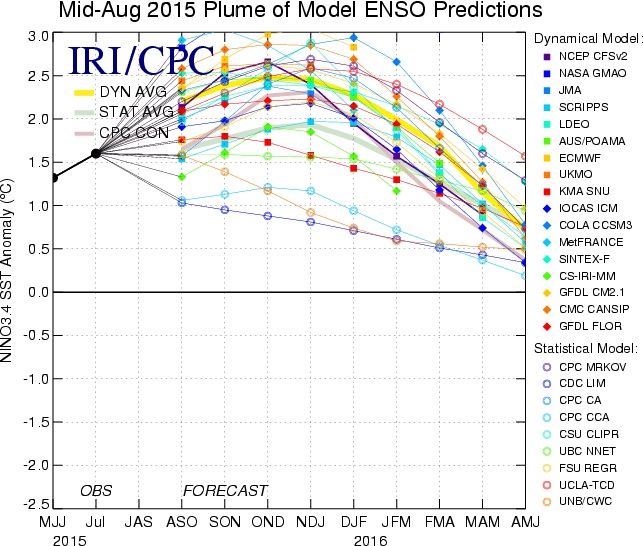
Above, NOAA has published a graph of modeling predictions from various professional groups looking at the developing El Nino event in the Pacific.
The dark line that starts at the left is actual observations of what we see so far in unusually warm surface water in the central and eastern pacific.  The various colored lines that proceed to the right are the different attempts at predictions. As you can see, they are running hot – very hot, to the point of sailing off the top of the chart…

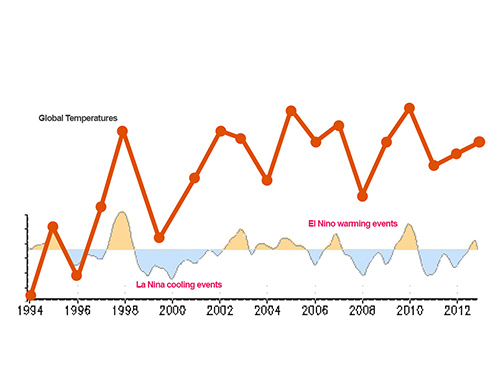
As you can see from this diagram, global temperatures tend to get a bounce in El Nino years, while La Nina years exert a cooling influence.
EL NIÑO is Spanish for…The Niño!” joked Chris Farley on a 1997 episode of Saturday Night Live, a sketch comedy programme. The skit was memorable for its absurdity but it did not do much to explain “The Niño”. It aired during the devastating 1997-1998 El Niño, which caused at least $35 billion in destruction and 23,000 deaths globally. A new El Niño is now brewing. NASA satellite pictures indicate this year’s could be even bigger than the 1997-1998 one, the strongest on record. So what is El Niño?
godzillarises
Spanish for “little boy”, El Niño was so named by Peruvian fishermen in the 1600s in honour of the Christ child. They observed that periodically around Christmastime, Pacific waters grew warmer and fish vanished, migrating to cooler waters. Unlike hurricanes, El Niño is not an individual weather event, it is a climate pattern. In non-Niño years trade winds, which blow east to west, push warm equatorial water into the western Pacific, allowing cold water from the deep ocean to well up in the eastern Pacific. During a Niño, those winds slacken. The warm water that is normally pushed westward pools right across the Pacific Ocean. Water temperature increases, and increased heat and moisture rise into the atmosphere, altering wind and storm patterns. If ocean-surface temperatures are between 0.5 to 1°C above average during a three-month window, America’s National Oceanic and Atmospheric Administration (NOAA), a federal agency, deems it a Niño. The current one could produce temperatures 2°C higher than average, or more.


sst_anom0815


Dahr Jamail has written his latest on abrupt climate change.


The World on Fire: Record-Breaking Wildfires, Greenland Melting and Earth's Hottest Month Ever


A massive wall of wildfire smoke, blowing in from record-breaking fires in Eastern Washington, covers Puget Sound and Seattle. (Photo: Dahr Jamail)
A massive wall of wildfire smoke, blowing in from record-breaking fires in eastern Washington State, covers Puget Sound and Seattle. (Photo: Dahr Jamail)

When I go up into the mountains, I'm used to being afforded magnificent views of alpine meadows filled with wildflowers, crystal-clear mountain streams, glaciers tucked under the shoulders of high valleys, stratified ridges arcing into the sky, and views so far into the distance one can sense the curvature of earth.
But on August 22, as I carefully climbed my way toward one of the high summits of Eastern Olympic National Park, the solace of the mountains eluded me due to an ominous sign. The view east - toward what has now officially become the largest complex of wildfires in history for Washington State, where over one-quarter million acres have burned - was dominated by a large, greyish-white plume of smoke that stretched as far north and south as I could see.
At first it appeared as a large storm cloud layer, which was confusing given that the weather-folk had called for a stable high-pressure ridge over western Washington through the weekend. But as I continued through the morning, the large white wall neared and slowly began enveloping the entire eastern mountains of the Olympics, and my eyes began to burn as I smelled the smoke.
By the time I reached the summit of my climb, the view south was already obscured by the smoke as it began to fully infiltrate Olympic National Park

For rest of the article GO HERE

Smoke from West coast fires


Unprecedented.

Drifting wildfire smoke from the West coast states, covers the Midwest today, from Hudson Bay in northern Canada, all the way through the Midwest to the Gulf of Mexico.


Arctic Ocean 08 31 2015. 


Storm approaching is visible in the upper left hand corner

Western Wildfire Smoke Has Drifted Over the Atlantic

Terra image of wildfire smoke over the Atlantic

Smoke from the treacherous western wildfires of both the U.S. and Canada has wafted across country and out to sea.  In this natural-color satellite image collected by the Moderate Resolution Imaging Spectroradiometer (MODIS) aboard the Terra satellite on August 29, 2015, remnants of the smoke are swirling out above the Atlantic Ocean.  Prince Edward Island can be seen in this image as well as New Brunswick and Nova Scotia.

NASA image courtesy Jeff Schmaltz, MODIS Rapid Response Team. Caption: NASA/Goddard, Lynn Jenner


Arctic sea ice extent on August 28, 2015, was less than 5 million square km


Midday on Lake Baikal – like sunrise on the planet Crematorium

Полдень на БАЙКАЛЕ, как восход на планете Крематория.


Volunteers save lake Baikal from the fire: "the scale of the disaster is enormous, burning everything!"


Hurricane Fred hits Cape Verde islands


A hurricane with winds of up to 140km/h (85mph) has hit the island nation of Cape Verde, off the coast of West Africa


Climate change patterns

The Great Extinction

Purple Canfield Ocean

PART ONE

Something caused the land to dry up, the plants to die, and nearly every land animal to go extinct, and one critical cause of this global disaster is carbon dioxide from the lava rocks.


PART TWO

Having killed off most of the life on land, the Siberian Super Volcanic disaster was spreading to the seas. The seas had no oxygen at all, and scientists believe that the warming effect of volcanic carbon dioxide from Siberian eruptions was directly to blame for lack of oxygen.


PART THREE

Purple bacteria that thrive in oxygen depleted water poisoned the seas with hydrogen sulfide. The trilobites and virtually every other species of sea life died out and never returned. (bio-markers) (other videos mention volcanic activity release all kinds of toxic gas too)


Shades of a Canfield Ocean — Hydrogen Sulfide in Oregon’s Purple Waves?


Purple Waves


PART FOUR

Temperatures rose all over the globe, 10 degrees, too much for CO2 alone, methane is top of the list. The light carbon, a finger print of methane gas, in the extinction zones is so high that it equates the sudden release of a trillion tons of gas. Burning coal is one possible source, the other is methane ice, locked in permafrost, more energy in methane ice than all fossil fuels combined, key to past, and melting ice released enough


ISIS has created a name for itself

The Production of Evil
Roman Nosikov


30 August, 2015

[Sometimes a peеk behind the Iron Curtain erected by western media can be most instructive. However, this can be rather difficult to do for those who can only read in English or other western European languages. And so, to show you what people are thinking out in the big world where most people live, here is a translation of an opinion piece that appeared recently in the Russian press. If any of this is a surprise to you, you need to do more research. Enjoy!]

The word “ISIS” was laid out in the same font as the word “Hollywood.”

ISIS fighters executed the director of the architectural complex at Palmira, The 82-year-old Khalid Al Asaad was beheaded, and his body was hung on an antique column in the main town square.

ISIS has created a name for itself not just because of their exceptional cruelty. Lots of people can be cruel. But usually countries, organizations and people hide their cruelty. They hide it even if they aren't ashamed of it, but ISIS is demonstratively cruel, for the sake of the show.

But even this isn't news. Lots of people kill other people, behead them, blow them up with bombs, or tear them apart with their bare hands. You can't surprise anybody with that. People hang each other on city squares, behead each other at gas stations, send each other to gas chambers and seat each other in electric chairs.

ISIS is different from all the other executioners in that it didn't just turn death and atrocity into a show, but in that it has then turned this show into art. ISIS is not ashamed of the fact that it is evil. It doesn't hide it. It tells of its evilness, of its hatred, of its inhumanity, even its anti-humanity—on a Hollywood scale and with Broadway pizzazz.

What ISIS does is not amateur evil, it is not evil for the sake of monetary gain, it is not evil for the sake of power. It is evil for the sake of demonstration. ISIS is a government of artists, of poets, movie directors and produces, of makeup artists of evil.

There is such a concept as a “creative handwriting.”

The word “ISIS” is inscribed in the same font as the word “Hollywood” on a hill in Southern California.

The orange robes, the convulsions of a man being burned alive, the blood which spurts at the camera, the assembly-line executions by firing squad—all of this is done with relish, from different angles, with good quality camerawork and post-production.

The screenplay, the production, the costumes, the camerawork—all of these are obviously those of professionals from western culture.

How should evil portray itself from the point of you of a western person? It has to fall from above and smash the symbol of western civilization, of its freedom and power. Evil must throw down a challenge.

Do you remember the terrible video clips of airliners flying into skyscrapers? Do you remember the silent screams of people running away from collapsing buildings? Do you remember how they were raining down? This was all filmed from a multitude of vantage points—slowly, methodically, majestically—the skyscrapers seemed to be submerging in the earth.

These two symbols of American greatness—the towers of the World Trade Center, the towers of money, of freedom, of power and potential, of national pride—were destroyed with an audience in mind—western audience—and had the same “creative handwriting” as the atrocities now being perpetuated by ISIS.

I don't suppose I'll surprise anyone at all, and won't say anything new, if I say that both Al Qaeda and ISIS are western creations. This is old news. I am just mentioning this as a reminder. And the “creative handwriting” of their latest deeds speaks to the fact that they also share the same goal. No, it's not the governments in Lebanon or Iraq or Afghanistan. Their goal is the west itself.

If you can't unite your subjects by serving their common interests, you can do it using a common enemy. And if this common enemy doesn't exist—no problem, you can create one with your own hands. You can give it the opportunity to grow up, give it weapons, grant it immunity and release it into the world.

The most important thing in such a creation is that it must be horrible. It must be self-evidently horrible. So horrible that everyone—even the idiots—could understand that this—this thing covered in blood, holding a torn-off human leg in its hand—is the only alternative to having the United States of America in complete control of everything. That burning people alive, mass executions, beheadings, sanctioned rapes—this is the only alternative to gay marriage, feminism, total surveillance of everyone and extraterritorial American “justice.”

The western establishment is nurturing ISIS like an attack dog, feeding it, training it to like human blood, in order to then release it and offer people the freedom of choice: you can die in its teeth, or you can hide behind a gate, the keys to which are in the hands of global capitalism. And they will charge you for the entry—but not in money. That is, not just in money. The payment they require is your freedom—your right to choose for yourself what is good and what is evil. Anyone who wants to enter has to relinquish this right, and give it to the owner. Because anyone who enters through the gate automatically acquires an owner.

The history of the 1930s is repeating itself, except that now those who want to reform the world order are not facing the countermodern phenomenon of Nazism, but the countermodern (or post-modern) phenomenon of radical Islam—of an archaic being with a torch, a knife and a videocamera. His role—to herd all of humanity into a single project, to rid the world of alternatives, by replacing with itself or by destroying everything that could possible offer the world alternative paths of development.

In this case, the means tell us everything there is to know about the goal.

The goal is power through any means—power to set entry fees for all those who want to be safe behind the locked gate. Needless to say, there will be no possibility of exit. It's not in the plans.

Roman Nosikov, lawyer, publicist, author of journal “Однако”.
August 28, 2015


Climate change in the United States North-East

Here’s Why the Northeast’s Next Winter Is Going to Be Freakishly Cold
New research shows that vanishing Arctic summer sea ice—a consequence of global warming—may drive extreme winters in lower latitudes for decades to come.


31 August, 2015


When it comes to the global climate, what happens in the Arctic does not stay in the Arctic. The latest proof comes in new research connecting the unusually brutal winter of 2014–15 along the East Coast of North America to rapidly vanishing summer sea ice on the western side of the Arctic Ocean.

The new study, published Monday in the journal Nature Geoscience, advances a growing body of science demonstrating that these record-breaking extremes have not been a pause in the advance of human-driven climate change but a result of it.

The findings suggest that as the Arctic continues to thaw, the mercury will crash over many winters to come.

Temperatures reached record lows across the Northeastern United States last winter, with towns and cities in states from Maine to Maryland registering their coldest temperature averages from January to March.

Among the region’s weather extremes, parts of Buffalo in upstate New York disappeared under more than 100 inches of snow in November, before winter had even formally commenced. Snow fell for 23 straight days during February in Syracuse, another upstate New York city.

Boston’s total of 108.6 inches of snow for the season broke a 17-year record and crippled the city. To the south, ocean waves along the Cape Cod, Massachusetts, shoreline grew so cold and thick with icy slush that they froze in place for weeks.


The newly published study, led by Jong-Seong Kug of South Korea’s Pohang University of Science and Technology, used climate and weather observations as well as climate change modeling to investigate potential connections between these and other extreme cold winter weather systems over North America and South Asia last winter and historically low levels of summer sea ice in areas of the Arctic Ocean.

Kug and his colleagues determined that the reduced extent of summer sea ice in the Beaufort and Chukchi seas during the summer of 2014 led to a bulge of warmer temperatures in the lower atmosphere.

Those warm-temperature areas are “an indication that the jet stream is taking a big northward swing, creating what we call a very strong ridge,” said Jennifer Francis, an atmospheric scientist at Rutgers University who studies Arctic ice and its effects on weather patterns in lower latitudes of the northern hemisphere.

“Downstream of that ridge, the effect is like taking a jump rope and giving it a big whip: It creates a big wave further downstream, a southward dip in the jet stream,” Francis said. “That means that cold air is able to plunge down into that area from the Arctic, and that’s been contributing to these very cold winters in eastern North America.”

The same conditions also formed high above the Barents and Kara seas, on the Atlantic side of the Arctic Ocean, and drove severe cold weather in South Asia during the winter.

Kug’s work has advanced understanding of the mechanisms that link Arctic warming to changes in weather in lower latitudes, Francis said, adding that the knowledge could help residents and governments in these regions better prepare for severe winters to come. However, once the Arctic Ocean becomes completely ice-free in summer, which scientists expect to happen in the next 25 to 35 years, weather patterns are likely to shift again in ways that are impossible to anticipate.

The extent of summer sea ice in the Beaufort and Chukchi seas has been tracking below 2010, 2013, and 2014 levels since mid-August—three years that each went on to see significantly colder, snowy winters in the Northeast—according to the U.S. National Snow and Ice Data Center.

On Aug. 16, the NSIDC reported, ice covered 2.24 million square miles on the two seas—521,200 square miles below the 1981–2010 average and 451,700 square miles above the level on the same date in 2012, which holds the record for the lowest recorded summer sea ice extent.


On Aug. 16, sea ice area on the Chukchi and Beaufort seas, in the Arctic Ocean, was tracking below ice extents on the same day in 2010, 2014, and 2014, as well as the 19-year average. It had not dipped below the record-setting low ice extent of 2012. (Image: National Snow and Ice Data Center)

Arctic sea ice will continue to melt until early to mid-September.


“There is so much disturbing evidence coming out these days about the impacts of increasing fossil fuel burning and other human-caused climate change,” said Francis. “It’s hard to imagine that anyone can just snub their noses at it and say ‘Things are fine—we don’t have to do anything.’ ”


The fate of the refugees


While we're on the theme, perhaps this might be one solution?


Another explosion in China

China Rocked By Another Massive Chemical Explosion

© People's Daily,China
31 August, 2015

Seriously, what the f##k is going on over there?

    *BLAST SEEN IN CHEM. IND. ZONE IN SHANDONG, CHINA: PEOPLES DAILY
This is the second explosion in Shandong, which both follow the huge and deadly explosion in Tianjin.


We'll await the details which we imagine will suggest that, as was the case in Tianjin, many more tonnes of something terribly toxic were stored than is allowed under China's regulatory regime which apparently only applies to those who are not somehow connected to the Politburo.

After the last Shandong explosion, The People's Daily reported that the plant contained adiponitrile, which the CDC says can cause "irritation eyes, skin, respiratory system; headache, dizziness, lassitude (weakness, exhaustion), confusion, convulsions; blurred vision; dyspnea (breathing difficulty); abdominal pain, nausea, [and] vomiting."

Breaking: A blast seen and heard in a chemical industry zone in Lijin, Dongying City of Shandong around 23:25 Mon. pic.twitter.com/Yi29nJXEuX
— People's Daily,China (@PDChina) August 31, 2015
Sur #weibo, série de clichés de l'explosion de #Shandong pic.twitter.com/TFk8w6daZz
— Breaking3zero (@Breaking3zero) August 31, 2015

This clip has just been posted to a Weibo account - reportedly showing tonight's explosion (we are unable to confirm it this is the most recent or the previous Shandong explosion although that was more twlight than dead of night).


Image of collapse

THEY DIDN’ T PUBLISH THIS IN THE NEWS: Refugees from Tripoli and other places in North Africa set off for Europe
LO QUE NOS OCULTAN EN LAS NOTICIAS, ESTO NO LO PUBLICAN LOS NOTICIEROS: "Refugiados de Tripoli e outros locais do Norte de África para a Europa"


POSTSCRIPT.

I am told that these images are from 1991 and people fleeing Albania


This, however, is real


Refugees Are Human. This Simple Fact Seems To Have Been Forgotten
By Owen Jones


30 August, 2015


August 30, 2015 "Information Clearing House" - "The Guardian" -  They’re not people: nobody would tolerate hearing about the drowning of human beings over and over again. At best they are bleak but intangible statistics, the object of a bit of tutting before mundane everyday life takes over. For others, they are an unwanted and uninvited swarm that Fortress Europe must keep out: full of undeserving would-be leeches who have no place in the west. In the hierarchy of death, anyone labelled “migrant” must take their place somewhere near the bottom. It is a dehumanised word: for all too many people, it is somewhere down with “petty criminal”, and who mourns petty criminals?
As the news of up to 200 dead refugees, drowned off the coast of Libya, filters fleetingly into news coverage, the only guarantee is that more will drown. And with news of more than 70 refugees found dead in a truck in Austria – to try to imagine their last living moments triggers a horrible feeling in the pit of the stomach – we know that more bodies will be found in more trucks. Those of us who want more sympathetic treatment of people fleeing desperate situations have failed to win over public opinion, and the cost of that is death.
Other than a tiny proportion of sociopaths, our species is naturally empathetic
For those who believe that hostility to human beings from other countries who lost the lottery of life is somehow hardwired into us, there is evidence to the contrary. Germany takes in around four times as many refugees as Britain does; and for every Syrian asylum seeker received by Britain, Germany gets 27. And despite German generosity comparing starkly with our own, half of Germans polled support letting in even more refugees.
This is a debate that cannot be won by statistics. We can tell people that those reaching Europe represent a tiny fraction of the world’s refugee population; that while developing countries housed 70% of refugees a decade or so ago, that has now leapt to 86%. Far smaller and poorer countries take in far more than us, such as Lebanon, with its population of around 4.5 million including 1.3 million Syrian refugees. But it won’t shift people’s attitudes. We have to do it with stories, humanising otherwise faceless refugees.
Other than a tiny proportion of sociopaths, our species is naturally empathetic. It is only when we strip the humanity from people – when we stop imagining them as being quite human like us – that our empathetic nature is eroded. That allows us either to accept the misery of others, or even to inflict it on them. Rightwing newspapers hunt down extreme and unsympathetic stories of refugees, and we fight back with statistics. Instead, we need to show the reality of refugees: their names, their faces, their ambitions and their fears, their loves, what they fled.

Yes, the solution to global human misery is not to extricate a tiny lucky number and parachute them into richer countries. We need the west to take responsibility for disaster zones it helped create, like Libya and Iraq. We should pressure our governments to do more to solve situations that compel human beings to flee. At home, communities with higher levels of both migrants and refugees should be given extra resources and support. But as long as there is misery, people will flee it, and a tiny proportion will come this far. If we want to help them, we need to change public attitudes by humanising refugees. If we fail, then more and more women, men and children will spend their last few hours drowning in seas or suffocating in lorries. It is as bleak as that