Showing posts with label sea level rise. Show all posts

Thursday, 27 October 2016

Antarctica's runaway glaciers

Half a Kilometer of Ice Gone in Just 7 Years — West Antarctica’s Smith Glacier Points To Nightmare Melt Scenario


26 October, 2016
The nightmare global warming melt scenario for West Antarctica goes something like this —
First, ocean waters warmed by climate change approach the vast frozen continent. Melt already running out from the continent forms a fresh water lens that pushes these warmer waters toward the ocean bottom. The waters then get caught up in currents surrounding Antarctica that draw them in toward numerous submerged glacial faces. The added ocean heat combines with falling melting points at depth to produce rapid melt along sea fronting glacier bases. Since many of these glaciers sit on below sea level beds that slope downward toward the interior of Antarctica, a small amount of initial melt sets off an inland flood of these warmer waters that then produces a cascade of melt. This glacial melt chain reaction ultimately generates a Heinrich Event in which armadas of icebergs burst out from Antarctica — forcing global sea levels to rapidly rise.

This is Why We Worry So Much About Multi-Meter Sea Level Rise

Ultimately, seas rising by multiple meters this Century are a very real possibility under current warming scenarios in which such a series of cascading melt events occurs in West Antarctica.


(NASA video narrated by Dr. Eric Rignot, a prominent glacial scientist. Concerns about the origin of melt water pulse 1A during the end of the last ice age led to investigation of large Antarctic melt pulses as a potential source. Subsequent investigation identified melt vulnerabilities at the bases of large sea fronting glaciers in West Antarctica to present and predicted levels of ocean warming. At issue was the fact that bottom waters were warming and that because many glaciers rested on sea beds that sloped inland, melt rates had the potential to very rapidly accelerate.)

Though such a nightmare melt scenario was recently theoretical, it represented a very real potential near-future event as global temperatures rose into the 1-2 degrees Celsius above 1880s range during recent years. For times in the geological past around 115,000 years ago also produced large glacial melt pulses and related sea level rises of 15-25 feet during periods of similar warmth.
However, direct evidence of such a powerful melt dynamic had not yet been directly observed in Antarctica’s glaciers. Fresh water lenses were developing, rates of glacial loss were quickening. Basal melt rates looked bad. But the kind of tremendous losses necessary to produce rapid sea level rise were not yet fully in evidence.
Smith Glacier Loses Half a Kilometer of Ice in Sven Years

The studies, entitled Rapid Submarine Ice Melting in the Grounding Zones of Ice Shelves in West Antarctica and Grounding Line Retreat of Pope, Smith and Kohler Glaciers took a comprehensive look at both surface and underside melt of three major west Antarctic glaciers near the Thwaites and Pine Island Glacier systems. These glaciers included Pope, Smith and Kohler — which have seen increasing instability and rates of seaward movement during recent years. Using multiple instruments, the scientists found evidence of massive ice losses and speeding ice flows.
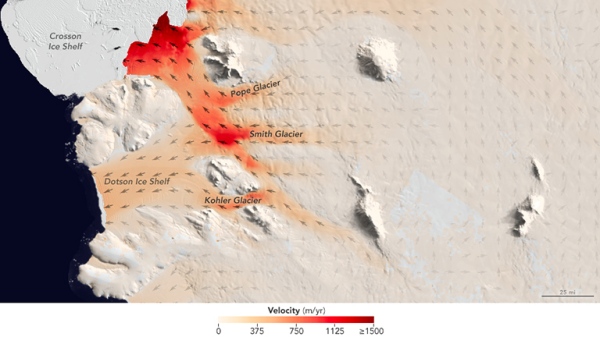
pope-smith-and-kholer-glacial-flow-velocities
(Surface velocity of Kohler, Smith and Pope Glaciers provided by NASA. More rapid seaward movement of glaciers = faster rates of sea level rise.)

The losses occurred at a time when an influx of warmer water (warming circumpolar deep water) was heating the ice shelves and grounding lines buttressing these three partially submerged glaciers. This warming was found to have produced melt along the grounding zones of these glaciers in the range of 300 to 490 meters from 2002 to 2009. In other words, about 1/3 to 1/2 a kilometer of ice thickness at the grounding line was lost in just seven years. Melted away from below by warming deep ocean conditions at the rate of up to 70 meters or around 230 feet per annum.

The studies found that the Pope and Kohler glaciers, which rested on up-sloping sea beds, produced slower rates of melt. While Smith, which sat on a retrograde (or down-sloping bed)produced very rapid rates of meltAccording to the Nature study:
We attribute the different evolution of Smith Glacier to the retreat of its grounding line deeper allowing warmer waters to flood its grounding zone, and increasing ocean thermal forcing due to the lowering of the in situ melting point; as well as to the exposure of the glacier bottom to ocean water as the grounding line retreated rapidly.

A Context of Worsening Risk

Unfortunately, numerous glaciers in the Amundsen Sea region including parts of the Thwaites system and the massive Pine Island Glacier also sit on retrograde slopes. These glaciers are seeing increasing fluxes of warm, deep water. By themselves they represent multiple feet of sea level rise (4-7 feet). Furthermore, Thwaites and Pine Island Glacier currently buttress a number of massive inland glaciers that become vulnerable to melt if inland-running retrograde slopes become flooded with warming ocean waters.
The very real concern is that Smith Glacier serves as a harbinger for near future events to come. As a result, coastal regions around the world are now under a heightened risk of swiftly rising seas and rapid coastal inundation over the coming years and decades.
Links:

Hat tip to Zack Labe
Hat tip to Miles h

Wednesday, 26 October 2016

Sea Level Rise is Devouring the Coast of West Africa

We Have Nowhere to Go” — Sea Level Rise is Devouring the Coast of West Africa


I am very afraid for the future of this place. Sooner or later we will have to leave, but we have nowhere to go.” 
— Buabasah a resident of Fuvemeh, a West African town being swallowed by the sea.

*****
25 October, 2016

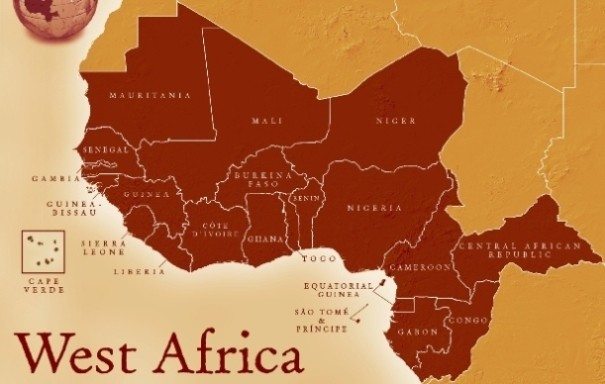
The coastal zone of West Africa stretches for 4,000 miles from Mauritania to the Congo. It includes highly populated regions surrounding low elevation cities and towns in such African nations as Gabon, Nigeria, Senegal, Guinea, The Ivory Coast, Sierra Leone, Cameroon, Liberia, and Ghana. Most industrial activity and food-growing is located near the coast of these nations — accounting for 56 percent of GDP for the region according to the World Bank. And coastal population concentrations in regions vulnerable to sea level rise are very high. In all about 31 percent of the 245 million people dwelling in West Africa live in this fragile and.

global-sea-level-rise
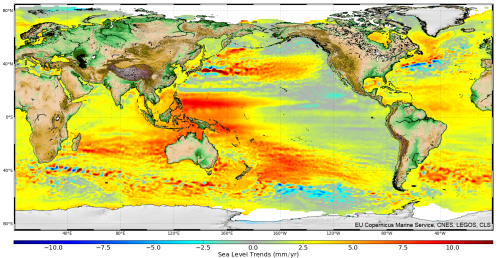
(Due to global warming and glacial melt spurred by fossil fuel burning, oceans are now rising at their fastest rates in 10,000 years. As a result, many coastal towns and cities around the world are under increasing threat of flooding. In West Africa, a recent report by Foreign Policy paints a picture of broadening inundation. Unfortunately, current rates of ocean rise are far slower than what human-caused climate change may set off over the coming decades. Image source: AVISO.)

Most of the coastline features a lagoonal geography that is very low-lying. Meanwhile, funds for coastal defenses like planting mangrove forests and pumping in sand to re-nourish beaches are difficult to procure. As a result, these large cities and population centers are highly vulnerable to impacts from human-forced climate change related to sea level rise.
The Great Flooding Begins

Ever since the early 1990s, scientific reports have highlighted the vulnerability of West Africa to inundation, flooding and loss of key industries, food growing and infrastructure due to glacial melt, thermal expansion of ocean waters set off by warming, and an increase in storm strength in the North Atlantic. All impacts that scientists feared would be coming due to a human-forced warming of the world. Now, just such an inundation and loss appears to be underway.

According to a recent report out in Foreign Policy, sea level rise and increasing erosion due to powerful storms is now in the process of destroying a Ghana fishing village (Fuvemeh) that recently housed 2,500 people. Homes, coconut plantations, and fishing wharfs have all been taken by the rising waters. But Fuvemeh is just one of thousands of like communities now confronting an onrush of waves that each year bites off as much as 80-120 feet of coastline.
(House destroyed by waves in Fuvemeh, Ghana. Sadly, sea level rise related impacts like this are now being seen all up and down West Africa’s 4,000 mile long coastline.)
Moreover, megacities like Lagos (population 5.6 million) and large cities like Accra (population 1.6 million) are increasingly threatened by the encroaching waters. In Accra, the rainy season now causes an annual inundation of sections of the city — a new impact that resulted in 25 people losing their lives last year. Nouakchott, the capital of Mauritania and home to approximately 1 million people, now sees the loss of 80 feet of coastline along its Atlantic shore every year. Meanwhile, parts of Togo lost 118 feet of shore line last year alone. Along the coast from Gambia to Senegal and including communities like Cotonou and Lome, growing numbers of houses, hotels, restaurants, roads, and even water treatment plants are now little more than washed out husks and crumbling bits of infrastructure — lapped by a rising tide.

Heartbreak, Loss of Homes, Dislocation

As the waters rise, residents are forced to move inland. Younger, more mobile residents have often fled the region entirely. Others have rebuilt their homes further inland only to have them flooded again. Ocean productivity is on the decline. Fish and other animals that supported coastal industries have migrated northward or succumbed to worsening ocean conditions. The combined losses have produced economic hardships as coastal cities see increasing gang activity, drug use, theft and violence.

Overall, the United Nations estimates that 5-10 percent of West Africa’s GDP will ultimately be lost due to impacts related to sea level rise. And the recent report by Foreign Policypoints to growing evidence that the crisis is starting now. But the ever-more-human toll is nothing less than heart-wrenching.

The people of Fuvemeh are among hundreds of millions [globally] who are paying a heavy price for a problem they didn’t create. At the current erosion rate, villagers predict that their homes will disappear in less than six months. Left with the bitter choice of staying to be swept out to sea or abandoning his land, history, and way of life, Buabasah doesn’t know what to do. He has moved his wife and children to another village, but he can’t follow them because Fuvemeh serves as his fishing base. Migrating would mean giving up on his job and his ability to feed his family, since the government will only facilitate resettlement to inland communities.
I am very afraid for the future of this place,” he says in despair. “Sooner or later we will have to leave, but we have nowhere to go.”
Links:

Hat tip to Colorado Bob
Hat tip to Wili


Wednesday, 2 December 2015

Climate change in the Pacific

Kiribati faces heat of global warming


From al-Jazeera

Climate change is predicted to impact people all over the world. Some countries are already reeling from the effects of global warming.Al Jazeera's Environment Editor Nick Clark has been to Kiribati (pronounced Kirabas), the Pacific nation which lies no more than three metres above sea level.


Thursday, 8 October 2015

"That’s not holy shit. Its worse than that"

NASA Scientist Eric Rignot , "West Antarctica is going to melt no matter what"


"Stopping our carbon emissions is wishful thinking at this point...that’s not holy shit. Its worse than that"


Clip from HBO VICE. NASA Scientist Eric Rignot , "West Antarctica is going to melt no matter what".I thank Professor Guy McPherson for bringing me the awareness of Abrupt Climate Change.Please check Guy McPherson his many videos on Youtube, or at my Facebook page, to see how much time we have left.You have a right to know.Ice sheets contain enormous quantities of frozen water. If the Greenland Ice Sheet melted, scientists estimate that sea level would rise about 6 meters (20 feet). If the Antarctic Ice Sheet melted, sea level would rise by about 60 meters (200 feet).Michael J. Sliwa and Guy McPherson will be doing a call-out show in a couple weeks, and we're asking your help. Specifically, we'll be calling out climate scientists and other public figures for their absurdity. Please put clips here and indicate where in the clip the scientist expressed unfounded hope (e.g., 10:12-11:35). Or submit a clip of somebody who contradicts him/herself regarding climate change. Some obvious names for you: Michael Mann, Naomi Klein, and Bill McKibben. But surely there are others. No clips longer than 3 minutes, please. Print media will work, too. THANKS, EVERYBODY.Please click below for more info.https://www.facebook.com/groups/592090680907692/829165957200162/?comment_id=829308253852599&notif_t=like
Posted by Marc Haneburght on Tuesday, 14 July 2015

Thursday, 24 September 2015

The Demise of the Arctic

This is a boon to me at a time when I find it difficult to concentrate for longer than short periods at a time.


Xnotes of Parts 1 to 5: Methane Monster II ~ Demise of the Arctic


Thank you to Ivy Cone of Fuki Cafe, from Bellingham (her FB), for her great effort in taking video work already done by Malathy Drew of WEupLifeUs, in breaking this vast video presentation int0 manageable segments.  Great job!!

Thank you also to David Korn Special Projects, for his continued support in also materially helping me share and prepare my work.  Shown on one page for easy getting around.

Remember, full set of slides are shared here.  Source Methane Monster II – Demise of the Arctic video here.  Original Methane Monster’s Rapid Rise video here.  And both downloadable or web hosted transcripts here.

1. Xnotes: Part 1 Introduction MM2 (6:23)


2. Xnotes: Part 2 Radical Predictions MM2 (12:57)


3. Xnotes: Part 3 Just How Bad? MM2 (13:29)


4. Xnotes: Part 4 Alaska Wildfire MM2 (25:24)


5. Xnotes: Part 5 The Methane Monster Roars MM2 (21:03)


————–
Full view of Xnotes of Parts 6 to 11 are similarly shown here. Vignettes shared all the same thus:

6. Xnotes: Part 6 Ice Age! MM2 (20:34)


7. Xnotes: Part 7 Antarctica MM2 (7:51)


8. Xnotes: Part 8 Sea Level Rise MM2 (11:10)


9. Xnotes: Part 9 Entering El Nino MM2 (14:27)


10. Xnotes: Part 10 Earthquakes MM2 (9:52)


11. Xnotes: Part 11 Population MM2 (23:48)


Wednesday, 15 July 2015

20-75 Feet of Sea Level Rise Already Locked In?

At Least 20-75 Feet of Sea Level Rise Already Locked In? Putting Climate Central’s Surging Seas Into Context


There are some recent modeling efforts that now show you could get a section of the Antarctic ice sheet, several meters worth of sea level rise, to go in a decade. We used to think it was centuries.” 
— Andrea Dutton Geochemist at the University of Florida.

*  *  *  *  *

14 July, 2015

Recent reports out from Climate Central and supported by the work of experts show that a sea level rise of at least 6 meters could already be locked in. And as bad as that sounds, a six meter sea level rise from the warming already set in motion by high atmospheric greenhouse gas levels and likely to come from further human emissions could be a best-case or even unrealistic scenario.

To get an understanding as to why so much water may be heading toward the coastal cities of the world, enough water in a 6 meter rise to set off a mass migration of hundreds of millions away from the world’s coasts (just 1.1 meters is enough to flood out 150 million people), it helps to take a good, hard look at paleoclimate. In studying past, warmer, climate states, we can get an idea how much additional sea level rise might be in store. When looking at these past climates for comparison, the key readings to keep in mind are — temperature, greenhouse gas level, and related sea level.

A Question of Whether We Lock in Greenhouse Gas Levels Comparable to Past Climates

Starting with the current climate that is now being rapidly warmed by human fossil fuel burning, we find that this year peak monthly CO2 levels hit near 404 parts per million. It’s a value fast approaching the top of this key greenhouse gas’s range during the Pliocene around 3.5 million years ago. A time when temperatures were 2-3 degrees Celsius hotter and sea levels were between 25 and 75 feet higher than they are today.

Virginia Beach 6 meter sea level rise
(What Virginia Beach looks like after 6 meters of sea level rise. Notably, about everyone I knew as a child or who still lives in VB now is under water in this scenario. Image source:Climate Central.)

Looking at the climate situation in this way tends to elicit a bit of an ‘oh crap’ response. And it should. For all other things being equal, if CO2 levels were to remain so high over the course of a few Centuries, that’s where we’re headed. Toward a world with 2-3 C hotter temperature and 25 to 75 foot higher seas.
But the atmosphere of today is only a rough allegory to that of Pliocene times. In addition to CO2, our airs now host expanding volumes of other greenhouse gasses — exotic and common. A vast majority of which are emitted as a result of fossil fuel burning, extraction, and industrial processes. So to compare our atmosphere to that of the period around 3.5 million years ago and expect the same results with regards to temperature and sea level would be unrealistic. Current methane readings alone — in excess of 1800 parts per billion — now hit levels likely twice that of the Pliocene. And methane is a greenhouse gas with a global warming potential equal to 20 to 120 times that of CO2 over timescales relevant to current human civilization.
As a result of this additional accumulation of methane and other gasses, this year’s atmosphere is a closer allegory to past atmospheres containing an equivalent of about 484 parts per million CO2 (CO2e). Such times, occurring 15-25 million years ago, hosted sea levels that were more than 100 feet (and possibly as much as 200 feet) higher than today.

It is for this reason that we should view Climate Central’s recent and excellent report on sea level rise — based on Paleoclimate and predicting that at least 20 feet of sea level rise could already be locked in — with a bit of concern. At issue with the report are two factors. The first is that the study bases its findings on predicted temperature increases for the 21st Century only. A process established by IPCC-based studies in which it is assumed that 2 degrees Celsius warming over the course of this Century is, perhaps, the best possible target we can hit through a pretty rapid transition to a zero or near-zero carbon civilization. Implied in this IPCC approach is limiting global CO2 accumulation to 450 parts per million or less. A level that also implies a 530 to 550 parts per million CO2e when other gasses are added in unless all the methane overburden falls out due to its short atmospheric lifetime (about 8 years). A dicey assumption at best considering that at least some and possibly all of that overburden could be maintained by feedbacks now at play in the Arctic and in the world’s land and ocean systems.

Miami submerged 6 meters
(At six meters of sea level rise, Miami is completely submerged. Image source: Climate Central.)

In worse cases, we could see the methane overburden expand in the event that the Arctic carbon stores are less stable than we’d hoped. So while 450 parts per million CO2 might limit us to between 2 and 2.3 C warming this Century, 530 to 550 parts per million CO2e gets us to 2.2 to 2.9 C.
The second issue is that we are only looking at warming for the 21st Century. Due to the long term warming impact of CO2 and other greenhouse gasses on the climate system in total, each 1 C worth of warming this Century implies about 2 C worth of warming long term (ESS sensitivity). So hitting the 2 C target by 2100 gets you to 4 C after many Centuries. And hitting a 550 parts per million CO2e threshold means about 2.7 to 2.9 C 21st Century warming and 5.5 to 5.8 C long term warming. An upper range that is nearly enough to melt all the land ice on Earth and raise sea levels by nearly 240 feet.
How Fast Could Sea Levels Rise?

At least 6 meters indeed! In the 550 parts per million CO2e case, we have one of the better global human carbon emissions scenarios meeting with one of the somewhat more pessimistic Earth Systems response scenarios (but not the worst case) for an absolutely terribly catastrophic outcome. An outcome made even more terrifying by the fact that it is in the mid-to-low range of overall projected greenhouse gas forcings for this Century. In other words, 2 C warming this Century can start to look like a pretty bad outcome for the long haul and we’d probably best be trying to hit well below the implied 450 ppm CO2 target (as Hansen and others have warned). And to this point, we had better move very fast on emissions reductions, because the longer even current greenhouse gas levels are maintained the more likely we hit ice sheet destabilizations that push world ocean levels closer and closer to the Pliocene’s or Miocene’s swollen seas.
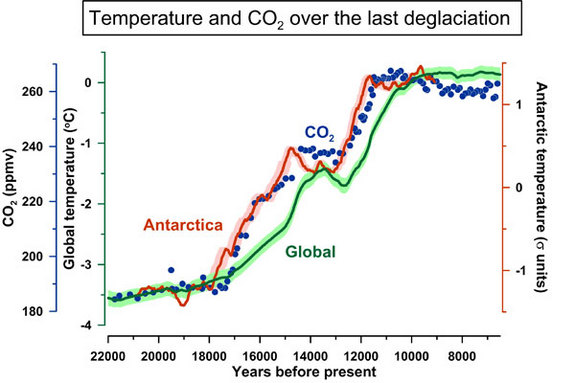
Post-Glacial_Sea_LevelTemperature Change End of Last Ice Age
(Just 1 C worth of global warming from 22,000 years BP to 15,000 years BP was enough to set off rapid sea level rise during the end of the last ice age. We are fast approaching the 1 C warmer than 1880s thresholds now. Image source: Commons and Livescience.)

Which brings us to a final question hinted at in the header — how fast could sea levels rise if human forced warming approaches 2 C or more this Century? The modelling efforts Dutton hinted at shows that West Antarctica alone can contribute meters of sea level rise over the course of just decades. And going back to paleoclimate studies of the end of the last ice age hint that somewhere between 1 and 2 C worth of warming can trigger very large and rapid glacial outbursts (that then increased sea levels by as much as 16 feet per Century). Finally, recent glacier surveys from Antarctica to Greenland have found extensive and expanding destabilization. Efforts and evidence that imply the 39 inches of sea level rise predicted by IPCC this Century may be quite conservative, even under the better case emissions scenarios.

Links: